Large-Scale Wheat Farm Equipment Guide
A comprehensive procurement guide covering throughput requirements, mechanical specifications, gearbox robustness, fleet configuration, and regulatory compliance for large-scale commercial wheat straw operationsRequest a Quote
1. What 500 Hectares of Wheat Straw Actually Means for Your Round Baler Selection
Baling wheat straw from 500 hectares or more is a fundamentally different problem from small-farm straw collection. The scale introduces time pressure, mechanical reliability requirements, and throughput targets that eliminate most consumer-grade or light-duty round baler options from consideration before any other specification is evaluated. A typical Korean large-scale wheat farm in Gyeongbuk, Jeonnam, or Chungcheong province can expect to produce between 2.5 and 4.5 metric tons of dry wheat straw per hectare after grain harvest, depending on variety and growing conditions. At 500 hectares, that represents 1,250–2,250 metric tons of straw to be picked up, compressed, wrapped, and moved in a harvest window that typically runs 10–18 days before the next crop must be planted or field preparation must begin. This window is not flexible — the cash crop rotation does not wait for the straw operation.
Converting that harvest window into a daily baling requirement makes the specification challenge concrete. If a 500 ha operation has 12 working days to bale 1,500 metric tons of straw, and each day allows 10 effective baling hours after accounting for travel, refueling, and net-wrap changes, the operation needs to process 12.5 metric tons per hour. A round baler machine producing bales at 160 kg/m³ in a φ1,300×1,400 mm bale format generates approximately 298 kg per bale. Meeting 12.5 metric tons per hour requires roughly 42 bales per hour from a single machine — a throughput that is achievable but near the upper end of what a single high-specification round baler can sustain continuously. Most 500 ha operations run two machines to achieve both the throughput target and mechanical redundancy: if one machine goes down, the operation continues at reduced speed rather than stopping entirely. Understanding this scale-and-redundancy logic is the starting point for building a procurement specification that actually works in the field.

2. The Throughput Calculation — How to Size Your Round Baler Fleet for 500+ Hectares
Before evaluating individual round baler models, a 500+ ha wheat producer needs to complete a throughput sizing exercise that accounts for the specific parameters of their operation. The key variables are total straw mass to be baled, effective baling hours per day, number of available baling days in the harvest window, target bale density (which determines bale weight at a given bale volume), and the net bale output rate of the machine being considered. The exercise below uses representative numbers for a Korean large-scale wheat operation; producers should substitute their own farm-specific data.
| Parameter | 500 ha Example | 750 ha Example | Note |
|---|---|---|---|
| Total straw at 3 t/ha | 1,500 metric tons | 2,250 metric tons | Yield varies 2.5–4.5 t/ha; use actual field average |
| Harvest window (days) | 12 | 14 | Includes weather allowance; Korean June window typically 10–18 days |
| Effective baling hours/day | 10 | 10 | Deducts travel, refueling, net-wrap, bale collection |
| Required throughput (t/hr) | 12.5 | 16.1 | Total straw ÷ (window days × hours/day) |
| Bale weight at 160 kg/m³ (φ1,300×1,400 mm) | ~298 kg/bale | ~298 kg/bale | Bale volume ~1.86 m³; density × volume |
| Required bale output (bales/hr) | 42 | 54 | Required throughput ÷ bale weight × 1,000 |
| Machines needed (9YG-2.24D at max 100 bales/hr) | 1 (with margin) | 1–2 | Add 1 machine for redundancy on large operations; 2 machines strongly recommended for 500+ ha |
This calculation reveals an important insight for 500+ ha Korean wheat producers: a single full-specification 9YG-2.24D round baler running at sustained output (40–100 bales per hour depending on field and windrow conditions) can technically cover the throughput requirement of a 500 ha operation in a good weather window. However, running a single machine with zero redundancy on this scale is commercially risky — a two-day mechanical failure during peak harvest represents 17% of the total baling window lost, which cannot be recovered. The standard practice for operations of this scale is to run two machines in the same field, achieving both the higher daily throughput needed to build a weather buffer and the redundancy that keeps the operation moving through any single-machine failure.
3. Manufacturing Structure — What 500+ Hectare Operations Need from Chamber Design and Frame Engineering
At 500 hectares of wheat straw, a round baler machine is not running 200 hours a season — it is running closer to 400–600 hours depending on the operation structure. At that accumulated operating time, the structural fatigue behavior of the main frame, the wear patterns on the compression roller bearings, and the cumulative stretch of the drive chains become the dominant factors in per-season cost of ownership rather than the initial purchase price. Understanding what structural engineering choices determine long-term durability under high-hour commercial use is therefore a more important part of the procurement evaluation for large-scale operations than it would be for occasional-use farm equipment.
The drum-type compression chamber used across the 9YG series places 18 compression rollers of φ222 mm diameter around the 1,200 mm chamber in the 2.24D format, mounted on bearing-supported axles that run the full width of the bale. The full-width axle mounting distributes the compression load evenly across the roller bearing pair rather than cantilevering the load to a single bearing race — a structural choice that significantly extends bearing service life under the sustained high-cycle compression loading that characterizes a 500+ ha harvest season. On operations running 500 bales per day, the compression chamber completes 500 full pressurize-and-release cycles daily, each cycle loading and unloading the roller bearings. Over a 30-day season, that accumulates to 15,000 full-compression cycles — a fatigue loading that distinguishes commercial-grade bearing specification from light-duty alternatives within the first two seasons of operation.
The main frame weld quality and steel grade set the fatigue life floor for the entire machine. The 9YG series uses high-tensile Q355B structural plate processed through CNC laser cutting for precision fit-up geometry, welded on automated welding lines that produce consistent bead quality and penetration depth across all joint types including the T-joints and corner joints at high-stress frame locations. For a 500+ ha operation expecting to use the same machine for 8–12 seasons, the frame weld quality is a more consequential purchase specification than for a farmer expecting 3–5 seasons of use. Visiting the manufacturing facility or requesting weld quality certification documentation before purchase is a standard practice for large agricultural contractors who are evaluating commercial-scale round baler acquisition.
4. Material System — Chain Grade, Bearing Specification, and Surface Protection for High-Hour Commercial Use
For a 500+ ha wheat straw operation, the material specification decisions that matter most are the ones that determine scheduled vs. unscheduled maintenance events. Scheduled maintenance — chain tension checks, oil changes, tine replacement — can be planned around the harvest schedule. Unscheduled failures — bearing seizure, chain link fracture, hydraulic fitting leak — stop the machine in the middle of a field at a moment when every baling hour is commercially critical. The material specifications that differentiate round balers in the commercial-scale category are precisely those that determine the boundary between scheduled and unscheduled maintenance events over a 400–600 hour annual operating cycle.
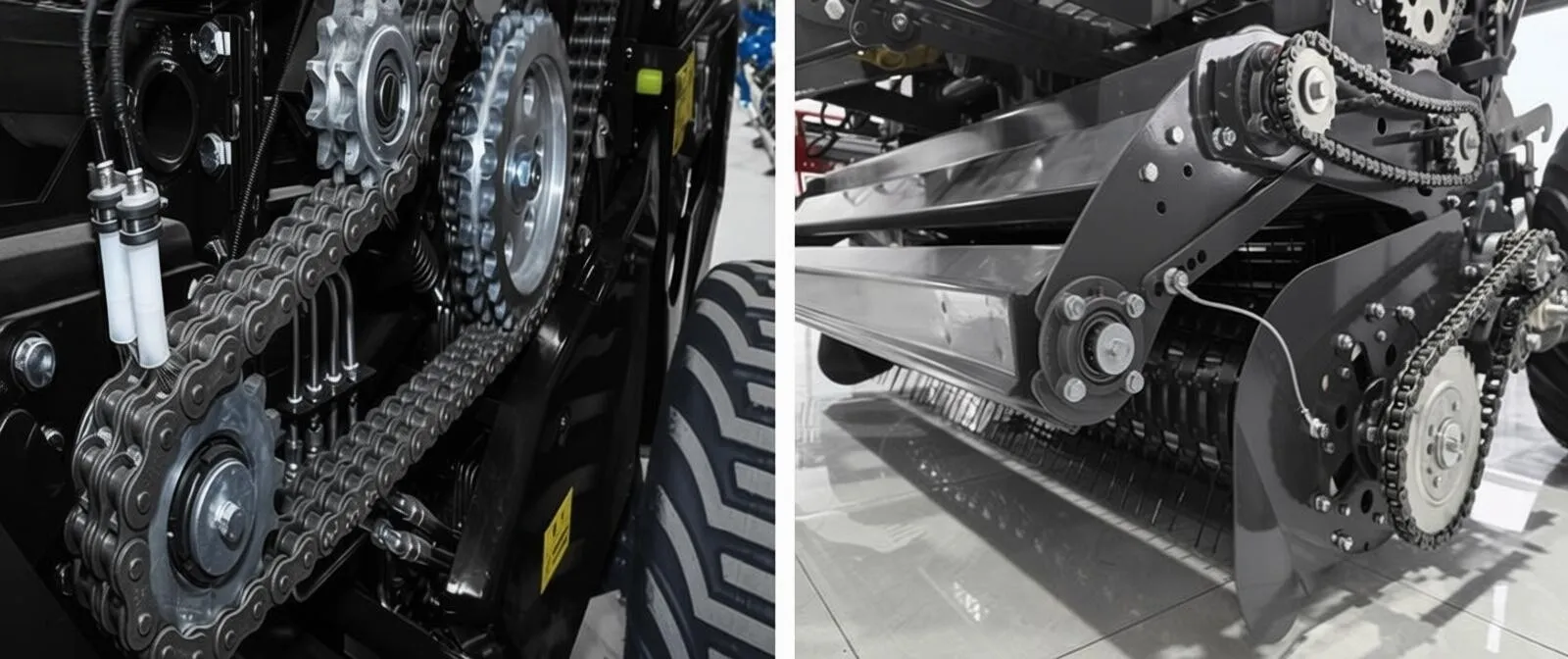
Chain grade is the most consequential material specification for large-scale commercial use. The rear chamber dual-side drive on the 9YG-2.24D S9000 and Classic uses 20A heavy-duty chain (1.25-inch pitch), which has a rated tensile strength approximately 60% higher than 16A chain and a correspondingly lower stretch rate under the sustained compression loads of high-throughput wheat straw production. At 500 bales per day, the rear chamber chain drive completes approximately 500 load cycles, each cycle involving the full compression and ejection force of a dense wheat straw bale. Over a 30-day season this represents 15,000 high-load cycles — a cycle count at which 16A chain in a high-compression position will typically show significant stretch requiring adjustment or replacement, while 20A chain in the same position maintains tension specification within acceptable tolerances for the full season. This means that specifying 20A chain for a 500 ha operation is not a premium option — it is the baseline specification required for acceptable annual chain service interval economics.
Roller bearing specification and housing seal design are the second critical material category. The wheat straw harvest environment generates fine silica dust at levels that challenge bearing seals far beyond what most general agricultural applications impose. At 400–600 annual operating hours in a wheat harvest dust environment, open or lightly shielded bearings accumulate abrasive debris that accelerates race wear to the point of measurable play within two to three seasons. Sealed maintenance-free bearings — the specification used on the 9YG commercial-grade models — provide a positive dust exclusion barrier that maintains the clearance geometry essential for consistent compression chamber performance throughout the commercial service life of the machine. The incremental cost of sealed bearing specification versus standard bearings is recovered in the first unscheduled bearing replacement event that is avoided at peak harvest time.
5. Gearbox Engineering for 500+ Hectare Operations — Torque Capacity, Thermal Management, and Overload Protection
At commercial scale, the round baler gearbox is under sustained thermal and mechanical stress for periods that small-farm equipment simply never experiences. A 10-hour baling day on 500 hectares means the gearbox operates continuously at PTO speed — 720 r/min — for the full productive window, with load spikes at each bale formation peak and each tailgate ejection event. Over a 30-day season, the gearbox accumulates 300 hours of sustained load operation at this intensity. The gearbox oil temperature in this operating cycle regularly reaches 70–90°C in summer Korean harvest conditions, accelerating oil oxidation and viscosity reduction at a rate that makes the standard 200-hour oil change interval a minimum rather than a conservative guideline.
The dual-joint gearbox design on the 9YG-2.24D S9000 Surpass distributes the transmission load across two articulation points rather than concentrating it at a single coupling. This load distribution has a direct effect on gearbox thermal behavior: lower stress concentration at any individual gear mesh point means lower local heat generation, reducing peak oil temperature by a measurable margin compared to single-joint designs under equivalent load. For a 500+ ha operation where the gearbox runs continuously rather than intermittently, this thermal advantage accumulates into a meaningful extension of oil service life and gear surface life. The rigid coupling between the gearbox assembly and the drawbar frame also eliminates the oscillating bending loads that cause fatigue cracking at the gearbox-to-frame interface on designs that rely on flexible coupling for terrain accommodation — a failure mode that typically appears after 1,500–2,000 operating hours on high-cycle commercial machines.
The torque-limiting driveshaft incorporated as standard on higher-specification 9YG models provides overload protection that is particularly valuable on large flat wheat fields where dense slug ingestion events can occur without warning from terrain feedback. On a Korean Honam Plain wheat field where the terrain offers no visual warning of variations in windrow density, the operator has less time to react to an approaching slug than on smaller parcels with more visual landmarks. The torque-limiting coupling absorbs the instantaneous torque spike from a dense slug before it reaches the gearbox internals, preventing the catastrophic gear tooth failure or shaft shear that represents the most expensive unscheduled failure mode in high-cycle commercial baling. At the scale of a 500+ ha operation, a torque-limiting coupling is not an optional safety feature — it is an economic necessity that pays for itself by preventing a single catastrophic gearbox failure over the machine’s commercial service life.
6. Regulatory Compliance for Commercial-Scale Round Baler Operations — Korea and Global Standards
Large-scale commercial wheat straw operations in Korea and internationally face regulatory requirements that go beyond what individual smallholders typically encounter, because commercial operations are more likely to be subject to labor safety audits, environmental compliance inspections, and supply-chain documentation requests from institutional buyers. Understanding the full regulatory landscape helps large operators choose equipment that meets all applicable standards without requiring after-purchase modification or supplementary certification work.
Südkorea: Under the Agricultural Mechanization Promotion Act (농업기계화 촉진법), all round balers operating commercially in South Korea must carry RDA (Rural Development Administration / 농촌진흥청) type approval. The type approval protocol evaluates PTO gearbox performance at rated speed, operator safety guard coverage, noise emission, and functional performance including bale density consistency. For large-scale operations serving biomass energy buyers under the Renewable Portfolio Standard (신재생에너지 공급의무화제도), equipment quality management documentation — including ISO 9001 certification at the manufacturer level — may be requested by the energy buyer as part of their supply chain qualification process. The Agricultural Machinery Subsidy Program (농기계지원사업) provides up to 50% subsidy on approved equipment, though the per-machine ceiling may mean large operations receive proportionally less support than smallholders on a percentage basis. The Industrial Safety and Health Act (산업안전보건법) applies full workplace safety requirements to commercial agricultural operations employing operators, including PTO guard inspection requirements and operator training documentation.
European Union: CE marking under Machinery Directive 2006/42/EC is required for round balers marketed or used in EU member states. EN ISO 4254-7 (Balers) specifies performance and safety requirements including gearbox torque overload protection, PTO shaft guard coverage, and Declaration of Conformity documentation. From January 2027, the updated Machinery Regulation EU 2023/1230 introduces enhanced digital technical documentation requirements. For commercial operations, DGUV Rule 114-015 (Germany) mandates periodic professional inspection of agricultural machinery drives and gearboxes, with documented records — a requirement that affects Korean exporters supplying straw to German buyers who specify production equipment compliance.
EAEU Markets: TR CU 010/2011 and EAC certification govern all machinery in the Eurasian Economic Union market including Russia, Kazakhstan, Belarus, and Mongolia. GOST 21354 gear reliability standards and GOST R 12.2.111 agricultural machinery safety standards apply. For large-scale operations exporting straw to EAEU markets, the production equipment must meet these standards to support supply chain documentation requests from institutional buyers.
North America: For Korean producers supplying North American markets, ASABE S493 and ANSI/ASABE S296 set the design safety framework for round baler power transmission. Large commercial operations in US grain states may additionally encounter state-level air quality requirements (particularly dust emissions under county-level AQMD regulations in California) that affect the operating parameters of high-throughput baling operations near residential or sensitive areas.
Japan: MAFF agricultural machinery safety standards and JIS B 9700 apply. For Korean producers supplying straw to Japanese buyers who specify production equipment certification, MAFF type approval documentation provides the appropriate compliance evidence.
| Region | Standard (Gearbox / Drive) | Commercial Scale Relevance | Mark |
|---|---|---|---|
| Südkorea | Agricultural Mechanization Promotion Act; RDA Protocol; Industrial Safety and Health Act; RPS supply chain docs | ISO 9001 at manufacturer level; labor safety inspections for employed operators; subsidy ceiling may limit large-farm benefit | RDA 농기계 형식검정 |
| European Union | Machinery Directive 2006/42/EC; EN ISO 4254-7; EU 2023/1230 (from 2027) | DGUV 114-015 periodic inspection records; digital DoC from 2027; buyer supply chain compliance requests | CE Mark + DoC |
| Russia / Kazakhstan / Belarus | TR CU 010/2011; GOST 21354; GOST R 12.2.111 | Full-scale commercial operations may face EAEU inspection; straw export supply chain requires EAC compliance | EAC Mark |
| USA / Canada | ASABE S493; ANSI/ASABE S296; OSHA 29 CFR 1928.57; state AQMD (California) | Commercial operations subject to OSHA inspection; California dust requirements affect large-scale baling near communities | ASABE Conformance |
| Japan | MAFF Agricultural Machinery Safety; JIS B 9700 | Straw export buyers may request MAFF type approval documentation as production equipment evidence | MAFF Type Approval |
| Australia / New Zealand | WHS Act; AS 4024; state agri machinery codes | Commercial farm operators required to maintain WHS-compliant equipment records for all staff-operated machinery | WHS Documentation |
7. Which Round Baler Models Suit 500+ Hectare Wheat Operations — Model-by-Model Analysis
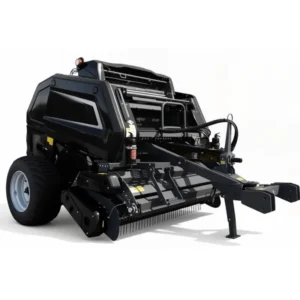
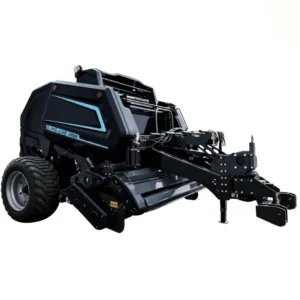
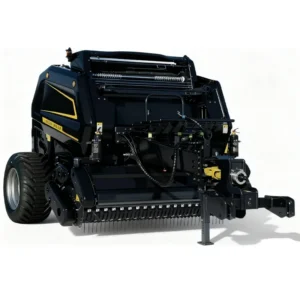
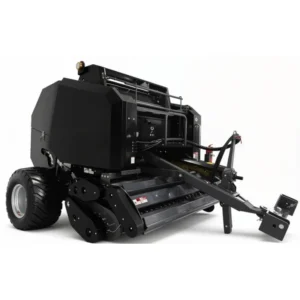
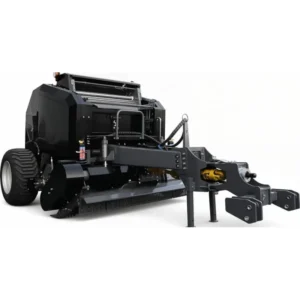
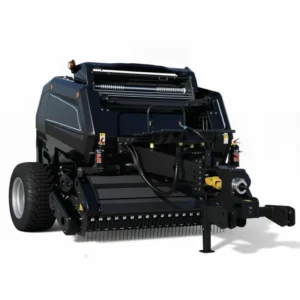
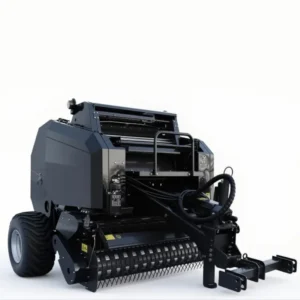
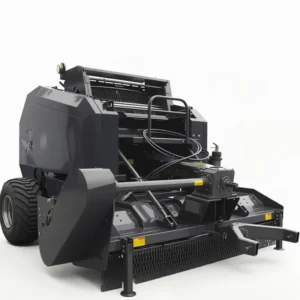
For wheat farms of 500 hectares or more, the model selection narrows quickly when throughput, mechanical robustness, and annual operating hour requirements are applied as filters. The key models for commercial-scale wheat straw operations are the full-width 9YG-2.24D variants, which deliver the pickup width, output rate, and structural specification needed for sustained commercial production. The smaller models in the 9YG-1.0 and 9YG-1.25 range remain relevant as support machines in a two-machine fleet, or as the primary machine for smaller satellite parcels. View the complete product range here.
8. Fleet Configuration Recommendations by Farm Scale — 500 to 1,000+ Hectares
| Farm Scale | Recommended Primary Machine | Support / Redundancy Machine | Configuration Rationale |
|---|---|---|---|
| 500–600 ha, flat terrain | 9YG-2.24D S9000 × 1 | 9YG-1.25 or 9YG-2.24D Standard × 1 | Primary handles large fields; support covers irregular parcels and provides redundancy during primary downtime |
| 500–600 ha, hilly terrain | 9YG-2.24D Transcend × 1 | 9YG-2.24D Classic × 1 | Transcend handles cross-slope fields; Classic covers flatter zones; both run 20A chain for commercial-grade service intervals |
| 700–800 ha, mixed terrain | 9YG-2.24D S9000 × 2 | 9YG-1.25 × 1 (multi-crop support) | Dual primary machines provide throughput buffer for weather delays; 1.25 handles rotation crop residue in autumn |
| 1,000+ ha, commercial scale | 9YG-2.24D S9000 × 2–3 | 9YG-2.24D Classic × 1; 9YG-1.0C × 1 (rotation) | Full commercial fleet with full redundancy; 1.0C provides year-round crop residue management across all rotation crops |
9. About Our Round Baler Manufacturing Capability for Commercial-Scale Operations
Our round baler series is produced at a 32,000-square-meter manufacturing facility equipped with CNC laser cutting machines, automated welding systems, electrostatic spray painting lines, and an independent quality testing department operating under ISO 9001:2015 quality management certification. National high-technology enterprise designation and close to 100 registered technical patents support a continuous product development program that has progressively refined the 9YG series to meet the mechanical demands of high-hour commercial baling operations. Annual production capacity of 2,000 round baler units provides the scheduling flexibility to fulfill large fleet orders — whether a Korean commercial operator needs two machines delivered simultaneously before the wheat harvest window, or an international contractor requires staggered delivery of multiple units across the season.
For large Korean wheat operations, the manufacturing team provides RDA type approval documentation, technical construction files for supply chain compliance, and ISO 9001 certification records that support biomass energy supply contracts under the Korean RPS system. Commercial fleet buyers can discuss spare parts pre-positioning, operator training support, and remote diagnostic assistance through the after-sales team — services that matter most precisely when a machine failure during peak harvest needs to be resolved in hours rather than days. Contact our commercial sales team to discuss fleet configuration and delivery scheduling for your specific operation scale and harvest window.

Frequently Asked Questions
Q1. What round baler machine specification is required for a 500 hectare Korean wheat farm to complete straw baling within the 12-day harvest window?
A 500 ha wheat operation at 3 t/ha straw yield needs to process approximately 12.5 metric tons of straw per hour to complete baling in 12 working days at 10 effective hours per day. With a 9YG-2.24D S9000 producing φ1,300×1,400 mm bales at 160 kg/m³, each bale weighs approximately 298 kg. Meeting the 12.5 t/hr requirement needs about 42 bales per hour — achievable in good conditions with a single S9000, but most 500 ha Korean operations run two machines to achieve a weather buffer and mechanical redundancy. A two-machine fleet of 9YG-2.24D variants provides the throughput to complete 500 ha in 6–8 days, leaving a meaningful weather reserve within the window.
Q2. How does the round baler gearbox dual-joint design on the 9YG-2.24D S9000 improve reliability on large Korean wheat farms with tight headland turning requirements?
The dual-joint gearbox rotates up to 90 degrees left and right relative to the tractor, significantly reducing the headland turning radius compared to fixed-coupling designs. On large Korean wheat fields in Gyeongbuk or Jeonnam where field lengths exceed 300 meters, the turning radius difference between a dual-joint and single-joint design adds up across the hundreds of headland turns in a 500 ha baling run. The dual-joint design also allows the tractor to complete turns without cutting PTO power, eliminating the start-stop cycling that stresses the gearbox and causes inconsistent density in the first bale formed after each PTO re-engagement. Over a 30-day season, these operational efficiency gains accumulate into a meaningful reduction in total harvesting hours.
Q3. What round baler parts maintenance schedule should a 500+ hectare Korean wheat operation follow to avoid unscheduled downtime during the harvest window?
For a 500+ ha operation running 10 hours per day, the maintenance priority list is: daily — pickup tine visual check, net-wrap guide cleaning, hydraulic fitting inspection; every 25–30 operating hours — chain tension check and adjustment for all drive runs; every 50 hours — lubricate chain runs, check roller bearing play, inspect sensor housing seal; pre-season — full chain replacement if any run shows 3%+ elongation, gearbox oil change, all hydraulic seals inspection, sensor cable continuity test. Carrying a pre-positioned spare parts kit including 30+ pickup tines, two net-wrap blades, chain master links, and a set of hydraulic ferrule fittings at the field location eliminates the 2–4 hour parts procurement delay that turns a 30-minute repair into a half-day stoppage.
Q4. Where can large Korean wheat farm operators get a supplier quote for a two-machine round baler fleet with commercial service support?
Fleet quotes for two or more round baler machines are available through our commercial contact page. The technical team provides machine specifications, delivery schedule options for pre-harvest arrival, pre-positioned spare parts package recommendations, and documentation for RDA type approval and Agricultural Machinery Subsidy Program applications. For large commercial operators, fleet procurement discussions typically include operator training support, remote diagnostic access during the harvest season, and post-season inspection scheduling. Beginning fleet procurement discussions at least 4–6 months before the harvest window allows adequate lead time for machine customization, type approval completion, and delivery scheduling to Korean ports.
Q5. How does the 20A chain specification on the 9YG-2.24D S9000 extend service intervals for large Korean wheat farms running 400+ annual operating hours?
20A chain (1.25-inch pitch) has a tensile load rating approximately 60% higher than 16A chain and stretches at a proportionally lower rate under the sustained compression loads of high-throughput wheat straw production. At 400+ annual operating hours with 500+ bale-formation load cycles per day, a rear chamber drive equipped with 16A chain typically requires adjustment or replacement within a single season, while 20A chain in the same position maintains tension within specification through the full season and often into the following season. For a 500+ ha operation where chain replacement requires removing the baler from service during harvest, the single-season service life advantage of 20A chain directly translates into fewer unscheduled stoppages per harvest period.
Q6. Which round baler manufacturer provides RDA type approval documentation and biomass supply chain compliance records for large Korean wheat straw commercial operations?
Our manufacturing facility holds ISO 9001:2015 certification and can provide technical construction documentation, performance test data, and ISO 9001 certification records in formats suitable for Korean RDA type approval submission, Korean Customs clearance under HS Code 8433.40, and biomass energy supply chain qualification under the Korean Renewable Portfolio Standard (RPS / 신재생에너지 공급의무화제도). For large commercial operations that are asked by institutional biomass buyers or government inspection agencies to demonstrate the quality management status of their production equipment, these documents are available on request alongside the commercial supply agreement.
Q7. What is the round baler application strategy for a 500 ha Korean wheat farm that also grows 200 ha of corn in summer rotation with the same baling equipment?
A farm running 500 ha of wheat and 200 ha of corn rotation can use the same two-machine fleet for both crops with appropriate seasonal reconfiguration. The 9YG-2.24D S9000 and Classic handle wheat straw in June-July with their spring-tine pickups. In autumn corn stover season, a 9YG-1.25 (with interchangeable hammer-claw pickup) or 9YG-1.0C added to the fleet handles corn stover collection from the 200 ha rotation area, while the 2.24D machines can also be used for corn stover windrow pickup with standard spring-tine heads where the stover has been mowed and raked prior to baling. This approach maximizes the annual utilization hours across the two-crop calendar, improving the per-hour cost economics of the full fleet investment.
Q8. How does the round baler machine torque-limiting driveshaft protect the gearbox on large flat Korean wheat fields where dense windrow slugs can occur without terrain warning?
On large flat wheat fields in Korea’s Honam Plain where terrain gives no visual warning of approaching dense windrow areas, the operator has less advance notice of slug conditions than on smaller undulating parcels. When a dense straw slug — created by combine discharge accumulation in field low spots or at field ends — enters the pickup, the instantaneous torque demand on the gearbox can spike 3–5 times the nominal operating load within a fraction of a second. The torque-limiting coupling in the driveshaft absorbs this spike before it reaches the gearbox gear mesh, preventing gear tooth fracture or shaft shear that represents the most expensive single-event failure mode in commercial baling. The cost of replacing a damaged torque-limiting coupling is typically 5–10% of the cost of a subsequent gearbox overload failure it prevents.
Q9. When should a 500 hectare Korean wheat farm operator consider adding a third round baler to the fleet rather than running two machines through the harvest window?
Adding a third round baler to a 500 ha wheat fleet is economically justified when any of three conditions apply: first, when the effective baling window is shorter than 10 days due to weather patterns in the specific growing region; second, when the farm supplies time-sensitive buyers (biomass plants with tight delivery windows, export consolidators working fixed shipping schedules) who impose penalties for late delivery that exceed the annual cost of running a third machine; or third, when the operation has expanded to 700+ ha and the two-machine fleet can no longer complete baling in a safe weather buffer window. A simpler trigger is to track the number of days in the past three seasons where both primary machines ran at capacity through the full effective day without achieving the daily bale target — if this occurs more than twice in three seasons, a third machine is justified.
Q10. What round baler gearbox regulation applies to commercial agricultural operators in South Korea and how does ISO 9001 certification at the manufacturer support compliance?
Under the Agricultural Mechanization Promotion Act (농업기계화 촉진법), round baler gearboxes must pass RDA type approval evaluation including functional performance at rated PTO speed and operator safety guard assessment. For commercial operations employing operators, the Industrial Safety and Health Act (산업안전보건법) additionally requires documented safety management procedures covering PTO-driven equipment, which may include periodic equipment inspection records. ISO 9001 certification at the round baler manufacturer provides a documented quality management framework that supports the type approval process by demonstrating that the design, production, and testing of the gearbox assembly follow a controlled and documented quality system. For commercial operators whose straw buyers are institutional organizations requesting supply chain documentation, the manufacturer’s ISO 9001 certificate provides a recognized quality evidence document at the equipment production level.
Herausgeber: PXY