
Round Baler Technical Guide
A detailed technical reference on power take-off speed, its mechanical relationship with round baler systems, bale density outcomes, and what every operator managing a hay or straw baling operation needs to understand — with Korean agricultural regulatory context included.
Understanding the Basics
1. What Is PTO Speed and Why Does It Matter on a Round Baler?
The power take-off, universally abbreviated as PTO, is the mechanical shaft at the rear of a tractor that transmits rotational energy to attached implements. On a round baler, this shaft connects directly to the machine’s gearbox, which then distributes motion to the pickup rotor, feeding mechanisms, bale chamber rollers, and the net wrapping system. The speed at which this shaft rotates — measured in revolutions per minute, or r/min — governs nearly every aspect of how the round baler machine processes incoming crop material, forms the bale, and ultimately determines the density and consistency of the finished bales deposited in the field.
Most tractors offer two standard PTO speed options: 540 r/min and 1000 r/min. Round balers are typically designed and calibrated around one of these two speeds, and running a machine at the wrong speed — or at an inconsistent speed caused by engine load fluctuations or incorrect gear selection — can produce a chain of consequences ranging from uneven bale density to accelerated component wear or outright mechanical failure. For Korean agricultural operators evaluating a round hay baler for sale, or comparing round balers from different manufacturers, understanding PTO speed requirements is as fundamental as knowing the tractor horsepower requirements listed in the machine’s specification sheet.
The 9YG series round balers, for example, are calibrated to operate at a PTO output shaft speed of 720 r/min — a specification that sits between the two standard speeds and reflects the optimized balance between feeding capacity, compression energy, and net wrapping timing that the engineering team established for these machines. Knowing why that number was chosen, and what happens when it varies, is the subject of this entire guide.
Action Mode
2. How PTO Speed Translates Into Mechanical Action Inside the Round Baler
When the tractor PTO engages and begins rotating the input shaft of the round baler’s gearbox, that rotational energy moves through a series of gear stages, chain drives, and sprocket arrangements before reaching each individual working component. The pickup reel at the front of the machine lifts crop from the windrow using spring-tine fingers rotating at a speed proportional to the PTO input. If the PTO speed is lower than the calibrated rate, the tines slow down and may fail to cleanly pick up every strand of material in the windrow, leaving losses on the ground — a particular concern for fine-stemmed crops like Korean ryegrass or timothy hay where leaf material is high in feed value.
The feeding mechanism — on the 9YG series this is a combination of a toothed roller and a drum-type intake — is directly driven from the same gearbox chain, so its throughput is also PTO-speed dependent. At the correct 720 r/min, material flows continuously into the bale chamber without gaps or surges. If the operator reduces engine throttle to navigate obstacles or slow down for a turn, the feeding rate drops proportionally, and the bale currently forming in the chamber receives uneven material distribution — resulting in an asymmetric bale that will not roll cleanly when ejected or stack properly for storage or transport.
Inside the bale chamber, the press rollers — 18 individual rollers on the 9YG-2.24D models, each measuring 222 mm in diameter — rotate at speeds derived from the gearbox output. The surface speed of these rollers determines the rate at which incoming crop is compacted against the growing bale core. At the specified PTO speed, this surface velocity is optimized to achieve the target bale density range of 100–200 kg/m³ for full-size bales. Running at a reduced PTO rate lowers roller surface speed, which reduces compaction energy per unit of time and produces a softer, lower-density bale that may not hold its shape through transport or weather exposure.

PTO Speed Specifications Across the 9YG Round Baler Series
| Model | PTO Output Speed (r/min) | Required Tractor Power | Bale Density Range | Output (bales/h) |
|---|---|---|---|---|
| 9YG-2.24D (S9000 Transcend) | 720 | 55–100 kW | 100–200 kg/m³ | 40–100 |
| 9YG-2.24D (S9000 Classic) | 720 | 55–100 kW | 100–200 kg/m³ | 40–100 |
| 9YG-2.24D (Base) | 720 | 55–100 kW | 100–200 kg/m³ | 40–100 |
| 9YG-1.25 (Double) | 720 | ≥75 kW | 100–200 kg/m³ | 40–100 |
| 9YG-1.25A | 540–1000 | ≥75 kW | 100–200 kg/m³ | 40–100 |
| 9YG-1.0 | 720 | 48–80 kW | 115–200 kg/m³ | 40–100 |
| 9YG-1.0C | 540 | ≥70 kW | 115–200 kg/m³ | 40–80 |
Material System
3. Chains, Sprockets, and Roller Alloys: What PTO Speed Stress Demands of the Material System
Every material in the round baler drivetrain is under mechanical stress that scales with PTO speed. Higher rotational input means higher centrifugal forces on sprocket teeth, greater impact loads on chain link plates, and elevated surface contact stress on press roller shells. Understanding which materials are used — and why — helps operators appreciate why operating at or near the rated PTO speed extends service life rather than shortening it, provided the machine is properly maintained.
Heavy-Duty Roller Chain
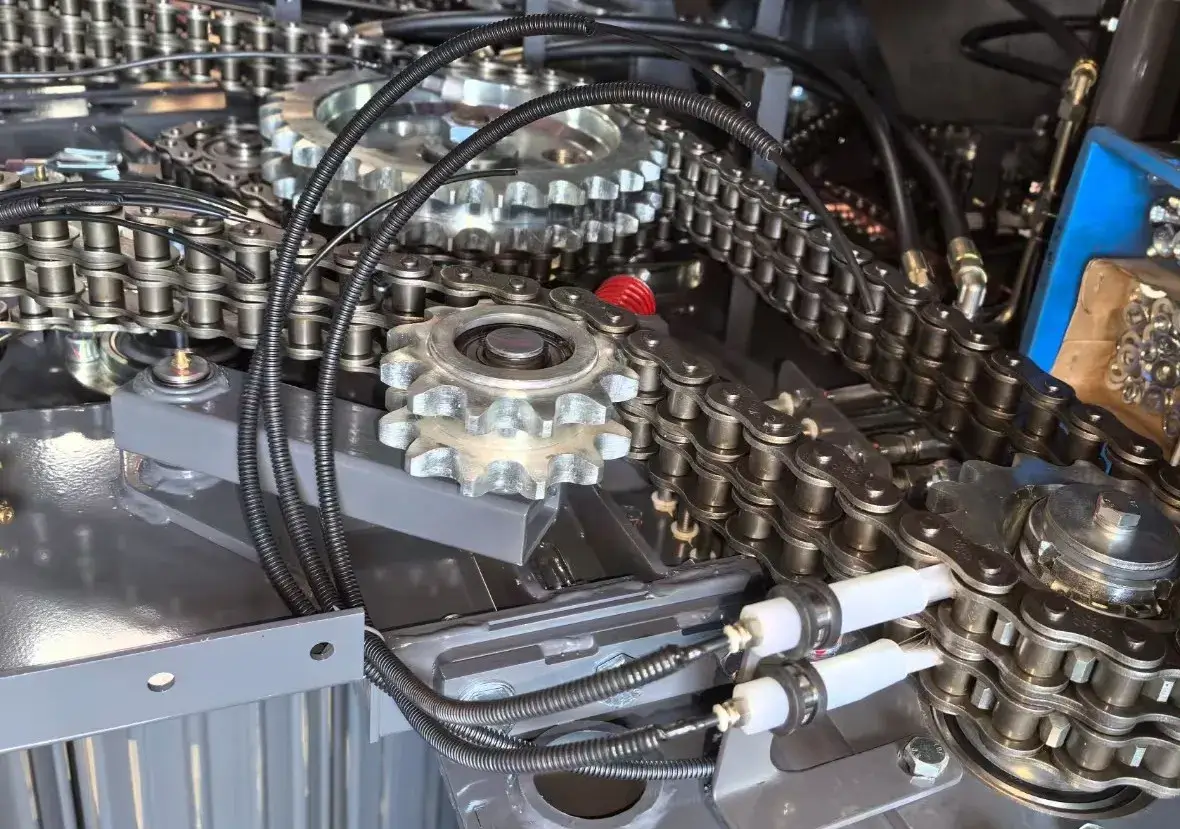
The rear bale chamber on large round balers uses 20A specification roller chain on both sides of the drum drive. At 720 r/min PTO input, this chain operates within its rated dynamic load capacity, distributing tension evenly across link plates and roller bushings. The dual-side chain arrangement used in the 9YG-2.24D series ensures that torque delivery is symmetric — a design consideration that prevents the differential wear patterns that would occur if a single-side chain carried the full compressive load. Smaller models use 16A chain for proportionally scaled loads consistent with their lower tractor power requirements.
Press Roller Shell Material
The 18 press rollers in the 9YG-2.24D bale chamber — each 222 mm in diameter — are fabricated from structural steel tube with machined journal ends. At the correct PTO speed, the roller surface velocity creates the necessary crop-to-roller friction to pack material uniformly. If PTO speed is chronically under-spec, the rollers fail to develop the surface velocity needed for efficient packing, and the bale chamber tends to accumulate loose, wet material around the roller ends rather than drawing it uniformly toward the bale core. This material accumulation increases drive resistance, which can in turn cause gearbox overload if the operator tries to compensate by pushing forward faster.
Spring Tine Pickup Material
The spring tine pickup fingers on the 9YG series use high-tensile spring steel, which is chosen for its combination of elasticity and fatigue resistance. At rated PTO speed, the tines flex on contact with windrow material and return to position before the next engagement — completing their designed duty cycle. At over-speed conditions — which can occur if a tractor’s PTO mechanical governor is faulty or if the operator selects an incorrect PTO gear ratio — tines can experience resonant vibration that drives cracks from the base of the tine upward. The pickup width on the 9YG-2.24D series is 2,240 mm, meaning there are enough tines in simultaneous contact with the windrow that even a few broken ones degrade pickup efficiency noticeably.
Bale Quality Impact
4. What Happens to Bale Quality When PTO Speed Is Too Low, Too High, or Unstable?
Bale quality in a round hay baler context is typically measured across four dimensions: density uniformity, shape consistency, surface integrity after net wrapping, and moisture retention behavior during storage. All four are directly sensitive to PTO speed consistency, though in different ways and to different degrees depending on crop type and operating conditions.
PTO Speed Too Low
Pickup losses increase, especially in damp or tangled windrows. Chamber filling becomes uneven, producing a bale that is soft at the core and denser at the outer wraps. Net wrapping tension may be insufficient for the machine’s auto-wrap timing. Finished bales tend to be lighter than the sensor target, triggering ejection before full density is reached if the sensor is calibrated for mass rather than geometry.
On Korean summer forage operations where the harvest window is compressed and bale weight targets are set for silage fermentation calculations, low-density bales create downstream quality control failures. Silage contractors and livestock feed buyers in Korea typically specify minimum bale weights in purchase contracts.
Unstable PTO Speed
Intermittent speed variations — caused by engine load fluctuations during uphill travel, crop density surges in thick windrow sections, or operator throttle inconsistency — create the most problematic bale quality outcome: asymmetric density distribution. When the chamber fills faster on one side than the other due to speed variations, the bale core shifts off-center. This results in a bale that rocks when set down, resists consistent stacking, and may partially unwrap from net material under its own weight.
From a round baler parts perspective, unstable PTO also generates cyclical shock loads on the gearbox input bearing. Over multiple seasons, these shocks fatigue the bearing race and can cause early failure — a disproportionately expensive repair given that the gearbox is often the most labor-intensive component to access.
Correct & Consistent PTO Speed
When the tractor delivers a stable 720 r/min at the PTO output — consistent with the rated speed for the 9YG-2.24D series — every component in the drivetrain operates within its designed duty envelope. Pickup efficiency is maximized, chamber filling is uniform, bale density builds symmetrically from the core outward, and the sensor-controlled density management system can make accurate ejection decisions based on reliable data rather than compensating for speed-induced variability.
Consistently formed bales also improve the efficiency of subsequent handling operations — round bale transport machines, silage wrappers, and bale stacking systems all perform better when the bales they process are geometrically uniform and within a predictable weight range.
Power Transmission
5. The Round Baler Gearbox: Translating PTO Input Into Productive Work
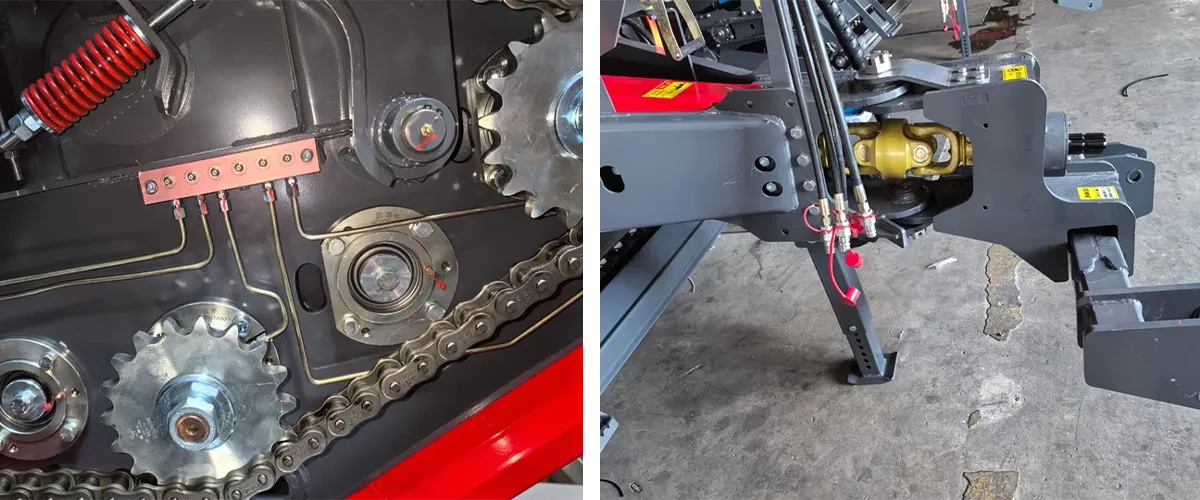
The round baler gearbox is the single most stress-critical component in the machine’s powertrain. It receives the raw rotational energy from the tractor’s PTO shaft and splits it across multiple output paths — each serving a different working component with a different speed and torque requirement. On the 9YG-1.25A model, the gearbox is designed to accept input shaft speeds across a wider range from 540 to 1,000 r/min, which gives Korean operators the flexibility to pair this machine with tractors that have either standard PTO speed output. This wider input tolerance is achieved through gear ratio selection within the gearbox that maintains acceptable output speeds at the pickup and bale chamber regardless of which PTO speed the connected tractor uses.
The gearbox on the 9YG-2.24D S9000 Transcend is a proprietary heavy-duty dual-coupling design with a significantly higher torque rating than standard class units. The additional torque capacity means that even when the machine encounters a dense patch of tangled material — which temporarily increases the resistance at the press rollers and pickup — the gearbox can absorb the brief overload without the kinds of gear tooth stress that would cause fatigue cracks over time. Combined with the safety torque shaft in the PTO driveline, which acts as a mechanical fuse to protect against sudden overload events, this system is well-suited to the varied conditions common in Korean farming environments where fields may contain unexpected obstacles or uneven windrow densities.
For operators evaluating round baler parts support and long-term maintenance costs, the gearbox oil change schedule is one of the most important items in the service manual. Gearbox oil in a round baler should typically be inspected every 50 operating hours and replaced according to the manufacturer’s recommendation — usually at the end of each major baling season. Operating at the correct PTO speed ensures the oil temperature stays within the range where viscosity is stable and protective film strength is maintained on all contact surfaces.
Crop-Specific Considerations
6. How PTO Speed Requirements Vary Across Different Crop Types
Different crop types impose different mechanical demands on the round baler drivetrain, and while PTO speed is the same for all crops on a given machine model, the effect of operating near the upper or lower end of the acceptable speed range varies significantly between materials. For Korean operators working with multiple crop types across a single season — rice straw in autumn, hay in summer, corn stover as a secondary residue — understanding these differences helps with both pre-season setup and in-field throttle management.
| Crop Type | PTO Sensitivity | Primary Risk at Under-Speed | Primary Risk at Over-Speed | Recommended Approach |
|---|---|---|---|---|
| Dry Grass / Hay | Moderate | Pickup losses; loose bales | Excessive leaf shatter; feed value loss | Hold rated speed; avoid surge throttle |
| Rice Straw | High | Chamber blockage from low intake momentum | Tine breakage on brittle stems | Steady rated speed; avoid abrupt acceleration |
| Corn Stover | Very High | Material bunching at rotor | High impact loads on hammer-claw tines | Use 9YG-1.0C with hammer-claw at 540 r/min PTO |
| Silage Grass (High Moisture) | High | Insufficient compression pressure | Overheating of chain and gearbox oil | Consistent throttle; monitor gearbox temperature |
| Timothy / Ryegrass | Moderate | Pickup leaf loss; bale weight below target | Minor surface abrasion increase on rollers | Rated speed; adjust forward speed for windrow density |
Legal & Regulatory Context
7. PTO Shaft Safety, Gearbox Standards, and Regulatory Frameworks in Korea and Globally
The PTO shaft and gearbox on agricultural machinery are subject to specific safety standards in multiple jurisdictions. For Korean operators sourcing or operating imported round balers, knowing the relevant frameworks avoids compliance issues and informs purchasing decisions.
Republic of Korea — Industrial Safety and Health Act (산업안전보건법)
Under Korea’s Industrial Safety and Health Act administered by the Ministry of Employment and Labor, PTO-driven agricultural machinery must have protective guards over the rotating shaft between the tractor and implement. Exposed driveshafts are a leading cause of entanglement injuries recorded in Korea’s agricultural sector. The Rural Development Administration (RDA) machinery certification process evaluates PTO shaft guarding as part of type approval for round balers sold or subsidized in Korea. Machines without compliant PTO shaft guards are not eligible for agricultural machinery purchase subsidies under the national support program.
ISO 5674 — Guards for Power Take-Off Drive Shafts
ISO 5674 specifies the dimensional and performance requirements for PTO driveshaft guards on agricultural machinery. It defines torque resistance, material strength requirements for the guard tube and end cone, and labeling requirements. Round balers exported from any country to Korean buyers are expected to meet or exceed the protection levels in this standard. The ISO certification held by the FASCAR manufacturing facility supports compliance documentation for export orders.
EU Machinery Directive 2006/42/EC
The EU Machinery Directive requires that round balers sold in European markets carry CE marking, which involves assessment of PTO shaft coupling design, guard integrity, and interlocks that prevent unsafe operation modes. While this directive does not directly apply in Korea, Korean importers evaluating European or European-standard machines from non-EU manufacturers often reference CE conformity as a quality benchmark. It is also relevant for Korean farm operators exporting hay to EU member state buyers where machinery compliance is part of the supply chain audit.
ASABE Standards (North America)
The American Society of Agricultural and Biological Engineers standard ASABE S318 covers PTO shaft safety for farm equipment, including speed markings, color coding (540 r/min shafts are yellow, 1000 r/min shafts are green under the standard), and connection point design. While ASABE standards are North American, manufacturers serving the global market — including those supplying Korean buyers — increasingly align with these guidelines because they provide a clear operational language that reduces operator error when connecting tractors and implements across different PTO speed categories.
Russia / Eurasian Economic Union — GOST Standards
For round balers operating in Russia and Kazakhstan — significant export markets for machines in this product category — GOST R 53248 covers PTO shaft and agricultural implement safety. The Eurasian Economic Union technical regulation TR EAEU 042/2017 on agricultural machinery safety requires that PTO-driven implements carry Russian-language safety markings and comply with specified guard performance criteria. Operators in these markets must ensure that replacement PTO shaft guards sourced as round baler parts are GOST-compliant and not substituted with non-standard components.
Australia — AS 4024 Machinery Safety Standard
Australia’s AS 4024 machinery safety series, relevant for round baler application in Australian markets, specifies guarding requirements for rotating mechanical power transmission components including PTO shafts and exposed chain drives. Safe Work Australia guidance for agricultural machinery identifies PTO entanglement as a priority hazard, and enforcement is handled at state level through WorkSafe and equivalent bodies. Korean manufacturers and importers supplying to Australian buyers need to ensure that driveshaft guards and chain cover designs meet these state-enforced requirements.
Operator Guidance
8. Practical Throttle and PTO Management for Consistent Bale Output
Getting the most from any round baler machine — whether it is a large full-size unit or a small round baler suited to a 40 hp tractor — comes down to operator technique as much as equipment specification. PTO speed management is one of the areas where relatively small behavior changes during fieldwork translate directly into measurable improvements in both bale quality and machine longevity.
Before engaging the PTO, bring the tractor engine up to the speed at which the transmission will output the rated PTO speed — for most tractors with live PTO systems, this means setting the throttle to the position that gives 720 r/min at the PTO stub before the baler is connected and before any crop is being processed. Engaging the PTO with the engine at idle and then ramping up throttle causes every component in the baler drivetrain to accelerate simultaneously, with consequent shock loads on the gearbox, chain pins, and roller bearings. Pre-setting throttle before PTO engagement is one of the simplest habits that reduces wear meaningfully across a long season.
During field operation, the most common cause of PTO speed drop is tractor engine lug — a condition where the crop density in the windrow exceeds the tractor’s available torque at the current throttle position, causing the engine to slow below its governed speed. Modern tractors with electronic engine management often compensate automatically through turbocharger response, but older or lower-specification tractors may not. The practical response for operators is to reduce forward travel speed rather than increasing throttle aggressively — slowing the rate of crop intake reduces the peak torque demand at the PTO and allows the engine to recover its speed without a manual throttle adjustment.
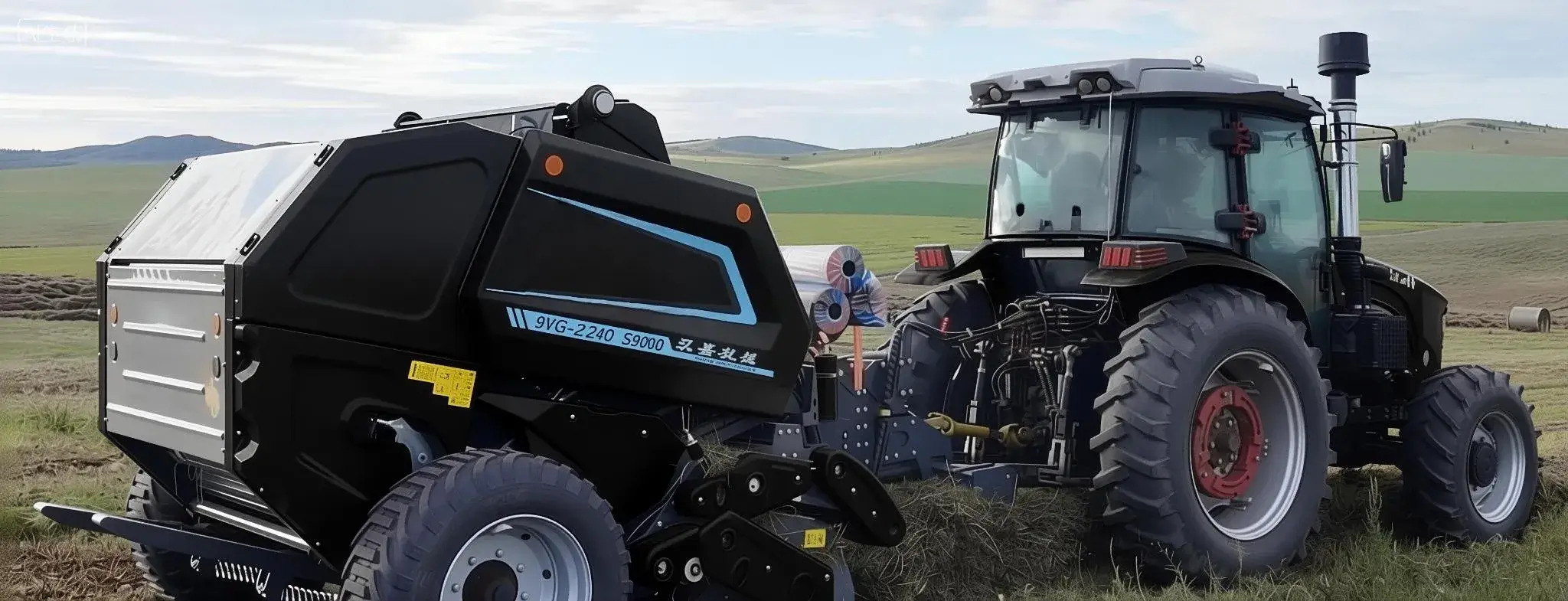
On models with the dual-coupling gearbox — notably the 9YG-2.24D S9000 Transcend — PTO speed consistency during headland turns is improved structurally because the driveshaft can flex through a much wider angular range without loss of rotational efficiency. However, even on these machines, operators should avoid making tight turns at full forward speed when the bale chamber is nearly full, since the increased weight of the forming bale raises the effective moment of inertia and can cause brief gearbox input shock if the tractor turns abruptly. A brief pause in forward travel at the start of each headland turn is a good practice regardless of machine model.
Product Range
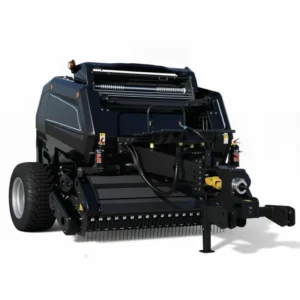
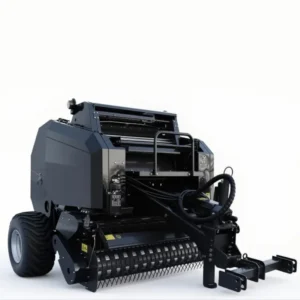
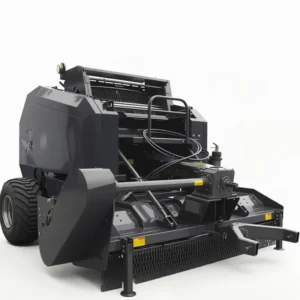
9. Round Baler Models and Their PTO Speed Requirements
Each model in the lineup below has been engineered around a specific PTO speed output to match its pickup width, chamber volume, and target bale weight range. Selecting the right machine starts with confirming that your tractor’s PTO speed output aligns with the rated input for the model you are considering.
Manufacturing Quality
10. Built to Run at Rated Speed, Season After Season
The round baler series described in this guide is manufactured in a 32,000 m² facility with two dedicated production lines — one for round balers and one for mowing equipment — each with an annual capacity of 2,000 units. The manufacturing process uses CNC laser cutting for all structural plate components, ensuring dimensional consistency in the gearbox mounting brackets, chain tensioner guides, and tailgate hinge structures that directly interact with the PTO-driven drivetrain.
Automated welding lines provide consistent joint quality on the critical structural nodes that bear the cyclic loads generated during continuous baling at rated PTO speeds. The electrostatic powder coating process applied after fabrication provides a corrosion-resistant surface that holds up through the wet harvest conditions common in Korean summers and autumns. ISO 9001 quality management certification governs the entire production process, from incoming material inspection to final functional testing before dispatch.
720 r/min
Rated PTO (9YG-2.24D)
18 Rollers
Per Bale Chamber
40–100
Bales per Hour
ISO 9001
Quality Certified
FAQ
Frequently Asked Questions About PTO Speed and Round Baler Performance
Editor: PXY