Agricultural Technology Deep Dive
Comment fonctionne le contrôle de la densité des balles sur les presses à balles rondes modernes ?
Understanding the sensor systems, mechanical architecture, and material science behind consistent bale formation — a complete technical guide for farmers, contractors, and equipment buyers in Korea and across Asia-Pacific.
1. What Is Bale Density Control — and Why Does It Matter?
When a round baler picks up windrows and rolls them into cylindrical bales, the resulting density is not simply a matter of how much you feed into the machine. It is the outcome of a carefully managed interplay between mechanical pressure, belt or roller tension, crop moisture, and real-time sensor feedback. Bale density control refers to the collection of systems that monitor, regulate, and maintain a target compaction level throughout each baling cycle — ensuring every bale meets a consistent weight and structural integrity standard that makes storage, transport, and feeding practical.
Why does this matter so much in practice? A bale that is too loose falls apart during handling or wrapping, loses nutritional value faster due to oxygen infiltration, and occupies far more storage space per unit of dry matter. A bale that is over-compressed, on the other hand, strains the machine’s drivetrain, gearbox, and net-wrapping system, shortening component life and occasionally causing catastrophic failures in the field. For Korean livestock farmers managing tight storage facilities, or for large-scale grassland contractors in Northeast Asia operating across challenging terrain, achieving the right density on every bale is not a convenience — it is an economic necessity.
Modern round balers accomplish this through a combination of hydraulic pressure circuits, spring-tensioned roller or belt systems, and electronic sensor networks that continuously feed data back to either the operator or an automatic control unit. The following sections break down each layer of this system, from the mechanical skeleton through to the software logic that governs it.
2. Working Principle: How Does the Baling Chamber Build Pressure?
The fundamental action of a round baler is deceptively simple: crop enters a chamber through a pickup header, and rotating rollers or moving belts push and squeeze it into a tightening cylinder. The density-building process begins the moment material enters the compression chamber and does not stop until the wrapping sequence initiates. But the mechanics that govern how pressure builds — and how that pressure is maintained at a target level — vary significantly depending on whether the machine uses a fixed-chamber or variable-chamber design.
In a fixed-chamber roller-type baler, the compression chamber has a set internal diameter. Rollers arranged around the perimeter spin continuously, drawing crop inward and forcing it to rotate and compact against itself. As the bale grows, the crop resists the rollers more firmly, and the torque required from the gearbox increases proportionally. A pressure sensor — typically a strain gauge or load cell mounted on the roller frame — reads this resistance and translates it into a density signal. When the target threshold is reached, the controller initiates the net wrapping sequence and eventually opens the tailgate to release the bale. On models like the 9YG-2.24D series, the compression chamber reaches a diameter of φ1200 mm, and 18 rollers of φ222 mm provide uniform compression across a 1400 mm chamber width, delivering bale densities in the range of 100–200 kg/m³.
Variable-chamber designs use belts or a combination of belts and rollers, where the effective chamber diameter expands as crop accumulates. Spring-loaded or hydraulically actuated tensioning arms maintain consistent belt pressure against the growing bale. The tension in these arms — and the resistance they create — is what the control system reads as a proxy for bale density. As tension climbs toward a pre-set value, an audible alarm or cab display indicator tells the operator the bale is ready for wrapping. On more automated systems, the wrapping cycle begins without any input from the operator at all.
The axial-flow semi-forced feeding mechanism — a proprietary design found on the 9YG series — eliminates the cam-ring and guard-ring pickup configuration used in earlier machines. This reduces power consumption, increases crop intake volume, and cuts the probability of blockages nearly in half, which means the compression chamber maintains steadier feed conditions and more predictable density output.
3. Sensor-Based Density Monitoring: The Electronic Brain of a Modern Round Baler
All models in the current round baler lineup — from the compact 9YG-1.0 suited to tractors in the 48–80 kW range, up to the full-scale 9YG-2.24D S9000 rated for 55–100 kW tractors — use sensor-controlled bale density management. This is not merely a marketing claim; it represents a genuine shift in how field accuracy is achieved. Rather than relying on the operator’s intuition or a simple mechanical stop, sensor control means the machine itself measures bale compaction in real time and communicates the result through a cab display or alert system.
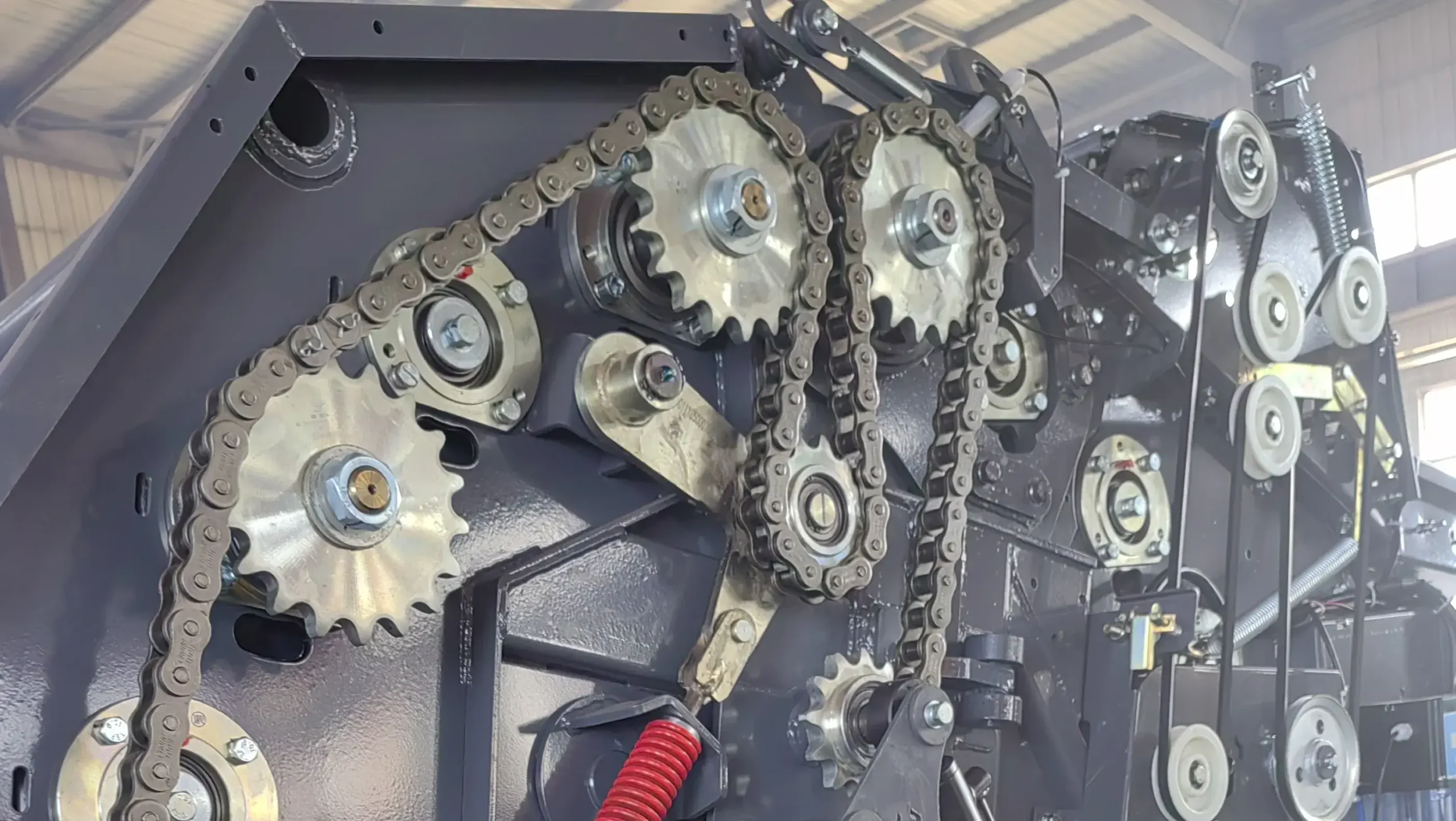
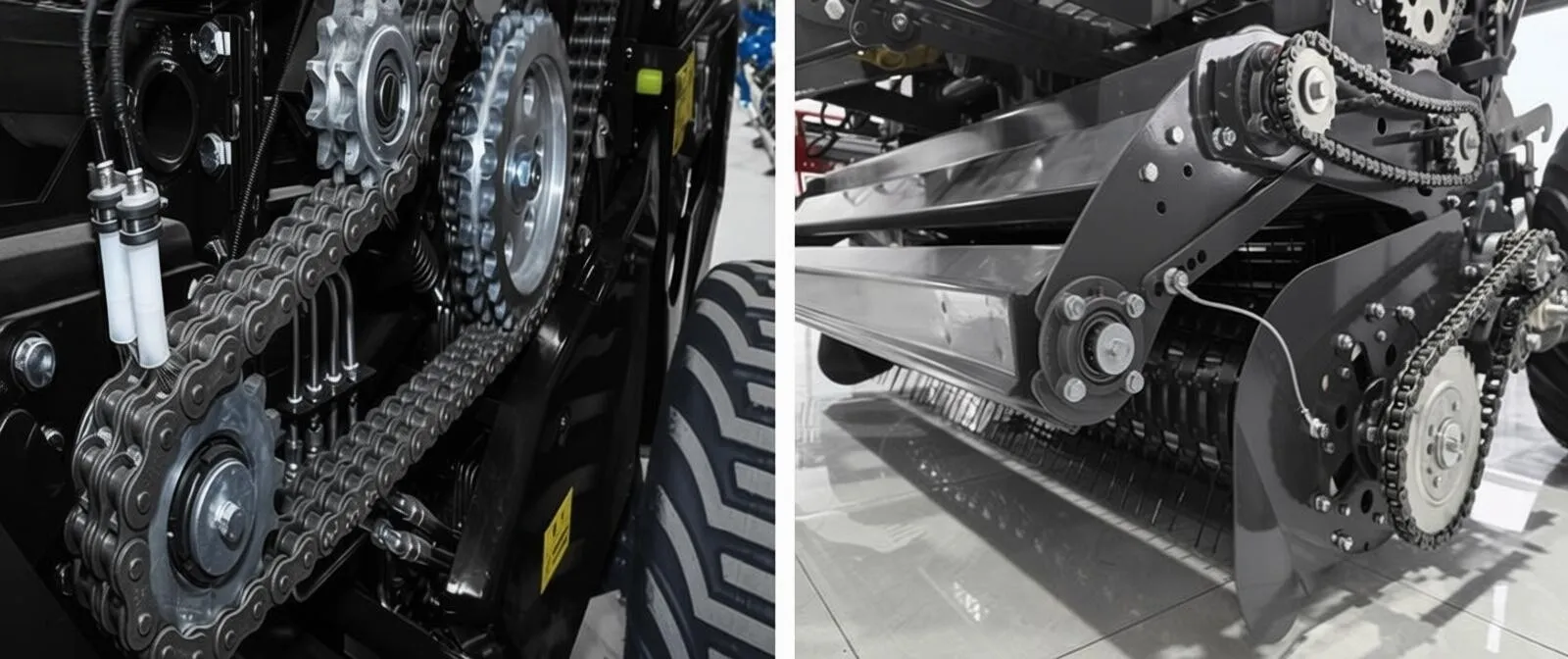
Typical sensor configurations monitor several parameters simultaneously. Pressure transducers in the hydraulic system detect the force exerted on tensioning cylinders. Proximity or inductive sensors track the angular position of the tailgate or tensioning arms, giving the controller a continuous bale-diameter reading. Some advanced systems add load cells on the roller shafts themselves to measure instantaneous torque, which correlates directly with core density rather than outer-diameter growth alone.
The electronic control unit (ECU) processes these sensor inputs and compares them against operator-programmed target values. When parameters fall within the acceptable range, the machine continues baling without intervention. When they approach the set threshold — which the operator can typically adjust based on crop type, moisture content, and intended end use — the system triggers the wrapping sequence. This means a skilled operator can configure the machine once at the start of a run and trust that each subsequent bale will meet the same density standard, even as crop conditions change across the field.
For Korean users managing rice straw or dry grassland forage under variable humidity conditions — situations where crop bulk density changes dramatically between morning dew and afternoon sun — this kind of closed-loop control is particularly valuable. Without it, bale-to-bale variation is large enough to create serious problems for automated handling and wrapping systems downstream.
4. Round Baler Model Comparison: Density Control Specifications
5. Manufacturing Structure: What Is Inside the Compression Chamber?
The physical architecture of the compression chamber is the foundation on which all density control depends. Understanding what the machine is made of — how rollers are arranged, how the frame is constructed, and how the tailgate opens and closes — helps explain both why certain balers produce denser bales than others, and what failure modes to watch for when density performance degrades unexpectedly.
In roller-type round balers, the chamber is formed by a circular arrangement of steel rollers mounted on heavy-gauge welded steel frames. Front and rear sections of the frame are typically hinged, allowing the rear section (the tailgate) to swing open hydraulically when the bale is complete. The rollers themselves are driven by a chain-and-sprocket system on both sides of the chamber — in models such as the 9YG-2.24D S9000, dual-side chain sprocket transmission on the rear section is a deliberate engineering choice that distributes drive torque evenly and reduces the asymmetric wear that plagues single-drive configurations.
The rollers are precision-turned from steel tube stock, with hardened bearing surfaces at each end. Roller diameter in the 9YG series is uniformly φ222 mm — a dimension chosen to balance peripheral surface speed, self-cleaning action, and the structural rigidity needed to withstand repeated high-density baling cycles without deflection. The spacing between rollers is tight enough to prevent crop escape while leaving adequate clearance to avoid jamming on coarse materials like corn stalks or thick-stemmed legumes.
The tailgate sealing and cushioning system plays a direct role in density control as well. On the 9YG-2.24D S9000, a buffer hydraulic cylinder is fitted to the rear door to absorb the shock that occurs when the tailgate closes after bale ejection. This cushioning prevents structural stress to the frame and, just as importantly, keeps the chamber geometry consistent over time. A distorted chamber produces bales with irregular density distribution — denser at one end or along one axis — which creates wrapping problems and uneven fermentation in silage applications.
6. Featured Round Baler Models
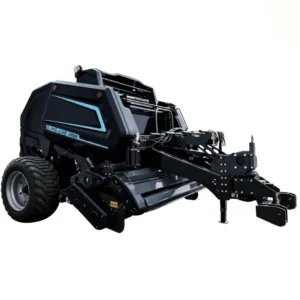
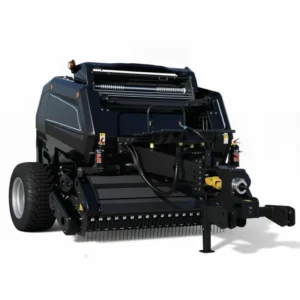
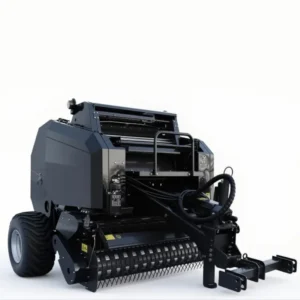
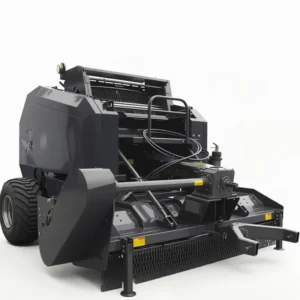
7. The Round Baler Gearbox: Transmitting Power Under Density Loads
The round baler gearbox is the critical link between the tractor’s power take-off (PTO) shaft and the chamber rollers. Its design determines how efficiently torque is delivered across the full density range, and how well the machine tolerates the sudden load spikes that occur when a slug of dense material enters the pickup header all at once. Understanding the gearbox arrangement explains a great deal about why certain balers handle difficult crops better than others.
On standard round balers, a straight gearbox takes PTO input at 540 or 720 r/min and distributes drive through bevel and spur gear sets to the roller chains. The 9YG-2.24D S9000 operates with a PTO speed of 720 r/min, feeding a heavy-duty gearbox that drives 18 compression rollers simultaneously. The dual-gearbox design found on select models in the 9YG-2.24D S9000 Transcend series adds another dimension: the twin gearbox can rotate left and right up to 90 degrees, enabling the machine to operate in tight field corners without cutting PTO power — a significant practical advantage for Korean farms where field parcels are often small and irregular.
The torque characteristics of the gearbox must be matched to the anticipated bale density range. A machine designed to produce bales at 200 kg/m³ — the upper end of the 9YG-2.24D range — experiences chamber roller forces that are roughly double those at 100 kg/m³. The gearbox must transmit this load continuously without excessive heat buildup or gear tooth wear. Heavy-duty configurations, such as the reinforced gearbox used in the 9YG-2.24D Classic (which features dual-side 20A heavy chain in the rear section), address this by increasing the contact area and load-bearing capacity of the chain drive system.
The self-developed dual universal joint PTO shaft used on certain 9YG-2.24D models (with a maximum torque rating of 1000 Nm and a transverse steering angle of 100°) also contributes to density stability. By preventing PTO shaft binding during sharp turns, it ensures the compression chamber continues to receive consistent power even while the tractor maneuvers — so bale density does not drop unexpectedly at headlands or when navigating obstacles.
8. Material System: Crop Types, Moisture, and How They Affect Bale Density
The bale density control system on a modern round baler does not operate in a vacuum. It interacts with the physical properties of the material being baled, and those properties — crop species, stem diameter, moisture content, and windrow width — all influence how quickly and uniformly the bale forms. Getting the most from a sensor-controlled density system requires understanding these material relationships and configuring the machine accordingly.
Dry grasses and straws are among the most forgiving materials for round baling. Their low moisture content (typically 12–18% for properly cured hay) means they compress readily without generating the back-pressure that wetter crops create. The density sensor reaches its target quickly, cycle times are short, and output rates near the upper end of the rated 40–100 bales/hour capacity are achievable. Rice straw, a critical material for Korean farmers, behaves similarly when properly dried but requires attention to windrow uniformity because straw stems can tangle and create uneven material distribution in the chamber.
Silage crops — whole-plant corn, grass cut at early heading, or sorghum — present more complex density management challenges. These materials contain 40–65% moisture, which makes them physically denser per unit volume but also more resistant to compression because the water content creates hydraulic pressure within the crop mass itself. Balers handling silage crops typically need to be set to a slightly lower target density than they would for dry hay, and the net wrapping must begin before the bale reaches the maximum chamber diameter to prevent surface material loss. The 9YG-1.0C model, with its hammer-claw pickup designed for standing corn stalks, can transition between elastic-tine and hammer-claw configurations — meaning it adapts to both dry baling and green stalk collection without requiring a new machine.
Legumes, including alfalfa and clover, have a high leaf-to-stem ratio and are extremely sensitive to density over-compression. Crushing the leaves at the baling stage can reduce digestible nutrient content by 10–15%, which has a direct effect on livestock feeding value. On these crops, operators should set the density sensor threshold to the lower end of the available range, accepting a slightly larger bale diameter in exchange for leaf integrity. The sensor control system allows this adjustment without mechanical change — simply reprogramming the target value in the control interface is sufficient.
9. Net Wrapping and the Density–Integrity Connection
Once the bale reaches target density, the net wrapping system activates. The relationship between bale density and wrapping quality is more direct than many operators realize. A bale that is too loose will tend to bulge at the sides as the net is applied, creating an hourglass profile that reduces wrap coverage at the bale’s widest circumference and leaves the surface material exposed. A bale that meets its density target is geometrically stable and accepts net coverage uniformly, which is important both for preserving the bale in outdoor storage and for compatibility with downstream wrapping machines.
All models in the 9YG series use automatic net wrapping, with net roll specifications matched to the chamber width. The 9YG-2.24D series uses net rolls with a width of 1.4 meters and a length of 2000 meters per roll, producing bales at a diameter of φ1300 mm and width of 1400 mm. The 9YG-1.25 and 9YG-1.25A use 1.25-meter-wide nets for chambers of the same name, while the 9YG-1.0 uses 1.0-meter-wide nets suited to its more compact φ1100 × 1000 mm bale size. These dimensional matches are not arbitrary: they ensure the net wrap count per bale results in adequate hold-on-count at the target density without excessive net consumption.
The timing of the wrapping cycle initiation is itself a density-related decision. When the sensor control system triggers wrapping, the chamber rollers typically continue to rotate briefly while net is fed in, adding a small increment of additional compaction before the bale is actually sealed. This “wrap-under-tension” behavior slightly increases final density compared to the sensor threshold value, which is why experienced operators often set their target value slightly below the absolute maximum they want in the finished bale.

10. Regulatory Standards for Round Balers and Gearboxes by Region
Agricultural machinery sold internationally must meet a range of regulatory requirements that govern everything from mechanical safety to electromagnetic compatibility. For round balers specifically, the gearbox and PTO drive systems are subject to the most detailed regulatory scrutiny because they represent the primary interfaces between the tractor and the implement — and therefore the most common location for serious operator injury.
Corée du Sud
In South Korea, agricultural machinery is regulated primarily under the Agriculture Mechanization Promotion Act (농업기계화 촉진법) and its implementing regulations. Imported agricultural machinery must pass performance and safety evaluation by the Korea Agricultural Machinery Institute (KAMI / 농업기계화연구소) before receiving purchase subsidy eligibility — a critical factor for Korean farmers, as government subsidies cover a significant portion of new equipment purchases. The relevant performance standard for round balers falls under RDA (Rural Development Administration) quality testing protocols, which assess pickup efficiency, bale uniformity, net wrapping reliability, and field safety. PTO shaft guards are mandatory under Korean industrial safety regulations aligned with ISO 500, and any gearbox attachment point on the tractor side must comply with ROPS and PTO interface standards derived from ISO 11684 for safety sign placement.
European Union
In the EU, all agricultural machinery must comply with the Machinery Directive 2006/42/EC (to be replaced by the Machinery Regulation EU 2023/1230 from January 2027). This directive requires manufacturers to conduct a conformity assessment, prepare a technical file, and affix the CE mark before placing equipment on the market. For round balers, specific attention is paid to the PTO shaft guarding requirements under EN ISO 4254-7 (Agricultural Machinery — Safety — Part 7: Combine Harvesters, Forage Harvesters and Cotton Harvesters, as interpreted through EN ISO 4254-1 for general field machinery). Gearbox oil seals and lubrication intervals must be documented in operator manuals in all EU languages of sale. Additionally, acoustic emission limits under Directive 2000/14/EC apply to tractor-implement combinations operating in noise-sensitive agricultural environments.
United States and Canada
In North America, the ASABE (American Society of Agricultural and Biological Engineers) publishes voluntary standards for round baler design, including ASABE S361.3 for PTO drive shafts and ASABE EP443 for equipment safety signs. While compliance is not mandatory under federal law, conforming to ASABE standards is a practical prerequisite for commercial sale in the US and Canadian markets. The OSHA General Industry Standard 29 CFR 1910.217 covers mechanical power transmission guards. State-level regulations on equipment transport dimensions (affecting baler width and height during road transit) also vary and must be observed when moving machines between fields.
China
Domestically, round balers must comply with GB/T national standards and JB/T agricultural machinery standards. The relevant performance standard for round balers is GB/T 25423, which covers minimum baling efficiency, bale density uniformity, and wrapping quality requirements. The ISO 9001:2015 quality management certification — held by the equipment manufacturing entity referenced in this series — ensures that production processes meet international consistency requirements. Agricultural machinery that has been listed in national and regional subsidy purchase catalogues (农机购置补贴目录) has already passed mandatory testing under these standards, providing independent verification of performance claims.
Mongolia and Central Asia
In Mongolia and neighboring Central Asian markets, agricultural machinery standards are broadly based on Russian GOST standards, many of which align with earlier ISO versions. For gearbox systems specifically, GOST R 52901 (Tractors and Machinery for Agriculture and Forestry — Test Procedures) provides the framework for performance verification. Equipment exported to these markets must typically include Cyrillic-language operator documentation and may be subject to in-country certification through the national metrology body before distribution. Equipment that has already passed Chinese GB/T and ISO 9001 certification processes is generally well-positioned to meet these requirements.
11. Key Variables That Influence Round Bale Density
12. How to Optimize Bale Density in the Field: Practical Guidance
Even the best sensor-controlled density system produces suboptimal results if the field preparation and machine setup steps are not handled correctly. The density sensor reads what is happening inside the chamber, but it cannot correct for problems that originate upstream — in how the crop was cut, dried, and rowed up, or in how the tractor-baler combination is driven across the field. A few practical habits consistently separate operators who get uniform, high-density bales from those who struggle with bale variation.
Windrow consistency is arguably the most important upstream factor. A windrow that varies from 40 cm wide in thin areas to 120 cm wide in heavy growth will cause the baler to alternate between underfed and overfed states — producing bales that are soft-centred where crop was thin and prone to blockages where crop was heavy. Spending extra time on the rake pass to create a uniformly sized, fluffy windrow is time well spent. For rice straw specifically — a major concern for Korean operations — a windrow width that matches the pickup header width of the baler (1900 mm for the 9YG-1.0, 2150 mm for the 9YG-1.25A, and 2240 mm for the 9YG-2.24D series) gives the best density uniformity.
Forward speed management is the second key variable. Balers are rated for operating speeds of 5–35 km/h, but this range covers a wide variety of conditions. In heavy spring-flush ryegrass or late-summer cereal straw at full yield, 6–10 km/h is typically the practical ceiling before the pickup begins to build slugs. In light aftermath growth or thin windrows, speeds up to 15–20 km/h are achievable without density loss. Learning to read the cab display or density indicator in real time — and modulating speed to keep the bale-filling time within a narrow, consistent window — is a skill that comes with practice but has a significant impact on finished bale quality.
Finally, end-of-season maintenance on the density sensor circuit and its associated hydraulics pays dividends in the following season. Sensor contacts corrode, hydraulic fittings can weep, and the controller’s threshold values can drift if the system is stored with moisture ingress. The H-type compression fitting used in the hydraulic circuit of the 9YG-2.24D series is specifically designed for high-pressure retention and reduced leak risk, but inspection before the first bale of the season is always worthwhile. Catching a 5% sensor drift before the season starts is far less costly than baling 500 tonnes of hay at the wrong density.
13. About the Round Baler Series
The round baler models described throughout this article are part of a lineup developed for the full spectrum of pastoral and mixed-crop farming operations. Backed by ISO 9001:2015 quality management certification and tested under rigorous national agricultural machinery performance standards, these machines carry the FASCAR brand identity and are available through a distribution network that now extends to over 30 provinces and international markets including Mongolia, Russia, and Central Asia.
The engineering behind the density control systems is protected by a portfolio of utility model patents covering the axial-flow feeding mechanism, the dual universal joint PTO shaft design, and the reinforced rear-chamber dual-chain drive configuration. These patents reflect a commitment to continuous product development driven by field feedback from customers across the highly varied terrain and crop types encountered in Northeast Asian pastoral regions.
For Korean farmers and agricultural contractors seeking round baler solutions with proven sensor density control, compatible tractor power ratings from 48 kW to 100 kW, and the operational flexibility to handle rice straw, pasture hay, corn stalks, and legume forages, the full product range is available at the link below. Technical specifications, dimensional drawings, and quote requests can be directed through the contact channel.
Frequently Asked Questions About Round Baler Density Control
Éditeur : PXY