Large-Scale Grain Farm Operations Guide
A detailed operational guide to post-harvest straw management on large grain farms — covering round baler machine selection, pickup and compression chamber engineering, gearbox specifications, straw baling productivity benchmarks, regulatory requirements across key markets, and practical field strategies for maximising residue value after cereal, rice, and mixed-grain harvests.
Straw management is one of the most consequential decisions a large grain farm makes at harvest time. What happens to the residue left behind after a combine finishes a field — whether it is incorporated, burned, left in place, or baled — affects the next crop’s planting conditions, the farm’s income from straw sales or livestock feed, its compliance with local air quality and crop residue regulations, and the long-term trajectory of soil organic matter. On a 300-hectare wheat farm, the straw from a single harvest season represents hundreds of tonnes of material that must be dealt with efficiently and within a narrow time window before the next land operation begins.
For farms that choose to bale — and the number doing so has grown consistently as straw burning restrictions tighten across South Korea, the European Union, and major cereal-producing regions globally — the round baler machine is the workhorse that determines how quickly that residue can be converted into a storable, transportable, and marketable product. The choice of machine, and specifically its pickup width, compression chamber design, gearbox specification, and bale density control system, has a direct effect on how many hours are spent in the field after harvest and how much of the available straw volume is successfully captured before conditions change.
This guide covers every major aspect of that decision — from understanding what large grain farms actually need from a round baler, to the technical specifications that separate contractor-grade machines from lighter-duty alternatives, to the regulatory context that shapes straw management choices in South Korea, the European Union, Russia, the United States, and other key markets. Whether you operate a large grain farm and are evaluating your first baler purchase, or you are a cooperative managing equipment for multiple member farms, the information here should help you make a well-grounded decision before the next harvest season.

1. Why Baling Makes Operational and Economic Sense on Large Grain Farms
On large grain operations — farms managing 200 hectares or more of wheat, rice, barley, or mixed cereals — straw baling competes against several alternative residue management approaches: incorporation with a disc cultivator, leaving as mulch ahead of direct drilling, or, in regions where it remains permitted, field burning. Each of these alternatives has real advantages in specific contexts. But baling consistently wins on the combination of income generation, time efficiency, and regulatory compliance that large commercial grain farms need to balance simultaneously after harvest.
The income case is straightforward: baled straw from wheat, rice, and barley has a ready market in livestock feed, mushroom substrate, biogas feedstock, and industrial processing applications. On large farms that can produce 1,000 or more bales from a single harvest season, this revenue is material — particularly in years when grain prices are depressed and the farm needs additional income streams. The bale format also gives the farm flexibility: straw sold immediately after harvest at spot prices, or held in storage and sold through winter when prices are typically higher, provides options that bulk loose straw does not.
The time efficiency case rests on the fact that a modern large-format round baler operating at 40 to 100 bales per hour can clear a 300-hectare farm’s straw residue within two to four working days — a rate that no other residue management method approaches. Incorporation requires multiple passes and leaves the residue problem partially unresolved in wet conditions. Burning, where still permitted, requires preparation, permits, and post-burn monitoring that adds operational complexity. Baling completes the task in a single pass per row and leaves the field ready for the next operation immediately after ejection.
The regulatory compliance case has become increasingly significant. In South Korea, the Clean Air Conservation Act (대기환경보전법) imposes strict restrictions on open field burning of crop residues. In the European Union, national-level crop residue burning regulations — including the UK’s Crop Residues (Burning) Regulations 1993 and Germany’s Bundes-Bodenschutzgesetz (Federal Soil Protection Act) guidance on soil organic matter management — significantly limit or effectively prohibit straw burning across most cereal-producing areas. For large grain farms in these regulatory environments, baling is not merely an economic preference; it is the primary compliant alternative.
2. Post-Harvest Straw Types and Their Baling Characteristics
Not all grain straw behaves the same way in a round baler, and understanding the differences between crop types is useful when evaluating which machine specification is best suited to a farm’s primary residue stream. Wheat straw is dry, brittle, and relatively uniform in strand length, which makes it well suited to high-speed spring-tooth pickup at travel speeds toward the upper end of the 5 to 35 km/h operating range. The main challenge with wheat straw is leaf shatter — the brittle leaf sheaths break off easily at high pickup speeds, leaving a portion of the available material on the ground rather than in the bale.
Rice straw presents different handling challenges. It is typically cut closer to the ground, has shorter and finer stems than wheat, and — particularly in Korean post-combine conditions — may be baled at relatively high moisture content if the harvest window is compressed by autumn weather. The axial-flow semi-forced feeding mechanism in the 9YG series handles this combination better than passive-feed designs, actively pushing material through the feed channel regardless of moisture-induced clumping or short-strand variability. Barley straw sits between wheat and rice in terms of handling characteristics: somewhat more brittle than wheat at maturity but with similar strand length and moisture profiles.
On mixed-grain farms that harvest several crop types across a season, the practical value of the interchangeable pickup system on models like the 9YG-1.25 Double — which can switch between spring-tooth and hammer-claw configurations — is significant. Corn stover, which may follow a cereal harvest on the same farm in a rotation, requires a completely different pickup approach to the spring-tooth design suited to wheat straw. Carrying one machine with two pickup configurations covers both crop types without a separate equipment investment or contractor arrangement.
| Straw Type | Typical DM at Baling | Key Baling Challenge | पिकअप प्रकार | Recommended Model |
|---|---|---|---|---|
| Wheat straw | 85–92% | Leaf shatter at high speed | Spring-tooth | 9YG-2.24D (any), 9YG-1.25A |
| Rice straw | 70–85% | High moisture, short strand | Spring-tooth | 9YG-2.24D S9000, 9YG-1.25 |
| Barley straw | 82–90% | Awns — tine wear higher | Spring-tooth | 9YG-2.24D, 9YG-1.25A |
| Corn stover | 60–80% | Coarse, standing material | Hammer-claw | 9YG-1.25 Double, 9YG-1.0C |
| Soybean straw | 80–88% | Short and tangled windrow | Spring-tooth | 9YG-1.25, 9YG-1.0 |
3. Manufacturing Structure: What a Large Grain Farm Needs from a Round Baler
The structural demands placed on a round baler by large-scale grain farm straw management are different from those placed by pasture management or mixed livestock operations. On a large grain farm, the baler operates in intensive short bursts — perhaps 8 to 12 hours per day for 5 to 10 consecutive days, then not again for months until the next harvest. This use pattern means the machine experiences extreme thermal and mechanical loading during the operational period, followed by extended idle storage. Structural elements that would gradually fail under continuous year-round use may instead fail under the shock loading of a rapid high-intensity season, making upfront structural quality a more important procurement criterion than anticipated service intervals.
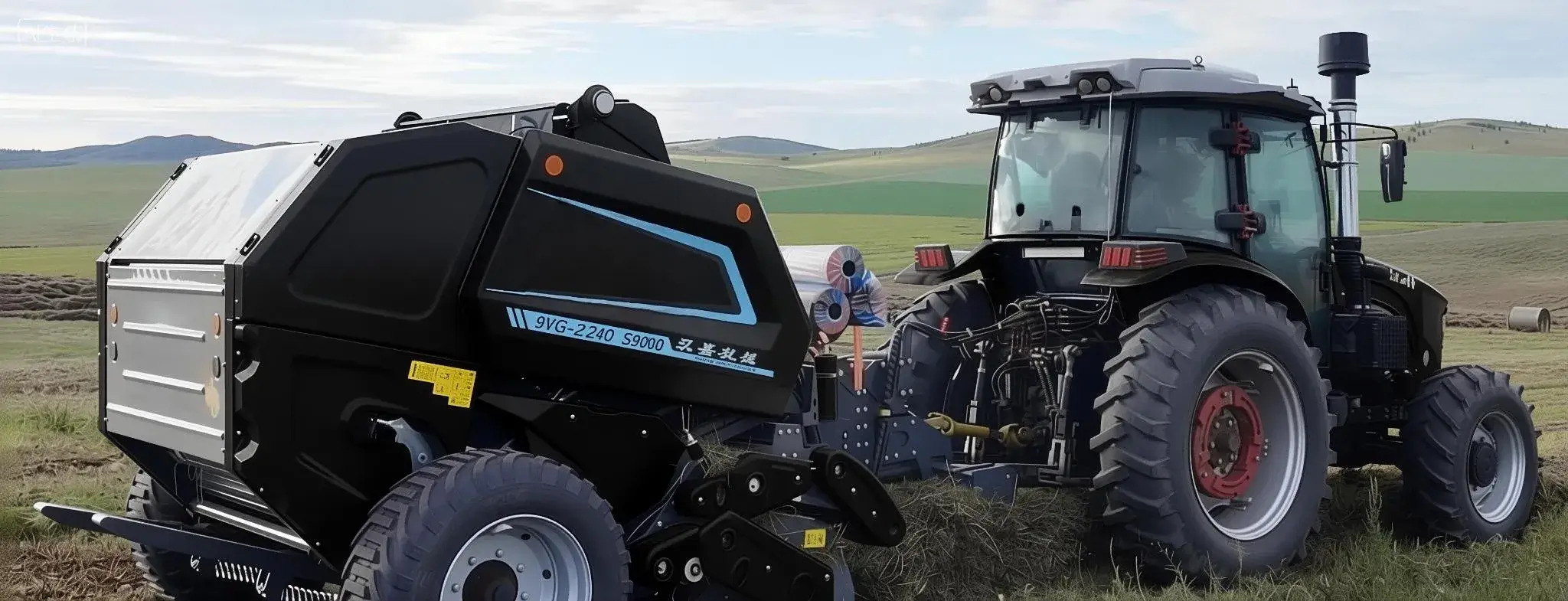
The 9YG-2.24D series uses a roller-type compression chamber with 18 ø222 mm steel compression rollers arranged around a chamber measuring 1,400 mm wide and ø1,200 mm in diameter. This 18-roller arrangement distributes the compression load across a larger contact area than 16-roller designs, reducing peak stress on any individual roller and on the frame brackets that hold them. For a machine being asked to produce 800 to 1,000 bales in a single week — a realistic target for a 300-hectare grain farm — this structural reserve is not just a nice-to-have; it is the margin that separates a machine that completes the season from one that requires unscheduled repair mid-harvest.
The dual cross-joint drive shaft with integrated torque-limiting protection is equally important in the grain farm context. Post-harvest straw windrows on large fields are rarely perfectly uniform: they contain patches of soil compaction from combine wheel tracks, occasional debris from the header, and density variations caused by uneven crop yield across the field. Each of these produces a sudden load spike in the drivetrain during baling. The torque limiter absorbs these spikes before they reach the gearbox housing or the pickup drive, preventing the driveline failure events that are disproportionately common during the high-intensity post-harvest period when operators are under pressure to clear fields quickly and may be running at or near maximum field speed continuously.
The traction hitch assembly on the S9000 variant — with a maximum rated torque of 1,000 Nm and the ability to rotate 90 degrees left and right without cutting PTO power — is particularly relevant on the long rows typical of large grain fields. A 500-metre row on a cereal farm means the baler completes a full pass before needing to turn. The dual-coupled gearbox’s turning capability means headland turns are completed quickly and without mechanical interruption, allowing the operator to re-engage the windrow at the next pass with no cycle disruption and minimal material left at field ends.
4. Material System: Drive Components, Roller Specifications, and Long-Term Durability
The material choices made during manufacturing of a round baler directly determine its service life under the demanding conditions of large-scale straw baling. Grain straw — particularly wheat and barley, with their abrasive silica-rich stems — accelerates wear on tine surfaces, roller faces, and chain components more rapidly than softer forage crops. Understanding the metallurgical specifications of the most wear-exposed components helps buyers assess the realistic service intervals and replacement costs associated with a particular machine investment.
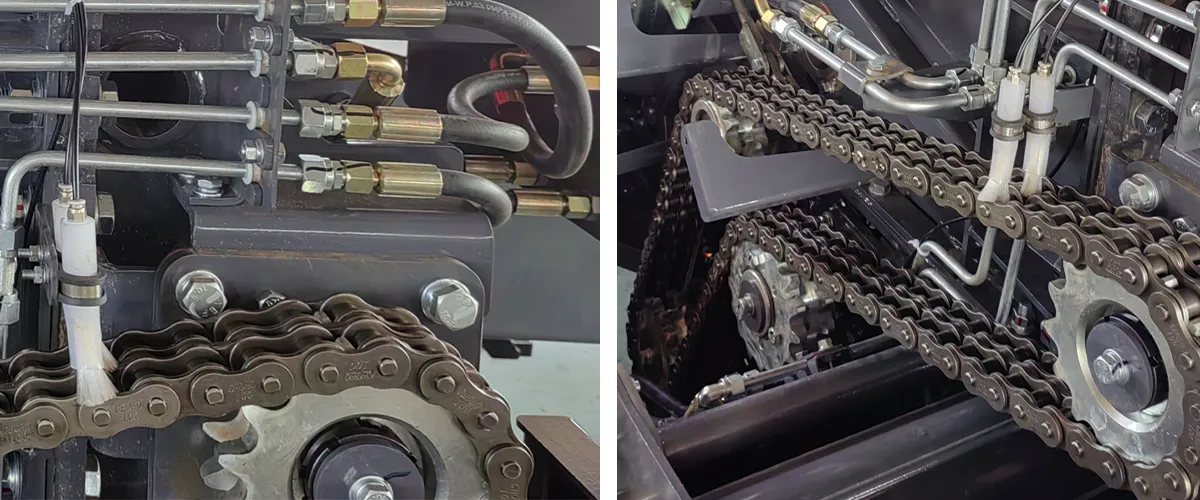
The dual-sided heavy-duty 20A roller chain used in the rear compression chamber of the 9YG-2.24D S9000 variant is rated for significantly higher tensile loading than standard 16A chain. In the context of grain straw baling, where the compression chamber may process 600 to 800 kg of material per hour at moderate to high bale density settings, the chain is under near-continuous load throughout the operating day. Heavy 20A chain elongates at a lower rate than 16A under these sustained loads, maintaining consistent roller-to-roller speed relationships over a longer service period and reducing the tensioning adjustment frequency that consumes operator time during a tight harvest window. On the 9YG-1.0C variant, the front and rear compartments use dual-sided 16A heavy chain, suited to the lighter structural weight and lower power input range of that model.
The spring-tooth pickup tines are manufactured from high-temper spring steel that deflects and recovers on contact with soil clods, stones, and the edge-of-windrow irregularities that are common in grain straw harvested from heavily trafficked combine fields. The camless, no-guard-ring pickup mechanism removes the cam follower and cam track from the pickup assembly — the most maintenance-intensive components in conventional pickup designs and a consistent source of wear-related failures during high-intensity straw seasons. By eliminating this component, the design reduces both the parts inventory a farm needs to carry through the season and the frequency of pickup disassembly for maintenance. For a large grain farm completing its straw baling in a six-day window, eliminating one two-hour pickup repair from the schedule adds a meaningful number of additional bales to the season’s output.
| Model | पिकअप चौड़ाई | Rollers | Chamber Width | Power (kW) | Op. Speed | गठरी घनत्व | उत्पादकता |
|---|---|---|---|---|---|---|---|
| 9YG-2.24D (S9000) | 2,240 mm | 18 | 1,400 mm | 55–100 | 5–35 km/h | 100–200 kg/m³ | 40–100 bales/h |
| 9YG-2.24D (Classic) | 2,240 mm | 18 | 1,400 mm | 55–100 | 5–35 km/h | 100–200 kg/m³ | 40–100 bales/h |
| 9YG-2.24D (Transcend) | 2,240 mm | 18 | 1,400 mm | 55–100 | 5–35 km/h | 100–200 kg/m³ | 40–100 bales/h |
| 9YG-1.25 (Double) | 2,240 mm | 18 | 1,250 mm | ≥75 | 5–20 km/h | 115–200 kg/m³ | 40–80 bales/h |
| 9YG-1.25A | 2,150 mm | 18 | 1,250 mm | ≥75 | 5–35 km/h | 100–200 kg/m³ | 40–100 bales/h |
| 9YG-1.0 | 1,900 mm | 16 | 1,000 mm | 48–80 | 5–20 km/h | 115–200 kg/m³ | 40–100 bales/h |
| 9YG-1.0C | 2,400 mm | 16 | 1,250 mm | ≥69.8 | 5–20 km/h | 115–200 kg/m³ | 40–80 bales/h |
5. Round Baler Gearbox Design for Large-Farm Straw Operations
The round baler gearbox is the interface between tractor power and field productivity, and on large grain farms where achieving the highest possible bale output per available harvest-day is a real operational priority, gearbox specification is not a secondary consideration. The standard PTO input speed of 720 r/min on the 9YG-2.24D and 9YG-1.25 series aligns with the output shafts of the mid-to-large tractors that large grain farms typically already own — typically 55 to 100 kW (75 to 135 hp) machines that are used for multiple field operations across the season and are already on the farm for grain drilling and spraying.
The dual-coupled gearbox design in the S9000 variant offers two structural advantages specific to large grain farm conditions. First, it can rotate 90 degrees left or right relative to the tractor’s centreline while maintaining PTO engagement, enabling tighter headland turns on the long-row grain fields typical of large arable operations. A machine completing a 300-metre windrow row that saves 6 to 8 seconds per turn compared to a fixed-frame equivalent adds approximately 5 to 8 minutes of productive baling time per hour — which, over a 10-hour working day, translates into 20 to 40 additional bales depending on cycle time. Second, the rigid connection between the gearbox assembly and the traction frame prevents the torsional misalignment that occurs when a lighter frame flexes over the undulating headlands and soil compaction ridges typical of combine-harvested fields. This alignment preservation directly extends bearing life in the gearbox input section — the most expensive component to replace in the field.
For farms operating the 9YG-1.25A specifically, the PTO input range of 540 to 1,000 r/min makes the machine compatible with older tractors that Korean grain farms may retain in their fleet alongside newer equipment — a genuinely useful specification in the South Korean context where average farm operator age exceeds 65 and tractor fleet modernisation is uneven across operations. Being able to run the baler from a 30-year-old 540-rpm tractor that the farm already owns is a meaningful cost advantage compared to a machine that requires a 1,000-rpm shaft and therefore necessitates either a new tractor or a separate purchase.
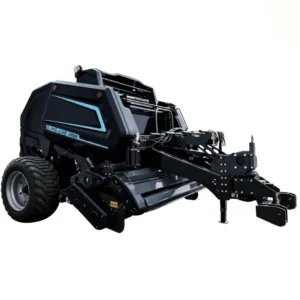
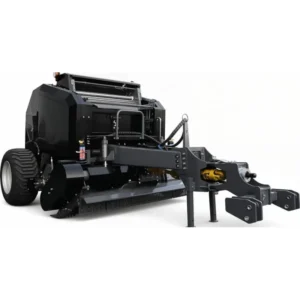
6. Round Baler Models for Large Grain Farm Straw Management
7. Straw Burning Regulations and Gearbox Compliance Across Key Markets
Straw management choices on large grain farms are increasingly shaped by a regulatory environment that has moved decisively against field burning in most major cereal-producing regions. Understanding both the straw-specific regulations and the machinery safety rules that govern gearbox and PTO shaft design is important for grain farm procurement decisions that involve international equipment sourcing.
South Korea
In South Korea, the Clean Air Conservation Act (대기환경보전법) imposes comprehensive restrictions on the open burning of crop residues including rice straw, wheat straw, and corn stalks. Provincial and municipal governments enforce burning prohibition notices during and after harvest periods, making baling the primary compliant residue management option for most Korean grain farms. The Ministry of Agriculture, Food and Rural Affairs (농림축산식품부, MAFRA) actively promotes straw baling through the Agricultural Machinery Purchase Subsidy program (농업기계화 지원사업), through which RDA-certified round balers can qualify for subsidised acquisition — a meaningful financial incentive for grain farms investing in baling capacity for the first time. Agricultural machinery including round baler gearboxes must pass Rural Development Administration (농촌진흥청, RDA) certification testing for domestic subsidy eligibility. Transport of large-format balers on Korean roads is subject to Road Traffic Act (도로교통법) width and weight notification requirements.
United Kingdom
The UK’s Crop Residues (Burning) Regulations 1993 prohibit the burning of cereal straw, cereal stubble, and oilseed rape, field bean, and pea residues except in narrow specific circumstances — primarily disease control and disposal of broken bale remnants. These regulations make post-harvest straw baling effectively mandatory for most large arable farms in England, Wales, and Scotland. Agricultural machinery safety — including gearbox guarding and PTO shaft protection — is governed by the Work at Height Regulations 2005, PUWER 1998 (Provision and Use of Work Equipment Regulations), and HSE guidance documents on agricultural machinery safety. PTO shaft guarding requirements follow EN ISO 5674.
European Union
Across EU member states, crop residue burning is controlled through national implementations of the Common Agricultural Policy’s Good Agricultural and Environmental Condition (GAEC) requirements — specifically GAEC 6, which addresses minimum soil cover and restrictions on burning practices as a condition of direct payment eligibility. Germany’s Bundes-Bodenschutzgesetz (Federal Soil Protection Act, BBodSchG) provides additional guidance on soil organic matter management that discourages residue burning in favour of incorporation or baling. Agricultural machinery gearbox and PTO safety must comply with the Machinery Directive 2006/42/EC and, from January 2027, the Machinery Regulation (EU) 2023/1230. PTO shaft guarding standards are specified under EN ISO 5674, and safety markings must follow EN ISO 11684.
Russia and EAEU
In Russia and the wider Eurasian Economic Union, open burning of crop residues is regulated under Federal Law No. 69-FZ on Fire Safety and regional agricultural administrative ordinances. In major grain-producing regions such as Krasnodar Krai and Stavropol Krai, straw burning restrictions are progressively being tightened, increasing commercial interest in baling as a compliant alternative. Agricultural machinery must carry EAC conformity certification (Евразийское соответствие) under Technical Regulation TR CU 010/2011, and gearbox performance standards are referenced under GOST R 53056. The 9YG-2.24D’s broad power compatibility range of 55 to 100 kW suits the range of tractors found on large Russian and Kazakhstani grain farms.
United States
In the United States, straw burning regulations are administered at the state level. California’s Air Resources Board (CARB) restricts rice straw burning to a limited number of permitted days per year in the Sacramento Valley, and post-harvest baling has expanded significantly as an alternative. In the Midwest cereal states, open burning restrictions vary by county and air quality district, with voluntary conservation programs under USDA’s Conservation Reserve Program incentivising residue management through baling. OSHA 29 CFR 1928.57 mandates PTO shaft guarding and all driveline protective shielding on farm equipment, applicable during all baling operations regardless of urgency.
8. Productivity Benchmarks: What a Large Grain Farm Can Realistically Expect
Setting realistic productivity expectations before purchasing a round baler is important for large grain farms that need to complete straw baling within a defined number of days after the combine finishes. The rated productivity figures of 40 to 100 bales per hour on the 9YG-2.24D series represent a wide range, and understanding what drives a machine toward the upper or lower end of that range helps operators plan their field season accurately.
Windrow density and consistency is the primary determinant of baling speed. A dense, well-formed windrow from a good-quality combine swath — material is deposited evenly, width is consistent, and the windrow lies flat — allows the baler to operate at near-maximum field speed throughout the pass. A thin, patchy windrow from a low-yield field section, or a wind-spread windrow that is uneven in width, forces the operator to slow down to maintain bale density within the sensor’s target range, reducing per-hour output significantly. Pre-baling raking — merging two or three combine windrows into one heavier pass — can substantially increase baling productivity on large fields where individual windrows are too thin to fill the pickup efficiently at good speeds.
Bale-cycle time — the interval from when one bale reaches target density to when the next bale starts building — is the second productivity variable. On the 9YG-2.24D S9000 variant, the hydraulic chamber door uses H-type sleeve fittings rated for high working pressure, which speeds door opening and closing compared to lower-rated fittings. The buffer cylinder on the Classic variant prevents door-closure damage that would extend the between-bale idle period. Both of these design choices reduce cycle time, keeping the machine productive rather than stationary between ejections.
| Operating Scenario | Est. Bales/Hour | 10-Hour Day Output | Notes |
|---|---|---|---|
| Dense, well-formed wheat windrow, high speed | 80–100 | 800–1,000 bales | Good crop yield, merged windrow, experienced operator |
| Standard wheat, single combine windrow | 55–70 | 550–700 bales | Typical large-farm wheat harvest condition |
| Rice straw, post-combine, moderate moisture | 45–65 | 450–650 bales | Korean autumn conditions, some moisture variation |
| Thin windrow, variable density, patchy crop | 35–50 | 350–500 bales | Low-yield areas; consider raking before baling |
9. Straw Markets and Revenue Streams: Where Baled Straw Goes After Large Grain Harvest
Understanding the downstream markets for baled straw is important context for large grain farms evaluating the return on their round baler investment. The value of a bale at the farm gate varies significantly depending on crop type, moisture, bale density, and the buyer’s application — but consistent bale quality from a well-specified round baler machine is a prerequisite for accessing the better-paying markets in each category.
Livestock bedding is the highest-volume application for baled wheat and barley straw in Korea, Japan, and most European markets. Livestock operations — dairy farms, cattle feedlots, poultry houses — consume large quantities of bedding straw year-round, with demand peaking in winter. Bedding buyers are typically specific about moisture content and bale integrity: bales with over 20% moisture are rejected as bedding due to mould risk, and bales that fall apart on opening because of insufficient density or poor net wrap create handling problems that result in contracts moving to more reliable suppliers. Sensor-based density control producing consistent ø1,300 × 1,400 mm bales within the 100 to 200 kg/m³ range directly supports access to the bedding market’s quality requirements.
Mushroom cultivation substrate is a significant market for rice straw specifically in Korea, Japan, and Vietnam. Commercial mushroom producers — primarily oyster mushroom operations — require straw bales with specific moisture profiles, consistent density for substrate sterilisation efficiency, and clean material free from soil or excessive debris. This market typically pays at a modest premium over livestock bedding rates and is available close to large Korean rice-growing regions through established distributor networks. Biogas plants represent the fastest-growing end market for cereal straw globally, with large-format round bales being the preferred feedstock delivery format for transport and metering efficiency. In Germany, South Korea, and other markets with active biogas infrastructure, contracted straw supply to biogas producers provides grain farms with a reliable forward-price arrangement — an important consideration for farms planning their baler ROI calculation over a three to five year horizon.
10. Windrow Preparation and Field Operation Strategy on Large Grain Farms
The quality of straw management after harvest depends almost as much on the preparation steps that precede baling as on the baler’s mechanical specifications. A high-specification round baler operating from a poorly prepared windrow will under-perform against its rated productivity, and the converse is also true: even a moderately sized machine achieves excellent output when windrows are correctly formed and the field is prepared for efficient baling passes. On large grain farms where time pressure after harvest is acute, investing one additional operation in windrow preparation before baling typically returns more than its cost in reduced baling time and improved bale quality.
The two most valuable pre-baling operations on large grain fields are windrow merging and windrow conditioning. Merging involves using a raking machine or windrow merger to combine two or three adjacent combine windrows into a single heavier windrow that is wide enough to fully load the baler’s 2,240 mm pickup on every pass, with consistent density from one end of the row to the other. This single operation can increase baling productivity by 20 to 40 percent on low-to-medium-yield fields by eliminating the speed reductions and density drops associated with thin, gappy windrows. Windrow conditioning — turning or tedding the windrow in wet conditions — reduces moisture content before baling, extending the window of suitable baling weather and reducing the risk of baling wet material that stores poorly and generates heat in the stack.
For the baling operation itself on long-row large fields, a consistent forward speed matched to windrow density is more productive than alternating between high-speed and stop-start operation. The sensor-based density control standard on all 9YG series models monitors compression build-up continuously and initiates net wrap at the correct point regardless of the operator’s momentary field speed. This removes the operator judgment variable from the density equation and allows them to focus on maintaining line and speed across the field rather than monitoring the bale-building process — a meaningful operator fatigue reduction on days when 10 or more hours of baling are needed to stay ahead of changing weather.
Key Field Operation Practices for Large Grain Farm Straw Baling
Merge thin combine windrows before baling on fields below 6 t/ha yield — this one step typically increases baling productivity by 25 to 40 percent and produces denser, more uniform bales.
Allow straw to dry to below 18% moisture before baling when market applications require it — wet bales from rushed post-rain harvests cause downstream storage and quality problems that reflect on the farm’s supply reputation.
Check pickup tine count and chain tension before the first pass of each day — missing tines create collection gaps that produce irregular bales, and a chain that needs tensioning mid-morning is an avoidable interruption on a tight schedule.
Maintain a net roll forward stock of at least two full days of production at all times during the harvest period — supply runs during the harvest window cost more than the rolls and lose more than their value in production time.
Frequently Asked Questions
संपादक: पीएक्सवाई