1. Why Feed Cost Is the Biggest Variable in Korean Beef Cattle Farming
For Korean Hanwoo (한우) beef cattle farmers, feed accounts for 55–70% of total annual production cost. In years when imported feed grain prices spike — as they did sharply in 2022 and again in 2024 due to global supply disruptions — this feed cost proportion can push operations to the margin of profitability or beyond. The core challenge is that a significant portion of this feed cost is avoidable for farms that have access to land capable of producing forage. Rice straw — generated on most Korean paddy farms in enormous volumes during October and November — is a freely available roughage source that is chronically underutilised simply because many beef farms lack the mechanised harvesting capacity to collect and store it efficiently. Italian ryegrass overseeded into harvested paddies provides a high-quality spring forage that typically yields 8–12 tonnes of dry matter per hectare across two cuts, yet most Korean farmers either sell this material unharvested or depend on contractor baling at a per-bale rate that erodes much of the economic benefit.
The strategic solution that consistently delivers the largest feed cost reduction is owning or operating your own round baler. A round baler machine transforms standing or windrow-laid forage — whether rice straw, ryegrass, corn stover, sorghum-sudangrass, or natural grassland hay — into storable, handleable bales that can be fed directly to cattle with minimal processing. The key distinction between owning a round baler and depending on contractors is timing: with your own machine, you can bale at the optimal crop moisture for maximum dry-matter preservation, rather than waiting for a contractor’s availability window and baling at a suboptimal stage. This timing advantage alone can increase the feeding value of stored forage by 15–25% compared to bales made at incorrect moisture, which translates directly into reduced purchased concentrate supplement requirements and measurable savings per animal per day.
2. How a Round Baler Converts Field Forage Into Stored Feed Value
The fundamental value proposition of the round baler machine for beef cattle operations is simple: it converts a low-cost or zero-cost field resource into a measured, storable, feedable commodity. But the quality of that conversion — how much of the original crop’s dry matter and nutritive value is preserved from field to feed bunk — depends heavily on how the baler is designed, set up, and used. Understanding this conversion process helps beef farmers make more informed decisions about both equipment selection and field management practices.
When forage is cut and wilted in the field, the drying process reduces moisture from the fresh-cut level (70–80% for grass) down to the target baling range of 15–25% for hay or 40–65% for silage. During this period, plant cells continue respiring and consuming carbohydrates, so the longer the crop lies on the field, the more dry-matter loss occurs. A round baler that can work quickly and reliably — maintaining 40–100 bales per hour throughput in good conditions — minimises this in-field loss by reducing the time between optimal moisture and bale formation. Every hour of unnecessary delay after optimal moisture is reached costs approximately 1–2% of the dry-matter yield in continued respiratory loss, plus additional weathering risk if rain events occur.
Once inside the round baler compression chamber, the 16 or 18 steel rollers compact the crop material into a dense cylindrical form. This compaction is critical for feed value preservation: a well-compacted bale with a smooth, tight outer surface excludes oxygen from the interior more effectively than a loose bale. In silage baling, oxygen exclusion is the prerequisite for the anaerobic fermentation process that preserves nutritional value. In hay baling, the dense outer crust formed by compaction resists weather penetration and minimises the mould development that reduces both feed value and palatability. The sensor-controlled density system on all 9YG round baler series models allows operators to set and hold consistent bale density across varying crop conditions, which is essential for achieving predictable feed quality across a stored batch of bales.
3. Calculating the Feed Cost Savings From On-Farm Round Baling
The economics of owning a round baler become compelling when viewed across the full production cycle of a beef cattle operation rather than just the purchase price. Korean Hanwoo farms with 50–200 head of cattle typically require 3–6 tonnes of dry-matter roughage per animal per year, meaning a 100-head operation needs 300–600 tonnes of dry-matter forage annually. At typical contractor baling rates in Korea of 8,000–15,000 KRW per bale, and with each net-wrapped round bale containing approximately 150–300 kg of dry matter depending on crop type and density, the annual contractor baling cost for such an operation can range from 8–25 million KRW per year — before accounting for the feed value lost to suboptimal baling timing.
Owning a round baler machine in the 9YG-1.25A or 9YG-2.24D class eliminates contractor fees and replaces them with a capital cost spread over the machine’s working life of 8–15 years, plus annual maintenance and fuel. At an output of 40–100 bales per hour over 200–300 operating hours per year in a typical Korean two-season forage programme (spring ryegrass + autumn rice straw), an owner-operator baler can process 8,000–30,000 bales per year. Even at the lower end of this range, the breakeven point against contractor costs is typically reached within 2–4 years of operation for a medium-scale cattle farm. Beyond that breakeven, every bale the round baler produces represents net savings that directly improve the profitability of the cattle enterprise.
| Parameter | Contractor Baling | Own Round Baler |
|---|---|---|
| Timing flexibility | Depends on contractor schedule | Full operator control |
| Baling moisture optimisation | Often suboptimal | Operator sets ideal window |
| Dry-matter preservation | Variable (70–85%) | Consistent (85–95%) |
| Per-bale cost trend | Rises with inflation | Falls as capital is amortised |
| Crop loss during delay | 1–2% DM per extra hour | Minimised with own machine |
| Bale density consistency | Variable across contractors | Sensor-controlled consistency |
| Annual volume scalability | Limited by contractor capacity | Scales with tractor hours |

4. Choosing the Right Round Baler for Your Cattle Operation Scale
Selecting the correct round baler model for a beef cattle operation requires matching three key parameters: the available tractor horsepower, the annual volume of forage to be processed, and the primary crop type. Getting this match right is fundamental to achieving the low per-bale operating cost that makes owner-operator baling financially superior to contracting. An undersized round baler operating at or near its rated capacity limit will consume more fuel per bale, wear components faster, and produce lower-density bales than a correctly rated machine running comfortably within its design envelope. Conversely, an oversized machine represents unnecessary capital investment and may be physically awkward on the small paddy field headlands common in Korean agricultural landscapes.
For Korean Hanwoo farms with 30–80 head of cattle and a 15–50 kW tractor, the 9YG-1.0 mini round baler is the natural entry point. It requires 48–80 kW PTO input, produces bales of 1100 × 1000 mm diameter at 115–200 kg/m³ density, and at 2640 kg working weight is manageable on small paddy parcels with tight turning requirements. For medium-scale operations with 80–200 head and 55–75 kW tractors, the 9YG-1.25A and 9YG-1.25 Double models offer the additional capacity and versatility needed to handle both spring ryegrass baling and autumn rice straw and corn stalk collection within the limited seasonal windows that Korean farming calendars impose. The largest Hanwoo and commercial mixed beef operations — those running 200 head or more — benefit from the full-capacity 9YG-2.24D series models, which deliver 40–100 bales per hour at bale sizes of 1300 × 1400 mm and can handle the complete range of Korean forage crops efficiently.
5. Manufacturing Structure: What Makes a Beef Farm Round Baler Durable
A round baler purchased for a beef cattle operation needs to deliver reliable performance across many years of two-season use without requiring costly mid-season breakdowns that disrupt the forage harvest schedule. The manufacturing structure of the machine — the way its key components are designed and assembled — determines how well it holds up under this sustained demand. A beef farm round baler is not used for show; it is used hard, often by a single operator managing a full-time cattle enterprise alongside the baling work, who needs the machine to start every morning and finish every evening without mechanical drama.
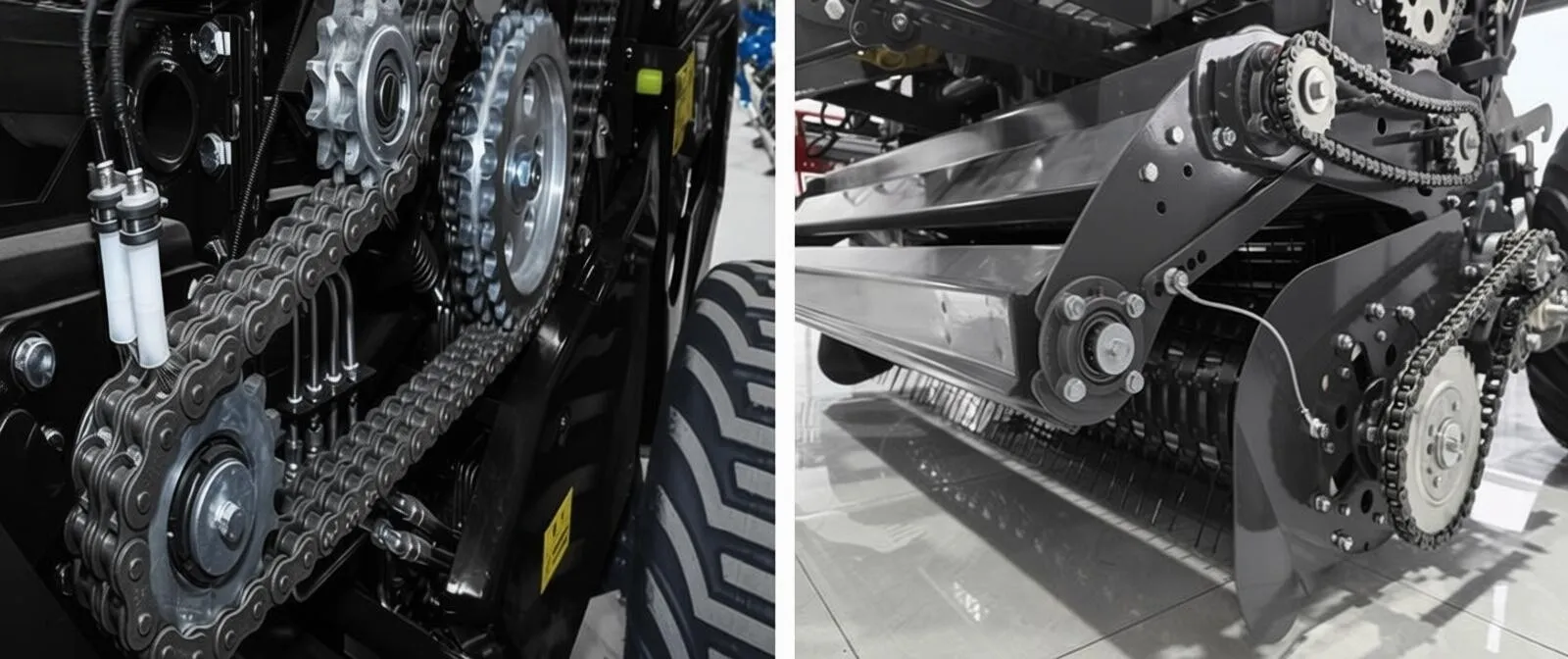
The main chassis frame is the structural backbone on which all other components depend. CNC laser-cut from high-strength structural steel plate and MIG-welded with full-penetration joint preparation at the highest-stress load paths, the frame must accommodate the combined dynamic loads of pickup operation, bale chamber compression, and the shock of the rear gate opening against a loaded bale, cycle after cycle across a full season. Post-weld precision machining of the compression roller mounting bores ensures that all 16 or 18 rollers maintain their designed radial position relative to the bale-forming zone even after the thermal distortion introduced by the welding process. This dimensional precision is what guarantees that bales are formed round and symmetrically dense, which matters to a beef farmer because a consistently shaped bale is easier to stack, easier to net-wrap, and loses less material to weathering during outdoor storage.
The rear gate assembly on a round baler used in beef cattle operations carries a special structural significance. This gate must swing open under hydraulic power against the resistance of a completed bale weighing anywhere from 200 kg in rice straw service to 500 kg in silage grass service, and it must do so with predictable, controlled speed thousands of times per year without fatigue failure at the hinge welds. Gusseted hinge flanges that distribute the cylinder’s reaction force over a broad area of gate plate, combined with hardened steel pivot pins running in sealed spherical bearing races, deliver this durability. The cushion cylinder fitted as standard on the 9YG-2.24D S9000 Classic and Transcend variants decelerates the gate in the final 15 degrees of its closing arc, eliminating the impact shock that would otherwise accumulate as fatigue damage in the hinge welds over thousands of operating cycles.
Chassis Frame
CNC laser-cut structural steel. Full-penetration MIG welds. Post-weld roller bore machining for geometric accuracy across crop types.
Gate Assembly
Gusseted hinge flanges, hardened pivot pins, sealed spherical bearings. Cushion cylinder standard on S9000 Classic and Transcend.
Compression Rollers
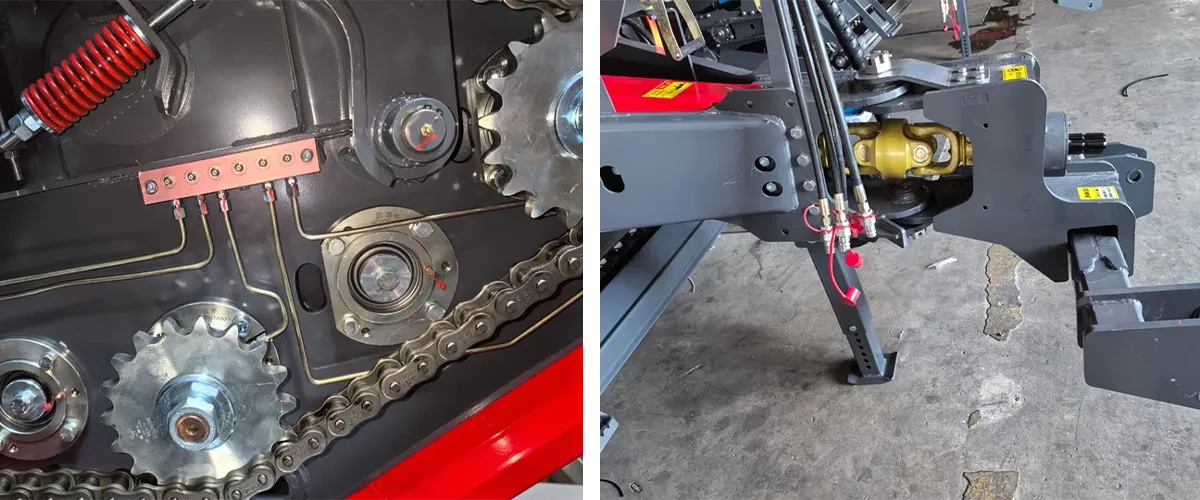
16 or 18 hardened-surface steel rollers. Sealed-for-life or re-greaseable labyrinth bearing seals. Dual-side 20A chain drive on S9000 series.
Dual Gearbox Tongue
90° lateral rotation each side. Rigid connection to drawbar eliminates torsional shock during headland turns. Reduces PTO angle stress.
6. Material Systems That Support Long-Term Cost Reduction
For a round baler being used to reduce beef cattle feed costs, the material choices made in its construction determine the maintenance budget over the machine’s working life just as directly as the purchase price. A round baler with premium material systems in its crop-contact components will require fewer roller replacements, fewer tine sets, and fewer bearing overhauls across a ten-year service life than a machine built to a lower material specification. In a beef cattle operation context, where the round baler is part of a cost-reduction strategy, keeping the round baler’s own running costs low is as important as the savings it generates in the feed budget.
The compression rollers are the single most wear-critical components in the round baler. They contact every kilogram of crop that passes through the machine, and for a beef farm processing 300–600 tonnes of dry-matter forage annually, this means millions of crop-contact events per year. Roller shells are formed from cold-drawn seamless steel tube and then induction-hardened or hard-chrome plated on the outer surface to bring working hardness into the 55–62 HRC range. At this hardness level, the silica in rice straw cannot efficiently abrade the surface, and grass moisture cannot initiate the corrosion pitting that leads to grass wrap-up on softer surfaces. A set of properly hardened rollers in rice straw service will maintain acceptable dimensional tolerance for 4–6 years of typical Korean two-season use before requiring replacement, compared to 1–2 years for unhardened equivalents.
Spring tines on the pickup reel are heat-treated medium-carbon steel, typically 65Mn or equivalent specification. They must flex millions of times across a season’s operation without developing fatigue cracks, which means the heat treatment process must achieve the correct balance of hardness (for surface wear resistance) and core toughness (for fatigue crack resistance). Tines that are too hard become brittle and snap; tines that are too soft bend permanently and reduce pickup efficiency. Zinc-phosphate surface coating or equivalent corrosion protection extends the functional life of tines in the wet conditions typical of Korean spring grass baling, where early morning dew means the first few rounds of each morning’s baling are done with high-moisture surface conditions regardless of the bulk crop moisture level.
The hydraulic cylinder rods — which are exposed to crop chaff, soil splash, and weather during every baling session — are hard-chrome plated over low-alloy steel cores to a surface hardness of approximately 800 HV. This coating provides the combination of corrosion resistance and abrasion resistance needed to maintain the cylinder rod seal integrity that prevents oil leaks. A leaking cylinder rod on the gate opening cylinder is both a hydraulic efficiency problem and a fire hazard in a hay barn environment, making the material quality of the rod coating directly relevant to beef farm safety as well as maintenance cost.
| Component | Material / Treatment | Beef Farm Relevance | Expected Service Life |
|---|---|---|---|
| Compression rollers | Induction-hardened / chrome plated, 55–62 HRC | Resists silica abrasion in rice straw service | 4–6 years (two-season use) |
| Spring tines | 65Mn heat-treated, zinc-phosphate coated | Fatigue resistance in high-volume paddy straw | 2–3 seasons |
| Hydraulic cylinder rod | Hard chrome plated, ~800 HV | Prevents oil leaks in hay barn environments | 5–8 years (seal dependent) |
| Drive chain (20A) | High-strength alloy steel, hardened pins | Withstands peak torque spikes in straw operation | 3–5 seasons with correct tensioning |
| Chassis frame steel | High-strength structural steel, electrostatic paint | Corrosion resistance during wet season storage | Machine life (10–15 years) |
7. Round Baler Gearbox Performance and Its Impact on Operating Cost
The round baler gearbox is the mechanical heart of the drive transmission, converting the tractor’s PTO rotational input into the distributed power that drives the compression rollers, the pickup reel, and the feed mechanism simultaneously. For a beef cattle farmer focused on minimising round baler operating cost, the gearbox has two critical performance dimensions: transmission efficiency (how much PTO power reaches the working components without being lost to internal friction and heat) and structural longevity (how many operating hours the gearbox can deliver before requiring servicing or replacement).
All 9YG series round baler models accept 720 r/min PTO input at their standard operating speed. The dual gearbox design fitted to the 9YG-2.24D S9000 variants does more than just transmit power — it provides the 90-degree lateral rotation capability that allows the baler to make tight turns on Korean paddy field headlands without requiring the tractor to describe a wide arc. This turning flexibility reduces headland trampling loss and allows the baler to operate efficiently on smaller and more irregular field shapes that would otherwise require the baler tongue to be disconnected and the tractor to make multi-point turns. For a beef farmer running a paddy-field forage programme, this operational efficiency translates directly into more bales per fuel litre and less wasted field area at field margins.
The self-developed dual cross-joint drive shaft used in the Transcend variant adds a safety torque limiter to the driveline, which protects the gearbox from the sudden overload events that occur when the bale chamber unexpectedly encounters a large slug of dense material — a common event when baling across an irregular windrow where density varies between near-empty and very full sections of the pickup path. Without torque protection, these events would be transmitted directly to the gearbox as shock loads that accelerate bearing wear and gear tooth fatigue. With torque protection, the gearbox absorbs only the design load and the overload energy is dissipated at the slip element in the drive shaft. From a total cost of ownership perspective, this protection mechanism can extend gearbox service intervals from the typical 3–5 year replacement cycle on unprotected designs to 6–10 years or more on protected designs.
8. Bale Density, Dry-Matter Preservation, and Feed Wastage
From a beef cattle feeding perspective, bale density is not just a storage logistics parameter — it is directly connected to feed wastage and ultimately to the cost per kilogram of dry matter delivered to the animal. A poorly compacted round bale has a larger proportion of internal air space relative to its total volume, which means more oxygen is available to support the mould, yeast, and aerobic bacteria that degrade dry matter and reduce palatability. Cattle presented with a mouldy or heat-damaged hay bale will sort aggressively, leaving a significant proportion uneaten that then becomes wasted material. Research in Korean Hanwoo operations has documented dry-matter wastage rates of 20–40% from poorly stored or low-density bales, compared to 5–12% from well-made, high-density bales stored correctly. The difference across a 100-head operation’s annual forage supply represents tens of tonnes of dry matter that either contributes to animal growth or goes to waste.
The sensor-controlled hydraulic density system on all 9YG round baler series models measures bale diameter growth through a star-wheel position sensor and modulates the compression chamber back-pressure in real time to hold a user-set density target. For beef cattle hay baling (ryegrass, mixed grass, rice straw), a density setting in the 140–180 kg/m³ range is appropriate for most conditions, producing a bale that is dense enough to resist oxygen infiltration but not so tightly packed that the hay’s natural structure is broken down. For silage baling (fresh-cut ryegrass or sorghum-sudangrass at 50–65% moisture), a slightly lower density target of 120–160 kg/m³ allows the fermentation gasses produced during ensiling to vent out of the bale through the net wrapping rather than creating internal pressure that could eventually rupture the net seal.
Net wrapping quality also plays a direct role in dry-matter preservation. The round baler net-wrap sub-circuit on all 9YG models controls the netting tension through a hydraulic brake clutch that keeps the net drawn tightly against the spinning bale surface during the 2–3 wrap passes. A correctly tensioned net creates a tight, smooth outer skin that sheds rain and resists UV degradation more effectively than a loosely applied net with folds or gaps. For outdoor storage — the norm on most Korean Hanwoo farms where covered storage space is limited — this net-wrap quality is a significant determinant of how much of the bale’s outer layer is preserved versus lost to weather damage during a 6–12 month storage period.
9. Round Baler Application: Crop Types for Beef Cattle Forage
One of the most compelling characteristics of the round baler for beef cattle operations is its versatility across a wide range of crop types that collectively cover the Korean cattle farmer’s full annual forage calendar. No single forage crop provides optimal nutrition across all seasons, so a well-managed forage programme draws on several different crops to maintain consistent roughage quality and volume throughout the year. The round baler machine is the central harvesting and preservation tool that makes this multi-crop strategy practically achievable.
| Crop / Season | Korean Baling Window | Target Moisture at Baling | Round Baler Model Recommendation |
|---|---|---|---|
| Italian ryegrass hay | April–May, July–August | 18–25% | 9YG-1.25A, 9YG-2.24D series |
| Ryegrass silage | April–May (first cut) | 40–65% | 9YG-1.25, 9YG-2.24D series |
| Rice straw | October–November | 10–18% | 9YG-1.0, 9YG-1.25A, 9YG-2.24D |
| Corn stover / standing stalks | September–October | 30–50% (stover) / various | 9YG-1.0C, 9YG-1.25 (hammer-claw) |
| Sorghum-sudangrass | July–August | 45–65% (silage) | 9YG-1.25, 9YG-2.24D series |
| Wheat/barley straw | June | 10–15% | 9YG-1.0, 9YG-1.25A |
The 9YG-1.25 Double variant occupies a particularly strategic position in this multi-crop programme because its switchable pickup system — spring-tine for hay and grass, hammer-claw for corn stalks — means a single round baler machine serves three distinct seasonal campaigns without requiring separate dedicated equipment for each crop type. For Korean beef cattle farms with land suitable for both corn and ryegrass production alongside paddy rice, this versatility represents a substantial capital efficiency advantage over deploying two or three purpose-specific machines.
10. Round Baler Product Lineup — Matching Machine to Herd Size
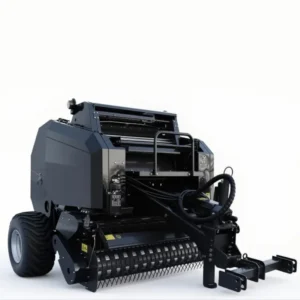
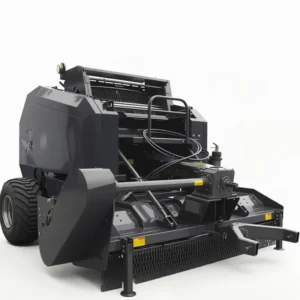
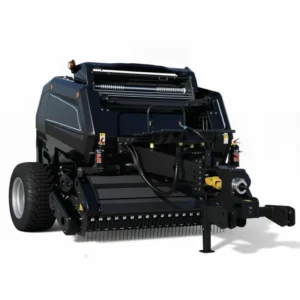
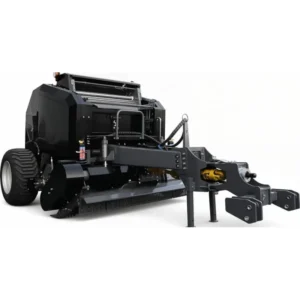
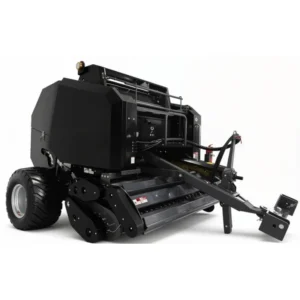
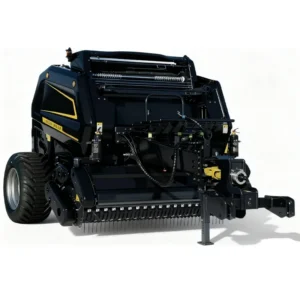
Each model below covers a specific combination of tractor horsepower range and annual forage volume suited to different scales of Korean beef cattle operation — from small family farms to large commercial Hanwoo enterprises.
11. Legal Regulations for Round Balers and Gearboxes by Region
Beef cattle farmers purchasing or operating round baler machines should be aware of the regulatory environment governing agricultural machinery in their country. These regulations cover gearbox safety, PTO driveline guarding, hydraulic system standards, and the certification requirements that determine eligibility for government purchase subsidies — which in Korea can cover 30–50% of the machine purchase price for qualifying models.
Korea (대한민국)
Under the Act on the Promotion of Agricultural Mechanisation (농업기계화 촉진법), all round baler models eligible for the Agricultural Machinery Subsidy Programme must hold a valid Agricultural Machinery Performance Test Certificate (농업기계 성능검정서) issued after testing by the Rural Development Administration (농촌진흥청). For the round baler gearbox specifically, Korean standard KS B 1521 covers gear oil specification requirements, and the gearbox must demonstrate rated torque capacity through the test programme. PTO driveline guards must be intact and functional as a condition of subsidy approval. Beef cattle farmers in Korea purchasing a round baler under the subsidy programme should confirm that the specific model they are buying — not just the product family — holds current certification, as certification is model-specific and can lapse if the manufacturer does not renew it with each version update.
European Union
EU Machinery Directive 2006/42/EC (transitioning to EU Machinery Regulation 2023/1230 effective January 2027) requires CE marking for all round baler machines sold within EU territory. EN ISO 4413 governs hydraulic system safety, EN 1553 covers self-propelled and trailed agricultural machinery safety requirements including gearbox venting and rated power marking, and EN ISO 11684 requires pictographic safety signs on all hazardous component zones. In Germany, DGUV Vorschrift 74 (agricultural machinery accident prevention regulation) requires annual inspection of PTO driveline components including the gearbox input seal and drive shaft guard tubes. In the Netherlands and Belgium, where intensive dairy and beef operations are common, agricultural machinery insurers increasingly require evidence of current CE certification as a condition of liability cover for contractor operators.
United States and Canada
ASABE Standard ASAE S430 sets the baseline safety requirements for tractor-powered agricultural implements including round balers in North American markets. OSHA 29 CFR 1928 requires functional PTO driveline guarding for commercial farm operations. The ASABE standard additionally covers minimum performance requirements for the PTO driveline connection, specifying that the gearbox input shaft must be capable of accepting the tractor’s standard 540 or 720 r/min PTO output without requiring adapter components that might create additional failure modes. Canadian provinces apply equivalent occupational health and safety requirements under provincial OHS acts, with Alberta and Saskatchewan — the largest beef cattle provinces — having active farm safety programmes that conduct random equipment inspections.
Russia and CIS (Eurasian Market)
For round baler machines sold in Russia, Kazakhstan, Belarus, and Mongolia — markets where extensive grassland beef and sheep operations create significant demand for round baling equipment — the EAC (Eurasian Conformity) mark under Technical Regulation TR CU 010/2011 is required. Gearbox components must be type-tested and documented in the EAC Declaration of Conformity. Mongolia in particular represents a growing market for round balers used in native grassland hay harvesting for winter livestock feeding, where the short seasonal window and extreme cold weather storage conditions create strong demand for dense, well-wrapped bales that the 9YG round baler series is specifically equipped to produce.
| Region | Standard / Law | Subsidy Impact |
|---|---|---|
| Korea | 농업기계화 촉진법 / KS B 1521 / KS B ISO 4413 | Certification required for 30–50% subsidy eligibility |
| EU | Machinery Directive 2006/42/EC / EN 1553 / EN ISO 4413 | CE mark required; affects CAP subsidy eligibility |
| USA / Canada | ASABE S430 / OSHA 29 CFR 1928 | Compliance affects liability insurance coverage |
| Russia / CIS | TR CU 010/2011 / EAC mark | EAC required for legal market entry in all CIS states |
| International | ISO 4413:2010 / ISO 11684 | Referenced by multiple national certification bodies |
12. Total Cost of Ownership: Maintenance Strategy for Beef Farm Round Balers
For a round baler being used as a feed cost reduction tool on a Korean beef cattle farm, the maintenance strategy needs to be as deliberate as the forage management programme it supports. A round baler that breaks down mid-season and cannot be repaired within the narrow baling window does not just incur repair costs — it loses the forage yield that would have been harvested during the downtime, which in high-yield conditions can represent a significant portion of the annual forage budget. The objective of a well-planned maintenance strategy is therefore not just component longevity but operational availability: ensuring the round baler is ready to work on every day of the baling season.
Pre-season inspection should take place at least four weeks before the first anticipated baling date, allowing time for any identified parts to be ordered and fitted. Key items to check include all compression roller bearing clearances and surface condition, spring tine sets for fatigue cracks and bend angles, hydraulic hose assemblies for surface cracking at ferrule ends, the chain tension on both the front pickup drive and the rear roller drive chains, and the gearbox oil level and condition. The gearbox oil check is particularly important following a heavy straw season, because the sustained higher PTO loads of straw operation generate elevated oil temperatures that accelerate oxidation of the gear oil additive package. Oil that has become dark, thin, or shows a burnt smell should be drained and replaced with fresh oil meeting the manufacturer’s specification before the spring grass season begins.
During the baling season, a brief daily check routine adds minimal time but catches the small issues before they become major failures. Checking chain tension takes two minutes; inspecting hose connections for weeping takes five minutes. Greasing the pickup pivot bearings and gate hinge pins every 50 operating hours prevents the premature wear that silent lubrication starvation causes. After each season ends — rice straw in November, ryegrass in early June — a thorough internal cleaning of the bale chamber removes accumulated chaff that retains moisture and promotes corrosion on roller surfaces over the inter-season storage period. A light coating of protective spray on exposed steel surfaces before winter storage is a low-cost step that consistently extends roller service life by protecting against the surface rust initiation that would otherwise begin within weeks of the machine being parked.
Round Baler Annual Maintenance Schedule — Beef Cattle Farm
Pre-Season (4 weeks before)
- Inspect roller surfaces and bearing clearances
- Replace cracked or bent spring tines
- Check all hydraulic hose assemblies
- Tension front and rear drive chains
- Change gearbox oil if post-straw season
- Verify sensor arm moves freely
In-Season (Every 50 h)
- Grease pickup pivot and gate hinge pins
- Check chain tension (front and rear)
- Inspect hydraulic hoses for weeping
- Check gate opening/closing cycle time
- Verify net-wrap tension setting
- Check roller bearing temperature after operation
Frequently Asked Questions
Q1. What is the best round baler model for a Korean beef cattle farm with a 40 hp tractor that needs to bale both rice straw and ryegrass hay? +
Q2. Which round baler application is most cost-effective for Korean beef cattle farms that grow corn and rice paddy on the same land in rotation? +
Q3. How does round baler bale density affect feed wastage rates in Korean Hanwoo beef cattle feeding operations? +
Q4. Where can Korean beef cattle farmers get a supplier quote for round baler parts including gearbox components and roller seal kits? +
Q5. How does owning a small round baler for a 40 hp tractor help Korean family beef cattle farms qualify for MAFRA agricultural machinery subsidy programmes? +
Q6. What is the round baler output rate needed to justify the capital cost for a Korean beef cattle operation with 150 head and two annual forage crops? +
Q7. How does the axial-flow semi-forced feed system in the 9YG round baler reduce fuel cost per bale in Korean beef cattle forage harvesting operations? +
Q8. When is the most cost-effective time for Korean beef cattle farms to service a round baler to minimise downtime risk during the critical spring ryegrass harvest window? +
Редактор: PXY