Pasture and Meadow Grass Baling — Model Comparison
A side-by-side engineering and field-performance analysis of two compact round baler models — designed for farmers who need the honest answer before they buy.
The question of whether to buy the EP-9YG-1.0 or the EP-9YG-1.25 comes up consistently among small livestock farm operators who are buying their first dedicated 원형 베일러 or replacing an older compact machine. Both 원형 베일러 models sit in the light-duty category — not the high-throughput class of the 9YG-2.24D series — and both are designed with the resource constraints of a family-scale farm in mind. But they are not interchangeable, and the differences between them matter considerably in pasture and meadow grass applications.
Pasture 원형 베일러 operation is mechanically different from baling cereal straw. Grass windrows are softer, denser by volume when fresh, and more variable in moisture than the relatively predictable windrows produced by a combine header. A 원형 베일러 model that copes well in dry straw conditions may bog or produce uneven bales when pushed into a heavy first-cut grass windrow on a wet June morning. This guide goes through the mechanical differences between the 9YG-1.0 원형 베일러 and the 9YG-1.25 in that context — covering structure, materials, drivetrain, crop handling, and tractor compatibility — so that the comparison is grounded in what actually matters in the field.
By the end of this page you should have a clear picture of which model fits your operation, what the trade-offs look like, and when a step up to the 9YG-1.25 is justified versus when the 9YG-1.0 원형 베일러 gives you everything you need without the additional investment.
At a Glance: How the Two Models Compare
Before going deeper into engineering detail, the table below gives a side-by-side overview of the key parameters that differentiate the EP-9YG-1.0 and the EP-9YG-1.25 in pasture service.
| Parameter | EP-9YG-1.0 | EP-9YG-1.25 |
|---|---|---|
| Bale diameter | approx. 1 000 mm | approx. 1 250 mm |
| Bale density range | 115–200 kg/m³ | 100–200 kg/m³ |
| Recommended PTO HP | 30–45 PTO HP | 45–65 PTO HP |
| PTO input speed | 540 rpm | 540 rpm |
| Target farm scale | 30–80 ha | 60–160 ha |
| Crop types | Pasture grass, rice straw, soybean stover, corn stover | Pasture grass, alfalfa, mixed swards, silage crops, straw |
| Wrapping options | Twine; net wrap compatible | Twine and net wrap (dual system) |
| Frame material | Q345B high-strength structural steel | Q345B high-strength structural steel, reinforced chamber |
| Approx. dry hay bale weight | 100–220 kg | 180–350 kg |
| Loader required for handling | Optional — lighter bales manageable with basic handler | Recommended — bale weight requires front loader or spike |
On paper the 9YG-1.25 원형 베일러 looks like the obvious choice because it produces larger bales and handles a broader range of crop types. In practice, the 9YG-1.0 is better matched to operations where the tractor is in the 30–45 PTO HP class, the farm runs 30–80 ha, or the operator is baling exclusively for their own livestock rather than for sale or custom work. The 9YG-1.25 원형 베일러 earns its larger footprint on farms where output volume per season matters, where mixed legume-grass swards demand higher compression pressure, or where the farm is selling hay commercially and needs a bale weight that buyers expect.
Manufacturing Structure: What Changes Between Models
Both the 9YG-1.0 and 9YG-1.25 are fixed-chamber 원형 베일러 designs. In a fixed-chamber baler, the forming roller arrangement does not expand outward as the bale grows — the bale dimensions are set by the chamber geometry from the beginning of the cycle. This is the most mechanically robust and consistent-performing design for small-to-mid-size balers because there are fewer moving parts involved in the forming process, fewer sealing surfaces to maintain, and simpler hydraulic circuits than you find on variable-chamber machines.
EP-9YG-1.0 Structure
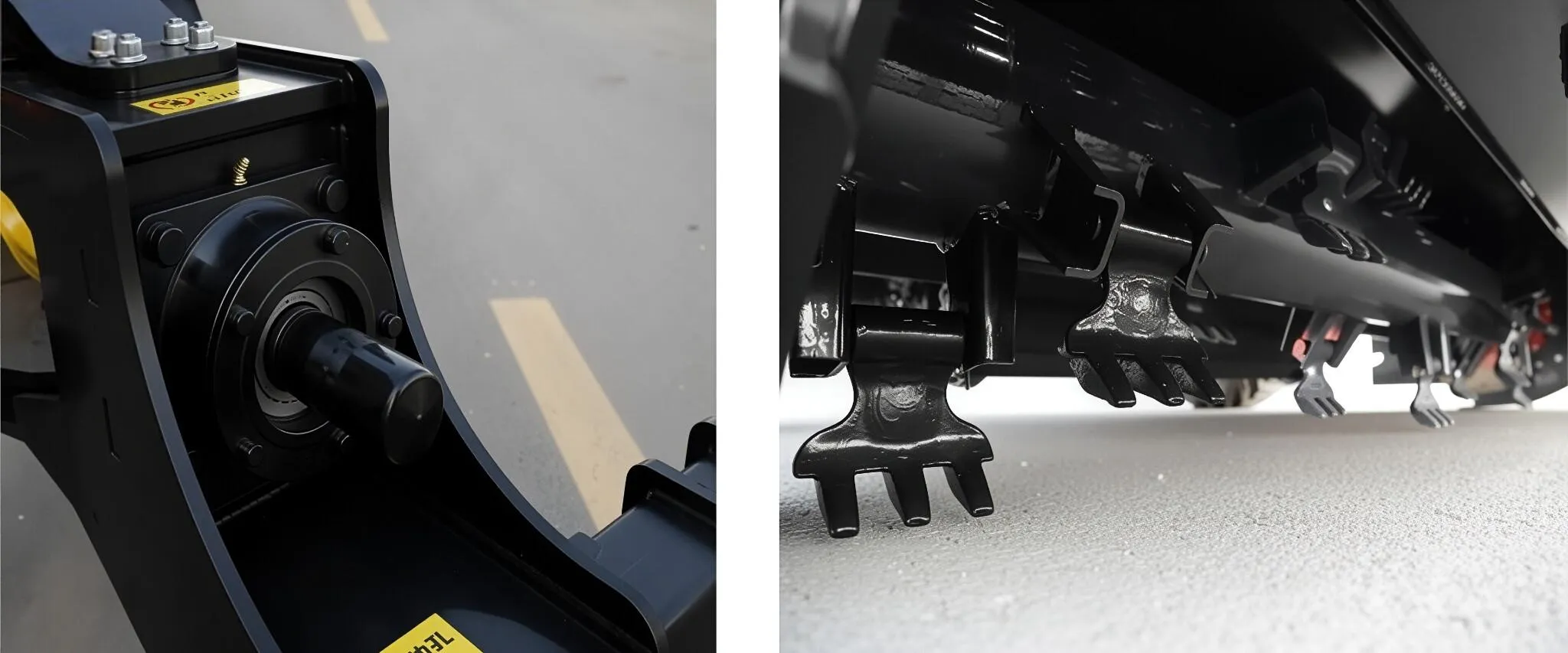
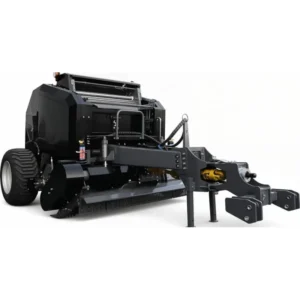
The 9YG-1.0 원형 베일러 is built around a compact frame sized for light-duty continuous operation on tractors in the 30–45 PTO HP range. The pickup assembly uses a spring-tine rotor in the camless, guard-ring-free configuration that allows direct crop intake without the mechanical complexity of a cam-follower track system. This semi-forced feeding arrangement feeds the crop axially into the forming chamber with fewer transition points, reducing blockage risk in soft, damp grass conditions. The chamber roller count and diameter are proportioned to the 1 000 mm bale geometry, meaning all forming components are working within their designed load range at normal operation — not pushed to the edge of their capacity as they would be in an overloaded machine.
The drawbar is adjustable for standard category-I and category-II hitch heights, and the hydraulic tailgate circuit is kept simple — a single-acting cylinder opens the tailgate for bale ejection, with gravity-assisted return aided by a tension spring. This minimises hydraulic flow demand on the tractor, which matters on older Korean utility tractors where hydraulic capacity can be limited.
EP-9YG-1.25 Structure
The 9YG-1.25 원형 베일러 shares the same fixed-chamber architecture but scales all structural elements to accommodate the larger 1 250 mm bale diameter and the higher peak forces this implies. The frame is wider and uses heavier-gauge cross-members at the key stress concentration points — the pickup mounting brackets and the tailgate hinge bosses — that experience the highest bending loads during normal operation. The forming chamber uses a greater number of rollers to maintain consistent contact pressure over the larger bale surface area, and the chamber wall panels are reinforced against the longer moment arm generated by a heavier bale at ejection.
The wider pickup on the 9YG-1.25 is the most immediately visible difference in field use. A wider tine rotor collects material across a broader swath in a single pass, which matters when the windrow formed by a twin-rotor rake or a mower-conditioner is wider than what a 1 000 mm class pickup can efficiently ingest. The 9YG-1.25 also carries a more capable wrap system by default, with both twine and net wrap available as standard rather than as options.
The structural consequence of the 원형 베일러 size difference is straightforward: the 9YG-1.25 weighs more, requires more tractor drawbar pull, and places more hitch load on the rear axle. On Korean pasture fields with soft or pugged ground conditions, this is worth factoring into the decision. A 9YG-1.0 원형 베일러 behind a 35 HP compact tractor will cover soft ground with noticeably less wheel slip than a 9YG-1.25 pushing the same tractor to the edge of its weight capacity. Operating at the margin of tractor power on soft ground is the fastest route to compaction damage and reduced sward recovery.
Material System: Steel Grades, Wear Parts, and Surface Protection
Both 원형 베일러 models share the same material philosophy at the frame level. The main chassis and drawbar are fabricated from Q345B high-strength structural steel, which provides a minimum yield strength of 345 MPa. For the bending and torsional loads experienced during pickup engagement and bale compression, this grade provides adequate safety margin without the cost penalty of a true high-yield engineering steel. The continuous-weld construction — all joints are full-penetration welds rather than tack-welded and boxed — ensures that load paths are continuous through the frame rather than relying on weld toes at stress concentration points.
| Component | 9YG-1.0 | 9YG-1.25 | Pasture Impact |
|---|---|---|---|
| Frame steel | Q345B | Q345B, heavier section | Both adequate for pasture loads; 9YG-1.25 handles higher peak forces from larger bale mass |
| Pickup tines | 65Mn spring steel | 65Mn or 60Si2Mn spring steel | 60Si2Mn offers marginally better fatigue life on stony pasture ground; wear rate similar in practice |
| Chamber rollers | Alloy steel, surface-hardened | Alloy steel, induction-hardened, larger diameter | Larger roller diameter on 9YG-1.25 distributes contact load, reduces grit wear in grass applications |
| Gearbox housing | Ductile iron QT500 | Ductile iron QT500 | Same grade; 9YG-1.25 gearbox is physically larger to handle higher torque demand from wider chamber |
| Wrap guides | UHMWPE polymer | UHMWPE polymer, UV-stabilised | UV stabilisation matters for the 9YG-1.25 which is more often used for outdoor-stored silage applications |
| Hydraulic cylinders | Chrome-plated carbon steel rod | Chrome-plated carbon steel rod, larger bore | Larger bore cylinder on 9YG-1.25 provides faster and more positive tailgate operation under the weight of a 300+ kg bale |
| Surface coating | Epoxy primer + polyurethane topcoat | Epoxy primer + polyurethane topcoat | Both use the same coating system; resistance to silage acids is adequate for both models in outdoor storage conditions |
The material differences between the two 원형 베일러 models are incremental rather than categorical. This is consistent with both being members of the same product family produced under the same ISO 9001 Quality Management System. Where they diverge is in the dimensioning of shared components rather than in a change of material specification — a larger bore cylinder, a wider chamber roller, a heavier-section frame crossmember. Buyers should be realistic about what this means: neither machine is poorly made by being the smaller or larger of the two; both are scaled to their design brief.
The most practically significant material point for pasture-specific use is the pickup tine spring steel specification. On pasture ground that has been grazed by cattle and carries embedded stones in the turf, tine deflection and recovery rate matter more than on arable straw applications. The 65Mn tines on the 9YG-1.0 and the optional 60Si2Mn tines available on the 9YG-1.25 both provide adequate stone-contact resilience for typical Korean grassland conditions, but the 60Si2Mn grade’s higher silicon content improves elastic recovery over the tine’s service life — a practical difference that accumulates across 200 operating hours of season use.
Round Baler Gearbox and Drivetrain: Power Transmission in Pasture Conditions
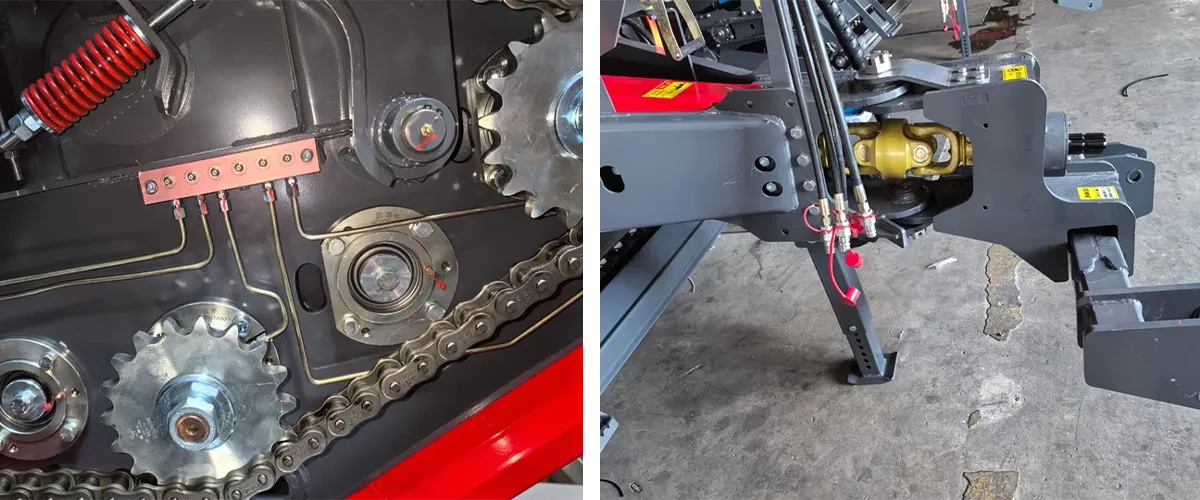
그만큼 round baler gearbox on both models receives PTO shaft input at 540 rpm and distributes drive to the pickup rotor and the chamber forming rollers through a combination of gear stages and roller chain secondary drives. The gear stages in the main gearbox are helical-cut for quieter operation and better load distribution than straight-cut spur gears, which is the correct design choice for a machine that may run continuously for four to six hours during a peak baling period.
The key difference between the two 원형 베일러 gearboxes is torque capacity. The 9YG-1.25 원형 베일러 gearbox is physically larger and rated for the higher peak torque generated at full compression in a 1 250 mm diameter chamber packed with a dense grass or legume crop. At full chamber pressure, the compression torque on the forming rollers is roughly proportional to the square of the bale diameter — so a 1 250 mm bale generates approximately 56% more forming torque than a 1 000 mm bale of the same density. The 9YG-1.25 gearbox accommodates this without operating close to its service limit; on the 9YG-1.0 gearbox, attempting to form a 1 250 mm bale would not be possible by definition, but the point is that both 원형 베일러 machines are engineered to use a significant portion of their gearbox capacity at routine operation, and the service-factor margins have been set accordingly.
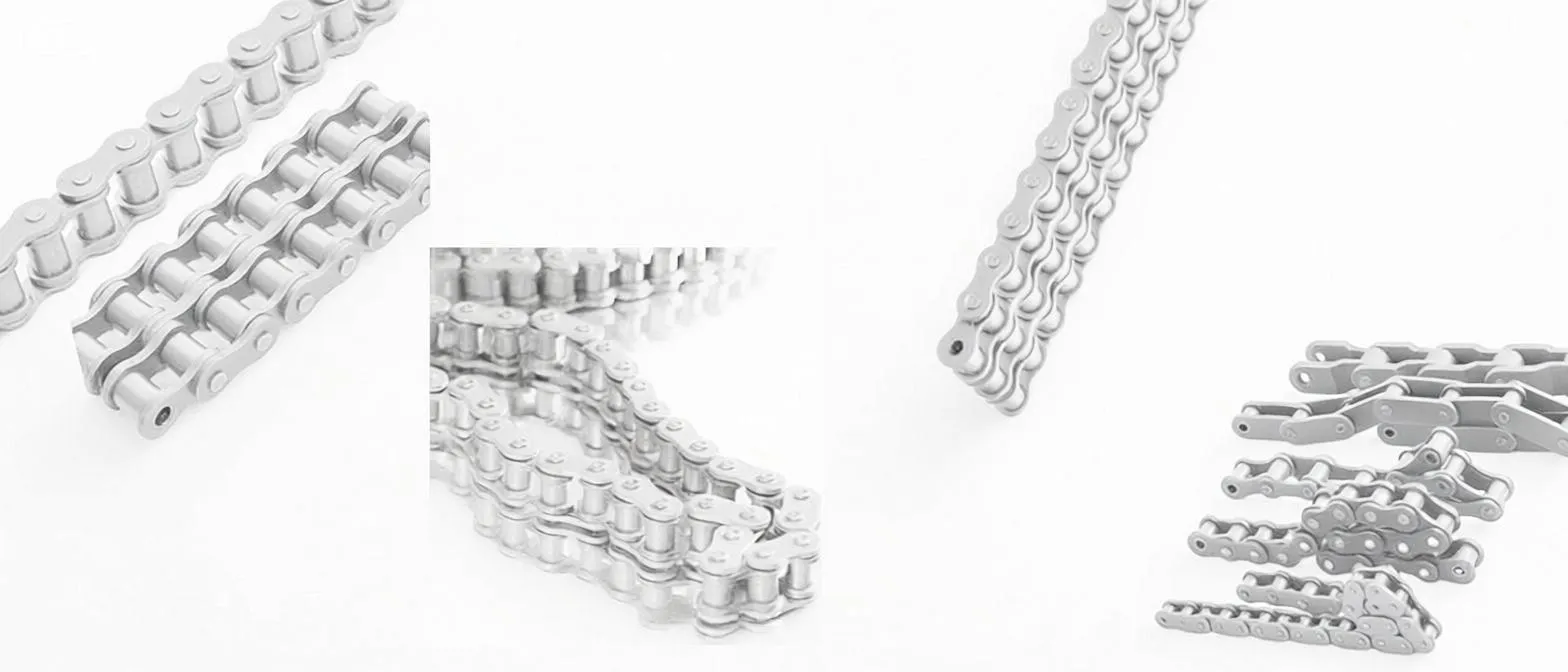
The chain drive stages on both 원형 베일러 models connecting the gearbox to the pickup rotor use standard agricultural roller chain. The 9YG-1.25 uses a heavier chain pitch on the high-torque forming drive to match its larger power throughput. Chain tension must be checked every 50 operating hours during the season — this is the single maintenance step most frequently skipped and most often responsible for accelerated sprocket wear and chain fatigue failure. A correctly tensioned chain on the 9YG-1.0 or 9YG-1.25 in normal pasture service should last two to three full seasons before replacement is needed if tension is maintained; one that is allowed to run slack will require replacement within a single season and will additionally wear the driven sprocket teeth to a profile that means the new chain will never seat properly on the existing sprockets.
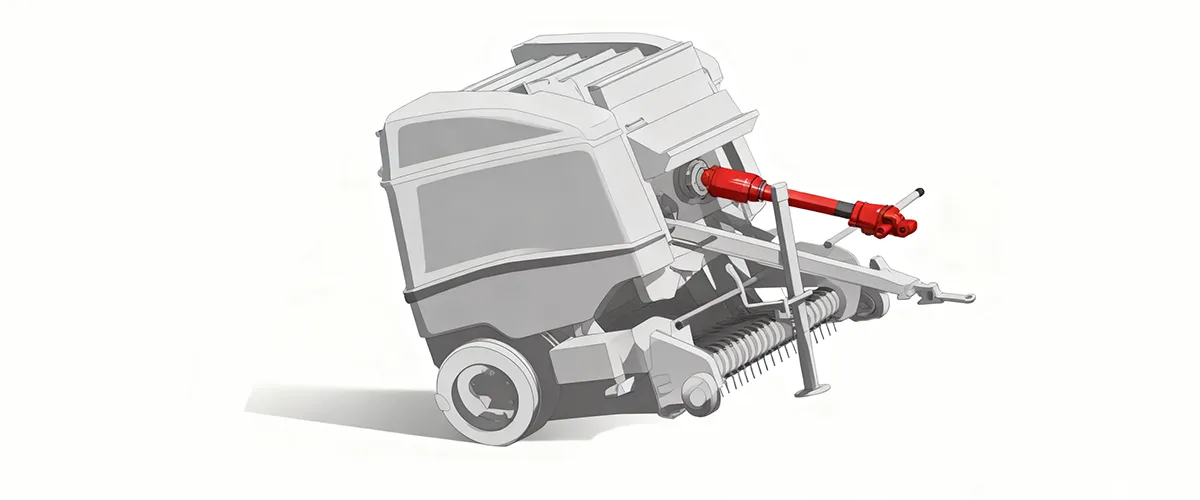
The PTO shaft connecting tractor to baler is not supplied as part of the baler in most export configurations and must be sourced separately to match the specific tractor and baler combination. Both models use a 1 3/8 inch, 6-spline input coupling at 540 rpm. The shaft must include a functional overrun clutch — also called a freewheel clutch — to protect the gearbox from wind-up when the tractor throttle is closed mid-cycle. This is particularly important on pasture balers because operators often decelerate quickly after bale completion to allow the wrapping cycle to finish cleanly before ejection.
Pasture Performance: Grass Type, Windrow Density, and Seasonal Timing
Korean livestock farms — particularly those running Hanwoo beef cattle, dairy operations, or sheep and goat enterprises — typically harvest pasture across two to three cutting windows per year. The first cut in late May to June produces the heaviest and most fibrous crop; second and third cuts in August and September are lighter and leafier. The two 원형 베일러 models perform differently across these conditions.
First-Cut Heavy Grass
The 9YG-1.25 원형 베일러 handles first-cut heavy pasture swards better than the 9YG-1.0 원형 베일러. The wider pickup ingests a larger windrow without needing to reduce forward speed, and the higher PTO power requirement translates into greater compression force in the forming chamber, producing denser bales from a moisture-rich crop. On a dense ryegrass or orchardgrass sward at first cut, the 9YG-1.0 will need to slow down or the operator will need to merge windrows into narrower lines to prevent pickup blockage. The 9YG-1.25 manages a full merged windrow at normal working speed.
Second and Third Cut Aftermath
For second and third-cut aftermath, the 9YG-1.0 원형 베일러 performs very well. The lighter, leafier crop forms into the pickup cleanly, the lower PTO demand leaves tractor capacity in reserve for headland turns on sloping ground, and the smaller bale size is actually an advantage for manual handling in livestock buildings where bales may be moved by hand or on a basic pallet trolley. The 9YG-1.0 원형 베일러 is particularly well-suited to farms that produce later-cut haylage intended for daily hand-feeding rather than mechanised ration mixing.
Mixed Legume Swards
Red clover, white clover, and alfalfa components in a sward increase crop density significantly compared to pure grass. These crops are also more sensitive to mechanical damage during pickup — bruised leaves lose protein through oxidation faster than intact leaves during the wilting period. The 9YG-1.25 원형 베일러 with its wider, smoother intake rotor handles legume fractions more gently than the 9YG-1.0 working at maximum intake capacity. If your sward contains more than 25% legume by dry matter, the 9YG-1.25 produces better-quality bales in practice.
Moisture Management
Both 원형 베일러 models operate best when the crop has been wilted to 18–28% moisture before baling. Below 15% and grass becomes brittle, losing leaf in the pickup and producing a loose bale surface that holds rain and encourages mould growth in storage. Both models will struggle with crop above 35% moisture, which flows unevenly through the forming chamber and produces bales that deform under their own weight. The 9YG-1.25 원형 베일러 has marginally more tolerance for damp crop because its larger chamber and higher compression force can still produce an acceptable bale at 32–33% moisture, whereas the 9YG-1.0 will produce noticeably softer bales at the same moisture level.
The honest summary on pasture performance is that the 9YG-1.0 원형 베일러 is adequate for most small Korean livestock farms managing fewer than 80 ha across all three cuts, provided windrow management is disciplined — consistent windrow density and width — and the farm does not regularly encounter very heavy first-cut swards. The 9YG-1.25 earns its additional capacity on farms above 80 ha, on farms where first-cut grass is the primary product, or where the operator wants a single machine that covers the full range of cutting conditions without needing to manage windrow size to stay within the baler’s capability.
Product Spotlight: The Two Models Side by Side
Tractor Compatibility: Matching Machine to Available Power
Both models require a tractor PTO connection at 540 rpm. The difference in recommended PTO HP — 30–45 for the 9YG-1.0 and 45–65 for the 9YG-1.25 — reflects the peak power draw at bale completion, not the average running load. It is common for small-farm 원형 베일러 operations to underestimate this distinction. A tractor delivering 45 engine HP may deliver only 38–40 PTO HP at the stub after drivetrain losses, and a first-cut grass bale in the 9YG-1.25 at high density will draw 40–45 PTO HP at peak compression. The result is that the tractor operates at or very near full power for 15–20 seconds per cycle — acceptable if done occasionally but damaging to the cooling system and PTO clutch plates over a long season of continuous operation.
| Tractor PTO HP | Suitable for 9YG-1.0? | Suitable for 9YG-1.25? | Notes |
|---|---|---|---|
| 25–32 PTO HP | Marginal — light crop only | No | 9YG-1.0 at this power requires very narrow windrows; not suitable for heavy first-cut grass |
| 33–45 PTO HP | Yes — comfortable match | No | This is the optimal power range for the 9YG-1.0 across all pasture crop types |
| 46–55 PTO HP | Yes — under-utilised | Yes — lower margin | 9YG-1.25 will work but reduce forward speed in heavy first-cut conditions |
| 56–70 PTO HP | Yes — over-spec but fine | Yes — comfortable match | This power level suits the 9YG-1.25 across all pasture crop types including heavy first-cut |
Korean farms that operate a compact utility tractor under 45 HP as their primary or sole tractor should choose the 9YG-1.0 without hesitation. Running the 9YG-1.25 on an underpowered tractor is not just a performance compromise — it risks PTO clutch slippage, elevated gearbox temperature, and premature chain drive wear from the repeated torque spikes generated when the tractor cannot maintain speed through the bale-completion phase. These are repair costs that quickly exceed the difference in purchase price between the two models.
Regulatory Context: What Buyers in Korea and Other Markets Need to Know
Choosing between the 9YG-1.0 and 9YG-1.25 is not purely a technical decision — regulatory context and subsidy eligibility also affect which model makes commercial sense for buyers in specific markets.
South Korea (KR)
Both the 9YG-1.0 and 9YG-1.25 원형 베일러 models imported as agricultural balers fall under the Agricultural Mechanization Promotion Act governed by the Rural Development Administration (RDA). Each model must appear on the RDA approved equipment list for subsidy eligibility — the lists are updated annually and maintained at the national level, with implementation through county-level agricultural extension offices. The Ministry of Agriculture, Food and Rural Affairs (MAFRA) Forage Rice and Silage utilisation policy actively supports mechanised baling as part of the feed-sufficiency programme for Korean livestock farms, including Hanwoo beef and dairy enterprises. Buyers using either model for silage or IRG baling may be eligible for MAFRA forage mechanisation subsidies — confirming current eligibility against the two specific model numbers before purchase is a necessary step. Road transport regulations under the Road Traffic Act require that the baler transport width stays within 2.5 m on general roads, and that adequate rear lighting and reflective markings are fitted before road use.
European Bloc (EU)
Both 원형 베일러 models as trailed implements fall under the Machinery Directive 2006/42/EC (transitioning to Machinery Regulation (EU) 2023/1230 from January 2027) and require CE marking and a Declaration of Conformity. The safety standard EN ISO 4254-7 (agricultural machinery — safety — balers) applies specifically to both 원형 베일러 models and covers guarding requirements for the pickup, forming rollers, PTO shaft, and wrap mechanism. PTO shaft guarding under EN ISO 4254-7 requires full-length shielding that remains in place during normal operation and can only be removed with a tool. Both models must be supplied with an operator manual in the language of the country of sale — a requirement frequently not met by lower-cost imports and one that has real implications for after-sales safety audits on commercial farms in France, Germany, and Scandinavia.
Australia (AU)
Australian state WHS Acts require that any imported 원형 베일러 or agricultural machine be safe by design and accompanied by adequate operational and maintenance documentation. The Safe Work Australia Code of Practice on agricultural machinery risk management applies to both models when operating in commercial farm environments. The pickup tine area and PTO shaft on both models require proper guarding consistent with Australian Standard AS 4024 principles on safeguarding of machinery. Customs classification under Chapter 84 of the Customs Tariff Act 1995 applies to both balers at HS code 8433.40.00. Both models are suited to Australian conditions including the dry, short-fibre pasture types common in southern Queensland and New South Wales, provided the crop is adequately conditioned and windrow density is managed to avoid blockage in very dry, brittle material.
North America (US / Canada)
OSHA 29 CFR Part 1928 on agricultural safety and ASABE standards both apply to the 원형 베일러 models in this comparison and ASABE standard S493 on agricultural machinery guarding both apply to commercial use of either model in the US and Canada. ASABE S361 specifies the PTO stub dimensions and shielding requirements applicable to the 1 3/8-inch, 6-spline, 540 rpm input shaft on both models. Insurance policies on commercial North American farms increasingly reference ASABE compliance as a condition of cover for machinery-related incidents — confirming that both models meet S361 and S493 requirements is an important due-diligence step for North American importers. Canada’s provincial transportation acts govern road movement of agricultural equipment and may require a slow-moving vehicle (SMV) emblem and transport lighting on either model when moved on public roads.
Both 원형 베일러 models are manufactured under ISO 9001 Quality Management System certification, which provides a documented quality assurance baseline recognised in all the markets above. ISO 9001 does not itself constitute product approval in any of these markets, but it is increasingly referenced in import assessments and dealer agreements as evidence that the manufacturing process is systematically controlled rather than relying solely on end-product inspection.
Round Baler Parts: Planned Wear and Service on Both Models
Understanding which round baler parts wear on each 원형 베일러 model in pasture service, and at what rate, helps buyers plan maintenance budgets and avoid the mid-season downtime that ruins a baling window. The two models share common parts families in the pickup and wrapping systems; the forming chamber components differ by model.
| Part | Typical Replacement Interval (Pasture) | Common Cause of Failure |
|---|---|---|
| Pickup tines | 1–2 seasons, depending on stone content in crop | Stone contact fatigue; grit abrasion on tine body |
| Primary drive chain | 2–3 seasons if correctly tensioned | Slack tension; inadequate lubrication; grit ingestion |
| Twine / net wrap cutter blade | 1 season in normal use | Normal wear; edge dulling from repeated cutting |
| Pickup shaft bearings | 3–5 seasons with correct greasing | Moisture ingress; missed greasing intervals; overload from blockage |
| Gearbox oil | Every season or every 100 h | Contamination; thermal degradation; water ingress through vent |
| Chamber roller bearings | 5–8 seasons with correct greasing | Missed greasing; sustained overload from crop blockage at roller gap |
| Hydraulic seals (tailgate cylinder) | 4–6 seasons in normal outdoor service | UV degradation of exposed seals; chrome pitting from silage acid |
Both 원형 베일러 models use the same spare parts supply infrastructure. Pickup tines, cutter blades, and chain are the items most commonly needed mid-season and should be stocked on-farm at the start of each baling period. Chamber roller bearings and hydraulic seals are less frequent replacements but have longer lead times if sourced remotely — it is worth confirming with your supplier that these items are available ex-stock before the baling season begins.
Final Decision Guide: 9YG-1.0 vs 9YG-1.25 Round Baler for Your Farm
After going through the engineering and operational comparison above, the decision between these two 원형 베일러 models comes down to four practical criteria. Work through each one in the context of your own farm, and the right 원형 베일러 choice becomes clear without needing to resolve the comparison on paper alone.
Criterion 1 — Tractor PTO HP
Under 45 PTO HP: the 9YG-1.0 원형 베일러 is your model. Above 50 PTO HP: either 원형 베일러 works, but the 9YG-1.25 makes better use of the available power and increases output per season.
Criterion 2 — Farm Area
Below 80 ha baled per season: the 9YG-1.0 원형 베일러 provides enough throughput without idle machine capacity. Above 80 ha: the 9YG-1.25 원형 베일러 reduces total machine time per tonne of forage produced.
Criterion 3 — Crop Weight
Pure grass, second or third cut: the 9YG-1.0 원형 베일러 handles this cleanly. Heavy first-cut grass, alfalfa fractions, or legume-dominant swards: the 9YG-1.25 원형 베일러 maintains consistent density in these conditions without windrow management adjustments.
Criterion 4 — Bale Handling
Manual handling in livestock buildings or limited loader access: the 9YG-1.0 원형 베일러 produces lighter bales (100–220 kg dry hay) that are more manageable. Mechanised handling via front loader or bale chaser: the 9YG-1.25 원형 베일러 at 180–350 kg produces better feed-value return per handling cycle.
Both 원형 베일러 models are manufactured under the same ISO 9001 quality system, use the same Q345B structural steel frame, and share the same core round baler parts supply infrastructure. The choice between them is not a quality decision but a capacity and compatibility decision. Choosing the wrong 원형 베일러 size in either direction — a 9YG-1.25 on an underpowered tractor, or a 9YG-1.0 on a farm that regularly needs to process 150+ ha of first-cut grass — creates operational problems that no amount of maintenance can resolve.
If you remain uncertain after applying these criteria, submit an enquiry with your tractor PTO HP and annual bale volume, and the correct 원형 베일러 recommendation will be confirmed by return. Getting the 원형 베일러 model selection right at the start of the relationship is the most straightforward way to ensure that the 원형 베일러 serves your farm well across its full expected working life without requiring an early replacement driven by a specification mismatch.
Compatible Accessories: PTO Shaft and Agricultural Chain
Neither the 9YG-1.0 nor the 9YG-1.25 원형 베일러 is supplied with a PTO shaft as standard in export configurations. Selecting the correct shaft and ensuring the drive chain specification is correct for your model are two steps that directly affect how long the baler performs without unscheduled maintenance.
Agricultural PTO Shaft
The PTO shaft for either 원형 베일러 model must match the 1 3/8-inch, 6-spline input coupling at 540 rpm, be rated to transmit the peak torque of the chosen model — higher for the 9YG-1.25 — and include an overrun clutch to protect the gearbox on tractor deceleration. The shaft length must be selected for the actual drawbar-to-PTO-stub distance on your tractor; this varies between tractor models even within the same HP class. EP-compatible PTO shafts for round baler applications are engineered to the specific torque envelope of each model, with CE-compliant full-length safety guards that satisfy EN ISO 4254-7 requirements for both Korean and EU markets. Fitting an incorrect or undersized PTO shaft is one of the fastest ways to shorten the life of a correctly specified round baler gearbox.
Agricultural Drive Chain
The secondary chain drives on both 원형 베일러 models use standard agricultural roller chain, but the pitch and strength class differ between the 9YG-1.0 and 9YG-1.25 to reflect their different torque requirements. Using a chain of lower specification than the machine requires reduces service life significantly and may result in a failure mode — chain snapping under load — that is difficult to repair in the field and can damage surrounding components when it occurs. Heavy-duty agricultural chain with case-hardened pins, nickel-plated outer plates, and a breaking load matched to the baler’s peak drive torque provides the operating life margin that a seasonal-use 원형 베일러 requires. At replacement, always replace the matched sprocket pair at the same time — new chain on worn sprocket teeth achieves less than half the service life of the same chain on new sprockets.
10+ Years Building Agricultural Machinery for Working Livestock Farms
Our agricultural machinery operation started in 2013 with a straightforward goal: build harvesting and baling equipment that actually earns its keep on a working livestock farm, rather than one that performs well on demonstration days and then disappoints across a full seasonal workload. Over more than a decade that foundation has grown into a modern manufacturing enterprise producing the full EP range — from the compact 9YG-1.0 원형 베일러 to the heavier-duty 9YG-2.24D Transcend 원형 베일러 — alongside mowers, rakes, and mower-conditioners covering the complete harvest workflow.
The manufacturing facility runs more than 60 sets of large-scale production equipment including CNC laser cutting lines and electrostatic spray finishing systems, all within an ISO 9001 Quality Management System that controls every process from material intake to final inspection. Independent import and export rights allow direct engagement with buyers in all key markets — Korea, Japan, Southeast Asia, Central Asia, and beyond — without channel intermediaries that add cost without adding technical value.
Annual design production capacity stands at 2 000 units, supported by a technical service approach that includes first-time user training, annual season follow-up, and a feedback loop from field operators into product development. Both the 9YG-1.0 and 9YG-1.25 원형 베일러 models carry field-improvement details that originated from operator feedback rather than from design-office assumptions about what pasture conditions look like.
Established
2013
Production Sets
60+
Annual Capacity
2,000 units
Quality Standard
ISO 9001 QMS
Not sure which model fits your farm? Start with the full product range.
The complete EP 원형 베일러 range is listed with specifications, images, and direct enquiry options. If the 9YG-1.0 and 9YG-1.25 do not fit your scale, the 9YG-2.24D 원형 베일러 family covers larger farm requirements — a natural upgrade path from either compact 원형 베일러 model — without requiring a complete system rethink.
Frequently Asked Questions
편집자: PXY