Knowledge & Technology Guide
How Does Crop Flow Management Technology
Reduce Waste in Round Balers?
A deep-dive into the mechanical principles, structural design, and material engineering that allow modern round balers to capture more crop, compress it more densely, and waste far less with every pass across the field.
Every season, farming operations around the world lose a measurable percentage of their harvested forage — not because of bad weather or poor timing, but because of how the round baler machine itself handles the crop from the moment it enters the pickup through to the final bale ejection. Crop flow management technology is the collective term for the engineering systems that govern that entire journey: how material is gathered, guided, compressed, wrapped, and released. When these systems are well-designed and properly integrated, waste drops sharply. When they are poorly matched or worn, losses accumulate with every bale.
This guide breaks down the key mechanisms at play — from pickup finger geometry and auger-roller feeding systems to compression chamber dynamics and net-wrap sequencing — and explains the specific ways each component reduces waste in a modern round baler. We also connect those principles to the actual specifications you will find on production machines like the 9YG-2.24D, 9YG-1.25, 9YG-1.0, and 9YG-1.0C round baler series, so the technical concepts stay grounded in real-world equipment.
1. What Is Crop Flow Management Technology in a Round Baler?
Crop flow management refers to the coordinated set of mechanical and hydraulic systems that control how crop material moves through every stage of the baling process. Think of it as the internal logistics of your round baler machine — a sequence of pickups, conveyors, feeding rollers, and compression elements that must work in harmony to receive an irregular, tangled windrow and convert it into a dense, uniform, field-ready bale. The term encompasses both physical hardware and control logic: sensor-based density monitoring, hydraulic pressure regulation, and automatic wrapping triggers all fall under the same umbrella.
At its core, waste reduction happens when crop flow is consistent. Interruptions — blockages in the pickup zone, uneven feeding into the compression chamber, or premature chamber opening — each result in material being left on the ground, incompletely compressed, or ejected before the bale reaches target density. A well-engineered crop flow system minimises these interruptions through wider pickup widths, semi-forced feeding mechanisms, and sensor-controlled density management, all working together so the operator can focus on fieldwork rather than troubleshooting breakdowns.
The financial and environmental stakes are significant. In Korea’s rice-straw harvest season, for instance, inefficient baling can mean a considerable portion of available biomass is left uncollected per hectare, translating directly into lost feed value and increased field-burning — a practice restricted under Korea’s Clean Air Conservation Act (대기환경보전법). Globally, the Food and Agriculture Organization estimates that post-harvest losses in forage crops frequently exceed 10–15% when equipment handling is suboptimal. Crop flow management technology directly addresses this gap.
2. Action Method: How the Pickup Mechanism Captures More Crop
The pickup mechanism is the first point of contact between the baler and the windrow, and it is where a disproportionate share of waste either originates or is prevented. The dominant design in modern round balers uses a spring-tooth (弹齿式) pickup reel — a rotating drum fitted with rows of flexible tines that comb through the windrow, lifting material up and rearward into the feed channel. The 9YG-2.24D series uses exactly this approach across all variants, with a pickup width of 2,240 mm, which is wide enough to capture a well-formed windrow in a single pass without over-running the edges and scattering material.
Spring-tooth designs offer a key advantage over rigid-tine systems: when a tine strikes a rock, clump of soil, or embedded root, it deflects elastically and springs back rather than breaking or stalling. This resilience means the operator does not need to slow down dramatically over rough ground, and material flow into the baler remains continuous. At field-operating speeds between 5 and 35 km/h — the rated range for the 9YG-2.24D — maintaining even travel speed is itself a major factor in minimising windrow losses, because irregular speed creates surges and gaps in feed density.
Some models in the series, notably the 9YG-1.25 double version and the 9YG-1.0C, offer interchangeable hammer-claw (锤爪式) pickups for direct collection of standing corn stover. This eliminates the separate raking pass entirely, reducing field traffic — and with it, the risk of ground-compacted material being left behind. The 9YG-1.0C features 20 claw units and a 2,400 mm pickup width to handle wider, denser windrows of corn stover at a working speed of 5–20 km/h.
| 픽업 타입 | Typical Width | Best Crop Application | Waste Reduction Benefit |
|---|---|---|---|
| Spring-tooth | 1,900–2,240 mm | Hay, pasture grass, wheat straw | Consistent flow; tine deflection prevents jamming |
| Hammer-claw | 2,400 mm | Standing corn stover, rice straw | Eliminates raking pass; reduces field losses |
| Interchangeable | 2,240–2,400 mm | Mixed operations | Maximum versatility; single machine for all crops |
3. The Feeding System: Semi-Forced Axial Flow Mechanism
Once material leaves the pickup, it enters the feed channel — and this is where conventional designs have historically struggled. Traditional cam-track feeding systems rely on fixed-path motion that works well with dry, uniform crops but tends to choke on green silage, wet rice straw, or tangled material, generating the frustrating “blockage” scenarios that force operators to stop and clear the machine manually. Every stoppage costs time, and material left half-fed through the pickup tends to scatter or get re-wrapped around mechanical components.
The 9YG-series machines address this through a proprietary axial-flow semi-forced feeding mechanism (轴流式半强制喂入机构) developed with exclusive intellectual property rights. Unlike cam-track designs, this system uses a combination of auger conveyors, paddle rollers (拨齿辊), and driven drum rollers arranged to push material actively into the compression chamber rather than simply guide it passively. The result, validated across field conditions in Inner Mongolia, is a roughly twofold increase in effective feed capacity compared to traditional mechanisms — alongside a marked reduction in blockage incidents even when handling wet, dense, or coarse material.
4. Manufacturing Structure: Compression Chamber Design
The compression chamber is the heart of the round baler. It is where loose, irregular material is transformed into a dense, self-supporting cylinder that can be stored outdoors, transported on roads, and fed to livestock with minimal losses. In the 9YG-2.24D series and related models, the compression chamber uses a roller-type configuration, meaning a ring of independently driven steel rollers surrounds the bale as it forms, each roller exerting radial pressure inward. The 9YG-2.24D carries 18 compression rollers of ø222 mm diameter inside a chamber 1,400 mm wide and ø1,200 mm in diameter — producing finished bales of ø1,300 × 1,400 mm at densities of 100–200 kg/m³.
Roller-type chambers outperform belt-type designs in crop-flow terms for one primary reason: the clearance between rollers can be tuned by adjusting the spring-loaded arms that hold them, allowing the system to apply higher pressure as the bale grows without creating a fixed “ceiling” that blocks material from entering. This means the chamber accepts an incoming surge of crop without stalling or deflecting material back into the feed channel. The 9YG-2.24D S9000 variant uses 18 rollers and heavy-duty dual-sided 20A chain drive on the rear compartment, raising compression pressure and enabling bale densities consistently reaching 500–1,000 jin (250–500 kg), depending on crop moisture.
Sensor-based density control is standard across the entire 9YG product range. A pressure or position sensor monitors bale diameter and signals the operator — or triggers automatic net-wrap — when the target density is reached. This prevents under-dense bales that fall apart during handling (a direct source of forage waste) and prevents over-filling that can strain the chamber mechanism or delay cycle times. Productivity rates of 40–100 bales/h are achievable under normal conditions, which translates to more of the available field window used efficiently rather than waiting for the machine to recover from density errors.
| Model | Chamber Width | Rollers | Bale Size (Dia × W) | Density | Power |
|---|---|---|---|---|---|
| 9YG-2.24D (S9000) | 1,400 mm | 18 | ø1,300 × 1,400 mm | 100–200 kg/m³ | 55–100 kW |
| 9YG-1.25 (Double) | 1,250 mm | 18 | ø1,300 × 1,250 mm | 100–200 kg/m³ | ≥75 kW |
| 9YG-1.25A | 1,250 mm | 18 | ø1,300 × 1,250 mm | 100–200 kg/m³ | ≥75 kW |
| 9YG-1.0 | 1,000 mm | 16 | ø1,100 × 1,000 mm | 115–200 kg/m³ | 48–80 kW |
| 9YG-1.0C | 1,250 mm | 16 | ø1,000 × 1,250 mm | 115–200 kg/m³ | ≥69.8 kW |
5. Material System: What the Baler Is Built From Matters
The relationship between material selection and crop-flow efficiency is less obvious than pickup width or chamber diameter, but it is equally consequential over the lifespan of the machine. When compression rollers wear prematurely, their clearances grow, pressure drops unevenly, and bale density becomes inconsistent — one of the more subtle but persistent sources of forage waste. When frame welds crack under vibration, drive shafts misalign and feeding irregularities follow. Material and manufacturing quality are the foundation on which crop flow management technology operates.
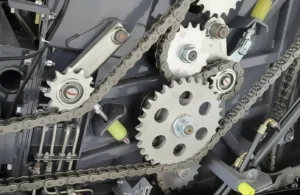
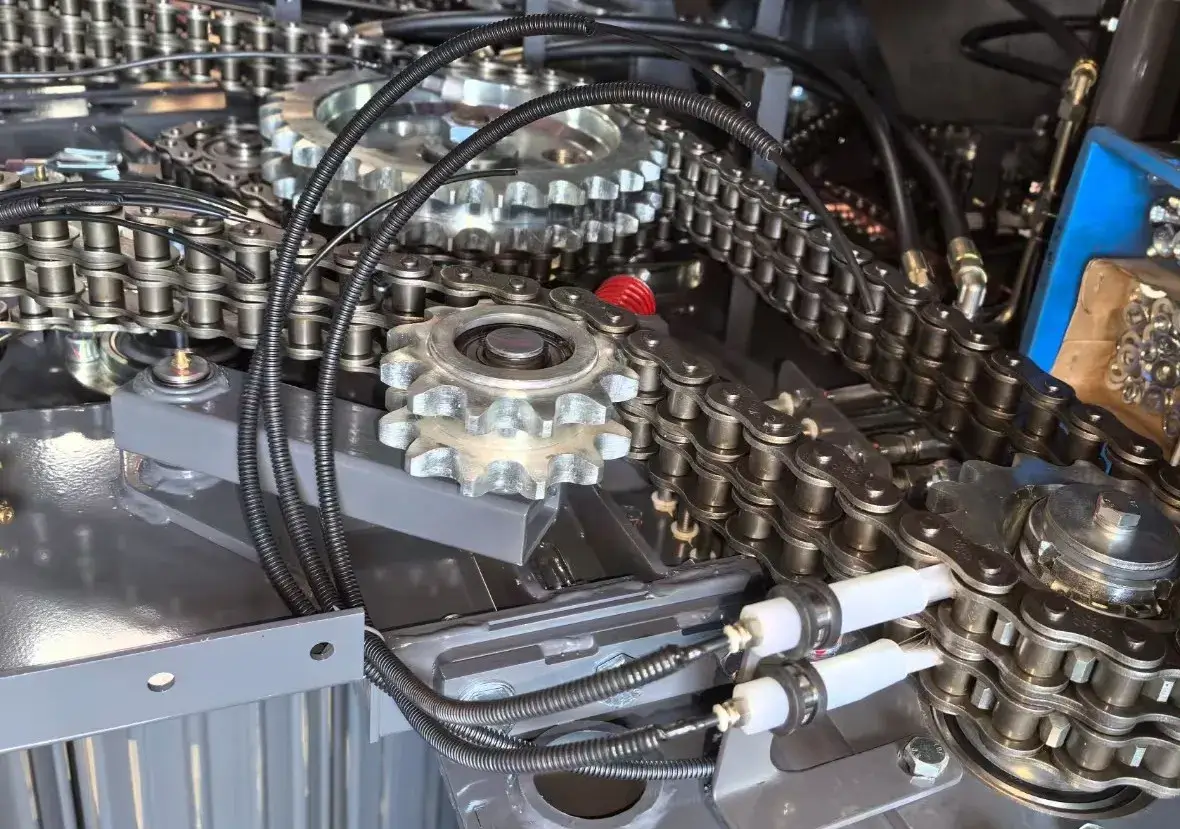
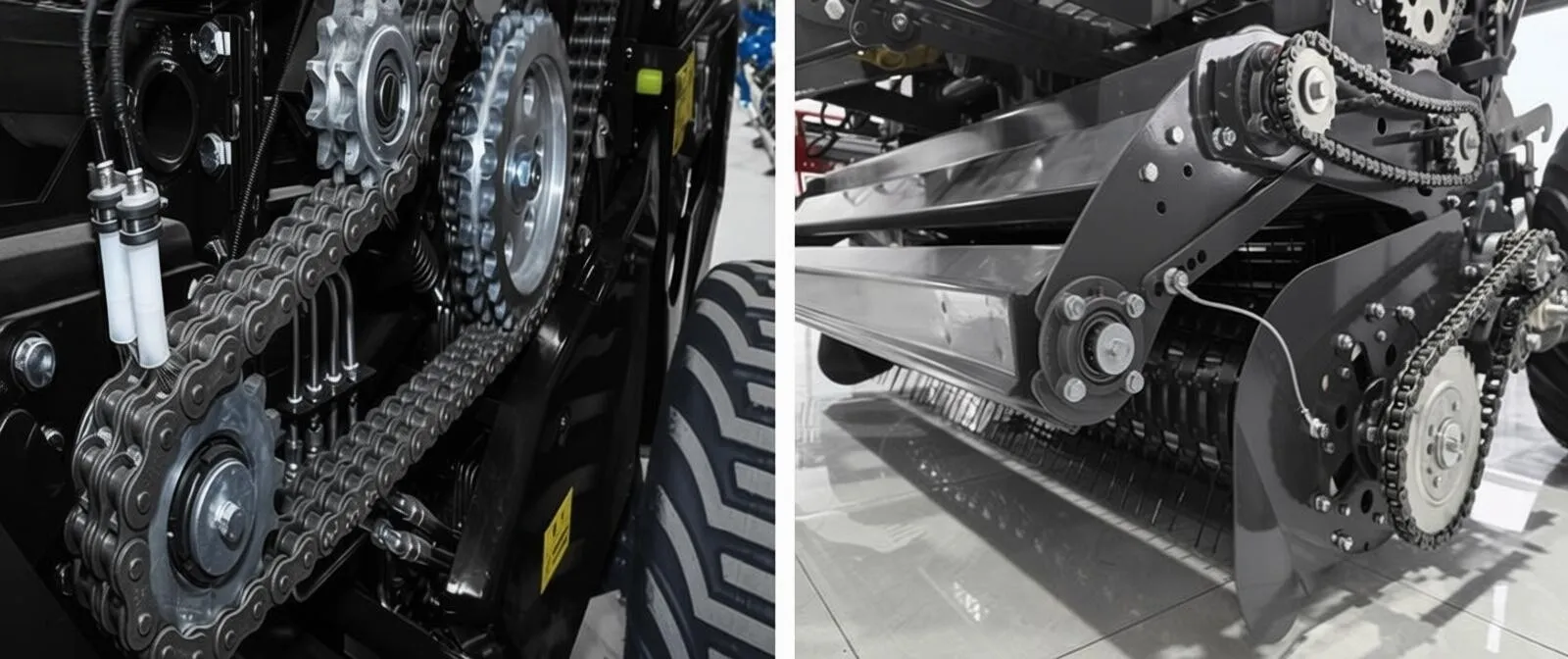
The 9YG-2.24D S9000 variant uses dual-sided heavy-duty 20A roller chain on the rear compartment drive, a specification significantly more robust than the 16A chain found in lighter machines. This matters because chain stretch under high-load baling is a common cause of roller-speed variation inside the compression chamber — and speed variation across the 18 rollers directly affects how evenly the bale builds, sometimes causing soft spots that collapse during storage. The hydraulic system on the S9000 Classic uses H-type sleeve fittings rated for higher working pressures, which speeds up chamber opening/closing and reduces the time the machine sits idle between bales.
Frame integrity is addressed through the dual cross-joint drive shaft system developed for the S9000 range, complemented by a safety torque-limiting shaft that protects the drivetrain during sudden crop surges. This protects against the kind of catastrophic driveline failure that takes a machine out of service for days during peak season — when every hour offline translates to unharvested crop left in the field. The traction frame itself is rigidly connected to the gearbox assembly, so the machine navigates undulating terrain without the twisting forces that can crack lighter welded frames over time.
6. Round Baler Gearbox Performance and Regulatory Compliance
The gearbox in a round baler is the central power node: it receives rotational input from the tractor’s PTO shaft (typically at 720 r/min for the 9YG-2.24D and 9YG-1.25 series, or 540 r/min for the 9YG-1.0C) and distributes it to the pickup, feed rollers, and compression drum array. In the 9YG-2.24D S9000 design, a dual-coupled gearbox is used, allowing the unit to rotate 90° left or right relative to the tractor centerline. This is not merely a convenience feature — it directly affects crop flow by enabling tighter turning radii without cutting tractor power during headland maneuvers, so the machine continues baling at field edges instead of stopping and losing the end rows of each windrow.
From a regulatory standpoint, gearboxes on agricultural machinery sold in export markets are subject to a patchwork of national and regional standards that equipment buyers should be aware of. In South Korea, agricultural machinery — including round balers — must comply with the Agricultural Machinery Certification System (농업기계 검정제도) administered by the National Institute of Agricultural Sciences (농촌진흥청, RDA). Machines that qualify may be eligible for the Farmland Mechanization Subsidy (농업기계화 지원사업), which can offset a portion of purchase costs for registered farms. The RDA testing protocols include drivetrain endurance testing under Korean field conditions, covering gearbox thermal performance and torque rating. In the European Union, agricultural machinery gearboxes must meet EN ISO 11684 safety marking requirements and the Machinery Directive 2006/42/EC. In Russia — another key export market — GOST R 53056 governs agricultural machine performance standards, and Eurasian Economic Union (EAEU) Technical Regulation TR CU 010/2011 on machinery safety applies to imported equipment. The 9YG series machines are designed with ISO 9001 quality management certification as the baseline, which covers manufacturing process controls relevant to drivetrain component tolerances.
For farmers in Japan and South Korea considering round balers for rice-straw harvest, it is worth noting that local subsidy programs often require that equipment meet specific emission or efficiency thresholds. In Japan, the Agricultural Machinery and Equipment Rational Use Promotion Law sets framework rules for machinery adopted under national mechanization programs, and gearbox efficiency is one technical parameter that can influence qualification. South Korea’s Rural Development Administration regularly updates its equipment recommendation lists, and gearbox torque ratings and service life benchmarks are part of the evaluation criteria.

7. Net Wrap System and Bale Ejection — The Final 10% That Matters
Farmers who have spent time troubleshooting round balers will tell you that one of the most frustrating sources of loss comes not during pickup or compression, but in the last few seconds before bale ejection: a late-triggered wrap, a mis-fed net, or a rough chamber door opening that bounces the bale out of round. The 9YG series addresses these through automatic net-wrapping with sensor-triggered initiation, meaning the operator does not have to manually judge when to begin wrapping — the system fires when density readings confirm the target has been reached, every time, regardless of crop moisture or tractor speed variation.
Net roll specifications matter too: the 9YG-2.24D uses 2,000 × 1.4 m net rolls per bale, engineered to completely cover the ø1,300 × 1,400 mm bale surface with adequate overlap to prevent unraveling during rolling or transport. For the smaller 9YG-1.0, the net is 2,000 × 1.0 m per bale, scaled to the ø1,100 × 1,000 mm bale. A properly netted bale maintains its shape during the 4–6-month storage period and sheds rainwater rather than absorbing it — a factor that materially affects the nutritional quality of stored hay and silage, and therefore the actual value recovered per tonne of harvested material.
Chamber door opening is controlled hydraulically, with buffer cylinders on the S9000 Classic variant specifically designed to absorb the shock of door closure after ejection. This extends the service life of door hinges and latches, and — more directly relevant to waste — ensures the next bale begins forming in a fully closed, correctly pressurised chamber rather than one that has been knocked slightly out of alignment by a hard close. Even small misalignments in the chamber accumulate over a long day, gradually increasing bale irregularity and the proportion of loose material that escapes the net.
8. Sensor-Based Density Control: Closing the Feedback Loop
One of the meaningful advances separating current-generation round balers from machines produced a decade ago is the integration of sensor-based density control as a standard — not premium — feature. On every model in the 9YG lineup from the compact 9YG-1.0 up to the large-format 9YG-2.24D S9000 Beyond, chamber pressure or diameter sensors continuously read bale-building status and relay that information to a cab indicator or automatic wrap trigger. The practical benefit is consistency: the target density of 100–200 kg/m³ (or 115–200 kg/m³ on the 9YG-1.0C) is achievable on every bale regardless of whether the operator is a seasoned contractor or a first-season hire.
Density consistency is directly linked to waste reduction at three stages. Under-density bales deform during stacking, split open during loading, and have more surface area per unit of forage — meaning proportionally more oxidation and spoilage losses during storage. Over-density baling, while less common, stresses drivetrain components and can cause the bale to expand unpredictably after ejection, tearing the net wrap. And mid-cycle density errors — where the bale builds unevenly and the soft side collapses during rolling — send loose material across the field that is rarely recovered. Sensor control eliminates all three by maintaining an even building curve throughout the compression cycle.
For Korean rice farms using the 9YG-1.25 or 9YG-1.25A models on autumn straw after combine harvesting, this level of consistency has practical legal relevance as well. Under South Korea’s Act on the Promotion of Saving and Recycling of Resources (자원의 절약과 재활용촉진에 관한 법률), local governments increasingly incentivize crop residue utilization over open burning. A machine that produces consistent, handleable bales is far more suitable for the subsidy-eligible biomass pathways than one producing irregular bales that break apart before they reach the processing facility.
9. Choosing the Right Round Baler for Your Crop Flow Needs
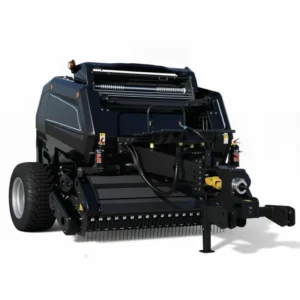
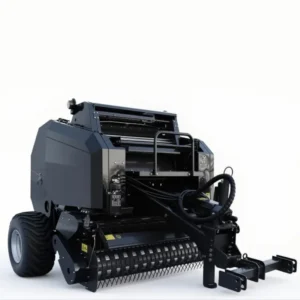
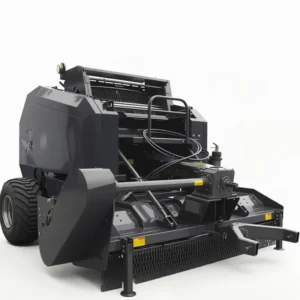
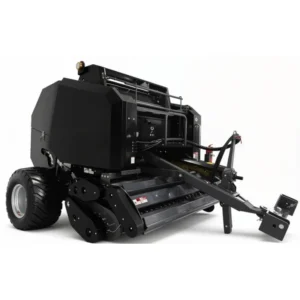
Understanding the technology is one thing — finding the right machine for a specific farm operation is another. The models in the product range span a wide spectrum of scales and use cases, from the compact 9YG-1.0 suited to small round baler applications with 48–80 kW tractors, through to the heavy-duty 9YG-2.24D S9000 Beyond designed for contractors running continuous operations with 55–100 kW tractors at up to 35 km/h. The selection decision ultimately comes down to matching pickup width, bale size, and tractor horsepower to the specific crops and field conditions involved.
10. Crop-Specific Flow Management: Hay, Straw, Silage, and Corn Stover
Different crops present fundamentally different flow management challenges, and understanding how the technology adapts is useful for farmers selecting a machine or adjusting operating parameters for the first time. Dry hay — whether meadow grass, alfalfa, or ryegrass — flows most freely through the baler because it has low moisture and relatively uniform strand length. The main waste risk with dry hay is shattering during pickup and compression, where brittle leaf material breaks off and falls to the ground. High-speed, aggressive pickup action worsens this, so the semi-forced feeding approach used in the 9YG series — which pulls material forward gently before feeding it into the chamber — reduces leaf losses compared to designs that fling material upward at high velocity.
Rice straw presents the opposite problem in Korean and Japanese rice-producing regions: it is often damp at harvest, heavy, and inclined to mat into dense layers that resist the pickup tines. The 2,240 mm pickup width on the 9YG-2.24D provides enough working width to engage the windrow across its full spread without concentrating material into one dense column that would choke the auger. Combined with the axial-flow feeding mechanism, which handles high-moisture loads more reliably than passive cam-track systems, the machine can bale post-combine rice straw without the repeated stops for blockage clearance that plague older designs in this application.
Corn stover is arguably the most mechanically demanding crop because standing stalks require cutting and gathering rather than simple pickup of a lying windrow. The 9YG-1.0C’s hammer-claw system addresses this directly: 20 rotating claw units sever and lift standing material into the feed channel at a 2,400 mm working width, eliminating the separate mowing and raking passes that otherwise scatter material across the field. The result is a two-to-three step operation reduction, which means less total field passes, less soil compaction, and less material left on the ground between machine runs — all translating into net waste reduction per hectare.
11. About Our Round Baler Manufacturing
The round baler machines referenced throughout this article are produced at a modern agricultural machinery manufacturing facility certified to ISO 9001 quality management standards, with a manufacturing footprint of over 32,000 m² and a workforce of 180 personnel. The facility runs dedicated production lines for round balers and mowing equipment, each with annual capacity of 2,000 units, supported by CNC laser cutting, automated welding lines, and electrostatic coating systems. The product range has earned recognition including the Best Innovation Award at the 12th Jiangsu International Agricultural Machinery Expo, an AAA Credit Enterprise rating, and a Quality Trustworthy Products designation.
The 9YG round baler series holds top market share in annual domestic sales, with export reach into Russia, Mongolia, Belarus, Kazakhstan, and other international markets. All current models are registered in national and regional agricultural machinery subsidy catalogs, meaning qualifying buyers in applicable markets can offset part of their investment through government agricultural mechanization programs.
12. Maintenance Practices That Preserve Crop Flow Performance
Even the best crop flow management technology delivers diminishing returns if the machine is not maintained to specification. The most impactful maintenance actions — in terms of waste reduction — are those that preserve the precision relationships between moving components: tine clearance, roller surface condition, chain tension, and hydraulic pressure calibration all affect the machine’s ability to gather and compress material evenly. Worn pickup tines leave material in the windrow; loose compression chains allow roller speed variation that builds uneven bales; contaminated hydraulic fluid causes sluggish chamber responses that delay wrapping and slow the cycle.
For the 9YG-2.24D series running at 720 r/min PTO speed, chain tension should be checked at the start of each season and after every 50 operating hours under heavy load conditions. The heavy-duty 20A chain on the S9000 variant has a lower stretch rate than standard 16A chain, but it is not immune to elongation over time. Roller surfaces should be inspected for pitting and flat spots at the end of each season, since deformed rollers do not maintain consistent contact with the forming bale and create the uneven density profiles discussed earlier. Hydraulic fittings — particularly the H-type sleeve fittings on the S9000 Classic — should be checked for micro-leaks, as even small pressure drops affect chamber-door response speed.
Pre-season checks should also include lubrication of the pickup drive shaft bearings, inspection of the PTO connection for wear on both the tractor coupling and the baler’s input shaft, and verification that the density sensor is calibrated correctly against a known reference bale weight. Farms that keep systematic maintenance logs consistently report lower in-season breakdown rates and more consistent bale output than those that perform maintenance reactively — a pattern borne out across multiple seasons of field operation.
13. Operator Practices That Directly Reduce Waste
Beyond the mechanical design, operator habits play a measurable role in crop flow efficiency. Travel speed is the most immediately controllable variable: running the 9YG-2.24D at the upper end of its 5–35 km/h operating range across sparse windrows tends to scatter more material than running at moderate speeds matched to windrow density. The machine’s pickup is optimised to gather material at a rate proportional to both travel speed and windrow volume — when speed outpaces the incoming material volume, pickup tines strike the ground intermittently and bounce, disturbing material and reducing collection efficiency.
Windrow uniformity before baling is also worth attention. A tightly packed windrow of consistent width feeds through the baler more smoothly than an irregular one. If the preceding raking operation has left gaps or double-thick sections, the baler will produce variable bales regardless of how well its internal flow systems are designed. Farms that invest in matched raking equipment — from the same product family, ideally — tend to see significantly better bale consistency than those using mismatched equipment at the pre-baling stage. The round baler works best as part of an integrated harvest system, not a standalone machine.
Headland management matters more than many operators realize. When the baler is turning at the end of a row, material continues to enter the pickup if travel is not briefly halted or slowed. This can result in a partially built bale ejecting early with suboptimal density, or material backing up in the feed channel and triggering a jam. The dual-coupled gearbox design of the 9YG-2.24D S9000 — which can rotate 90° left or right without cutting PTO power — reduces the severity of this issue by allowing tighter turns, meaning less time is spent on the headland and more time is spent on productive windrow passes.
Quick Reference: Three Operating Habits That Reduce Waste
1. Match travel speed to windrow density — slower through thick windrows, moderately paced through thin ones. Avoid running at maximum field speed continuously.
2. Ensure windrow uniformity before baling — a consistent raking width and density makes a bigger difference than most settings adjustments on the baler itself.
3. Use the density sensor, not guesswork — let the automatic net-wrap trigger fire when the sensor confirms target density has been reached on every single bale.
14. Summary: Why Crop Flow Management Is Worth Your Attention
Crop flow management technology in a round baler is not a single feature — it is a layered system where pickup geometry, feed mechanism design, compression chamber configuration, drive chain specification, density sensing, and net-wrap sequencing all interact to determine how much of the windrow actually becomes a finished, usable bale. The 9YG series addresses each of these layers systematically: wider spring-tooth and interchangeable hammer-claw pickups, proprietary semi-forced axial-flow feeding, 16–18 roller compression chambers, heavy-duty drive chains, sensor-based density control, and automatic net wrapping. Together, these design choices raise effective material utilization and reduce per-bale operating losses across a wide range of crop types and conditions.
For farmers in South Korea, Japan, and other East Asian markets where crop residue regulations, subsidy systems, and field conditions create specific operational requirements, understanding these technology layers helps in making an informed selection — and in setting up the machine correctly once purchased. A round baler machine that is well-matched to the crop and properly maintained will consistently outperform one that is larger or more powerful but poorly suited to local conditions. Browse the full range of available models to find the right fit for your operation.
Frequently Asked Questions About Round Baler Crop Flow Management
편집자: PXY