Round Baler Knowledge Series
What Is Automatic Bale Ejection and Why Is It Important for Large Operations?
A complete technical guide covering mechanics, structural design, material systems, and the field advantages of automatic ejection on modern round balers — with special reference to Korean agricultural conditions and international machinery standards.
Foundational Concept
1. What Is Automatic Bale Ejection?
Automatic bale ejection is a hydraulically controlled function built into modern round baler machines that triggers the opening of the rear tailgate chamber and releases a completed bale onto the field without requiring the operator to manually intervene between each cycle. Once the bale reaches its target density or diameter — typically monitored via integrated sensors — the machine initiates the wrapping sequence, completes the net binding, and then activates the tailgate lift cylinders. The rear door swings open, the bale rolls out cleanly under gravity or guided by a pushbar, and the chamber prepares itself for the next cycle, all within seconds.
For farmers running a round baler across hundreds of hectares in a single harvest window, this distinction between manual and automatic ejection can translate directly into the number of bales produced per day, the fuel consumed, and the physical fatigue experienced by operators. It is no longer a premium add-on reserved for high-end equipment — on machines like the 9YG-2.24D round baler, automatic net wrapping and sensor-controlled bale density are already standard engineering features that form the foundation for the ejection sequence. Understanding how this system works, what it is built from, and why it matters at scale is essential for any farm manager evaluating round baler options today.
Action Mode
2. How the Ejection Mechanism Operates — Step by Step
The ejection sequence on a round baler is a coordinated, multi-stage mechanical event driven by the machine’s hydraulic circuit and electronic control unit. Understanding this sequence helps explain why proper maintenance of each component matters and why failures at any single stage can halt the entire baling operation.
Density Sensor Trigger
As the crop builds up inside the bale chamber, tension sensors or pressure transducers continuously measure bale density. When the target threshold is reached — on models like the 9YG-2.24D, this is sensor-controlled with a density range of 100–200 kg/m³ — the control unit sends a signal to begin the wrapping cycle.
Net Wrapping Cycle
The net wrap mechanism feeds netting around the rotating bale for a preset number of revolutions. Once the wrapping is complete, the net cutter activates and severs the material cleanly, sealing the bale. The entire process occurs while the tractor is stationary or slowing to a stop.
Tailgate Hydraulic Lift
Double-acting hydraulic cylinders — mounted on both sides of the rear chamber — extend simultaneously, lifting the tailgate upward. Buffer cylinders, as featured on the 9YG-2.24D Classic, absorb the mechanical shock when the gate opens, protecting the structural frame from vibration fatigue over thousands of cycles.
Bale Roll-Out
With the tailgate open, the completed bale rolls rearward under gravity. On machines fitted with an active pushbar, a secondary cylinder gives the bale a controlled push to ensure it clears the chamber entirely before the tailgate closes. This is especially valuable in wet grass conditions where a heavy bale can otherwise stick momentarily.
Gate Close & Cycle Reset
Once the bale has cleared the sensor threshold or the operator confirms ejection, the tailgate lowers back into the sealed position, the retaining latches engage, and the system signals readiness for the next bale. On models with fully automatic operation, the tractor can move forward again while the gate is still closing.

Manufacturing Structure
3. How the Ejection System Is Built: Structural Engineering Overview
The structural reliability of the automatic ejection system depends entirely on how the rear chamber, tailgate frame, hinge points, and hydraulic mounting brackets are designed and manufactured. In the FASCAR round baler lineup, CNC laser-cut steel plates form the primary structural skeleton, with automated welding lines providing consistent joint penetration that manual assembly simply cannot replicate at volume. This level of manufacturing precision matters in the ejection system more than anywhere else on the machine, because the tailgate undergoes repeated load cycles every few minutes during a long baling day — often several hundred open-close sequences in a single season.
On large-format models like the 9YG-2.24D, the rear chamber is constructed with a compression chamber width of 1,400 mm and a diameter of 1,200 mm, supported by 18 press rollers each measuring 222 mm in diameter. The dual-side chain drive design used in the rear compartment ensures that the rotational forces transmitted during bale formation are balanced across both sides of the frame — this reduces asymmetric stress on the hinge points where the tailgate pivots during ejection. If the frame were not engineered with this balance in mind, the repeated one-sided loading would cause premature fatigue at the hinge welds.
The hydraulic mounting points for the ejection cylinders are reinforced with boxed-section steel brackets, which distribute the cylinder extension force across a wider area of the main frame rather than concentrating stress at a single bolt hole. This design decision is what separates a machine rated for 40–100 bales per hour from one that requires structural repairs after a few thousand cycles. The H-type ferrule hydraulic fittings used in the system carry significantly higher working pressures than older cone-seal designs, which translates directly to faster and more reliable gate actuation on every single cycle.
Key Specifications — 9YG-2.24D Round Baler (S9000 Series)
| Parameter | 사양 | Relevance to Ejection |
|---|---|---|
| Bale Size (Dia × Width) | Ø1300 × 1400 mm | Large bale size requires high-force ejection cylinders |
| 베일 밀도 | 100–200 kg/m³ | Sensor-controlled; triggers ejection at target density |
| 생산력 | 40–100 bales/hour | High cycle rate demands reliable, fast ejection |
| Press Rollers | 18 rollers, Ø222 mm each | Dual-side chain drive balances chamber load |
| Wrapping Method | Net wrap (auto) | Automatic wrap completion triggers ejection sequence |
| 필요 전력 | 55–100 kW | Hydraulic ejection draws from PTO-powered system |
| 작동 속도 | 5–35 km/h | Tractor must stop or slow during ejection sequence |
| 베일 밀도 조절 | Sensor-controlled | Automation backbone for the entire ejection process |
| 기계 무게 | 3,922–4,570 kg (model dependent) | Heavy-duty frame supports repeated ejection forces |
Material System
4. Steel Grades, Chain Specifications, and Hydraulic Components
The materials used in the ejection mechanism directly determine its longevity and dependability across different operating environments — from the frozen steppe conditions where some models are deployed, to the humid paddy-field perimeters common in parts of Korea and Southeast Asia. Three material subsystems deserve particular attention when evaluating any round baler’s ejection assembly.
Chain Drive System
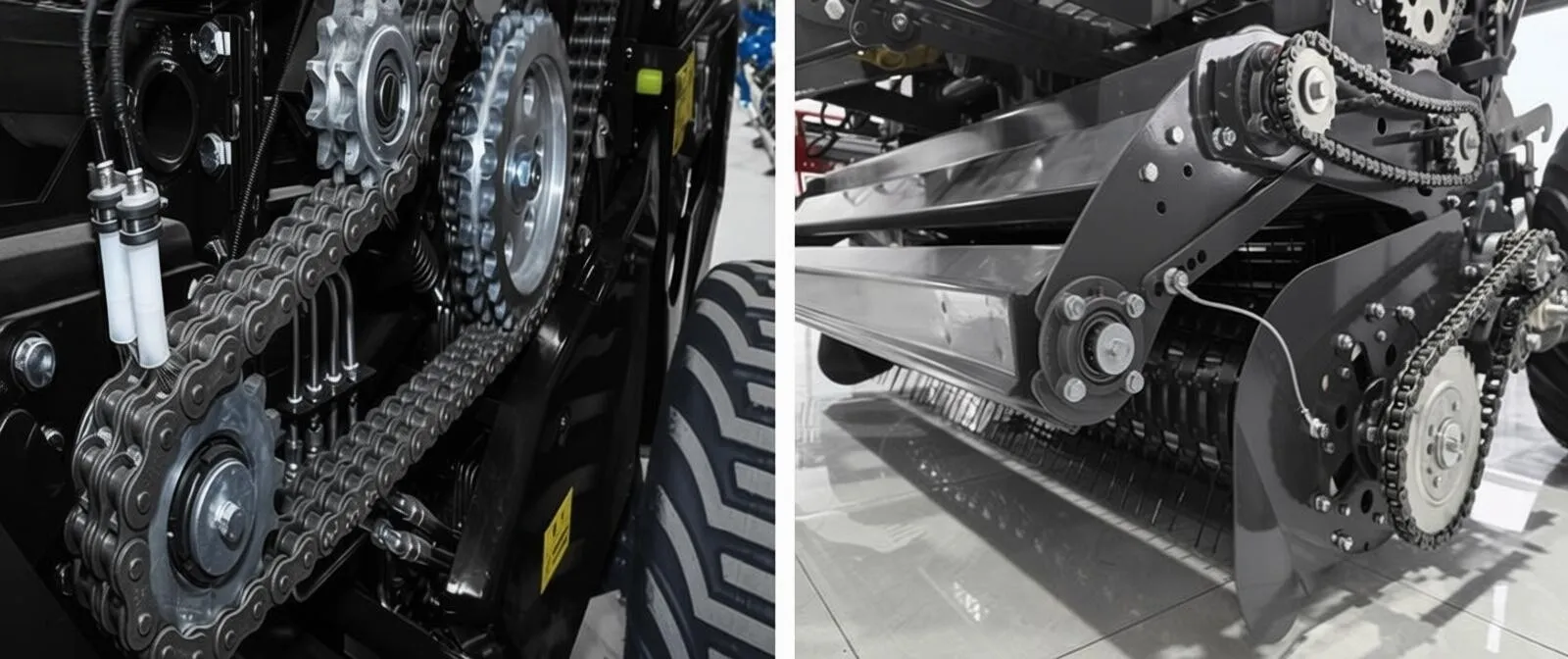
The rear chamber of large round balers uses heavy-duty roller chain for the bale-forming roller drive. On the 9YG-2.24D S9000 Transcend variant, the rear chamber uses 20A reinforced chain on both sides, which significantly increases the compression pressure achievable before ejection, allowing consistent bale densities in the 500–1,000 jin (roughly 250–500 kg) range. The dual-side arrangement ensures balanced loading across the tailgate frame. The 9YG-1.0C, designed for smaller tractors in the 48–80 kW range, uses 16A reinforced chain in a front-and-rear dual-chamber layout — a proportionally scaled solution for the smaller bale format.
Hydraulic Circuit Materials
H-type ferrule fittings used throughout the hydraulic lines deliver a substantially higher burst-pressure rating than older threaded cone designs, which means ejection speed is faster and less dependent on tractor hydraulic flow rate. Buffer cylinders on the tailgate absorb the kinetic energy of the opening gate, protecting welds and bearings that would otherwise be subject to repeated shock loading. High-grade hydraulic hose with steel wire braiding handles the pressure spikes that occur when the gate opens rapidly under a full hydraulic stroke.
Frame Structural Steel
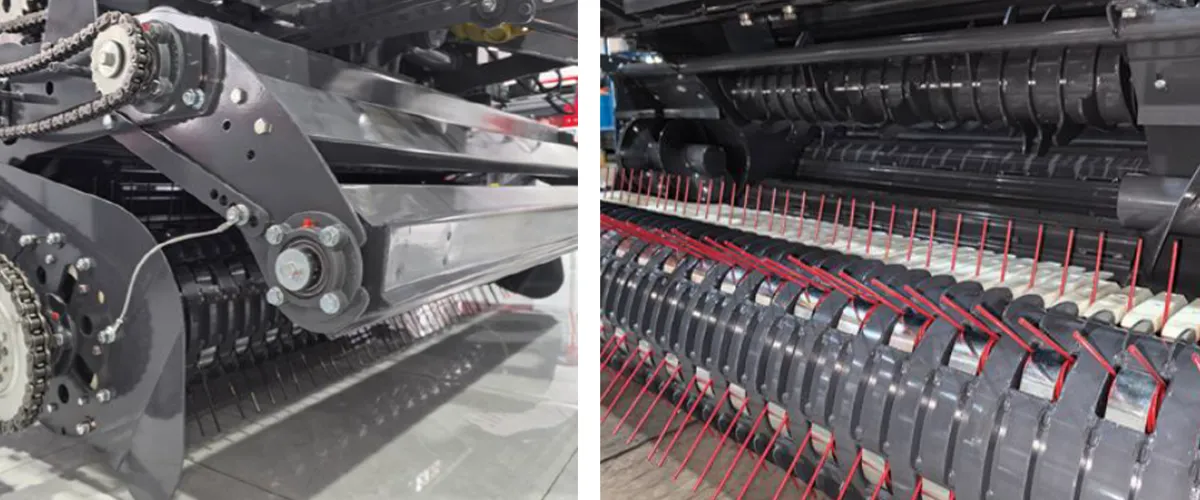
CNC laser-cut structural steel plates with precision-bent profiles form the tailgate and main frame. Electrostatic powder coating or wet paint over sandblasted surfaces provides corrosion resistance, which is particularly important in Korea’s humid summer conditions during the ryegrass and rice straw baling seasons. The pickup tine bar housings use alloy steel with hardened surfaces to withstand the repeated impact of picking up windrows at up to 35 km/h working speeds.
Operational Impact
5. Why Automatic Ejection Changes the Economics of Large-Scale Baling
At a single-operator level, the difference between a machine with manual ejection and one with full automation might feel modest — a button press here, a lever pull there. But when you scale that interaction across a 200-hectare operation producing 600 bales in a two-day window, every second of ejection delay has a compounding effect on throughput. More critically, fatigue plays a major role: a driver making manual ejection inputs every 45–90 seconds for eight hours accumulates hundreds of repetitive actions per shift, increasing the risk of missed inputs, slow responses, and ultimately, costly bale jams or unsatisfactory density.
From a purely mechanical standpoint, automatic ejection also promotes more consistent bale quality. When a human operator manually triggers ejection at slightly different moments each time — sometimes before the wrapping is fully taut, sometimes after the bale has been over-compressed — the resulting bales are less uniform in weight and shape. This inconsistency creates downstream handling challenges for bale transport trailers, stacking systems, and silage wrapping machines, all of which are designed around standardized bale dimensions. The sensor-controlled ejection on machines like the 9YG-2.24D series ensures every bale exits the chamber at the same density and wrapping completion status, which directly improves bale quality uniformity across the entire harvest run.
Power Transmission
6. The Round Baler Gearbox: How Power Reaches the Ejection System
The round baler gearbox sits at the heart of all mechanical motion on the machine, receiving power from the tractor’s power take-off shaft and distributing it to the pickup rotor, feed rollers, bale chamber, and — critically — the hydraulic pump that powers the ejection cylinders. On the 9YG-2.24D S9000 Transcend variant, the dual-coupling gearbox is an entirely proprietary design that can rotate up to 90 degrees left and right relative to the drawbar, eliminating the driveshaft bind that often occurs when conventional balers make tight turning maneuvers in small paddocks. This design means the hydraulic system powered through the gearbox maintains consistent pump input speed throughout field turns, which keeps ejection hydraulic pressure stable even during the maneuver phase.
The added torque capacity of the heavy-duty gearbox used across the 9YG-2.24D range — rated for higher transmission torque than standard-class units — provides the hydraulic pump with a more consistent energy supply. This directly translates to faster tailgate actuation times and more reliable ejection sequences. The gearbox-to-hydraulic pump connection on this family of machines also incorporates an overload protection feature via a safety torque shaft, which prevents mechanical damage to the gearbox if the pump encounters a sudden pressure spike during ejection — for instance, if the bale resists rolling out due to wet crop adhesion.
Regulations & Standards
7. Korean and International Regulatory Frameworks for Round Balers
Understanding the regulatory context is essential for Korean agricultural operators considering imported or locally sourced round balers with automatic ejection systems. Korea’s agricultural machinery sector is governed by several overlapping frameworks that affect machine specification, operator safety, and subsidy eligibility.
Republic of Korea — Agricultural Machinery Law (농업기계화 촉진법)
Under the Act on Promotion of Agricultural Mechanization, round balers intended for commercial use in Korea must comply with safety testing requirements administered by the Rural Development Administration (RDA, 농촌진흥청). Automatic bale ejection systems with hydraulic components must meet pressure and safety valve specifications set out in relevant KS (Korean Industrial Standards) machinery standards. Machines used in subsidy-eligible purchases must pass RDA certification before being listed in the approved machinery registry (농기계 구입 보조 지원 목록).
ISO Standards for Agricultural Machinery Safety
ISO 11684 governs safety signs and hazard pictograms on agricultural machinery, including baler ejection warning labels. ISO 4254-7 covers safety standards for baling machines specifically, including requirements for tailgate locking mechanisms to prevent unintended ejection while the machine is in motion or during servicing. Products manufactured under ISO 9001 quality management systems — as certified for the FASCAR range — demonstrate process controls that support consistent compliance with these international standards.
EU CE Marking and Export Standards
Korean farm machinery exporters and importers engaged with European markets need to be aware that the EU Machinery Directive 2006/42/EC requires CE marking for round balers sold in Europe, including specific assessment of the ejection mechanism’s guarding and emergency stop provisions. This framework is also referenced by Korean importers as a quality benchmark when evaluating foreign round baler suppliers.
Mongolia & Central Asian Market Regulations
In Mongolia, where imported round balers operate under the Ministry of Food, Agriculture and Light Industry guidelines, there are no formal national type-approval requirements equivalent to Korea’s RDA system. However, machines sold in the country are expected to comply with the technical specifications stated in their country of origin’s certification. Kazakhstan follows GOST-R technical regulations under the Eurasian Economic Union framework, requiring documentation of hydraulic system pressure ratings — directly relevant to the ejection mechanism design.
Note: Regulatory requirements change over time. Operators should always verify current certification status with the relevant authority before purchasing machinery for commercial use.
Product Range
8. Round Baler Models Featuring Automatic Ejection Systems
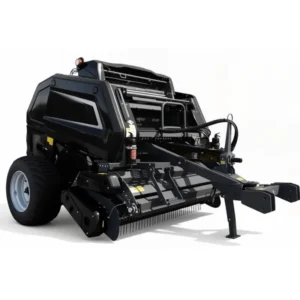
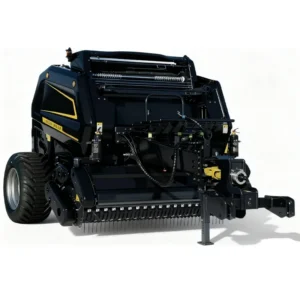
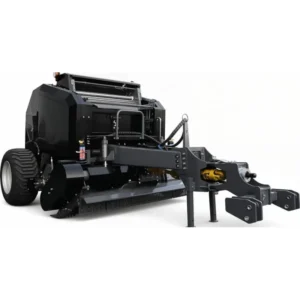
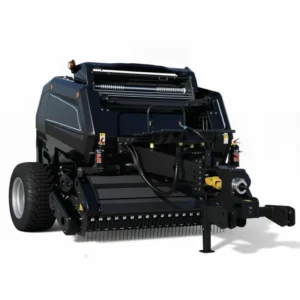
The round baler lineup below covers multiple operating scales and tractor power requirements. All models in the 9YG series use sensor-controlled bale density management, which forms the core trigger mechanism for automatic ejection. Selecting the right model depends on field size, tractor horsepower, and target bale dimensions.
Comparative Analysis
9. Manual vs. Automatic Ejection: A Direct Comparison for Farm Buyers
When evaluating a round hay baler for sale, the ejection system should be one of the first differentiating factors buyers examine. The table below summarizes the key differences between manual and automatic ejection across the dimensions that matter most to large-scale operators.
| Factor | Manual Ejection | Automatic Ejection |
|---|---|---|
| Operator Workload | High; requires attention every bale cycle | Low; machine handles ejection independently |
| Bale Consistency | Variable; depends on operator timing | High; sensor triggers at identical density each time |
| Productivity Ceiling | Limited by human reaction time | Determined by machine cycle speed |
| Long-Day Fatigue Risk | High; operator fatigue increases error rate | Very low; system performance is time-independent |
| Equipment Lifespan | May shorten due to irregular load cycles | Extended by consistent, predictable stress cycles |
| Suitability for Large Farms | Acceptable for occasional small-volume use | Essential for high-volume commercial hay and straw operations |
Field Applications
10. Where Does Automatic Bale Ejection Make the Greatest Difference?
Automatic ejection is not a universal need — its value scales with the intensity and conditions of the baling operation. The following scenarios represent where this feature delivers its most pronounced return.
Large Hay and Silage Operations in Korea
Korean forage farms producing ryegrass, timothy, and Italian ryegrass for the domestic livestock feed market face tight weather windows — a completed round baler with automatic ejection and net wrapping can process large windrow quantities during narrow dry weather intervals between rain events. Consistent bale density directly affects fermentation quality in silage operations.
Rice Straw Baling After Harvest
Korea’s paddy fields generate substantial volumes of rice straw each autumn. As combine harvesting windows compress the available baling time to just a few days before soil preparation begins, automatic ejection becomes a critical time-saver. Models like the 9YG-1.0C with its hammer-claw pickup interchangeability allow operators to switch between spring-tooth and corn-stalk pickup configurations for different post-harvest residues.
Export-Scale Hay Production
For Korean hay exporters or large cooperative farms supplying baled feed for export to neighboring Asian markets, bale uniformity is a contractual requirement. Automatic ejection ensures all bales meet the dimensional and density tolerances required for palletizing and container loading, reducing rejection rates and improving logistical predictability. Buyers in export markets specifically quote bale weight ranges — sensor-controlled ejection is the only reliable way to hit those targets consistently.
Biomass and Industrial Crop Processing
Beyond animal feed, round baler applications extend to biomass energy crops, mushroom substrate straw, and crop residue recycling initiatives. In these contexts the operator may be processing material under time-sensitive industrial contracts, where machine downtime directly triggers penalty clauses. Automatic ejection reduces the number of manual interventions that could cause delays and supports solo-operator logistics on large field sites.
Maintenance & Longevity
11. Keeping the Automatic Ejection System in Working Order
Automatic bale ejection systems are mechanically reliable when properly maintained, but they do introduce hydraulic and electronic components that require attention across the service schedule. The most common failure points in the ejection system — in order of frequency — are hydraulic hose abrasion, cylinder seal wear, sensor cable chafing from crop material contact, and tailgate hinge pin wear. Most of these failures are preventable with a structured pre-season inspection routine.
Hydraulic fittings should be inspected for weeping or moisture contamination at the start of each season and after any hydraulic pressure loss event. On machines using H-type ferrule fittings, the fitting should be checked for thread engagement rather than relying solely on visible seal condition. The tailgate buffer cylinders — which absorb the mechanical shock of rapid gate opening — should have their seals replaced every two to three seasons or after any impact event that causes the gate to open faster than normal. Density sensors are generally sealed units, but their cable routing should be inspected for pinch points where repeated crop material packing could cause insulation wear.
Chain drive lubrication is another important factor: the 20A and 16A roller chains used in large round balers should be lubricated per the manufacturer’s schedule, typically every 8–10 operating hours. Dry or poorly tensioned chains increase the rotational resistance in the bale chamber, which in turn increases the load on the density sensor — causing it to trigger ejection at inconsistent actual bale densities. Proper round baler parts availability for the 9YG series is supported through the FASCAR distribution network, making replacement components accessible for operators in Korea and other export markets.
About the Manufacturer
12. Engineered for Durability, Certified for Quality
The FASCAR round baler range is developed and manufactured in a 32,000 m² facility with annual production capacity exceeding 2,000 units per line. The manufacturing process incorporates CNC laser cutting, automated welding, and electrostatic coating lines — all of which contribute directly to the structural consistency of the ejection system components described in this article.
The facility operates under ISO 9001 quality management certification, has achieved national high-technology enterprise status, and holds close to 100 registered utility patents covering key mechanical innovations in the round baler drivetrain and pickup systems. Products are exported to Mongolia, Russia, Belarus, Kazakhstan, and are available for inquiry from buyers in Korea and across the Asia-Pacific region.
~100
Registered Patents
2,000+
Units/Year Capacity
ISO 9001
Quality Certified
20+
Product Models

FAQ
Frequently Asked Questions About Automatic Bale Ejection and Round Balers
편집자: PXY