Seed Production Operations Guide
A technical and regulatory guide to the role of round baler machines in certified seed hay production — covering varietal purity protection, equipment cleanliness protocols, bale density requirements, gearbox compliance, manufacturing structure, and the certification frameworks that govern seed hay operations in South Korea, the OECD member countries, the European Union, and other key seed-producing markets.
Certified seed hay production sits at an unusual intersection of precision agriculture and commercial forage management. It demands the throughput and durability of large-scale hay production — the kind of operation where a round baler machine runs for 10 to 12 hours a day during a compressed harvest window — while also imposing constraints around varietal purity, mechanical cleanliness, and traceability that most conventional hay or straw operations never face. The baler is not simply a packaging tool in this context; it is a link in the seed certification chain, and how it is specified, maintained, and operated has direct consequences for whether the harvested material meets the standards required for certified seed designation.
Certified seed operations cover a wide range of crop types: forage grasses, legumes such as alfalfa and clover, cereals produced under pedigreed seed programs, and specialty hay varieties grown under contract for seed companies and agricultural extension programs. In South Korea, the Korea Seed and Variety Service (국립종자원), a government organisation under the Ministry of Agriculture, Food and Rural Affairs (농림축산식품부), oversees the production and distribution of certified seeds for major agricultural crops including rice, barley, wheat, and soybean under the Seed Industry Act (종자산업법). Globally, the OECD Seed Schemes — established in 1958 and now operating across more than 60 participating countries — set internationally recognised standards for varietal certification that determine the commercial value and regulatory acceptance of certified seed in cross-border trade.
This guide examines what these requirements mean for round baler selection and operation on certified seed hay farms, covering the full range of technical considerations from pickup mechanism design and compression chamber specifications to gearbox oil contamination risk and net wrap selection for seed-quality bales. It also addresses the regulatory frameworks in key markets and the practical field management steps that separate a compliant certified seed hay operation from one that risks failing inspection.

1. What Makes Certified Seed Hay Production Different from Standard Hay Baling
Conventional hay production optimises for yield, density, and speed. On a certified seed hay operation, those priorities remain relevant but are accompanied by a second set of requirements that govern the integrity of the harvested material at a genetic and botanical level. Certified seed must conform to minimum standards for varietal purity, germination rate, physical purity (freedom from weed seeds, inert matter, and other crop types), and in some schemes, freedom from specified pests and diseases. Any step in the harvest chain that introduces off-type plant material, weed seeds from a previous crop, or mechanical damage that reduces germination viability can cause an entire field’s harvest to fail certification testing.
The round baler machine enters this chain at the most physically intensive point: the harvest. It lifts material from the field, concentrates it, compresses it, and wraps it — and at each of these stages, a machine that is not properly cleaned, correctly calibrated, or appropriately specified for the crop type can inadvertently introduce contamination that was not present in the standing crop. Residual seed material from a previous crop left in the pickup tine assembly, in the feed channel, or in the compression chamber can be deposited into a new variety’s baled harvest and create botanical admixture that fails purity testing. A baler that compresses excessively hard may also damage seed heads where the primary crop value is the seed itself, reducing germination rates in the baled material below the certification threshold.
For the round baler machine to function appropriately in a certified seed hay operation, three design characteristics matter above all others: ease of thorough cleaning between crop lots or varieties, precision of bale density control to avoid seed damage at the compression phase, and reliability of the pickup mechanism to collect material without leaving seed heads on the ground or shattering them against the tine assembly. Each of these maps directly onto specific technical features in the 9YG series design that are worth examining in detail for seed hay buyers evaluating procurement options.
2. Certified Seed Hay Crop Types and Their Round Baler Requirements
The range of crops grown under certified seed hay programs is broader than most non-specialist buyers realise. It extends well beyond the familiar alfalfa and timothy hay categories and includes a diversity of forage grasses, cool-season legumes, and specialist hay varieties whose seed value significantly exceeds their forage value. Understanding the baling requirements of each crop type is essential for selecting the correct machine configuration and operating parameters.
Perennial ryegrass (Lolium perenne) and Italian ryegrass (Lolium multiflorum) are among the most commercially significant certified grass seed crops in temperate regions. Both are harvested at seed maturity — typically when the seed head is firm and dry but before significant shattering begins — requiring a pickup system that lifts the windrow gently without excessive agitation. The spring-tooth (弹齿式) pickup on the 9YG series, designed for consistent gentle collection across varying windrow densities, suits this requirement better than aggressive hammer-claw configurations that would shatter mature seed heads. Alfalfa (Medicago sativa) seed production presents additional complexity: the seed pods can shatter on abrupt pickup contact, and the value of seed per tonne of baled material is high enough that collection efficiency directly determines lot value.
In South Korea, the certified seed program managed by the Korea Seed and Variety Service (국립종자원) covers major crops including rice, barley, wheat, and soybean as primary certified varieties. Certified seed hay production for pasture improvement and livestock fodder programs — covering species like orchardgrass (Dactylis glomerata), tall fescue (Festuca arundinacea), and red clover (Trifolium pratense) — is supported through the national fodder improvement initiative under the Rural Development Administration (농촌진흥청, RDA). These programs require that equipment used in certified seed operations meet cleanliness standards that prevent cross-contamination between consecutive seed lots, with documentation maintained for field inspection purposes.
| Seed Crop | Harvest Timing Risk | Key Baler Requirement | Jenis Pengambilan | Recommended Model |
|---|---|---|---|---|
| Perennial ryegrass | Seed shattering at high speed | Gentle pickup, low speed | Spring-tooth | 9YG-1.25A, 9YG-1.25 |
| Alfalfa seed hay | Pod shatter, leaf loss | Low-agitation feed, density control | Spring-tooth | 9YG-1.25A, 9YG-2.24D |
| Orchardgrass | Seed maturity window narrow | Rapid throughput, sensor control | Spring-tooth | 9YG-2.24D (S9000), 9YG-1.25 |
| Red clover seed | Small seed, contamination risk | Thorough pre-cleaning, camless pickup | Spring-tooth | 9YG-1.0, 9YG-1.25 |
| Wheat / barley (pedigreed) | Admixture from prior crop | Complete machine cleaning between lots | Spring-tooth | 9YG-2.24D, 9YG-1.25A |
| Tall fescue seed | Moisture variation at harvest | Semi-forced feeding, moisture tolerance | Spring-tooth | 9YG-1.25, 9YG-2.24D |
3. Manufacturing Structure: Design Features That Support Certified Seed Operations
The structural design of the 9YG round baler series addresses several requirements that are directly relevant to certified seed hay operations, even though the machines were engineered primarily for high-throughput forage and crop residue applications. The camless, no-guard-ring pickup mechanism is the most significant structural advantage for seed crop applications, because it removes the cam track component that is most difficult to clean thoroughly when switching between crop lots or varieties. In a conventional cam-track pickup, the grooved cam path accumulates dust, chaff, broken stems, and seed material from every crop the machine has previously baled. Cleaning this surface adequately between certified seed lots typically requires disassembly — a time-consuming process that creates scheduling pressure during a narrow harvest window. The camless design eliminates this component and its associated cleaning burden entirely.
The roller-type compression chamber using 18 ø222 mm steel rollers in the 9YG-2.24D and 9YG-1.25 series — or 16 rollers in the 9YG-1.0 — creates a more accessible interior cavity than belt-chamber designs where the belt surface itself accumulates seed material that is difficult to dislodge completely. Between consecutive certified seed lots of different varieties, the roller-type chamber can be inspected and cleaned more thoroughly because there are no enclosed belt surfaces or lacing joints that trap fine seed material. For seed producers switching between grass varieties — for example, from perennial ryegrass to tall fescue in consecutive weeks — this accessibility difference is operationally significant, particularly where certifying agency protocols require documented equipment cleaning before each certified lot.
The axial-flow semi-forced feeding mechanism in the 9YG series provides consistent material flow at varying crop densities and moisture levels, which is valuable in seed hay operations where the windrow may be uneven due to the irregular seed heading pattern of many certified grass varieties. Orchardgrass and fescue, in particular, have naturally variable lodging patterns across a field, creating windrow sections that alternate between dense and thin. A passive-feed design would produce bale density variation that could lead to seed head compression damage in the dense sections. The semi-forced mechanism maintains steady flow and consistent chamber fill rates that allow the density sensor to regulate compression more precisely, staying within the target density range that captures seed heads intact rather than crushing them.
| Model | Lebar Pengambilan | Rollers | Chamber Width | Power (kW) | Ketumpatan Bale | Speed |
|---|---|---|---|---|---|---|
| 9YG-2.24D (S9000) | 2,240 mm | 18 | 1,400 mm | 55–100 | 100–200 kg/m³ | 5–35 km/h |
| 9YG-2.24D (Classic) | 2,240 mm | 18 | 1,400 mm | 55–100 | 100–200 kg/m³ | 5–35 km/h |
| 9YG-1.25A | 2,150 mm | 18 | 1,250 mm | ≥75 | 100–200 kg/m³ | 5–35 km/h |
| 9YG-1.25 (Double) | 2,240 mm | 18 | 1,250 mm | ≥75 | 115–200 kg/m³ | 5–20 km/h |
| 9YG-1.0 | 1,900 mm | 16 | 1,000 mm | 48–80 | 115–200 kg/m³ | 5–20 km/h |
| 9YG-2.24D (Transcend) | 2,240 mm | 18 | 1,400 mm | 55–100 | 100–200 kg/m³ | 5–35 km/h |
4. Material System: Contamination Risk, Component Access, and Cleanability
In certified seed production, every material that contacts the harvested crop becomes a potential contamination vector. This applies to the physical components of the round baler as directly as it does to field inputs like fertiliser and irrigation water. The metallurgical and constructional characteristics of key baler components — specifically those that have direct or near contact with the collected material — determine how easily and how completely the machine can be decontaminated between certified lots.
The spring-tooth pickup tines on the 9YG series are manufactured from high-temper spring steel with a smooth surface that sheds chaff and fine seed material more readily than rough-cast components. During the between-lot cleaning protocol — which should include compressed-air blowdown, manual brush sweep, and visual inspection of all internal surfaces — smooth-profile tines significantly reduce the time required to confirm that no material from a previous seed variety is retained on the pickup reel assembly. This is particularly important when transitioning from a fine-seeded grass variety like perennial ryegrass to a larger-seeded crop such as wheat or soybean under a pedigreed seed program, where a small number of surviving grass seeds in the certified cereal lot could fail varietal purity testing.
The hydraulic H-type sleeve fittings used in the chamber door circuit present a different but related consideration for seed hay operators. Hydraulic fluid leakage onto baled material is not a mechanical contamination event in the botanical sense, but it represents a surface contamination of the bale that could in principle interfere with seed germination if the fluid contacts seed heads directly. High-rated H-type sleeve fittings maintain sealing integrity over more operating cycles and at higher pressures than standard ferrule-compression fittings, reducing the frequency and likelihood of micro-leaks during the rapid door-cycling typical of high-output seed hay baling days. For operations where any surface contamination is a concern — and certified organic seed operations represent an extreme example of this sensitivity — the fitting specification is directly relevant to product integrity.
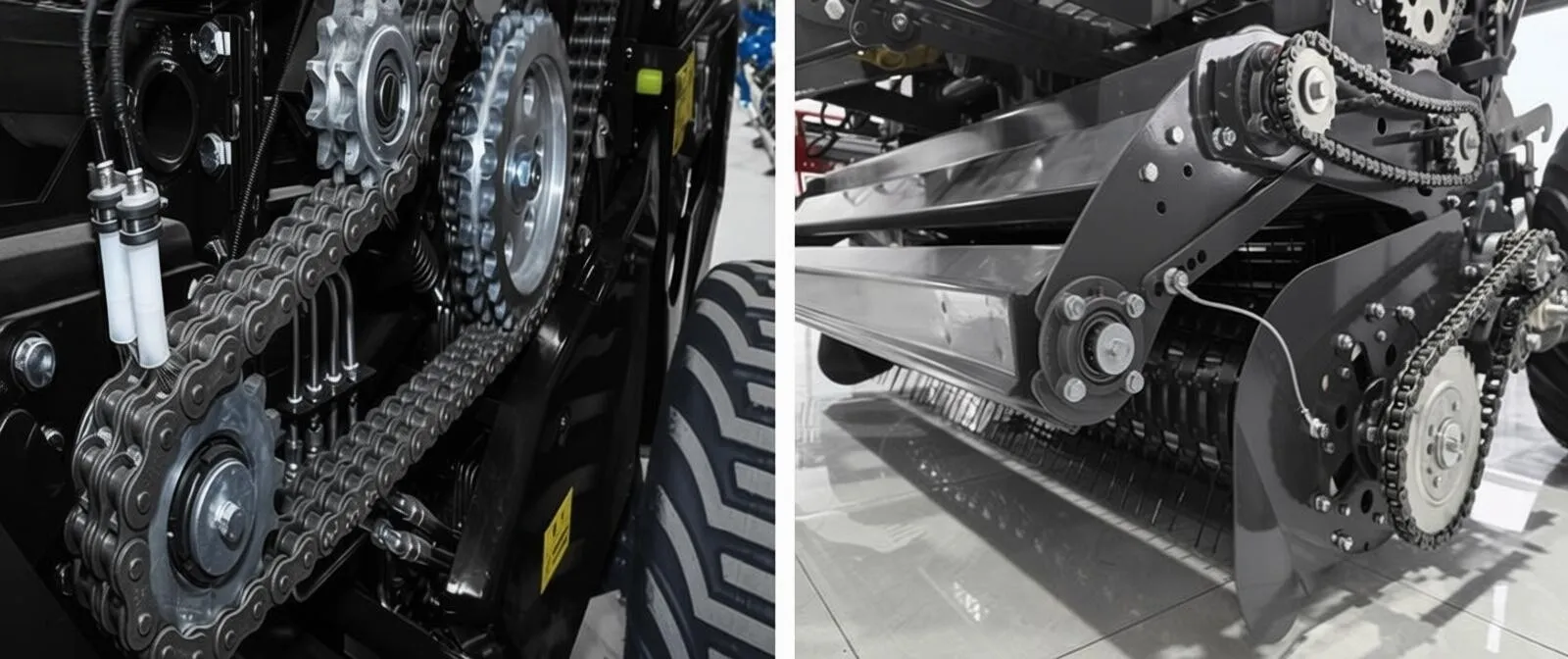
The dual-sided heavy-duty 20A drive chain on the S9000 rear compartment is enclosed within the chamber housing and physically separated from the crop flow path. This separation means chain oil and metal wear particles from the drive system remain within the mechanical enclosure rather than entering the material stream — a structural containment approach that addresses the contamination concern without requiring operators to use food-grade or non-contaminating lubricants as a compensating measure. For operators who do choose to use biodegradable chain lubricants as an additional precaution, the 20A chain’s higher surface hardness and lower elongation rate under load reduces lubricant consumption compared to lighter-grade chains, so the choice of lubricant type has a lower cost impact on the operation’s running expenses.
5. Round Baler Gearbox Performance in Seed Hay Operations
The round baler gearbox connects tractor PTO output to the pickup, feed, and compression systems simultaneously. In certified seed hay applications, where harvest timing is compressed into a narrow window — grass seed can begin shattering within 24 to 48 hours of reaching peak maturity if weather conditions are warm and dry — the gearbox’s contribution to machine reliability takes on added importance. A gearbox failure that puts the machine out of service for two days during peak seed maturity can result in a field’s entire certified seed yield being lost to shattering, which is not recoverable.
The 9YG-2.24D and 9YG-1.25 series use a standard PTO input speed of 720 r/min, while the 9YG-1.25A is rated across the broader range of 540 to 1,000 r/min, making it the most compatible choice for operations using older tractors. The dual-coupled gearbox design in the S9000 variant rotates 90 degrees in both directions without disengaging PTO power, enabling tighter headland turns without interrupting the bale-building cycle. On certified seed hay fields — which are typically smaller and more carefully managed than general hay fields, often with more complex boundary shapes from isolation strips and buffer zones — this turning capability reduces the amount of seed crop left at field ends that cannot be reached during normal passes.
The new-design traction hitch with safety torque-limiting shaft on the S9000 variant protects the gearbox input from sudden overload events. In seed hay operations where the baler may encounter variations in windrow density caused by different heading patterns across a field — particularly with lodging-prone grass seed crops — these overload protection features prevent the driveline failures that result in unscheduled stoppages at exactly the wrong moment in the harvest calendar. Gearbox oil level should be checked every 50 operating hours, and a full service change should be completed before the start of each seed hay season — not deferred until post-season, when contaminated or degraded oil has already done its damage to bearing surfaces.
6. Round Baler Models for Certified Seed Hay Operations
7. Seed Certification Regulations and Gearbox Compliance Across Key Markets
Understanding the regulatory architecture that governs certified seed hay production is as important as understanding the mechanical specifications of the baling equipment. Different national systems impose different requirements on equipment cleaning, lot traceability, and documentation, and the machinery safety rules governing gearbox and PTO shaft design apply regardless of the seed certification context.
Korea Selatan
In South Korea, seed production and certification are governed by the Seed Industry Act (종자산업법) and its implementing regulations. The Korea Seed and Variety Service (국립종자원, KSVS), operating under the Ministry of Agriculture, Food and Rural Affairs (농림축산식품부), is responsible for producing and distributing certified seeds of major crops and overseeing the national variety protection system. Field inspections for certified seed operations are conducted by authorised seed crop inspectors at multiple stages during the growing season. Equipment used in certified seed harvest operations is subject to the general requirement that it prevents mechanical admixture between varieties — which operationally requires the cleaning protocols described above for round balers moving between seed lots. Agricultural machinery including round balers must meet Rural Development Administration (농촌진흥청, RDA) certification standards to qualify for the Agricultural Machinery Purchase Subsidy (농업기계화 지원사업). The Road Traffic Act (도로교통법) governs machine transport on public roads.
OECD Seed Schemes (International)
The OECD Seed Schemes, established in 1958 and now involving over 60 participating countries, provide internationally standardised certification for seed classes including Pre-Basic Seed, Basic Seed, First Generation Certified Seed, and Second or Successive Generation Certified Seed. South Korea participates in the OECD Seed Schemes, as do the United States, EU member states, Australia, Japan, and the EAEU countries. Under OECD rules, certified seed must pass field inspection conducted by the certifying agency or accredited institution and post-harvest laboratory testing for varietal purity, germination rate, and physical purity. Harvest equipment — including balers — must be cleaned between lots where the certifying agency requires it under its specific crop certification standards. OECD labels on certified seed are recognised for cross-border trade, making OECD certification commercially significant for seed hay exporters in Korea, Russia, and Central Asia.
European Union
The EU’s seed certification framework is governed by the Council Directive 66/401/EEC on the marketing of fodder plant seed, Council Directive 66/402/EEC on cereal seed, and related implementing regulations. These directives specify minimum standards for varietal purity, germination, and physical purity for certified seed of covered crop species. National implementing agencies in member states conduct field inspections and post-harvest testing. Agricultural machinery safety falls under the Machinery Directive 2006/42/EC and, from January 2027, the Machinery Regulation (EU) 2023/1230. PTO shaft guarding must comply with EN ISO 5674, and safety markings on gearbox housings must follow EN ISO 11684. Germany’s Saatgutverkehrsgesetz (Seed Marketing Act, SaatgVerkG) provides additional national-level implementing provisions for seed certification in one of the EU’s most active certified seed markets.
United States
In the United States, certified seed production is administered at the state level through State Seed Certifying Agencies (SCAs), which are members of the Association of Official Seed Certifying Agencies (AOSCA). The Federal Seed Act (7 U.S.C. 1551-1611) provides the national legal framework for seed labelling and certification standards. Under AOSCA protocols, harvest equipment inspection is required before harvesting Foundation or OECD basic seed lots: the combine — and by extension, the baler — must be free of all contaminating material from previous crops. Documented equipment cleaning and inspection records are required for each certified lot. Agricultural machinery safety including baler PTO shaft guarding is governed by OSHA 29 CFR 1928.57.
Russia and EAEU
In Russia, seed certification is governed by Federal Law No. 149-FZ on Seed Production (Федеральный закон «О семеноводстве»), which establishes the legal basis for varietal testing, state registration, and seed certification of agricultural crop varieties. The Russian Federal State Budgetary Institution Rosselkhoznadzor oversees seed certification compliance. Agricultural machinery — including round balers used in seed production — must carry EAC conformity certification (Евразийское соответствие) under Technical Regulation TR CU 010/2011. Gearbox performance standards reference GOST R 53056. The broad 540 to 1,000 r/min PTO compatibility of the 9YG-1.25A makes it well suited to the diverse tractor fleet across Russian and Kazakhstani certified seed operations.
Japan
Japan’s seed production and certification is governed by the Seeds and Seedlings Act, administered by the Ministry of Agriculture, Forestry and Fisheries. Certified seed of registered plant varieties can only be propagated with variety rights holder authorisation. Equipment used in certified seed operations is subject to the contamination prevention expectations common to other certification systems. Agricultural machinery safety including gearbox PTO shaft standards falls under the guidelines of the Japan Agricultural Machinery and Food Technology Research Association (JAFT) and JISB0144 coupling standards.
8. Bale Density Control and Seed Head Integrity in Compression
Bale density management in certified seed hay operations requires a different calibration mindset than in standard hay or straw baling. The primary value in a seed hay bale is not the dry matter per bale (as it would be for livestock feed) but the germination viability of the seed heads within the bale. Excessive compression can physically crack seed heads, rupture seed coats, and reduce germination rates below certification thresholds — turning a potentially high-value seed crop into uncertified forage feed at a fraction of the original price.
Sensor-based density control, standard across all 9YG series models, allows operators to set a target density and rely on the system to maintain it consistently regardless of windrow density variation across the field. For certified grass seed baling, running the target at the lower end of the rated range — around 100 to 130 kg/m³ — preserves seed head structure while still producing a bale that is dense enough to maintain its shape during handling and transport. This is a meaningful calibration advantage over machines with manual pressure adjustments, where operator distraction or windrow variation can produce bales that inadvertently exceed the safe compression threshold for fragile seed heads.
The automatic net-wrapping system with sensor-triggered initiation ensures that the wrapping cycle fires at the same compression point every time. This consistency prevents the partial bale ejection events — where the door opens early during a distracted or rushed harvest — that leave seed material scattered on the field and create traceability gaps in the certified lot record. Every bale must be fully formed and properly wrapped before ejection for the lot to maintain its certification chain of custody from field to conditioning plant. The net roll specifications — 2,000 × 1.4 m for the 9YG-2.24D, 2,000 × 1.25 m for the 9YG-1.25, and 2,000 × 1.0 m for the 9YG-1.0 — ensure complete surface coverage on every bale format, protecting the seed heads in the bale’s outer layers from moisture ingress and shattering during field-side storage between harvest completion and transport to the conditioning plant.
9. Equipment Cleaning Protocol Between Certified Seed Lots
The equipment cleaning requirement between certified seed lots is one of the most operationally demanding aspects of running a round baler in certified seed hay production. Unlike cleaning a general-purpose hay baler for storage at the end of a season, cleaning between seed lots is time-pressured — the next variety’s harvest window may be only days away — and it must be thorough enough to satisfy either an internal quality system or an external certifying agency inspection. The AOSCA protocol for the United States requires documented evidence that equipment has been cleaned before harvesting Foundation or OECD basic seed. Korean KSVS protocols for certified seed operations similarly require demonstration that contamination from previous crop varieties has been eliminated.
A practical between-lot cleaning protocol for a 9YG series round baler should cover the following in sequence: compressed-air blowdown of the entire pickup assembly from the tine root inward, with particular attention to tine-mounting brackets and the stub-auger sections at the pickup ends; manual brush sweep of the feed channel and all accessible internal surfaces of the compression chamber, followed by a second compressed-air sweep; visual inspection of all roller faces, roller gaps, and net-wrap path for residual seed material; and final inspection and photographic documentation before the machine is released for the next certified lot. This protocol takes between 90 minutes and three hours depending on machine size and the extent of contamination from the previous lot, and it should be timed against the harvest schedule rather than attempted under time pressure.
The camless pickup design and the roller-type compression chamber of the 9YG series both reduce the time this cleaning protocol requires compared to conventional cam-track or belt-chamber designs, as discussed in the manufacturing structure section. For operations running multiple certified varieties in a single season — which is increasingly common as certified seed farms diversify their crop mix to manage market price risk — the cumulative time saved across several between-lot cleaning events is a meaningful operational advantage that contributes directly to the economics of running a round baler in this specialised application.
Between-Lot Cleaning Checklist for Certified Seed Hay Baling
Compressed-air blowdown of full pickup reel assembly including tine roots, stub augers, and mounting brackets — always blow from the inside outward to avoid re-depositing material in inaccessible areas.
Manual brush sweep of feed channel walls, paddle roller surfaces, and all accessible compression chamber roller faces and gaps — followed by a second blowdown to clear dislodged material.
Visual inspection and photographic record of all cleaned surfaces before release for next lot — photographs should be dated and retained for the certification audit file alongside the field inspection and harvest records.
Net roll check and replacement if any traces of previous variety material are visible on the film guide rollers or the net-wrap path — small seed adhering to the net roll housing can be deposited on the outer wrap of the first bale of the next lot.
10. Bale Storage and Traceability for Certified Seed Hay Lots
Post-baling storage of certified seed hay requires a different approach to conventional forage bale stacking. In a standard hay operation, bales are stacked by size and moisture class, and individual bale provenance is rarely tracked. In a certified seed operation, each bale belongs to a specific field lot with a documented seed class (Foundation, Registered, or Certified), a field inspection record, and a harvest date that connects it to the certification chain. Mixing bales from different certified lots — even the same variety from different fields or inspection records — can compromise the certification of both lots.
Practical storage management for certified seed hay bales should include physical lot separation — stacking each certified lot separately with visible identification markers — and documentation of the bale count per lot, the net roll batch used for wrapping, and the baler cleaning record that preceded the lot’s harvest. The net-wrapped round bales produced by the 9YG series maintain their structural integrity for six to nine months under outdoor storage conditions on elevated bearers, which provides sufficient buffer time for the conditioning plant to schedule processing and laboratory testing before the seed’s viability window closes. Bales that are damaged by rodents, machinery impact, or flooding before processing should be segregated and re-sampled before inclusion in the certified lot, as any event that compromises bale integrity could also affect seed viability and purity within the affected section.
The 2,000 × 1.4 m net rolls used on the 9YG-2.24D provide full-overlap coverage on ø1,300 × 1,400 mm bales, creating a weather-shedding outer surface that protects the seed heads from moisture ingress during storage. For seed varieties with particularly high germination sensitivity to storage temperature — notably some ryegrass and fescue varieties — an additional consideration is air circulation around stored bales: dense stacking that traps heat in humid conditions can accelerate germination viability loss even in externally undamaged bales. Allowing adequate space between rows and avoiding storage against warm walls or under metal roofs that conduct summer heat are practical precautions that preserve certified lot quality through the storage period.
Frequently Asked Questions
Editor: PXY