Corn Stover Baling — 9YG-1.0C Deep-Dive Guide
How the 9YG-1.0C Handles Standing Corn Stalks with 20 Hammer-Claw Units at 2400mm Width
A technical product knowledge guide explaining exactly how the 9YG-1.0C round baler’s 20-element hammer claw pickup system operates on standing and semi-erect corn stalks — covering the mechanical engagement sequence, the 2400mm pickup width advantage, bale formation parameters, and the field conditions where this configuration outperforms conventional spring-tine machines.
1. Why Standing Corn Stalks Require a Different Approach from Conventional Round Balers
Corn stover baling presents a fundamentally different mechanical challenge from hay or cereal straw baling. After the combine harvester passes through a corn field, the remaining stalk material is distributed in a pattern unlike any other crop residue: partially standing stems at the node height above the combine header cut point, cut stub sections at ground level, and a mixture of leaves, husks, and lateral branches in between. This three-dimensional residue field — part standing, part lying, part tangled — is exactly the material distribution that a conventional spring-tine round baler pickup handles worst. Spring tines rely on material lying horizontally in a defined windrow so that the tine sweep can lift and guide it into the intake channel. They have no reliable mechanism for engaging material that is above their natural sweep path, which means standing or semi-erect corn stalks either deflect off the tine tips or enter the intake in random, uncontrolled bursts that create density variation in the forming bale.
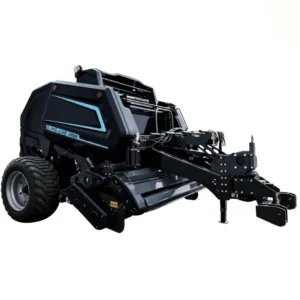
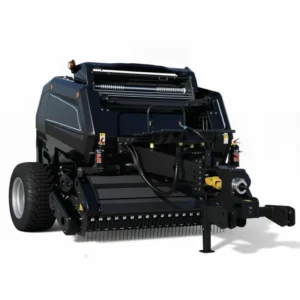
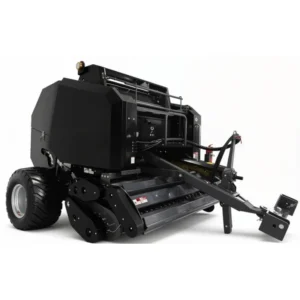
The 9YG-1.0C round baler was specifically designed to address this challenge. Its 20-element hammer claw pickup operating across a 2400 mm width — the widest direct-pickup configuration in the 9YG range — engages standing and semi-erect corn stalks at their standing height and pulls them into the intake channel through positive mechanical force rather than passive tine sweep contact. The result is consistent intake flow from a corn stover field that would defeat a conventional spring-tine machine, without requiring a prior raking or tedding pass to lay the material into a defined windrow. This article explains exactly how that mechanical process works, what the 20-unit claw arrangement provides at 2400 mm that narrower or fewer-element configurations cannot, and what field and crop conditions the 9YG-1.0C is designed for in Korean and regional corn-growing contexts.
Understanding this machine’s working principle is valuable for three groups: farm operators comparing round baler options for an autumn corn stover collection programme; agricultural contractors building a service business around corn residue baling for biogas, livestock feed, or biomass energy buyers; and equipment planners at cooperative or extension level assessing which machine specification best fits a regional corn stover utilisation programme. Each of these groups benefits from a clear mechanical explanation of what differentiates the 9YG-1.0C’s hammer claw pickup from both conventional spring-tine pickups and simpler single-element claw designs.
2. The 20-Element Hammer Claw Mechanism: How It Engages Standing Corn Stalks
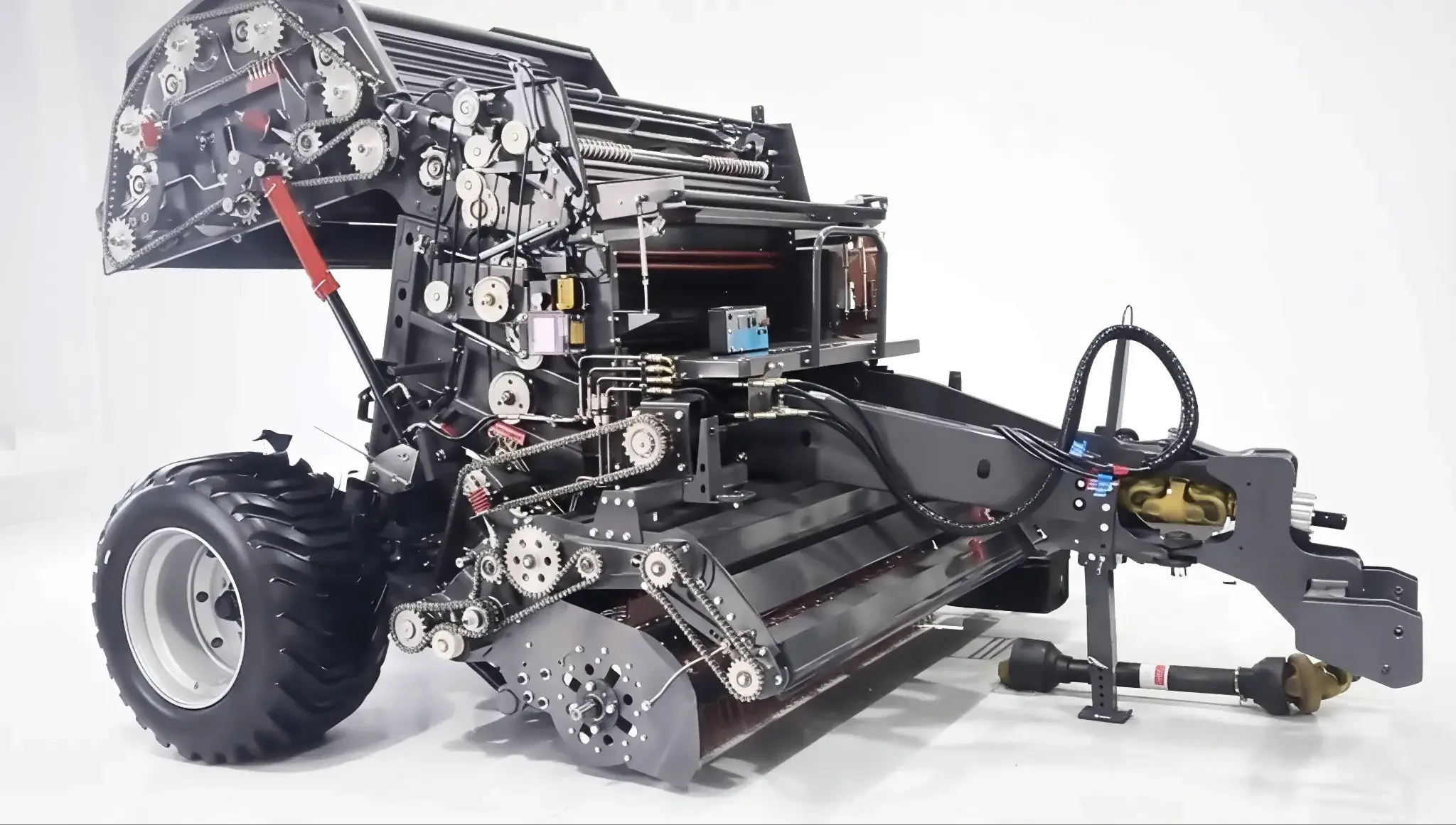
The core of the 9YG-1.0C’s capability is its hammer claw pickup assembly — 20 individually rotating claw elements mounted on a common rotating shaft across the 2400 mm pickup width. Each claw element is an independently moving pick-and-release mechanism: as the shaft rotates, each claw reaches forward and downward into the crop zone, closes to grip the stalk material, carries it backward and upward into the intake channel, and then releases it into the pre-chamber feed zone before rotating back to repeat the cycle. This active grasping motion contrasts fundamentally with the passive tine sweep of a spring-tine pickup, where the tines do not close or grip — they simply sweep material upward and hope friction and crop weight keep the material in contact with the tine surface long enough to guide it into the intake.
For standing corn stalks, the mechanical significance of this difference is substantial. A spring tine approaching a standing corn stalk from below will contact the lower portion of the stalk and may lift it if the stalk is light enough and the tine has enough upward velocity. But corn stalks after harvest retain their base root connection at the cut point and are relatively heavy compared to cut hay or straw windrow material — a spring tine’s passive sweep typically deflects the stalk to one side rather than lifting it into the intake. The hammer claw, by contrast, closes around the stalk section within its operating radius, grasps it actively, and pulls it through its rotation arc into the intake channel. The 20 individual claw elements are staggered across the 2400 mm width at a pitch that ensures continuous coverage — as one claw completes its release cycle, the adjacent element is in the grip phase, so the intake channel receives a steady, continuous flow of material rather than the surge-and-gap pattern that fewer elements or wider element spacing would produce.
The 20-element count is a design parameter that balances engagement coverage against mechanical complexity and maintenance load. More elements provide denser coverage across the pickup width — reducing the gap between adjacent claw cycles and providing more consistent intake flow from variable-density crop material. Fewer elements would create wider gaps between claw cycles, increasing the density variation in the intake stream and producing bales with less consistent internal density. At 20 elements across 2400 mm, the 9YG-1.0C achieves a claw spacing of approximately 120 mm — enough to prevent adjacent element interference while providing dense enough coverage for consistent standing corn stalk engagement across the full pickup width during field operation.
3. The 2400mm Pickup Width: Why the Widest Configuration Matters for Corn Stover
The 2400 mm pickup width of the 9YG-1.0C is the widest in the 9YG series — wider than the 2240 mm used on the 9YG-2.24D class machines and the 9YG-1.25 Double, and wider than the 2150 mm of the 9YG-1.25A and the 1900 mm of the 9YG-1.0. This distinction is not incidental. For corn stover collection, the pickup width determines how many corn rows the machine can directly harvest per baler pass without requiring a prior raking step to merge multiple rows into a narrower windrow.
Standard Korean corn planting is typically conducted at 70–80 cm row spacing in continuous rows. At this spacing, a 2400 mm pickup width covers approximately 3 corn rows per baler pass — a ratio that produces a practical, workable intake volume per pass without overloading the intake channel or creating uneven density distribution across the bale width. A narrower pickup width on the same hammer claw design would cover fewer rows per pass, increasing the total number of baler passes required to cover a given field area. This directly affects the total field-pass economics: with the 2400 mm pickup covering 3 rows per pass, a 10-hectare corn stover field at 70 cm row spacing requires fewer baler passes to complete than with a 2240 mm or narrower pickup. Fewer passes means less soil compaction, less fuel consumption per hectare covered, and a faster completion of the corn stover collection operation within the available dry-weather window.
The 2400 mm width also accommodates the irregular row-pattern residue distribution that occurs in Korean corn fields where the combine’s header operates on curved contour rows or where end-row overlapping creates sections of denser stover coverage. A wider pickup can straddle the overlap zones without requiring the operator to slow down or adjust the baler path, maintaining throughput efficiency across these variable-coverage areas. Narrower configurations must navigate more carefully around density variations, either reducing speed to manage overloading risk or accepting density inconsistency in bales produced from overlap zones.
4. 9YG-1.0C Full Technical Specifications
The following specification table covers all key parameters of the 9YG-1.0C round baler. These figures represent the machine in its standard hammer claw configuration as designed for standing and direct-cut corn stover collection. All figures are from the 9YG-1.0C product specification.
| Parameter | Specificatie | Significance for Corn Stover |
|---|---|---|
| Model | 9YG-1.0C | Dedicated hammer claw configuration for standing crop residue |
| Type trekhaak | Traction (drawbar) | Compatible with all standard Korean tractor drawbars |
| Pick-up breedte | 2400 mm | Widest in the 9YG range; covers 3 rows at 70–80 cm row spacing per baler pass |
| Ophaaltype | Hammer claw (20 elements) | Active mechanical engagement handles standing stalks, bypasses raking requirement |
| Feed Mechanism | Auger + toothed roller + drum | Three-stage positive feeding maintains intake flow from irregular-density stover material |
| Compression Chamber Type | Roller type | Continuous circumferential roller pressure for even density across bale section |
| Chamber Width | 1250 mm | Produces 1250 mm wide bales compatible with standard Korean flatbed transport |
| Chamber Diameter | phi 1000 mm | phi 1000 mm bale — compact format manageable with front loader or bale handler |
| Number of Compression Rollers | 16 rollers | 16 phi 222 mm rollers apply consistent radial pressure to developing bale |
| Bale Size | phi 1000 x 1250 mm | Manageable unit weight — suitable for local livestock and biogas cooperative deliveries |
| Bale Density Range | 115–200 kg/m3 | Sensor-controlled; meets most Korean corn stover buyer minimum density specifications |
| Bindingsmethode | Automatic net wrap | Net wrap maintains bale shape integrity during handling and transport |
| Net Roll Specification | 2000 m x 1.25 m per roll | Standard Korean-market net wrap specification — readily available from domestic suppliers |
| Required Tractor Power | 69.8 kW / 95 HP minimum | Compatible with mid-range Korean tractors commonly used for corn production |
| PTO Output Speed | 540 r/min | Standard Korean tractor PTO configuration — no speed conversion required |
| Bedrijfssnelheid | 5–20 km/h | Lower top speed than hay balers — appropriate for variable-density standing crop conditions |
| Productiviteit | 40–80 bales/hour | Practical corn stover throughput range depending on stover coverage rate |
| Track Width | 2100 mm | Fits between standard Korean corn row groups without excessive field traffic |
| Machine Mass | 3198 kg | Relatively low mass reduces autumn soil compaction per field pass |
| Working Dimensions (L x W x H) | 3800 x 2850 x 2200 mm | Compact working envelope suitable for Korean field sizes and road transport |
| Hammer Claw Count | 20 units | Provides continuous claw coverage across 2400 mm at approximately 120 mm element spacing |
| Drive Chain (Front and Rear) | Dual-side 16A heavy-duty chain | Dual-side drive provides even compression pressure distribution for consistent bale density |
5. Three-Stage Feed Mechanism: From Stalk to Bale Chamber
After the hammer claw pickup engages standing corn stalks and lifts them into the machine’s intake zone, the material must be metered consistently into the forming chamber to produce uniform bale density. The 9YG-1.0C uses a three-stage positive feed mechanism — auger, toothed roller, and drum — between the claw pickup and the compression chamber. This three-stage arrangement is what distinguishes the 9YG-1.0C from simpler hammer claw designs that deliver material directly from the claw to the chamber without an intermediate metering stage.
The auger section receives material from the hammer claws and moves it laterally across the full 2400 mm intake width to concentrate it toward the 1250 mm chamber width. This width reduction is necessary because the pickup covers 2400 mm while the forming chamber is 1250 mm wide — the auger transitions the material stream from the pickup width to the chamber width without creating a choking point at the chamber entrance that would cause plugging events in heavy stover material. The auger’s helical flight design moves material smoothly inward without compacting it prematurely, preserving the material’s ability to form a uniform bale cross-section when it enters the compression zone.
The toothed roller following the auger section provides a positive metering action that delivers material to the chamber drum at a controlled rate. In corn stover applications where stover coverage varies across different sections of the same field — heavier near the combine’s return row and lighter near the end rows — the toothed roller’s metering action dampens the effect of this coverage variation on the material flow rate entering the chamber. Without this metering stage, coverage variation translates directly into density variation within the bale. With it, the material flow rate is buffered, giving the forming chamber’s compression rollers a more consistent material supply and reducing the density variance between bales produced from different field sections. The chamber drum then distributes the metered material across the full 1250 mm chamber width before it engages the compression roller array, ensuring that all 16 compression rollers receive approximately equal material loading and apply approximately equal compression force per unit of bale circumference.
6. Manufacturing Structure: How the 9YG-1.0C Is Built for Sustained Corn Stover Service
The 9YG-1.0C’s capability on standing corn stalks is not simply a function of the hammer claw pickup system in isolation — it depends on the complete mechanical architecture supporting and transmitting force from the PTO input through to the bale ejection point. The manufacturing standards applied to each sub-system determine whether the machine’s performance characteristics hold across a full season of intensive corn stover baling or degrade as components wear beyond their design tolerance.
Hammer Claw Pickup Assembly
The 20 hammer claw elements are mounted on a precision-machined rotating shaft supported by bearings at each end and at intermediate span points to prevent shaft deflection under the asymmetric loading that occurs when one section of the 2400 mm pickup encounters dense stover while an adjacent section encounters a gap. Shaft deflection under this loading would cause claw engagement depth variation across the pickup width — inconsistent engagement on one side of the machine while the opposite side has normal engagement — which the three-stage feed mechanism can only partially compensate. The bearing arrangement keeps shaft deflection within the tolerance range that maintains consistent claw engagement depth across all 20 elements throughout the operating session.
16-Roller Compression Chamber
The 9YG-1.0C uses 16 compression rollers of phi 222 mm diameter arranged in a phi 1000 mm diameter chamber. This smaller chamber diameter compared to the 9YG-2.24D class machines (phi 1200 mm) is appropriate for the 9YG-1.0C’s bale size target of phi 1000 mm — the chamber diameter determines the final bale size, and the phi 1000 mm chamber produces bales that are manageable with standard Korean front loaders and bale handlers without requiring specialist large-bale equipment. The 16 rollers provide continuous circumferential contact around the developing bale, applying consistent radial pressure as the bale grows from its initial core to the full target diameter. Corn stover’s fibrous, multi-section structure compresses progressively well under this multi-point roller arrangement, producing a bale with a firm, coherent structure that holds its shape after ejection and net-wrap application.
Dual-Side 16A Chain Drive
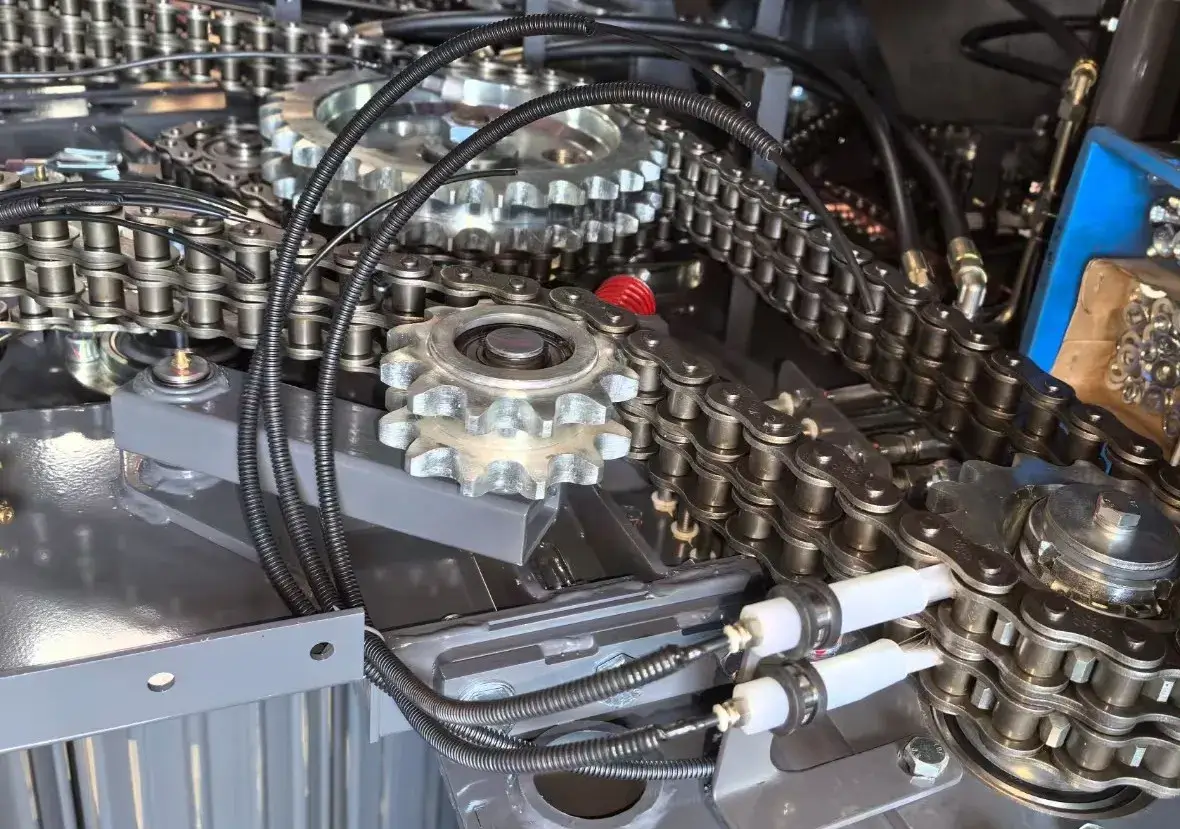
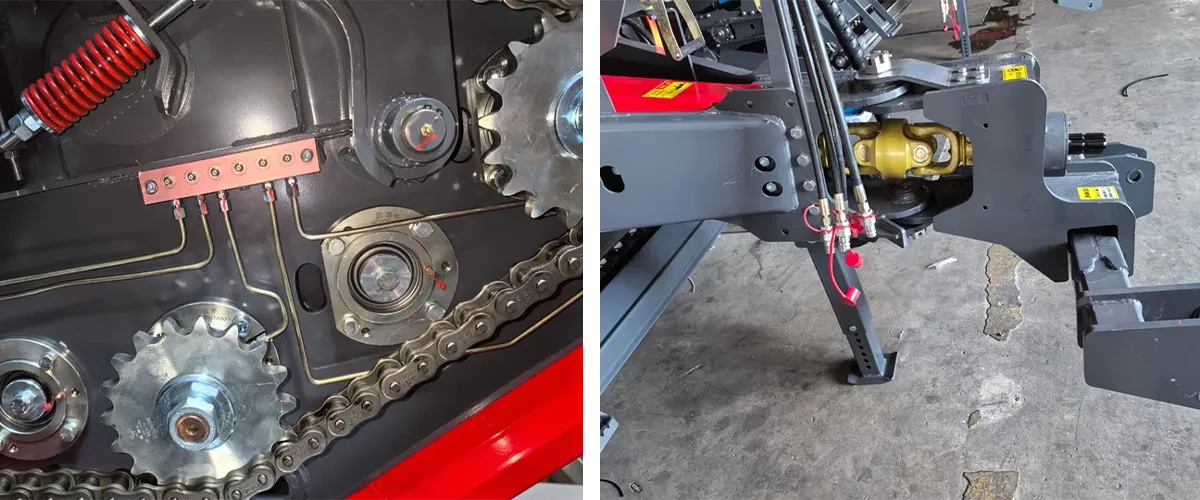
The 9YG-1.0C uses dual-side 16A heavy-duty chain in both the front and rear chamber drives. The dual-side arrangement distributes the drive force across two chain runs on each side rather than concentrating it in a single chain per side — which reduces the peak tension per chain link and extends chain service life in the high-load corn stover application. The 16A specification provides adequate tensile rating for the compression forces generated in the phi 1000 mm chamber at the 115–200 kg/m³ density target range. In contrast to the 20A chain used in the larger 9YG-2.24D Classic model — which is necessary for the higher forces of the phi 1200 mm chamber at the same density range — the 9YG-1.0C’s smaller chamber diameter inherently generates lower absolute compression forces at equivalent density, making the 16A specification appropriate for this machine’s application profile.
7. Material System: Structural Steel, Coating, and Long-Term Durability in Corn Stover Conditions
Corn stover baling subjects the round baler to a specific set of material environment conditions that differ from hay baling: corn stalk fragments are more abrasive than grass stems, the moisture range at baling is wider (from dry stalks at 15% to green material at 40%+), and the fibrous dust generated from the leaf and husk fraction during baling accumulates on machine surfaces at rates above those encountered in standard hay operations. The material specification of the 9YG-1.0C’s frame and drive components addresses these conditions specifically.
The structural frame is manufactured from CNC laser-cut structural steel sections joined by automated welding processes. CNC laser cutting produces dimensional accuracy at all key joint interfaces — particularly at the hammer claw pickup mounting points and the chamber roller bearing housings, where dimensional error would translate into misalignment that accelerates bearing and claw wear in service. Automated welding delivers consistent weld quality at all structural joints, which is particularly important for the pickup shaft support brackets that carry the asymmetric loads described in the previous section. Manual welding processes introduce variability in weld penetration depth and bead geometry that creates stress concentration points where fatigue cracking initiates — typically visible after a few hundred operating hours under the cyclic loading of hammer claw operation on standing corn stalks.
The electrostatic powder coating applied over the complete machine structure — including the hammer claw pickup housing, the chamber frame, and all external mechanical components — provides a chemically bonded protective surface layer that resists the combined effects of corn stover field conditions: the slightly alkaline soil particles carried in with root-attached stalk sections, the corn leaf acid fraction at high moisture conditions, and the physical abrasion from corn stem fragment contact on all external surfaces during operation. Conventional spray-painted finishes develop surface damage at these contact points within one or two seasons, allowing the corrosion progression that reduces the dimensional accuracy of load-bearing surfaces over time. The electrostatic coating’s greater surface adhesion energy resists this damage pattern and maintains the surface integrity of precision surfaces — particularly important at the hammer claw shaft bearing housings where surface corrosion would accelerate bearing inner race wear.
The machine mass of 3198 kg is notable in the context of Korean autumn corn stover operations. This is among the lower masses in the 9YG product range — the 9YG-2.24D Standard at 3922 kg and the 9YG-1.25 series models at 4060–4558 kg are all significantly heavier. Lower machine mass reduces the ground pressure per wheel contact area during field operation, which directly reduces the depth and extent of soil compaction per field pass. In Korean autumn conditions where rainfall in September and October can leave soils above field capacity — reducing their load-bearing strength and making them more susceptible to compaction damage — the 9YG-1.0C’s 3198 kg operating mass is a genuine practical advantage for soil health across the corn stover collection operation.
8. Round Baler Gearbox on the 9YG-1.0C and International Compliance Standards
The round baler gearbox on the 9YG-1.0C transmits PTO power at 540 r/min from the tractor input to the hammer claw drive, the three-stage feed mechanism, the forming chamber roller circuit, and the net-wrap system. The 540 r/min rated PTO speed aligns with the standard output speed of the Korean tractor models commonly used for corn production — 95 HP (69.8 kW) class tractors from LS Mtron, TYM, Kukje, and Branson all offer a 540 r/min PTO as standard, meaning the 9YG-1.0C connects to these tractors without requiring a 1000 r/min to 540 r/min speed conversion or a specialised reduction gearbox.
The gearbox input receives the 540 r/min PTO rotation and distributes it to the multiple downstream drive circuits via a bevel gear set. The hammer claw pickup drive is an additional power circuit compared to a standard spring-tine pickup — the claws require positive power input for their rotating-and-grasping motion, unlike the cam-track passive control of spring tines. This additional circuit adds a continuous torque load on the gearbox output during operation, which is accommodated in the 9YG-1.0C’s gearbox sizing and lubricant specification. Correct lubricant for the 9YG-1.0C gearbox is SAE 90 GL-4 gear oil — available from Korean suppliers without special ordering. In corn stover conditions, the gearbox breather filter should be inspected and cleaned at each operating day start, as corn leaf and husk dust accumulates on the breather element at rates above those in standard hay baling.
| Region | Key Regulation | Gearbox and Corn Stover Relevance |
|---|---|---|
| Zuid-Korea | Agricultural Mechanisation Promotion Act; Safety Standards for Agricultural Machinery; Clean Air Conservation Act; Rural Development Administration stover utilisation guidelines | PTO shaft guarding mandatory; 540 r/min standard compliant; gearbox certification for subsidy eligibility; corn stover burning restricted — baling supported as primary disposal route |
| European Union | EU Machinery Regulation 2023/1230; EN ISO 4254-7 (round balers); RED III biomass sustainability; ATEX 2014/34/EU | CE marking mandatory for EU market; hammer claw pickup mechanism assessed as integral machinery element under CE scope; corn stover qualifies under RED III; corn dust ATEX risk noted |
| United States | ASABE S331.4 (PTO safety); OSHA 29 CFR 1928.57; EPA Renewable Fuel Standard | PTO master shield and gearbox torque documentation required; corn stover qualifies as cellulosic biofuel under EPA RFS; USDA recommends partial stover removal to maintain soil organic matter |
| Japan | Agricultural Machinery Safety Standards; Law Promoting Agriculture in Harmony with Environment; JAS | JAS safety mark for domestic market; gearbox 540 r/min PTO standard compliant with Japanese tractor fleet; corn stover utilisation subsidy available under environmental farming law |
| India | BIS IS 9898 (agricultural machinery safety); National Policy on Biofuels 2018; State burning prohibition ordinances | Hammer claw round baler relevant for standing corn stover collection in states with burning bans; BIS-compliant gearbox for subsidy eligibility; corn stover qualifies as biofuel feedstock under NBP 2018 |
9. Field Operating Parameters: Getting the Best from the 9YG-1.0C on Standing Corn Stalks
Achieving consistent, high-quality bale output from the 9YG-1.0C on standing corn stalks requires attention to three operating parameters: travel speed, sensor density target, and combine discharge configuration. Each of these is adjustable by the operator and has a direct effect on bale quality, throughput rate, and the proportion of standing stover successfully collected per field pass.
Operating speed on standing corn stalks should be set between 4–8 km/h for most Korean corn stover conditions — lower than the 5–20 km/h maximum specification, and lower than the typical hay baling speed of 8–15 km/h. Lower speed allows the 20 hammer claw elements more contact time per unit of forward travel, which improves engagement of stalks that are leaning at angles less favourable to claw contact. At higher speeds, the claw elements have less time to complete their grip-and-release cycle before the machine has moved forward past the stalk — resulting in stalks deflecting off the claw rather than being engaged. The 4–8 km/h range balances engagement quality against throughput rate for the variable stalk distributions encountered in most Korean corn stover fields. Operators should set speed based on the stover coverage rate in each field section, reducing to the lower end of this range in sections with dense, irregular stover and increasing toward the upper end in sections with more uniform lighter coverage.
Sensor density target for corn stover baling on the 9YG-1.0C should be set based on the end buyer’s minimum specification plus a buffer. Korean livestock feed buyers typically specify 100–130 kg/m³ for corn stover round bales. Biogas substrate buyers — supplying anaerobic digestion facilities for biogas production — often specify 120–150 kg/m³ for volumetric handling efficiency at the facility. Setting the sensor target 10–15 kg/m³ above the buyer’s minimum provides the buffer needed to ensure that bales from lighter stover sections — which the pickup may collect at a lower fill rate per bale cycle — still meet specification after natural density variation. The 9YG-1.0C’s sensor system manages the bale-eject timing automatically once the target is set, which removes the need for operator judgement on bale completion and is the primary mechanism for maintaining consistent density across varying stover coverage conditions.
10. The 9YG-1.0C in Context: How It Compares to Other Models in the Range
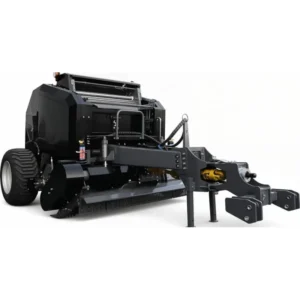
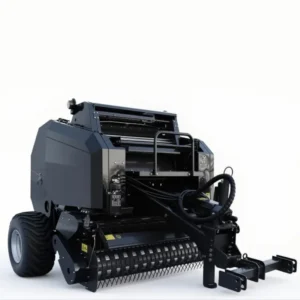
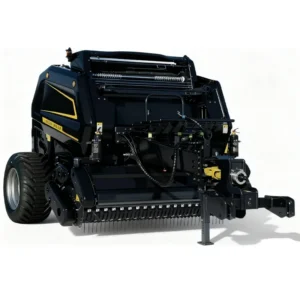
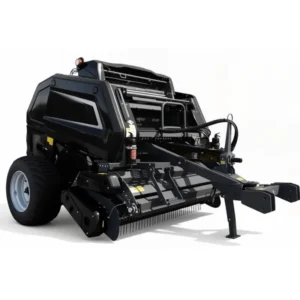
The 9YG-1.0C is the dedicated standing-crop-residue model in the 9YG range. The following overview positions it relative to the other round baler models available, helping operators understand where the 9YG-1.0C’s specific capabilities are most advantageous and where other models in the range are better suited.
11. Compatible Systems: PTO Shaft and Agricultural Chain for the 9YG-1.0C
The 9YG-1.0C’s 20-element hammer claw pickup generates drivetrain demands that differ from standard spring-tine round baler operation. A correctly specified PTO shaft and well-maintained drive chain are the components that protect the gearbox and forming chamber from the variable torque loads of standing corn stover collection.
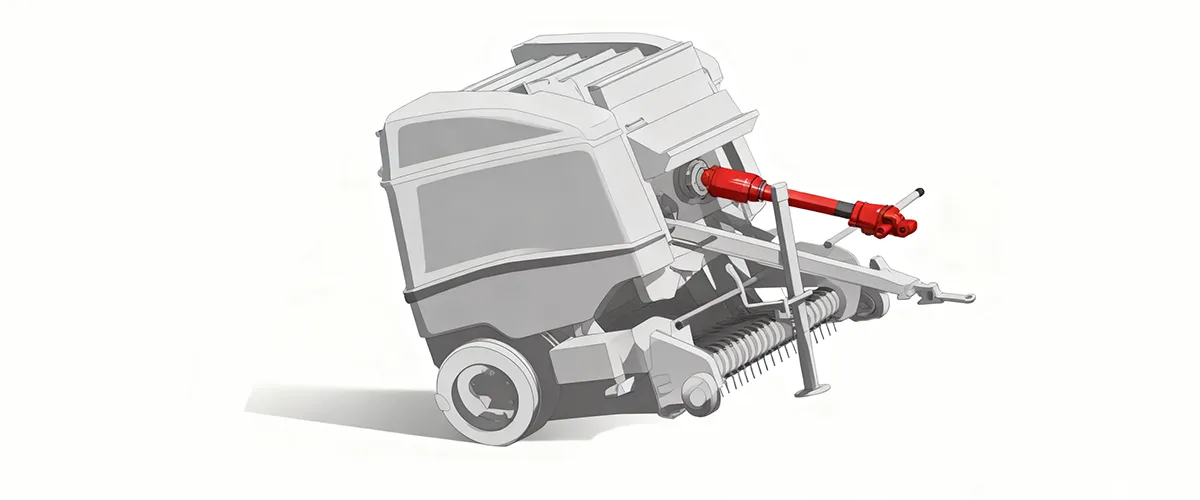
Agricultural PTO Shaft — 540 r/min Rated for 9YG-1.0C
The 9YG-1.0C operates at 540 r/min PTO input — the standard configuration for Korean 95 HP class tractors. A correctly rated Agricultural PTO Shaft for Round Balers matched to this speed and torque profile connects the tractor’s PTO to the baler’s gearbox input without the angular velocity variation or shaft fatigue that under-rated or mismatched shafts generate in standing corn stover collection conditions. The hammer claw pickup adds a continuous additional torque load to the drive system compared to a spring-tine round baler — meaning the PTO shaft’s safety clutch engagement threshold must be set at the correct value for the combined pickup and forming chamber load of the 9YG-1.0C, not just the forming chamber alone. Our PTO shaft range for round balers is available in specifications matched to the 9YG series across all Korean tractor PTO output ratings, providing a one-stop drivetrain supply solution that simplifies specification verification and ensures system-level performance consistency from tractor output to bale chamber roller.
Agricultural Drive Chain — 16A Dual-Side for 9YG-1.0C Chamber Drive
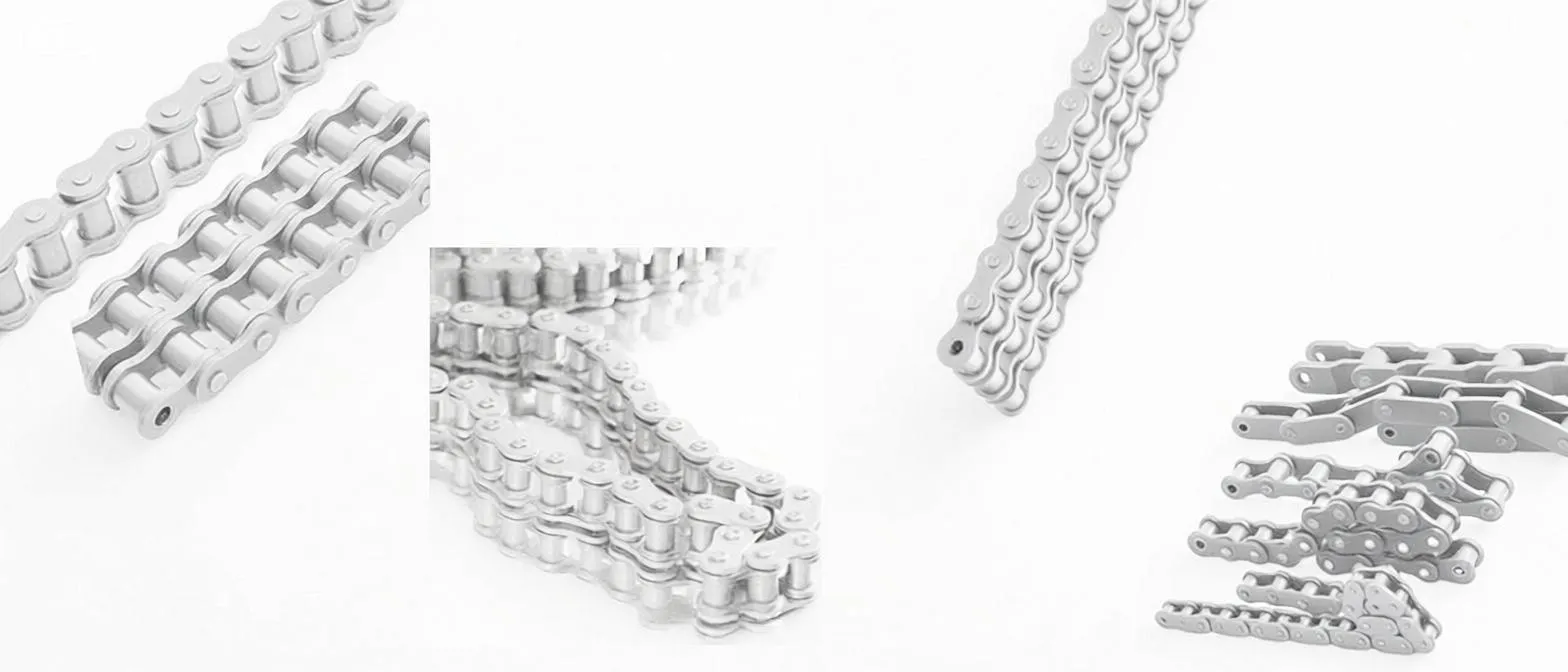
The 9YG-1.0C’s dual-side 16A heavy-duty chain in the forming chamber drive is a specific component choice that balances drive force distribution against chain service life in the phi 1000 mm chamber’s compression load range. Maintaining this specification with correctly matched replacement chain — same pitch, same link cross-section geometry, same surface hardness — is what keeps the dual-side drive’s load-sharing geometry correct through multiple seasons of corn stover service. Replacement chain of different pitch tolerance or lower surface hardness changes the sprocket engagement geometry and can introduce the same drive timing inconsistency that chain elongation produces over time, degrading bale density consistency in ways that are difficult to diagnose without knowing the chain specification history. Our agricultural drive chain supply covers 16A standard for the 9YG-1.0C, using Korean-market standard sprocket profiles for field-side replacement from any Korean industrial hardware supplier. A pre-season chain elongation check and a spare 16A chain section kept on the machine provide the low-cost protection against a mid-season failure during the Korean autumn corn stover collection window.
Frequently Asked Questions
Redacteur: PXY