Alfalfa & Hay Baling — Parts Lifespan & Wear Reference
Knowing when a ronde balenpers component will wear out is as important as knowing how to replace it. In alfalfa baling — where abrasive silica dust, plant juice, and high bale cycle counts combine into one of the most demanding operating environments a baler encounters — parts that fail earlier than expected generate unplanned downtime during the baling window. This guide maps the expected wear rates and service lives for the three most maintenance-intensive component categories: compression rollers, drive chains, and pickup tines.
Why Alfalfa Is Harder on Round Baler Parts Than Most Other Crops
Operators who have run a round baler machine on cereal straw or grass hay and then switched to multi-cut alfalfa frequently report that parts they expected to last three or four seasons wore out in one or two. This is not a machine defect — it is an accurate reflection of what alfalfa does to baler components. The plant’s high silica content in stem and leaf tissue generates an abrasive effect on all metal surfaces that the crop contacts during the baling process. Alfalfa’s mildly acidic plant juice, released from cells crushed during pickup and compression, degrades lubricants and attacks seal compounds faster than dryer gramineous crop residues. And the multi-cut nature of intensive alfalfa programmes means a baler accumulates bale cycles at a rate two to four times higher than a single-cut hay programme on an equivalent area, accelerating every wear mechanism proportionally.
Understanding the expected wear rates for round baler parts under alfalfa conditions allows operators to move from reactive replacement — replacing components after they fail in the field — to planned maintenance, where the seasonal service schedule aligns with the actual wear curve of each component. The financial difference between these two approaches is significant: a pickup tine failure in the middle of a baling window costs both the tine and the time to clear the blockage it created. Catching the same tine at a pre-cut inspection costs only the tine. Across an 8,000-bale season, this kind of planned-versus-reactive calculation applies to every wear item on the machine.
The Four Wear Drivers Specific to Alfalfa Baling
Before mapping wear rates to specific components, it is worth identifying the four distinct mechanisms that drive wear faster in alfalfa than in comparable baling applications. Each mechanism targets different parts of the machine with different intensity depending on moisture conditions, cut number, and field management.
The first mechanism is silica abrasion. Alfalfa carries silicate particles in its stem walls and, particularly in late-season dry cuts, in the dried leaf tissue that breaks into fine airborne fragments during pickup and chamber processing. These particles act as a lapping compound on any surface they contact at speed — roller surfaces, tine tips, chain side plates, and the inside faces of auger flights. The abrasion rate is proportional to both particle hardness (which is a fixed property of the silica) and relative surface velocity (which is a machine design variable). High-speed pickup tines in dry late-cut conditions generate the worst abrasion scenario in the machine because the tine-to-particle impact velocity is highest at that point in the feeding system.
The second mechanism is chemical attack from plant juice. Fresh alfalfa contains plant juice with a pH in the 5.5–6.5 range, which is mildly acidic. This juice contacts seal lip faces, bearing outer races, and chain side plates at the point of initial pickup and through the compression roller nip. Over a season, the cumulative chemical contact time is enough to degrade standard grease formulations and attack the NBR elastomer compounds used in lower-specification lip seals. The third mechanism is fatigue loading from bale ejection shock — the sudden release of compression force when the rear gate opens puts a large impulse load through the frame, the hinge, and the pivot bearing. At 8,000–15,000 bale cycles per season, this impulse contributes to progressive fatigue cracking in components not designed for cyclic load. The fourth mechanism is thermal cycling — from cold morning startups in early spring through sustained high-temperature afternoon operation in late summer — which alternately expands and contracts every press fit in the machine, progressively loosening interference-fit bearings and sprocket bosses if the original manufacturing tolerances were at the loose end of specification.
| Wear Mechanism | Primary Target Components | Worst Conditions | Detection Method |
|---|---|---|---|
| Silica abrasion | Tine tips, roller surfaces, chain side plates, auger flights | 4th cut dry alfalfa; dusty conditions; high forward speed | Visual surface profile check; tine tip measurement |
| Plant juice chemical attack | Lip seals, bearing outer races, chain link pin corrosion | 1st and 2nd cut; high-moisture conditions; worn seal faces | Oil colour check; bearing noise; seal weeping |
| Ejection shock fatigue | Gate hinge pins, rear gate pivot bearings, frame weld joints | High bale cycle counts; large heavy bales; worn hinge clearance | Gate play measurement; crack inspection at pivot points |
| Thermal cycling | Press-fit bearings, sprocket bosses, machined bores | Multi-season use; large seasonal temperature range; spring-to-autumn operation | Bearing axial play; sprocket wobble under load |
Compression Roller Wear: Expected Lifespan and Failure Modes in Alfalfa
Compression rollers are the highest-mass wear items in a round baler and typically carry the longest service life expectation — but in alfalfa, the expected life is meaningfully shorter than manufacturers’ figures based on grass hay testing. The 9YG-2.24D uses 18 rollers at 222 mm diameter, manufactured from high-carbon alloyed steel with a controlled surface profile. In grass hay or cereal straw, this roller specification is expected to deliver 20,000-plus bales before the surface profile wears smooth enough to affect grip on the incoming crop stream. In four-cut irrigated alfalfa at 8,000–10,000 bales per season, the same roller may reach the grip-loss threshold in 14,000–18,000 bales — approximately 1.5 to 2 seasons — primarily because the silica abrasion rate is substantially higher than in grass hay.
The critical failure mode for compression rollers in alfalfa is surface smoothing — the gradual loss of the roller’s grip profile without any dramatic visual change that would alert an operator during a routine inspection. A smooth roller still looks intact and rotates freely, but it has lost the micro-texture that allows it to grip the incoming alfalfa and impart rotational momentum to the forming bale core. The result is bale core slip: the core rotates slower than the rollers, the outer layers compress unevenly, and the bale exits the chamber with a softer centre and a harder shell — the inverse of the ideal density gradient for silage fermentation. By the time bale density variation is noticeable in the field, the rollers have been underperforming for potentially hundreds of bales.
The correct inspection method is to use a machined straight-edge along the roller’s axial length and a surface comparator gauge or a calibrated feeler gauge set against a reference surface. If the roller profile deviation exceeds the manufacturer’s service limit — typically in the range of 0.3–0.5 mm cross-sectional deviation from the new profile — replacement should be planned before the next cut. In practice, most operators in multi-cut alfalfa programmes are better served by treating rollers as an end-of-second-season planned replacement rather than a conditional one, given the difficulty of accurately measuring profile loss in the field and the high cost of bale quality degradation if the rollers are left in service too long.
| Operating Condition | Expected Roller Life (bales) | Primary Wear Mode | Planned Replacement Interval |
|---|---|---|---|
| Grass hay (single cut) | 20,000–30,000 | Gradual surface smoothing | Every 3–4 seasons |
| Cereal straw | 15,000–22,000 | Silica abrasion and smoothing | Every 2–3 seasons |
| Alfalfa, 2-cut programme | 16,000–20,000 | Silica abrasion; plant juice surface softening | Every 2–3 seasons |
| Alfalfa, 4-cut irrigated | 12,000–18,000 | Silica abrasion (dry cuts) + plant juice (wet cuts) | End of 2nd season — planned |
Roller bearing life in the 9YG-2.24D series is rated at L10 exceeding 10,000 hours for the 6208-2RS sealed deep-groove specification. At 300–400 operating hours per season in a four-cut programme, this translates to a theoretical bearing L10 life of 25–33 seasons — far exceeding the roller surface life. Bearing failure before the L10 limit is therefore almost always a seal failure event rather than a fatigue event: the double seal has been compromised by plant juice penetration or silica dust accumulation at the lip face, the lubricant has been contaminated, and the bearing races have corroded. This is why pre-cut inspection of bearing seal integrity is more important than monitoring bearing load hours in alfalfa applications.
Manufacturing Structure of Wear-Critical Round Baler Parts
The manufacturing structure of wear-critical round baler parts determines how long the component maintains its service specification before reaching a condition that affects machine performance. For rollers, chains, and tines, the relevant manufacturing decisions are not just the choice of base material but the tolerances held in machined fits, the consistency of surface treatment depth, and the quality of the assembly process that determines how well the component is supported during its working life.
Compression rollers in the EP commercial series are forged from 20CrMnTi alloy steel — a chromium-manganese-titanium case-hardening grade — and processed through a carburising and quenching cycle that achieves 58–62 HRC surface hardness over a controlled case depth. The case depth is the critical manufacturing parameter for alfalfa wear resistance: a shallow case (less than 0.8 mm) will abrade through to the softer core within one or two four-cut seasons, at which point the wear rate accelerates sharply as the abrasive now contacts softer base material. A correct case depth of 1.2–1.5 mm extends the surface hardness zone across the full expected abrasion depth in alfalfa conditions, keeping the roller surface within specification for the full planned two-season replacement interval. The tolerance on case depth is held during manufacturing by controlling carburising atmosphere composition and time — variables that can only be controlled in a furnace with active gas monitoring rather than a batch-process atmosphere furnace without feedback control.
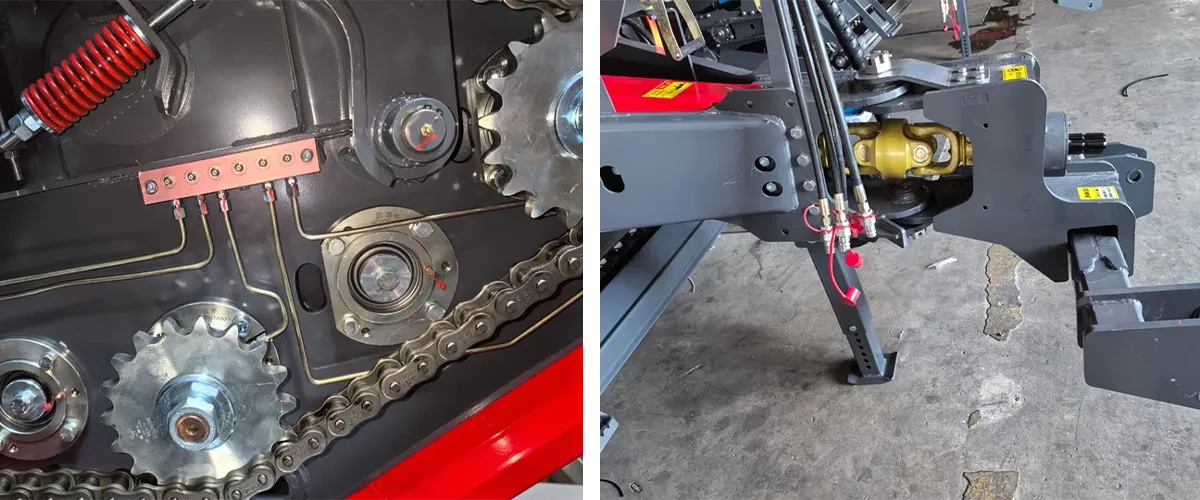
Drive chains manufactured for baler applications are held to ANSI B29.1 Class A pitch accuracy, which means the pin-to-pin distance across a 25-link span is held within 0.05% of nominal. This precision matters in alfalfa applications because pitch variation causes the chain to load the sprocket tooth inconsistently across its face — some engagement events hit the tooth root while others hit the tip. Over 15,000 bale cycles per season, each misaligned engagement removes material from a different point on the tooth flank, creating a wave-form wear pattern that causes the chain to become noisy and then to jump sprocket teeth under load. Class A pitch accuracy minimises this misalignment and extends the useful chain life before this failure pattern develops.
| Component | Manufacturing Specification | Key Manufacturing Control Variable | Effect on Alfalfa Wear Life |
|---|---|---|---|
| Compression rollers | 20CrMnTi, 58–62 HRC surface, 1.2–1.5 mm case depth | Carburising atmosphere gas composition and time | Correct case depth extends abrasion life to 2+ seasons in 4-cut alfalfa |
| Drive chain | ANSI B29.1 Class A pitch accuracy, heavy-series option | Pin-to-pin span tolerance over 25-link count | Minimises sprocket flank wear from inconsistent tooth engagement |
| Pickup tines | Spring steel, heat-treated, specific tip geometry | Tempering temperature and quench rate for spring hardness | Tip geometry retention determines pickup efficiency in dry late-cut conditions |
| Roller bearings | 6208-2RS sealed deep-groove, L10 >10,000 hr | Seal lip contact pressure and elastomer grade | Seal integrity determines actual bearing life in alfalfa dust and juice |
| Gate hinge pins | Case-hardened steel, surface ground | Pin-to-bore diametral clearance at assembly | Tight clearance reduces wobble growth per bale ejection cycle |
Material System: How Alloy and Treatment Choices Affect Lifespan in Alfalfa Conditions
Material selection in round baler wear components is a balance between competing performance requirements that become more acute in alfalfa than in other baling applications. For compression rollers, the abrasion resistance needed to survive silica-rich alfalfa dust conflicts with the toughness needed to survive the impulse loads when a dense, wet windrow slug enters the bale chamber at speed. For pickup tines, the spring hardness needed to recover after stone impact conflicts with the low-tip-force requirement needed to avoid shattering dry late-cut alfalfa leaves. For drive chain, corrosion resistance to plant juice conflicts with the chain stiffness needed to transmit high torque cleanly through the sprocket mesh.
The resolution of these conflicts in the EP commercial series uses a layered approach at each component. Compression rollers use the 20CrMnTi case-hardening alloy’s dual-zone structure — hard abrasion-resistant surface over a tough, shock-absorbing core. Pickup tines use spring steel processed to a specific tempering profile that achieves enough spring hardness to return after moderate deflection but does not become brittle enough to shatter on stone impact. The tempering temperature window for alfalfa-duty tines is narrower than for cereal straw tines because alfalfa fields (particularly irrigated ones) are managed to minimise stone presence, so the tine can be tempered slightly softer to reduce tip impact force at the cost of some stone tolerance — a trade-off appropriate to the specific application context.
Drive chain in the heavy-series specification uses a pin and roller cross-section 40% larger than standard agricultural chain, which reduces the contact stress at the pin-to-bush interface. Lower contact stress means slower bush bore wear and slower pin diameter wear, which in turn means the chain reaches the 3% elongation replacement threshold later in its operating life. The additional material in the link plate side faces also provides a larger wear volume against the sprocket tooth side load, extending the time before the chain develops the lateral looseness that produces the characteristic rattle and misalignment under load that signals approaching replacement. In four-cut alfalfa where the chain operates under sustained high tension during first-cut baling and then under lower but abrasive tension during dry fourth-cut baling, this additional cross-section provides meaningful protection across both regimes.
| Component | Material / Treatment | Alfalfa-Specific Design Trade-off | Failure Indicator |
|---|---|---|---|
| Compression rollers | 20CrMnTi, carburised, 58–62 HRC / 30–35 HRC core | Hard surface vs tough core; case depth critical for 4-cut life | Bale core density drop; surface feels smooth against straight-edge |
| Output shafts | 42CrMo4, quench & temper, h6 precision ground | Fatigue resistance vs fretting corrosion at bearing fits | Bearing axial creep; fretting oxide at bearing seat |
| Drive chain (standard) | ANSI B29.1 Class A, standard pitch | Pitch accuracy vs corrosion resistance to plant juice | 3% elongation over 25-link span; lateral rattle under load |
| Drive chain (heavy-series) | 40% larger pin and roller; ANSI B29.1 Class A | Higher contact area vs slightly higher mass — trade-off acceptable for 4-cut use | Same 3% elongation criterion; longer time to reach it |
| Pickup tines | Spring steel, application-specific temper profile | Softer temper for lower tip impact (leaf preservation) vs harder for stone resistance | Tip radius measurement; permanent bend angle over 5° |
| Gearbox lip seals | FKM fluoroelastomer, spring-loaded dual lip | Chemical resistance to alfalfa juice vs cost vs NBR seals | Oil weep at shaft exit; contaminated gear oil |
Drive Chain Wear in Alfalfa: Measuring Elongation and Setting Replacement Thresholds
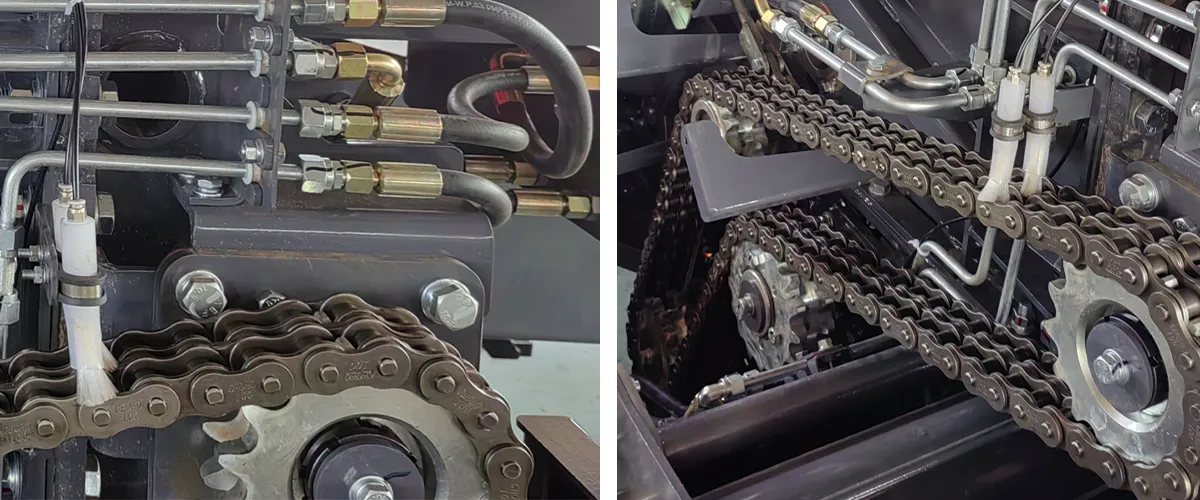
Drive chain is the round baler part with the most predictable wear curve — and therefore the most manageable replacement planning — in alfalfa baling. Chain elongation is a measurable and repeatable indicator of wear progression that does not require specialist equipment beyond a ruler and a knowledge of the chain’s nominal pitch. The standard measurement method is to tension the chain on the sprocket, measure the distance across 25 consecutive links, and compare against the nominal 25-link span. At 1% elongation, the chain is still within normal operating range. At 2%, inspection frequency should increase. At 3%, replacement is indicated before continuing — at this elongation level, the chain is riding up the sprocket tooth faces rather than seating in the tooth root, and continued operation accelerates both chain and sprocket wear rapidly.
In alfalfa conditions, the time to reach 3% elongation depends on the chain specification and the bale cycle count. Standard-pitch agricultural chain (ANSI B29.1 Class A) in four-cut irrigated alfalfa conditions typically reaches 3% elongation in 4,000–6,000 bale cycles in the most heavily loaded circuit — the main compression roller drive. The heavy-series option with 40% larger pin and roller extends this to 6,000–9,000 bale cycles, roughly corresponding to a full four-cut season in a 500 ha operation. This extension is the primary commercial argument for specifying the heavy-series chain in large-scale alfalfa operations, where fitting the replacement cost of one chain set against the cost of unplanned downtime makes the heavier specification clearly the better value proposition.
A complicating factor in alfalfa chain wear is corrosion from plant juice. The mildly acidic juice from wet first-cut alfalfa promotes corrosion at the chain link pin-to-bush clearance, which is the internal wear zone that elongation measurement captures. If the chain is not adequately lubricated at the time of juice exposure — for example, if the lubrication interval was missed before the first cut of the season — the juice-to-metal contact time at each pin engagement is long enough to etch the pin surface. Etched pin surfaces have a higher friction coefficient against the bush bore, which accelerates elongation independently of the mechanical load. This is why the pre-cut chain lubrication check is not optional in alfalfa programmes: it is the step that prevents an otherwise manageable first-cut load from triggering premature elongation.
CHAIN REPLACEMENT THRESHOLD
Measure 25 consecutive links under tension on the drive sprocket. Replace the chain when the measured span exceeds the nominal value by 3%. Do not wait for the chain to jump sprocket teeth — by this point, the sprocket tooth flanks have been damaged by the climbing chain and the sprocket will need replacement alongside the chain, which multiplies the cost. In four-cut alfalfa, check elongation before each cut, not just at season end.
Pickup Tine Wear in Alfalfa: Lifespan Factors and Replacement Triggers
Pickup tines are the shortest-lived wear item in an alfalfa round baler parts inventory by bale cycle count. Their service life is variable because they are subject to two distinct failure modes that operate at very different rates: abrasive tip wear, which is gradual and predictable, and stone-impact bend, which is sudden and unpredictable but manageable if the field is well-managed before baling. In four-cut irrigated alfalfa, where stone presence is typically low and crop management quality is generally high, abrasive tip wear is the dominant failure mode, and tine life becomes more predictable and plannable.
In managed irrigated alfalfa conditions with low stone risk, spring steel tines with the appropriate tempering profile can reasonably be expected to deliver 4,000–8,000 bale cycles before tip radius loss is significant enough to reduce pickup efficiency in dry late-cut conditions. In unmanaged dry-land alfalfa with higher stone presence and more variable windrow quality, the stone-impact failure mode pushes effective tine life down to 2,000–4,000 bale cycles depending on field conditions. For a 500 ha four-cut irrigated programme at 8,000–10,000 bales per season, this means tines are a per-season replacement category, and having a full set of spare tines at the start of each season is standard operating practice, not a precautionary measure.
The most important tine inspection criterion in alfalfa is not just tip wear — it is permanent set angle. A tine that has taken a permanent set of more than 5 degrees from its designed working angle will not follow the correct pickup arc relative to the pickup drum housing, causing the tine to either under-reach the windrow (missing crop and reducing pickup efficiency) or over-reach and strike the pickup drum housing (generating noise and potentially cracking the tine mounting bracket). Inspect tines with a simple angle gauge or by comparing against a known-good tine alongside the suspect one on a flat surface. Any tine with a visible angle deviation should be replaced before the next baling session.
| Field Condition | Expected Tine Life (bales) | Dominant Failure Mode | Inspection Frequency |
|---|---|---|---|
| Irrigated, low stone, 4 cuts | 4,000–8,000 | Tip radius wear (gradual) | Before each cut |
| Dry-land, moderate stone | 2,000–4,000 | Stone impact bend + tip wear | Before each cut + after every 200 bales in poor fields |
| Dry-land, high stone | 500–2,000 (highly variable) | Stone impact bend (sudden) | After every 100 bales; carry spares in field |
Featured Round Baler: 9YG-2.24D — Parts Designed for Extended Alfalfa Service Life
The wear rates described throughout this article are based on the specific component specifications used in the 9YG-2.24D series. Its 18-roller 222 mm diameter compression chamber, 20CrMnTi roller alloy specification, 6208-2RS sealed deep-groove bearings, and IP65-sealed gearbox housing are all calibrated for multi-season commercial alfalfa use. Understanding the expected component lifespans in this machine allows operators to plan seasonal maintenance budgets accurately and to hold the right spare parts inventory without over-stocking. Explore the full range of round baler models to find the configuration best suited to your alfalfa operation’s scale and power budget.
Translating Wear Rates into a Planned Maintenance Schedule for Alfalfa Round Baler Parts
Mapping the wear rates for rollers, chains, and tines to a practical maintenance schedule requires converting bale cycle estimates to seasonal timelines based on the farm’s actual throughput. The schedule below is calibrated for a four-cut irrigated programme producing 8,000–10,000 bales per season, using the 9YG-2.24D as the reference machine. Farms with different throughput should scale the bale-based intervals proportionally.
Before Each Cut
Inspect all pickup tines for permanent set (over 5°) and tip radius wear. Lubricate all chain drive circuits. Check gearbox shaft seals for weeping — plant juice from the previous cut may have migrated past the seal face. Verify roller bearing seals visually; any evidence of dust accumulation in the seal lip area warrants replacement before the cut begins.
Every 50 Operating Hours
Measure chain elongation across 25 links; record and compare to previous reading to track rate of change. Grease all eight auger end bearing points. Check gate hinge pin clearance by rocking the gate by hand — any play exceeding 2–3 mm at the pin location indicates wear that will accelerate if left. Replace worn tines found at this check before continuing.
End of Season — 8,000+ Bales
Full gearbox oil change in both units using ISO VG 220 EP-rated gear oil. Replace all FKM fluoroelastomer lip seals regardless of appearance. Check compression roller surface profile against new-roller reference; if deviation exceeds manufacturer’s limit, plan roller replacement before next season. Replace drive chain if elongation is above 2% — this avoids mid-season replacement during the following cutting programme.
End of 2nd Season — 16,000+ Bales
Plan compression roller set replacement regardless of profile measurement — by this bale count in four-cut alfalfa conditions, the abrasion history is sufficient to bring the roller surface close to the grip-loss threshold even if the profile measurement still reads within tolerance. Replace gate hinge pins and pivot bushes as a matched set. Re-torque all critical fasteners at pivot points and frame brackets after the season’s fatigue loading.
Regulatory Requirements Affecting Round Baler Parts, Maintenance and Gearbox Standards
Round baler maintenance practices — including when worn parts must be replaced and what standards apply to driveline components — are increasingly governed by formal regulatory frameworks in major alfalfa-producing markets. Operators buying replacement round baler parts and maintaining gearbox systems in commercial alfalfa operations should be aware of the requirements listed below.
| Region | Key Standard / Regulation | Relevance to Round Baler Parts and Maintenance |
|---|---|---|
| Zuid-Korea | Agricultural Mechanization Promotion Act; KS B ISO 11684 (PTO safety); NAAS machinery evaluation; MAFRA Livestock Products Sanitary Control Act | Machinery must maintain functional driveline guarding as a condition of continued NAAS compliance and subsidy eligibility. Worn PTO guards and gearbox covers that no longer meet KS B ISO 11684 specifications must be replaced. MAFRA silage quality standards indirectly require that baler parts maintain adequate bale density performance — degraded rollers producing out-of-specification density can affect silage feed safety compliance. |
| European Union | EU Machinery Directive 2006/42/EC; EN ISO 4254-7; EC No. 183/2005 (feed hygiene); GMP+ certification in Netherlands and Germany | Replacement parts used in CE-marked machinery must not reduce the machine’s safety classification. Gearbox replacement must use components with equivalent IP rating and torque specification. GMP+ audited alfalfa silage operations require documented maintenance records including part replacement history as part of the production process traceability file. |
| United States | ASABE S206.5 (PTO shaft guarding); OSHA 29 CFR 1928.57; FDA FSMA 21 CFR Part 507 | Worn PTO guards must be replaced — OSHA 1928.57 requires functional driveline guarding on all farm equipment operating with employees present. FSMA Part 507 requires commercial alfalfa silage producers to document hazard controls including equipment maintenance records. |
| Japan | Agricultural Machinery Act; Feed Safety Law; JIS B 7001; NARO type certification | Type-certified balers operating under NARO approval must be maintained with equivalent-specification replacement parts that do not alter the machine’s certified configuration. Gear lubricants must comply with JIS K 2219; non-compliant lubricants in gearbox systems may affect warranty status and NARO certification standing. |
| Australia | AS/NZS ISO 11684; Safe Work Australia Mobile Plant Code; state farm safety acts | PTO guards and gearbox covers in a state of wear that reduces their guarding function must be replaced before the machine is returned to commercial service. South Australia’s Work Health and Safety (Primary Industries) Regulations require documented pre-season equipment safety inspections covering driveline components. |
| Canada | CSA Z96 (PTO guarding); Feeds Act SOR/83-593; provincial farm safety codes | Alberta’s Occupational Health and Safety Code Part 36 requires that farm equipment driveline components maintain their guarding function and that worn guards are replaced. Feeds Act alfalfa silage quality requirements are affected by baler maintenance status if density records show degradation attributable to worn compression components. |
| Brazil | ABNT NBR 15827; MAPA registration; NR-12 machinery safety | NR-12 requires that machinery safety devices including PTO guards and protective covers be maintained in functional condition. Worn driveline components that create exposed rotating parts are a non-compliance situation under NR-12. MAPA-registered balers must be serviced with compatible replacement parts that maintain the registered configuration. |
Compatible Replacement Components: One-Source Supply for Round Baler Parts in Alfalfa
Sourcing replacement round baler parts from the same supply chain as the original machine removes the specification uncertainty that arises when third-party components with unknown tolerance grades are fitted. In alfalfa applications where parts lifespan is already compressed compared to other crops, fitting a replacement chain of lower pitch accuracy than the original will shorten the next replacement interval and cause premature sprocket wear in the process. The two component categories below are specified for compatibility with the EP round baler commercial series.
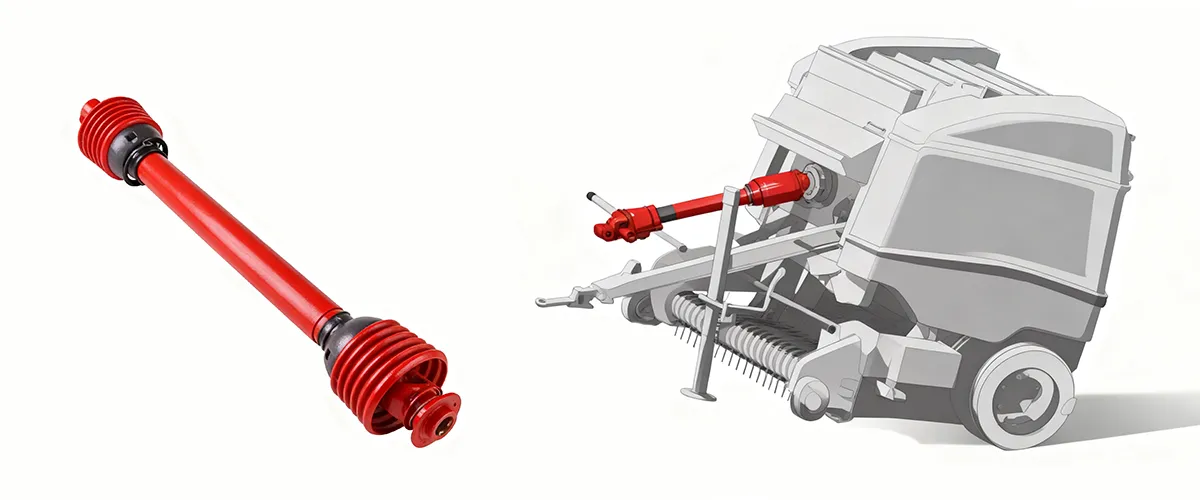
Agricultural PTO Shaft for Round Balers
The EP-PTO shaft series connects to the 9YG-2.24D gearbox input at 1-3/8-inch Z6 spline, 540 RPM, with length adjustable from 600 to 1200 mm. Rated for continuous torque above 500 Nm — the sustained level present during first-cut wet alfalfa baling at maximum chamber pressure. The PTO shaft is a wear item itself, and the universal joint crosses in the articulated design should be inspected at the same 50-hour interval as the chain elongation check. Grease purging from the cross grease nipple is normal; absent purging indicates the grease port is blocked and the cross is running dry. PTO shaft replacement using the original-specification articulated universal joint design ensures the baler gearbox sees the same smooth torque curve that the original shaft provided, not a replacement with higher angular velocity variation that increases baler gearbox load at each cross-plane. A full-range worm gear reducer series is available from the same supply chain for non-standard drive requirements.
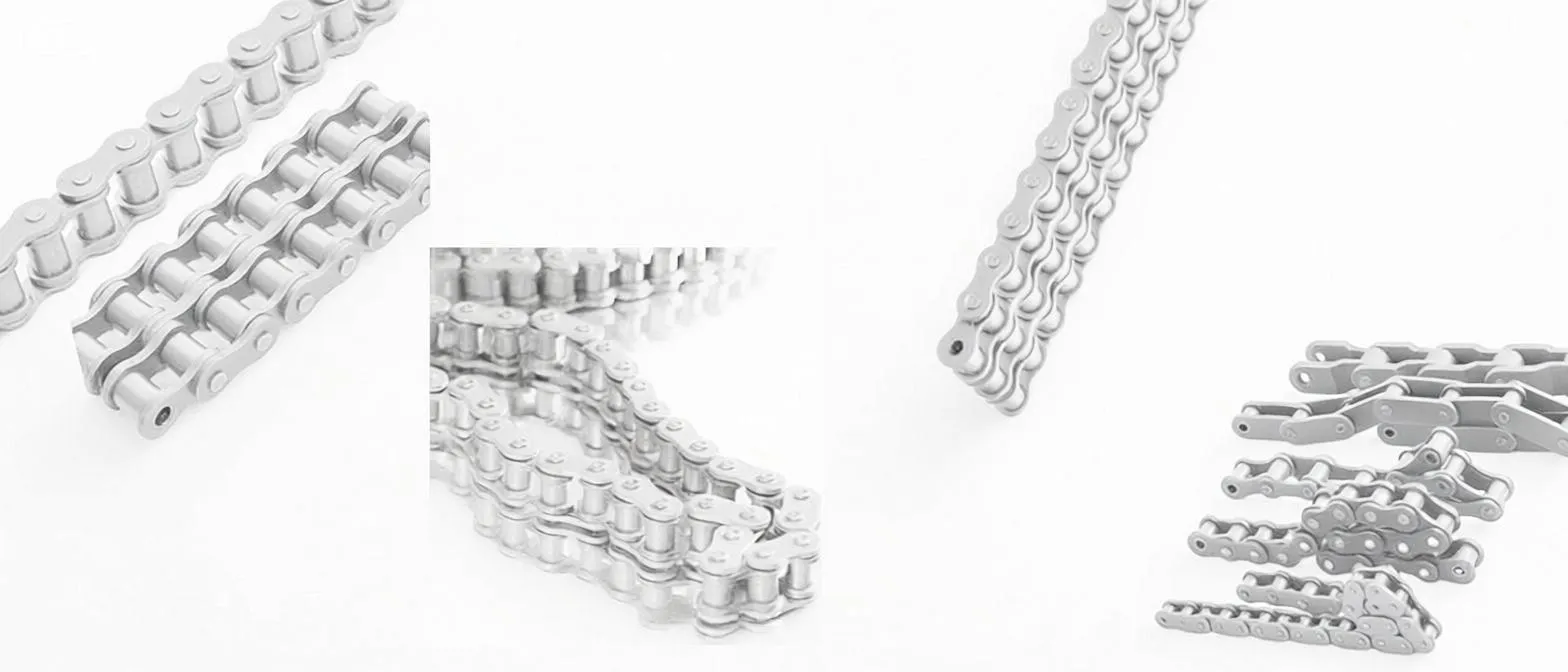
Agricultural Chain for Round Baler Drive Circuits
Replacement agricultural chain for the EP round baler series is specified to ANSI B29.1 Class A pitch accuracy, matching the original chain’s engagement geometry at every sprocket tooth. The heavy-series option — with 40% greater pin and roller cross-section than standard-pitch chain — is the correct specification for four-cut irrigated alfalfa programmes where the main compression roller drive chain operates under sustained high tension during first-cut baling. Chain sets are offered in matched-length configurations for both the primary compression roller circuit and the auxiliary pickup-and-feeder circuit, with the two circuits specified at different pitch grades to match their respective load profiles. Fitting a heavy-series replacement in the primary circuit while retaining a standard chain in the auxiliary circuit is a valid approach for operations where budget favours staged replacement, as the primary circuit chain reaches the 3% elongation threshold approximately 50% sooner than the auxiliary circuit chain in high-volume alfalfa conditions.
About Our Agricultural Machinery Manufacturing Operation
Founded in 2013, our operation has spent over a decade building a comprehensive agricultural machinery manufacturing enterprise within the farming and animal husbandry sector. The product line covers light and heavy round balers, single and double blade mowers, disc rotary mowers, and single and double side rakes — all produced under ISO 9001 Quality Management System certification with independent import and export rights. The facility operates more than 60 sets of large-scale production equipment, including CNC laser cutting systems, automatic MIG welding lines, and electrostatic powder-coating production lines, supporting an annual design capacity of 2,000 units. Close to 100 registered patents support the product range. Every baler that leaves the production line is load-tested on a dedicated PTO test bench before shipping, verifying that the compression chamber, gearbox output, and driveline alignment are within the production specification before the unit is dispatched. This pre-shipment verification step is part of the commitment to ensuring that the wear rates and service intervals documented in materials like this article represent the machine as it actually performs in the field, not as it was designed on paper.
Frequently Asked Questions
Q1. How long do compression rollers last on a round baler running four-cut irrigated alfalfa in South Korea?
Q2. What is the best way to check drive chain wear on a round baler machine used for alfalfa baling?
Q3. Which round baler parts wear out fastest in alfalfa compared to grass hay and how should I budget differently for alfalfa?
Q4. How do I know if my round baler rollers have worn beyond their useful life in an alfalfa programme without measuring instruments?
Q5. When should I replace pickup tines on a round hay baler running irrigated alfalfa and what are the signs of tine failure?
Q6. What round baler gearbox oil should I use in alfalfa conditions and how often should I change it?
Redacteur: PXY