Corn Silage & Stover Baling — Technical Deep Dive
For operations harvesting corn stover or producing high-moisture corn silage bales, the engineering inside your round baler gearbox is not a background detail — it is a direct factor in how much material you leave behind at the field ends, and how reliably the machine cycles through the turning sequence without dropping density or fouling the feeder.
Why Headland Losses Matter More Than Most Operators Realize
Every time a tractor-and-baler combination reaches the end of a row and swings through a headland turn, the machine undergoes a complex mechanical event. The pickup drum is still rotating, the PTO shaft continues delivering torque, and the bale chamber is mid-cycle — yet the lateral load vector shifts abruptly as the tractor steers. In long-row corn fields, where individual rows can run 400 to 800 metres, these headland sequences occur less frequently than in segmented paddock systems, but each turn demands far more from the driveline when the baler is carrying a half-formed, high-density corn stover core. A poorly engineered power transmission path at this moment causes incomplete bale formation, excessive twine or net consumption, and — in the worst cases — hydraulic pressure spikes that prematurely wear the bale chamber rollers.
The shift toward dual-coupled gearbox architecture in modern round baler drivetrains directly addresses this vulnerability. Rather than routing all PTO-derived torque through a single transmission stage, dual-coupled designs split and re-synchronise the mechanical load across two matched gearbox units operating in tandem. The result is a measurable reduction in peak torque spikes during headland events, smoother power delivery to the feeder rotor, and significantly better bale density consistency across the full harvest cycle — including during those critical turning phases where material flow is most unpredictable.
Manufacturing Structure of the Dual-Coupled Gearbox System
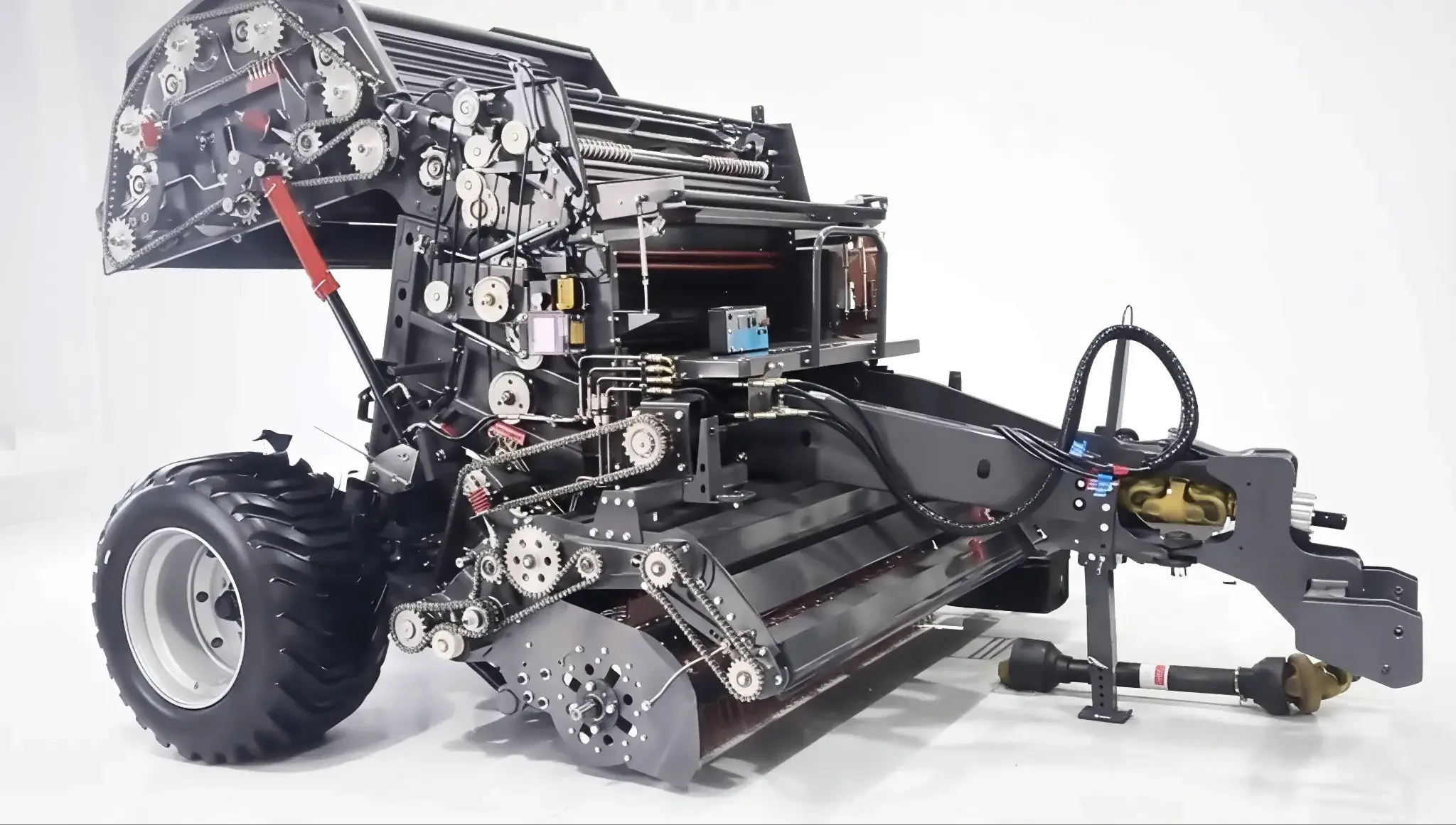
The physical architecture of a dual-coupled gearbox assembly begins at the input flange, where the PTO shaft connects at a standard 540 RPM rotational speed via a 1-3/8-inch Z6 spline interface. At this connection point, incoming torque — typically exceeding 500 Nm under full corn stover load — enters the primary gearbox housing. The first gearbox stage performs the primary speed reduction, bringing the high-speed PTO rotation down to the intermediate drive speed required by the bale chamber roller array. On the 9YG-2.24D series, this intermediate output feeds both the main compression roller chain drive and a secondary input shaft leading directly into the coupled auxiliary gearbox unit.
The secondary gearbox operates as a torque-equalising stage. Its internal gear train mirrors the reduction ratio of the primary unit but is calibrated to handle the variable-load character of the axial-flow feeder mechanism rather than the more predictable compression roller circuit. During headland turns, when the rate of material entering the pickup fluctuates sharply, this secondary stage acts as a buffer — absorbing the instantaneous load changes without transmitting them as shock loads back through the main chain drive. The two housings are rigidly coupled by a short intermediate shaft with a torsional damper element, which absorbs residual vibration that neither gear stage fully suppresses on its own.
The case geometry of each housing is CNC-machined from ductile iron. All internal shaft bores are line-bored in a single setup, which is the critical manufacturing step that ensures concentricity between input and output bearings. Without this step, even small angular misalignments in the gear mesh translate into audible noise under load and accelerated flank wear on the helical tooth profiles. The housings are then paired, and the external mounting face is machined as a matched set — meaning the two housings are not interchangeable with housings from different pairs. This matched-pair approach is more expensive to manufacture than using interchangeable housings, but it eliminates the parasitic vibration modes that arise when two independently-made housings are bolted together in the field.
| Component | Primary Gearbox Stage | Secondary (Auxiliary) Stage |
|---|---|---|
| Housing material | CNC-machined ductile iron | CNC-machined ductile iron (matched pair) |
| Input interface | 1-3/8” Z6 spline, 540 RPM | Intermediate shaft from primary output |
| Gear tooth profile | Helical, carburised and ground | Helical, carburised and ground |
| Rated torque | > 500 Nm continuous | Variable load buffer, > 320 Nm peak |
| Bearing specification | 6208-2RS sealed, L10 >10,000 hr | 6208-2RS sealed, L10 >10,000 hr |
| Sealing standard | IP65 dustproof seal | IP65 dustproof seal |
| Inter-stage coupling | Rigid flanged intermediate shaft | Torsional damper element integrated |
Material System: What the Internal Components Are Made From and Why It Matters in Corn Stover
Corn stover is one of the more demanding baling materials from a tribological perspective. The combination of abrasive silica particles embedded in the stalk tissue, high sugar-and-moisture content in freshly harvested green stover, and the inherent variability of ear-residue density means that every component in the power transmission path is subjected to a chemically aggressive, mechanically irregular load environment. This is why the material choices inside a round baler gearbox are not interchangeable with those used in lighter hay baler drivetrains.
The gear blanks in the dual-coupled system are forged from 20CrMnTi alloy steel, a chromium-manganese-titanium case-hardening grade that achieves surface hardness in the range of 58–62 HRC after carburising and quenching, while retaining a tough, shock-absorbing core hardness of 30–35 HRC. This combination is specifically chosen because corn stover baling generates transient torque spikes — particularly when the auger-and-tine-roller feeder encounters a dense knot of interlocked stalks — that can momentarily exceed rated torque by 40 to 60 percent. A purely high-hardness gear tooth would chip or spall under these conditions. The tough core absorbs the spike energy and distributes it away from the surface contact zone.
Output shaft material is stepped up to 42CrMo4 (AISI 4140 equivalent), a chromium-molybdenum grade with significantly higher tensile strength and fatigue resistance than plain carbon steel. This matters at the shaft-to-bearing interference fit location, where fretting corrosion is a known failure mode in machines that operate in high-humidity silage conditions. The 42CrMo4 shaft is also more resistant to the minor surface oxidation that occurs when corn juice — which is mildly acidic — migrates past worn lip seals. Shafts are precision-ground to h6 tolerance on all bearing seats, ensuring the interference fits remain within specification throughout the L10 bearing life envelope of over 10,000 hours.
| Component | Material Grade | Treatment | Key Benefit in Corn Stover Use |
|---|---|---|---|
| Gear blanks | 20CrMnTi forged alloy steel | Carburised, quenched, ground | Hard surface + tough core for spike absorption |
| Output shafts | 42CrMo4 (AISI 4140 equiv.) | Quench & temper, precision ground h6 | Fatigue and fretting resistance in wet silage conditions |
| Housings | GGG50 ductile iron | CNC-machined, matched-pair line-bored | Dimensional stability; eliminates parasitic vibration |
| Bearings | 6208-2RS sealed deep-groove | Double-sealed, grease-packed | L10 >10,000 hr; corn chaff exclusion |
| Lip seals | FKM fluoroelastomer | Spring-loaded, dual lip | Resistant to acidic corn juice and silage leachate |
| Gear oil | ISO VG 220 EP gear oil | Change interval approx. 500 hr | Extreme pressure protection for helical tooth flanks |
The Mechanics of Headland Loss — and How Dual-Coupling Interrupts the Failure Chain
Headland loss in corn silage baling follows a fairly predictable sequence. As the tractor initiates its turn at the field end, the operator typically reduces forward speed to navigate the headland without over-running the bale. This speed reduction changes the rate at which material feeds into the pickup. The pickup tines continue rotating at a PTO-proportional speed, but the crop delivery rate drops below the threshold needed to maintain the bale core rotation. Without intervention from the driveline, the partially formed bale begins to lose its rotational momentum — the inner core slackens, and the density profile from the previous high-speed rows is disrupted.
A single-stage gearbox system has limited ability to compensate for this transition because its torque delivery curve is essentially fixed by the input-to-output ratio. As forward speed drops, PTO torque remains constant, but the mechanical advantage delivered to the bale chamber rollers does not automatically adjust to accommodate the lower material throughput. The result is either over-tensioned belts or chains during the low-feed phase, or under-tensioned components that fail to keep the bale core tight enough to restart clean rotation when the tractor accelerates back into the next row.
The dual-coupled architecture changes this dynamic in two measurable ways. First, the auxiliary gearbox stage continues to drive the feeder rotor at its calibrated speed independently of the main compression roller circuit speed. This means the auger-and-tine-roller system remains active and properly loaded even when the tractor is at minimal forward speed, preventing the pickup from going into what field operators describe as a “soft cycle” — a condition where the pickup tines engage the windrow but fail to deliver material with enough velocity to sustain core rotation. Second, the torsional damper element in the inter-stage coupling absorbs the mechanical shock of restarting the bale core at full throughput when the tractor accelerates back into the row. Without this damper, the restart event generates a torque spike that propagates through the entire driveline and is experienced as a hard jolt in the PTO shaft — a condition that accelerates wear in both the baler gearbox and the tractor’s PTO gearset.
TECHNICAL NOTE
Field data from long-row corn operations indicates that machines equipped with dual-coupled gearbox drivetrains produce bales with density variation of less than 8% between mid-row and headland-adjacent positions. Single-stage gearbox balers in comparable conditions typically show density variation of 18–25% at headland-adjacent bale positions — a gap that translates directly into inconsistent silage fermentation quality and increased net-wrap consumption per bale.
Interaction Between the Dual Gearbox and the Axial-Flow Feeding Mechanism
The 9YG-2.24D round baler’s feeding architecture — a three-stage Auger + Tine Roller + Drum system — was specifically designed to work with the dual-coupled gearbox’s power delivery characteristics. Understanding why the two systems are co-dependent requires a brief look at how the axial-flow mechanism distributes material across the bale chamber width.
When corn stover enters through the 2.24-metre pickup width, the auger flights gather the windrow and consolidate it toward the chamber centre. The tine rollers then take over, accelerating the material stream and distributing it evenly across all 18 compression rollers inside the variable chamber. The drum acts as a metering element — its rotational speed controls how quickly material is handed off from the tine rollers to the bale core. Each of these three sub-systems has a different optimal operating speed range, and a single fixed-ratio gearbox cannot simultaneously satisfy all three.
The dual-coupled design solves this by dedicating the primary gearbox to the drum and compression roller circuit — where consistent speed is the priority — and the secondary gearbox to the auger and tine roller circuit, where the load character is far more variable. During headland transitions, the secondary stage can momentarily absorb extra load from the tine rollers as they clear the last of the windrow, while the primary stage maintains roller speed to finish the bale already in the chamber. This separation of responsibilities is what prevents the characteristic “bale dropout” that operators describe when a partial bale exits the chamber before the wrapping sequence has completed — a loss mode that wastes both net and crop material.
Featured Round Baler: 9YG-2.24D for Corn Silage and Stover Operations
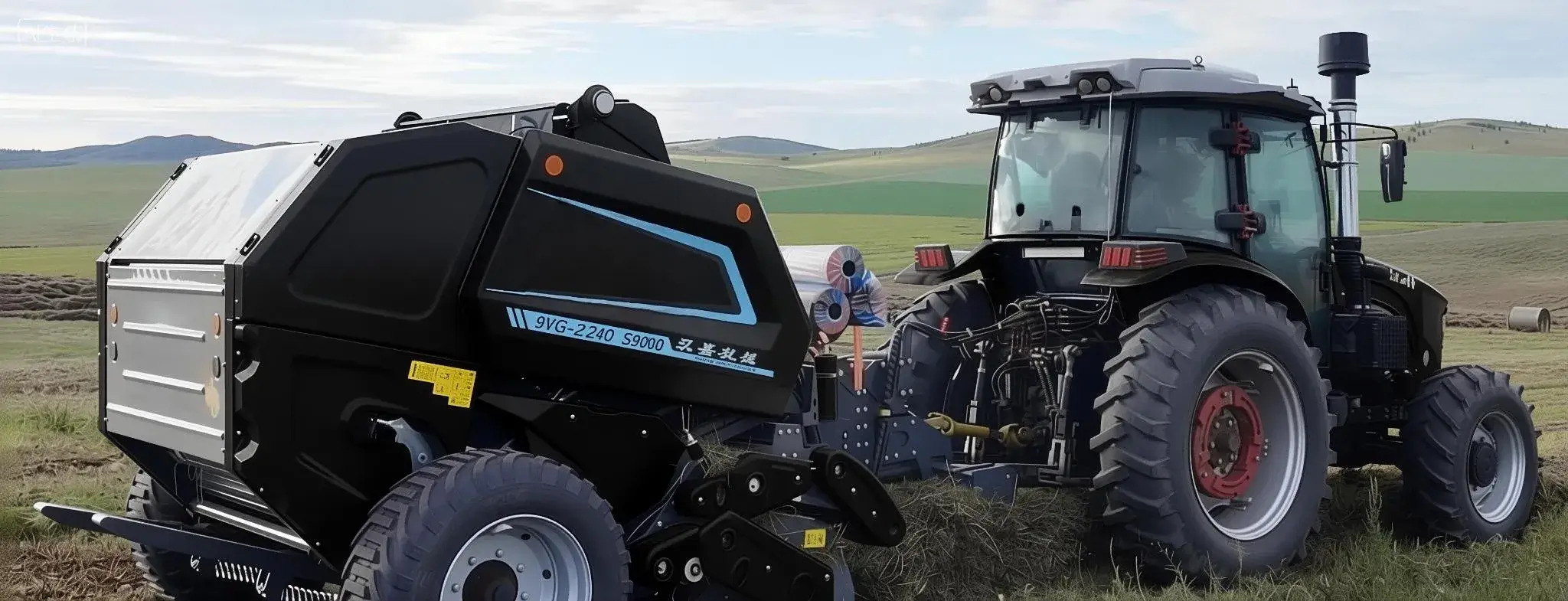
The 9YG-2.24D is the primary round baler model designed for large-scale corn stover and silage baling in fields where long rows and high-volume throughput are the operating reality. Its 2.24-metre pickup width, 18-roller variable compression chamber, and axial-flow feeding mechanism are all calibrated to work with the dual-coupled gearbox architecture described throughout this article. Key verified specifications include a machine structure mass of 3,922 kg, maximum road transport speed of 35 km/h, and a bale density range of 100–280 kg/m³ depending on material moisture and roller pressure setting.
Torque Load Distribution Across the Headland Cycle
Understanding the actual torque load distribution across a complete headland cycle helps explain why the dual-coupled design produces a meaningful reduction in drivetrain wear compared to single-stage alternatives. The cycle can be broken into four distinct phases, each with different mechanical demands on the gearbox assembly.
| Phase | Description | Gearbox Load Character | Dual-Coupled Response |
|---|---|---|---|
| 1 — Row end approach | Tractor decelerates, bale chamber near full | High compression load, decreasing feed rate | Secondary stage buffers feed-rate drop |
| 2 — Wrap & eject | Net wrapping sequence; bale drops from chamber | Momentary load release; roller unloading | Damper absorbs load release oscillation |
| 3 — Headland turn | Tractor steering at reduced speed, empty chamber | Low torque demand; risk of chain slack | Primary stage maintains minimum roller speed |
| 4 — Row re-entry & restart | Tractor accelerates; new windrow enters pickup | Sharp torque spike as bale core forms | Torsional damper absorbs restart spike |
Phase 4 is the most mechanically demanding moment in the cycle, and it is the phase most poorly handled by single-stage gearbox systems. The dual-coupled design’s ability to isolate the restart torque spike within the inter-stage damper element — rather than allowing it to propagate to the PTO shaft and tractor gearbox — is a significant factor in the extended service life reported for both the baler drivetrain and the tractor’s PTO output shaft when this combination is used consistently in long-row corn conditions.
Regulatory Framework Governing Round Baler Gearboxes and Agricultural Drivelines
Agricultural gearboxes used in round balers are subject to an evolving set of national and regional regulations covering mechanical safety, noise emissions, PTO standardisation, and — increasingly — agri-chemical residue management. Operators importing or purchasing round baler equipment for corn silage operations should be aware of the following regulatory environments.
| Region / Country | Relevant Standard or Regulation | Key Requirement for Baler Gearboxes |
|---|---|---|
| South Korea | Agricultural Mechanization Promotion Act (농업기계화 촉진법); KOLAS-accredited type approval via NAAS | Safety guarding of PTO driveshaft and gearbox must meet KS B ISO 11684 equivalent. Machinery subject to NAAS field performance evaluation before subsidy eligibility. |
| European Union | EU Machinery Directive 2006/42/EC; EN ISO 4254-7 (agricultural machinery — baling equipment) | CE marking required; driveline guards must comply with EN ISO 11684. Noise emission declaration required under 2000/14/EC. |
| United States | ASABE S206.5 (PTO shaft safety guarding); OSHA 29 CFR 1928.57 | PTO master shield must cover driveline to within 25 mm of tractor housing. Gearbox must not create nip or shear points accessible during operation. |
| Japan | Agricultural Machinery Act (農業機械化促進法); JIS B 7001 series | Type certification via Agriculture, Forestry and Fisheries Research Council. Gear lubricants must comply with JIS K 2219 specifications for agricultural use. |
| Australia | AS 1546 series; Safe Work Australia Code of Practice for Powered Mobile Plant | PTO guarding compliant with AS/NZS ISO 11684. Machinery imported for commercial use must carry supplier declaration of conformity with applicable harmonised standards. |
| Brazil | ABNT NBR 15827 (agricultural machinery safety); MAPA registration | Baler and gearbox assemblies must be registered with MAPA (Ministry of Agriculture). PTO shielding follows NR-12 occupational safety guidelines. |
| Canada | CSA Z96 series; provincial OHS farm safety regulations | PTO guarding follows CSA Z96 master shield standard. Saskatchewan, Alberta, and Ontario each have farm implement safety acts that govern driveline hazard guarding. |
For the South Korean market specifically, the Agricultural Mechanization Promotion Act mandates that machinery imported for use under the government’s farm mechanization subsidy programme must pass field performance and safety evaluations conducted by NAAS (National Institute of Agricultural Sciences). The 9YG-2.24D round baler’s IP65-sealed gearbox housings and KS B ISO 11684-compatible PTO guarding design are relevant compliance factors for buyers pursuing NAAS evaluation approval and subsidy eligibility under the Ministry of Agriculture, Food and Rural Affairs (MAFRA) support programme.
Impact on Silage Fermentation Quality: Why Bale Density Consistency Matters
The connection between gearbox engineering and silage quality is not immediately obvious, but it is direct and measurable. Corn silage fermentation inside a wrapped round bale depends on two primary conditions: the exclusion of oxygen from the bale core, and the maintenance of sufficient moisture within the 60–70% range required for Lactobacillus-dominated anaerobic fermentation. Both conditions are directly influenced by bale density and uniformity — and bale density uniformity is directly determined by how consistently the round baler delivers torque to its compression rollers throughout the entire field operation, including during headland transitions.
A bale that enters the headland sequence with 90% of target density and exits with only 72% at its outer wrap layer has a structural problem: the lower-density outer zone compresses during stacking, creating micro-channels that admit atmospheric oxygen. Even brief oxygen ingress in the outer 80–100 mm of the bale is sufficient to initiate aerobic spoilage, which generates heat, consumes dry matter, and produces butyric acid — a fermentation endpoint associated with reduced palatability and depressed dry matter intake in cattle. In beef operations such as South Korean Hanwoo cattle farming, where silage quality has a direct impact on intramuscular fat deposition and marbling scores, this quality degradation carries a real economic cost that far exceeds the minor fuel saving that might appear to offset operating a lower-specification baler.
Maintenance Schedule for the Dual-Coupled Gearbox in Corn Stover Conditions
Corn stover is harder on seals and lubricants than grass or hay. The combination of abrasive chaff, crop juice, and high-humidity silage conditions means that the maintenance intervals appropriate for dry hay operations are not conservative enough for corn stover use. The following schedule reflects recommended intervals for continuous corn stover and silage baling operations.
Daily — Before Each Session
Inspect PTO shaft for grease purge from universal joint crosses. Check primary gearbox housing for oil weeping around shaft seals. Verify that the inter-stage coupling guard is intact and undamaged. Clear any accumulated corn chaff from around both gearbox housings — chaff can trap moisture and initiate external corrosion on the housing paint.
Every 50 Operating Hours
Grease both gearbox input shaft bearings via the external grease nipples. Check gear oil level in both housings via the sight glass or dip plug. Inspect the torsional damper element for cracking or delamination — a damaged damper must be replaced before the next session, as operating without it removes the key protection against restart torque spikes.
Every 500 Operating Hours
Full gear oil change in both housings using ISO VG 220 EP-rated gear oil. This interval is mandatory in corn stover conditions regardless of oil appearance — corn juice contamination is not always visually detectable until it has already degraded the oil’s extreme-pressure additive package. Inspect input shaft seal and replace if any weeping is observed. Recheck bearing preload on output shaft.
Compatible Components: One-Source Supply for Round Baler Drive Systems
Operating a round baler as a system — rather than sourcing the baler and its driveline components separately — reduces setup time, eliminates compatibility guesswork, and provides a single accountability chain when warranty claims arise. The following two categories of components are engineered and tested to work with the round baler gearbox systems described throughout this article.
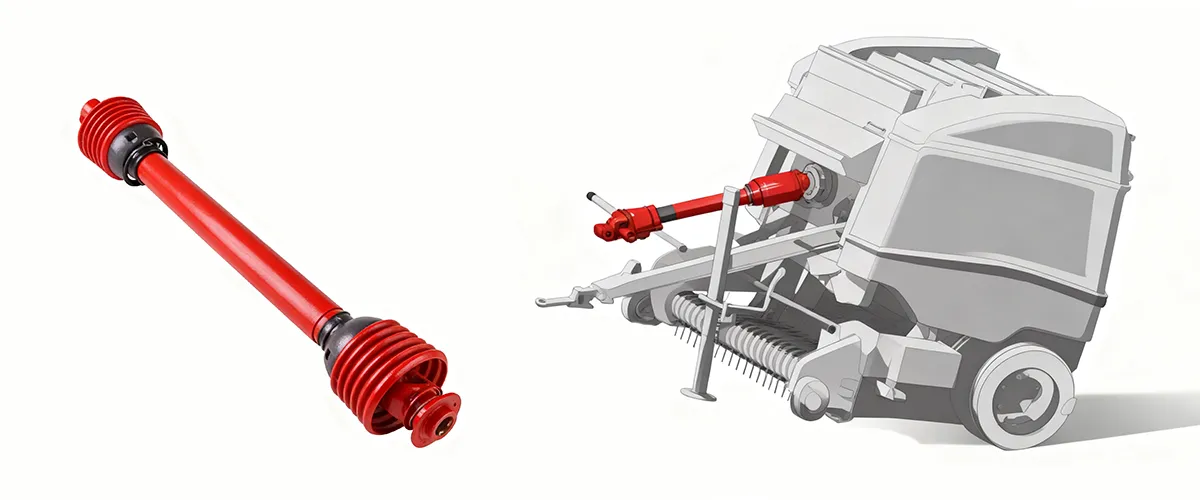
Agricultural PTO Shaft for Round Balers
The EP-PTO series is specifically engineered for round baler applications, with a 1-3/8-inch Z6 spline interface that matches the 9YG-2.24D gearbox input directly. Adjustable length range covers 600–1200 mm, accommodating a wide range of tractor-to-baler hitch distances without field modification. The shaft is rated for torque exceeding 500 Nm at 540 RPM continuous, with a 20% declared fuel-saving advantage over older oversize PTO shafts in comparable applications. The articulated universal joint design maintains smooth torque delivery through steering angles encountered during headland turns — a compatibility detail that reinforces the dual-coupled gearbox’s ability to control restart torque spikes.
Agricultural Chain for Bale Chamber Drive
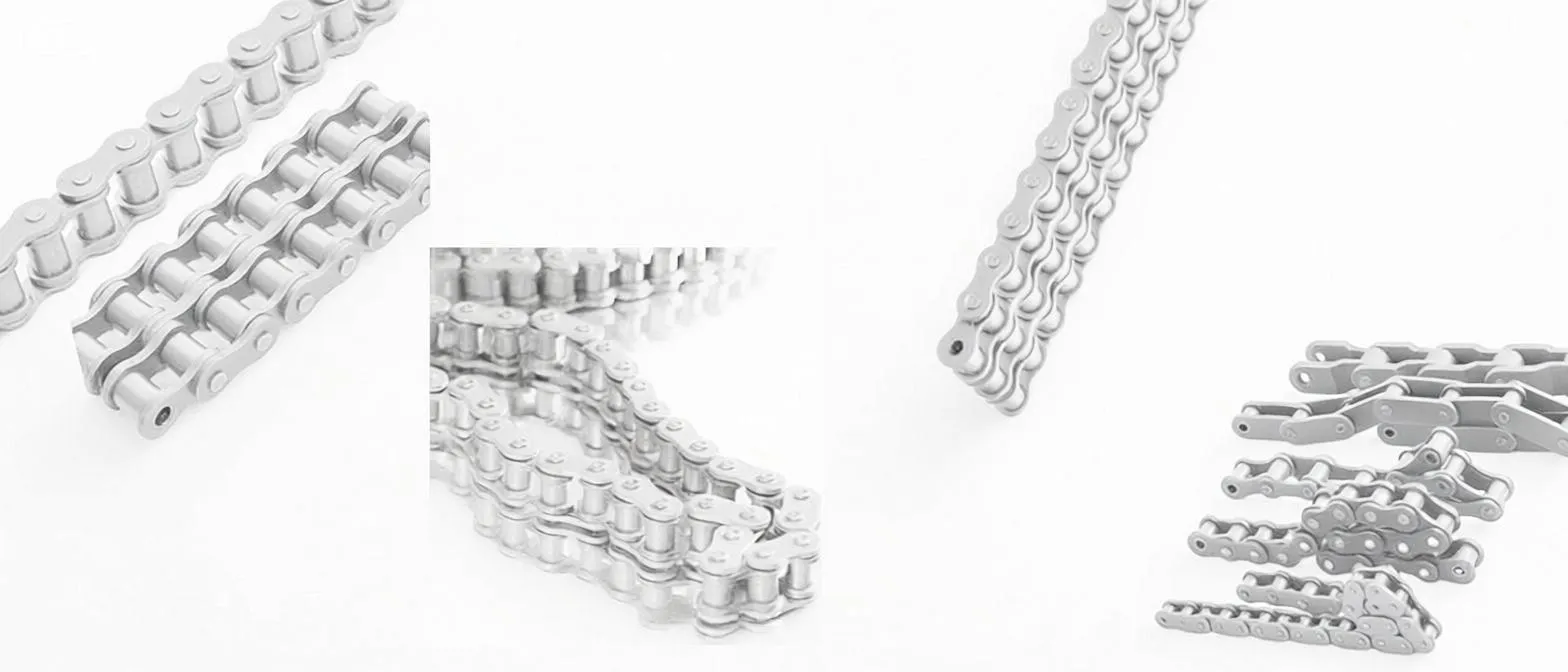
The reinforced chain transmission that connects the gearbox output to the bale chamber rollers is a consumable component that must be matched precisely to the dual-coupled gearbox’s output torque envelope. The agricultural chain sets supplied for the 9YG-2.24D system are manufactured to the same tolerance class as the gearbox sprockets they engage — pitch accuracy is held to ANSI B29.1 Class A, which minimises dynamic load variation as each chain link enters and exits the sprocket mesh. In corn stover conditions, chain wear is accelerated by abrasive fine particles. The available heavy-series chain option provides 40% greater pin and roller wear resistance compared to standard-pitch agricultural chain, extending replacement intervals significantly under high-abrasion harvest conditions.
About Our Round Baler Manufacturing Operation
Our production facility spans 40,000 square metres and is staffed by more than 260 engineering and manufacturing professionals. The facility operates a full complement of CNC laser cutting machines, automatic MIG welding lines, electrostatic powder-coating systems, and coordinate measuring machines for dimensional verification of gearbox housings and shaft assemblies. Every dual-coupled gearbox assembly is load-tested on a dedicated PTO test bench before installation — torque is applied at simulated field conditions including the transient spike profiles that characterise corn stover headland transitions. Units that do not meet the internal torque-consistency specification are rejected and remanufactured, not reworked in place.
OEM and ODM configuration services are available for buyers operating in specific regional markets where regulatory or agronomic conditions differ from standard configurations. The engineering team works directly with agronomists and machinery dealers in target markets to confirm that gearbox reduction ratios, PTO spline specifications, and maintenance schedules are appropriate for local tractor fleets and crop conditions. This manufacturer-to-market approach reduces the post-purchase adjustment period that commonly occurs when a baler is specced without reference to the tractor models actually in use on the buyer’s operation.
Mid-Scale Corn Stover Baling: 9YG-1.25A Round Baler
For operations running tractors in the 50–80 HP range — a common configuration across small and medium corn farms in South Korea, Japan, and similar East Asian markets — the 9YG-1.25A provides a matched-scale alternative that retains the core gearbox engineering principles of the larger 9YG-2.24D while adapting chamber dimensions and pickup width for smaller tractor power budgets. The machine produces bales of 1.25 m width and 1.20–1.50 m diameter, and its net wrap system is compatible with standard-width wrapping film available in most agricultural supply chains.
Frequently Asked Questions
Q1. How does a dual-coupled gearbox in a round baler actually reduce crop losses at the headlands of a long corn field?
Q2. What tractor HP is needed to run the 9YG-2.24D round baler efficiently for corn silage in Korean farming conditions?
Q3. Which round baler gearbox standard should I check for compliance when importing a baler into South Korea for use under MAFRA subsidy programmes?
Q4. How often should round baler gearbox oil be changed when baling green corn stover compared to dry hay operations?
Q5. What is the bale density range achievable in corn silage with the 9YG-2.24D, and how does that compare to older john deere round baler equivalents?
Q6. How does the axial-flow feeding system on these round balers prevent blockages during corn stover harvesting with a no-cam pickup?
Q7. Which round baler manufacturer offers OEM or ODM configuration for gearbox ratio and PTO spline spec when importing to East Asian markets?
Q8. When should I replace the torsional damper element in a round baler dual-coupled gearbox, and what are the signs it is failing?
Editor: PXY