1. What Is Corn Stover and Why Does It Matter for Biomass Energy?
Corn stover is the collective term for all the non-grain plant material left in a corn field after grain harvest — stalks, leaves, husks, cobs, and the upper portion of the root zone that remains above ground. It is the single largest agricultural residue stream in most corn-growing regions of the world, and in Korea, where corn cultivation spans approximately 70,000–90,000 hectares of upland and hillside fields primarily in Gangwon, Gyeonggi, and northern Chungbuk provinces, the annual stover resource represents a substantial biomass feedstock that has historically been underutilised. When corn grain is harvested at moisture contents suitable for storage (14–20%), the residual stover has dried to a moisture content of 30–60% in the standing phase, dropping to 15–30% once it has fallen or been cut and exposed to field drying for several days.
From a biomass energy perspective, corn stover has a lower heating value of approximately 17–18 GJ per tonne of dry matter, which compares favourably with wood chips at 19–20 GJ/t and is substantially above that of most agricultural residue straws. The cellulose and hemicellulose content of corn stover — typically 34–36% cellulose and 22–25% hemicellulose — also makes it an attractive feedstock for second-generation bioethanol production, where enzymatic hydrolysis breaks these structural carbohydrates into fermentable sugars. In Korea, the government’s Renewable Energy Portfolio Standard (RPS) and the associated 바이오매스 에너지 (biomass energy) promotion policies under the New and Renewable Energy Act (신에너지 및 재생에너지 개발·이용·보급 촉진법) have created commercial demand pathways for agricultural biomass including corn stover, making the logistical challenge of collecting and densifying this dispersed residue more economically attractive than in previous decades.
The fundamental logistical problem that any round baler operator faces with corn stover as a biomass feedstock is its low bulk density in the uncollected state. Loose stover lying on the field surface has a bulk density of only 30–60 kg/m³, making direct transport impractical and expensive. Compressing stover into round bales using a round baler machine brings this density up to 100–200 kg/m³ depending on the machine settings and stover moisture content, reducing the transport volume by a factor of 3–6 compared to loose material and making the entire round baler supply chain from field to biomass facility economically viable. The round baler is therefore not just a farm implement in this context — the round baler is an essential link in the biomass energy supply chain.
2. How a Round Baler Collects Corn Stover — The Complete Process
The corn stover collection process using a round baler begins after the grain combine has made its pass through the field. Modern combine harvesters are typically set to spread the stover across the full cutting width using their residue management systems, creating a loose, uniform distribution that is then raked into windrows before baling. In Korean upland corn fields, where field widths are often narrower and combine cutting widths smaller, the windrow may be formed by a side-delivery rake or the V-board deflector behind a two-row combine, producing a narrower but denser windrow that the round baler’s pickup reel can handle efficiently.
Once the stover is in windrow form, the round baler machine is tractor-towed along the windrow at a working speed of 5–20 km/h. The spring-tine or hammer-claw pickup reel — depending on the model — lifts the stover material off the ground and throws it backward through the crop feed zone into the compression chamber. In the 9YG round baler series, the axial-flow semi-forced feed mechanism that bridges the pickup exit and the chamber entrance handles corn stover particularly well because the absence of the conventional cam ring and pickup guard eliminates the bridging and blockage point that conventional baler designs experience when encountering the mixed particle sizes of stover material. Corn stalks range from the thin leaf blades down to thick base sections up to 25 mm in diameter, and this particle size mixture creates bridging risks in narrow-throated feed systems that the open axial-flow round baler design avoids.
Inside the compression chamber, the stover accumulates around the rotating roller assembly and is progressively compacted into a growing cylindrical bale. The sensor-controlled density system on the round baler monitors bale diameter growth through a star-wheel position sensor and adjusts the hydraulic back-pressure on the compression rollers to maintain the target density. When the bale reaches the operator-set target diameter — for example 1300 mm for the 9YG-2.24D models — the system triggers the automatic net-wrap cycle, which winds 2–3 passes of net around the bale to bind it securely before the rear gate opens and the bale is ejected onto the field surface for collection and transport to the biomass facility.
3. Action Modes: How the Round Baler Adapts to Stover vs. Other Crops
3.1 The Hammer-Claw Pickup Advantage for Corn Stover
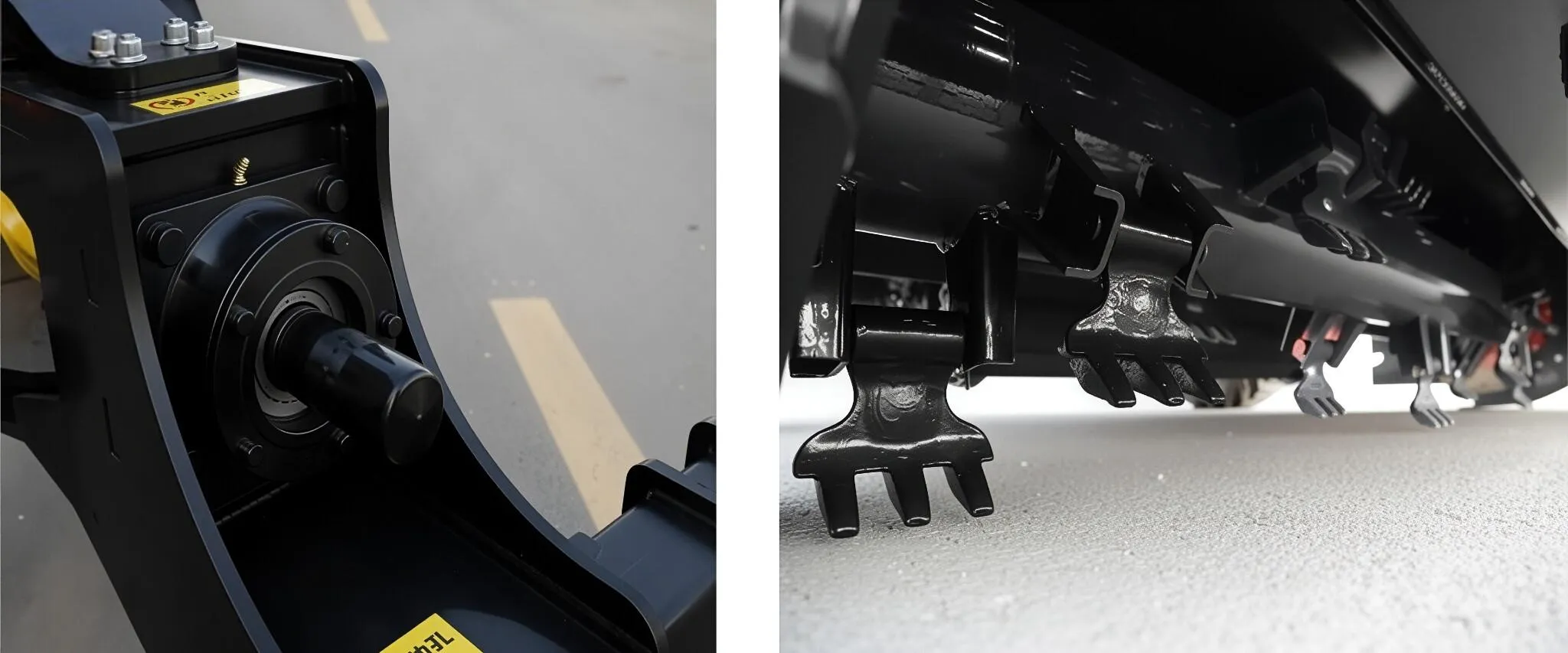
The most significant round baler configuration advantage for corn stover collection is the hammer-claw pickup option available on the 9YG-1.0C round baler and 9YG-1.25 Double round baler models. Unlike the standard spring-tine reel that is optimised for windrow-laid material, the hammer-claw pickup uses rotating flail-type fingers that actively engage and collect standing corn stalks that have not been cut and windrowed. For a Korean corn farmer who wants to collect stover immediately after grain harvest without a separate cutting and windrowing pass — saving one complete field operation — this capability is economically and logistically significant. The hammer-claw collects stalks from a standing position, shreds them to a manageable length during pickup, and delivers a partially pre-chopped feed stream to the compression chamber that actually compresses more efficiently than whole-length stalks because the shorter pieces interlock and pack more tightly.
For windrow-laid stover, the round baler spring-tine pickup performs well and is the more appropriate choice because it causes less physical damage to the stover material, preserving the structural cellulose chains that are important for bioethanol production feedstock quality. Spring-tine pickup at 5–12 km/h over a windrow of raked stover produces a continuous, controlled feed rate into the bale chamber that the axial-flow feed system handles smoothly without the surge-and-stall pattern that narrow-throated conventional feed systems often exhibit with mixed particle size material.
3.2 Compression Chamber Behaviour with Corn Stover
Corn stover presents a different compression challenge compared to grass hay or rice straw because of its particle size variation and relatively high lignin content. Lignin — the structural polymer that binds the cellulose fibres in the stalk — is highly resistant to compression at ambient temperature and tends to cause the bale to spring back after compression force is removed. This spring-back means that achieving a round baler target bale density of 150–200 kg/m³ in corn stover requires higher sustained hydraulic pressure than would be needed for the same density in ryegrass hay. The hydraulic density control on the 9YG-2.24D round baler series can be set to the 160–200 bar range appropriate for stover, where the higher compression force overcomes the lignin spring-back and produces a stable, dense bale that retains its shape after ejection. Poorly set machines that cannot hold this pressure consistently produce irregular, low-density bales that deform after ejection and are difficult to transport and store effectively in a biomass supply chain context.
3.3 Ejection and Gate Action in Stover Service
A fully compacted corn stover bale is a relatively firm, stable object that ejects cleanly from the round baler’s rear gate when the gate opens. The fibrous, interlocked nature of the compressed stover means there is less adhesion between the bale surface and the compression rollers than occurs with moist silage grass, so the gate-opening hydraulic force required is generally at the lower end of the system’s operating range. However, the heavy 20A chain drive used in the S9000 series is still appropriate for stover service because the peak torque spikes during the compression buildup phase — when the bale core is forming and the chamber resistance is variable — can briefly exceed what a lighter chain grade would safely handle before settling into a steady working load.
4. Manufacturing Structure: Engineering for Heavy-Duty Stover Collection
Corn stover collection places distinctive structural demands on a round baler machine because it combines the high-volume, abrasive characteristics of cereal straw with the particle size variability and occasional rigid stalk sections of a heavier crop. Every round baler built for corn stover biomass service needs a manufacturing structure that anticipates these combined demands rather than being optimised for any single crop type.
The main chassis frame — CNC laser-cut from high-strength structural steel plate and MIG-welded with full-penetration joint preparation — carries all the dynamic loads imposed by the baling cycle. In stover service, these loads include the intermittent shock events generated when the pickup reel encounters dense patches of stover material, as well as the sustained high-compression loads during the bale density buildup phase. Post-weld precision machining of the compression roller mounting bores ensures that all 16 or 18 rollers maintain their designed radial position even after the thermal distortion introduced by welding — a precision step that is invisible once the machine is assembled but which has a significant effect on bale geometry consistency across thousands of operating cycles. Bales with inconsistent internal geometry are harder to transport efficiently in biomass supply chains because they stack less securely on trailers and in storage yards.
The rear gate hinge system deserves particular attention in the biomass supply chain context. In a dedicated stover baling operation, a biomass contractor may produce 200–500 bales per working day, meaning the round baler rear gate opens and closes 200–500 times in a single shift. Over a full autumn corn stover season of 20–30 working days, this accumulates to 4,000–15,000 gate cycles — a demand that fully exercises the durability margins of the hinge pins, spherical bearings, and cushion cylinder design. The gusseted hinge flanges on the 9YG-2.24D gate distribute the opening cylinder reaction force across a broad structural area rather than concentrating it at bolt holes or simple butt weld joints, which is the configuration most vulnerable to fatigue crack initiation under repeated high-cycle loading.
Chassis Frame
CNC laser-cut structural steel. Full-penetration MIG welds. Post-weld bore machining for geometric consistency in high-cycle stover service.
Gate Hinge System
Gusseted flanges, hardened pins, spherical bearings, cushion cylinder. Rated for 4,000–15,000 gate cycles per stover season in commercial biomass operations.
Dual Gearbox Tongue
90° lateral rotation each side. Rigid drawbar connection prevents torsional shock transmission in uneven stover field conditions.
Hammer-Claw Pickup
Available on 9YG-1.0C and 9YG-1.25 Double. Collects standing corn stalks directly — eliminates separate cutting pass in biomass collection workflow.
5. Material Systems That Survive Corn Stover’s Abrasive Demands
Corn stover is one of the most materially demanding crops a round baler machine will encounter in its working life. The combination of silica deposits in the stalk epidermis (similar to rice straw but with larger, harder particles in the node sections), the abrasive cob fragments that mix into the stover stream when combine settings leave cob material in the windrow, and the intermittent hardened base sections of the stalks creates a crop environment that tests every material in the machine’s crop-contact zone more severely than softer crops do. Choosing a round baler with material systems rated for this environment is a critical decision for biomass operators who plan to run high annual hours in stover service.
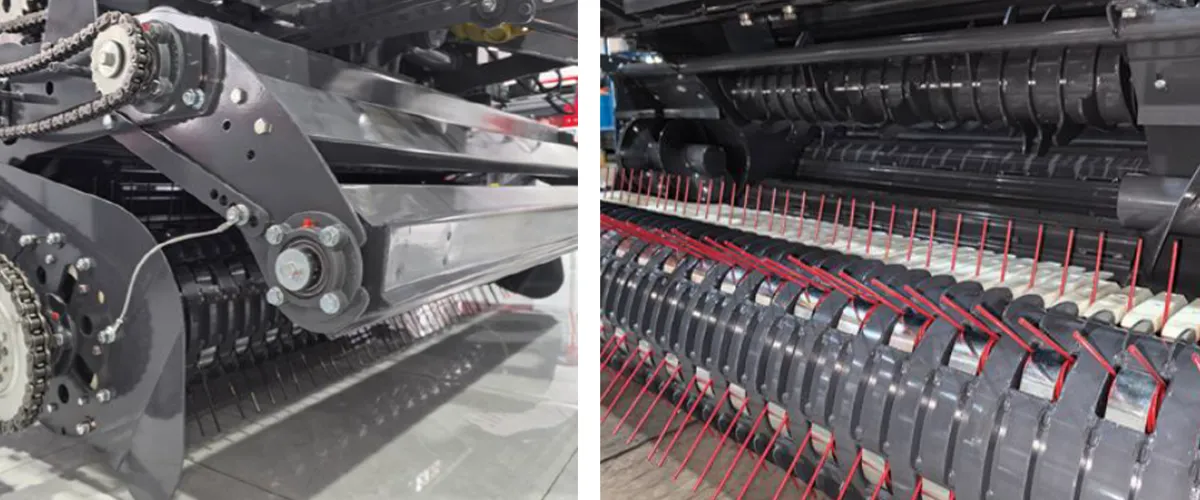
The compression rollers are where the material battle is most acute. Each of the 16 or 18 rollers in the 9YG round baler series compression chamber contacts every tonne of stover that passes through the machine. In a commercial biomass operation processing 2,000–5,000 tonnes of dry corn stover per season, the cumulative abrasive contact cycles on each roller surface run into the hundreds of millions. Rollers induction-hardened or hard-chrome plated to 55–62 HRC have a hardness level that prevents the stalk silica and cob fragments from efficiently cutting the surface, because the hardness differential between 60 HRC steel and silica is insufficient for significant abrasive cutting to occur. In practical terms, this means hardened rollers maintain their cylindrical profile within acceptable dimensional tolerance for 4–8 years of commercial stover service, versus 1–2 years for unhardened equivalents. The financial consequence of this material choice in a commercial biomass context is significant: roller replacement involves machine downtime, parts cost, and labour, all of which reduce the contractor’s effective capacity utilisation during the narrow autumn stover collection window.
The hammer-claw tines on models equipped for direct stover pickup are subject to an additional wear mode that spring tines do not experience: impact fatigue from contact with rigid stalk base sections and occasional embedded stones in the lower stover layer. Claw tines are cast or forged from high-manganese work-hardening steel alloys (Mn13 grade or equivalent) that respond to impact by becoming harder at the contact point — exactly the behaviour needed in an application where repeated hard impacts are the primary wear mechanism. This work-hardening property means that after the initial break-in period, the tine wear rate actually decreases as the working surface self-hardens to resist further impact wear.
| Component | Stover Wear Mechanism | Material / Treatment | Commercial Service Life |
|---|---|---|---|
| Compression rollers | Silica abrasion, cob fragment impact | Induction-hardened / chrome plated, 55–62 HRC | 4–8 years |
| Hammer-claw tines | Impact fatigue, stalk base collision | Mn13 work-hardening steel alloy | 2–4 seasons |
| Spring tines (windrow pickup) | Bending fatigue, surface abrasion | 65Mn heat-treated, zinc-phosphate coated | 2–3 seasons |
| Drive chain (20A) | High-torque spike fatigue | High-strength alloy steel, hardened pins | 3–5 seasons |
| Roller bearing seals | Dust contamination from stover chaff | Sealed labyrinth or re-greaseable design | Per machine service schedule |
| Hydraulic hose assemblies | Abrasion from airborne chaff | SAE 100R2AT anti-abrasion outer sheath | 4–5 years (inspect annually) |
6. Round Baler Gearbox Requirements for Corn Stover Operations
The round baler machine gearbox in corn stover biomass service faces a more demanding operating environment than in standard hay baling, and understanding why helps operators make better decisions about machine selection, maintenance scheduling, and operational practices that protect the gearbox over a long commercial service life. Corn stover collection for biomass purposes typically involves higher daily operating hours than farm hay baling — commercial biomass contractors often run 10–14 hours per day during the narrow autumn window — and the stover crop itself creates more frequent peak torque events than hay due to the particle size variation and rigid stalk sections that cause periodic compression chamber resistance surges.
All 9YG series round baler models accept 720 r/min PTO input at their standard operating speed. The dual gearbox design on the 9YG-2.24D S9000 variants provides not just the power transmission function but also the pivoting tongue geometry that keeps the PTO drive shaft angle within safe limits even when the baler is turning across the narrow headlands of Korean upland corn fields. A PTO shaft operating at excessive angle generates cyclical velocity variation at the gearbox input that manifests as a pressure pulse pattern in the hydraulic system and accelerated wear on the input shaft bearings. The dual gearbox’s rigid drawbar connection and 90-degree lateral rotation capability largely eliminates this risk during field operation.
The safety torque drive shaft fitted to the Transcend round baler model provides a particularly valuable layer of gearbox protection in commercial stover service. When the bale chamber encounters a dense slug of stover — which happens regularly when a windrow contains a concentrated section where the combine has deposited more residue material — the instantaneous load on the gearbox can briefly exceed two to three times the steady-state working torque. On an unprotected driveline, this torque spike is transmitted directly to the gearbox gear teeth and bearings as a shock load. With the safety torque shaft, the slip element absorbs the excess energy and the round baler gearbox sees only its rated load. Over a commercial biomass season of 100,000+ bales across multiple machines in a fleet, this protection reduces the gearbox rebuild frequency and maintains higher per-machine availability — a commercially significant advantage when every day of the autumn collection window has material value.
7. Bale Density and Biomass Energy Value: Why Compaction Matters
In a biomass energy supply chain, the round bale is not just a storage unit — it is the unit of commodity that is traded, transported, and sold to the biomass facility. The density of that unit directly determines the economics of every step between the field and the combustion chamber or bioethanol fermentation tank. A round baler machine that consistently produces bales at 150–200 kg/m³ dry matter density delivers two to three times as much energy per transport trip and per unit of storage space as a poorly compacted bale at 60–80 kg/m³. At biomass facility gate, bales are typically bought on a dry-weight or energy-content basis, so a denser bale from the same field area represents more revenue per bale regardless of the contractual pricing mechanism.
The sensor-controlled density system on every 9YG round baler series model is particularly valuable in the biomass supply chain context because it creates batch-consistent bales that can be contracted to a specification rather than delivered with highly variable quality. A biomass power plant or bioethanol facility procurement team wants predictable feedstock quality — consistent moisture content at baling, consistent dry-matter density, and consistent bale dimensions that allow automated handling systems to function reliably. A round baler with sensor control and a well-trained operator can deliver bales with density variation of less than 10% across a full production day, meeting the quality specifications that premium biomass supply contracts increasingly demand.
The target density for corn stover round baler biomass bales depends on the downstream application. For direct combustion biomass power generation, the highest achievable density is generally preferred because it maximises transport efficiency and storage density at the facility. The 9YG-2.24D models can achieve stover bale densities of 150–200 kg/m³ at hydraulic pressure settings of 160–200 bar, producing bales of 1300 × 1400 mm at weights of approximately 330–520 kg depending on stover moisture content. For bioethanol feedstock applications, where particle size and physical structure affect enzymatic hydrolysis efficiency, a moderately compacted bale at 120–150 kg/m³ may be preferred, preserving more of the porous structure that allows enzyme penetration during the pretreatment stage of the conversion process.
| Downstream Use | Target Bale Density | Hydraulic Pressure Setting | Recommended Model |
|---|---|---|---|
| Biomass combustion power | 160–200 kg/m³ | 160–200 bar | 9YG-2.24D S9000 Classic / Transcend |
| Bioethanol feedstock | 120–150 kg/m³ | 120–160 bar | 9YG-2.24D Standard / 9YG-1.25A |
| Animal feed (stover-hay mix) | 100–140 kg/m³ | 100–140 bar | 9YG-1.0C / 9YG-1.25 Double |
| Compost / soil amendment | 80–120 kg/m³ | 80–120 bar | 9YG-1.0 / 9YG-1.25A |
8. Round Baler Application: Stover Baling in Korean and Global Biomass Chains
The round baler machine application for corn stover biomass collection spans a wide range of operational contexts, from small Korean family farms participating in local biomass aggregation schemes to large commercial contractors running multiple round baler machines as dedicated biomass harvesting equipment. Understanding where in this spectrum a particular round baler application sits helps match the right machine specification to the operational requirement and maximise the return on the equipment investment.
In Korea, the primary commercial pathway for corn stover biomass is the Renewable Energy Portfolio Standard (RPS) system, which requires power generation companies above 500 MW capacity to source a defined percentage of their electricity from renewable sources including agricultural biomass. This has created a contracted market for biomass bales from aggregation points near major power stations, particularly in the Gangwon and Gyeongbuk regions where corn cultivation coincides geographically with industrial facilities seeking biomass supply. Korean round baler operators who have signed biomass supply contracts with these facilities typically need to deliver bales meeting a moisture specification (usually below 20% for combustion applications) and a minimum density specification, making the sensor-controlled density management of the 9YG round baler series directly relevant to contract compliance.
Internationally, the largest corn stover biomass markets are in the United States — where the Department of Energy’s Bioenergy Technologies Office has supported research into agricultural residue supply chains — and in parts of Europe where agricultural biomass counts toward national renewable energy targets under the EU Renewable Energy Directive (RED II and RED III). In these markets, round baler machines are the dominant field densification technology for stover collection because their combination of throughput, portability, and bale density meets the logistical requirements of dispersed-feedstock biomass supply chains more cost-effectively than alternatives like square balers or in-field chipping systems for most operational scales. The 9YG round baler range serves these international biomass markets through export to Russia, Mongolia, and Central Asian markets where corn and sorghum stover represents a significant agricultural residue resource.
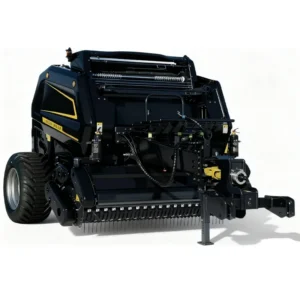
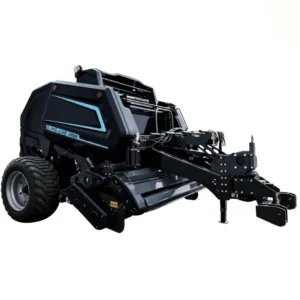
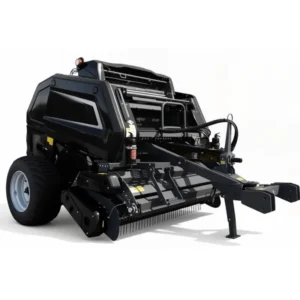
9. Corn Stover Round Baler Product Range
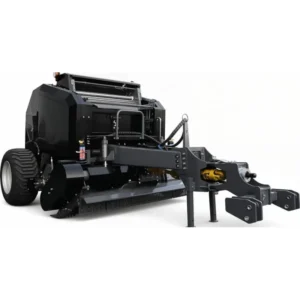
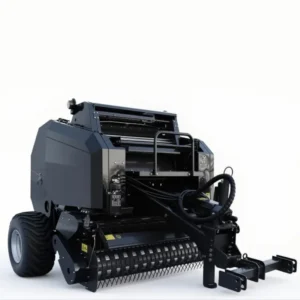
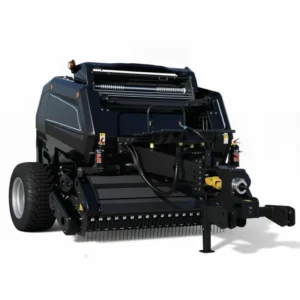
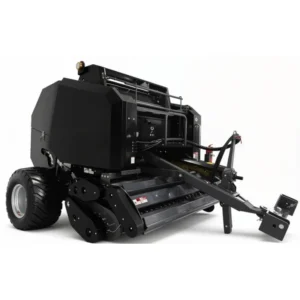
The following round baler models cover the full range of corn stover biomass collection applications, from compact units for Korean family farms participating in local biomass programmes to high-throughput commercial machines for large-scale dedicated biomass contractors.
10. Legal and Regulatory Framework for Round Balers and Gearboxes
Round baler machines used in corn stover biomass collection must comply with the same agricultural machinery safety regulations as those used in conventional hay and straw operations, but the commercial and industrial context of biomass contracting introduces additional considerations — particularly around equipment certification as a condition of biomass supply contract compliance and insurance coverage for contractor operators.
Korea (대한민국)
Under the Act on the Promotion of Agricultural Mechanisation (농업기계화 촉진법), round balers participating in government-supported biomass harvesting programmes must hold a current Agricultural Machinery Performance Test Certificate (농업기계 성능검정서). Korean standard KS B 1521 governs gear oil specification for agricultural gearboxes, and KS B ISO 4413 covers hydraulic system safety. For the round baler gearbox specifically, the rated input torque must be documented and must not be exceeded during biomass contract operations. Korean biomass subsidy programmes administered through KEREA (한국에너지공단, Korea Energy Agency) under the New and Renewable Energy Act may additionally require equipment compliance documentation as part of the supply contract registration process. PTO driveline guards must be intact as a standard operating requirement regardless of biomass or conventional use context.
European Union
EU Machinery Directive 2006/42/EC (transitioning to EU Machinery Regulation 2023/1230 effective January 2027) requires CE marking for all round baler machines including those used in biomass contracting. The EU Renewable Energy Directive RED III (recast 2023) sets sustainability criteria for agricultural biomass used in energy production, and these criteria include requirements for low greenhouse gas emissions from biomass supply chains — making efficient baling operations (lower fuel per tonne of dry matter collected) directly relevant to RED III compliance for biomass traders. EN 1553 covers agricultural machinery gearbox safety requirements including rated power marking and pressure venting systems. In Germany, DGUV Vorschrift 74 requires annual inspection of PTO driveline components for commercial agricultural contractors.
United States
ASABE Standard ASAE S430 sets baseline safety requirements for tractor-powered agricultural implements. The USDA Bioenergy Program for Advanced Biofuels and DOE’s Bioenergy Technologies Office (BETO) have both supported research into corn stover supply chain optimisation that references round baling as the primary densification technology. Commercial biomass contractors in the US operating under USDA BCAP (Biomass Crop Assistance Program) contracts may be required to demonstrate equipment compliance as part of programme participation. OSHA 29 CFR 1928 applies to PTO driveline guarding requirements for commercial operations.
Russia and Central Asian Markets
For round balers exported to Russia, Kazakhstan, and other EAC member states — where corn stover is increasingly recognised as a biomass resource by national energy agencies — the EAC (Eurasian Conformity) mark under Technical Regulation TR CU 010/2011 is required. Kazakhstan’s national biomass energy programme (Kazakhstan 2030 energy strategy) has identified agricultural residue including corn stover as a priority resource, creating growing demand for round baler equipment in regions such as the Almaty and East Kazakhstan oblasts where corn cultivation is concentrated. Equipment used in contract biomass supply under Kazakhstani state energy programmes must additionally comply with the national agricultural machinery safety standard ST RK 1510.
| Region | Key Standard / Law | Biomass-Specific Requirement |
|---|---|---|
| Korea | 농업기계화 촉진법 / KS B 1521 / 신재생에너지법 | Equipment certification for KEREA biomass supply contract registration |
| EU | Machinery Directive 2006/42/EC / RED III | CE mark; efficiency standards affect RED III GHG calculation |
| USA | ASABE S430 / USDA BCAP | Equipment compliance for BCAP biomass programme participation |
| Kazakhstan / CIS | TR CU 010/2011 / ST RK 1510 | EAC mark required; state biomass programme compliance |
| International | ISO 4413:2010 / ISO 11684 | Hydraulic safety and hazard labelling baseline |
11. Environmental and Carbon Policy Context for Agricultural Biomass
The use of corn stover as biomass energy feedstock sits at the intersection of agricultural residue management and renewable energy policy, and the carbon accounting framework that governs how stover combustion or conversion is treated in national greenhouse gas inventories has direct implications for the economic viability of round baler-based stover collection programmes. Understanding this policy context is increasingly relevant for Korean agricultural operators considering whether to enter the biomass supply chain.
Under Korea’s Greenhouse Gas Emissions Trading Scheme (K-ETS, 온실가스 배출권 거래제), agricultural biomass used for energy is treated as carbon-neutral when it displaces fossil fuel combustion, because the carbon released during combustion was sequestered from the atmosphere by the growing crop rather than extracted from geological storage as fossil carbon. This treatment is consistent with the IPCC guidelines for national greenhouse gas inventories and with the EU RED framework, and it means that biomass power generation using corn stover contributes to Korea’s national renewable energy targets without creating a carbon liability for the electricity generator. For the farmer selling stover bales, the carbon-neutrality treatment of biomass is what makes the product commercially attractive to power generators seeking to meet their RPS obligations cost-effectively.
However, the carbon balance of agricultural biomass is not unconditionally positive. Leaving some proportion of corn stover on the field after harvest serves soil health functions — adding organic matter, reducing erosion, and cycling nutrients — and complete stover removal can degrade soil carbon stocks over time if not compensated by other organic matter inputs. Korean agricultural extension guidance generally recommends removing no more than 50–70% of available stover by mass to maintain soil organic matter at acceptable levels. A round baler-based collection programme that respects this constraint — collecting from windrows that have been raked to represent approximately 50% of total stover mass — can deliver a sustainable biomass supply while maintaining the soil carbon stock that makes the land productive for future crops.
12. Practical Field Operations for Corn Stover Baling
Efficient corn stover round baler baling for biomass requires a well-planned field workflow that maximises tonne per hour throughput while maintaining the bale quality specifications required by biomass facility contracts. The following operational guidance draws on the design capabilities of the 9YG round baler series and the specific characteristics of Korean upland corn stover harvesting conditions.
The timing of stover collection relative to grain harvest is critical. If baling begins immediately after the combine, the stover moisture content is typically 35–55%, which produces heavy, adhesive bales that are difficult to net-wrap cleanly and may not meet the moisture specification for combustion applications. Waiting 5–10 days after grain harvest — or until a field moisture reading taken in the lower stalk sections shows 20% or below — allows the stover to field-dry to a baling moisture that produces better bale quality for most end-uses. In Korean autumn conditions, where September–October weather is typically dry with moderate temperatures, this field-drying window is usually achievable without significant weathering loss. The exception is when rain is forecast within 2–3 days of anticipated bale readiness, in which case it is better to bale at slightly higher moisture and let the bales equilibrate during storage than to risk heavy re-wetting of the windrows.
Ground speed management during stover baling follows the same principles as other crop types but with an additional consideration specific to stover: the distribution of material in the windrow is often less uniform than in a grass hay windrow because the combine’s residue spreading system may leave heavier concentrations of stover in some zones. Reducing tractor speed when approaching visibly thicker windrow sections prevents surge-feeding events that can overload the compression chamber and cause blockages or torque spikes. The axial-flow feed mechanism in the 9YG round baler series handles this variation better than conventional designs, but no mechanical system is entirely immune to a sudden doubling of feed rate from a standstill, so operator attentiveness to windrow density variation remains important for achieving maximum daily throughput.
Corn Stover Baling Field Operations Checklist
Pre-Baling Preparation
- Measure stover moisture at lower stalk — target below 25%
- Confirm windrow density by walking the field
- Set pickup float to low position (stover lies flat)
- Set hydraulic density control to target range
- Confirm net-wrap roll loaded and tension set
- Check chain tension (front and rear drives)
During Operation
- Reduce speed at visible windrow density peaks
- Monitor bale diameter display for density sensor status
- Note and re-approach any missed windrow sections
- Check bale shape after first 5–10 ejections
- Record bale count and GPS track for yield mapping
- Inspect hose connections every 2–3 hours
Frequently Asked Questions
Q1. How does the round baler hammer-claw pickup on the 9YG-1.0C handle standing corn stalks differently from a spring-tine pickup used for windrow stover in Korean biomass operations? +
Q2. What round baler bale density specification do Korean biomass power plants typically require for corn stover supply contracts and which round baler model meets this? +
Q3. How does the round baler gearbox on the 9YG-2.24D Transcend protect itself from the torque spikes that occur when baling dense sections of Korean corn stover windrows? +
Q4. What round baler parts are most likely to need replacement after a full season of commercial corn stover biomass collection in Korean autumn harvesting conditions? +
Q5. How does owning a small round baler for corn stover collection help Korean farmers participate in the national RPS biomass energy supply programme? +
Q6. What moisture content should Korean corn stover be at before baling with a round baler to meet biomass combustion facility quality specifications? +
Q7. How does the round baler application for corn stover biomass differ from hay baling in terms of the round baler machine settings and output rates in Korean agricultural conditions? +
Redaktor: PXY