Agricultural Machinery Knowledge
How Does a Round Baler’s Pickup Reel Function in Wet Conditions?
A practical guide to pickup mechanism behavior, structural design, material systems, and operational best practices when harvesting damp or rain-soaked forage.
Anyone who has run a enfardadeira redonda through a field of rain-wet grass or early-morning dew-soaked straw already knows the challenge: material that clumps, wraps, and clings where it shouldn’t. The pickup reel — that rotating drum fitted with spring tines at the front of the machine — is right at the center of this problem. It is the first point of contact between the baler and the crop, and in wet conditions it has to do considerably more work than on a dry summer afternoon.
Understanding how the pickup reel operates when moisture is involved matters whether you are trying to reduce field losses, protect your machine from premature wear, or simply decide whether it is worth baling today or waiting for the field to dry. This article walks through the mechanics, the materials, the design considerations, and the regulatory context that shapes how modern pickup reels are built and used — particularly in Korea and other markets where seasonal rainfall patterns can make wet-condition baling a regular reality.
1. Action Mechanism: How the Pickup Reel Operates
The pickup reel on a round baler functions as a continuous lifting and transferring device. Driven by the tractor’s power take-off (PTO) shaft through a gearbox — typically at 720 r/min for most full-size round balers — the reel rotates forward and downward at the front, sweeping tines through the windrow and directing the crop material rearward into the feeding zone. The tines themselves are spring-loaded, which allows them to flex when striking the ground or encountering an obstacle, then snap back to their working position as the reel continues rotating.
In dry conditions, the reel passes through the windrow almost effortlessly. The tines penetrate the loose material, lift it, and hand it off cleanly to the feed rollers or auger assembly immediately behind. Wet conditions change this sequence considerably. Moisture adds weight to the crop — a windrow of wet ryegrass or silage-cut alfalfa may weigh 30–50% more per meter than the same crop at optimal baling moisture — and the individual stalks or blades become sticky and prone to tangling around the tine shafts and reel frame.
The reel must now not only lift material but also shed it quickly enough to prevent wrap-up. Modern designs address this through tine geometry, tine spacing, and reel rotation speed relative to ground speed. When ground speed drops — as it often does in heavy, wet windrows — the reel’s peripheral speed increases relative to the crop, which can actually help clean-off. Some operators consciously reduce travel speed when conditions are wet to improve reel efficiency and reduce the risk of plugging downstream in the bale chamber.
The transition between the pickup reel and the feeding system is equally important. In machines like the 9YG-2.24D series, a rotor-type feeding mechanism using paddle rollers works alongside the pickup to move material into the compression chamber. In wet conditions, this combination tends to outperform simpler auger-only systems because the positive mechanical grip of the rollers handles sticky, matted material more reliably.
2. Manufacturing Structure of the Pickup Reel
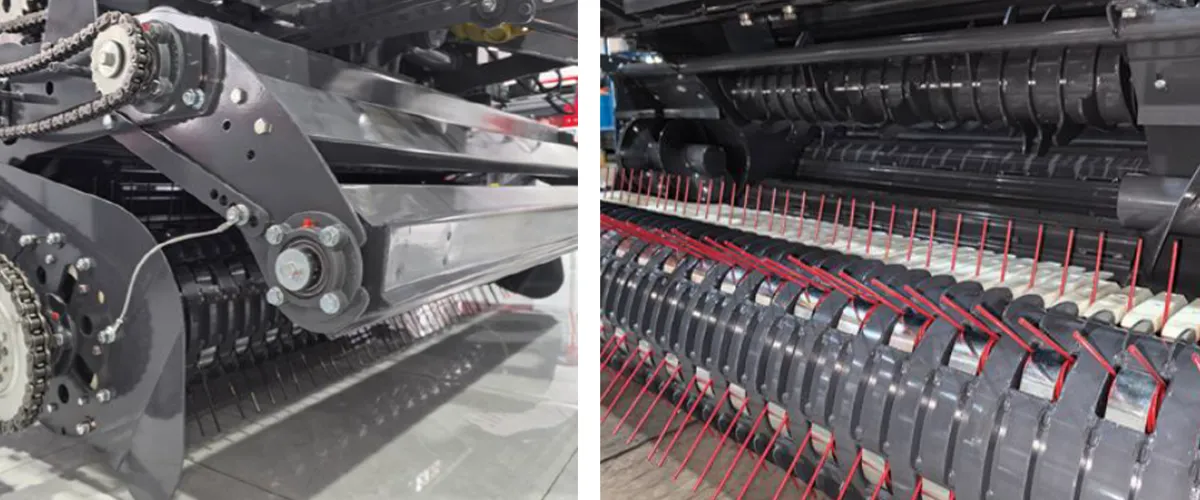
A typical full-width pickup reel on a large-format round baler consists of a central shaft, multiple tine bars mounted radially around that shaft, and the individual spring-tine elements fitted along each bar. On a 9YG-2.24D series machine, the pickup width is 2,240 mm, meaning the reel spans essentially the full chamber width of 1,400 mm and extends laterally beyond it to gather windrows that are somewhat wider than the chamber itself.
The tine bars are steel tubes welded to flanged end discs mounted on the central shaft. Spacing between bars is calculated to achieve complete coverage of the ground pass while minimizing inter-bar gap through which material can escape. Too few bars and the reel skips material; too many and the machine becomes heavy and the tines interfere with each other at high speeds. Most current designs use five to eight bars for this size range.
The cam mechanism inside the reel housing is what actually controls tine angle through the rotation cycle. As the reel spins, each tine bar’s angular position relative to the housing is governed by a fixed cam profile. This causes the tines to point downward and forward during the ground-contact phase (scooping position), then rotate backward relative to the bar — effectively shortening their reach — during the transfer phase. The result is that the tines retract slightly just as they release the crop to the feeder, which reduces drag and tangling. In wet-condition operation, this cam-controlled retraction is essential for preventing material from riding around on the reel instead of being handed off.
| Model | Pickup Width (mm) | Tipo de coleta | Feed System | PTO Speed (r/min) |
|---|---|---|---|---|
| 9YG-2.24D (S9000) | 2240 | Spring-tine | Paddle roller + drum | 720 |
| 9YG-1.25 | 2240 | Spring-tine / Hammer-claw interchangeable | Auger + paddle roller + drum | 720 |
| 9YG-1.25A | 2150 | Spring-tine | Paddle roller + drum | 540–1000 |
| 9YG-1.0 | 1900 | Spring-tine | Axial-flow semi-forced feed | 720 |
| 9YG-1.0C | 2400 | Hammer-claw | Auger + paddle roller + drum | 540 |
The no-cam, no-guard pickup design used in the 9YG-1.0 series is a notable alternative: by eliminating the traditional cam ring and shield assembly, this axial-flow-inspired pickup reduces the number of moving parts around which wet material can accumulate. The approach simplifies cleaning and reduces the likelihood of blockages, an advantage that becomes significant during humid harvesting seasons.
3. Material System: What the Reel Is Made Of and Why It Matters
The tines themselves are almost universally made from high-carbon spring steel, heat-treated to achieve a balance between hardness and elasticity. The spring function requires the material to flex under impact — when striking the ground, a rock, or a dense clump — without permanently deforming. Wet conditions increase the load on tines because the machine encounters heavier material per unit length of windrow, and because mud-laden soil thrown up during pickup can cause repeated impact loading that dry-field operations rarely produce.
Tine tip geometry varies by application. Pointed tips are standard for conventional grass and hay pickup — they penetrate windrows cleanly and shed crop well on the retraction phase. For wetter, heavier crops like silage-cut material or rice straw (common in Korean paddyland farming), slightly wider, blunt-tipped tines are sometimes preferred because they provide more lifting surface per tine, reducing the tendency for individual stalks to slip through the gap between adjacent tines.
The tine bars and reel frame are typically fabricated from structural steel tubing, with joints that may be MIG-welded or bolted depending on the manufacturer’s philosophy. Welded construction provides better rigidity and reduces the number of potential corrosion initiation sites — an important consideration in wet environments where water sits in bolt holes and threaded joints. Surface treatment for the entire reel assembly generally involves powder coating or two-part epoxy paint over a phosphate primer, providing a hard, moisture-resistant barrier.
The bearings at either end of the reel shaft are sealed and grease-packed. Sealed bearings reduce the frequency of manual greasing required and — critically — prevent water and crop debris from entering the bearing race during wet-field operation. Heavy-duty sealed bearings rated for the combined radial and axial loads of a wide reel are standard on larger machines like the 9YG-2.24D series.
4. Specific Challenges in Wet Conditions
Tine Wrapping
Wet, fibrous material — particularly long-stemmed grasses — coils around tine shafts and tine bars if the crop is not cleanly released. Once wrapping begins it accumulates rapidly and can seize the reel entirely within minutes of onset.
Ground Scalping
Soft, saturated ground offers less support to the reel’s gauge wheels, causing the reel to dig in. Even a minor drop in reel height strips soil into the windrow, which damages tines and contaminates the bale — a significant problem for silage quality.
Feeder Bridging
Clumps of wet material delivered by the reel can bridge across the inlet of the bale chamber, blocking smooth inflow. This typically manifests as uneven bale density — dense on one side, loose on the other — and can cause net wrapping failures.
Corrosion Acceleration
Prolonged wet-field operation accelerates corrosion on any bare metal surface inside the reel assembly. Bearing housings, tine bar mounting points, and cam ring contact surfaces are all potential sites if preventive maintenance intervals are not shortened during the wet season.
Beyond these mechanical issues, wet conditions affect the quality of the bale itself. A round baler machine produces bales with density measured in kg/m³ — the 9YG-2.24D series achieves bale densities of 100–200 kg/m³ using sensor-based density control. Wet material at the same compression setting will produce a denser bale by weight but may have compromised internal air circulation, increasing the risk of mold if the bale is stored without adequate wrapping or drying time. Operators targeting silage quality should monitor internal bale density data during wet-crop baling and may need to reduce the sensor pressure setpoint slightly to avoid over-compressing material that still needs to ferment aerobically in its outer layer before wrapping.
Travel speed also becomes a more deliberate variable in wet fields. At the 5–35 km/h operating range listed for the 9YG-2.24D, there is significant room to slow down without stalling the machine. Many experienced operators reduce speed to 6–8 km/h in wet conditions, which allows the pickup reel more time per meter to gather and transfer material cleanly while reducing the peak load on the feeder system.
5. The Gearbox Role: Driving the Pickup Under Wet Load Conditions
The round baler gearbox is the mechanical heart of the entire drive system. In wet-condition operation, the gearbox faces peak torque demands that are considerably higher than nominal because of the increased mass and resistance of the wet crop. A gearbox that is undersized or poorly lubricated under these conditions is a common source of field failures. Modern large-format machines address this with heavy-duty gearboxes featuring increased wall thickness on gear teeth, larger bearings, and premium-grade lubricants rated for both cold-start and high-load operation.
The dual-gearbox designs used in some 9YG-2.24D variants allow the gearbox assembly to pivot 90° left and right around the tow hitch, enabling tighter turning radii in small paddocks without interrupting power flow to the pickup or bale chamber. This matters in wet Korean paddyland fields or hillside plots where tight headland turns are unavoidable. The ability to turn without cutting power ensures the reel keeps rotating and does not stall with a full material load.
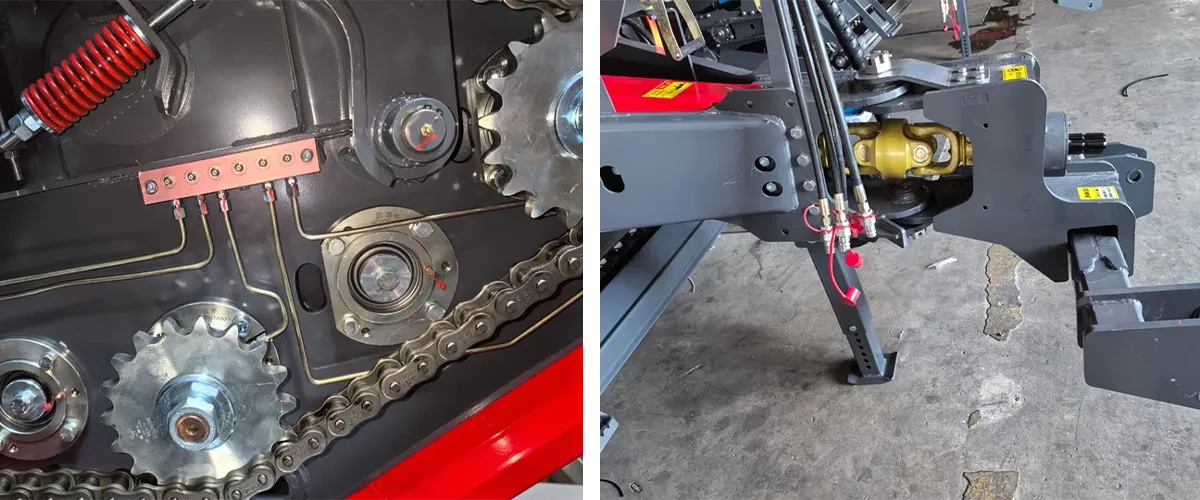
The torque protection system — incorporating a shear bolt or friction clutch at the PTO input — is a critical safety component that deserves specific attention during wet operation. Wet material blockages create sudden torque spikes that can exceed the design limits of the driveline. If the protection device is worn or incorrectly set, these spikes reach the gearbox and can shatter gears or fracture the PTO shaft. Inspecting and correctly setting the torque limiter before each season and after any plugging event is a maintenance step that experienced operators treat as non-negotiable.
| Maintenance Item | Dry Season Interval | Wet Season Interval | Notes |
|---|---|---|---|
| Gearbox oil check | Every 50 hours | Every 25 hours | Condensation can enter seals in wet conditions |
| Pickup reel bearing grease | Every 40 hours | Every 20 hours | Water washes lubricant from unsealed points |
| Torque limiter check | Start of season | After every plugging event | Wet blockages cause frequent torque spikes |
| Tine inspection | Weekly | Daily | Bent or missing tines cause pickup gaps |
| Chain tension (bale chamber) | Every 20 hours | Every 10 hours | Wet material increases chain side-load |
6. Matching Tractor Power to Wet-Condition Pickup Demands
One of the most overlooked factors in wet-condition baling is the adequacy of tractor power. The round baler models in the 9YG-2.24D series are rated for tractors in the 55–100 kW range. Under dry conditions, machines at the lower end of this range can often handle the full chamber width and production rate. In wet conditions, the effective power demand rises steeply — the pickup reel alone can account for an additional 10–20% of total machine power consumption when material is heavy and sticky.
Running a tractor at continuous high load in wet, slippery field conditions also affects traction. Wheel spin wastes power, increases compaction on soft ground, and reduces the operator’s ability to maintain the consistent travel speed that the reel needs to function smoothly. Tractor tire specification — particularly the use of radial tires rather than bias-ply, and appropriate ballasting — has a direct effect on how consistently the pickup can be fed. For Korean farmers working wet paddy-adjacent fields in autumn, this combination of machine power matching and tractor tire preparation is a meaningful part of preparing for harvest.
The small round baler category — machines like the 9YG-1.0, designed for tractors in the 48–80 kW range — can actually be advantageous in wet conditions on smaller or more irregular fields precisely because lighter machines impose less ground pressure, reducing the tendency to sink and cause pickup height problems. The trade-off is lower productivity: bale capacity and production rate per hour are reduced compared to the 9YG-2.24D series.
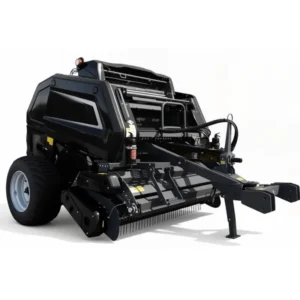
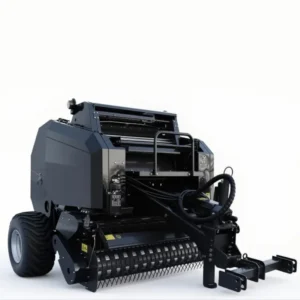
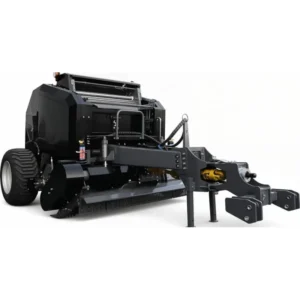
7. Round Baler Series — Designed for Field Versatility
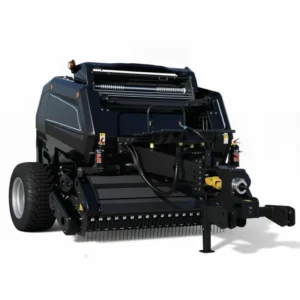
A selection of round baler models suited to various field conditions and crop types
8. Regulatory and Standards Framework: Korea and Global Context
Agricultural machinery in Korea is regulated primarily under the Act on the Promotion of Agricultural Mechanization (농업기계화 촉진법), which mandates safety certification and performance testing for machinery sold or imported for farm use. Balers and their component systems — including the pickup mechanism — fall under inspection frameworks administered by the Rural Development Administration (RDA) and the Korea Conformity Laboratories (KCL). Manufacturers wishing to sell round balers in Korea must demonstrate compliance with applicable KS (Korean Standards) specifications covering structural strength, guarding of rotating parts, and operator safety.
The rotating pickup reel is specifically addressed by guarding requirements that prohibit operator access to the reel zone during operation. Fixed guards over the top and sides of the reel housing, combined with interlocks or clear warning labeling at access points, are required. These requirements align with ISO 4254-7 (Agricultural machinery — Safety — Part 7: Combine harvesters, forage harvesters and cotton harvesters), which, while nominally covering combine harvesters, is also referenced in Korean national standards documents covering forage handling equipment.
In the European Union, round balers sold or used in member states must comply with Directive 2006/42/EC (the Machinery Directive, now transitioning to Regulation (EU) 2023/1230 which entered force in 2023). This directive requires CE marking and a Declaration of Conformity covering design safety, guarding, and the provision of adequate operator instructions. The EN 703:2004 standard, “Agricultural machinery — Silage-making equipment — Safety,” specifically addresses pickup reels and feeder systems in silage equipment — stating requirements for guard geometry, minimum clearances, and the labeling of nip-point hazards. Wet-condition operation is implicitly addressed through requirements for ground-clearance adjustment mechanisms and tine retraction systems that prevent wrap-up.
In Japan, round baler regulation falls under the Agricultural Machinery Act (農業機械化促進法) and JAMAS (Japan Agricultural Machinery And Equipment Association Standard) specifications. Given the geographic and climatic similarity between Japan and Korea — particularly in terms of wet paddy-field baling conditions — Korean importers and users sometimes reference Japanese field practice and maintenance documentation as a proxy when Korean-language technical guidance is sparse.
The United States OSHA standards (29 CFR 1910.212 and 1928.57) address general machinery guarding and agricultural equipment guarding respectively. While not directly applicable in Korea, these US standards are frequently cited in global product safety documentation and provide a baseline framework that most major manufacturers use when designing universal guard systems. The ASABE (American Society of Agricultural and Biological Engineers) standard S316, covering agricultural machinery safety, similarly provides a reference point for pickup reel guard design that influences products sold globally.
9. Practical Operating Tips for Wet-Condition Baling
Getting the best out of a round baler machine in wet conditions comes down to adjusting the way you use the machine rather than simply powering through. The following guidance is drawn from the physics of what the pickup reel actually does and the real-world variables that affect it most.
Sensor-based density control — standard on the 9YG-2.24D series — helps in wet conditions by providing real-time feedback on bale formation. If the sensor detects uneven density buildup, it signals the operator before a problem becomes structural. Operators should familiarize themselves with the alarm thresholds and not dismiss early warnings as false positives: in wet material, what looks like an early-stage density variation on the sensor display can become a misshapen bale or a net-wrapping failure within the next 30 seconds of operation.
10. Spring-Tine vs Hammer-Claw Pickup: Which Works Better in Wet Fields?
The 9YG-1.25 series offers a genuine choice between spring-tine and hammer-claw pickup configurations — an interchangeable arrangement that is relatively unusual in the round baler market and directly relevant to wet-condition decision-making. Standard spring-tine pickups are optimized for conventional hay and pasture grass: the spring action provides smooth, low-ground-impact gathering with good material release. In moderately wet conditions — morning dew or a field that received light rainfall 12 hours earlier — the spring-tine performs well at slightly reduced speed.
The hammer-claw pickup, which uses heavier, rigid claw-shaped tines mounted on a rotor rather than a spring-tine bar, was originally developed for corn stover and standing crop applications. In genuinely heavy, wet, dense windrows — think late-season grass silage or rain-soaked rice straw — the hammer-claw’s more aggressive mechanical grip can outperform the spring-tine design. The heavier tines do not deflect around dense material; they cut through it. The trade-off is that the hammer-claw is less forgiving on uneven ground and does not shed crop as cleanly on the retraction cycle, which means the feeding system must be capable of handling a less consistent material flow rate.
For Korean rice straw baling — a seasonal task that often coincides with the post-typhoon wet period in September and October — the hammer-claw configuration on a machine like the 9YG-1.0C (which uses a 20-claw rotor with a pickup width of 2,400 mm) represents an interesting option. The 9YG-1.0C pairs the hammer-claw pickup with front/rear chamber chains using a heavy-duty 16A reinforced double-strand chain, giving the whole material path from pickup through compression the durability margins needed for continuous heavy-material work.
11. About Our Round Baler Product Range
The round baler series described throughout this article spans models from compact small round balers designed for lower-horsepower tractors up to high-capacity full-width machines capable of baling 40–100 bales per hour. All models are developed through computer-aided engineering processes and manufactured under ISO 9001 quality management systems. Design priorities include high pickup efficiency across a range of crop types and moisture levels, durable gearbox and drive systems that maintain reliability under wet-season workloads, and user-serviceable designs that keep maintenance time practical for solo operators.
The product range has been refined through feedback from operation in diverse climates and crop types — including the grasslands and wetland meadow environments common in Northeast Asia, the paddy-adjacent fields of Korean farming regions, and the steppe grasslands of Central Asia where wet-season baling is a predictable annual challenge. This breadth of field experience informs specific design choices: the dual cross-joint torque-protecting driveshaft, the heavy-duty 20A chain specification on the 9YG-2.24D S9000 rear chamber, and the axial-flow feeder on the 9YG-1.0 are all responses to lessons learned from demanding field conditions
Frequently Asked Questions
Editor: PXY