Choosing the right binding material is one of the most consequential decisions a round baler operator makes each season — and yet it often receives less attention than the machine itself.
Walk into any conversation among Korean livestock farmers or crop producers, and the debate over twine versus net wrap versus stretch film comes up quickly. Each method has real, measurable impacts on bale density, storage losses, labor time, and — for silage producers — fermentation quality. The “best” option simply does not exist in a vacuum. It depends on your crop type, tractor horsepower, storage conditions, how long the bales will sit before feeding, and your overall workflow priorities.
This guide breaks down all three systems in practical terms. We cover how each one works mechanically inside a round baler, what materials are involved, how they compare under field conditions, and what regulatory and environmental considerations are increasingly shaping purchasing decisions in South Korea, Europe, and other markets. Whether you run a small hay baler on a 40 hp tractor or a large-scale commercial net-wrap operation with a 9YG-2.24D class machine, the information here applies directly to your work.
At a Glance: Three-Way Comparison
A quick reference before we go deeper into each method.
1. Action Method: How Each System Works Inside the Baler
Twine Binding
Twine binding is the oldest and most mechanically straightforward of the three approaches. When the bale reaches its target diameter — detected by sensor-based density monitoring systems in modern round balers — the baler’s twine arm begins traversing side to side across the chamber width. Twine is threaded from spools mounted on the machine through a guide arm that systematically lays multiple strands around the spinning bale. The number of passes varies by operator setting, typically between 4 and 8 wraps, depending on the desired holding strength and the crop being baled.
Inside a roller-type baling chamber — such as those used in the 9YG-2.24D series, which features 18 press rollers each with a φ222mm diameter — the bale continues rotating at a controlled speed during the wrapping cycle. The twine feed mechanism is driven off the baler’s PTO-powered drivetrain, and the knotting or tie-off function is performed automatically before the rear gate opens to eject the finished bale. This entire process adds roughly 20–40 seconds per bale, compared to the much shorter wrapping time of net wrap, making field cycle time noticeably longer in high-throughput conditions.
Net Wrap Application
Net wrap operates on a substantially different principle. Rather than a string passing repeatedly over the bale surface, a roll of open-weave mesh is fed across the full bale width in a single pass. The net is captured between the bale surface and one or more press rollers at the chamber entrance, causing it to be drawn in and wrap around the rotating bale. Depending on operator setting, 1 to 2.5 revolutions of net wrap is sufficient to fully cover and retain the bale — a process that typically takes under 10 seconds on modern machines.
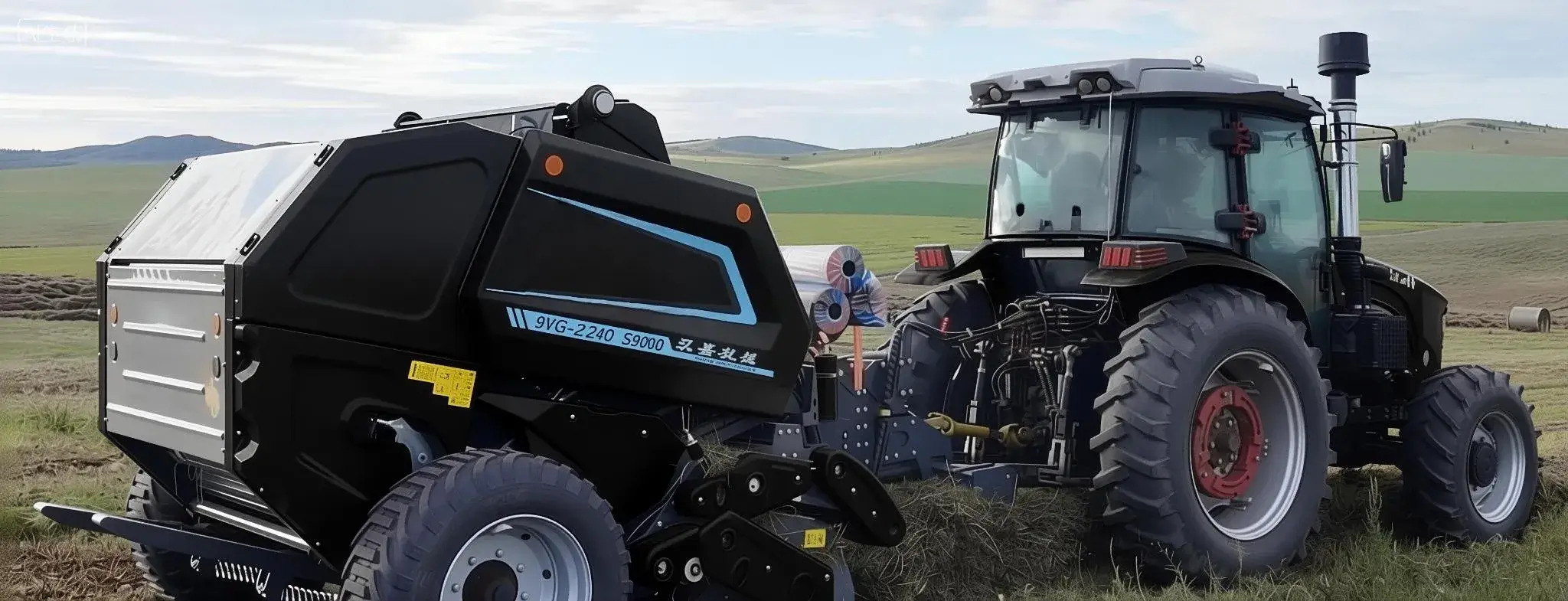
The net is then cut by an integrated knife, and the bale ejects cleanly. Because the net forms a continuous mesh covering across the bale’s cylindrical surface (though not the flat ends), the finished package holds its shape significantly better than twine-bound bales, especially in humid conditions or when the bale is transported over uneven ground. This contributes directly to better field handling and reduced losses during stacking. For operations running a high-capacity round baler machine like the 9YG-2.24D S9000 with a production rate of 40–100 bales per hour, net wrap’s speed advantage compounds meaningfully over a full working day.
Film / Stretch Wrap Integration
Silage film wrapping involves a fundamentally different workflow than twine or net. After the bale is formed and netted (net wrap is typically applied first for structural integrity), the bale is transferred — either via an integrated wrapper or a separate tow-behind unit — to a wrapping table where multiple overlapping layers of UV-stabilized plastic stretch film are applied at a consistent overlap, usually 50%. The number of layers varies between 4 and 8, with more layers providing greater airtightness and puncture resistance.
Some producers opt for combined bale-and-wrap machines that complete both operations in a single continuous pass through the field, minimizing bale handling time. The 9YCM-850 bale-and-wrap integrated unit, for instance, handles both operations simultaneously, achieving a production rate of 30–40 packages per hour with film wrapping dimensions of φ85–90 × 85 cm per package. These integrated systems reduce the risk of bale damage that can occur when wrapped bales are moved separately, and they eliminate the delay between baling and wrapping that is critical for high-quality silage fermentation.
2. Manufacturing Structure: How Each Binding System Is Built
Twine: Simple but Demanding
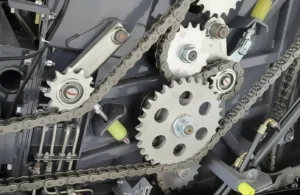
Twine feed systems on round balers consist of a spool holder, a feed tube or guide arm with adjustable tension, and a traverse mechanism that moves the twine guide across the bale width. The knotting mechanism is the most mechanically complex element — it must reliably form a secure knot or self-tying loop under field conditions with varying crop material sizes and moisture levels. Failures in this component lead to incomplete wrapping and bale loss. Most modern round balers use a side-to-side cam-driven traverse for consistent coverage. The simplicity of the overall system means fewer parts to maintain, but the knotting assembly requires careful seasonal inspection and adjustment.
Net Wrap: Precision Feed Mechanics
Net wrap systems require more precise mechanical design than twine. The net roll holder must maintain consistent tension to avoid feed jams or skipped revolutions, and the cutting blade must sever the net cleanly at the right moment without leaving a loose tail that could catch in the roller system. Better machines use a dedicated counter-roller to grip the net against the bale surface as it first enters the chamber, ensuring smooth uptake even at higher baling speeds. The net roll itself sits in a protected compartment — critical for keeping the net free of moisture and debris that could cause feed issues. On the 9YG-2.24D round baler, the hydraulic system uses H-type ferrule fittings that increase pressure tolerance and ensure rapid rear gate operation, allowing net-wrapped bales to be ejected smoothly and consistently.
Film Wrap: Separate or Integrated Systems
Standalone bale wrappers are typically trailer-mounted units with a rotating table and a film arm that travels around the stationary bale. The film arm carries one or two film rolls on a pre-stretch carriage, which stretches the film to 55–70% of its original length during application, significantly reducing material consumption while increasing adhesion and tension. Integrated bale-and-wrap machines, by contrast, incorporate the wrapping function directly into the baler’s operational sequence, with a transfer arm moving the freshly formed bale from the baling chamber to the wrapping table automatically. This type of system requires more complex hydraulic circuits and electronic controls, but eliminates the labor bottleneck of separately moving bales to a standalone wrapper.
3. Material Systems: What Each Binding Product Is Made Of
Agricultural Twine Materials
Baling twine is produced from several base materials, each with different performance profiles. Sisal twine, made from natural agave fibers, is biodegradable and breaks down in soil — a meaningful advantage where environmental regulations restrict plastic waste. Its tensile strength is lower than synthetic alternatives, making it more susceptible to breakage under heavy bale weights, and it is more sensitive to moisture, which can cause swelling and feed jams. Polypropylene twine dominates modern commercial operations because of its consistent tensile strength (typically rated between 130 and 300 kg per strand), resistance to moisture, and low cost. A blend twine combining sisal and polypropylene offers a middle ground, retaining some biodegradability while improving strength consistency. Tensile strength and knot-holding ability are the two most important specifications to evaluate when sourcing twine for a specific round baler machine and crop combination.
Net Wrap Construction
Net wrap is a knitted or woven open-mesh product made from high-density polyethylene (HDPE) or a polyethylene-polypropylene blend. The mesh structure allows air to circulate around the stored bale, which is important for dry hay that needs continued curing after baling. Net wrap is manufactured in specific widths to match baler chamber dimensions — a 9YG-2.24D or 9YG-2.24D S9000 baler with a 1400 mm chamber width uses net wrap rolls of 2000 m × 1.4 m per bale, while the 9YG-1.0 compact baler with its 1000 mm chamber uses 2000 m × 1.0 m rolls. UV stabilizer content is a key quality indicator; low-UV net wrap degrades rapidly when bales are stored outdoors, leading to premature bale surface exposure and elevated storage losses. Premium net wrap products carry UV ratings of 12–18 months for outdoor storage.
Silage Stretch Film Specifications
Silage stretch film is a co-extruded, multi-layer LLDPE (linear low-density polyethylene) product with a high tackifier content that allows overlapping layers to self-adhere without adhesive. Standard widths are 500 mm and 750 mm; standard thickness is 25 microns for most applications, with heavy-duty grades running to 30–38 microns for rocky terrain or extended storage. UV stabilizers, typically 18–24 months, protect the film from photodegradation. Color matters: white film reflects sunlight and reduces heating, making it preferable in warmer Korean summers or Southeast Asian conditions; black film provides better UV protection on the underside; green film blends visually into field settings. Film quality directly determines fermentation outcome — any pinhole, tear, or inadequate layer overlap allows oxygen ingress, which converts the anaerobic fermentation environment to aerobic spoilage within days.
Round Baler Models: Net Wrap Specifications at a Glance
4. Bale Density, Shape, and Storage Loss
Bale density is one of the most important quality metrics a producer can control, and it is affected by both machine design and the binding method chosen. A well-designed roller-type round baler can achieve bale densities of 100–200 kg/m³ for hay — a range that covers both lighter forage crops and heavy, dense materials like straw and corn stover. The dual-chain design in certain S9000 models using 20A heavy-duty chains increases compression pressure, enabling consistent densities at the upper end of that range (the equivalent of 500–1,000 jin per bale, or roughly 250–500 kg, in practical field terms).
Twine-bound bales tend to lose shape more readily after ejection, particularly in warmer conditions where the material relaxes. The individual strands cannot exert even pressure across the entire bale surface. Net wrap counters this by distributing holding tension evenly across the full cylindrical surface area, resulting in better shape retention from field to storage to feeding. Studies comparing hay quality in Korean agricultural research institutions have consistently found that net-wrapped bales left in outdoor storage for more than six weeks show significantly lower surface damage than equivalent twine-bound bales. Film-wrapped bales (for silage and haylage) retain virtually all nutritional content through the fermentation process, with dry matter losses in properly wrapped bales typically below 3–5% compared to 10–20% or higher in poorly bound or exposed bales.
5. Matching the Method to the Crop
Dry Hay (Alfalfa, Timothy, Orchard Grass)
Both twine and net wrap work well here. Net wrap’s faster cycle time and better shape retention give it an edge for large-volume operations. Silage film is generally not used unless producing haylage at above 40% moisture.
Corn Stover and Straw
The 9YG-1.25 and 9YG-1.0C models with hammer-claw pickup attachments can collect standing corn stalks directly without prior windrowing. Twine is common here for loose-structure material; net wrap adds value when bales will be transported or stacked. Film is rarely used.
Fresh-Cut Grass / Haylage
Film wrapping is the only viable approach for preserving high-moisture forage. Net wrap alone is insufficient — oxygen will penetrate and spoilage begins within 24–48 hours. Wrapping must be completed within 4–6 hours of baling to prevent early fermentation degradation.
Rice and Wheat Straw
Very common crop for round baler application in Korea and wider East Asia. Material tends to be smooth and slippery, so higher net wrap revolution counts (2–2.5 turns) improve bale security. Twine is also effective if bales are sheltered from rain quickly after baling.
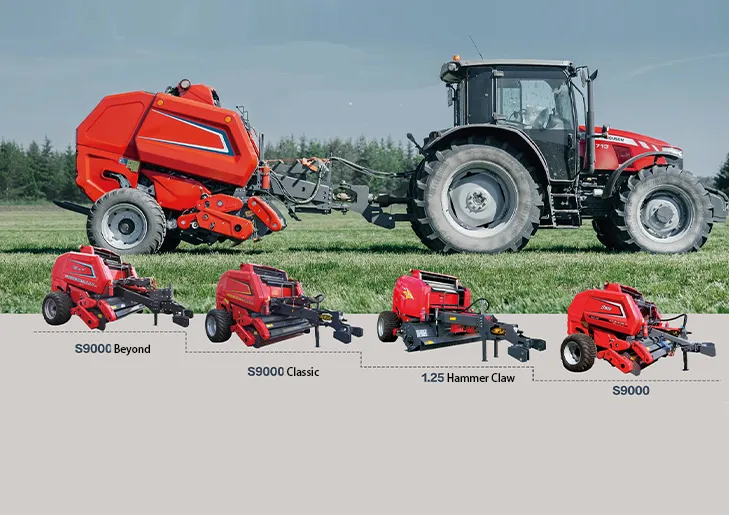
6. Round Baler Series — Net Wrap Ready
All models below feature sensor-controlled bale density management and automatic net wrap systems.
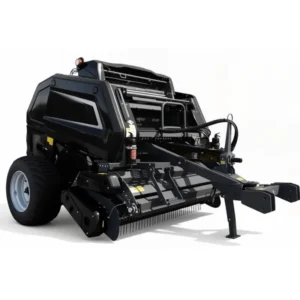
9YG-2.24D S9000
55–100 kW | 1400 mm
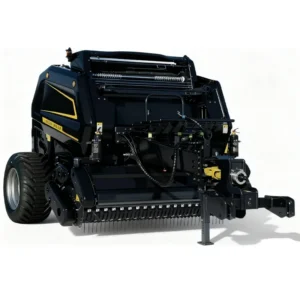
9YG-2.24D Classic
55–100 kW | 1400 mm
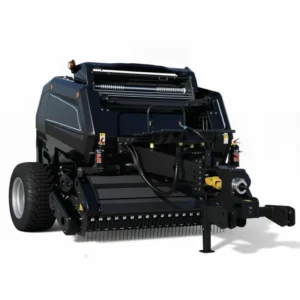
9YG-1.25A
≥75 kW | 1250 mm
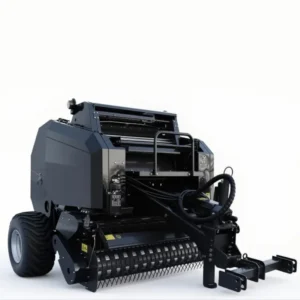
9YG-1.0
48–80 kW | 1000 mm
7. Round Baler Gearbox Design and International Regulatory Considerations
Gearbox Role in Baling Performance
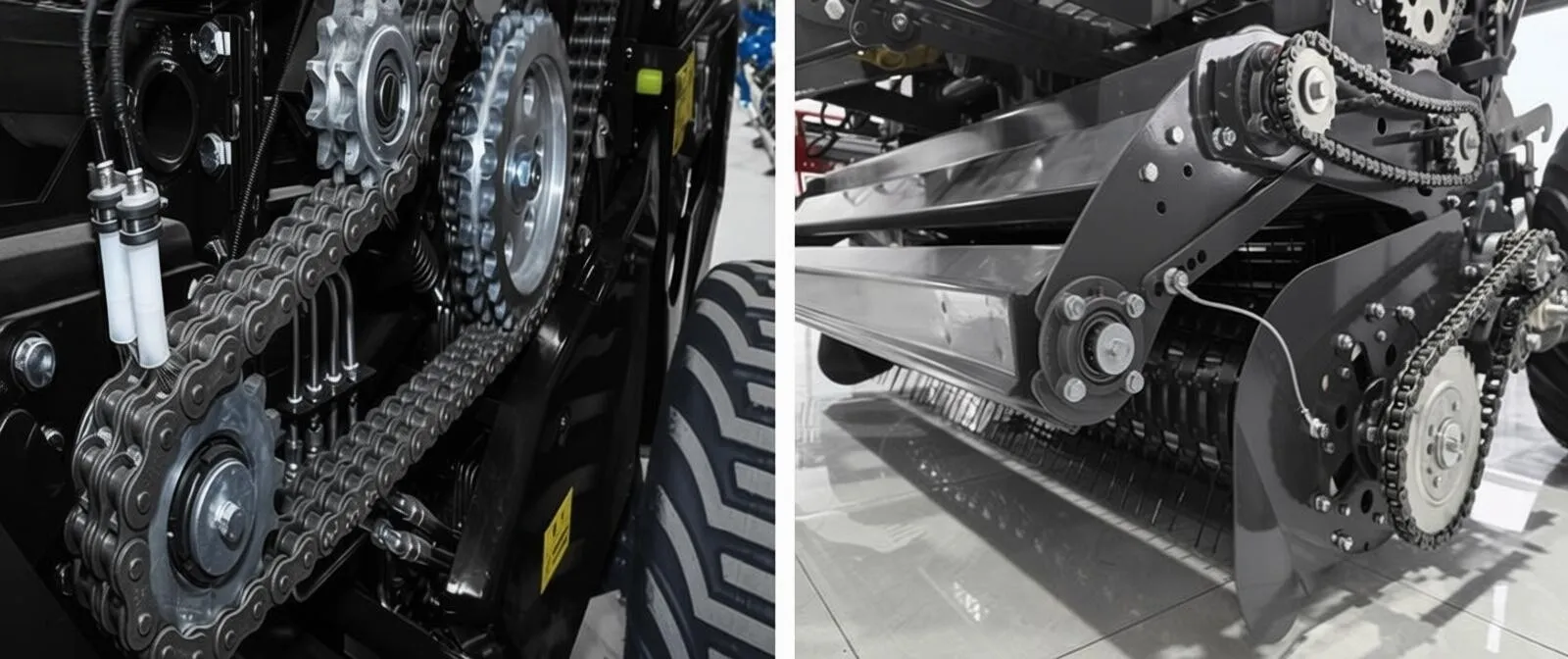
The gearbox is the central power distribution component in a round baler, translating PTO input from the tractor into the rotational forces needed to drive pickup rollers, feed mechanisms, and the press roller assembly. In dual-gearbox designs, such as those used on the 9YG-2.24D S9000 super-advanced model, the twin gearbox can rotate left and right up to 90 degrees each side. This design reduces the baler’s turning radius significantly, allowing it to continue operating without cutting PTO power during headland turns — a feature that improves both efficiency and drivetrain longevity. The gearbox and hitch frame are rigidly connected as a single unit, which prevents torsional stress that would otherwise damage the drawbar or driveshaft when operating over uneven terrain.
For the 9YG-2.24D S9000 classic variant, a reinforced heavy-duty gearbox increases transmission torque capacity, paired with dual-side chain sprocket drive on the rear baling chamber for smoother, more consistent roller operation under heavy loads. These engineering details directly affect how reliably the net wrap or twine binding system can be activated and completed at full baling speed without mechanical interruption.
South Korea: Agricultural Machinery Regulations
In South Korea, agricultural machinery including round balers and baling material is subject to several regulatory frameworks. The Act on the Safety Control of Agricultural and Fisheries Products (농수산물의 안전관리에 관한 법률) and the Agricultural Mechanization Promotion Act (농업기계화 촉진법) govern equipment standards and subsidy eligibility. Balers intended for government subsidy programs must pass inspection and registration under the Rural Development Administration (농촌진흥청, RDA). Plastic baling materials — net wrap and film — fall under the Act on the Promotion of Saving and Recycling of Resources (자원의 절약과 재활용촉진에 관한 법률), which requires producers of agricultural plastic waste to either join a producer responsibility scheme or arrange for compliant disposal. The Korea Environment Corporation (한국환경공단) manages the extended producer responsibility (EPR) system for plastic film, and farmers are increasingly obligated to collect and submit used film and net wrap to authorized recycling facilities rather than disposing in fields.
European Union: Plastic Baling Material Policy
The EU’s Directive on Single-Use Plastics (SUP Directive, EU 2019/904) and the broader European Green Deal framework increasingly apply pressure to agricultural plastic use. While baling net wrap and film are not directly regulated under the SUP Directive (which focuses on consumer single-use items), the associated Circular Economy Action Plan and national transpositions in Germany, France, and the Netherlands have established collection and recycling targets for agricultural films. Germany’s VerpackG (Packaging Act) requires agricultural film producers and importers to register with a licensed dual system and contribute financially to collection. France’s ADEME-managed “FilAgri” program specifically addresses baling film collection from farms. Operators selecting net wrap or film products from verified EU-compliant suppliers benefit from established collection channels, reduced disposal cost, and compliance with evolving national regulations.
United States: ASTM and State-Level Considerations
In the United States, baling twine and net wrap products are often evaluated against ASTM International standards for tensile strength and UV resistance, though no federal mandate specifies minimum performance requirements for agricultural baling materials. California’s SB 54 (Plastic Pollution Prevention and Packaging Producer Responsibility Act) creates downstream pressure on agricultural plastic sourcing, and several state extension services actively recommend biodegradable twine alternatives to reduce plastic contamination in compost and manure systems. Operators sourcing round baler parts and consumables should verify supply chain compliance with applicable state requirements, particularly if products will be distributed into California, Oregon, or Washington markets.
Russia and CIS Markets
In Russia and CIS countries including Kazakhstan and Mongolia — active export markets for high-performance round balers — agricultural machinery must carry GOST certification (Государственный стандарт). GOST R standards for forage harvesting equipment specify minimum performance thresholds for baling density, pickup loss rates, and operator safety systems. Baling material requirements are less formally codified in these markets, but growing awareness of plastic field waste is driving regional conversations about biodegradable twine adoption, particularly among producers exporting forage to Western European buyers with quality verification requirements.
8. Which Method Is Right for Your Operation?
There is rarely a single correct answer, but the following decision framework covers the majority of use cases encountered in Asian and global farming operations.
| Your Situation | Recommended Method | Notes |
|---|---|---|
| Small-scale dry hay, sheltered storage | Twine | Low cost, adequate for protected storage conditions |
| Large hay volume, outdoor storage | Envoltório de rede | Faster cycle, better weather resistance, lower long-term loss |
| Fresh-cut grass, dairy silage | Film (Stretch Wrap) | Essential for anaerobic fermentation and nutritional preservation |
| Corn stover / straw for bioenergy | Twine or Net Wrap | Net wrap if transport distance is significant |
| Haylage (wilted forage, 40–60% DM) | Net + Film | Net first, then overwrap with minimum 6 film layers |
| Small 40 hp tractor, compact fields | Twine (9YG-1.0 class) | Mini hay baler for small round baler use with lower power demand |
9. How Pickup Mechanism Design Affects Baling Method Compatibility
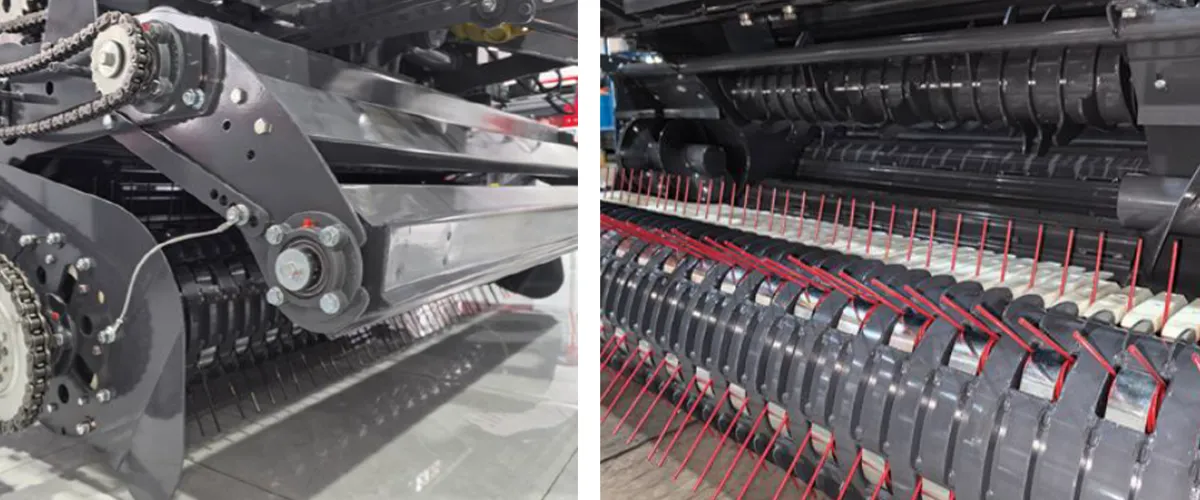
The pickup and feed system design of a round baler affects how consistently material is delivered to the baling chamber, which in turn affects the quality and shape of the finished bale — and therefore how well any binding method can secure it. Spring-tooth (弹齿式) pickups are the standard for clean, windrowed hay and straw, gathering material gently while leaving minimal field losses. The hammer-claw alternative used on models like the 9YG-1.0C and 9YG-1.25 is purpose-built for standing corn stalks, processing the material through a 2400 mm pickup width with 20 hammer claws before feeding into the baling chamber.
The axial-flow semi-forced feed mechanism used across the 9YG product line features no cam and no guide ring — a proprietary design that reduces power consumption, increases feed volume, and sharply reduces the probability of crop blockages. This is particularly relevant when baling wet or tangled material that is more prone to causing feed inconsistencies that disrupt the binding cycle. A cleaner, more consistent feed means the bale builds evenly, which is critical for net wrap application — uneven bales cause the net to contact the surface inconsistently, leading to partial coverage on the ends and potential bale loss during handling.
Frequently Asked Questions
Editor: PXY