Crop Residue Management & Agricultural Sustainability
A comprehensive guide to how round baler technology transforms post-harvest rice straw from a disposal burden into livestock feed, mushroom substrate, bioenergy feedstock, and soil amendment — with practical guidance on machine selection for Korean and Asian rice-growing operations.
1. The Rice Straw Problem — and the Round Baler Solution
Rice is the most widely cultivated cereal crop in East Asia, and South Korea is no exception. Each year, Korean rice paddy fields produce several million tonnes of straw as a co-product of grain harvest. For most of the twentieth century, this straw was either incorporated directly into the soil by tillage, burned in the field, or left to decompose on the paddock surface. All three of these disposal routes carry significant drawbacks. Soil incorporation can interfere with the following crop’s establishment if decomposition is incomplete. Field burning — still practiced in some regions despite regulatory restrictions — releases particulate matter and carbon dioxide into the atmosphere and contributes directly to the air quality problems that affect Korean urban populations downwind of agricultural areas in autumn. Leaving straw on the paddock surface slows soil temperature recovery in spring, affects transplanting timing for the following rice crop, and can harbor fungal pathogens that persist into the next season.
The round baler machine offers a fundamentally different approach: rather than treating rice straw as a waste product to be managed, it treats it as a recoverable resource. By picking up the straw windrow left by a combine harvester and compressing it into dense round bales, a round baler converts loose, unmanageable field residue into a standardized, storable, and tradeable commodity. The baled straw can then enter multiple value chains — livestock feed and bedding, mushroom growing substrate, bioenergy feedstock, erosion control matting, or even as a carbon-sequestering soil amendment when returned to agricultural land in composted form. Each of these end uses delivers more economic value from the same crop than field burning or soil incorporation could offer.
For Korean rice farmers, this transition from straw disposal to straw resource management is increasingly driven by policy as well as economics. Air quality regulations restricting field burning, government incentive programs for agricultural biomass energy, and the growing domestic demand for livestock bedding and feed have all aligned to make straw collection and baling a commercially viable activity for the first time in many farming operations. A round baler that can handle rice straw reliably and efficiently is the enabling technology for this shift.
2. Why Rice Straw Presents Unique Challenges for Round Baler Design
Rice straw is not a straightforward crop for round baler machines. Unlike the grass or legume crops that most baler designs are optimized around, rice straw has a set of physical properties that create specific demands on pickup, feed, and compression systems. Understanding these challenges helps explain why not every round baler performs equally well in rice straw applications — and what design features to look for when selecting equipment for this crop.
The first challenge is silica content. Rice straw contains 10–15% silica by dry weight — many times higher than grass or cereal straw from wheat or barley. This silica is concentrated in the outer cell wall layer and gives rice straw its characteristic rough, abrasive texture. It is highly erosive to any metal surface that contacts it at speed: pickup tines, feeder roller surfaces, compression roller working faces, and even the inside walls of the baler body wear at accelerated rates compared to grass-crop applications. Machines designed for rice straw service should have hardened surfaces on all high-contact components, and operators should plan for shorter maintenance intervals and faster wear-item consumption than a grass baler schedule would suggest.
The second challenge is bulk density. Dry rice straw has an extremely low bulk density — typically 30–50 kg/m³ loose — which means the pickup header and feeder rotor must process very large volumes of material per unit time to fill the baling chamber to target diameter. A feeder mechanism that struggles with high-volume low-density material will create bottlenecks at the chamber inlet, producing a phenomenon called “plugging” where the feeder stalls against a wad of material and brings the operation to a stop. The axial-flow semi-forced feed mechanism used in the 9YG series — which distributes crop across the full chamber width before rotational compression begins — handles high-volume low-density material significantly better than conventional slug-feed designs, because it prevents the formation of uneven feeding wads that trigger blockages.
The third challenge is moisture variation. Rice straw can be baled at a wide range of moisture contents depending on field conditions and the time elapsed since grain harvest. Freshly cut straw at 40–50% moisture content compacts well but requires longer drying before safe long-term storage. Fully dried straw at 12–15% moisture content is lighter, more abrasive, and can be dusty — creating challenges for chain lubrication retention and bearing seal longevity. Machines that will be used across this moisture range benefit from sealed bearing assemblies and chain lubrication systems that retain lubricant in dusty conditions.
3. Manufacturing Structure: Engineering Round Balers for Rice Straw Durability
The manufacturing structure of a round baler machine intended for sustained rice straw operation must address the silica abrasion, high-volume low-density feed, and moisture variation challenges described above through deliberate engineering choices at every level of the machine’s design. This is where the difference between a machine that survives one Korean harvest season and a machine that provides five years of reliable service becomes clear.
Frame construction begins with high-strength structural steel plate — S355 or equivalent (355 MPa yield strength minimum) — cut by CNC laser for dimensional accuracy and welded with automated welding programs that produce consistent, inspectable weld quality at every joint. The main side cheeks of the baling chamber are typically fabricated from 10–14 mm plate with reinforcing gussets at the tailgate pivot brackets and pickup mounting points, where fatigue loading from repeated heavy-crop baling cycles concentrates stress. The tailgate hinges and latch mechanism see particularly high cycle counts in straw operations where throughput rates are high, and heavier-section hinge pins with hardened bearing surfaces are necessary to maintain dimensional integrity across thousands of open-close cycles per season.
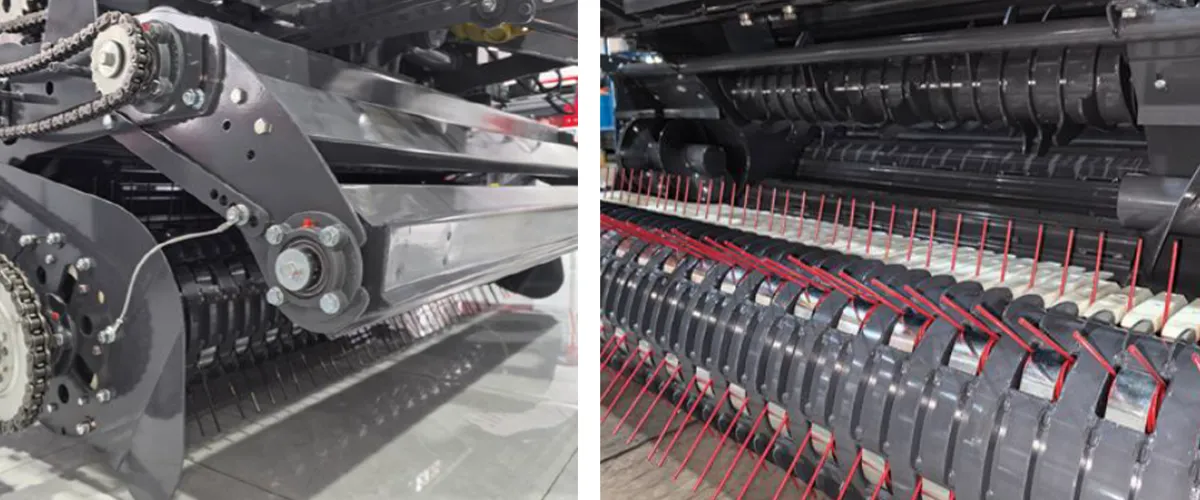
The compression roller assembly is the most mechanically demanding component in a rice straw round baler. In the 9YG series, 18 compression rollers of φ222 mm diameter are arranged around the baling chamber. For rice straw applications, the roller surface treatment is critical: case-hardened or hard-chrome roller surfaces resist the silica abrasion that would rapidly groove an unhardened steel surface. As the groove depth increases, the effective roller diameter decreases and the compression geometry changes, producing bales of inconsistent shape and density. Hard-surfaced rollers maintain their geometric integrity for much longer, preserving consistent bale quality across the full service life of the roller set.
The axial-flow semi-forced feed mechanism used in the 9YG series is a particularly significant manufacturing feature for rice straw applications. This mechanism — proprietary in design and covered by the manufacturer’s patent portfolio — operates without the cam guides and guard rings found in conventional feed designs. In rice straw operation, cam guides are problematic because the long, brittle straw stems can catch between the cam and its guide surface, wrapping and jamming rather than feeding through. The camless design eliminates this catch point entirely, reducing the frequency of blockage events that cost time, strain the drive train, and frustrate operators. The result in practice is a measurably higher net working rate per hour on rice straw than competing designs of nominally similar specification.
Key Manufacturing Specifications for Rice Straw Application
| Component | Rice Straw Requirement | 9YG Series Design |
|---|---|---|
| Pickup tines | Wear-resistant, flexible enough to absorb ground variation | Spring-tine type, 2,240 mm working width |
| Feed mechanism | High-volume capacity, blockage-resistant for light dry straw | Axial-flow semi-forced, camless, proprietary design |
| Compression rollers | Hard surface to resist silica abrasion | 18 rollers, φ222 mm, case-hardened surface |
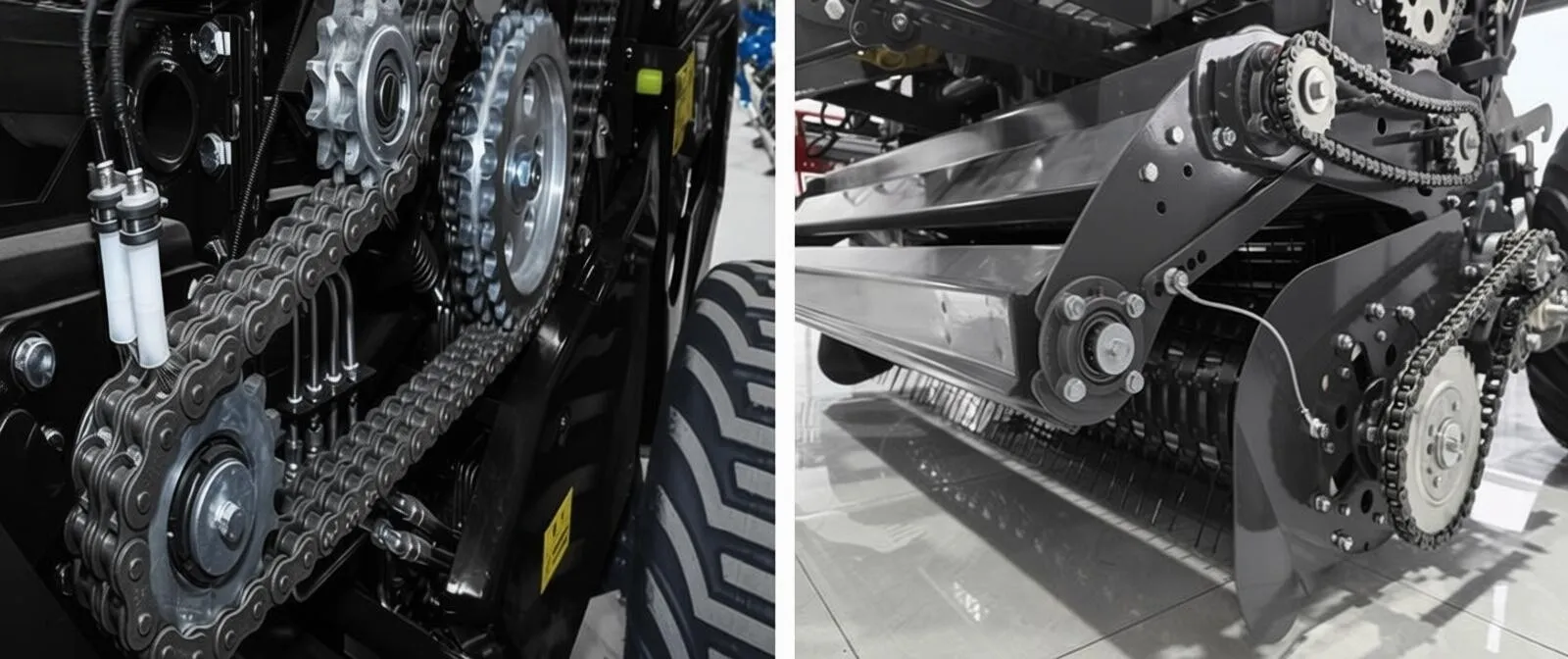
| Drive chain | Heavy gauge for sustained load, dusty environment | 20A heavy-duty roller chain, dual-side rear chamber |
| Tailgate hydraulics | Reliable rapid cycling for high throughput | H-type compression fittings, buffer cylinder |
| Binding system | Clean cut through dry, abrasive material | Automatic net wrap, hardened knife assembly |
| Density sensor | Consistent triggering despite variable dry straw density | Electronic sensor, cab ECU display |
| Frame material | Fatigue-resistant for high cycle count operations | S355 equivalent structural steel, laser-cut, robot-welded |
4. Material System: Protecting the Machine Against Rice Straw Wear
The material selection and surface treatment system of a round baler machine intended for rice straw applications requires specific attention to abrasion resistance in ways that differ from grass or legume baling. Rice straw’s high silica content makes it a highly erosive material for any machine component it contacts repeatedly under pressure or at speed. A machine assembled from standard-grade, unprotected steel components will show measurable wear on pickup tines, feed roller surfaces, and compression roller faces within a single harvest season of sustained straw operation — wear that gradually degrades bale shape, density, and crop recovery rate.
External painted surfaces on a straw baler face a different threat than silage machines do: rather than organic acid corrosion, the primary challenge is mechanical abrasion from dry straw dust and silica particles that act like fine sandpaper against any surface they contact at speed. High-quality polyurethane or epoxy-polyester powder coat systems, applied over a shot-blasted and primed surface, resist this abrasion far better than standard single-coat paint systems. Operators who intend to use their machine primarily for straw collection should also consider underseal treatment on the belly of the machine, which is exposed to continuous crop dust impingement during operation.
Internal chain materials are particularly important in rice straw applications. The combination of fine silica dust, low-moisture straw particles, and the heat generated by sustained high-speed chain operation creates an environment that depletes standard chain lubricants rapidly — sometimes within a few hours of operation. Machines with self-oiling chain systems or sealed chain assemblies that retain lubricant against dust ingestion perform significantly better in straw conditions than machines relying on manual oiling alone. The 20A heavy-duty roller chain used in the 9YG series rear compression circuit is chosen partly for its larger cross-section and higher material volume, which provides more wear tolerance before replacement is required compared to lighter-gauge chain.
Pickup tine materials in straw applications should be spring steel — typically 65 Mn spring steel or equivalent — with a yield strength sufficient to flex around obstacles without permanent deformation while being stiff enough to lift material cleanly from the ground. Tines that are too soft bend permanently on rocky or uneven ground, disrupting pickup geometry and leaving crop behind. Tines that are too brittle snap without warning when they contact embedded stones, creating immediate performance loss and potentially introducing broken tine sections into the bale that can damage downstream equipment during straw processing. Correct material specification for pickup tines is therefore not a minor detail but a substantive product quality issue.

5. Where Baled Rice Straw Creates Value: The End-Use Options
The commercial case for collecting and baling rice straw rather than burning or incorporating it depends on having a clear destination for the baled material. Several established value chains exist for rice straw in South Korea and the wider Asian agricultural economy, each with its own quality requirements and handling logistics. Understanding the end-use options before making a baling investment helps operators align machine selection — particularly bale size, density, and binding type — with the specific requirements of their intended market.
The most established domestic market for baled rice straw in Korea is as livestock bedding and supplementary roughage for beef cattle and horses. Rice straw is lower in nutritional value than grass hay, but it provides dietary fiber, maintains rumen fill, and serves as an effective bedding material. Korean beef cattle operations — particularly in Gyeonggi and Chungcheong provinces — are consistent buyers of well-baled dry rice straw throughout the winter housing period.
Rice straw is a primary growing substrate for oyster mushroom (Pleurotus ostreatus) and straw mushroom (Volvariella volvacea) cultivation, both of which are commercially significant in Korean and East Asian markets. Straw bales of uniform density and moisture content are particularly valued by commercial mushroom producers who need consistent substrate quality for predictable yields. This market demands tightly bound bales with low contaminant levels — a strong argument for using good-quality net wrap rather than twine binding, which can be difficult to remove cleanly from mushroom growing substrate.
Biomass energy policy in South Korea — including the Renewable Portfolio Standard (RPS) and agricultural biomass subsidy programs — has created demand for rice straw as a combustion or gasification feedstock at biomass power plants and district heating facilities. Baled straw is preferred for transport logistics over loose straw, and energy facilities typically specify minimum bale density and maximum moisture content to meet their fuel quality requirements. This application can absorb large volumes, making it a suitable outlet for farms producing straw at commercial scale.
Straw bales are used in civil engineering and landscape construction for temporary erosion control on cut slopes, construction site perimeters, and stream bank stabilization. In these applications, bale shape consistency and binding integrity are important, as bales are often staked into slopes and must maintain their form under rainfall impact. This is a smaller but persistent market that absorbs straw in areas near construction activity.
Composted rice straw returns organic carbon and silica to agricultural soils in a form that is beneficial to soil structure and microbial activity. Compost facilities sourcing straw for large-scale composting operations prefer baled material for logistics reasons. Returns of composted straw to rice paddies can improve long-term soil organic matter levels, potentially reducing fertilizer inputs over time — a compelling argument in a policy environment that is increasingly focused on sustainable soil management.
6. Round Baler Models for Rice Straw Collection
The following models have the design features — high-volume feed capacity, wear-resistant compression rollers, heavy-duty drive chains, and sensor-controlled bale formation — that make them suitable for demanding rice straw harvesting operations in Korean and wider Asian paddy farming environments.
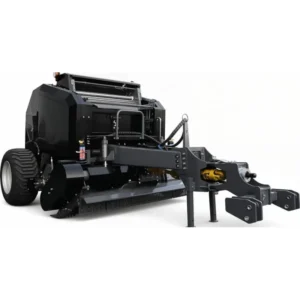
9YG-1.25 Round Baler (Double)
Interchangeable pickup · ≥88.2 kW · 4,558 kg · Bale 1,200×1,250 mm · Auger + feed roller + drum feed system
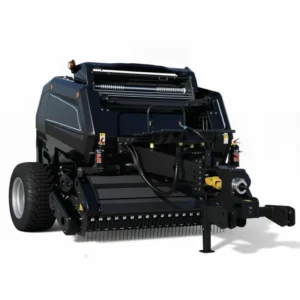
9YG-1.25A rundbalpress
540–1,000 r/min PTO · Density 100–200 kg/m³ · Net 2,000×1.25 m · 4,472 kg · ≥75 kW
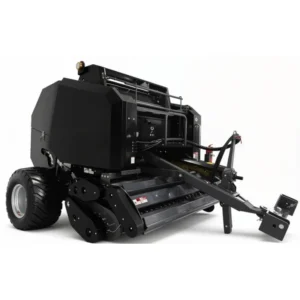
9YG-2.24D rundbalpress
Axial-flow semi-forced feed · Camless pickup mechanism · 3,922 kg · 55–100 kW · 40–100 bales/h
7. Round Baler Gearbox: Managing Power Through Demanding Straw Conditions
The round baler gearbox in rice straw applications operates under a different load profile than in grass silage work. Rice straw creates high-volume, low-resistance feeding conditions that can allow the machine to run at relatively high forward speeds — but the intermittent high-load events that occur when a large wad of straw enters the compression chamber can generate sudden torque spikes far exceeding the steady-state running load. The gearbox must be designed to absorb these spikes without damage to internal gear teeth, bearing surfaces, or the housing structure.
The torque protection system in PTO-driven balers — typically a shear bolt or friction clutch limiter positioned between the PTO shaft connection and the main gearbox input — plays a particularly important role in rice straw operations. Straw fields frequently contain embedded stones, irrigation pipe sections, or other debris that the combine harvester left behind or pushed into the straw windrow during grain harvest. When the pickup header encounters such an object, the immediate load spike on the drive system can be many times the design running torque. A correctly calibrated shear bolt or clutch limiter protects the gearbox, gear train, and frame welds from absorbing this energy destructively, limiting the damage to a replaceable shear bolt or clutch slip event rather than a fractured gear tooth or bent frame.
The dual-joint gearbox design in the 9YG-2.24D Transcend model deserves specific mention in the context of Korean paddy field operations. Korean rice paddies are typically small, irregularly shaped parcels bounded by drainage channels, access roads, and terraced embankments. Turning the baler on these tight headlands with a conventional single-joint PTO shaft is mechanically stressful and often requires the operator to disengage PTO during the turn, losing time and disrupting the baling rhythm. The dual-joint design — which allows 90 degrees lateral and 30 degrees vertical articulation while maintaining power transmission — eliminates this constraint and allows continuous PTO operation through turns, directly improving throughput rate and reducing cycle time per bale in the fragmented field geometries typical of Korean rice country.
Gearbox oil maintenance in rice straw operations requires particular attention to oil contamination. Fine rice straw dust penetrates all but the most tightly sealed housings over the course of a season’s operation. Where the gearbox breather or filler cap seals are not fully intact, dust-contaminated oil gradually degrades the lubricant film quality and accelerates gear tooth and bearing wear. Checking breather condition and oil cleanliness at mid-season — not just at the annual service — is a practical step that protects gearbox life in straw applications. The appropriate oil specification for most round baler gearboxes in straw service is ISO VG 150 GL-4 or GL-5 classified gear oil, changed at no more than 250-hour intervals.
8. Matching Bale Size to Rice Straw End Use
One of the practical decisions when selecting a round baler for rice straw work is bale size, and the right answer depends on what will happen to the bale after it leaves the field. Different end-use markets have different practical constraints around bale weight, diameter, and binding type — and selecting a machine that produces bales matched to your intended market avoids the situation of producing bales that technically meet the harvest objective but are difficult or expensive to handle and market afterward.
| End Use | Preferred Bale Diameter | Moisture Limit | Binding Preference | Suggested Model Range |
|---|---|---|---|---|
| Livestock feed and bedding | 1.0–1.3 m | <18% DM | Net wrap or twine | 9YG-1.0, 9YG-1.25A |
| Mushroom substrate | 1.0–1.2 m | <15% | Net wrap preferred | 9YG-1.0C, 9YG-1.25 |
| Bioenergy / biomass fuel | 1.2–1.4 m | <20% | Net wrap or twine | 9YG-2.24D, 9YG-2.24D S9000 |
| Erosion control / construction | 1.0–1.3 m | <20% | Twine or net wrap | 9YG-1.0, 9YG-1.25A |
| Compost / soil amendment | 1.2–1.4 m | <25% | Net wrap or twine | 9YG-2.24D, 9YG-2.24D Classic |
9. Regulatory Framework: Straw Burning Restrictions and Biomass Policy by Country
The regulatory environment for rice straw management is shifting significantly across East and Southeast Asia, creating both compliance requirements and new commercial opportunities for farmers and contractors who invest in round baler collection capacity. Understanding the current and anticipated regulatory landscape in your country and target market helps quantify the long-term commercial case for straw baling investment.
Sydkorea
South Korea’s Clean Air Conservation Act (대기환경보전법) regulates the burning of agricultural residues, including rice straw, in the field. While enforcement varies regionally, the general direction of policy is toward stricter restrictions on field burning, particularly in regions near urban areas where autumn rice harvest coincides with PM2.5 air quality deterioration periods. Government biomass energy programs — particularly the Renewable Portfolio Standard (RPS) regulations under the Act on the Promotion of Development, Use and Diffusion of New and Renewable Energy (신에너지 및 재생에너지 개발·이용·보급 촉진법) — create subsidy pathways for agricultural biomass including rice straw delivered to certified energy facilities. Agricultural machinery purchase subsidy programs administered by the Ministry of Agriculture, Food and Rural Affairs (농림축산식품부 — MAFRA) require that qualifying round baler equipment appear on the approved subsidy list following performance evaluation by the National Institute of Agricultural Sciences (농촌진흥청).
Japan
Japan has enacted field burning restrictions under the Air Pollution Control Act (大気汚染防止法) and prefectural ordinances that apply to agricultural residue burning, with most prefectures imposing restrictions that effectively prohibit open burning of rice straw except in narrow exempted circumstances. The Ministry of Agriculture, Forestry and Fisheries (農林水産省 — MAFF) actively promotes straw collection and utilization through subsidy programs targeting biomass energy, compost production, and livestock feed applications. PTO-driven machinery safety standards are governed by the Japanese Agricultural Machinery Safety Standards, with gearbox and drive shaft requirements specified in relation to JASO (Japan Automobile Standards Organization) norms.
European Union
In the EU, agricultural residue burning on agricultural land is generally prohibited under the common agricultural policy compliance requirements tied to Good Agricultural and Environmental Condition (GAEC) standards. Round balers used for straw collection in EU member states must carry CE marking under Machinery Directive 2006/42/EC, with harmonized standards EN ISO 4254-7 and EN 12965 applying to safety of harvesting machinery and PTO drive shafts respectively. Gearbox lubricant specifications for EU agricultural machinery markets reference ISO VG 150 gear oil for standard gearboxes and increasingly require lubricants meeting EU ecolabel standards near sensitive water environments.
Vietnam, Thailand, and Southeast Asia
Open burning of rice straw remains widespread across Southeast Asian rice-producing countries, but policy pressure is building. Vietnam’s Ministry of Natural Resources and Environment and Thailand’s Pollution Control Department have both enacted regulations and incentive programs targeting straw burning reduction in major rice-producing provinces. Demand for baling equipment capable of handling tropical-climate rice varieties — which produce higher-moisture straw at harvest than temperate varieties — is growing in these markets, driven by both regulatory pressure and the economic opportunity presented by the region’s expanding livestock and bioenergy industries.
Russia and Central Asia
Agricultural machinery sold in Russia and Eurasian Economic Union (EEU) member states including Kazakhstan must carry EAC conformity marking under TR EAEU 010/2011 (machinery safety technical regulation). Gearbox oil standards reference GOST 23652 (gear oils for agricultural machinery). These markets have substantial rice production in the Krasnodar and Astrakhan regions of Russia and in the Kyzylorda region of Kazakhstan, creating demand for capable straw baling equipment with EEU-compliant certification.
10. Maintenance Discipline for Rice Straw Round Baler Operations
Rice straw operation demands a more attentive maintenance regimen than any other common baling application, primarily because of the silica abrasion and fine dust environment it creates. Operators who apply the same service intervals they use for grass baling will find that chain wear, pickup tine damage, and roller surface degradation progress significantly faster in straw conditions. Adapting the maintenance schedule to the actual operating environment — rather than following a default schedule that was not designed with rice straw in mind — is the single most cost-effective step an operator can take to extend machine life and reduce per-bale operating cost.
Daily maintenance during rice straw harvest should include thorough chain lubrication across all circuits (more frequent than for grass — every two to three hours of operation in very dusty conditions rather than once daily), inspection of all pickup tines for tips missing or bent excessively from the operating plane, and blowing out or brushing accumulated straw dust from the chain guide areas, compression chamber walls, and bearing housings. Straw dust in bearing housings acts as an abrasive paste when mixed with lubricant residue, and removing it before it penetrates bearing seals prevents premature bearing failure that is otherwise difficult to diagnose until it has already progressed significantly.
At the end of the harvest season, a thorough post-campaign inspection should document compression roller surface condition by measuring roller diameter at multiple points and comparing to the new-condition specification. Rollers that have lost more than 2–3 mm of surface material from the nominal diameter are producing bales of reduced and inconsistent density and should be replaced before the next season rather than during it. Net-wrap knife condition, feeder rotor surface wear, and frame weld integrity at the tailgate pivot points and pickup header brackets should all be assessed and any deterioration addressed during the winter period when repair can be planned and parts ordered without harvest pressure.
Frequently Asked Questions
Redaktör: PXY