Alfalfa & Hay Baling — Large-Scale Irrigated Farm Selection Guide
Choosing the right เครื่องอัดก้อนกลม for large-scale irrigated alfalfa production is not simply a matter of picking the biggest machine available. Farm size, tractor fleet composition, bale handling logistics, and the number of cuts per season all determine which model and horsepower class delivers the best combination of field efficiency, bale quality, and running cost. This guide works through the decision factors relevant to 500-plus-hectare irrigated alfalfa operations and maps them to specific machine configurations.
Why Scale Changes Everything in Alfalfa Baler Selection
Irrigated alfalfa farms in the 500-plus-hectare range operate in a fundamentally different context than the family-scale hay operations that most standard round baler machine guides are written for. At this scale, the time available between cuts is the binding constraint — not just on individual paddocks but across the whole farm rotation. A typical four-cut irrigated alfalfa system on 500 ha generates approximately 125 ha of mature standing crop every three weeks. At that rate, a single round baler running at 60 bales per hour and working 10-hour days can clear about 80 ha per working week, assuming a windrowed crop in good conditions. That leaves roughly 10 working days between the start of one cut’s baling and the latest desirable point for the next cut to begin on the first paddocks. There is no buffer for machine downtime, slow throughput, or repeated bale quality failures that trigger rewrapping.
This is the operating reality that drives the model and power range question. At scale, machine specification errors are not absorbed by spare capacity — they compound across the season. An underpowered tractor-baler combination that produces 15% lower bale density because it cannot maintain chamber pressure at maximum crop flow rate does not just affect one day’s output; it affects the fermentation outcome of several hundred bales per season. An incorrectly sized เครื่องอัดก้อนกลม gearbox that accumulates wear faster than the service interval suggests will introduce a density variation event at the worst possible time — mid-season, when there is no slack to absorb an unplanned stoppage. Getting the selection right from the beginning is therefore a farm profitability question as much as a machinery procurement one.
Understanding the Field Throughput Demand on 500+ ha Irrigated Alfalfa
Before mapping models to power classes, it is worth quantifying exactly what throughput demand looks like across a typical large irrigated alfalfa programme. The figures below assume four cuts per year, a 10-day baling window per cut, and round bale size in the Φ1220 mm diameter range. These assumptions reflect the conditions common to intensive irrigated alfalfa production in temperate climates, including the Korean agricultural plains, Central Asian irrigated systems, and the interior agricultural zones of Australia and Brazil where irrigated multi-cut alfalfa has expanded significantly.
| Farm Area | Cuts/Year | Bales/Season (est.) | Daily Bale Target (10-day window) | Recommended Baler Configuration |
|---|---|---|---|---|
| 500 ha | 4 | 8,000–12,000 | 200–300 bales/day | 1–2 × Φ1220 mm, 80 HP+ |
| 750 ha | 4 | 12,000–18,000 | 300–450 bales/day | 2 × Φ1220 mm, 100 HP+ |
| 1,000 ha | 4 | 16,000–24,000 | 400–600 bales/day | 3 × Φ1220 mm or 2 × 3200×2500mm, 120 HP+ |
These throughput targets immediately narrow the model field to machines capable of sustained productivity at the upper end of their rated output range. A small round baler or compact model is not simply undersized for this application — it is the wrong tool category. The operational requirement is for commercial-duty machines with the structural engineering, driveline capacity, and service interval architecture to run 10-hour days for 10 consecutive days, repeated four times per year, across multiple seasons.
Manufacturing Structure: What Large-Scale Alfalfa Demands from a Round Baler’s Build
The manufacturing structure of a round baler for large irrigated alfalfa farms needs to meet a different engineering brief than a general-purpose hay baler. Three structural characteristics determine whether a machine is genuinely suited to this application: frame rigidity under cyclic load, the mechanical efficiency of the bale chamber roller array at sustained high-density settings, and the accessibility of service points for the rapid daily turnaround that large-scale operations require.
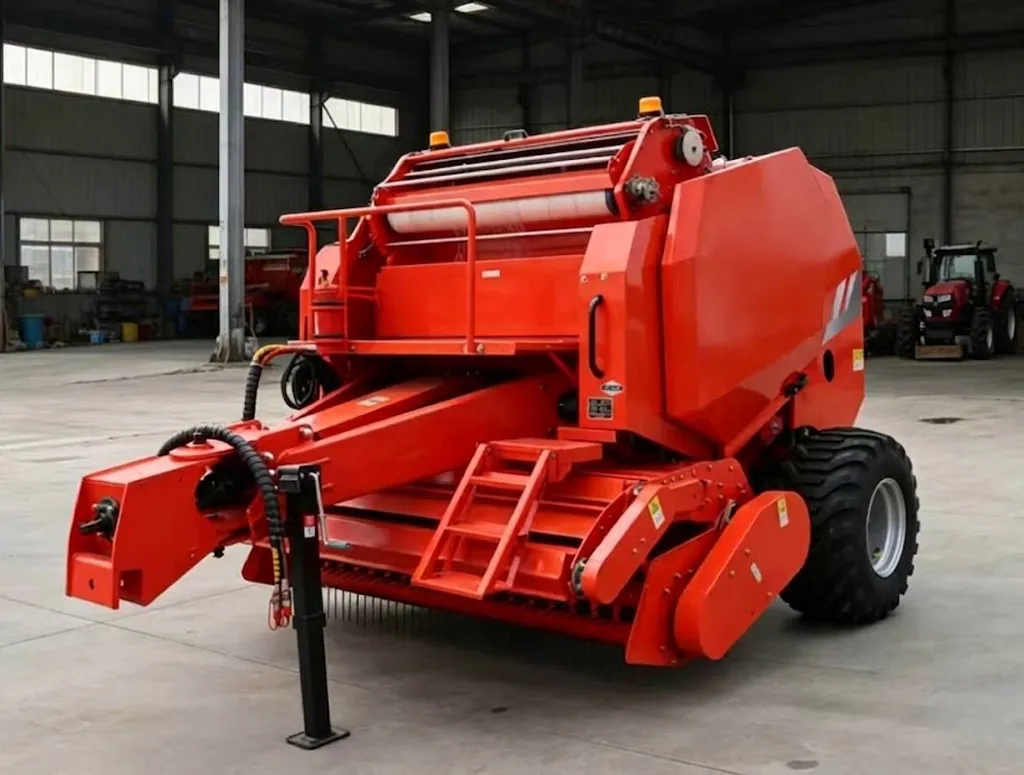
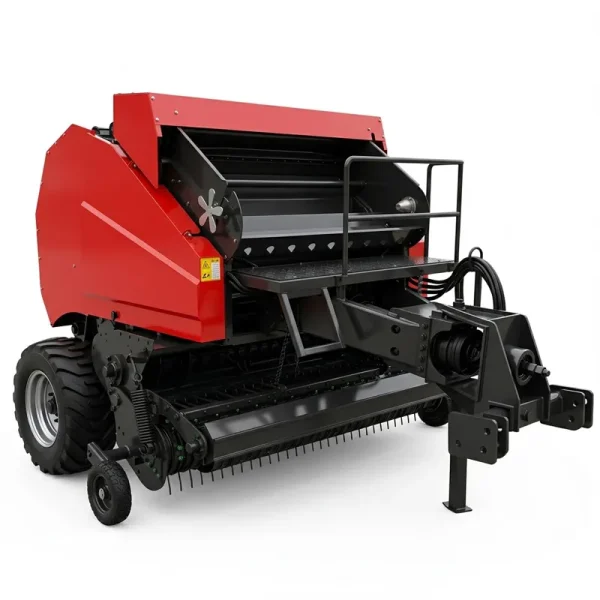
The EP Round Baler with Φ1220 mm compression chamber, at overall dimensions of 4100×2900×2400 mm, is the reference model for 500-plus-hectare irrigated alfalfa operations. Its frame geometry is designed around a large-diameter chamber that distributes bale formation load across a longer roller contact arc than is possible with smaller chambers. This is not incidental — the geometry of how force is applied to the forming bale directly determines the density gradient from bale core to surface, which in alfalfa silage is directly linked to fermentation uniformity. A wider contact arc produces a bale where the outer compression zone reaches a density comparable to the core, whereas a small-chamber design pressing the same material to the same nominal density delivers a bale where the core is significantly denser than the outer zone. In wrapped silage bales, this outer-zone density deficit is where aerobic spoilage initiates.
For operations that have identified a specific throughput requirement above what a single Φ1220 mm unit can deliver within the available baling window, the EP Round Baler at 3200×2500×2010 mm with Φ1000 mm compression provides a complementary configuration option. Its more compact footprint — at dimensions suited to running behind high-horsepower tractors without the transport restrictions of the larger model — makes it practical as the second machine in a two-unit operation covering 750–1,000 ha. The structural approach in this model uses a shorter but more deeply-braced frame section that achieves the same resistance to torsional deflection under bale ejection shock as the larger model achieves through frame length. Both models are manufactured with CNC laser-profiled side panels, matched-pair line-bored bearing housings, and automatic MIG frame welds at all pivot point locations.
| Structural Feature | EP Φ1220 mm (4100×2900×2400 mm) | EP Φ1000 mm (3200×2500×2010 mm) | 500+ ha Operational Relevance |
|---|---|---|---|
| Frame overall size | 4100×2900×2400 mm | 3200×2500×2010 mm | Larger frame = higher structural rigidity under multi-season cyclic load |
| Compression chamber diameter | Φ1220 mm | Φ1000 mm | Larger dia. = broader bale contact arc = even density gradient |
| Frame panel manufacture | CNC laser-profiled | CNC laser-profiled | Dimensional consistency = repeatable density across all bales in a run |
| Bearing housing manufacture | Matched-pair, line-bored | Matched-pair, line-bored | Eliminates angular misalignment vibration across sustained high-output seasons |
| Frame weld specification | Automatic MIG, full penetration | Automatic MIG, full penetration | Critical at rear gate pivot — the highest-fatigue point in multi-cut seasons |
| Hydraulic chamber control | Constant-pressure circuit | Constant-pressure circuit | Maintains target density irrespective of operator speed variation |
| Recommended tractor HP | 80 HP and above | 65 HP and above | Match to existing tractor fleet to avoid additional capital cost |
Material System: Engineering for Longevity Across Multiple Alfalfa Seasons
At a throughput of 10,000 to 20,000 bales per season, the material system of the round baler — the specific alloys, surface treatments, sealing specifications, and lubricant grades used at each point in the machine — is not an abstract engineering consideration. It is a direct determinant of total ownership cost. A machine that needs its compression rollers replaced after 8,000 bales in an irrigated alfalfa environment creates a scheduled maintenance event that costs both parts and baling window time. A machine whose roller surface treatment holds its grip profile for 20,000 bales or more allows the operator to concentrate on field productivity rather than component management.
Irrigated alfalfa produces a particularly demanding environment for baler materials. The crop alternates between very-wet early morning conditions — immediately after irrigation — and very-dry afternoon conditions after the day’s heat has removed surface moisture from the windrow. This moisture swing means the compression rollers, pickup tines, and drive chain all face a cycle that goes from high-humidity, chemically-active silage conditions to abrasive, silica-rich dry crop handling within the same working day. Materials that are optimised for one endpoint of this range will underperform at the other.
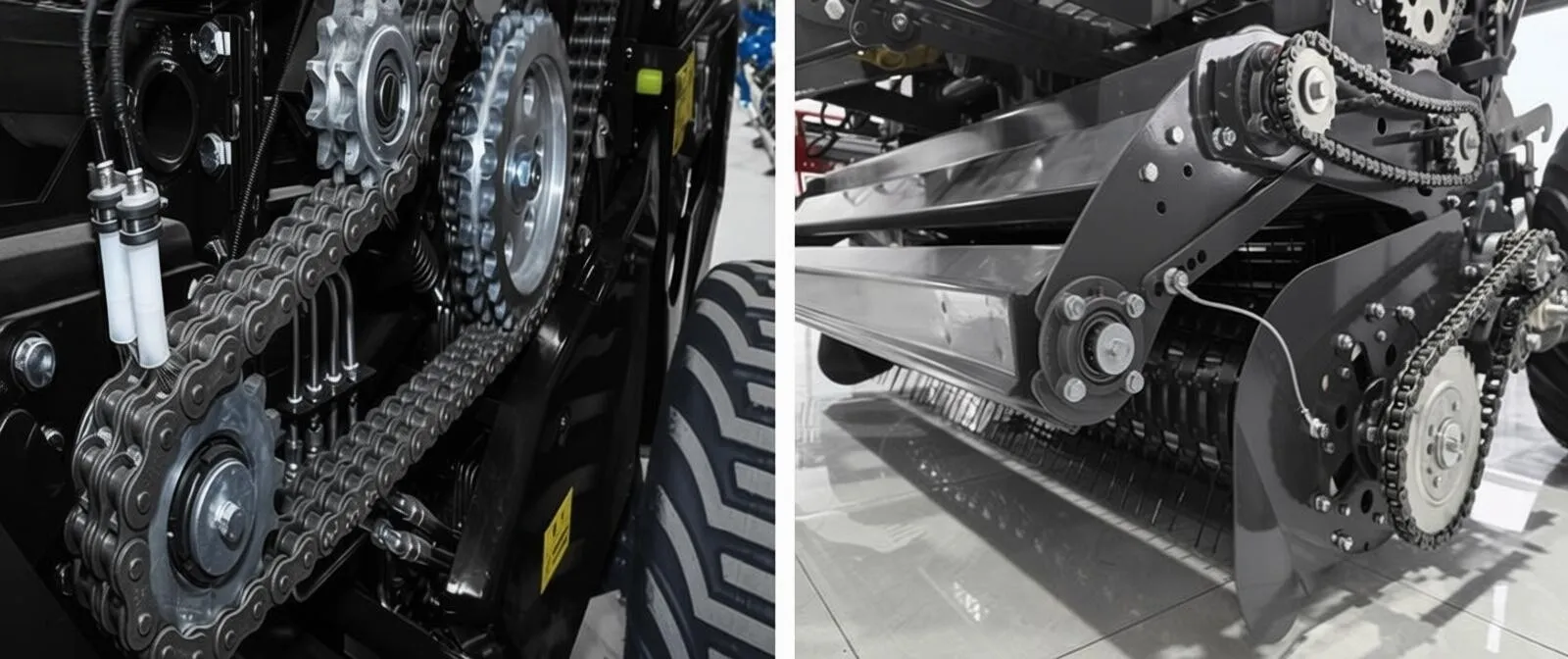
The compression rollers in the EP commercial series are manufactured from high-carbon alloyed steel with a surface treatment applied to maintain a controlled roughness profile across the roller’s operational life. This detail matters specifically for irrigated alfalfa because the wet early-morning crop loads the rollers with plant juice that can act as a surface lubricant, reducing grip on the incoming material stream and causing bale core slip — the condition where the partially-formed bale rotates less efficiently than the rollers. A roller that maintains its surface profile despite moisture exposure sustains grip throughout the full working day. The drive chain and sprocket assembly is manufactured to ANSI B29.1 Class A pitch accuracy, which minimises the dynamic load variation per chain link cycle — a source of both noise and incremental sprocket wear that compounds significantly at the 15,000-plus cycle counts typical of large-scale alfalfa seasons.
| Component | Material / Specification | Irrigated Alfalfa Service Relevance |
|---|---|---|
| Compression rollers | High-carbon alloyed steel, controlled surface profile | Grip maintained in both wet morning and dry afternoon conditions |
| Frame structural steel | Structural grade, electrostatic powder-coated | Corrosion resistance in irrigation splash and morning condensation environment |
| Drive chain | ANSI B29.1 Class A pitch accuracy, heavy-series option | Minimises cyclic load variation; 40% greater wear resistance than standard-pitch |
| Pickup tines | Spring steel, heat-treated | Flex resistance in irrigated field stones; low leaf shatter in dry afternoon crop |
| Roller bearings | 6208-2RS sealed deep-groove, L10 >10,000 hr | Double-sealed against irrigation-borne silica dust and crop juice ingress |
| Gearbox housing | GGG50 ductile iron, CNC-machined, IP65 sealed | IP65 protects against fine alfalfa dust in dry-condition cutting phases |
| Hydraulic hoses | SAE 100R2, UV-stabilised outer jacket | Sustained UV exposure and temperature cycling in irrigated field conditions |
| Gear oil | ISO VG 220 EP-rated, 500 hr change interval | EP additive package handles peak torque during dense-windrow feeding events |
Power Range: Matching Tractor HP to Baler Model for Irrigated Alfalfa
The power range question for large irrigated alfalfa operations is not simply about meeting the baler’s minimum PTO HP requirement. It is about understanding the continuous versus peak torque demand curve across a typical working session and ensuring the tractor can satisfy both without running near its thermal or hydraulic capacity limits for extended periods. An irrigated alfalfa crop, cut at 45–55% moisture and well-wilted to 40–50% before baling, generates a PTO torque demand that varies significantly within a single field as windrow density fluctuates between the light ends of rows and the heavier centre concentrations where the rake has merged two windrows.
For the EP Round Baler with Φ1220 mm compression at 4100×2900×2400 mm overall dimensions, the recommended tractor output is 80 HP and above. In practice, at a target bale density of 200–240 kg/m³ in moderate-moisture irrigated alfalfa, a tractor delivering 90–110 PTO HP provides adequate headroom for peak windrow events without running the tractor at sustained near-limit output. Running at 85–90% of rated PTO output continuously is an accepted operating point for well-maintained modern tractors, but it leaves little thermal margin for the sustained multi-day operation pattern of large irrigated alfalfa programmes. A 110 HP tractor gives the operator the ability to respond to heavy windrow concentrations by maintaining forward speed rather than slowing to reduce PTO load — which in turn maintains consistent bale density rather than allowing the chamber to fill unevenly at reduced throughput.
For the EP model at 3200×2500×2010 mm with Φ1000 mm compression, the 65-HP-and-above specification places it within the reach of many standard medium-frame tractors already present on large mixed farms. This is a practical advantage in operations where the second baler in a two-unit fleet is being assigned to a tractor that is not the primary high-HP unit. The smaller-frame model paired with a 75–90 HP tractor provides a workable secondary configuration that complements the primary Φ1220 mm unit on the farm’s most productive paddocks without requiring a dedicated high-HP tractor for both units.
POWER RANGE SUMMARY
At 500+ ha irrigated alfalfa scale, the practical power range for a primary single-unit operation is 90–120 PTO HP behind a Φ1220 mm chamber baler. Two-unit operations covering 750–1,000 ha benefit from one Φ1220 mm unit at 100–120 PTO HP and one Φ1000 mm unit at 75–90 PTO HP, allowing the two tractors to be assigned to paddocks in sequence and reducing the risk of a single mechanical event stopping the entire farm’s baling programme.
Round Baler Gearbox Specification for Large-Scale Alfalfa: What the Load Profile Requires
The round baler gearbox in a large irrigated alfalfa operation accumulates working hours faster than almost any other single baler application. Four cuts per year, each requiring 8–12 days of continuous operation at 8–10 hours per day, means the gearbox can accumulate 300–480 hours per season on a dedicated commercial operation. Over five seasons, that is 1,500–2,400 hours — a figure that moves the gearbox from the “consumable but long-life” category toward an active lifecycle management question.
The gearbox specification used in the EP commercial series is rated for continuous torque above 500 Nm at 540 RPM PTO input, with sealed bearings at the 6208-2RS specification carrying an L10 bearing life of over 10,000 hours. This L10 figure is the life at which 10% of bearings in a population can be expected to have failed — the actual median life being significantly longer. In the context of a 300-hour seasonal accumulation, a 10,000-hour L10 implies the bearing population remains well within its nominal life envelope for over 30 seasons at that accumulation rate, which means bearing failure should not be a meaningful maintenance event in a properly lubricated machine. The IP65 housing seal rating is equally relevant here — alfalfa dust in dry cutting conditions is extremely fine and penetrating, and a housing without adequate dust exclusion will contaminate the gear oil within a single season’s cutting, degrading the EP additive package that protects gear flanks during peak torque events.
Primary Recommendation: EP Round Baler Φ1220 mm Compression for 500+ ha Irrigated Alfalfa
For 500-plus-hectare irrigated alfalfa operations baling as a single-unit primary machine, the EP Round Baler with Φ1220 mm compression chamber is the direct recommendation. Its 4100×2900×2400 mm overall dimensions, large-arc compression geometry, and constant-pressure hydraulic circuit address the three primary failure modes of round balers at commercial alfalfa scale: frame fatigue from multi-season ejection shock cycling, density variation from inconsistent hydraulic pressure maintenance, and driveline wear from sustained high-torque operation. The IP65-sealed gearbox housing and SAE 100R2 hydraulic hoses are specified for the temperature and moisture cycling conditions typical of irrigated field environments.
Secondary / Companion Unit: EP Round Baler Φ1000 mm (3200×2500×2010 mm)
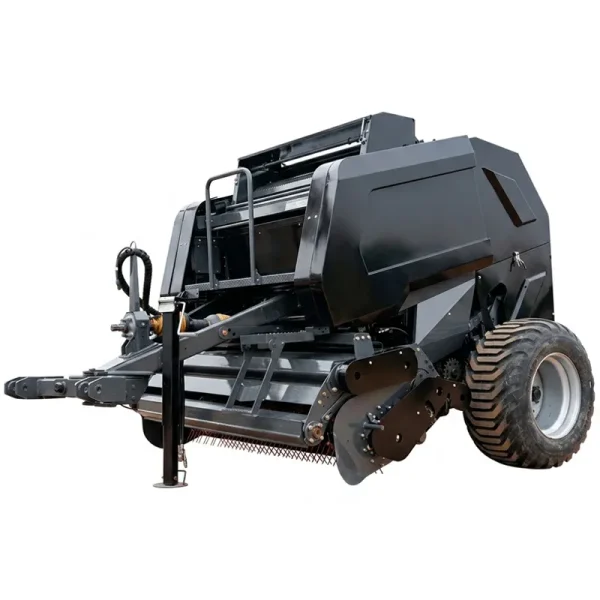
Operations covering 750–1,000 ha, or farms that want to reduce the risk of a single machine failure stopping the entire baling programme, benefit from running two units. The EP Round Baler at 3200×2500×2010 mm with Φ1000 mm compression is the recommended companion unit. Its more compact footprint makes it appropriate for secondary paddocks or for operations where the primary high-HP tractor is not always available. At 65 HP and above, it pairs with a broader range of the medium-frame tractors commonly found in mixed farming operations. As a round baler manufacturer, the production approach for this model uses the same matched-pair bearing housing and CNC laser frame panel manufacturing as the larger Φ1220 mm unit, which means the density consistency performance is structurally equivalent — the difference is bale volume and therefore daily throughput, not bale quality architecture.
Baling Window Planning for Multi-Cut Irrigated Alfalfa: Matching Machine Capacity to Harvest Calendar
On a 500-plus-hectare irrigated alfalfa farm, the baling window is a managed constraint rather than a flexible one. Alfalfa cut at the correct stage — early bud to early bloom — has a quality shelf life of approximately 10–14 days in the windrow before weather or continued maturity begins to degrade its nutritive value. This window defines the maximum allowable time between the first mowing pass and the last baling pass on each cutting cycle. Every day of delay in baling that is caused by insufficient machine throughput — rather than by weather or crop readiness — is a direct reduction in forage quality that cannot be recovered in subsequent processing.
Planning the baling window means working backward from the maximum acceptable crop age at baling and forward from the rate at which the mowing crew advances through the farm. A mowing operation that clears 60–70 ha per day on a 500 ha farm will complete the first cut in approximately 7–8 mowing days. If baling begins on day 3 of mowing — as is common practice in well-organised large operations — the last paddocks will be mowed on day 7–8 and the earliest-mowed paddocks will be 4–5 days into the wilting phase by the time baling starts on them. A baler achieving 250 bales per day, working 10-hour days, clears approximately 80 ha per day of Φ1220 mm bales at standard windrow density. This means a single primary baler can clear a 500 ha farm in approximately 6–7 baling days — comfortably within the 10–14 day quality window for the earliest-mowed paddocks and still within acceptable limits for the latest-mowed ones, assuming the baling team starts promptly after adequate wilting time has elapsed.
| Parameter | 500 ha Single Unit | 750 ha Two Units | Notes |
|---|---|---|---|
| Daily bale output | 200–280 bales/day | 350–500 bales/day | At Φ1220 mm, 10-hour operating day |
| Days to clear farm | 6–8 days | 7–10 days (2 units) | Assumes standard windrow density and crop at 45% moisture |
| Quality window compliance | Achievable | Achievable with proper scheduling | Start baling day 3 of mowing, not day 1 |
| Downtime risk impact | High — one unit failure delays full farm | Moderate — second unit covers partial production | Two-unit configuration reduces season risk significantly |
Regulatory Framework for Round Baler Gearboxes and Agricultural Drivelines on Large Irrigated Farms
Agricultural round balers operating on large commercial irrigated farms are subject to regulatory requirements covering driveline safety, machinery type approval, and — in markets with formal forage safety frameworks — the quality and hygiene of silage produced for commercial sale. The following frameworks are relevant to buyers operating in the primary markets for irrigated alfalfa silage and hay production.
| Region | Standard / Regulation | Practical Impact on Large Irrigated Farm Baler Use |
|---|---|---|
| South Korea | Agricultural Mechanization Promotion Act; NAAS machinery performance evaluation; MAFRA Livestock Products Sanitary Control Act | NAAS evaluation required for subsidy eligibility; KS B ISO 11684-compliant PTO guarding; commercial alfalfa silage for dairy sale subject to MAFRA hygiene standards. Density documentation increasingly required for premium forage market access. |
| European Union | EU Machinery Directive 2006/42/EC; EN ISO 4254-7 (baling equipment); EC No. 183/2005 (feed hygiene); GMP+ feed safety certification applicable in Netherlands and Germany | CE marking mandatory; noise emission declaration required under 2000/14/EC; large commercial operations producing silage for cooperative dairy supply chains may need GMP+ compliance including bale production records |
| United States | ASABE S206.5 (PTO shaft safety guarding); OSHA 29 CFR 1928.57; FDA FSMA 21 CFR Part 507 (animal food safety) | Large commercial alfalfa operations selling silage may fall under FSMA Preventive Controls for Animal Food; PTO guarding to within 25 mm of tractor housing required under OSHA standard. ASABE recommends documented service interval records for commercial machinery |
| Australia | AS/NZS ISO 11684 (PTO safety); Safe Work Australia Mobile Plant Code; national biosecurity standards for machinery cleaning between properties | PTO safety compliance required; large irrigated alfalfa contractors moving machinery between properties subject to biosecurity cleaning protocols; South Australia and Western Australia have formal farm machinery safety inspection requirements for commercial operations |
| Kazakhstan / Central Asia | GOST R 53056-2008 (agricultural machinery safety); EAC certification (Eurasian Conformity marking) required for commercial import | EAC certification covers machinery safety including PTO and driveline guarding; gear oil specifications must comply with GOST standards applicable in the importing country. Relevant given the growing scale of irrigated alfalfa in Central Asian export markets |
| Canada | CSA Z96 (PTO guarding); Feeds Act SOR/83-593; provincial agricultural equipment safety regulations | Commercial alfalfa silage for dairy sale under Feeds Act minimum quality standards; Alberta and Saskatchewan have large irrigated alfalfa sectors with provincial farm safety acts applying to commercial machinery operators and contractors |
| Brazil | ABNT NBR 15827 (agricultural machinery safety); MAPA registration; NR-12 occupational safety in machinery operation | Round balers imported for commercial use require MAPA registration and must comply with NR-12 guarding standards for all PTO and driveline systems. Large Mato Grosso and Goiás alfalfa operations increasingly subject to ESG reporting requirements that include machinery safety documentation |
For large South Korean irrigated alfalfa operations, the intersection of NAAS machinery evaluation, MAFRA silage hygiene requirements, and the Renewable Energy 3020 programme’s biomass targets creates a multi-layer compliance environment. A เครื่องอัดก้อนกลม that carries ISO 9001 manufacturing certification and is supported by documentation for the NAAS evaluation process positions the operator to access both equipment subsidy programmes and the premium forage quality premiums paid by certified dairy cooperatives. Aligning the machinery procurement decision with this compliance pathway from the beginning avoids the retrofit certification costs that arise when equipment is purchased on specification alone without consideration of the regulatory context.
Compatible Driveline Components for Large-Scale Alfalfa Round Baler Operations
Large-scale irrigated alfalfa operations accumulate baler working hours at a rate that brings consumable driveline components — PTO shafts and drive chains in particular — into active lifecycle management rather than periodic replacement. Sourcing these components from a supply chain that is verified compatible with the baler model removes the uncertainty that arises when aftermarket parts of unknown specification are fitted. The two component categories below are specified for use with the EP round baler commercial series and support the one-source supply model that simplifies parts management across a multi-unit commercial fleet.
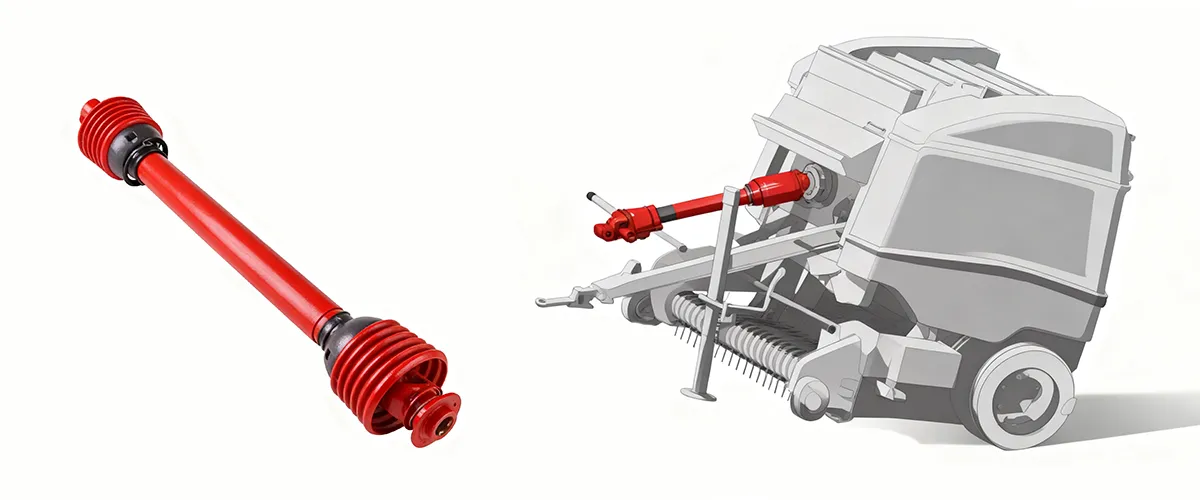
Agricultural PTO Shaft for Round Balers
The EP-PTO shaft series connects to the EP round baler gearbox input at 1-3/8-inch Z6 spline, 540 RPM, with adjustable length from 600 to 1200 mm. Rated for continuous torque above 500 Nm — the sustained load level present during commercial alfalfa baling at maximum chamber pressure settings. The articulated universal joint design maintains smooth torque delivery through the full range of steering angles used in large-paddock irrigated alfalfa operation, where long straight runs are occasionally punctuated by sharp headland turns at full crop-flow rate. A declared 20% fuel efficiency improvement versus oversized legacy shafts is a meaningful figure at the 400–600 PTO hours per season that large irrigated alfalfa programmes accumulate. Worm gear reducer options are available for non-standard drive configurations within the same supply chain.
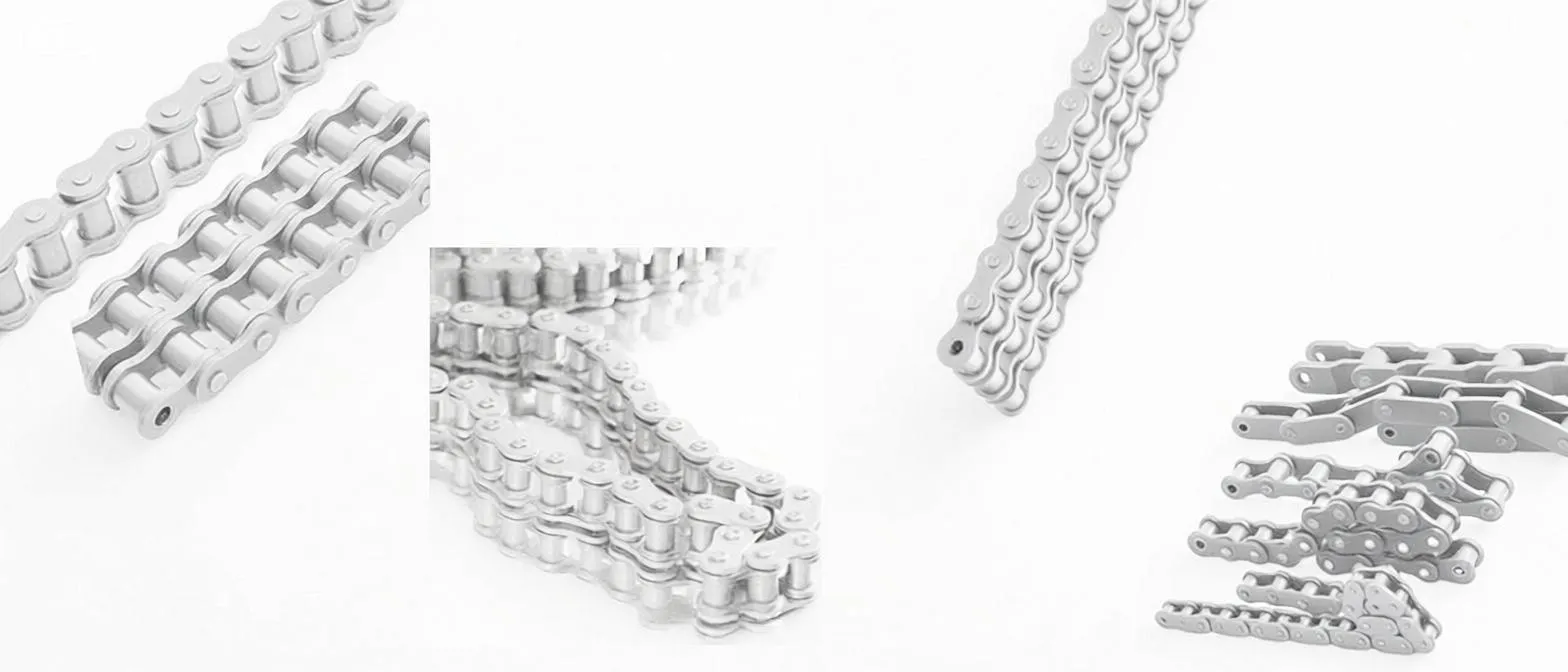
Agricultural Chain for Bale Chamber Drive
At 15,000 to 20,000 bales per season across a 500-plus-hectare irrigated programme, the bale chamber drive chain accumulates cyclic load events at a rate that places it firmly in the annual planned-maintenance category rather than the reactive-replacement category. The agricultural chain specified for the EP commercial baler series is manufactured to ANSI B29.1 Class A pitch accuracy, which keeps the dynamic load variation per chain engagement cycle at the minimum achievable level — directly reducing the rate of sprocket flank wear that determines how quickly the drive geometry degrades beyond the point of smooth power transmission. The heavy-series option, with 40% greater pin and roller cross-section compared to standard-pitch chain, is the recommended specification for large irrigated alfalfa operations where sustained high-tension operation is the norm rather than the exception. Chain sets are offered in matched-length configurations sized for both the Φ1220 mm and Φ1000 mm chamber drive circuits.
About Our Agricultural Machinery Manufacturing Operation
Our manufacturing enterprise was founded in 2013 and has grown into a modern, intelligent production operation serving the agricultural and animal husbandry machinery sector across more than a decade of continuous operation. The product range includes light and heavy round balers, single and double blade mowers, disc rotary mowers, and single and double side rakes, all produced under ISO 9001 Quality Management System certification with independent import and export rights. The production facility currently operates more than 60 sets of large-scale equipment, including CNC laser cutting lines, automatic MIG welding systems, and electrostatic powder-coating production lines, supporting an annual design output capacity of 2,000 units.
OEM and ODM configuration services are available for buyers with specific market requirements — including modifications to gearbox reduction ratios, PTO spline specifications, and frame dimensions needed to meet local road transport regulations or tractor fleet compatibility requirements. All machines undergo PTO load testing on the factory test bench before shipping, verifying that chamber pressure response, gearbox torque output, and driveline alignment meet the production specification before the unit leaves the facility.
Frequently Asked Questions
Q1. Which round baler model is best suited for a 500-plus-hectare irrigated alfalfa operation in South Korea running four cuts per year?
Q2. What tractor horsepower range do I need to run a commercial round baler on irrigated alfalfa at full density settings?
Q3. How does a round baler gearbox perform differently in irrigated alfalfa conditions compared to dry hay baling in terms of wear and service cost?
Q4. How many round balers does a 750-hectare irrigated alfalfa farm need to stay within the 10-day baling window for all four cuts?
Q5. What round baler parts have the highest replacement frequency in commercial irrigated alfalfa operations and how should I plan for them?
Q6. How does bale density from a round baler machine affect the value of alfalfa silage sold to dairy cooperatives in South Korea?
Q7. What is the difference between the EP Φ1220 mm and the EP Φ1000 mm round baler for large alfalfa farms and when should I choose each?
บรรณาธิการ: PXY