Cotton Stalk Baling | Chain Drive Engineering
Cotton stalk is among the most mechanically aggressive crop residues a round baler will encounter. Its woody lignified stems, embedded silica particles, and brittle branch nodes create a wear environment that exposes every weakness in a standard agricultural drive chain. Understanding how a purpose-specified 20A heavy-duty chain system is engineered to survive this environment is essential knowledge for any operator or buyer investing in cotton residue management equipment.
Cotton stalks present a fundamentally different challenge compared to grass hay, rice straw, or even corn stalks. After the cotton bolls are stripped — either mechanically or by hand — the remaining plant consists of a dense central stem that has undergone significant lignification through the growing season, lateral branches with irregular fracture profiles, and root-adjacent material that frequently carries soil and silica grit into the pickup zone. When this mixture enters a round baler compression chamber, the cumulative abrasion load on the drive system can be two to three times higher than equivalent throughput of cereal straw.
The прес-підбирач рулонний is the preferred machine for cotton stalk collection across the major cotton-producing regions of Central Asia, South Asia, the Middle East, and increasingly in East Africa and parts of Spain. Its ability to produce high-density cylindrical bales without requiring the material to be cut to precise lengths makes it well-suited to the irregular geometry of cotton plant residue. However, the performance of the baler over a full cotton harvest season depends almost entirely on whether its internal chain drive system was specified for the task — or whether a standard-grade chain is simply wearing out faster than the operator anticipated.
This article examines the engineering rationale behind 20A heavy-duty chain selection for cotton stalk applications: the metallurgy involved, the lubrication requirements, the interaction with compression roller geometry, and how this system translates into sustained bale density and reduced maintenance cost across a cotton harvest campaign. Product data referenced throughout reflects the specifications of our available round baler machine lineup, particularly the 9YG-2.24D series and the 9YG-1.0C, which are most commonly deployed in cotton residue scenarios.
1. Why Cotton Stalk Is Among the Most Abrasive Crop Residues for Round Balers
The abrasive character of cotton stalk is not immediately obvious from visual inspection. Unlike sand or grit — which are visibly present on poorly cleaned root crops — the abrasive elements in cotton stalk are distributed throughout the plant material itself. The primary sources are threefold: first, the silica phytoliths embedded in the epidermal cell layer of the stem; second, soil particles that adhere to the sticky surface residue left after chemical defoliation commonly used in commercial cotton production; and third, the hardened lignocellulosic fibre itself, which has a Janka hardness-equivalent that significantly exceeds that of cereal straw at equivalent moisture content.
When cotton stalks are fed into the compression chamber of a round baler, the compression rollers grip and compact the material by rolling and wrapping it into an ever-tighter cylindrical mass. Each revolution of each roller moves the contact surface across the crop material at high relative speed. For a roller-type baler running 18 rollers at chamber diameters of 222 mm — as in the 9YG-2.24D — the cumulative roller surface contact with crop per hour of operation is substantial. In a standard cereal straw application, wear on roller surfaces and drive chain components is manageable within a normal seasonal maintenance interval. In cotton stalk, without an upgraded drive chain specification, this wear rate accelerates to the point where chain elongation and roller surface damage can occur within a single harvest campaign.
Chain elongation is the primary failure mode. As pins and bushings wear, the effective pitch of each link increases fractionally. This fractional elongation accumulates across the total chain length — a 100-link chain that wears by 0.1 mm per link pitch delivers an elongation of 10 mm across its span. At this level, the chain begins to ride high on sprocket teeth rather than seating fully in the gullet, generating impact loads at each tooth engagement that accelerate further wear in a self-reinforcing cycle. The 20A designation — and specifically the heavy-duty variant specified for cotton stalk service — addresses this through pin diameter, bushing wall thickness, and roller outer diameter specifications that reduce the per-engagement wear rate from the outset.
The additional load from cotton stalk’s structural resistance also means peak chain tension during compression events is higher than in lighter crop materials. This is where the structural specifications of 20A heavy-duty chain, rather than standard 20A, become directly relevant: increased plate thickness and larger pin cross-section allow the chain to absorb spike loads during compression of particularly dense or tangled stalk material without plastic deformation of the link plates or shear failure at the pin joints.
2. Manufacturing Structure of 20A Heavy-Duty Agricultural Drive Chain
The ANSI 20A designation (equivalent to ISO 12A or European 60H in some cataloguing systems) refers to a chain with a 38.1 mm pitch — the distance between adjacent pin centres. At this pitch, the chain’s load-bearing geometry provides substantially more bearing area between pin and bushing than the smaller 16A or 12A chains typically found in lighter agricultural equipment. The “heavy duty” variant within the 20A family further increases inner link plate thickness, outer link plate thickness, and pin diameter beyond the standard ANSI tolerances, specifically to improve fatigue life under the cyclical loading that characterises compression chamber drive service.
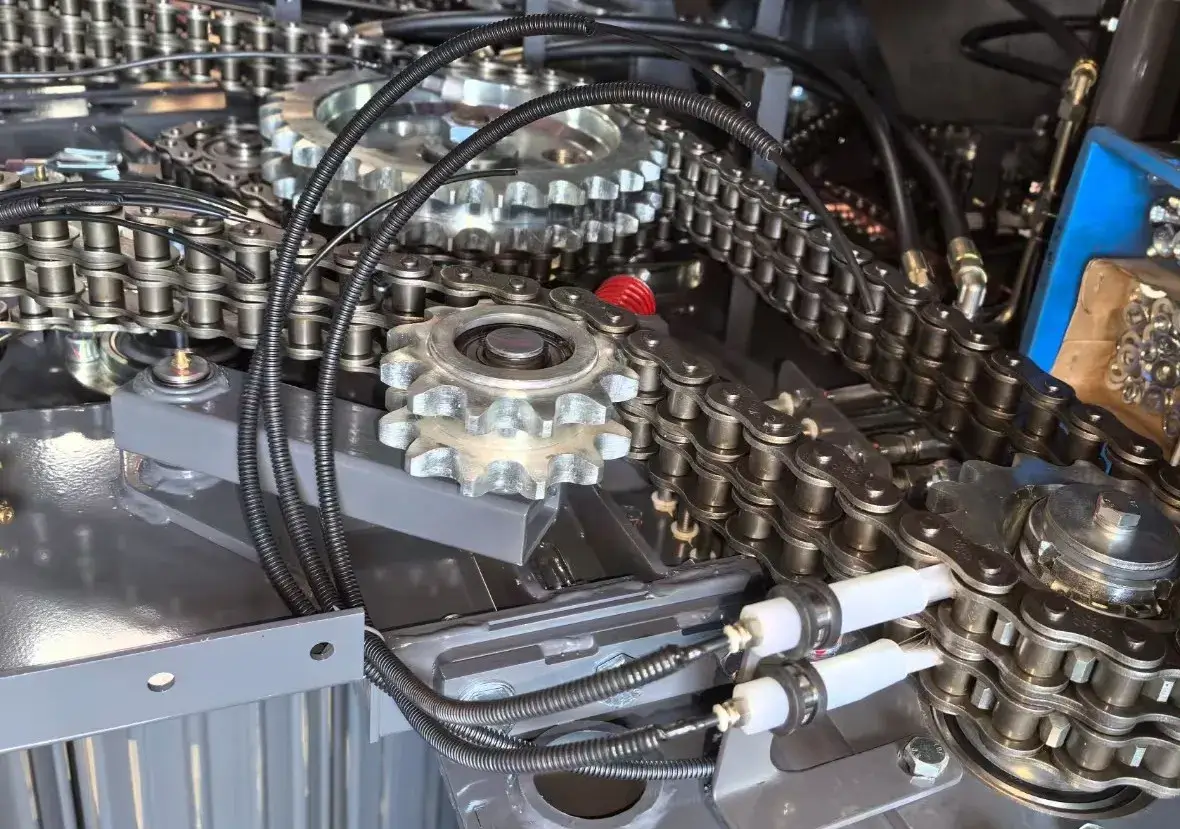
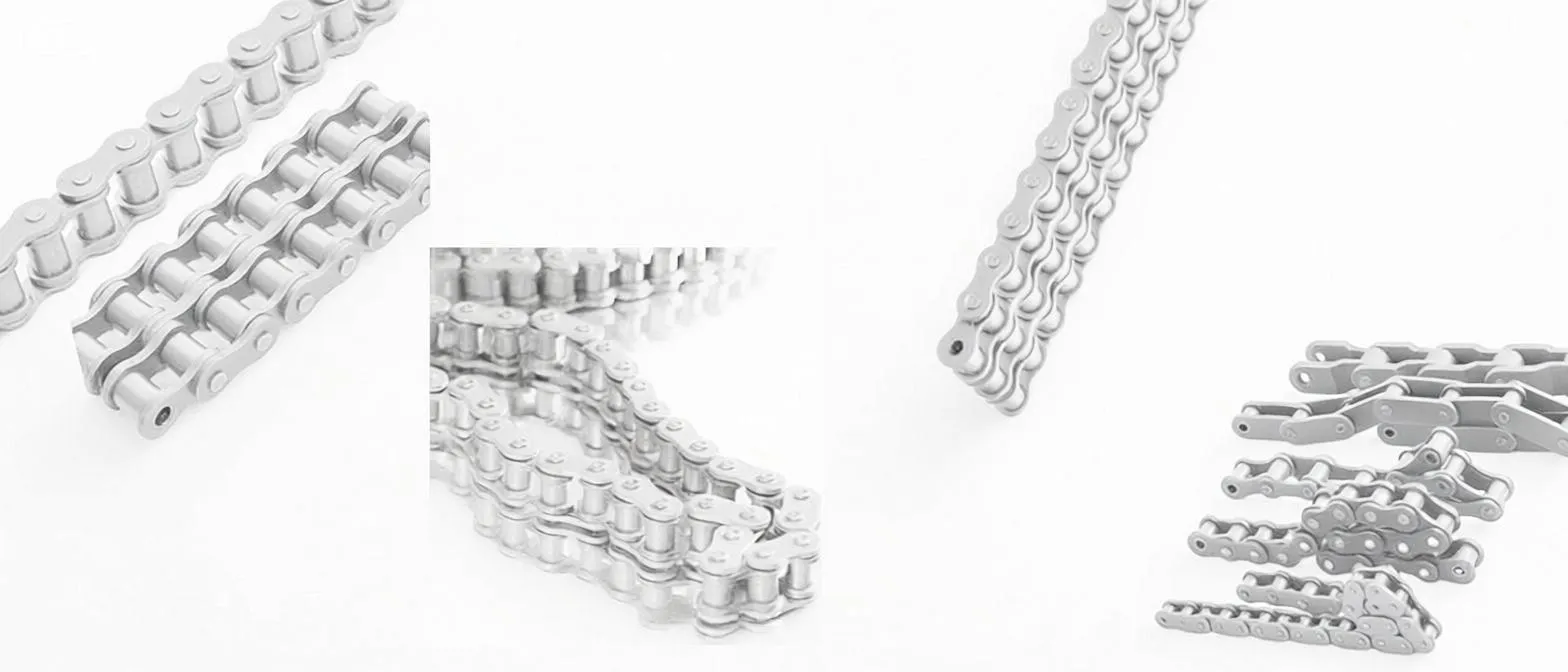
A complete 20A chain assembly consists of five functional elements working together. The inner link plates form the structural core of the inner links, transmitting load between the two bushings at each inner link. The outer link plates bridge the gap between two pins, creating the outer links that alternate with inner links along the chain length. The pins themselves are the primary wear interface in abrasive service — they rotate within the bushing during each chain articulation event as the chain bends around the sprocket, and their surface hardness and diameter directly set the bearing pressure at this interface. The bushings are press-fitted into the inner link plates and rotate around the pin; their inner diameter tolerance and hardness determine how much material is removed per articulation cycle. The rollers are the outermost element — they contact the sprocket tooth and, critically for abrasive crop environments, present the chain’s surface to crop material that may pack into the drive pathway.
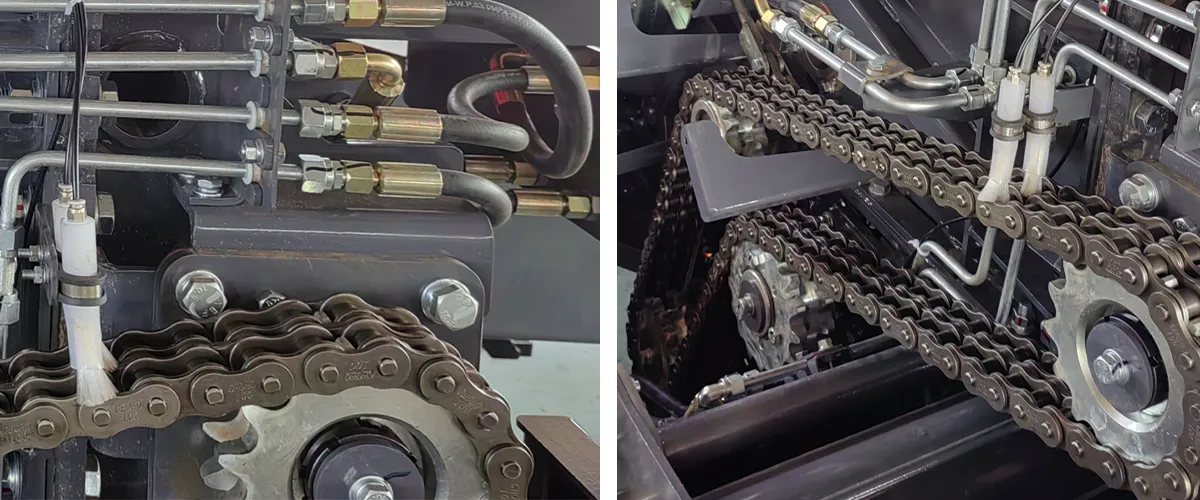
In the 9YG-2.24D round baler’s rear chamber configuration, the drive chain operates the full compression roller assembly — 18 rollers of 222 mm diameter — through a dual-side sprocket transmission design. This geometry means the chain must transmit the full compression torque to both sides of the roller bank simultaneously, which is why the heavy-duty specification in cotton stalk service is not a marginal upgrade but a structural requirement. In lighter baler designs with single-side chain drive, the asymmetric load distribution can cause roller skew that further increases wear; the dual-side design in the 9YG-2.24D series eliminates this by equalising load across the chain pair.
The chain’s articulation angle — the angle through which each link pair bends as it passes around each sprocket — determines how many times per unit of operation each pin-bushing pair slides against each other. Larger sprocket pitch diameters reduce this articulation angle and thus reduce the wear rate per engagement. In the 9YG-2.24D compression drive, the sprocket sizing is matched to the 20A chain pitch to keep articulation angles within the design limits that prevent excessive bushing edge loading — a detail that distinguishes a system engineered for abrasive crop service from one simply assembled with heavy-duty chain without corresponding sprocket redesign.

3. Material System: Metallurgy and Surface Treatment for Abrasion Resistance
The material selection for each component within a 20A heavy-duty chain destined for cotton stalk service follows a set of engineering trade-offs between hardness, toughness, and cost that determine how long the chain will hold its dimensions before elongation reaches the replacement threshold. Getting this balance wrong in either direction — too hard and the chain becomes brittle under impact loads from dense cotton stems; too soft and surface wear accelerates to unacceptable rates — is precisely why cotton stalk baling warrants a purpose-specified chain rather than a standard catalogue selection.
Pins in heavy-duty 20A agricultural chain for abrasive service are typically manufactured from case-hardened alloy steel — commonly a chromium-manganese steel grade such as 20CrMnTi or an equivalent — which provides a hardened surface layer of approximately 58–62 HRC over a tough core that absorbs impact energy without through-thickness cracking. The hardened surface resists the micro-cutting action of silica particles and abrasive crop fibres at the pin-bushing interface, while the ductile core prevents catastrophic pin fracture when the chain experiences an overload event during ingestion of a particularly dense or knotted cotton stalk bundle. Pin hardness depth is typically specified at a minimum of 0.3–0.5 mm, beyond which the core properties take over.
Bushings in abrasive service are increasingly specified with a through-hardened construction rather than the case-hardened approach used for pins. Through-hardened bushings at 40–50 HRC maintain their dimensional accuracy even as the surface wears incrementally, because the subsurface material has the same hardness as the contact surface. This prevents the accelerating wear rate that occurs in case-hardened bushings once the hardened layer is breached in high-abrasion service. The bushing’s inner bore diameter tolerance is typically held to ±0.01 mm in premium chain, which directly controls the initial bearing clearance between pin and bushing — tighter initial clearance means more articulation cycles are required to reach the elongation threshold.
Link plates — both inner and outer — for heavy-duty 20A are stamped from medium-carbon steel strip, heat-treated to approximately 35–45 HRC, and shot-peened on the critical tension surfaces. Shot peening introduces compressive residual stresses at the plate surfaces that significantly extend fatigue life under the cyclic tensile loads experienced during compression roller drive. In cotton stalk service, where bale density targets of 100–200 kg/m³ generate elevated peak chain tensions, fatigue life is the limiting failure mode for link plates rather than direct wear — making shot peening a non-negotiable surface treatment in this specification class.
Rollers in abrasive crop service benefit from a hardened outer surface — typically induction-hardened to 55–60 HRC — that resists the wear generated by crop particles packing between the chain and sprocket. In severe cotton stalk contamination environments, some operators specify sealed O-ring or X-ring chains that incorporate elastomeric seals between the inner and outer link plates to prevent abrasive particles from reaching the pin-bushing interface. While these sealed chains carry a cost premium, the reduction in internal wear rate in field conditions where cotton defoliant residue and soil fines are present can justify the investment through extended chain replacement intervals.
4. 20A Chain Specification Comparison: Standard vs. Heavy-Duty for Cotton Stalk Service
| Parameter | Standard 20A | Heavy-Duty 20A (Cotton) | Benefit in Cotton Stalk |
|---|---|---|---|
| Chain pitch | 38.1 mm | 38.1 mm | Same — ensures sprocket compatibility |
| Inner plate thickness | 3.9 mm | 4.5–5.0 mm | Higher fatigue resistance under spike loads |
| Pin diameter | 11.1 mm | 12.0–12.7 mm | Lower bearing pressure, reduced wear rate |
| Pin material/hardness | Case-hardened, 55–58 HRC surface | 20CrMnTi, 58–62 HRC, 0.5 mm case depth | Resists silica micro-cutting at interface |
| Bushing construction | Case-hardened | Through-hardened, 40–50 HRC | Consistent wear rate; no accelerated breakthrough |
| Link plate treatment | Heat treated | Heat treated + shot peened | Extended fatigue life at high bale density |
| Roller surface | Standard hardened | Induction hardened, 55–60 HRC | Resists abrasive crop contact at sprocket |
| Sealing option | Open (no seals) | O-ring or X-ring sealed variant available | Excludes soil/silica from pin-bushing interface |
| Minimum tensile strength | 88 kN | 110–125 kN | Handles peak loads during dense stalk ingestion |
5. How the 20A Chain System Functions Inside the Compression Chamber During Cotton Stalk Processing
Inside the compression chamber of a drum-roller type round baler, the 20A chain drive connects the sprockets of adjacent rollers in a continuous loop, ensuring that all 18 rollers rotate at a coordinated speed and in the correct direction to spin the forming bale. The chain does not directly contact the cotton stalk material — the rollers do — but the quality of the chain drive directly determines how consistently the rollers can maintain their rotational speed under varying load conditions as the bale builds density.
In the early phase of bale formation, the chamber is nearly empty and the chain operates under minimal load. As the bale core forms and the cotton stalk material begins to pack, compression resistance increases roughly proportionally to the square of bale diameter. By the time the bale approaches its target diameter — Φ1300 mm in the case of the 9YG-2.24D at its cotton stalk density setting of 100–200 kg/m³ — the chain is transmitting the full compression torque generated by the tractor’s PTO output. It is during this late-compression phase that chain quality matters most: a worn or under-specified chain will exhibit micro-slippage on the sprocket teeth, causing roller speed irregularities that produce density variations across the bale cross-section.
The rear chamber of the 9YG-2.24D uses a dual-side 20A heavy-duty chain arrangement — meaning the drive chain runs on sprockets at both ends of each roller simultaneously, rather than only at one end. This design decision was specifically made to prevent the torsional deflection of the roller shaft that occurs in single-side drive when high loads are applied at one end only. In cotton stalk service, where compression forces are higher than in grass or grain straw, this torsional stability translates into straighter roller surfaces at the end of the season and more uniform bale density across the full 1400 mm chamber width.
Lubrication of the 20A chain in a compression chamber environment is complicated by the presence of cotton fibre, stalk dust, and occasional defoliant residue that can contaminate conventional chain lubricant. The preferred lubrication strategy for cotton stalk baling is a high-viscosity adhesive chain oil — sometimes referred to as “sticky” or “tacky” chain lubricant — that has sufficient film strength to maintain a separating layer between pin and bushing despite contamination, while its adhesive quality prevents centrifugal throw-off during roller operation. Dry-film lubricants (molybdenum disulfide or PTFE-based) applied to the chain prior to the season provide a baseline protective layer that is particularly effective at preventing abrasive cotton dust from embedding into the pin-bushing clearance.
The sensor-controlled density system in the 9YG-2.24D communicates bale pressure data to the operator cabin in real time, enabling the operator to stop the bale at the correct density before peak compression loads exceed the design chain tension. This is not merely a convenience feature — in cotton stalk where unexpected density spikes can occur when a knotted stem bundle enters the chamber, having pressure feedback allows the operator to release the density accumulation before chain overload occurs. Operators running the 9YG-2.24D on cotton without the sensor system engaged are, in effect, running blind on chain load — a practice that consistently results in premature chain replacement.
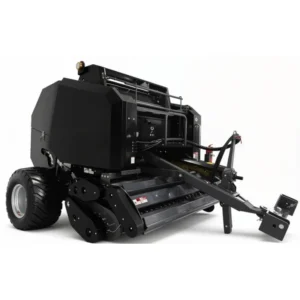
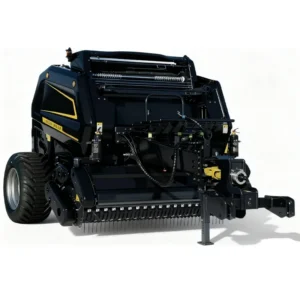
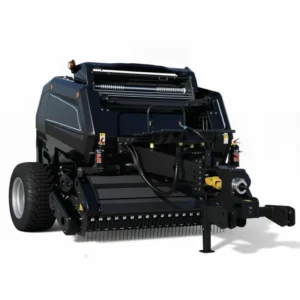
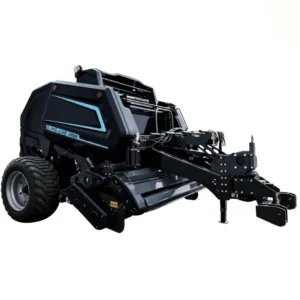
6. Round Baler Models Equipped for Cotton Stalk Applications
7. Chain Elongation Management and Maintenance Intervals in Cotton Stalk Season
Chain elongation monitoring is the single most important maintenance activity during a cotton stalk baling campaign. Unlike grain harvesting where chain condition can often be assessed visually by an experienced operator, the elongation of 20A agricultural chain is a dimensional measurement that requires a dedicated chain wear gauge or ruler measurement across a defined link count. The standard elongation replacement threshold for ANSI 20A chain is 3% — meaning a new chain segment of exactly 254 mm (20 pitches at 12.7 mm each for 20A’s actual per-pitch dimension) should be replaced when that segment measures 261.6 mm or more under a reference tension load.
In practice, achieving cotton stalk season chain life requires a structured lubrication interval that accounts for field conditions. In dry, dusty cotton fields — which are the norm in the Gangwon and Gyeonggi dryland areas of Korea where cotton is sometimes grown as a supplementary fiber crop — abrasive dust contamination of the chain occurs within hours of operation. The recommended lubrication interval in these conditions is every four to six operating hours, using penetrating chain oil applied to the inner link area while the chain is still warm from operation. Allowing the chain to cool before lubrication permits the capillary effect of the warm metal to draw lubricant into the pin-bushing clearance more effectively.
Sprocket wear must be assessed alongside chain wear, because a worn sprocket will rapidly re-elongate a new replacement chain by loading against the hook-shaped worn tooth profile rather than the correct involute profile. Sprocket replacement is warranted when tooth wear creates a visible hooked or shark-fin profile when viewed from the side. In cotton stalk service, sprocket replacement intervals are typically two to three times the chain replacement interval — one set of sprockets outlasts two to three chains — which has implications for parts inventory planning ahead of the harvest season.
Chain tension adjustment in drum-roller balers is typically performed by repositioning the takeup sprocket on its adjustment slot. Correct tension is achieved when the free sag in the slack span of the chain — measured midway between the two furthest-apart sprockets — is approximately 4–6% of that span length. Over-tensioning is as damaging as under-tensioning: excessive pre-tension eliminates the designed bearing clearance between pin and bushing during operation and dramatically accelerates wear at the interfaces that the heavy-duty specification was designed to protect.
8. Regulatory Framework for Round Baler Chain Drive Systems and Agricultural Machinery
The chain drive system of a round baler falls within the scope of agricultural machinery safety regulation in all major markets. Understanding which standards apply is important for operators, importers, and contractors who deploy round balers on cotton stalk collection work, because compliance determines both legal liability and insurance validity in commercial farming operations.
Korea: Agricultural machinery including round balers is regulated under the Agricultural Mechanization Promotion Act (농업기계화 촉진법). PTO-driven implements are subject to safety certification requirements administered by the Korea Agricultural Machinery Industry Association (KAMICO). Chain drive guards and PTO shaft guards on round balers must meet the shielding specifications set out in KS B 6906 (Safety of Agricultural Machinery). Any round baler imported and operated commercially in Korea requires KC mark certification. Operators engaged in contract baling services — including cotton stalk collection — are additionally covered by the Act on Safety and Health at Work (산업안전보건법), which requires that rotating components including chain drives be properly guarded and that operators receive documented machinery safety training.
European Union: Round baler chain drive systems fall within the scope of Machinery Directive 2006/42/EC (being reviewed for transition to EU Machinery Regulation 2023/1230). This directive requires that all power transmission components — including chain drives — be effectively guarded against contact, that guards be capable of withstanding foreseeable forces without deformation, and that the machinery incorporates interlocks or warning devices where guard removal would expose hazardous motion. EN ISO 4254-7 (Agricultural Machinery Safety — Balers) specifies the detailed safety requirements for baling machinery placed on the EU market, including requirements for chain drive guarding, chain tension indicators, and minimum clearances around rotating components.
India: India’s cotton belt — covering Maharashtra, Gujarat, Telangana, and Andhra Pradesh — is a significant market for round baler cotton stalk collection. Agricultural machinery in India is regulated under the Bureau of Indian Standards (BIS) framework, with IS 9024 covering agricultural machinery safety. The Cotton Corporation of India and various state agricultural departments increasingly specify round baler use for stalk incorporation as part of Pink Bollworm integrated pest management programs, and machinery used in these government-subsidised programs must meet BIS certification requirements. PTO shafts specifically must comply with IS 4468 governing power take-off shafts for agricultural tractors.
United States: ASABE Standard S540.1 (Safety for Agricultural Field Equipment) and ASABE EP366 (Agricultural Equipment Operator Training) govern agricultural machinery safety requirements applicable to round balers. OSHA’s agricultural machinery standards (29 CFR 1928) require that power transmission apparatus on farm equipment — which includes chain drives — be guarded when not located in a position making contact unlikely. Chain drives rated under ANSI/ASME B29.1 must meet the dimensional tolerances and minimum strength specifications published therein; the 20A designation within this standard carries defined minimum tensile strength requirements that must be verified by chain manufacturers supplying the North American market.
Uzbekistan and Central Asian Cotton Markets: Uzbekistan — the world’s sixth largest cotton producer — is an emerging market for mechanised cotton stalk collection. Agricultural machinery in Uzbekistan must comply with GOST standards inherited from the Soviet era (GOST 12.2.042 for agricultural machinery safety) and increasingly with Eurasian Economic Union (EAEU) Technical Regulation TR TS 010/2011 on machinery safety, which applies across Kazakhstan, Russia, Kyrgyzstan, Armenia, and Belarus. TR TS 010/2011 requires that power transmission elements including chain drives be guarded and that the machinery be CE-equivalent certified before market placement within the EAEU zone.
9. Practical Operating Guidelines for Round Baler Cotton Stalk Campaigns
Getting the most out of a heavy-duty 20A chain drive system in cotton stalk baling requires operator practices that complement the engineering specifications. The chain is designed to perform — but only if the machine is operated within its design envelope and maintenance is performed at the intervals the abrasive service environment demands.
Field preparation before baling has a measurable effect on chain life. Cotton stalks cut at the correct stubble height — 80–100 mm above soil level — minimise root-zone soil ingestion into the pickup mechanism. Root-zone soil in cotton fields is frequently high in clay content that, when dried, creates hard granular particles that behave exactly like fine abrasive grit inside the compression chamber. A blade-type stalk cutter set at the correct height before the round baler’s pickup pass can significantly reduce this contamination. Some operators in dust-intensive cotton regions use a preliminary mowing pass with a flail mower to fragment the stalks before baling, which reduces the structural load peaks on the chain drive but increases total passes per field — a trade-off to evaluate against chain wear cost.
Operating speed during cotton stalk pickup should be lower than for grass or cereal straw. The recommended operating speed range for the 9YG-2.24D in difficult material conditions is 5–15 km/h, which gives the pickup mechanism time to lift and orient the brittle cotton stems before they enter the feeding system. Excessive ground speed causes stalk bundles to enter the feeding zone horizontally rather than oriented toward the chamber entry, increasing the probability of blockage at the tine roller stage and generating impact loads on the chain drive that accelerate wear.
Pre-season chain replacement is a standard practice for professional cotton stalk contractors who operate their round balers intensively over a defined harvest window. Rather than running a chain to the 3% elongation threshold mid-season — with the associated risk of field-side chain failure during peak harvest — replacing the chain before the season starts and tracking operating hours provides predictable performance and eliminates unplanned downtime. Given that a full 20A heavy-duty chain set for the 9YG-2.24D series costs a fraction of the daily revenue loss from a day’s baling stoppage, pre-season replacement is almost always the economically correct decision.
10. Compatible Drive Accessories for Round Baler Cotton Operations
One-stop system compatibility — our round balers are matched with purpose-engineered drive components for reliable cotton stalk season performance.
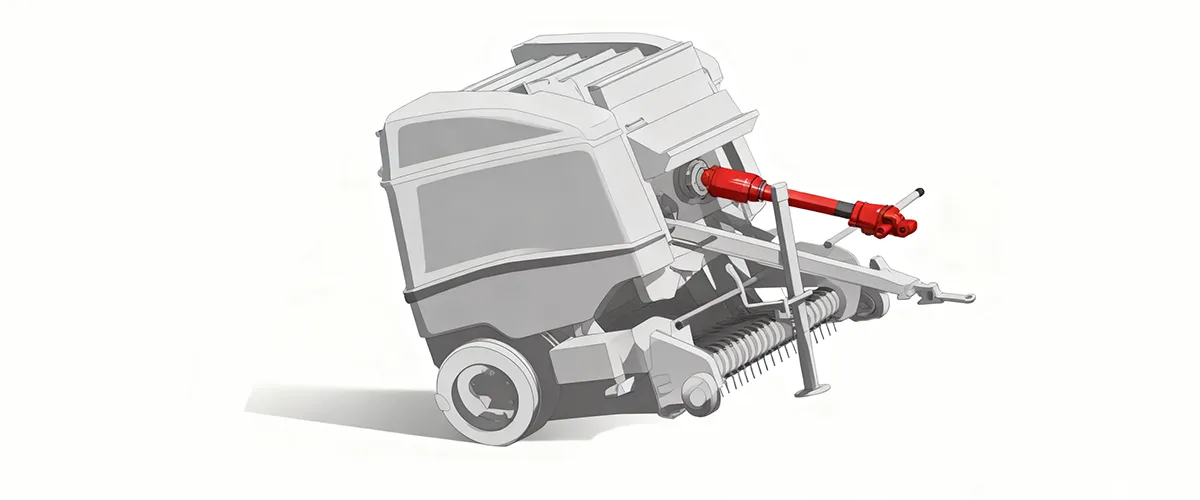
Agricultural PTO Shaft for Round Balers
Transmitting tractor power to the round baler gearbox is the first link in the chain drive load path — a weak PTO shaft connection creates torque spikes that propagate directly into the 20A chain drive and accelerate wear. Our EP PTO Shafts for Round Balers are matched to the torque profiles of the 9YG series machines, incorporating overload shear bolt protection that limits peak transmission loads before they can reach the compression chamber chain. Full guarding is standard, meeting KS B 6906 (Korea), EN ISO 4254-7 (EU), and IS 4468 (India) shielding requirements simultaneously. For cotton stalk operations where PTO torque demands are elevated throughout the compression phase, shaft selection should be based on the maximum PTO torque of the tractor — not the average — to maintain an adequate safety margin.
Agricultural Chain — Drive System Replacement Parts
The 20A heavy-duty chain fitted in the 9YG-2.24D rear chamber compression drive is available as a genuine replacement component through our parts supply network. Unlike generic market chain that may carry the 20A designation without meeting the heavy-duty pin diameter, bushing hardness, and plate shot-peening specifications required for cotton stalk service, our supply chain ensures that replacement chain matches the exact metallurgical specification of the original fitment. Replacement chain, sprockets, and master links are supplied as matched sets to ensure consistent performance from the first bale of the next season. Maintaining a spare chain set in the field kit during cotton harvest eliminates dependency on finding agricultural chain suppliers in remote farming regions during peak season — a practical consideration for large-scale cotton stalk contractors operating far from equipment dealers.
Frequently Asked Questions
Редактор: PXY