Municipal Waste Management & Circular Economy
A comprehensive knowledge guide exploring how round baler technology integrates into municipal organic waste management systems — covering machine engineering, material suitability, regulatory compliance, and operational practices for green waste recycling programs in Korea and beyond.
1. Green Waste, Round Balers, and the Circular Economy: An Emerging Connection
Municipal green waste — the organic fraction of solid waste generated by public parks maintenance, roadside verge mowing, cemetery management, urban forest thinning, and seasonal leaf collection — represents one of the largest volume waste streams handled by local government bodies in South Korea and across East Asia. In Korean cities and municipalities, annual green waste generation runs into hundreds of thousands of tonnes, with peaks in spring (when roadside grass growth begins) and autumn (leaf fall from street trees and park plantings). Traditionally, much of this material was either sent to landfill, composted at dedicated facilities, or incinerated in the domestic waste stream — all options that involve either resource loss or significant handling and transport costs.
The growing emphasis on circular economy principles in Korean environmental policy — reflected in the Resource Circulation Basic Act (자원순환기본법) and local government zero-waste targets — has created pressure on municipal authorities to find better ways of handling green waste. Baling this material using round baler machine technology is increasingly being explored and adopted as an intermediate processing step that reduces volume, facilitates transport, enables sorted organic recycling, and creates a product that can enter multiple value chains including composting, biogas production, and agricultural land amendment. Understanding how round balers support municipal green waste programs, and what equipment specifications are needed for this non-agricultural application, is the purpose of this guide.
The connection between agricultural round baler technology and municipal green waste processing is less obvious than it might first appear. Agricultural round balers are optimized for harvested crops — grass, straw, maize — that arrive as clean, relatively uniform windrows. Municipal green waste is messier, more variable in species and moisture content, and often mixed with minor contamination from urban environments (plastic bags, wire, small pieces of hard waste). Adapting round baler machine selection and operational approach to these differences is essential for municipal programs that want to benefit from baling technology without the frustration of equipment that performs well in agricultural fields but struggles with the specific characteristics of urban green waste streams.
2. Which Municipal Green Waste Types Are Suitable for Round Baling?
Not all municipal green waste streams are equally suited to round baling. The material characteristics that determine whether a round baler machine will handle a given green waste stream effectively include moisture content, particle size range, bulk density, and contamination level. Understanding these characteristics helps municipal program managers identify which waste streams can benefit from baling as an intermediate processing step and which are better handled by other means.
Grass from municipal road verges and highway shoulders is the green waste stream most analogous to agricultural hay or silage material. After a single or double pass with a verge mower, the cut grass forms a rough windrow that a spring-tine pickup header can process effectively. Moisture content varies by season — spring cuttings at 60–75% moisture, autumn cuttings at 30–50%. The key contamination risk is roadside litter embedded in the verge, which requires pre-inspection before baling.
Regularly maintained park grass is typically finer and more uniform than roadside verge material, but the volumes involved at large urban parks or sports facility complexes can be substantial. Park clippings at typical maintenance moisture of 70–80% are suitable for baling directly as silage-class material if the end use is composting or biogas; drier material from weekly cut sports fields can be baled as a denser product suitable for mulch or soil amendment applications.
Korean public cemeteries — particularly the large memorial parks on the outskirts of major cities — maintain substantial areas of closely mown turf around grave plots. Seasonal cutting programs generate significant volumes of fine grass clippings that are currently composted on-site or sent to municipal composting facilities. Baling provides a volume-reduction step that reduces transport costs for sites remote from composting facilities.
Street tree leaf fall in autumn represents a significant seasonal green waste peak in Korean cities. Collected leaves — raked or blown into windrows on grass verges — can be baled using a spring-tine pickup header, though the very low bulk density of dry leaves requires high-throughput feed capacity to form dense bales efficiently. Leaf bales are particularly suitable for anaerobic digestion feedstock or compost co-feedstock blended with higher-nitrogen green waste materials.
Korea’s extensive network of managed drainage channels, irrigation canals, and riverside green corridors generates significant volumes of cut reed (Phragmites australis), sedge, and emergent aquatic vegetation through annual maintenance cutting. This material — once cut and windrow-dried — is eminently suitable for baling and has downstream value as mulch material, composting feedstock, or biomass energy fuel. The hammer-claw pickup option on compatible models handles this tougher stemmed material better than spring-tine only designs.
3. Manufacturing Structure: What a Municipal Green Waste Round Baler Needs
Municipal green waste applications place a set of demands on round baler machine design that differ in specific ways from agricultural silage or dry hay production. The most significant difference is contamination tolerance. Agricultural windrows are formed from clean crop material; municipal green waste windrows contain variable amounts of non-organic contamination — plastic bag fragments, wire, small metal fasteners, stones, and other hard debris that urban environments introduce into managed vegetation. A round baler machine for municipal green waste applications must be designed with this contamination environment in mind, with robust pickup and feed components that can pass or deflect debris without catastrophic jamming, and a torque protection system that absorbs the sudden overload from embedded hard objects without damaging the drive train.
The frame construction of the 9YG series — laser-cut S355 structural steel, robot-welded with consistent penetration depth at every joint — provides the structural integrity needed for the irregular shock loads that characterize debris-containing green waste processing. The tailgate pivot brackets and pickup mounting points, which experience the highest lateral load during debris-contact events, are reinforced with gusset plates to resist the crack initiation that can develop at these locations when machines are repeatedly subjected to unexpected hard-object impacts. The buffer cylinder in the tailgate closing circuit, which cushions the closing movement on every bale cycle, also absorbs a portion of the dynamic load from bale ejection events where an unexpectedly dense or irregular bale is pushed against the closing gate.
The axial-flow semi-forced feed mechanism in the 9YG series handles the variable-density, mixed-species character of municipal green waste more effectively than conventional slug-feed designs for two reasons. First, it distributes material across the full chamber width before rotational compression begins, preventing the side-heavy bales that result when irregular windrows deliver material preferentially to one side of the pickup header. Second, its camless design has fewer projecting surfaces at which plastic bag fragments or long flexible debris can snag and wrap — a frequent cause of blockage in conventional cam-guided feed mechanisms when processing urban green waste material that contains flexible contamination.
The compression roller assembly with 18 rollers of φ222 mm diameter provides the surface area needed to compress the variable-density green waste material progressively into a consistent cylinder. For municipal green waste that ranges from dense wet grass clippings to lightweight dry leaves within the same windrow, the variable-chamber compression principle is particularly well-suited — the progressive compression cycle adapts to the material density available rather than requiring consistent material supply to achieve a target bale shape. The density sensor and ECU-controlled ejection trigger ensure each bale is completed at a consistent diameter regardless of how variable the material density was during formation.
Manufacturing Specifications for Municipal Green Waste Applications
| Component | Municipal Green Waste Requirement | 9YG Series Specification |
|---|---|---|
| Main frame | Shock resistance for debris-contact events | S355 structural steel, laser-cut, robot-welded, gusset-reinforced |
| Feed mechanism | Anti-wrap for flexible debris, even distribution for mixed density | Axial-flow semi-forced, camless, proprietary design |
| Compression chamber | Variable density tolerance for mixed green waste streams | Variable-chamber, 18 rollers φ222 mm |
| Torque protection | Absorb sudden overload from embedded hard objects | Shear bolt / friction clutch at PTO input |
| Density sensor and ECU | Consistent bale formation from variable-density material | Electronic sensor, cab ECU alert, programmable target |
| Pickup header | Adaptable to fine grass, coarse reed, mixed material windrows | Spring-tine 2,240 mm; hammer-claw option (select models) |
| Corrosion protection | Resist urban pollutant and acid organic residue | Epoxy primer + polyurethane topcoat, powder coat finish |
| Binding system | Secure binding compatible with downstream composting | Auto net wrap (removable) or biodegradable sisal twine |
4. Material System: Corrosion Challenges and Durability in Municipal Environments
Municipal green waste environments present a corrosion challenge that combines elements of both agricultural and urban industrial contexts. The organic acids generated by decomposing urban grass clippings and leaf litter attack machine surfaces in much the same way silage crop juice does — but the additional presence of urban pollutants (road salt, nitrogen oxide compounds in roadside verge material, low-level hydrocarbon residue from traffic-adjacent verges) adds complexity to the corrosion picture that pure agricultural environments do not present.
The coating system for a round baler machine used in urban green waste applications should follow the same two-stage system recommended for silage work: epoxy primer applied over shot-blasted steel, followed by polyurethane or powder-coat topcoat. However, for municipal machines that may also be deployed in lightly contaminated environments near road surfaces, an additional consideration is the resistance of the topcoat to petroleum-based compound splash — a concern for agricultural machines that is minimal, but relevant for verge-maintenance equipment that operates in close proximity to traffic and road runoff. Polyurethane topcoats with good chemical resistance ratings are preferred over standard alkyd formulations for this application.
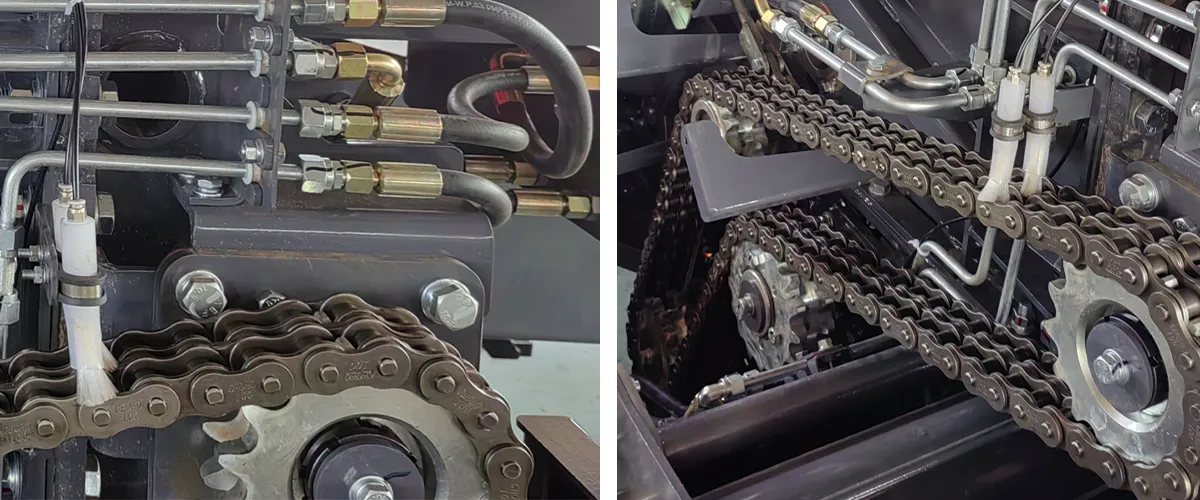
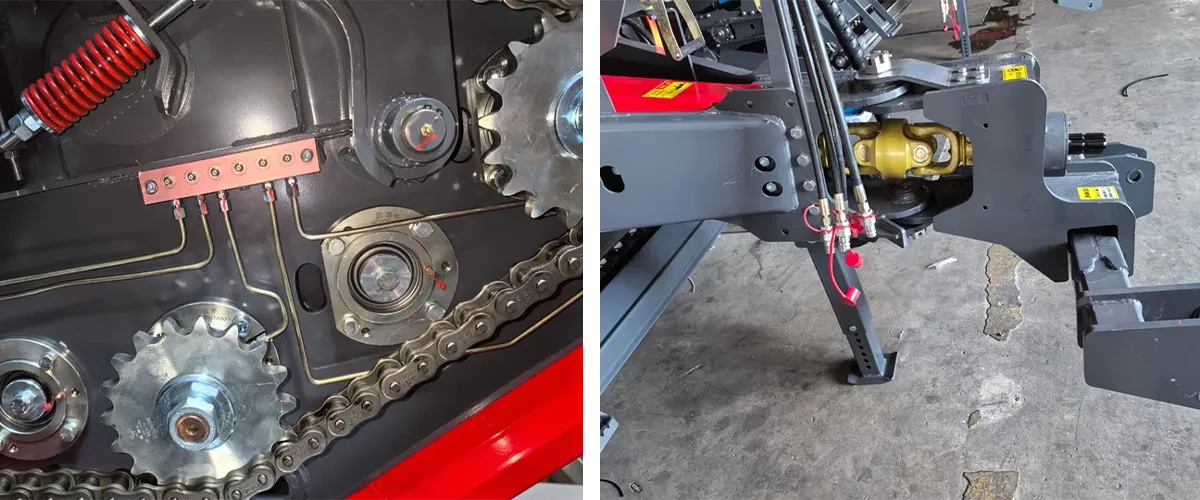
Drive chain materials in municipal green waste applications face the combined challenge of organic acid corrosion from wet grass and leaf material and the abrasive silica from soil particles that inevitably accumulate in roadside verge cuttings. The heavier cross-section of 20A series chain in the 9YG series compression circuit provides more material volume at the pin and bush wear surfaces, extending the service interval before replacement compared to lighter 16A chain under the same combined acid-abrasion load. Chain lubrication frequency in green waste applications should follow the silage protocol — every shift rather than every day — particularly during processing of wet spring verge cuttings where organic acid depletion of lubricants is fastest.
The net-wrap or twine binding material choice in municipal green waste applications has an additional dimension beyond agricultural applications: downstream compatibility with composting and biogas processes. Standard polypropylene net wrap, while mechanically effective, must be removed before the bale enters a composting facility or anaerobic digestion system because it does not biodegrade and will contaminate the finished compost or biogas digestate. For green waste bales destined for composting or anaerobic digestion, natural sisal twine or jute-based biodegradable net material is preferred — these decompose within the composting cycle and do not require a separate removal step. This distinction is operationally important: municipal programs planning to supply green waste bales to composting facilities should specify biodegradable binding materials at the time of machine purchase rather than attempting to adapt standard net-wrap machines afterward.
5. Round Baler Models for Municipal Green Waste Applications
The following models combine variable-chamber compression, sensor-controlled bale formation, and contamination-tolerant feed systems that make them applicable to the variable-density, mixed-species green waste streams generated by municipal park and verge maintenance operations.
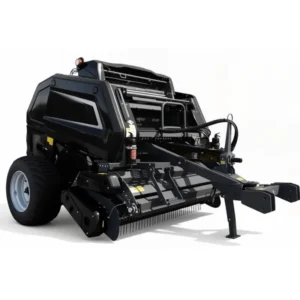
Máy ép kiện tròn 9YG-2.24D (S9000)
φ1,300×1,400 mm · 18 rollers · 55–100 kW · 4,262 kg · 40–100 bales/h · Sensor density control · Auto net wrap
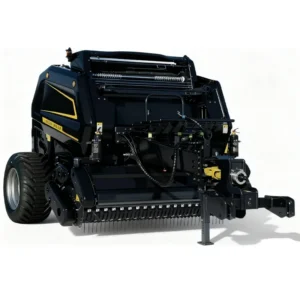
9YG-2.24D Round Baler (Classic)
4,312 kg · Dual-side 20A heavy chain · H-type hydraulic fittings · Buffer tailgate cylinder · 55–100 kW
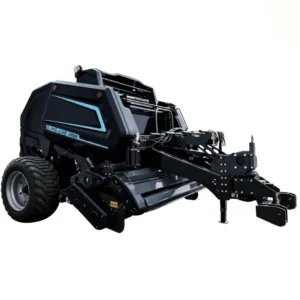
9YG-2.24D Round Baler (Transcend)
Dual-joint gearbox ±90° lateral · 4,570 kg · 720 r/min PTO · Safety torque driveshaft · 5–35 km/h
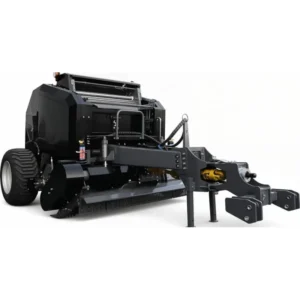
9YG-1.25 Round Baler (Double)
Interchangeable spring-tine / hammer-claw pickup · ≥88.2 kW · 4,558 kg · 1,200×1,250 mm · 40–80 bales/h
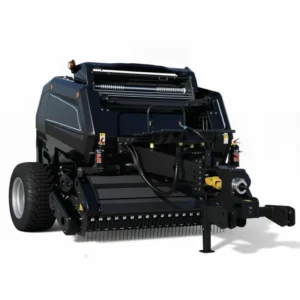
Máy ép kiện tròn 9YG-1.25A
540–1,000 r/min PTO · Density 100–200 kg/m³ · Net 2,000×1.25 m · 4,472 kg · ≥75 kW · 40–100 bales/h
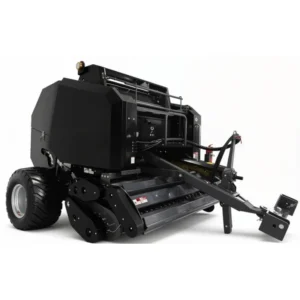
Máy ép kiện tròn 9YG-2.24D
Axial-flow semi-forced camless feed · 3,922 kg · 55–100 kW · φ1,300×1,400 mm · 40–100 bales/h
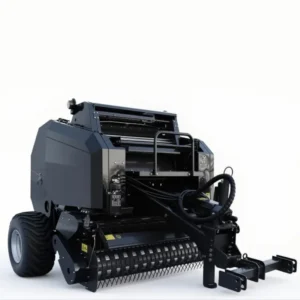
9YG-1.0 Round Baler (Mini Round Baler)
Small round baler for 40 hp tractor · 48–80 kW · Bale φ1,100×1,000 mm · 2,640 kg · 16 rollers · 40–100 bales/h
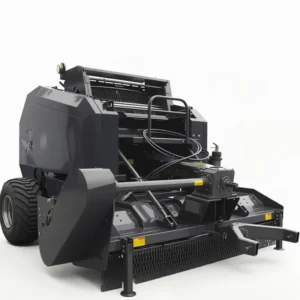
Máy ép kiện tròn 9YG-1.0C
Hammer-claw pickup option · Dual-side 16A heavy chain · ≥69.8 kW · Bale φ1,000×1,250 mm · 3,198 kg
6. Round Baler Gearbox: Performance and Protection in Municipal Operating Conditions
The round baler gearbox in municipal green waste operations faces a load profile that differs from both agricultural hay and silage work. Green waste material is generally less dense than silage crops, reducing average torque demands, but the higher frequency of unexpected debris-contact events — stones, metal fasteners, wood fragments — creates a higher rate of torque spike events than clean agricultural windrows. The gearbox and driveshaft torque protection system therefore needs to be calibrated and maintained with particular care in municipal applications to ensure it engages before debris-induced overloads reach the gearbox housing and internal gears.
The shear bolt or friction clutch torque limiter at the PTO input shaft connection is the first line of protection for the gearbox in green waste baling. In agricultural applications, shear bolt replacements after protection events are occasional occurrences; in municipal green waste work on roadside verges and park borders — where embedded debris is common — they should be treated as routine maintenance items with a stock of spares always on the machine. A friction clutch limiter, which resets automatically after the overload passes, may be more operationally convenient than shear bolts in high-frequency debris environments, though clutch slip calibration requires periodic professional check to ensure it remains effective at the correct torque threshold.
The dual-joint gearbox in the 9YG-2.24D Transcend model is particularly useful for municipal green waste operations on road verges and park boundaries where the tractor-baler combination must frequently negotiate access constraints — entering and leaving areas through narrow gates, working alongside drainage infrastructure, or maneuvering between street trees and park furniture. The ±90 degree lateral and ±30 degree vertical PTO articulation allows these maneuvers with continuous power transmission, reducing the time lost to PTO disengagement and re-engagement that conventional driveshaft designs require at tight turns. For municipal contractors covering multiple sites per day and needing to move efficiently between them, this operational flexibility has real value beyond its agricultural terrain-handling benefits.
Gearbox oil maintenance in municipal green waste applications should follow the standard 200–250 hour change interval, with a key additional check: inspecting the gearbox breather or filler area for contamination from road salt, which is present in roadside verge vegetation harvested near winter-salted roads in Korea. Sodium chloride contamination in gearbox oil accelerates internal corrosion of bearing surfaces and gear tooth flanks at rates that are not visible until damage has already progressed. Washing the exterior of the gearbox housing with clean water after each day’s operation on salt-affected verges takes minutes and significantly reduces the accumulation of salt residue that can eventually find its way into the gearbox through breather or gasket points.
7. Downstream Value Chains for Municipal Green Waste Bales
The economic and environmental case for baling municipal green waste rests partly on having clear downstream value chains for the baled material. Unlike agricultural silage, which has an established and well-understood feeding value for livestock, municipal green waste bales are a more heterogeneous product whose downstream options depend on material quality, contamination level, and moisture content at the time of baling. Mapping these options in advance helps municipal program managers make better decisions about which green waste streams to bale, what binding materials to use, and what quality controls to apply during collection and baling.
The most established downstream use for municipal green waste bales. Composting facilities mix green waste with carbon-rich co-materials (wood chips, cardboard) to achieve the correct carbon-to-nitrogen ratio for aerobic decomposition. Baled material is easier to proportion and handle in large composting operations than loose material. Binding must be removed or biodegradable before intake.
High-moisture green waste bales (grass clippings at 65–75% moisture) are suitable co-feedstocks for anaerobic digestion at biogas plants. Korean government support for agricultural and municipal biogas under the Renewable Energy Portfolio Standard creates commercial pathways for this application. Binding must be biodegradable or removed before feeding into the digester.
Dry green waste bales (autumn leaf collections, dry reed from canal maintenance) can serve as solid biomass fuel at Korean biomass energy facilities under the Renewable Portfolio Standard (RPS). Moisture content must be below 20% for efficient combustion. Volume-efficient transport logistics is one of the primary benefits baling offers for this application.
Clean roadside grass and park clippings, once composted or mulched from bales, can be returned to adjacent agricultural land as organic matter amendment. In peri-urban areas where Korean vegetable and horticultural farms are close to municipal green corridors, this creates a local closed loop where nutrient-rich organic matter from maintained vegetation is returned to productive farmland.
Clean park grass and verge material bales, where contamination risk is low and the material is free of road salt and chemical residue, can be used as livestock bedding or supplementary roughage by beef cattle operations. This creates a direct link between municipal maintenance operations and local agricultural enterprises, reducing waste disposal costs for municipalities while providing low-cost bedding material to farmers.
8. Korean Policy Framework: Green Waste, Circular Economy, and Equipment Procurement
South Korea’s approach to municipal green waste management is shaped by an increasingly comprehensive policy framework that extends from national resource circulation legislation through to local government procurement guidelines. The Resource Circulation Basic Act (자원순환기본법), enacted in 2018, established waste reduction and recycling targets for all major waste streams including organic waste, and created financial incentives for local governments that demonstrate measurable progress toward waste diversion from landfill. Municipal green waste — previously among the least prioritized organic waste categories — now falls within the scope of these performance frameworks.
The Ministry of Environment (환경부) has issued guidance documents on food and garden waste management that encourage local governments to develop infrastructure for on-site volume reduction of organic waste before transport to centralized facilities. Round baling for green waste collection represents exactly the type of on-site volume reduction technology that aligns with this policy direction — reducing the number of truck movements required to transport a given volume of green waste to composting or biogas facilities, with corresponding carbon emission reductions from the logistics chain that contribute to municipal carbon neutrality targets under the Carbon Neutral and Green Growth Act (탄소중립·녹색성장 기본법).
For municipal procurement of round baler machines for green waste programs, equipment eligibility under government subsidy schemes depends on machine classification and the procurement channel used. Agricultural machinery purchases through standard agricultural mechanization subsidy programs are not typically available to municipal government bodies — these programs are designed for registered farming operations. However, municipal procurement of green waste processing equipment can access separate green technology procurement preferences and environmental investment support programs administered through the Korea Environment Corporation (한국환경공단) and regional environmental management agencies. Understanding the correct procurement channel before purchase avoids the mistake of assuming agricultural machinery subsidies are available to municipal buyers.
9. Regulatory Compliance: Agricultural Machinery Safety and Green Waste Standards
South Korea — Equipment Safety
Round balers used for municipal green waste processing in South Korea must comply with the Industrial Safety and Health Act (산업안전보건법) requirements for PTO-driven machinery, including mandatory guarding of PTO shafts and intake zones. Municipal operators using contracted or employed labor for green waste baling operations have employer safety obligations that extend beyond individual farm equipment owner requirements. The machine must also meet the general safety and product conformity requirements under the Product Safety Basic Act (제품안전기본법) for equipment sold commercially in Korea.
South Korea — Green Waste Standards
Baled green waste destined for composting in South Korea must meet the organic waste acceptance criteria at certified composting facilities, which are regulated under the Act on the Promotion of Saving and Recycling of Resources (자원의 절약과 재활용촉진에 관한 법률). Key requirements include maximum contamination levels, moisture content limits for certain composting processes, and binding material biodegradability where the full bale (including net or twine) is fed into the composting system. Facilities receiving baled organic material may have additional site-specific intake specifications that municipal procurement teams should verify before baling operations begin.
European Union
In EU member states where municipal green waste baling is practiced, round balers must carry CE marking under Machinery Directive 2006/42/EC with EN ISO 4254-7 and EN 12965 as applicable harmonized standards. Green waste bales destined for composting or anaerobic digestion must comply with EU Regulation 1069/2009 (animal by-products regulation) if the green waste stream includes materials that might be classified as animal by-products (e.g., grass from sites where livestock have grazed). Compost produced from municipal green waste must meet quality standards under Regulation EU 2019/1009 (EU fertilizing products regulation) if it is to be sold commercially.
United States
Municipal green waste baling in the US operates within a state-regulated framework for organic waste diversion, with California (CalRecycle), Massachusetts (MassDEP), and other leading states having specific green waste recycling requirements under their solid waste diversion legislation. Round baler machinery safety in municipal operations is governed by OSHA 29 CFR Part 1910 (general industry safety standards) for municipal employees operating the equipment, with ASABE S318 providing the applicable agricultural machinery safety standards. Gearbox specifications follow ISO VG 150 GL-4 gear oil as standard.
Japan
Japan’s municipal green waste management is governed by the Act on Promotion of Sorted Collection and Recycling of Containers and Packaging and the Act for Promotion of Effective Utilization of Resources. Municipal green waste baling programs in Japan increasingly align with the Ministry of the Environment’s biomass utilization promotion policy, which identifies roadside vegetation and park maintenance green waste as eligible biomass resources under the Biomass Utilization Promotion Basic Plan. Equipment safety standards for PTO-driven machinery follow JASO and Ministry of Agriculture, Forestry and Fisheries (MAFF) agricultural machinery safety guidelines.
Germany and EU Member State Example
Germany’s Kreislaufwirtschaftsgesetz (Circular Economy Act) and the Bioabfallverordnung (Biological Waste Ordinance) provide the detailed regulatory framework for composting and anaerobic digestion of municipal organic waste including green waste. Machines used in green waste processing must comply with Betriebssicherheitsverordnung (Operating Safety Ordinance) requirements for PTO-driven implements, with gearbox oil specifications typically referencing DIN 51517-3 (CLP gear oils) at VG 150 viscosity grade for standard agricultural gearboxes.
10. Maintenance Discipline for Municipal Round Baler Operations
Municipal green waste operations subject the round baler machine to a maintenance challenge that combines elements of both agricultural silage work and construction site equipment service. The variety of material types processed, the higher incidence of non-organic debris, and the often-seasonal campaign structure of municipal maintenance programs all shape a maintenance approach that is somewhat different from standard agricultural service protocols.
After each day’s operation on roadside verge material — particularly material from salt-treated winter roads or heavily trafficked urban corridors — the entire machine exterior should be washed with clean water and inspected for embedded debris in the compression chamber, chain guide areas, and pickup tine assembly. Any metal objects (staples, wire, fastener fragments) found in the machine should be removed before the next operation — these objects migrate progressively deeper into the machine with each baling cycle if not removed, eventually reaching drive chain and bearing areas where they cause accelerated wear or sudden damage.
Net-wrap knife condition requires more frequent inspection in municipal green waste applications than in agricultural silage work, because urban green waste often contains tough, fibrous material (thick grass stems, reed sections, partially decomposed leaves) that presents more cutting resistance than clean wilted agricultural grass. A knife that is performing acceptably on agricultural material may struggle to cut cleanly through mixed municipal green waste, producing trailing net ends that catch and disrupt the next bale’s binding cycle. Weekly knife inspection and replacement at the first sign of edge deterioration is the appropriate protocol for intensive municipal operations.
The shear bolt or torque limiter should be checked for correct calibration at the start of each new municipal campaign. Municipal verge and park maintenance sites change throughout the year, and some sites will have higher debris risk than others. Pre-checking the torque limiter calibration before starting a new site — by attempting a controlled manual overload on a workbench with a calibrated torque wrench — takes less than 30 minutes and ensures the protection system will engage correctly at the first debris-contact event rather than after the first unprotected impact has already transmitted damaging loads to the gearbox housing. Maintaining a supply of correct-specification shear bolts on the machine at all times is the minimum operational precaution for debris-environment green waste baling.
Frequently Asked Questions
Biên tập viên: PXY