Wheat Straw Baling — Mid-Scale Farm Efficiency
A field-level technical and economic guide for Korean wheat farmers and regional cooperatives operating under 200 hectares — covering machine selection, bale economics, operational practices, manufacturing reliability, gearbox compatibility, and the regulatory frameworks that shape small-farm round baler investment decisions in Korea and internationally.

The Reality of Wheat Straw Management at Small Farm Scale
1. Why Under-200-Hectare Wheat Farms Have Different Baling Needs Than Large Commercial Operations
Korea’s wheat farming landscape is dominated by small and medium operations. The average wheat-growing holding in Korea is measured in a few hectares rather than hundreds, and even cooperatives that consolidate multiple family plots for mechanization purposes rarely exceed 150–200 hectares in total annual baling area. This scale context fundamentally changes the economics and operational priorities of wheat straw baling compared to what large-scale commercial farms or contract operators in major wheat-exporting nations face. On a 50-hectare wheat farm, the question is not which machine maximizes throughput per hour — it is which machine completes the straw baling within the available post-harvest weather window at the lowest practical cost per bale, with a tractor that the farm already owns, and produces bales that can be sold or used without additional handling equipment.
The phrase “small round baler” in the Korean small-farm context typically refers to machines in the 48–80 kW tractor power class producing bales under 1,300 mm in diameter. These machines differ from contractor-class full-size round balers not just in their specifications but in their entire operational logic: they are designed to be managed by a single operator across a diverse range of field and windrow conditions without specialist daily maintenance attention, to sit idle for 10–11 months between baling campaigns without requiring pre-season overhaul, and to produce bales that a farm family can handle, store, and sell without infrastructure investments beyond what the farm already has. The 9YG-1.0, 9YG-1.0C, and 9YG-1.25 series round balers are the models most relevant to this profile in the Korean wheat straw context.
This article approaches the question from three angles that matter most to Korean small wheat farm operators: the economic case for investing in a compact round baler rather than relying on contractor services or alternative disposal methods; the operational factors that determine how well the machine performs across the variable conditions of a Korean wheat harvest season; and the technical specifications of the relevant models that explain why certain features matter more at this scale than they would at commercial contractor scale.
Bale Economics
2. The Financial Case for Own-Farm Wheat Straw Baling Versus Contractor Services or Disposal
For a Korean wheat farm under 200 hectares, the financial decision between owning a round baler machine and relying on a baling contractor or loose-haul disposal service hinges on the annual straw yield, the local market rate for baled straw, and the cost of the available alternatives. Korean wheat straw — depending on variety and growing conditions — typically yields 3–5 tonnes of dry straw per hectare after grain harvest. For a 100-hectare farm, this represents 300–500 tonnes of straw per season that must be managed, either by baling and removal, tillage incorporation, or (where permitted) burning.
At compact round baler productivity rates of 40–100 bales per hour on a 9YG-1.0 class machine, a 100-hectare wheat straw season is achievable in 8–12 operating days — roughly 320–600 bales total depending on windrow yield and bale density. If each bale is sold to a local livestock farm at a market-competitive per-bale rate, the revenue over the season is substantial. Comparing this to the contractor service cost for the same work — which would be charged per bale or per hectare — the payback period for the machine investment becomes apparent within the first 3–5 seasons for farms in the 80–200 hectare range, and within 5–8 seasons for smaller operations in the 40–80 hectare range where the annual bale count is lower.
The market for Korean wheat straw bales spans several buyer categories. Cattle and horse farms are the most consistent buyers, purchasing straw for bedding and roughage use year-round. Mushroom substrate producers require wheat straw as a composting base material and typically pay a premium for net-wrapped bales with low soil contamination. Biomass energy buyers are a growing market as Korea’s RPS framework expands renewable energy obligations. And composting facilities around urban areas often actively seek agricultural residue bales as a high-carbon composting feedstock. This market diversity means that a small Korean wheat farm owning its own round baler can typically find a buyer for its straw output without significant search effort, making the bale revenue projection relatively reliable for investment planning purposes.
Korean Field Conditions
3. Wheat Windrow Variability and Field Surface Conditions on Korean Small Farms
Korean wheat fields present a specific set of operating conditions that influence how a small round baler should be configured and operated. Korean wheat is predominantly grown in the southern provinces — Jeollanam-do, Gyeongsangnam-do, and parts of Chungcheongnam-do — where field sizes are typically small (1–5 hectares per plot), field surfaces are often slightly irregular from the previous season’s tillage, and the harvest season overlaps with the beginning of the early monsoon period in late June and July. The combination of small field sizes with numerous headland turns and the weather uncertainty of the harvest window shapes the machine requirements more than any other single factor.
Windrow formation depends on the combine’s straw spread system. Modern Korean-operated combines typically have chopper/spreader configurations that create a relatively narrow windrow behind the cutterbar, concentrated at 50–70% of the header width. This windrow profile suits the spring-tooth pickup on the 9YG-1.0 and 9YG-1.25 series, which works most efficiently when the windrow is contained within 80% of the pickup width. Older combines with chaff spreaders may deposit straw in a wider, thinner spread that requires a consolidation rake pass before baling — adding half a day of preparatory work per 50 hectares but consistently improving bale quality and reducing field losses on the main baling pass.
Korean field surface conditions at wheat harvest time — June and early July — vary significantly depending on rainfall in the preceding weeks. A dry June produces firm, easily navigated fields where the pickup can run at the lower end of its ground clearance setting for maximum collection efficiency. A wet early monsoon can leave fields soft enough to create concern about wheel rutting and pickup depth control, requiring the operator to raise the pickup slightly above its standard position to avoid scooping soil into the windrow — a trade-off that accepts some straw losses at the bottom of the mat in exchange for keeping soil contamination of the bale within acceptable limits for buyers who specify low-ash straw.
Manufacturing Structure
4. Frame Engineering, Chamber Design, and Feed System Construction for Small-Scale Reliability
On a farm under 200 hectares, the round baler sits unused for roughly 50 weeks per year and then operates continuously for 2–4 weeks at the height of the harvest season. This extreme seasonal duty cycle demands a different structural philosophy from the machine than a continuously-operated commercial contractor unit. Components must resist corrosion during long idle periods, re-engage from cold starts reliably after months without use, and tolerate the variable operating inputs of an owner-operator who may not have daily machinery maintenance experience. The manufacturing approach of the 9YG compact series addresses each of these requirements through specific design choices.
Structural Frame — CNC Precision and Automated Welds
The structural frame is CNC laser-cut from structural steel plate at the full range of component geometries — main side plates, tailgate arms, drawbar sections, and pickup mounting brackets — ensuring dimensional consistency that allows all mounting points to align correctly without field adjustment. Automated welding at all primary structural nodes produces consistent joint penetration regardless of production position in the manufacturing sequence, eliminating the joint quality variation that manual welding introduces. For a small farm machine that will make thousands of field turns through irregular small Korean plots over its life, this joint consistency directly translates into frame geometry stability that prevents progressive misalignment of the bale chamber relative to the pickup axis.
Bale Chamber Press Roller Array
The bale chamber on the 9YG-1.0 uses a press roller array sized for the machine’s 48–80 kW power class, producing bales of Ø1100×1000 mm at a density of 100–200 kg/m³ depending on wheat straw moisture and compaction setting. For the 9YG-1.25 series, the chamber expands to Ø1300×1250 mm with a correspondingly larger press roller diameter that distributes compressive force over more contact area per revolution of the forming bale, producing a more evenly-compressed cross-section in mixed-composition wheat straw windrows. The sensor-controlled density management on both models triggers the net wrap and ejection cycle at the same target density regardless of windrow variations — ensuring that the bales produced on a 100-hectare farm have consistent weight whether they come from the first field of the season or the last.
Feed System Without Cam Components
The axial-flow semi-forced feeding mechanism on the 9YG series routes material from the pickup into the bale chamber through a guided path that does not rely on cam-and-guard timing components. The practical significance for small farm operators is that the number of components requiring precision adjustment after wear is substantially lower than on conventional pickup designs. A cam-and-guard blockage on a conventional baler during the middle of a baling day in a remote Korean wheat field may require adjustment tools and mechanical knowledge that a small farm owner-operator does not carry in the tractor cab. The cam-free design eliminates this specific risk category, reducing the probability of day-interrupting maintenance events during the critical harvest window.
Material System
5. How Material Choices in the Drivetrain and Frame Affect Long-Term Cost on Korean Small Wheat Farms
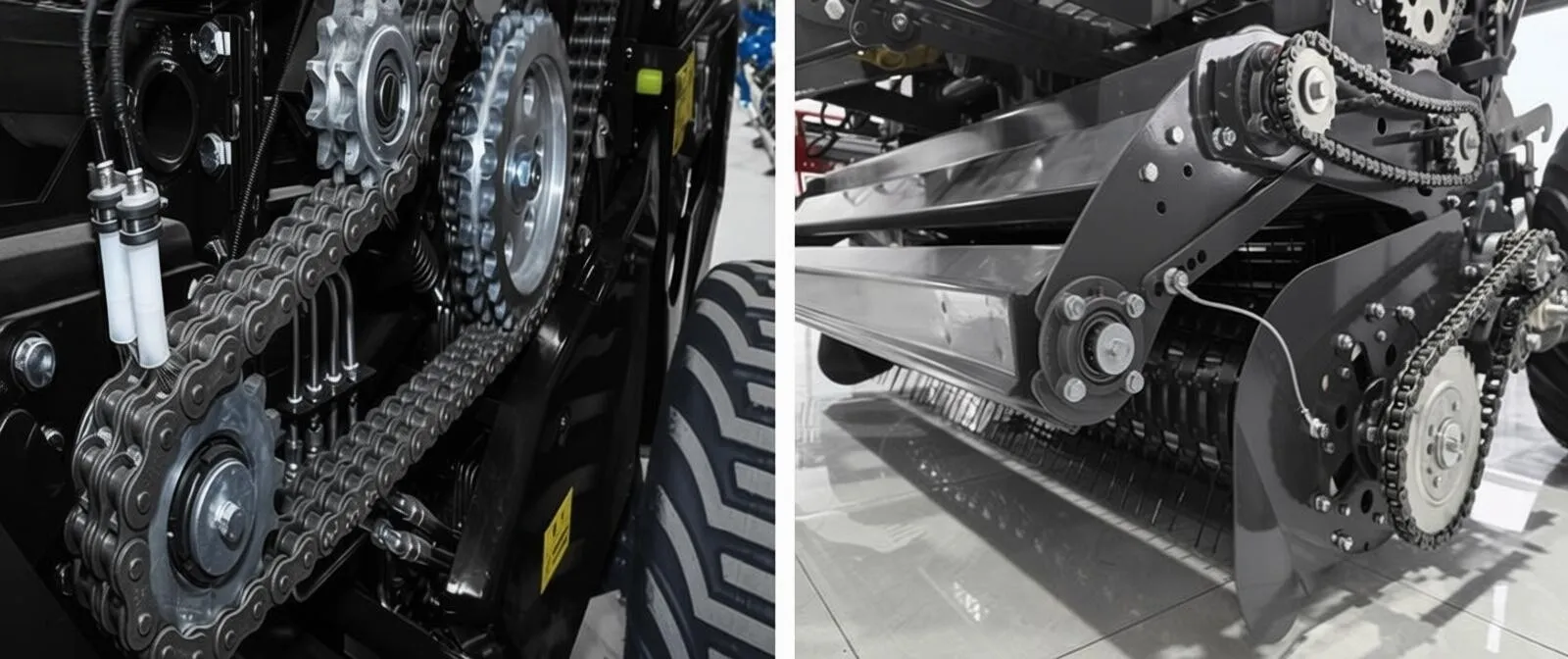
The total lifetime cost of a round baler on a small Korean wheat farm is determined as much by the materials used in its construction as by its purchase price. A machine with well-specified chain, tine steel, bearing sealing, and frame coating will require fewer part replacements across its life, maintain its field performance longer, and retain higher resale value than one built with cost-reduced materials that begin showing wear-related performance degradation within the first few seasons. For a farm where the round baler investment is a significant capital outlay relative to annual farm revenue, material quality is a directly financial consideration.
Roller Chain — Class-Appropriate Specification
The chain drives on compact 9YG models are specified proportionally to the tractor power class of each machine. On the full 9YG-2.24D Transcend and S9000, 20A heavy-duty roller chain drives both sides of the full-width chamber; on the compact 9YG-1.0 and 9YG-1.25 class, the chain specification matches the lower compressive loads of the smaller chamber format. For a Korean wheat farm producing 300–500 bales per season, the chain fatigue accumulation rate is low enough that replacement intervals extend across multiple seasons with proper lubrication — typically 8–10 hours of operating time between lubrication events during the baling campaign, and a full grease-down and storage preparation at season end.
Spring Tine Steel — Deflection Resistance and Fatigue Life
Spring-tooth pickup tines on the 9YG series are manufactured from high-tensile spring steel alloy with hardened tip geometry. In Korean small wheat farm conditions where occasional stones, soil clods, and field debris are encountered in the windrow pickup zone, the tine’s spring-deflection characteristic protects it from fracture by absorbing the impact energy through elastic deformation rather than transmitting it as a brittle failure stress. Tine tip hardness determines how long the original taper profile is maintained as tip material is gradually abraded by the straw’s silica content — a higher hardness extending the interval before tip wear causes the pickup’s efficiency to degrade visibly at the bottom of the windrow.
Bearing Sealing for Korean Storage Conditions
Sealed bearings at pickup reel ends and press roller journals protect the bearing races from the two contamination sources that most affect small farm machines in Korea: field debris infiltration during the operating season, and condensation moisture infiltration during the cold, damp winter storage period. An open bearing that was adequately greased before seasonal storage will often find that the grease has been displaced or diluted by condensation water by the following spring start-up, leading to surface corrosion in the bearing race during the first operating hours of the new season. Sealed-unit bearings eliminate this pathway and maintain their protection through long idle periods without requiring mid-season or pre-season bearing repacking.
Powder Coating — 10-Year Frame Protection
Electrostatic powder coating applied after CNC fabrication and automated welding provides better adhesion at frame joints and weld seams than spray paint applied to the same surface. The adhesion quality at the frame joint interface — where two steel surfaces meet at a weld toe — determines how quickly undercutting corrosion spreads from initial chip points. For a Korean small farm machine stored through cold, wet winters, the powder coat’s chip resistance and adhesion strength directly determines how long the frame surface provides adequate protection before spot treatment and re-coating becomes necessary to prevent structural corrosion development at hinge and mounting points.
Cooperative Use Models
6. How Small Korean Wheat Farms Share Round Baler Investment Through Cooperative Baling Arrangements
On farms under 50 hectares, the economics of individual round baler ownership may require longer payback periods than most Korean farm families are comfortable with. The alternative — and one that is actively promoted by Korean agricultural cooperative organizations including the National Agricultural Cooperative Federation (NACF) — is cooperative equipment sharing, where multiple small farms pool their annual baling workload and collectively finance and operate a single machine. This model significantly improves the annual utilization rate of the machine and shortens the payback period per participating farm relative to individual ownership.
A typical Korean wheat straw cooperative sharing model involves 4–8 small farms within a geographically compact area — typically within 5–10 km of each other — that have established a formal or informal agreement to share a single round baler machine through a designated operating schedule. One farm typically hosts and maintains the machine; a trusted operator (either a rotating member farm employee or a hired seasonal operator) runs the machine across all member farms in sequence; and the costs are shared on a per-bale or per-hectare basis. The machine’s productivity of 40–100 bales per hour on a 9YG-1.0 class baler is more than sufficient to cover 100–200 collective hectares within a 10–15 day window, which is achievable within the post-harvest weather window available before Korea’s full monsoon season establishes itself in early July.
For Korean agricultural cooperatives considering a shared round baler investment, the 9YG-1.25A is particularly well-suited because its 540–1000 r/min PTO input range accommodates the tractor diversity that typically exists across multiple member farms in a sharing arrangement — where each member’s tractor may be a different brand and model year with different PTO speed characteristics. This eliminates the performance inconsistency that would arise from running a fixed-PTO-speed machine across tractors that deliver their rated power at different engine RPMs.
Gearbox and PTO
7. Small Farm Gearbox Management: What Korean Wheat Farm Operators Need to Know
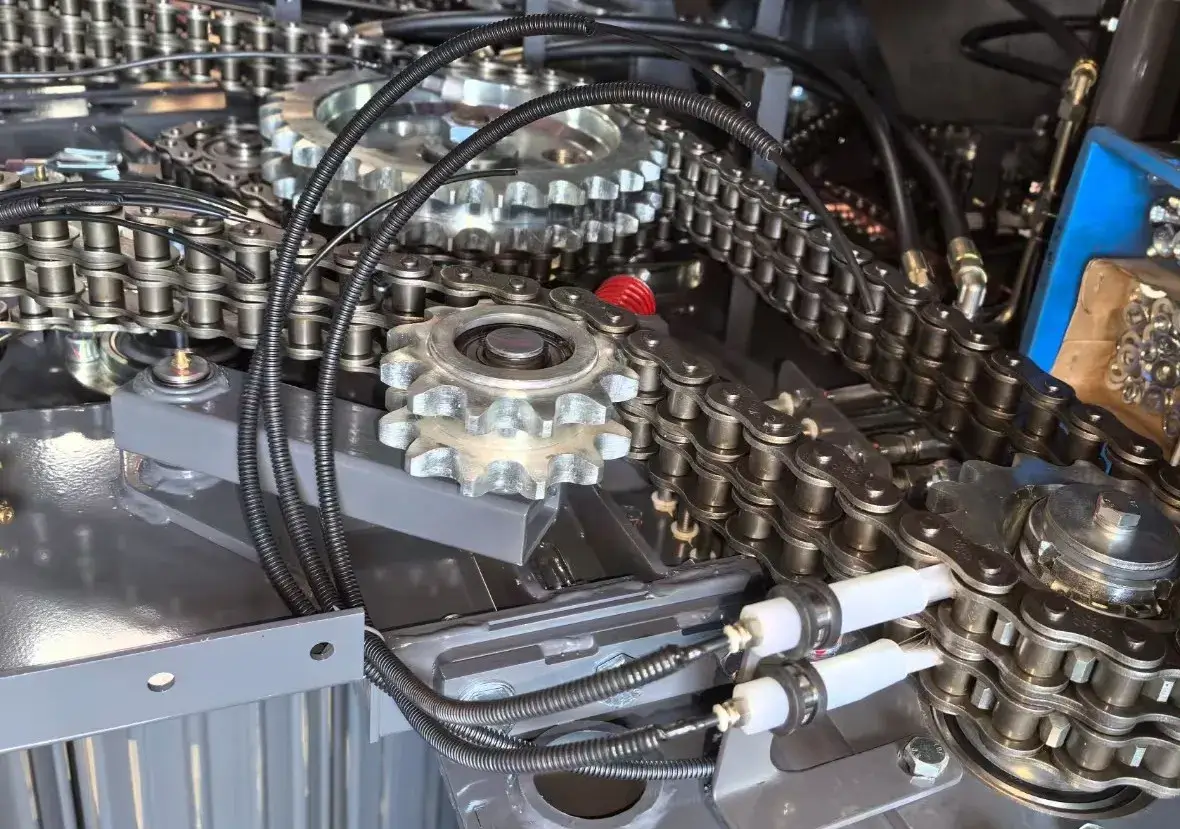
The round baler gearbox is the highest-precision mechanical assembly in the machine and the one most vulnerable to neglect during long seasonal idle periods. On a small Korean wheat farm where the baler may sit unused from July to the following June, the gearbox oil inside the sealed housing undergoes seasonal temperature cycling that causes the oil to expand and contract — a process that can draw moisture through the breather valve if the seal arrangement allows it, or simply degrade the oil’s viscosity characteristics through repeated thermal stress without moisture ingress. Either outcome reduces the lubricant film quality available at gear tooth contacts and bearing surfaces during the first operating hours of the new season, when the gearbox is running cold and the oil has not yet reached operating temperature.
The practical maintenance recommendation for Korean small wheat farm operators is to change the gearbox oil at the start of each baling season rather than on a fixed hourly interval, since the seasonal idle period is the primary degradation factor rather than operating hours. A seasonal oil change ensures that the gearbox starts each campaign with fresh, clean oil of the correct viscosity for the operating temperature range — which in June–July Korean wheat straw conditions spans from cool morning startup temperatures to warm afternoon running temperatures, requiring a multi-viscosity oil such as SAE 80W-90 that maintains adequate film thickness across this range.
The gearbox on the 9YG-1.0C uses a 540 r/min PTO input specification — a common output speed for Korean domestic-brand tractor models in the 70–90 kW class. The 9YG-1.25A accepts input across 540–1000 r/min, making it the most flexible choice for cooperative arrangements or farms where multiple tractor models may be used across different field operations within the same season. In either case, maintaining the correct engine throttle setting to achieve the rated PTO output speed is the single most impactful operating adjustment for maintaining consistent pickup and chamber performance throughout the baling day.
Model Comparison
8. 9YG Compact Series: Direct Comparison for Korean Wheat Farms Under 200 Hectares
| Thông số kỹ thuật | 9YG-1.0 | 9YG-1.0C | 9YG-1.25 | 9YG-1.25A |
|---|---|---|---|---|
| Min. Tractor Power | 48 kW (65 hp) | ≥70 kW (≥95 hp) | ≥75 kW (≥100 hp) | ≥75 kW (≥100 hp) |
| Tốc độ PTO | 720 r/min | 540 r/min | 720 r/min | 540–1000 r/min |
| Bale Dimensions | Ø1100×1000 mm | Ø1000×1250 mm | Ø1300×1250 mm | Ø1300×1250 mm |
| Loại xe bán tải | Spring-tooth | Hammer-claw (axial-flow) | Interchangeable | Interchangeable |
| Best For (Korea) | Under 60 ha; single family farm | Rain-affected straw; 40–80 ha | 60–150 ha; varied crops | Cooperatives; mixed tractor fleet |
| Bale Weight (dry straw) | 100–180 kg | Compact; manageable single-person | 180–280 kg | 180–280 kg |
Regulatory Frameworks
9. Korean and International Regulations Affecting Small Round Baler Investment on Wheat Farms
Small wheat farm operators using round balers are subject to the same agricultural machinery safety regulations as large commercial operations. Additionally, Korean-specific crop residue management regulations create direct incentives for baling investment that larger international wheat producers may not face.
Korea — RDA Certification and National Machinery Purchase Subsidy
Round balers purchased under Korea’s national agricultural machinery subsidy program must hold Rural Development Administration (RDA) type approval. For small Korean wheat farms and cooperatives that benefit significantly from the subsidy — which can offset a substantial portion of the purchase cost — confirming that the chosen model holds current RDA approval before purchase is a critical step. The 9YG series is manufactured under ISO 9001 quality management certification that supports the RDA approval documentation process. Subsidy-eligible buyers should contact us to confirm the current certification status of their chosen model at the time of inquiry.
Korea — Clean Air Conservation Act: The Baling Mandate
Korea’s Clean Air Conservation Act and its implementing regulations have progressively restricted open burning of crop residues in most agricultural regions. For small wheat farms in designated zones where burning is prohibited, the legal obligation to manage straw without burning — combined with the commercial attractiveness of bale sales — creates a double incentive for round baler investment that did not exist when burning was freely permitted. Local government enforcement of this restriction has intensified in the wheat-growing southern provinces, making the regulatory compliance argument for baling investment increasingly concrete for Korean small farm operators.
ISO 4254-7 — International Baler Safety Standard
ISO 4254-7 establishes safety requirements for baling machines internationally, covering pickup guarding, bale chamber access prevention, ejection zone hazard marking, and tailgate safety locks. Korean agricultural machinery insurance policies increasingly reference ISO 4254-7 as a compliance benchmark for coverage eligibility. A round baler that cannot demonstrate ISO 4254-7 compliance may face higher premiums or conditional coverage. The 9YG series’ ISO 9001 manufacturing certification provides the quality management documentation foundation that underpins ISO 4254-7 compliance verification in Korean insurance and RDA contexts.
India — CRM Scheme for Small-Scale Wheat Straw Baling
India’s Crop Residue Management (CRM) scheme subsidizes round baler purchase for small farmers in Punjab, Haryana, and Uttar Pradesh — the world’s largest wheat straw production regions. The scheme targets farms in the 2–10 hectare range that could not independently finance baling equipment, using cooperative machinery pooling arrangements similar to Korean NACF cooperative models. Eligible machines must be certified by AMTTI testing institutes for field loss rates and bale quality. For Korean ODA programs and equipment exporters working in Indian wheat straw management contexts, the CRM scheme framework is a direct commercial and development opportunity for the 9YG-1.0 class of machines.
EU — Small Farm CAP Cross-Compliance Requirements
EU small wheat farms receiving Common Agricultural Policy direct payments must comply with GAEC standards that mandate crop residue management to prevent soil erosion and nutrient loss. These cross-compliance conditions effectively require active management of wheat straw, making baling the most cost-effective compliance pathway for farms that cannot incorporate straw through annual tillage alone. All baling machinery used in EU agriculture must carry CE marking under the Machinery Directive 2006/42/EC. Small farm operators in EU wheat regions purchasing imported balers should confirm CE certification documentation for the specific model before purchase to ensure compliance with their agricultural insurer’s and scheme authority’s machinery requirements.
ASABE Standards — Small Farm PTO and Gearbox Guarding
ASABE S318 specifies PTO shaft color-coding and connection dimensions, while ASABE S210 covers guarding of agricultural field machinery including the pickup zone and PTO connection area. For small farm operators in North American wheat states purchasing compact round balers, verifying that the supplied PTO driveshaft includes a guard tube meeting the applicable ASABE S318 inner diameter and guard material specifications protects operators from the PTO entanglement hazard that remains the most common cause of serious agricultural machinery injury in the United States. The 9YG series uses standard-specification PTO connections compatible with guarding components available in Korean and North American agricultural supply channels.
Product Range
10. Round Baler Models for Korean Wheat Farms — From Village-Scale to Regional Operations
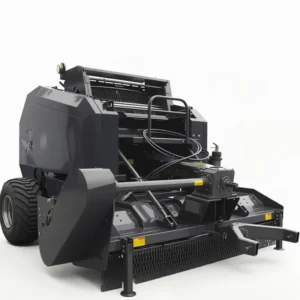
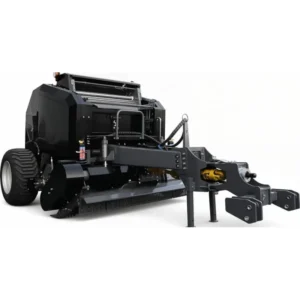
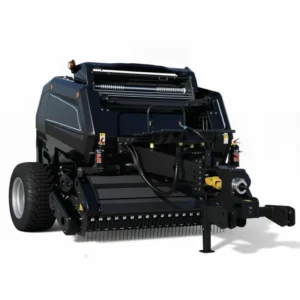
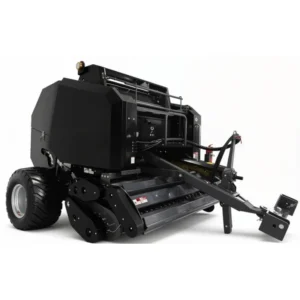
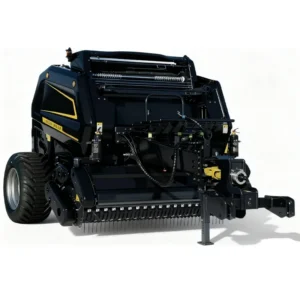
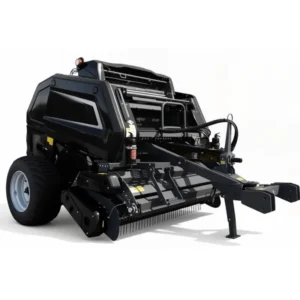
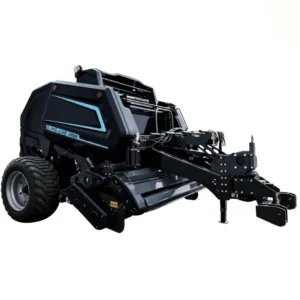
The 9YG series provides a complete scale range from the most compact small farm models through to full commercial machines, all manufactured under ISO 9001 certification and using sensor-controlled bale density management.
FAQ
Frequently Asked Questions: Small Round Balers for Wheat Straw on Korean Farms Under 200 Hectares
Biên tập viên: PXY