Farm Equipment Guide — Round Baler
How Does a Round Baler Work? A Complete Step-by-Step Guide for Farm Operators
Whether you are managing a hay operation in Korea’s Gyeonggi plains, a grassland enterprise in Gangwon province, or procuring baling equipment for a livestock farm in South Chungcheong, understanding exactly how a round baler works — from crop pick-up through twine or net wrapping to bale ejection — is the foundation of choosing the right machine, operating it safely, and keeping downtime to a minimum.
1. What Is a Round Baler?
A round baler is a tractor-towed agricultural machine that collects cut and windrowed crop from the ground, compresses it into a cylindrical bale inside a rotating chamber, wraps the bale in net or twine to hold it together, and then ejects the finished bale out of the machine’s rear door onto the field. The result is a dense, self-supporting cylindrical package of hay, straw, silage, or crop residue that can be stored outdoors, loaded mechanically, and transported efficiently to feeding areas or storage facilities.
The round baler is today the dominant baling technology in the global forage and crop residue harvest industry, having largely replaced the earlier rectangular baler for large-scale operations because of its continuous flow operation, lower labour requirement per tonne of material, and the inherent weather resistance of the cylindrical bale shape. Tightly wrapped round bales shed rain from their curved outer surface, allowing them to be stored in the open field without the rapid deterioration that affects flat-sided square bales in the same conditions. This characteristic is particularly valuable for Korean livestock farmers who need to stockpile fodder through the wet monsoon season (장마철) for use in the following winter feeding period.
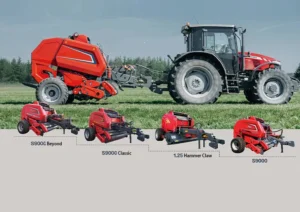
The term small round baler (or mini round baler) describes machines that produce bales of roughly 1 metre diameter or less, suitable for small farms with limited tractor power — down to 40 hp tractors — or for handling applications where bale weight must be kept manageable for manual or small mechanical handling. Large round balers like those producing bales of 1.2–1.4 metres diameter are designed for high-output commercial operations and require tractors of 75 kW (approximately 100 hp) or more. Understanding where your operation sits on this spectrum is the first step in choosing the right machine.
2. The Key Components of a Round Baler
Before walking through the operating sequence, it helps to have a clear mental map of the machine’s main sub-systems. The descriptions below apply to a typical towed round baler of the roller-chamber type — the most common configuration in the field today, including the models in our product range.
A wide, spring-tine or hammer-claw pickup that spans the full working width of the machine and sweeps crop from the windrow upward into the feed throat. Spring-tine pickups are the standard for hay and straw; hammer-claw pickups are used for standing corn stover and other upright residue. Working widths typically range from 1.9 m for small balers to 2.4 m for large-capacity models.
Located between the pickup and the bale chamber, the feed mechanism transfers crop evenly across the full chamber width to prevent uneven bale formation. Designs vary: tine-roller-drum combinations are common in mid-range machines; auger plus tine-roller configurations are used in designs with semi-forced feeding — the axial-flow mechanism found in our proprietary half-forced feed design that substantially reduces blockage rates.
The central enclosure where the bale forms. In roller-type machines, a set of parallel steel drums (typically 16–18 rollers of approximately Φ222 mm diameter) arranged in a circular or elliptical pattern rotate continuously to roll the crop core into an increasingly dense cylinder. Chamber width determines the bale width; chamber diameter determines the maximum bale diameter.
Modern machines use electronic sensor systems to monitor bale density in real time. When the bale reaches the preset density or diameter, the sensor triggers the wrapping sequence automatically. This removes the guesswork from timing the wrap initiation and ensures consistent bale dimensions and weights from one cycle to the next — important for automated handling and transport planning.
The net or twine wrap system feeds wrapping material into the chamber from a supply roll. For net wrapping , the net is drawn in by the rotating bale, spirals across the bale face, and is then cut automatically. For twine wrapping, a spreader arm moves the twine laterally while the bale rotates, laying down multiple overlapping spirals.
The rear section of the bale chamber is hinged and opens hydraulically when the wrap cycle is complete. The completed bale rolls or is pushed backward out of the chamber onto the ground. A buffer cylinder on modern designs cushions the door closing action, protecting the machine’s structure from the impact vibration that repeated hard closures would otherwise cause.
The power take-off (PTO) shaft from the tractor connects to the baler’s input gearbox at 540 rpm or 1000 rpm depending on model. The gearbox distributes power to the pickup, feed system, and chamber rollers. A heavy-duty dual-universal-joint driveshaft absorbs the angle changes during field turns. The gearbox is the highest-stress component in the entire machine and must be rated for sustained peak torques during blockage-clearance events.
The structural connection between the tractor’s drawbar and the baler chassis. Advanced designs use an articulating hitch that allows independent vertical (pitch) and lateral (yaw) movement, reducing stress on the driveshaft during operation on undulating ground. Some designs permit 90° or wider lateral articulation, significantly reducing the turning radius required for headland manoeuvres in small Korean fields.
3. How a Round Baler Works — Step by Step
The complete operating cycle of a round baler can be broken down into seven sequential stages. In continuous-operation mode the operator drives the tractor at a steady working speed, typically 5–20 km/h depending on crop volume and machine size, and the machine completes each cycle while the tractor continues moving forward.
As the tractor pulls the baler across the windrow, the spring-tine pickup reel rotates forward and downward, lifting cut crop off the ground and sweeping it rearward into the feed throat. The tines flex over surface irregularities and stubble rows without damaging themselves. Ground-following skids on either side of the pickup maintain the correct working height above the soil surface, preventing ground contact that would cause soil pickup and contamination of the forage.
The feed mechanism behind the pickup spreads the incoming crop evenly across the full chamber width and accelerates it into the compression zone. In the axial-flow semi-forced feeding design used in our range, the auger plus tine-roller combination actively distributes material laterally while the drum element prevents reversal and stalling at the chamber entrance. This design virtually eliminates the selective feeding that causes some machines to produce barrel-shaped or cone-shaped bales — a common problem with simpler passive-feed systems when crop is not uniformly distributed in the windrow.
The first material entering the empty chamber encounters the rotating rollers on all sides of the chamber. Friction from the roller surfaces causes the crop to begin rotating. As more material enters, the loose initial core grows in diameter and density. The rollers, typically 18 in a large-machine configuration at Φ222 mm diameter, exert progressive compressive force on the growing bale as it presses outward against them. This is the critical density-building phase, and the uniformity of the bale’s core at this stage determines the final bale shape.
As the bale grows toward its target size, the compression force increases. The electronic density control sensor continuously monitors the bale diameter or the resistance in the chamber compression mechanism. When the bale reaches the preset target — typically 100–200 kg/m³ bale density in our specification range — the sensor triggers an alarm or indicator in the tractor cab to alert the operator that the bale is ready for wrapping. On fully automatic systems, this trigger initiates the wrapping sequence directly without operator input.
For net-wrapped balers (缠网 type — standard in our range), the net feed mechanism draws the leading edge of the net into the chamber entrance. The rotating bale catches the net and pulls it in. The net unrolls and wraps spirally around the bale’s circumference. After two to three full rotations, the automatic cut-off mechanism severs the net and the trailing edge tucks under the bale surface. For twine wrapping, the twine spreader arm moves back and forth across the bale width as the bale rotates, laying down overlapping spiral turns of twine that secure the entire surface. Net wrapping is significantly faster (typically 10–15 seconds per bale vs. 20–30 for twine) and gives better moisture protection of the bale surface.
Once the wrap cycle is complete, the operator (or the automatic system) actuates the hydraulic circuit that opens the rear door of the bale chamber. The completed bale — now a dense, tightly wrapped cylinder — rolls backward out of the chamber under gravity and lands on the ground behind the machine. A buffer oil cylinder absorbs the impact of the door closing and protects the machine structure. The rear door closes, and the baler is immediately ready to begin the next cycle without the operator stopping the tractor.
Finished bales left in the field can be picked up by a round bale handler on a tractor front loader, a bale wrapping machine for silage production, or a dedicated bale pickup and transport machine. At densities of 100–200 kg/m³, a Φ1300×1400 mm bale produced by a large machine weighs approximately 250–560 kg, requiring mechanical handling in all cases. Proper storage — either under a roof, on a well-drained surface, or wrapped in stretch film for silage — is as important as the baling process itself for preserving forage quality through the storage period.
4. Fixed-Chamber vs Variable-Chamber Round Balers
Round balers are broadly divided into two chamber types that operate on fundamentally different principles, and each has strengths suited to different farming operations.
| Tính năng | Fixed-Chamber (Roller Type) | Variable-Chamber (Belt/Chain Type) |
|---|---|---|
| Bale diameter | Fixed (set by chamber size) | Adjustable (operator selects) |
| Bale density | High, consistent | Variable — soft core possible |
| Core formation | High-density from centre | Soft-centred, density builds outward |
| Throughput speed | High | Moderate |
| Crop suitability | Hay, straw, silage, corn stover | Primarily hay and silage |
| Maintenance complexity | Lower (no belt tracking) | Higher (belt tension, tracking) |
| Typical tractor power | 48–100+ kW | 75–130+ kW |
Our round baler product range uses the fixed-chamber roller design exclusively. The roller configuration delivers consistently higher bale density, is more tolerant of abrasive and wet crops, and requires less maintenance per operating hour than belt-type systems — advantages that translate directly into lower running cost for Korean livestock farmers who need to bale corn stover, rice straw, and mixed-grass hay across a compressed seasonal harvest window.
5. Bale Wrapping Methods: Net vs Twine
The choice between net wrapping and twine wrapping affects work rate, bale surface protection, and downstream handling. Both systems are offered across our product range, with net wrapping being the standard configuration for most models.
Net wrapping (缠网) applies a plastic mesh over the full bale surface in two to three rotations, taking approximately 10–15 seconds per bale. The net physically holds all surface fibres in compression, prevents the bale from loosening or unravelling during handling, and provides a relatively smooth outer surface that sheds rainfall and allows the bale to roll consistently. Net wrap bales can typically be stored outdoors for 3–6 months without significant weather-related dry matter loss, compared with 1–2 months for twine-wrapped bales in comparable conditions — an important consideration for Korean farms that stack bales outdoors during summer and use them through the following winter.
Twine wrapping (缠绳) uses polypropylene or sisal twine wound in multiple spiral passes across the bale face. Twine-wrapped bales cost less per bale in wrapping material and are easier to dispose of (cut the twine loops and remove before feeding), but the bale surface is not fully covered and the bale can unravel more readily if the twine is cut or breaks. For short-term storage of high-volume straw bales destined for direct use as bedding, twine wrapping remains a practical choice.
6. Round Baler Drive System and Gearbox
The round baler gearbox is the mechanical heart of the machine’s drive system. It receives rotational power from the tractor’s PTO shaft at 540 r/min (standard for most smaller and mid-range balers) or 1000 r/min (for high-speed large machines), converts it to the appropriate speeds for the pickup reel, feed rollers, chamber drums, and wrapping mechanism, and distributes torque across all these simultaneously operating sub-systems.
On twin-axle or dual-gearbox designs — a feature of our high-performance models — a second gearbox is mounted at the driveshaft connection point near the tractor hitch. This dual-gearbox arrangement provides 90° left-and-right lateral rotation capability (横向转向角度100°), allowing the tractor and baler to articulate through tight headland turns in small Korean paddy-perimeter fields without cutting the PTO power. Single-gearbox machines in comparison require the operator to disengage the PTO before sharp turns to prevent driveshaft damage — a process that interrupts throughput and increases operator workload on irregular-shaped fields.
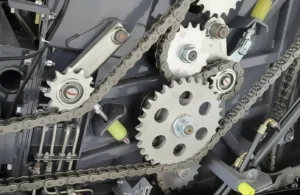
The rear section of larger machines uses double-sided heavy-duty chain transmission (后仓双侧20A加重型链条) rather than a single central drive chain. This bilateral chain arrangement equalises the compression load across both sides of the bale chamber, producing denser and more uniform bales — a measurable difference particularly visible when baling wet or high-bulk-density crops like rice straw under humid Korean autumn conditions.
7. Materials Used in Round Baler Construction
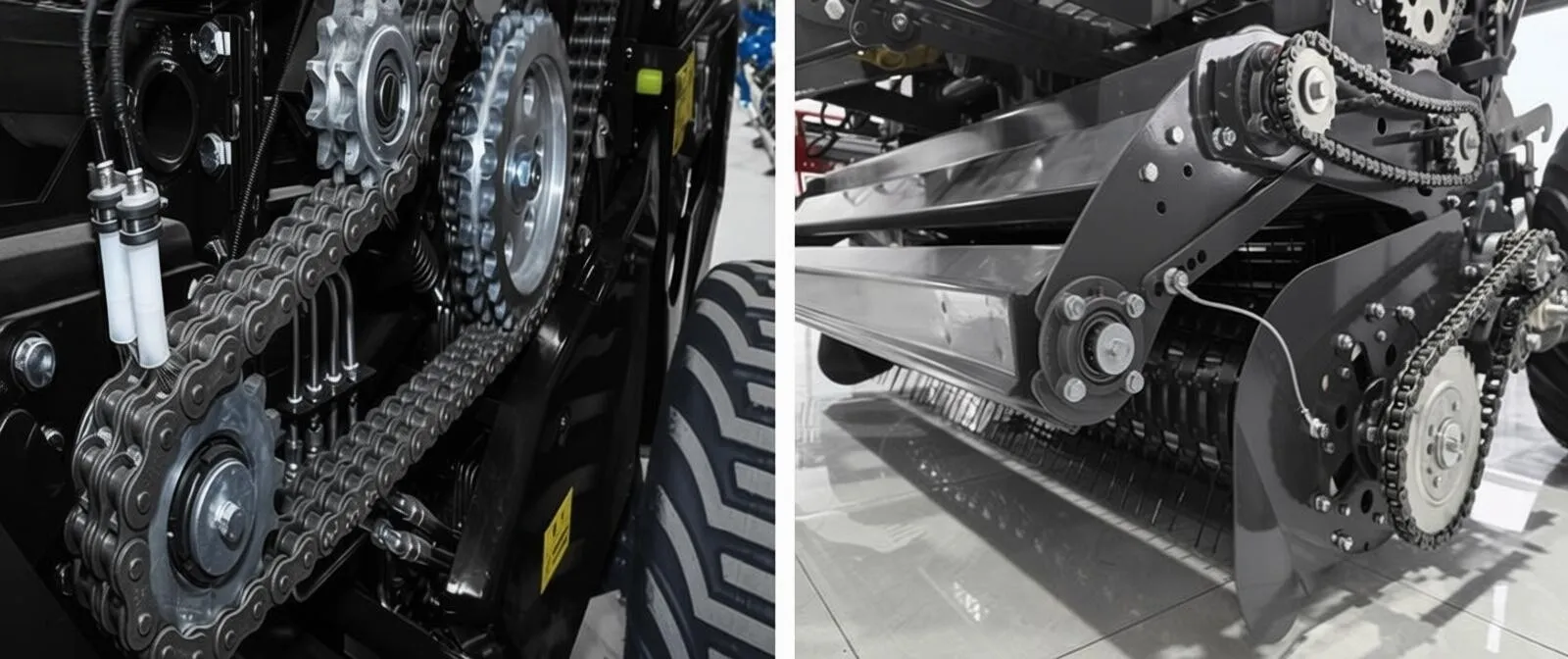
A round baler operates in one of the most mechanically demanding environments in agricultural machinery: continuous vibration, abrasive crop contact, mud and moisture ingress, chemical exposure from fertilisers and silage additives, and sustained high-torque loading through the PTO driveline. The material specifications of each major component directly determine field reliability and service life.
The main frame and side panels are fabricated from high-strength structural steel plate, cut by CNC laser cutter for dimensional accuracy and then welded on automated welding lines under controlled conditions. Weld quality directly affects fatigue life; machines with hand-welded frames show a significantly higher incidence of frame cracking in the 3–5 year timeframe compared with automated-weld machines, particularly at the high-stress points around the rear door hinges and pickup suspension brackets.
The chamber rollers — the components that do the actual bale compression work — are machined from medium-carbon alloy steel and surface-treated for hardness. At Φ222 mm diameter and spanning the full chamber width of 1000–1400 mm depending on model, each roller handles several tonnes of bale compression force over thousands of operating hours. Roller bearings are sealed for life in most cases, running in pillow-block housings that allow replacement in the field without disassembling the roller assembly.
The pickup tines are manufactured from hardened spring steel. Their temper is deliberately set to allow deflection over obstacles without permanent deformation: a tine that hits a stone should flex rather than break. Tines are consumable items, and our machines use standardised mounting formats that allow individual tine replacement from commercial spare parts stock without complete pickup reel disassembly — a practical maintenance advantage for Korean operators who may be servicing machines at distances from major dealer support centres.
All external painted surfaces receive an electrostatic powder-coat or multi-layer liquid paint system applied in a dedicated painting line, providing corrosion resistance for the humid and salt-laden atmospheric conditions experienced in many Korean coastal and lowland agricultural areas.
8. Crop Types and Application Scenarios
The round baler handles a broader range of crop types than any other single baling technology. The following scenarios represent the main applications in the Korean and global market context:
Post-harvest rice straw is one of the primary baling crops in South Korea, particularly in the Honam and Chungcheong rice-producing regions. Hammer-claw pickup models are well suited for collecting straw that has been left standing or partially flattened by combine headers. Baled straw is fed to beef cattle (한우) in winter, used as livestock bedding, or compressed for composting and soil amendment applications.
Natural and planted grasslands in Gangwon province and highland pastoral areas produce ryegrass, timothy, orchard grass, and mixed sward hay for dairy and beef cattle. Spring-tine pickup balers with wide working widths are the standard tool for this application. Multiple cuts per year require machines with reliable high throughput.
Corn stover baling after grain harvest or whole-plant silage corn baling uses hammer-claw pickup systems that can process standing or laid residue without requiring prior windrowing. Net-wrapped bales can subsequently be wrapped with stretch film for silage fermentation — a practice growing rapidly in Korean dairy regions as TMR (total mixed ration) feeding expands.
Post-harvest soybean straw, wheat straw, and barley straw are all suitable for baling with spring-tine pickup machines. These lighter-density crops require less tractor power but benefit from well-designed feed systems that prevent straw from bridging or wrapping around the feed rotor — a common failure mode in under-designed machines with simplified single-roller feeding.
Round bales intended for silage are wrapped in stretch film (4–6 layers) immediately after baling to create anaerobic fermentation conditions. Net-wrapped bales are preferred for silage because the tight surface wrap maintains bale shape through the stretch-film application process and provides a smooth surface for the film to adhere to.
Agricultural crop residue baling for biomass energy, compost production, or industrial fibre processing uses the same machine and operating technique as forage baling. Round balers for biomass applications often specify higher bale density settings to maximise the dry matter per bale and reduce transport cost per tonne of material.
9. Round Baler Selection Guide — Which Model Is Right?
The table below summarises the key specifications of round baler models suited to different farm sizes and crop types, drawn from our product range. All models use the roller-chamber design with electronic density control and automatic net wrapping. Dimensions shown are for working state (작업 상태).
| Model | Pickup Width (mm) | Chamber (W×D) | Bale Size (D×W mm) | Tractor Power (kW) | Output (bales/h) | Machine Weight (kg) | PTO Speed (r/min) |
|---|---|---|---|---|---|---|---|
| 9YG-1.0 | 1900 | 1000×Φ1000 | Φ1100×1000 | 48–80 | 40–100 | 2640 | 720 |
| 9YG-1.0C | 2400 | 1250×Φ1000 | Φ1000×1250 | ≥69.8 | 40–80 | 3198 | 540 |
| 9YG-1.25 | 2240 | 1250×Φ1200 | Φ1300×1250 | ≥75 | 40–100 | 4060 | 720 |
| 9YG-1.25A | 2150 | 1250×Φ1200 | Φ1300×1250 | ≥75 | 40–100 | 4472 | 540–1000 |
| 9YG-2.24D | 2240 | 1400×Φ1200 | Φ1300×1400 | 55–100 | 40–100 | 3922 | 720 |
| 9YG-2.24D Classic | 2240 | 1400×Φ1200 | Φ1300×1400 | 55–100 | 40–100 | 4312 | 720 |
| 9YG-2.24D S9000 | 2240 | 1400×Φ1200 | Φ1300×1400 | 55–100 | 40–100 | 4262 | 720 |
| 9YG-2.24D Transcend | 2240 | 1400×Φ1200 | Φ1300×1400 | 55–100 | 40–100 | 4570 | 720 |
Bale density range: 100–200 kg/m³ across all models. Net roll specification 2000 m per roll. All machines use towed (牵引式) attachment and electronic sensor-controlled density management.
10. Regulatory Standards for Round Balers
Agricultural machinery including round balers is subject to safety, quality, and import regulations in all major markets. Understanding these frameworks is important for B2B procurement teams in Korea and other markets.
Agricultural machinery in Korea is regulated under the Agricultural Mechanization Promotion Act (농업기계화 촉진법) administered by the Rural Development Administration (RDA, 농촌진흥청). Round balers for commercial use must carry relevant certification and may qualify for agricultural mechanisation subsidy programmes. Occupational safety for PTO-connected implements is governed by the Occupational Safety and Health Act (산업안전보건법) and KOSHA guidelines for PTO shaft guarding. Import clearance through Korea Customs (관세청) requires HS code classification typically under 8433.40.
Round balers sold in the EU must comply with the Machinery Directive 2006/42/EC (being superseded by EU Machinery Regulation 2023/1230). CE marking is required. Relevant harmonised standards include EN ISO 4254-1 (agricultural machinery — safety — general requirements) and EN ISO 11684 (safety signs). PTO driveshaft guarding must comply with EN 1152.
OSHA 29 CFR 1928 governs agricultural machinery safety. ASABE (American Society of Agricultural and Biological Engineers) standards S547 (round baler safety) and EP455.1 (PTO implement safety) provide the design framework for safe round baler operation. State-level road transport regulations apply when moving balers between farms on public roads.
ISO 8210 covers round balers specifically (round balers — safety). ISO 500-1 to ISO 500-3 define PTO shaft dimensions and speed categories. ISO 9001 quality management certification covers the manufacturing process and provides traceability documentation required for B2B procurement. Our machines are manufactured under ISO 9001-certified quality management.
Japan’s Agricultural Machinery Industrial Association and JIS B 9700 (safety of machinery — general principles) apply to imported round balers. MAFF (Ministry of Agriculture, Forestry and Fisheries) registration may be required for machinery to qualify for agricultural subsidy programmes under Japan’s agricultural mechanisation policies.
ASEAN member states including Vietnam, Thailand, and Indonesia are developing agricultural mechanisation subsidy programmes that increasingly specify ISO-conformant equipment. FAO (Food and Agriculture Organization) agricultural mechanisation guidelines provide a common reference framework. Halal certification of lubricants may be relevant for machines operating in food-crop handling contexts in Muslim-majority ASEAN countries.
11. Explore Our Round Baler Range
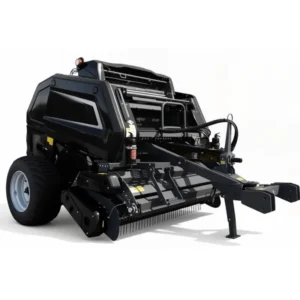
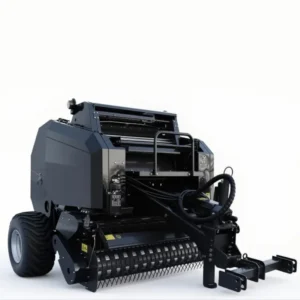
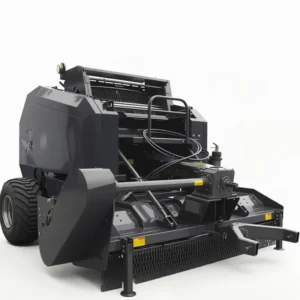
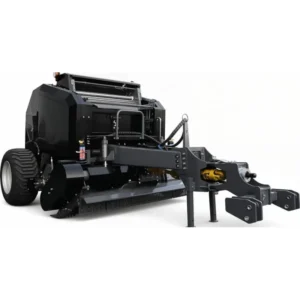
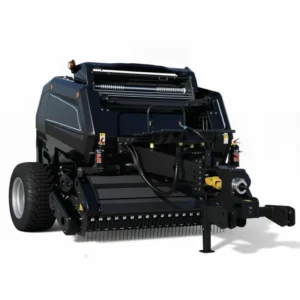
Our round baler product line spans compact small round balers suited to 40–50 hp tractors through to high-output large-format machines for commercial forage operations. All models share the roller-chamber design, electronic density control, and automatic net wrapping as standard. Below is a selection of models — click through to the individual product pages for full specifications.
12. About Our Round Baler Manufacturing
We are a specialist agricultural machinery manufacturer with ISO 9001-certified quality management, holding multiple utility model patents covering our proprietary axial-flow semi-forced feeding mechanism, dual-universal-joint driveshaft designs, and H-type hydraulic connection systems. Our manufacturing facility covers 32,000 m² of production floor space with dedicated CNC laser cutting, automated welding lines, and electrostatic spray painting production. Annual round baler production capacity reaches 2,000 units, with export experience spanning Mongolia, Russia, Belarus, Kazakhstan, and increasing interest from Korean and East Asian agricultural machinery importers seeking competitively priced, well-engineered small round baler and large round baler options.
For B2B customers in South Korea — agricultural machinery distributors, farming cooperatives (농업협동조합), large-scale contract farming operations, and government procurement for rural mechanisation programmes — we provide full technical documentation, ISO 9001 quality certificates, and production batch traceability records. We can discuss Korea-specific customisation including cab warning placards in Korean (한국어), adjusted PTO speed configurations to suit common Korean tractor brands, and packaging/shipping arrangements to Busan or Incheon port.
Frequently Asked Questions
Q1. What is a round baler and how does it differ from a square baler for rice straw collection in Korea?
A round baler compresses crop into a cylindrical bale and wraps it in net or twine, while a square baler (방형 베일러) produces rectangular bales tied with twine. For rice straw collection in Korean paddy fields, the round baler has several practical advantages: the cylindrical bale sheds monsoon and autumn rainfall much better than a flat-sided rectangular bale, the machine operates continuously without the reciprocating knotting mechanism that requires precise adjustment in square balers, and the resulting bale is more forgiving of wet conditions at baling. Round balers also generally require less maintenance per tonne of material baled in high-volume operations.
Q2. What is the minimum tractor horsepower required to operate a small round baler for a small farm in South Korea’s Gyeonggi or Chungcheong region?
Our 9YG-1.0 small round baler requires a minimum tractor power of 48 kW (approximately 65 hp), which is within the range of the mid-size tractors (50–80 hp) widely used by Korean livestock and mixed farms. If your tractor is rated below 48 kW (below approximately 65 hp), this model is the entry-level option; tractors of 75 kW (100 hp) and above can operate the 9YG-1.25 series with its larger 1250 mm wide chamber. Contact us with your tractor specifications and we can confirm compatibility and optimal model selection for your Gyeonggi or Chungcheong operation.
Q3. How many round bales can a farm baler produce per hour on a typical Korean grass hay field, and what affects the output rate?
Our round baler models are rated at 40–100 bales per hour under optimal field conditions. The actual rate achieved depends on three main factors: windrow density (more crop per metre of windrow = faster cycle times), field shape (more headland turns = more time lost to repositioning), and tractor/operator efficiency at clearing headlands without stopping. In Korean highland ryegrass hay operations with good windrow formation, 50–70 bales per hour is a realistic field throughput figure. Denser crops like corn silage may reduce this to 40–50 bales per hour as the wrapping and ejection time per bale represents a higher proportion of the total cycle.
Q4. What is the difference between net wrapping and twine wrapping on a round baler, and which is better for long-term outdoor storage in Korea?
Net wrapping covers the entire bale surface with a plastic mesh in 2–3 rotations (about 10–15 seconds), while twine wrapping winds 4–6 spiral passes of polypropylene or sisal twine around the bale. Net-wrapped bales are significantly more resistant to weather: the mesh surface prevents individual fibres from loosening, reduces the entry points for rain and wind, and gives the bale structural integrity for mechanical handling. For outdoor storage through Korea’s rainy summer and wet autumn, net wrapping is strongly recommended. Twine-wrapped bales stored outdoors will typically show 5–15% higher dry matter loss over 3–6 months compared with net-wrapped bales in the same conditions.
Q5. Where can I find a reliable round baler manufacturer or supplier for a Korean agricultural cooperative looking to purchase multiple machines?
We supply B2B orders to Korean agricultural importers, cooperatives, and large farming enterprises with delivery to Korean ports including Busan and Incheon. For cooperative procurement (농협 or 영농조합법인 group purchase), we can discuss volume pricing, staggered delivery schedules, and documentation packages including ISO 9001 certificates, origin documents, and technical manuals. Please use the contact form on this page to initiate an enquiry with your organisation’s name, required quantity, preferred delivery port, and timeline.
Q6. What round baler parts wear out most frequently, and how do I keep a mini round baler running efficiently through a Korean harvest season?
The highest-frequency wear items on a round baler are: pickup tines (spring-tine or hammer-claw fingers), drive chains (both the PTO transmission chains and the chamber roller chains), net or twine cut-off blades, and roller bearings. For a Korean harvest season running 200–400 hours, it is practical to inspect tines at every 50 hours, chain tension and lubrication at every 50 hours, and blade sharpness at every 200 hours or when bale wrapping becomes inconsistent. Carry a set of replacement tines, a chain repair kit, and a spare cut-off blade as field consumables to avoid downtime during peak harvest.
Q7. How does a small round baler for a 40 hp tractor compare with a large round baler in terms of operating cost and bale output for Korean livestock farms?
A small round baler (40–50 hp requirement, 1.0 m chamber) produces lighter bales (100–200 kg each) at a lower throughput rate, but costs less to acquire, uses less fuel per operating hour, and pairs with the compact tractors that many Korean family livestock farms already own. A large round baler (75–100 kW requirement, 1.25–1.4 m chamber) produces heavier bales (250–560 kg each) at significantly higher throughput, reducing the total time on the field per tonne of material. For farms with 20 hectares or more to bale per season, the large machine’s higher output generally produces a lower cost per tonne baled despite its higher fuel and purchase cost. For farms under 10 hectares, the small round baler is the more economical choice.
Q8. What is the round baler gearbox and why is it important for long-term machine reliability on a Korean farm?
The round baler gearbox is the central power distribution unit that receives PTO shaft rotation from the tractor and divides torque to drive the pickup, feed rollers, chamber drums, and wrapping mechanism simultaneously. It is subject to the highest sustained torque loads in the entire machine — particularly during blockage-clearance events when the operator engages the PTO against a partially jammed feed rotor. A heavy-duty gearbox with adequate oil capacity, quality seals, and robust bearing selection will last 3,000+ operating hours; an undersized gearbox may fail within the first 500 hours under demanding crop conditions. Our dual-gearbox design distributes load between two units, reducing the peak torque experienced by any single gearbox element.
Biên tập viên: PXY