Agricultural Development Series
A practical guide on how round baler machines are being adopted in developing agricultural markets — from smallholder cooperative models in Sub-Saharan Africa and South Asia to expanding mechanization programs in Central Asia and Southeast Asia — covering machine selection, cooperative deployment logistics, manufacturing structure, material durability, and international regulatory context.
The Developing Market Opportunity
1. Why Round Balers Are Reshaping Agricultural Mechanization in Emerging Economies
Smallholder farming — broadly defined as agricultural operations of less than 5 hectares cultivated by family labor — accounts for approximately 70% of food production in Sub-Saharan Africa, 80% of agricultural holdings in South Asia, and a substantial proportion of livestock-dependent farming in Central Asia and Southeast Asia. These producers face a structural disadvantage in forage and crop residue management: without access to mechanized baling, cut grass and straw must either be manually collected — a labor-intensive process that limits the scale of any individual operation — or left in the field to decompose, which wastes a valuable feed resource and can harbor crop disease vectors. The introduction of affordable, appropriately-scaled round baler machines into these environments transforms forage management from a binding constraint into a competitive advantage.
The cooperative farming model is the organizational structure most commonly used to facilitate this transition. By pooling resources across multiple smallholder members, a cooperative can purchase or lease a round baler machine that no individual member could justify as a standalone investment, and then operate it as a shared service that charges a fee per bale produced across member farms. This model is actively promoted by agricultural development agencies, government mechanization programs, and international development finance institutions in a range of countries — from Mongolia and Kyrgyzstan in Central Asia to Ethiopia and Tanzania in East Africa, and from Vietnam and Myanmar in Southeast Asia. For Korean agricultural equipment suppliers and Korean ODA (Official Development Assistance) project operators working in these regions, the round baler is frequently among the priority equipment categories identified for cooperative mechanization support.
This guide addresses the specific machine selection, structural engineering, and operational considerations that make a round baler work effectively within a smallholder cooperative context — where the tractor fleet is typically modest, operator skill levels are variable, field sizes are small, and maintenance access may be infrequent. Understanding these realities is the starting point for any equipment deployment that aims to deliver sustained benefit rather than short-term demonstration impact.
Cooperative Models
2. How Smallholder Cooperatives Deploy Round Balers: Ownership, Scheduling, and Revenue Structures
A successful cooperative round baler deployment requires more than simply providing the machine — it requires an organizational model that ensures the equipment is used effectively, maintained properly, and generates sufficient collective economic benefit to sustain the investment over its operational life. The most common deployment structures observed in developing market cooperative contexts are: direct cooperative ownership with a hired operator and fee-per-bale service model; equipment leased from an agricultural development agency with cooperative repayment obligations; and machinery contractor models where a single entrepreneur owns the baler and contracts services to surrounding smallholder farms under a seasonal agreement.
In each of these models, the machine selection decision is dominated by three practical constraints: the power output of the tractors available to pull the baler, the physical size of the fields being baled, and the cost and availability of spare round baler parts in the local market. On a cooperative serving smallholder farms with average plots of 0.5–2 hectares, the machine needs to be maneuverable in tight spaces, capable of producing bales that individual farmers can handle without large equipment, and simple enough to operate that a single trained operator can run it through a full day across multiple members’ fields without requiring specialist support for routine adjustments.
The 9YG-1.0 round baler addresses these constraints directly. It is designed for tractors in the 48–80 kW range — a specification that aligns with the tractor classes most commonly provided through agricultural mechanization programs in Sub-Saharan Africa and South Asia. It produces bales of Ø1100×1000 mm with a weight of 200–400 jin (roughly 100–200 kg) depending on crop moisture and compaction — a weight class that can be moved by hand or with simple farm equipment without requiring a front-end loader. Its axial-flow semi-forced feeding mechanism reduces blockage frequency compared to older cam-and-guard pickup designs, which matters in a cooperative context where the operator may be less experienced at managing feed rate consistency.
Model Comparison
3. Round Baler Model Selection for Different Cooperative Scales and Tractor Availability
The right model depends on the size of the cooperative membership, the tractor horsepower available, the crop types being baled, and whether the cooperative is working in a one-village context or serving a larger area across multiple villages. The table below maps cooperative scale to the most appropriate 9YG series round baler model.
| Cooperative Scale | Typical Tractor Power | Recommended Model | Bale Dimensions | Key Cooperative Advantage |
|---|---|---|---|---|
| 5–20 member, village-level | 48–80 kW (35–60 hp) | 9YG-1.0 | Ø1100×1000 mm | Low capital cost; bale weight manageable without equipment |
| 5–20 member; mixed crop residue | ≥70 kW (≥95 hp) | 9YG-1.0C | Ø1000×1250 mm | Hammer-claw pickup for coarse straw and corn stover |
| 20–80 member, district-level | ≥75 kW (≥100 hp) | 9YG-1.25 / 9YG-1.25A | Ø1300×1250 mm | Higher throughput; 9YG-1.25A accepts 540–1000 r/min PTO |
| 80+ member or contractor service | 55–100 kW (75–135 hp) | 9YG-2.24D series | Ø1300×1400 mm | 40–100 bales/h; large-area seasonal service contracts |
Manufacturing Structure
4. How the Frame, Chamber, and Feed System Are Built for Durability Under Cooperative Use Conditions
Cooperative round baler deployments in developing markets place a specific type of structural demand on the machine: the equipment must tolerate being operated by multiple different operators at different skill levels across different crop conditions, often with less frequent maintenance than a professional farming enterprise would provide. In these circumstances, the manufacturing quality of the frame, the robustness of the chamber structure, and the simplicity of the feeding mechanism determine whether the machine continues to function effectively over a multi-year deployment or requires expensive repairs during the critical harvest window.
CNC Laser-Cut Main Frame
The main frame of the 9YG series machines is fabricated from CNC laser-cut structural steel plate, providing dimensional consistency that is not achievable through manually-cut blanked steel in the field. This precision means that all bolt holes, bracket mountings, and hinge points align correctly as assembled — a seemingly minor point that becomes critical in a cooperative context where field maintenance may involve removing and reinstating components without specialist tools. Automated welding at all primary structural nodes produces consistent joint penetration quality across every unit, protecting against the premature joint fatigue that would compromise frame integrity under cooperative multi-user operating patterns.
Bale Chamber and Press Roller Array
The bale chamber on the 9YG-2.24D series measures 1,200 mm in diameter and 1,400 mm in width, supported by 18 press rollers each measuring 222 mm in diameter. The dual-side chain drive on both chamber side plates distributes compressive force symmetrically, preventing the asymmetric loading that would cause premature wear at the hinge points between the main chamber frame and the tailgate. For cooperative machines that may handle a wider range of material types across member farms — from fine grass hay to coarser crop residues — this symmetric design maintains bale quality consistency regardless of how the windrow material varies from one field to the next.
Axial-Flow Semi-Forced Feeding Mechanism
The axial-flow semi-forced feeding mechanism is a proprietary design that channels crop material from the pickup into the bale chamber without the cam-and-guard components found in older pickup designs. In a cooperative context, this matters because cam-and-guard failures are among the most common field breakdown events on conventional balers, and sourcing replacement cam components in a developing market rural area can be difficult. The feeding mechanism on the 9YG series eliminates this failure mode entirely, replacing it with a simpler, higher-throughput flow path that reduces blockage frequency and lowers the skill requirement for efficient operation.
Material System
5. Steel Grades, Chain Specification, and Surface Treatments Designed for Low-Maintenance Cooperative Environments
The material system of a round baler deployed in a cooperative developing market context must be evaluated with a different maintenance frequency assumption than commercial farming equipment in developed markets. When the machine is operated by cooperative members who may bale for 2–4 weeks per year and then store the equipment for the remainder, the materials need to protect themselves through extended idle periods as well as performing under operating loads. The 9YG series material choices reflect a design philosophy that prioritizes durability with predictable maintenance rather than peak performance with demanding service schedules.
Chain Drive — Scaled to Machine Size
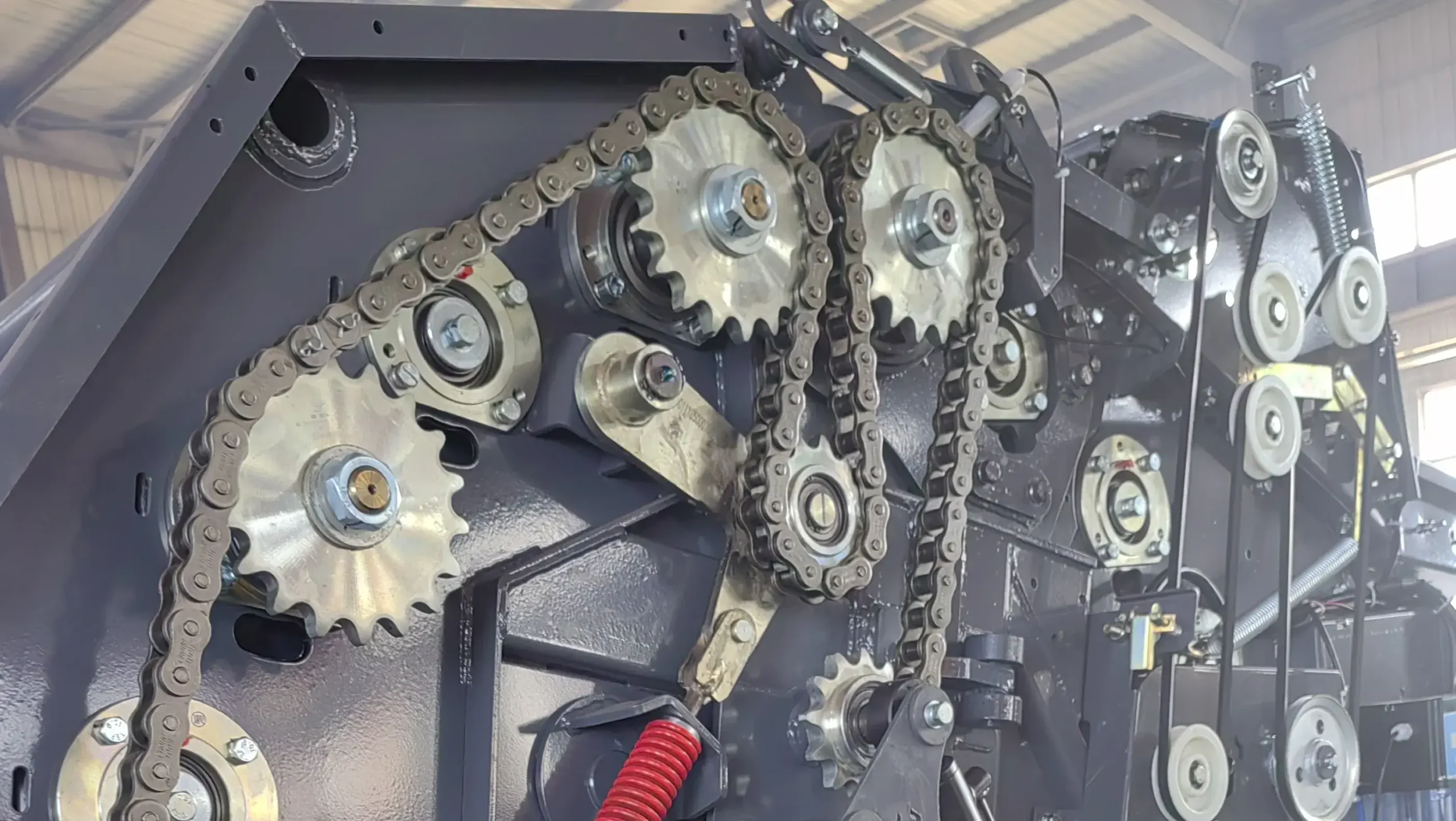
Large-format machines like the 9YG-2.24D Transcend use 20A heavy-duty roller chain on both sides of the rear chamber, while compact models like the 9YG-1.0 use appropriately-scaled roller chain for their 48–80 kW power class. In developing market contexts, chain lubrication is often the first maintenance step to lapse when cooperative management structures are not well-defined. The dual-side drive design on 9YG series models distributes load across both sides of the chain system, which means that even if lubrication has been less than ideal for a period, the load-per-link is lower than in single-side designs and elongation progresses more slowly.
High-Tensile Spring Steel Tines
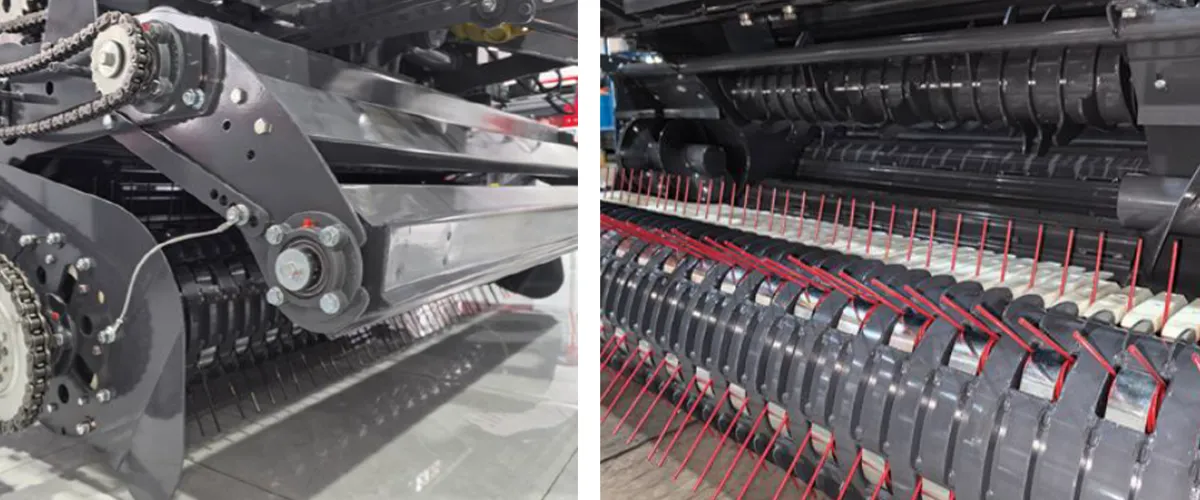
Spring steel pickup tines provide the flexibility needed to handle the mixed field conditions common in developing market cooperative operations, where individual member plots may include patches of gravel, soil crust, or debris from previous harvests. The tine’s ability to deflect on contact with solid objects and return to position without fracturing reduces the frequency of tine replacement — a critical consideration in contexts where replacement parts may need to be ordered weeks in advance. For cooperatives baling coarse crop residues like corn stover or sorghum stalks, the 9YG-1.0C’s hammer-claw pickup option provides an interchangeable solution within the same machine body.
Electrostatic Powder Coating
Machines deployed in developing market environments are often stored in open-sided structures, under temporary shelter, or in conditions with high ambient humidity during the off-season. The electrostatic powder coating applied over CNC-fabricated frame components after manufacturing provides an adhesion-bonded corrosion barrier that holds through multiple seasonal storage cycles without the bubbling and undercut corrosion that a wet-paint finish develops at chip points. For cooperative machines that may change custodians through membership transitions or management changes, the frame coating quality directly determines the machine’s condition after years of varied storage treatment.
Hydraulic System Reliability
H-type ferrule fittings throughout the hydraulic circuit provide higher burst-pressure tolerance and better vibration resistance than threaded cone fittings, reducing the frequency of hydraulic leaks that require fitting tightening or replacement during field operation. In cooperative deployments where a leaking hydraulic fitting may go unnoticed for several days before the next operator uses the machine, this seal quality reduces the risk of hydraulic oil depletion events that could damage the tractor’s hydraulic pump through low-flow operation. The buffer cylinder design on the tailgate of the 9YG-2.24D Classic absorbs ejection shock, protecting the gate hinge welds from the accelerated fatigue that would otherwise develop under cooperative multi-operator use.
Crop Applications
6. What Crops Do Smallholder Cooperative Round Balers Handle Across Different Regions?
The crop types handled by cooperative round balers in developing markets reflect the diverse agricultural systems of the regions where these machines are deployed. Unlike specialized commercial operations that process a single crop type in uniform conditions, cooperative balers frequently handle multiple materials across a single season — which makes machine versatility and operator adaptability more important than optimization for a single crop. Understanding the typical crop profile for each region helps cooperative procurement committees make informed model selection decisions and plan operator training appropriately.
Central Asia (Mongolia, Kyrgyzstan, Kazakhstan)
Natural steppe grass and irrigated alfalfa are the dominant forage crops. Baling season is concentrated in July–September, with machine idle periods from October through June. The 9YG-2.24D series is the established product in these markets through export channels, with the machines already demonstrating multi-season reliability in the harsh continental climate. Cooperative deployment is common in Mongolian herder collectives where several families share a single baling unit and tractor across communal grazing lands.
Sub-Saharan Africa (Ethiopia, Tanzania, Kenya)
Rhodes grass, Napier grass, teff straw, and maize stover are the most commonly baled materials. In Ethiopian highlands and Kenyan dairy farming regions, small round balers for 40 hp tractor use are the preferred format because most smallholder cooperative tractors fall below 60 kW. The 9YG-1.0 series is specifically suited to this profile. Baling season aligns with the dry season harvest window, typically January–March in East Africa.
South Asia (Pakistan, Bangladesh, Nepal)
Wheat straw is the primary baling material in Pakistan and northern India cooperative contexts, collected immediately after the combine harvest in April–May. Rice straw is the dominant material in Bangladesh and coastal Pakistan. Both materials are relatively dry at harvest and bale reliably with spring-tine pickup systems. The 9YG-1.25A’s flexible PTO input range of 540–1000 r/min accommodates the variety of tractor specifications found in South Asian smallholder cooperative fleets.
Southeast Asia (Vietnam, Myanmar, Philippines)
Rice straw is the dominant baling material, collected between the two or three annual harvests in double-cropping systems. The short window between crops — sometimes as little as 10–15 days — makes machine throughput and reliability critical: if the baler breaks down, the straw must be burned before field preparation for the next crop. The 9YG-1.0C with its axial-flow feeding mechanism handles wet, tangled rice straw more reliably than cam-and-guard designs and is suited to the 70 kW tractor class common in Vietnamese and Philippine cooperative fleets.

Power Transmission
7. The Round Baler Gearbox in Cooperative Developing Market Deployments
The round baler gearbox is the most complex and highest-value drivetrain component in the machine, and in cooperative developing market deployments it faces a distinctive combination of stresses: variable input quality from tractors of different ages and maintenance states, occasional over-speed or under-speed PTO conditions from operators less familiar with optimal throttle management, and longer intervals between oil inspections than a professionally maintained commercial machine would receive. Selecting a machine with an appropriately robust gearbox design — and establishing clear maintenance protocols at the cooperative management level — is the single most impactful equipment decision for long-term deployment success.
The 9YG-1.25A is notable in this context for its acceptance of PTO input across a range of 540–1000 r/min, which tolerates the throttle variability of inexperienced operators and accommodates the tractor diversity of a cooperative fleet more gracefully than machines calibrated for a single precise input speed. For the largest cooperative deployments using the 9YG-2.24D Transcend, the dual-coupling gearbox handles up to 90 degrees of relative rotation between tractor and baler — which protects gearbox input shaft bearings from the shock loads that occur when a less experienced operator takes tight turns at high throttle, a common pattern in training-phase cooperative operations.
A key recommendation for cooperative deployments in any developing market is to establish a clear gearbox oil change schedule as part of the cooperative management agreement, with the oil change task assigned to a specific designated member rather than left as a communal responsibility that no one owns. At the standard seasonal oil change interval, gearbox maintenance cost is minimal — the oil volume required is modest and the labor time is less than 30 minutes. Skipping this interval consistently is the most common avoidable cause of premature gearbox failure in cooperative-operated machinery, and the replacement cost of a gearbox is disproportionate compared to the cumulative cost of regular oil changes across the same period.
Regulatory Frameworks
8. Agricultural Machinery Regulations, Cooperative Legal Frameworks, and Gearbox Standards in Key Developing Regions
Round baler deployments in developing market cooperative settings are subject to agricultural machinery safety regulations, cooperative entity registration requirements, and in some cases international development finance standards. The following frameworks are relevant to procurement committees, development agencies, and Korean ODA operators selecting machinery for cooperative programs.
Republic of Korea — ODA and KOICA Agricultural Mechanization Programs
Korea’s Official Development Assistance (ODA) programs administered by KOICA (Korea International Cooperation Agency) and KOAFEC (Korea-Africa Economic Cooperation) include agricultural mechanization components in multiple developing country programs. Equipment procured under KOICA grants must meet the environmental and social safeguard standards set by the OECD Development Assistance Committee (DAC), including requirements that machinery be appropriate to the technical capacity of recipient farming communities. ISO 9001-certified manufacturing is typically required for machinery procurement under KOICA-funded programs, making the certification status of the round baler manufacturer a direct eligibility criterion for development-funded cooperative deployments.
Mongolia — Agricultural Machinery Registration and Cooperative Law
Mongolia’s Law on Agricultural Cooperatives provides the legal framework for equipment ownership by registered cooperative entities, including the right to own and operate agricultural machinery as a collective asset. Agricultural machinery imported for cooperative use must be registered with the General Authority for State Registration (GASR) and inspected by the State Agency for Standardization and Metrology (MASM) against applicable machinery safety standards. The FASCAR round baler range has demonstrated multi-season operation in Mongolian herder cooperative deployments, with the machines’ export documentation supporting the GASR registration process.
Ethiopia — Agricultural Transformation Agency and Cooperative Proclamation
Ethiopia’s Cooperative Societies Proclamation No. 985/2016 provides the legal basis for agricultural cooperative ownership of shared equipment. The Ethiopian Agricultural Transformation Agency (ATA) runs mechanization programs that provide shared machinery to farmer cooperative unions. Agricultural machinery imported for these programs is subject to certification by the Ethiopian Standards Institute (ESI) and may require adaptation documentation confirming that the machine is appropriate for local tractor horsepower availability. Round balers deployed in Ethiopian highland forage cooperatives typically require tractors in the 40–60 kW class — a range directly matched by the 9YG-1.0 model.
Vietnam — Ministry of Agriculture and Rural Development Mechanization Standards
Vietnam’s Ministry of Agriculture and Rural Development (MARD) administers national agricultural mechanization programs that subsidize machinery purchase for registered cooperative organizations (Hop Tac Xa). Agricultural machinery eligible for subsidy under the national program must be registered on the MARD approved machinery list and pass quality inspection by authorized certification bodies. The government’s Resolution 19/NQ-CP on agricultural restructuring specifically promotes cooperative mechanization for rice residue management — an area where the 9YG-1.0C is directly applicable through its handling capability for rice straw in double-crop systems.
ISO 4254-7 and ASABE Safety Standards for Cooperative Machinery
ISO 4254-7 covers safety requirements for baling machines including guarding of the pickup, bale chamber, and ejection zone. For cooperative deployments where machine operators may have limited prior experience with round baler safety, the presence of compliant guarding and safety labeling per ISO 11684 is particularly important. Development finance institutions including the World Bank and the African Development Bank require that equipment procured under their-funded projects comply with international safety standards, with ISO 4254-7 compliance documentation typically required as part of procurement tender specifications for agricultural machinery.
Kyrgyzstan and Tajikistan — EAEU Framework and National Agricultural Machinery Certification
In Central Asian countries participating in the Eurasian Economic Union technical regulation framework, agricultural machinery including round balers must comply with the TR EAEU 042/2017 technical regulation on agricultural machinery safety before being commercially sold or used in subsidized cooperative programs. The GOST-R-aligned standards within this framework specify gearbox design safety requirements, PTO shaft guarding dimensions, and chain drive enclosure criteria that exporters supplying these markets need to document. Kyrgyz and Tajik smallholder cooperative programs funded by the Asian Development Bank specifically list technical regulation compliance as a procurement requirement for equipment supply contracts.
Product Range
9. Round Baler Models for Cooperative Developing Market Deployment
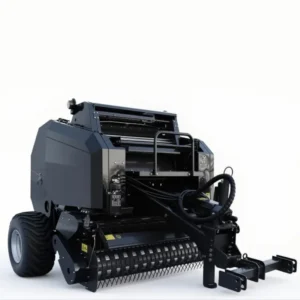
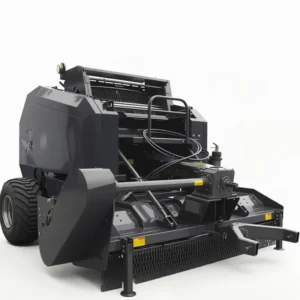
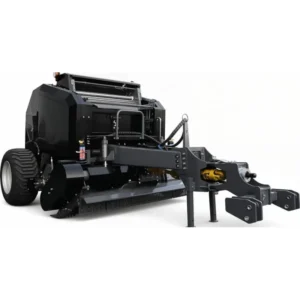
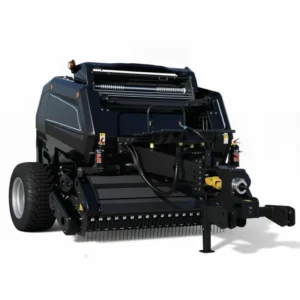
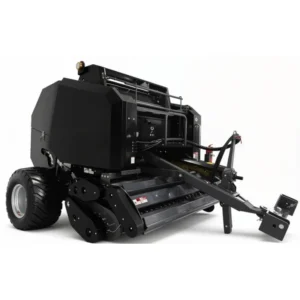
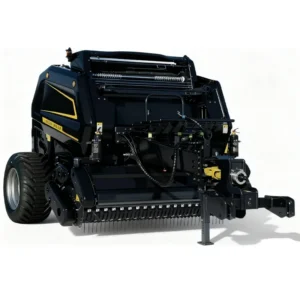
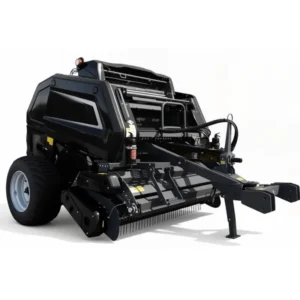
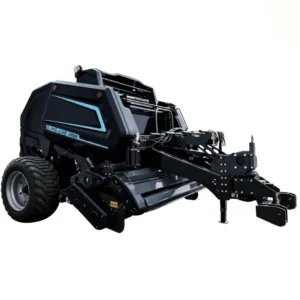
The full 9YG series covers the range from village-level smallholder cooperative units to district-scale shared machinery operations. All models use sensor-controlled bale density management, automatic net wrapping, and are manufactured under ISO 9001 quality management certification.

FAQ
Frequently Asked Questions: Round Balers for Developing Market Cooperative Farming
Biên tập viên: PXY