Tropical & High-Moisture Agricultural Technology
Round Balers in Tropical Climates:
Adapting to High-Moisture Crop Conditions
A comprehensive knowledge guide on how round baler technology performs in high-humidity, high-moisture agricultural environments — covering machine engineering, material selection, operational strategies, and regional compliance for farms across tropical Asia and beyond.
1. Why Tropical Climates Demand a Different Approach to Round Baling
The round baler machine was developed and refined primarily in temperate agricultural regions — the grasslands of Western Europe, the hay belts of North America, and the mixed-farming zones of continental Asia. These environments share a common characteristic: relatively predictable dry-down windows between rain events, allowing harvested crops to reach safe moisture content before baling. Tropical and subtropical climates operate on fundamentally different terms. Annual rainfall of 1,500–3,000 mm, high ambient humidity throughout the year, and growing seasons that overlap with major rain periods mean that the concept of waiting for a crop to fully field-dry before baling is often unrealistic or impossible.
South Korea sits at the boundary of these climate zones. While Korea’s temperate central regions allow reasonable hay-making windows for Italian ryegrass in late spring, the southern coastal areas — including Jeolla and Gyeongnam provinces — experience a humid subtropical summer with persistent humidity above 80% from June through September. For the second and third grass cuts in these regions, as well as for whole-crop maize and sudangrass harvested at silage stage, baling under high-moisture conditions is not an exception but the routine. Understanding how to adapt round baler selection, operation, and maintenance to these conditions is therefore directly relevant to Korean farmers in the country’s warmer farming districts.
Beyond Korea, the wider market served by this guide includes the expanding livestock and forage industries of Vietnam, Thailand, Indonesia, Malaysia, and the Philippines — all tropical or near-tropical environments where demand for baled silage and high-moisture forage is growing alongside dairy and beef herd expansion. In these countries, baling at 50–70% moisture content is the norm rather than the exception, and every aspect of machine design — from the feed mechanism to the corrosion protection system — needs to function reliably under these conditions for months at a time without the temperate farmer’s relief of a dry-crop period that allows the machine to rest and dry out.
2. What High Moisture Content Actually Does to a Round Baler Machine
High-moisture crop material — whether grass silage at 65% moisture, whole-crop maize at 68% moisture, or Napier grass at 75% moisture — imposes a fundamentally heavier load on every component of the baling system than dry hay does. A fresh-cut silage grass bale of φ1,300 mm diameter and 1,400 mm width at 65% moisture content can weigh 600–800 kg, compared to 200–300 kg for the same bale dimensions with dry hay at 15% moisture. Every mechanical system that forms, moves, binds, and ejects this bale is experiencing proportionally higher forces — and the materials and design margins built into the machine determine whether it handles these forces reliably or begins to fail progressively.
The compression roller assembly faces increased resistance during the baling cycle because wet material is less compressible than dry material — water is incompressible, and crop cells still containing water resist deformation more than dry, collapsed cells. This increases the torque required from the drive chain and gearbox throughout the compression cycle. In machines where the chain is undersized for high-moisture applications, progressive chain elongation begins within a single season of intensive silage baling, changing the chain-to-sprocket geometry and eventually causing sprocket tooth skipping under load. The 20A heavy-duty chain used in the 9YG series rear chamber circuit has a significantly higher tensile rating than the 16A standard chain found in lighter-duty machines, providing the additional safety margin that sustained high-moisture baling requires.
The hydraulic system in a round baler machine also works harder in high-moisture applications. The tailgate cylinder that opens and closes under a 600–800 kg bale rather than a 250 kg bale is subjected to higher peak forces at each cycle. H-type compression fittings on all hydraulic connections — rather than push-lock or friction-fit alternatives — resist the higher working pressures and vibration-induced loosening that occur when the machine is handling heavy wet bales on soft, uneven tropical field surfaces. The buffer cylinder in the tailgate closing circuit, which cushions the closing movement, protects the latch mechanism from the shock load of a heavy wet bale rolling against the closing tailgate — a load event that is far more damaging in tropical silage conditions than in temperate hay operations.
Net wrap cutting reliability also changes with moisture. Wet crop juice coats the net dispenser mechanism and can cause successive sheets of net to stick together, creating double-feed events where two layers are dispensed into the bale instead of one. The cutting knife must also sever through net that may be wet and slightly softened. Dispenser components made from stainless steel or receiving low-friction surface treatment resist juice adhesion better than bare carbon steel components, and knife blades should be checked more frequently for edge condition in high-moisture tropical operations.
3. Manufacturing Structure: Engineering for Sustained Tropical Performance
The manufacturing structure of a round baler intended for sustained tropical operation must treat moisture tolerance as a first-order design objective rather than an afterthought. This means considering corrosion at every surface, hydraulic integrity at elevated working pressures, drive chain sizing for wet-material load, and structural fatigue resistance for the higher cycle loads that heavy bales impose — all simultaneously and consistently across the machine’s lifetime.
Frame construction in the 9YG series uses S355 structural steel (355 MPa minimum yield strength) throughout the main chassis, cut by CNC laser for tight dimensional tolerances and assembled with robot-welded joints that achieve consistent penetration depth and weld quality at every joint across the production run. This matters in tropical applications because uneven or shallow weld penetration creates notch points at weld toes where corrosion-assisted fatigue cracks initiate under the elevated cyclic loads of high-moisture baling. The visible weld bead on a well-produced machine is not merely cosmetic — it is the physical evidence of the metallurgical bond that determines long-term frame integrity.
The compression roller arrangement — 18 rollers of φ222 mm diameter in the standard 9YG chamber design — uses rollers with case-hardened or hard-chrome surfaces. In tropical silage applications, the abrasive load on rollers is moderate (tropical grasses are less siliceous than rice straw), but the corrosive load from plant acids is high. Roller surfaces that have been appropriately treated maintain their geometric accuracy across multiple seasons, preserving the consistent bale shape and density that net-wrap sizing and wrapper geometry are based on. Rollers that corrode and pit lose dimensional accuracy within one or two seasons of tropical operation, and the resulting bales become irregular in shape — a problem that compounds at the wrapping stage when irregular bales do not rotate evenly on the wrapper turntable.
The variable-chamber compression principle is especially well-suited to tropical high-moisture applications. Because the chamber grows progressively from near-zero volume, compressive force is applied to wet material from the very first material entering the chamber — preventing the loose-core problem that fixed-chamber machines produce when their pre-set chamber volume is partially filled with wet, mobile material. In practice, variable-chamber machines consistently produce bales with higher and more uniform density when working at tropical silage moisture contents than fixed-chamber alternatives of nominally similar specification.
Key Manufacturing Elements for Tropical Round Baler Performance
| Component | Tropical / High-Moisture Requirement | 9YG Series Design |
|---|---|---|
| Main frame | Corrosion-assisted fatigue resistance at high cycle loads | S355 structural steel, laser-cut, robot-welded |
| Compression rollers | Corrosion and acid-juice resistance, geometric stability | 18 rollers φ222 mm, case-hardened / hard-chrome surface |
| Drive chain | Higher sustained torque capacity for wet bale formation | 20A heavy-duty roller chain, dual-side rear circuit |
| Hydraulic system | Higher pressure tolerance, vibration-resistant fittings | H-type compression fittings throughout, buffer cylinder |
| Feed mechanism | Anti-wrap for high-moisture leafy tropical grasses | Axial-flow semi-forced, camless design |
| Net-wrap dispenser | Non-stick surfaces, reliable cutting through wet net | Hardened knife assembly, stainless or low-friction housing |
| Density sensor system | Reliable signal through high-moisture crop interference | Electronic sensor, ECU-linked, cab alert |
| Gearbox housing | Sealed against acid vapor and moisture ingress | Cast iron / fabricated steel, sealed oil-bath lubrication |
4. Material System: Corrosion Protection and Long-Term Durability in Humid Conditions
Sustained operation in tropical humidity — where ambient relative humidity rarely drops below 70% and frequently exceeds 90% during and after rainfall — accelerates corrosion on every exposed steel surface at rates that are two to four times higher than in temperate continental climates. A round baler machine that gives ten years of reliable service in northern Korea can show significant frame corrosion and component deterioration within four to five years of tropical use if its corrosion protection system was not designed with this environment in mind. The material selection and surface treatment choices made during manufacturing therefore have a proportionally larger impact on total lifecycle cost in tropical markets than in temperate ones.
The primary corrosion challenge in tropical round baler applications is the combination of plant organic acids from high-moisture silage crops and the continuously humid environment that prevents surfaces from ever fully drying out between operations. Lactic acid, acetic acid, propionic acid, and various enzymatic breakdown products from cut crop material penetrate any gap in the protective coating system and establish active corrosion cells. These then propagate under the surrounding intact coating by a mechanism called underfilm corrosion — where the steel substrate corrodes laterally beneath the paint, causing blistering and flaking that exposes progressively larger bare metal areas to further attack.
Effective protection against this mechanism requires a two-stage coating system: an epoxy primer applied over a properly prepared (shot-blasted or chemically pre-treated) steel surface, followed by a polyurethane or powder-coat topcoat. The epoxy primer provides genuine chemical adhesion to the steel substrate and resistance to underfilm migration. The polyurethane topcoat provides mechanical hardness and UV resistance that the softer epoxy primer alone cannot deliver. Single-coat alkyd paint systems — still found on some entry-level agricultural machines — provide initial corrosion protection but deteriorate rapidly in tropical acid-organic environments and should be considered inadequate for tropical round baler applications.
Chain materials in tropical silage applications require enhanced lubrication retention because the combination of high humidity, crop juice contamination, and elevated temperatures depletes chain lubricant faster than in dry temperate work. Sealed roller chain with factory-applied lithium complex grease, or regular manual lubrication with a high-viscosity extreme-pressure chain oil during each shift, is necessary to prevent the corrosive wear that turns standard 200-hour chain service intervals into 60–80-hour intervals in continuous tropical silage operation. The heavy-gauge 20A chain in the 9YG compression circuit provides a dimensional reserve that tolerates faster wear rates and still delivers adequate service life — a meaningful operational advantage over lighter-gauge alternatives that reach their wear limit much sooner under the same conditions.
5. Tropical Forage Crops and Their Baling Characteristics
The forage crops grown for baling in tropical and near-tropical agricultural systems differ substantially from the grass swards and cereal crops that dominate temperate baling applications. Understanding the specific physical and chemical properties of these crops helps operators set up and operate their round baler machine correctly, and helps equipment buyers select the configurations — particularly feed mechanism design and pickup header type — that will perform best for their specific crop mix.
The highest-yield tropical forage crop, producing 40–80 tonnes of fresh weight per hectare per year under intensive management. At first cut, fresh moisture content can exceed 75%. Stems at first cut are thick and tough — a feed mechanism with robust cutting or pre-processing capability handles this better than a simple pickup-and-feed design. Best baled in 40–50 day regrowth cycles when stems are still relatively fine.
A Napier hybrid with slightly finer stems and higher nutritive value per unit of dry matter. Responds well to baling at 45–60 day cutting intervals when moisture is in the 65–72% range. Produces dense bales that ferment reliably when wrapped immediately after ejection from the baler.
Stoloniferous grass common across Southeast Asian and South Korean coastal lowland wet areas. Fine-stemmed but very high-moisture at harvest. Tends to mat in windrows after cutting, creating irregular feed patterns. A pickup header with good ground-following and wide tine spacing handles Para grass windrows better than close-tine designs.
Harvested in tropical and near-tropical systems at milk-to-dough stage, typically 60–68% moisture content. Maize produces dense, heavy bales with high fermentable starch content — excellent silage quality but demanding on compression roller load capacity and drive chain. The whole plant including cob and leaf provides high energy density silage suitable for intensive dairy and beef operations.
In southern Korean humid subtropical conditions, the summer ryegrass cut is harvested at 60–70% moisture content with only minimal field wilting possible before rain risk. These conditions require a baler capable of producing dense, well-wrapped bales immediately, without depending on the field-drying window that northern Korean producers can rely on in spring.
6. Round Baler Models for High-Moisture Tropical Crop Applications
Each model in the range below applies variable-chamber compression, sensor-controlled bale density management, and automatic net wrap — the combination of features that delivers consistent silage-quality bales from high-moisture tropical forage crops. Parameters are drawn from verified product specifications.
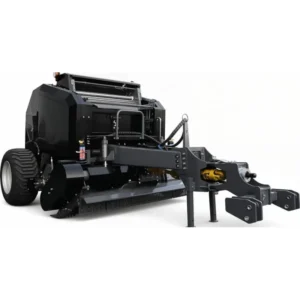
9YG-1.25 Round Baler (Double)
Interchangeable pickup options · ≥88.2 kW · 4,558 kg · 1,200×1,250 mm · Auger + feed roller + drum
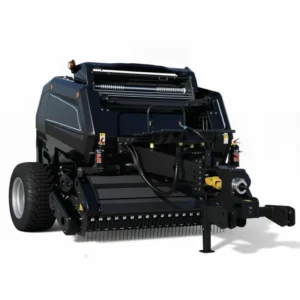
Máy ép kiện tròn 9YG-1.25A
540–1,000 r/min PTO range · Density 100–200 kg/m³ · Net 2,000×1.25 m · 4,472 kg · ≥75 kW
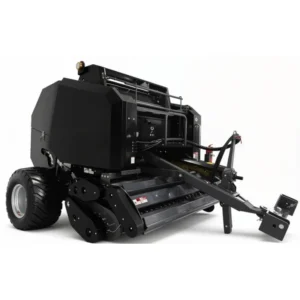
Máy ép kiện tròn 9YG-2.24D
Axial-flow semi-forced camless feed · 3,922 kg · 55–100 kW · φ1,300×1,400 mm · 40–100 bales/h
7. Round Baler Gearbox: Managing Torque and Temperature in Tropical Silage Conditions
The gearbox in a tropical round baler application operates under conditions that are significantly more demanding than in a temperate dry-hay machine. Sustained high-torque compression of wet, heavy silage crops keeps the gearbox at elevated operating temperatures throughout the working day. Ambient temperatures of 28–38°C in tropical environments — versus 15–22°C in Korean spring haymaking conditions — reduce the effective viscosity of gearbox oil and increase thermal stress on bearing surfaces and gear tooth contacts. A gearbox designed with adequate oil capacity and sealed housing to resist moisture and acid vapor ingress will perform reliably in these conditions; a gearbox that merely meets minimum design criteria for temperate dry-hay work will not.
The dual-joint gearbox design in the 9YG-2.24D Transcend model delivers an additional benefit in tropical field conditions beyond its articulation advantage: its independent front-and-rear torque path allows it to absorb and redistribute the sudden load spikes that occur when large wads of high-moisture tropical grass enter the compression chamber simultaneously. In tropical Napier grass baling, for example, a single pickup sweep can gather a windrow section weighing 15–20 kg of fresh material — a sudden mass feeding event that generates a significant torque spike at the drive train. The dual-joint design’s inherent mechanical compliance absorbs a portion of this spike rather than transmitting it fully to the gearbox housing and frame welds.
Oil specification for tropical round baler gearboxes requires careful attention. ISO VG 150 gear oil — the standard specification for temperate agricultural gearboxes — maintains its film strength adequately at tropical ambient temperatures of up to approximately 35°C. At sustained ambient temperatures above 35°C, as experienced in Southeast Asian tropical farming environments, operators should consult the machine manufacturer about whether ISO VG 220 or a synthetic GL-5 formulation is more appropriate — the higher viscosity retains better film thickness at elevated temperatures while still remaining fluid enough to circulate through the cold-start condition common on early tropical mornings after cool nights. Oil change intervals in tropical silage conditions should be shortened to 150–200 hours from the standard 250-hour temperate interval, reflecting the faster degradation rate under higher thermal and acid-contamination loads.
The PTO driveshaft protection system is also relevant in tropical environments where field moisture and mud exposure are continuous rather than seasonal. PTO shaft guards — both the tube guard covering the shaft and the bell guard at each universal joint — should be inspected at each day’s operation for damage, because mud and crop residue accumulation around an unguarded or damaged shaft is a significant entanglement safety risk in any agricultural environment, and the higher probability of soft, wet field conditions in tropical environments means tractor-baler combinations spend more time in slow, heavy-load conditions where shaft entanglement risk is elevated.
8. Wrapping High-Moisture Bales in Tropical Conditions: What Changes
In tropical silage systems, the time between bale ejection and wrapping is a critical quality window. Tropical ambient temperatures of 28–38°C mean that aerobic microorganism activity on the surface of an unwrapped bale proceeds far faster than in temperate conditions — potentially 3–5 times faster than the same bale face at 15°C. Each additional minute between bale ejection and film sealing represents proportionally more aerobic loss, more protein degradation, and more heating that will carry through into the stored bale’s fermentation pathway.
The practical implication for round baler operation in tropical environments is that bale wrapping should be completed within 30 minutes of ejection — ideally within 10–15 minutes on very hot days. This either requires a combination baler-wrapper machine that wraps bales immediately on ejection, or a rapid-cycle satellite wrapper deployed immediately behind the baler on the same field pass. Leaving unwrapped bales in the field overnight in tropical conditions is a significant silage quality compromise that experienced tropical forage producers avoid.
Stretch film behavior in tropical heat also requires attention. LDPE stretch film stored in direct sun at 35–40°C softens, reduces tack, and becomes more prone to tearing on application. Film rolls should be stored in shade until needed, and the wrapper tensioner settings may need to be relaxed compared to temperate settings to prevent film breakage during application. Film roll core temperatures above 40°C measured by touch should be taken as a sign to move rolls to shade before use. Using UV-stabilized film with at least 2.5% carbon black content is also recommended for tropical storage environments where bales may be stored partially in direct sunlight.
Comparison: Baling High-Moisture vs. Dry Crop in Tropical vs. Temperate Conditions
| Parameter | Tropical High-Moisture | Tropical Dry Season | Temperate Spring Silage |
|---|---|---|---|
| Typical bale weight (1.3 m diam.) | 600–800 kg | 200–300 kg | 400–600 kg |
| Drive chain load level | Very high — continuous | Low-moderate | High — sustained |
| Gearbox oil degradation rate | Fast — 150–200 hr interval | Normal — 250 hr interval | Normal — 250 hr interval |
| Wrapping urgency after ejection | Critical — within 15–30 min | Not applicable (dry hay) | High — within 30–60 min |
| Net-wrap knife inspection interval | Every 2–3 days in season | Weekly | Weekly |
| Chain lubrication frequency | Every 2–4 hours | Daily | Daily |
| Corrosion risk level | Very high — continuous acid/moisture | Moderate — UV and heat | Moderate — seasonal |
9. Regulatory Framework: Gearbox and Agricultural Machinery Standards in Tropical Markets
Agricultural machinery operating across the diverse regulatory environments of tropical Asia must comply with national and regional safety standards that, while sharing common principles with temperate-market regulations, have their own documentation requirements, certification pathways, and local enforcement characteristics.
Hàn Quốc
In South Korea, all commercially sold agricultural machinery including round baler machines must comply with the Act on the Promotion of Agricultural Mechanization (농업기계화 촉진법). Performance evaluation through the National Institute of Agricultural Sciences (농촌진흥청 — Rural Development Administration) is required for eligibility under the government purchase subsidy program administered by the Ministry of Agriculture, Food and Rural Affairs (농림축산식품부 — MAFRA). For high-moisture silage baling in the humid southern provinces — including Gyeongnam and Jeollanam where subtropical conditions prevail — the same machinery compliance requirements apply as in temperate regions, with the additional practical consideration that PTO shaft guarding under the Industrial Safety and Health Act (산업안전보건법) is especially important in wet, slippery field conditions where operator footing is less secure.
Vietnam
Vietnam’s Ministry of Agriculture and Rural Development (Bo Nong Nghiep va Phat trien Nong thon) oversees agricultural mechanization policy. Imported agricultural machinery must meet Vietnamese National Standards (TCVN) where applicable, and conform to the general technical requirements of TCVN 7304:2003 and related standards for agricultural machine safety. Vietnam’s agricultural subsidy programs — particularly in the Mekong Delta and Central Highlands where forage and livestock industries are expanding — increasingly include forage harvesting and baling equipment under eligible machinery categories, creating a formal channel for round baler machine procurement.
Thailand
The Thai Industrial Standards Institute (TISI) under the Ministry of Industry administers standards for agricultural machinery safety. Round balers and baling-related implements fall under general machinery safety standards with PTO guarding requirements comparable to international norms. Thailand’s Department of Agricultural Extension actively promotes mechanized forage production as part of dairy and beef herd expansion programs in the northern highlands, creating growing demand for capable round baler machines in that region.
Indonesia
Agricultural machinery in Indonesia must comply with relevant Indonesian National Standards (SNI) administered by the National Standardization Agency (BSN). Import of agricultural equipment requires compliance with Ministry of Agriculture regulations on agricultural tool and machinery introduction, with specific technical requirements varying by equipment category. Gearbox oil and lubricant standards in Indonesia reference international equivalents under SNI harmonization with ISO standards — ISO VG 150 GL-4 gear oil is the appropriate specification for round baler gearboxes in Indonesian conditions.
European Union
Round balers exported from tropical-market suppliers to EU member states require CE marking under Machinery Directive 2006/42/EC, with compliance to EN ISO 4254-7 (harvesting machinery safety) and EN 12965 (PTO drive shaft safety). In tropical-origin markets where baling equipment is used for biomass energy feedstock with cross-border EU trade implications, additional documentation for agricultural machinery provenance and safety conformity may be required under EU customs and sanitary/phytosanitary import regulations.
Australia
Agricultural machinery in Australia, including round balers used in the tropical northern states and territories where grass silage production is expanding, must comply with the harmonized Work Health and Safety (WHS) Act framework and relevant machinery safety standards AS 1152 and AS 4024.1. In Queensland and Northern Territory tropical farming environments, the combination of high ambient temperature, wet-season humidity, and soft field conditions during the wet season increases operator risk from PTO entanglement and machine stability hazards — areas where guarding compliance and operator training are both relevant safety measures.
10. Operational Strategies for Round Baling in Wet Tropical Field Conditions
Beyond equipment selection, the operational approach to round baling in wet tropical conditions makes a significant difference to both bale quality and machine longevity. Experienced tropical forage producers have developed a set of field practices that address the specific challenges of working with high-moisture crops in hot, humid environments — practices that reduce machine wear, improve silage fermentation outcomes, and keep the operation running through the long baling seasons typical of tropical and subtropical forage production systems.
The first principle is scheduling. In tropical environments with a distinct wet season, baling campaigns should be planned around the drier sub-periods within the growing season rather than during the peak wet months when field conditions are softest and crops are wettest. In southern Korea’s humid subtropical areas, the July-August monsoon period represents the highest-risk window for baling — field surfaces are soft, crop moisture is maximum, and rain between cutting and baling is almost guaranteed. Operators who shift their second grass cut to early June (before full monsoon onset) or late September (as humidity begins to moderate) consistently achieve better bale density, better fermentation outcomes, and lower machine wear than those who bale in the peak monsoon window.
The second principle is managing forward speed. In heavy, wet windrows of tropical silage crops, the temptation to maximize forward speed to complete the field faster often backfires — the feed mechanism receives irregular surge loads as the pickup sweeps thick windrow sections, creating blockage events that cost more time to clear than would have been saved by faster travel. Consistent moderate forward speed that maintains a steady windrow intake rate without overloading the feeder produces better bales, fewer stoppages, and less drive-chain stress than variable-speed driving in thick windrows.
The third principle is daily machine clean-down. In tropical environments, the organic residue from high-moisture silage crops decomposes rapidly on machine surfaces at ambient temperatures — faster than in temperate conditions. Leaving compressed crop residue on chain guides, bearing housing flanges, and inside the compression chamber overnight in tropical heat creates an environment that traps moisture, accelerates corrosion, and can breed bacteria that contaminate the next day’s baling crop. A thorough water wash of the baling chamber and feeder area at the end of each working day, followed by chain lubrication, takes less than 20 minutes and meaningfully extends machine service life compared with machines that are simply parked at day’s end without cleaning.
Frequently Asked Questions
Biên tập viên: PXY