Reed and Wetland Grass Baling — Equipment Guide
A practical guide for Korean wetland operators, Phragmites biomass contractors, and reed hay producers selecting the right tractor-and-round-baler combination for soft, waterlogged, or partially frozen wetland margins.
Selecting the right round baler for reed harvesting is only half the equipment decision. The tractor powering it — and specifically its weight distribution, wheel configuration, and power-to-weight ratio on soft ground — determines whether the system can actually enter and operate in the waterlogged organic soils found beneath mature Phragmites australis stands in Korean floodplain and reservoir margin environments. A round baler mounted behind a tractor that sinks past its axles on a soft wetland margin is not a productive system regardless of how well the baler itself is specified.
This guide covers tractor power requirements for common reed windrow densities when pairing a round baler with the right tractor, the ground pressure calculations that determine whether a given tractor can access Korean wetland sites, the wheel clearance requirements specific to reed baling pickup operations, and the material and structural considerations for the traction device connecting tractor to round baler on soft ground. It also addresses the legal and technical standards in Korea and other major agricultural markets that govern tractor-baler combinations operating in wetland environments.
1. Why Soft Wetland Ground Changes the Tractor-Round Baler Equipment Calculation
On firm agricultural soil, the primary tractor selection criteria for round baler operation are PTO power output, drawbar pull capacity, and hydraulic flow for the baler’s control system. On soft wetland ground — where the peat, clay, or organic soil beneath a reed stand has a bearing capacity of only twenty to forty kilopascals — two additional factors push to the top of the decision list: ground contact pressure and self-recovery capability. A tractor whose static ground contact pressure exceeds the soil’s bearing capacity will begin to sink from the moment it leaves the firm access track, regardless of its PTO output or drawbar rating.
Korean wetland sites add further complexity because their surface conditions change predictably through the day during the January-February reed harvesting window. At dawn, with overnight frost temperatures between minus four and minus ten degrees Celsius across Gyeonggi, Chungnam, and Gangwon wetland zones, the soil surface is typically frozen to a depth of five to fifteen centimetres and can support substantially higher loads than its unfrozen rating. By mid-afternoon, when solar radiation and ambient warming have softened the surface, the same soil reverts toward its unfrozen bearing capacity. A tractor combination that operated safely in the morning may become hazardous by early afternoon on the same site without any change in the equipment or the operator’s approach.
Understanding and anticipating this daily ground condition cycle is as important as selecting the correct tractor specification. The equipment recommendations in this guide are calibrated for the partially thawed or unfrozen condition — the limiting case — because designing for worst-case conditions is the only safe approach when machine recovery from a soft-ground sink event in a remote Korean wetland margin can take hours and may require specialist recovery equipment.
2. Tractor Power Requirements for Round Baler Reed Harvesting
Power demand in reed baling is dominated by two loads: the round baler’s pickup and feed system processing the dense, tangled reed windrow, and the rolling resistance of the combined tractor-baler on soft ground. On firm soil, rolling resistance is a minor component of total power demand and is usually ignored in tractor selection. On soft wetland ground with tyre penetration depths of fifty to one hundred millimetres, rolling resistance increases three to five times compared to firm soil conditions and becomes a significant fraction of total power demand — often matching or exceeding the baler’s PTO requirement during continuous soft-ground operation.
| Reed Windrow Density | Ground Condition | Baler PTO Demand | Soft-Ground Rolling Resistance Add | Minimum Tractor Power |
|---|---|---|---|---|
| Light (1.5 to 3.0 kg DM/m) | Frozen firm surface | 25 to 35 kW | +5 kW (negligible penetration) | 40 kW (55 hp) |
| Medium (3.0 to 6.0 kg DM/m) | Frozen firm surface | 35 to 50 kW | +8 kW | 55 kW (75 hp) |
| Medium (3.0 to 6.0 kg DM/m) | Partially thawed (soft) | 35 to 50 kW | +18 to 25 kW (50–80 mm rut depth) | 70 to 80 kW (95 to 110 hp) |
| Heavy (6.0 to 10.0 kg DM/m) | Partially thawed (soft) | 50 to 70 kW | +25 to 35 kW (80–120 mm rut depth) | 90 to 100 kW (120 to 135 hp) |
| Heavy (6.0 to 10.0 kg DM/m) | Unfrozen wetland organic soil | 50 to 70 kW | +35 to 45 kW (120+ mm penetration) | Not recommended without tracked or flotation configuration |
The 9YG-2.24D Round Baler S9000, with a matched power range of 55 to 100 kW for the round baler PTO (approximately 75 to 135 hp), covers medium to heavy frozen-surface reed conditions when paired with an appropriately configured tractor. For soft-ground conditions, the round baler’s lightweight relative to comparable-capacity machines reduces the tractor’s rolling resistance contribution from the baler itself, but the tractor weight remains the dominant ground pressure variable.
3. Ground Pressure Calculation — Matching Tractor Weight to Korean Wetland Soil Bearing Capacity
Ground contact pressure for a tractor on soft soil is calculated as the total machine weight divided by the total tyre contact area. The contact area is not the full tyre footprint but the actual ground contact patch, which depends on tyre inflation pressure, tyre section width, and tyre deflection under load. For agricultural tyres at typical field inflation pressures of 0.8 to 1.2 bar, the contact patch area approximates the tyre load divided by the inflation pressure — meaning lower inflation pressure produces a larger contact patch and lower ground contact pressure for the same vehicle weight.
For a typical 75 kW tractor weighing 4,800 kg with front-rear weight distribution of 35/65 percent and standard 18.4R38 rear tyres at 1.0 bar inflation, the rear axle ground contact pressure is approximately 85 to 95 kilopascals. This exceeds the twenty to forty kilopascal bearing capacity of unfrozen Korean wetland organic soil by a factor of two to four — meaning the tractor will sink progressively on unfrozen wetland margins regardless of driver technique. Reducing rear tyre inflation to 0.6 to 0.7 bar increases the contact patch area and reduces rear axle ground pressure to approximately 55 to 65 kilopascals, which is still above unfrozen wetland bearing capacity but approaches the partially frozen range of sixty to eighty kilopascals where marginal operation becomes possible.
The addition of a round baler significantly increases the rear axle load through the traction device coupling, further elevating rear axle ground pressure beyond the tractor-only figure. A round baler such as the 9YG-2.24D S9000 (4,262 kg total weight) — a relatively compact round baler for its capacity distributes approximately thirty to forty percent of its static weight onto the tractor rear hitch through the traction device — adding 1,200 to 1,700 kg to the rear axle load. This addition can increase rear axle ground pressure by fifteen to twenty percent above the tractor-only figure, which is significant when the margin between safe operation and unacceptable sinkage is already narrow.
Practical mitigation strategies for Korean wetland reed operations include dual rear wheels (adding forty to sixty percent additional tyre contact area), wide-flotation single rear tyres (520/85R42 or similar), and scheduling baling to frozen morning periods when soil bearing capacity is highest. Front axle ballasting to improve weight distribution balance also reduces the disproportionate rear axle loading caused by the traction-type round baler’s hitch geometry.
4. Wheel Clearance Requirements for Round Baler Reed Pickup Operations
Wheel clearance for round baler reed baling refers to the space between the tractor’s rear wheels and the sides of the round baler’s pickup header. In standard hay baling on open fields, this clearance is rarely a concern because the pickup width is typically narrower than the tractor’s rear wheel track, and the tractor wheels pass outside the windrow regardless of slight steering variations. In reed work, the clearance issue is more complex for two reasons specific to wetland harvesting geometry.
First, the tractor’s rear wheels in soft ground baling are typically run at wider-than-standard track width to improve lateral stability and reduce the tendency of the outside rear wheel to dig in when traversing soft patches asymmetrically. A rear wheel track wider than the pickup outer dimensions means the tractor’s outer rear wheels are tracking beside the reed windrow rather than between windrows — which is acceptable in flat open reed beds but creates a conflict in narrower Korean riverbank reed sites where the windrow occupies most of the available working width between the bank edge and standing vegetation.
Second, the tractor’s rear wheels create ruts during the first pass through a soft reed area, and these ruts persist for subsequent passes in the same area. When the round baler returns for a second baling pass adjacent to the first strip, the tractor’s inner rear wheel may track in the rut left by the first pass. If the rut depth exceeds 150 mm, the wheel’s effective track has shifted inward, reducing the clearance between the inner rear wheel and the pickup side guard. Below seventy-five to one hundred millimetres of clearance, reed stems that fall between the wheel and the pickup guard become entangled in the wheel-to-guard gap — causing progressive blockages that require the operator to stop and clear by hand.
For this round baler model with a pickup width of 2240 mm, the minimum recommended rear wheel track setting for adjacent-strip reed baling on soft Korean wetland ground is 1600 mm measured between tyre inner faces, leaving a minimum clearance of 320 mm between each tyre inner face and the pickup side guard. This clearance accommodates first-pass rut depth of up to 120 mm on the return pass without reaching the blockage-risk clearance threshold. Operators using dual-wheel configurations should verify clearance against the combined dual-tyre inner face measurement, which reduces available clearance significantly.
5. Mechanical Structure of the Round Baler Traction Device for Soft Ground Operation
5.1 Adjustable Traction Hitch — Lateral Steer and Tilt Functions
The traction device on the round baler connects it to the tractor’s hitch is the component most directly stressed by soft-ground operation. On firm flat ground, the traction device primarily transmits horizontal drawbar pull forces. On soft wetland ground, the loading becomes three-dimensional: vertical forces from the baler’s weight shifting as one baler wheel sinks deeper than the other, lateral forces from the tractor correcting its path around soft patches, and torsional forces from the baler pivoting relative to the tractor when the pickup drops into a waterlogged depression on one side.
The 9YG-2.24D S9000 series traction device is rated at 1000 Nm and provides 100-degree lateral steering and 30-degree lateral tilt adjustment. The 30-degree tilt limit is the specification most directly relevant to soft-ground wetland operation, because it defines how much lateral height differential can develop between the baler’s left and right wheels before the traction device reaches its limit and begins transmitting tilt moments to the tractor hitch and PTO driveline. A 30-degree tilt allows one side of the baler to sink approximately 900 mm relative to the other at standard baler wheel track width — an extreme but realistic scenario when one wheel encounters an unfrozen saturated depression that the other wheel does not.
5.2 Round Baler Running Wheels and Flotation Options
Round baler running wheels are frequently overlooked in soft-ground equipment discussions, because the tractor’s ground pressure dominates the overall system soft-ground performance. However, the baler’s running wheels contribute the remaining twenty to thirty percent of total system load onto the ground surface, and their tyre specification determines whether this contribution adds to or partially offsets the tractor’s ground pressure impact. The 9YG-2.24D S9000’s standard running wheel configuration includes tyres sized to distribute the baler’s 4,262 kg tare weight over an adequate contact patch for moderate soft-ground conditions. For sustained operation on unfrozen Korean wetland organic soils, fitting the baler with wider-section or lower-pressure running tyres extends the operational window by reducing the baler’s direct ground pressure contribution and reducing the depth of the baler’s wheel ruts — which in turn reduces the inter-pass clearance problem described in Section 4.
6. Material System — Traction Device and Running Gear Components for Wetland Service
The structural components connecting the round baler to the tractor, and the running gear that contacts the wetland ground surface, face corrosion, impact, and sustained loading conditions unique to reed harvesting environments. The table below covers the materials used in these components and their specific roles in wetland service life.
| Component | Material | Wetland Service Role |
|---|---|---|
| Traction Device Main Arm | Q345B high-tensile steel, hot-dip galvanized | Hot-dip galvanizing provides corrosion resistance in the salt-mineral wetland moisture contact environment; high-tensile grade maintains the bending strength needed for the 1000 Nm rated torque under combined three-dimensional soft-ground loading events |
| Traction Device Pivot Pins | 42CrMo4 alloy steel, through-hardened, HRC 32–38 | High-cycle tilt and steer articulation in Korean wetland terrain imposes fatigue loading on pivot pins not present in flat-field baling; 42CrMo4 through-hardening provides the fatigue limit required for multi-season soft-ground service without pin deformation that would change the tilt geometry |
| Traction Device Bearing Blocks | Spherical self-aligning bearings, double-sealed, stainless races where exposed | Spherical self-aligning design accommodates misalignment from irregular soft-ground tilt events; double seals and stainless races prevent the wetland mud and organic acid ingress that causes carbon steel race pitting in a single season of Korean reed wetland service |
| Running Wheel Hub Bearings | Tapered roller bearings, IP65-rated sealed units | IP65 sealing prevents the water and organic particle ingress from wetland mud splashing during low-clearance operation through reed stands; tapered roller bearing geometry handles the combined radial and axial loading from lateral rut wall contact when a running wheel is partially submerged |
| Main Frame Underside Panels | Structural steel, epoxy-primer plus polyurethane topcoat, stone-guard underbody treatment at low points | Low-clearance wetland operation exposes the baler underside to mud contact and organic acid splashing; stone-guard treatment at critical underside impact zones protects the coating from the reed stem bases and frozen clod impacts common when harvesting flattened winter reed at low pickup clearance |
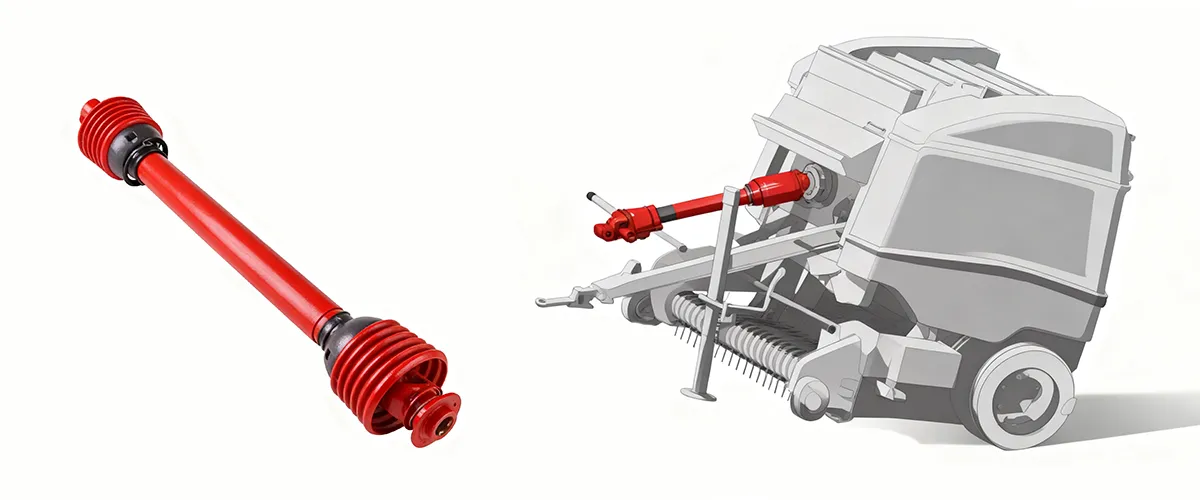
| PTO Driveshaft Coupling | High-tensile alloy steel, double-Cardan joint construction for soft-ground duty | Double-Cardan joint eliminates cyclic velocity variation from PTO shaft operating at the high angles generated by soft-ground lateral tilt events; protects the round baler gearbox input bearing from the axial load cycling that standard Hooke joint shafts transmit at sustained off-axis angles in Korean wetland reed operations |
7. Soft-Ground Operating Protocols for Korean Wetland Reed Baling
Time-of-Day Ground Management
Begin round baler passes immediately after dawn on hard-frost days when soil surface is at maximum bearing capacity. Monitor rut depth continuously as solar warming progresses. When rear-tractor rut depth exceeds one-hundred millimetres consistently, move to a different area of the site where surface remains firmer, or cease soft-ground baling for the day. Operating beyond the safe rut depth threshold on a soft Korean wetland margin dramatically increases the risk of a full sink event, from which recovery may require tracked excavator assistance and cause significant site damage.
Strip Working Pattern
Plan round baler passes to work from the firmest ground toward the softest, so that subsequent passes along already-rutted strips are made on firmer adjacent ground where possible. Avoid returning along the same strip in the same direction on the same day, as the ruts from the first pass remove the surface vegetation mat that provides the initial bearing capacity improvement over bare organic soil. Where the site allows, reverse out of each strip rather than turning at the soft end — turning on soft wetland ground is the highest-risk manoeuvre for a tractor-round-baler combination.
Forward Speed on Soft Ground
Maintain lower forward speed on soft ground than on firm soil even when the round baler pickup’s pickup performance would allow higher speed. Higher speed on soft ground increases the dynamic forces on the traction device and increases the amplitude of the lateral tilt events that occur when one wheel drops into a soft patch. The 9YG-2.24D S9000’s operating speed range of five to thirty-five km/h gives plenty of room to reduce to four to six km/h for soft-ground sections — a speed that minimises dynamic loading on the traction device and hitch coupling while maintaining adequate pickup tine tip speed for reed mat penetration.
Tyre Pressure Management
Reduce rear tractor tyre pressure to the minimum recommended value for field operation — typically 0.6 to 0.8 bar for larger agricultural tyres — before entering any soft Korean wetland site. This reduces ground contact pressure and increases traction in low-bearing-capacity soil, but also reduces tyre sidewall stiffness and increases the risk of tyre bead dislodgement if the tractor is driven rapidly over hard objects at the field access edge. Restore tyres to road pressure before exiting the site and travelling on public roads in Korea, as required under Korean Road Traffic Act load and tyre specifications for agricultural vehicle transport.
8. Regulatory Framework — Tractor-Baler Combinations, Gearboxes, and Wetland Access Standards
Operating a tractor-and-round-baler combination in wetland environments involves compliance with agricultural machinery safety standards, PTO and gearbox technical standards, and wetland access regulations that vary significantly between Korea and other major agricultural markets.
South Korea — Agricultural Mechanization Act and Road Traffic Act
The Agricultural Mechanization Promotion Act (농업기계화 촉진법) administered by MAFRA requires that tractor-baler combinations meet KS R ISO 4254-1 safety standards. The round baler gearbox must comply with KS B ISO 6336 gear load capacity standards. PTO driveshaft guarding is governed by KS B ISO 11684 safety marking requirements. Tyre inflation and road speed limits for agricultural tractors towing round balers on public roads are regulated under the Korean Road Traffic Act (도로교통법) — operators must verify that tractor tyre pressure is restored to road specification before leaving the wetland site. Wetland access permits under the Wetland Conservation Act must be obtained before mechanical equipment enters any designated Korean wetland conservation area.
European Union — Machinery Regulation, PTO Standards, and Nitrates Directive
EU Regulation 2023/1230 covers round baler and traction device safety. EN 12965 governs PTO driveshaft specifications including the double-Cardan joint requirements relevant to soft-ground high-angle operation. Round baler gearboxes must comply with EN ISO 6336 gear rating standards. The EU Nitrates Directive (91/676/EEC) indirectly regulates wetland area access for agricultural machinery by imposing buffer zone requirements around watercourses — relevant to riverbank reed operations where the baling equipment operates within the regulated buffer distance from a water body.
ISO Standards — Gearbox, PTO, and Safety
ISO 8210 covers round baler terminology and test methods including traction device load ratings — the standard against which the 1000 Nm traction device specification of the 9YG-2.24D series is benchmarked. ISO 4254-1 covers agricultural machinery general safety including traction device guarding. ISO 6336 series covers gear surface durability applicable to the round baler gearbox operating in the higher peak-load conditions of reed work on soft ground. ISO 23409 specifies tractor-to-trailed-implement PTO connection dimensions, ensuring compatibility between tractor PTO output flanges and round baler gearbox input couplings across different tractor brands used in Korean reed operations.
United States — ASABE Standards and Wetland Regulations
ASABE Standard S318 covers tractor-baler safety requirements. ASABE EP455 provides engineering guidelines for tractor tyre selection including soft-ground applications. Section 404 of the US Clean Water Act may require Corps of Engineers permits before operating wheeled tractor-baler combinations in jurisdictional wetland areas. ASABE S296.6 specifies PTO shaft dimensions and torque ratings covering the 720 RPM interface between tractor and round baler gearbox. State-level wetland regulations in agricultural states (Iowa, Minnesota, California, Florida) may impose additional restrictions on ground contact pressure or tyre specifications for machinery operating in state-regulated wetland areas.
9. Recommended Round Baler for Soft-Ground Reed Operations
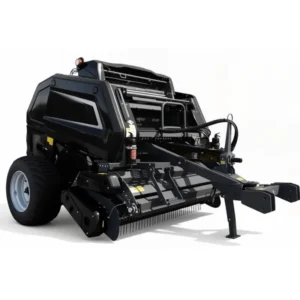
The 9YG-2.24D Round Baler S9000 addresses the three key soft-ground constraints described in this guide — traction device load capacity, PTO driveline angle tolerance, and ground pressure contribution from the baler itself — through specifications that are directly relevant to Korean winter wetland reed harvesting.
9YG-2.24D Round Baler S9000 — Soft-Ground Specification Summary
- Traction Device Rating: 1000 Nm — handles three-dimensional soft-ground loading events
- Lateral Tilt Adjustment: 30 degrees — accommodates differential sinkage across baler width
- Lateral Steering Range: 100 degrees — allows tight turns at firm site edges without dismounting
- Matched PTO Power: 55 to 100 kW at 720 RPM — covers all Korean reed windrow densities on frozen surfaces
- Total Weight: 4,262 kg — relatively compact for capacity; lower baler running wheel ground pressure than heavier alternatives
- Pickup Width: 2240 mm — wide coverage minimises the number of passes over soft ground per unit area
- Bale Density: 100 to 200 kg/m3 sensor-controlled — consistent bale weight regardless of reed windrow variation
- Operating Speed: 5 to 35 km/h — wide range allows reduction to soft-ground safe speed without productivity loss
10. Compatible Accessories — Complete Drivetrain Supply for Reed Baling on Soft Ground
Soft-ground reed baling places specific demands on the PTO shaft and internal drive chain beyond those encountered in firm-field operation. The following accessories are matched to the 9YG-2.24D series and available as part of a complete one-stop supply approach.
Agricultural PTO Shaft — Double-Cardan for Soft-Ground Angles
On soft Korean wetland ground, the tractor-to-baler hitch angle changes continuously as each wheel responds to individual soft patches independently. A standard Hooke joint PTO shaft operating at these variable angles introduces cyclic velocity ripple at the round baler gearbox input that accelerates bevel gear and input bearing wear. A double-Cardan PTO shaft eliminates this velocity ripple across the full operating angle range encountered in soft-ground reed work, providing smooth and constant power delivery to the round baler gearbox input regardless of instantaneous hitch geometry. The EP PTO shaft range for round balers includes double-Cardan configurations with overload clutch ratings matched to the 9YG-2.24D series gearbox input torque specification.
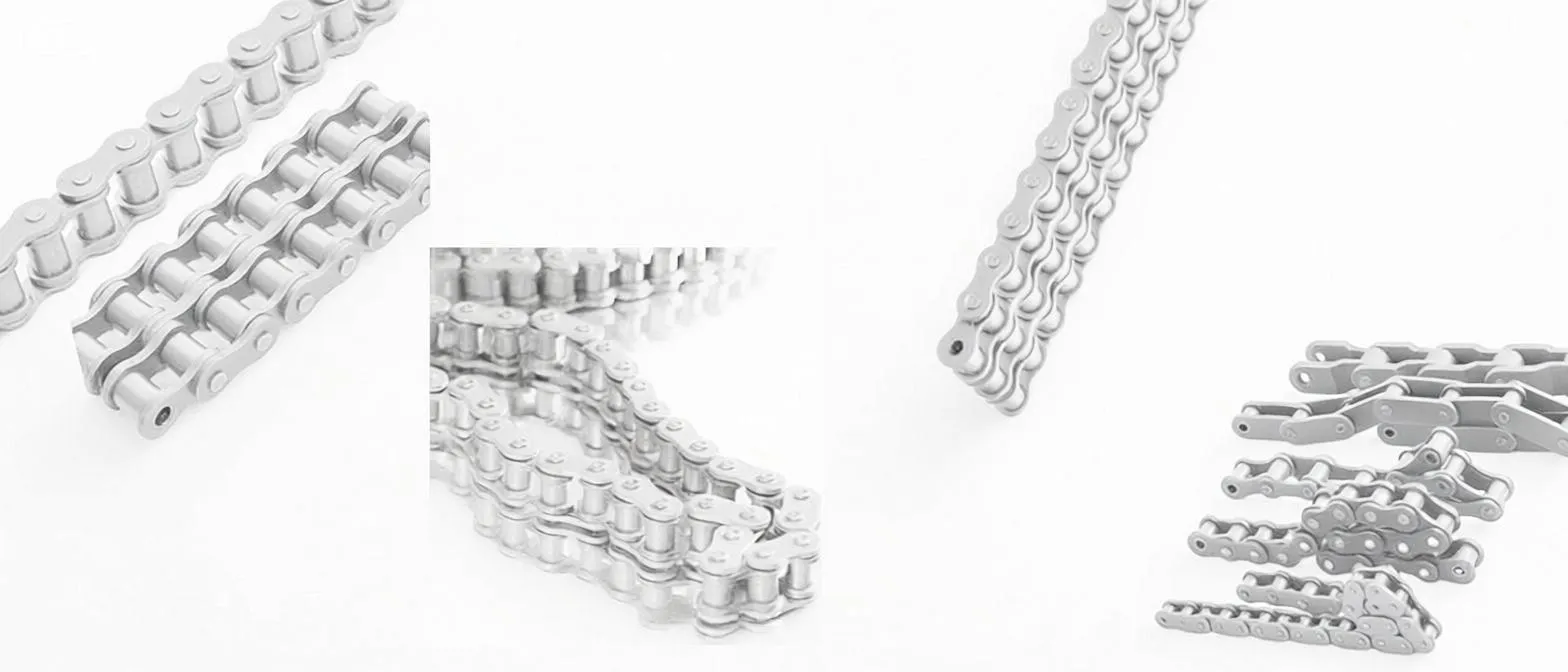
Heavy-Duty Agricultural Drive Chain
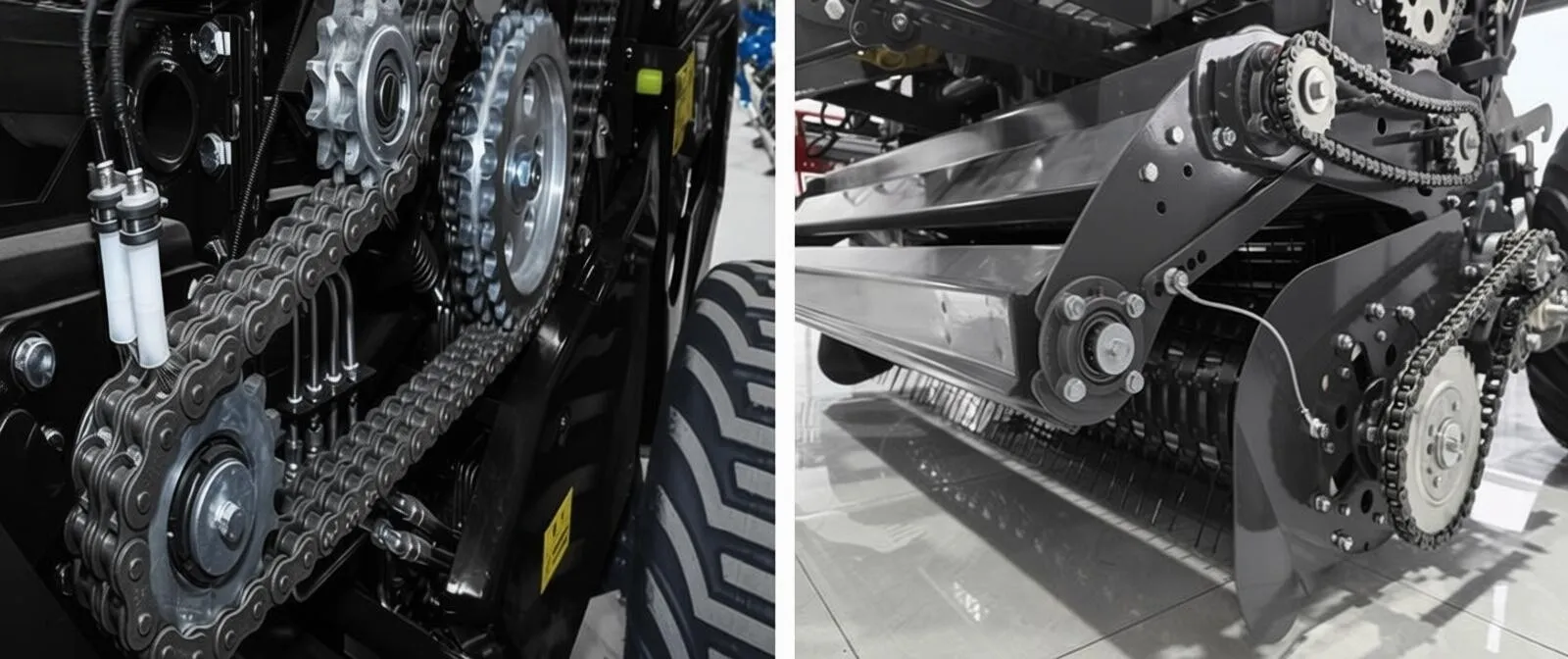
Soft-ground operation increases peak chain loads through two mechanisms: the higher rolling resistance of the tractor-baler combination on soft wetland soil means the PTO must deliver more sustained torque to maintain forward progress, which increases the average load on the round baler’s internal compression chain. Additionally, the reed pickup event on soft-ground-settled dense windrows generates higher instantaneous chain loads than the same windrow density on firm ground, because the pickup drum cannot rely on ground contact reaction force to assist stem penetration. Sealed heavy-duty roller chains rated to the round baler model chain specification maintain pitch consistency through both these elevated load conditions and prevent the chain stretch that disrupts tine phase geometry when operating in reed silica dust environments.
11. Over Ten Years of Agricultural Machinery Development
Our manufacturing operation was founded in 2013 and has spent more than a decade developing round baler models and supporting harvesting equipment for the real conditions of Korean and global agricultural and wetland biomass operations. Our product range spans compact round balers suited to small Korean plot operations through to heavy-duty traction balers built for large-scale Phragmites wetland harvesting along Korean riverbanks and reservoir margins. Supporting machinery includes single and double disc mowers, disc rotary rakes, twin-side rakes, and mower-conditioner units.
Our facility operates under ISO 9001 Quality Management System certification with independent import and export rights. More than sixty large-scale manufacturing machines support an annual design capacity of 2,000 units. After-sales programs cover genuine spare parts for all high-wear round baler components and first-season technical training for Korean operators in new baling applications including wetland reed work.
Founded
2013 — 10+ Years
Annual Capacity
2,000 Units Per Year
Equipment
60+ Large-Scale Machines
Certification
ISO 9001 Certified
Frequently Asked Questions — Tractor Power and Wheel Clearance for Reed Baling on Soft Ground
Editor: PXY