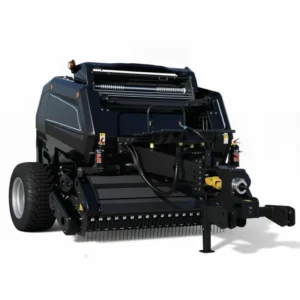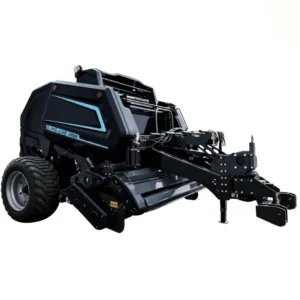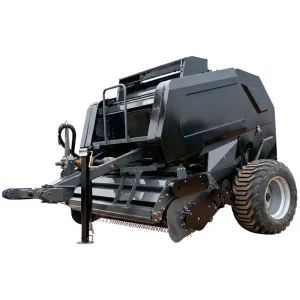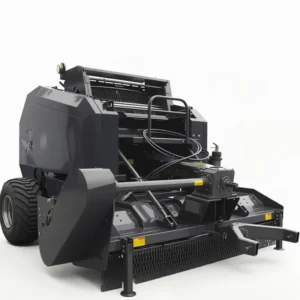
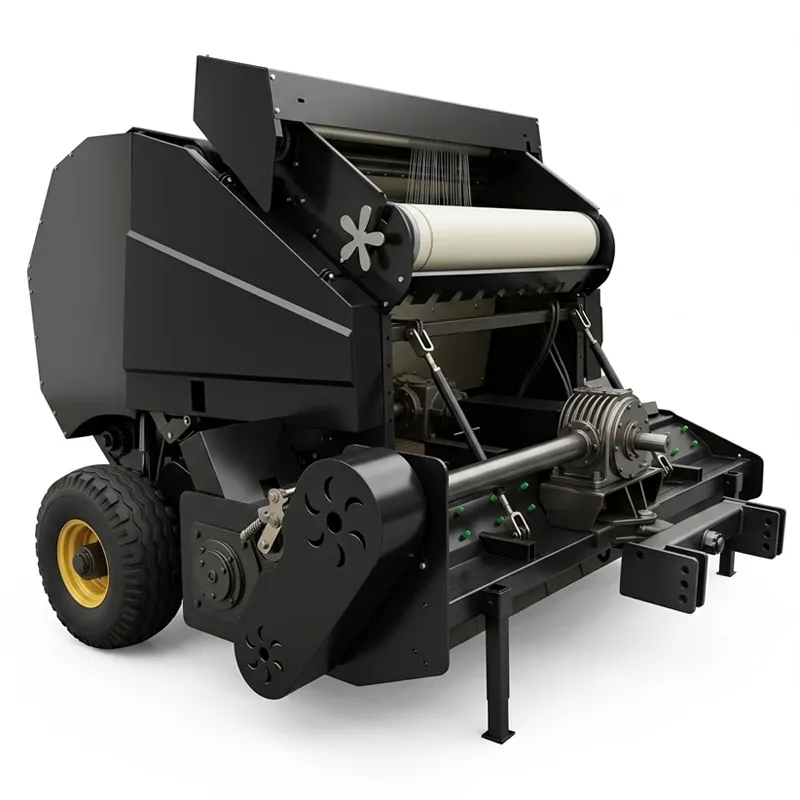
EP Round Baler- Φ1000 mm Compression 2950×2750×2050 mm (L×W×H)
This EP round baler machine — with a Φ1000 mm compression diameter and a 2300 mm spring tooth picking width — sits firmly in the commercial-scale segment of the agricultural round baler market.
The machine operates on a tractor-trailed configuration, meaning it attaches to the rear three-point hitch drawbar of a compatible tractor and receives drive power through a standard PTO connection. The generous power window means the machine performs consistently whether it is baling light oat straw behind a 80 hp tractor or handling dense ryegrass swaths with a 150 hp machine.
Bales produced at Φ1000 mm diameter and 1250 mm width typically weigh 350–600 kg for dry grass or straw and can reach 600–900 kg for higher-moisture silage crops. These large hay round bales require a telehandler or a loader with adequate reach and capacity, but their volume-to-handling-event ratio makes them far more efficient than smaller formats for commercial feeding operations.
Large-Scale Agricultural Round Baler Machine
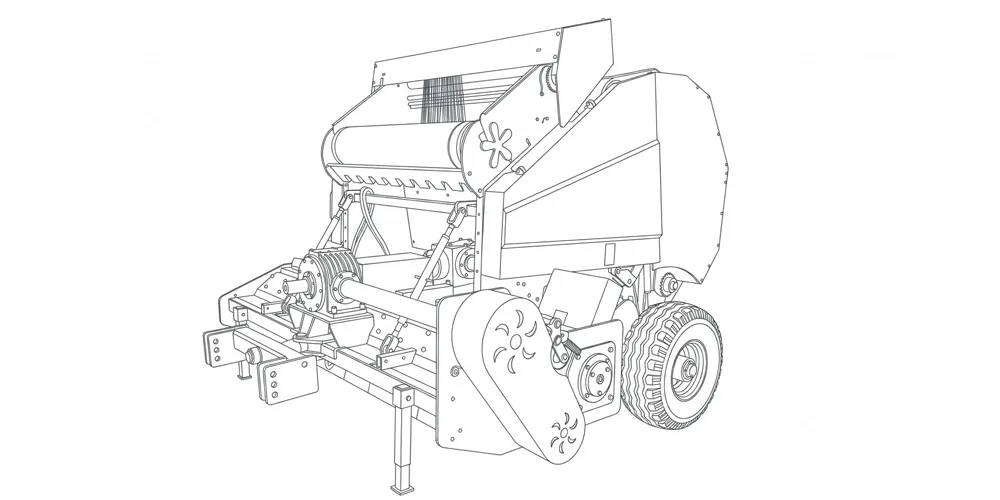
EP Round Baler — ∅1000 mm Compression 2950×2750×2050 mm (L×W×H)
A heavy-duty, tractor-trailed agricultural round baler engineered for 58.8–132.5 kW tractors, producing large Φ1000 mm diameter hay round bales with automatic net wrapping and a dual-mechanism feeding system for continuous high-throughput field operation.
1. Technical Specifications
All dimensions are in millimetres unless otherwise stated. Confirm tractor hydraulic and PTO specifications before connecting. Power figures are given in kW; multiply by 1.341 to convert to horsepower if required.
| No. | Parameter | Unit | Specification |
|---|---|---|---|
| 1 | Model Name | — | EP Round Baler (∅1000 mm Compression) |
| 2 | Hitching Method | — | Trailed |
| 3 | Picking Width | mm | 2300 |
| 4 | Feed Inlet Width | mm | — |
| 5 | Picker Structure | — | Spring tooth type |
| 6 | Feeder Structure | — | Shift fork feeding mechanism + Screw continuous feeding mechanism |
| 7 | Type of Compressing Bale Chamber | — | Roll drum type |
| 8 | Width of Compressing Room | mm | 1250 |
| 9 | Diameter of Compression | mm | Φ1000 |
| 10 | Quantity of Roll-Pressing Working Components | pcs | 18 |
| 11 | Diameter of Roll-Pressing Roller | mm | Φ190 |
| 12 | Bundling Type | — | Automatic net wrapping |
| 13 | Matching Power Range | kW | 58.8 ~ 132.5 |
| 14 | Overall Dimensions (L×W×H) | mm | 2950×2750×2050 |
| 15 | Machine Weight | kg | 2500 |
2. Five Key Advantages of This Heavy-Duty Round Baler Machine
A 2300 mm picking width means this machine clears a wide swath in a single pass. For large-acreage hay operations in Australia's wheat belt, Korean Jeolla plains (전라도 평야), and the Brazilian Cerrado, reducing the number of passes per field dramatically cuts total baling time and tractor fuel cost. The wide spring tooth pickup also handles spread or fluffed windrows without needing to rake twice, which is a common time sink on conventional-width machines. Fewer passes also means less ground compaction and reduced mechanical wear on the tractor and baler drivetrain over a full season.
The combination of a shift fork feeding mechanism and a screw continuous feeding mechanism is what sets this round baler apart from single-feeder designs. The fork mechanism handles initial crop uptake and breaks up dense mat layers, while the screw conveyor maintains a steady, metered flow into the compression chamber. This two-stage approach virtually eliminates feed channel blockages — the most common cause of field stoppages on large-format round balers. Commercial contractors operating this machine in high-yield corn residue or dense legume hay report significantly fewer unplanned stops compared to single-auger designs.
The 18 × Φ190 mm pressing rollers in the roll drum bale chamber create a large contact surface area that builds bales with exceptional density from core to periphery. A denser bale stores more dry matter per unit volume, which translates to lower storage cost per tonne of feed — critical for commercial operations where shed space is a constrained resource. Dense bales also handle round bale net wrap more efficiently: the wrap lies tight against the bale surface without loose folds, which would otherwise allow moisture ingress and accelerate spoilage.
Manual rope wrapping is appropriate for smaller single-operator machines, but at this bale size and production rate, automatic net wrapping is the right choice. The automatic net wrap system on this round baler initiates, measures, cuts, and finishes the net application without operator input beyond a single trigger signal. This reduces the bale cycle time by 20–35% compared to manual systems, keeps the operator in the tractor cab rather than outside the machine, and ensures consistent net wrap coverage on every bale regardless of operator fatigue or attention. These gains compound significantly over a full-day commercial baling run.
At 2500 kg machine weight and an overall footprint of 2950×2750×2050 mm, this is genuinely a commercial agricultural round baler — not an upscaled hobby machine. The structural frame is engineered for tractor power inputs up to 132.5 kW (178 hp), meaning the machine can absorb the full PTO torque of a large modern tractor without frame flexing, gearbox overload, or premature bearing failure. For large South Korean farm cooperatives (농업협동조합), Australian grain-livestock mixed farms, and Dutch forage contractors, this durability under sustained commercial duty is the single most important purchasing criterion.
3. How This Round Baler Works — The Dual-Feed Roll Drum Cycle
The operating cycle of this round baler machine integrates a wider pickup, a more complex feeding system, and an automated wrapping stage compared to smaller format models. The full cycle from crop pickup to bale ejection proceeds through five clearly defined stages, each of which has been engineered to minimise cycle time while maximising bale quality.
The 2300 mm spring tooth pickup reel sweeps a broad path as the tractor advances. Spring tines flex over uneven terrain and lift crop cleanly from the ground surface, feeding it rearward at a rate matched to field speed. The wide working width means two adjacent windrows can often be picked up simultaneously, further increasing throughput on well-raked fields.
Crop first encounters the shift fork feeding mechanism, which breaks up dense mats and distributes material evenly across the full chamber width. The screw continuous feeding mechanism then takes over, delivering a consistent, metered flow into the 1250 mm wide roll drum compression chamber. Together these two feeders prevent the uneven core formation that causes bale shape problems on single-auger designs.
The 18 × Φ190 mm pressing rollers rotate and grip incoming material, building the bale radially layer by layer. As the bale diameter increases toward Φ1000 mm, chamber pressure builds progressively. A diameter indicator in the cab alerts the operator when full size is reached, triggering the wrapping sequence.
The automatic net wrap system feeds net from the roll, applies the programmed number of passes over the rotating bale, then cuts and tucks the free end automatically. The entire wrapping sequence completes in 15–25 seconds without operator intervention, maintaining bale rotation speed for consistent net tension throughout the wrap cycle.
The rear tailgate swings open hydraulically and the finished hay round bale rolls to the ground. As the tractor continues forward the tailgate closes and the next bale cycle begins immediately. On flat terrain, an experienced operator can complete a full bale cycle — pickup to ejection — in under three minutes at typical field speeds.

4. Material Specification & Structural Engineering
At 2500 kg, this round baler machine carries its weight with purpose. The mainframe is fabricated from high-yield-strength structural steel — minimum 355 MPa yield grade — with all primary joints welded to full-penetration standards and then stress-relieved to reduce residual stress concentrations that could propagate cracks under the cyclic loading inherent in field baling. The frame geometry is designed with finite element analysis inputs to distribute the compression chamber reaction loads evenly into the drawbar and wheel axle assembly rather than concentrating them at single weld nodes.
The 18 pressing rollers are manufactured from seamless steel tube with controlled wall thickness, then surface-hardened to 50–55 HRC to resist the continuous abrasion from crop material passing across the roller surfaces. Each roller runs on sealed double-row spherical roller bearings, which tolerate the shaft misalignment that occurs under heavy side-loads in the bale chamber without generating edge loading on the bearing races. Bearing housings are machined from ductile iron, offering a combination of strength, vibration damping, and corrosion resistance that extends service intervals in wet field conditions common to Korean coastal regions and Dutch polders.
The automatic net wrap mechanism housing is fabricated from 304-grade stainless steel to resist corrosion from crop moisture and fertiliser residues that accumulate near the rear of the machine. Net guide rollers are coated with food-grade PTFE to prevent net adhesion during the cut cycle. The dual-mechanism feeder components — shift fork arms and screw conveyor flights — are made from wear-resistant Hardox-equivalent steel plate, significantly extending service life over standard mild-steel alternatives when baling abrasive crops such as rice straw or maize residue. All round baler parts that contact crop directly are either replaceable as bolted wear items or manufactured from materials specifically chosen for their erosion resistance in agricultural duty.
5. Round Baler Application — Where This Machine Delivers Results
The purpose of a round baler at this scale is commercial-grade forage and residue handling. The wide pickup, large bale format, and automatic net wrapping make this machine the right choice across a range of high-volume round baler application scenarios that would exceed the practical limits of smaller-format models.
Australian hay export operations, Korean agricultural cooperatives producing feed hay for the domestic dairy and beef sectors, and North American contract hay growers all operate in environments where field throughput determines profitability. The 2300 mm pickup width of this round hay baler allows operators to clear 20–40% more area per hour than a standard 1500 mm machine, and the Φ1000 mm bale format reduces the number of individual bales per tonne of output — fewer bales to move, stack, and account for. This is particularly valuable for Korean cooperative farms (농협) that consolidate baling services across multiple member farms during a compressed harvest window.
Post-harvest rice straw represents a significant recoverable resource in South Korea (충청남도, 전라남도), Vietnam, and Thailand. Open burning of rice straw is increasingly restricted under environmental regulations, creating both a compliance need and an economic opportunity for operators with round baler equipment capable of handling the light, fluffy windrows that rice straw forms. The shift fork and screw feeding system on this machine handles rice straw's tendency to bridge and tangle far better than belt-type feeders. Baled rice straw has established markets as livestock bedding, mushroom substrate, and biomass fuel pellet feedstock.
The automatic net wrap system on this agricultural round baler is essential for high-moisture silage applications, where bales must be wrapped in plastic film immediately after net wrapping to seal out oxygen. The speed of the automatic net stage reduces the interval between bale ejection and film wrapping, which is critical for silage fermentation quality — every additional minute of air exposure after the bale is formed increases dry matter losses. Large dairy farms in the Netherlands (Noord-Brabant), Germany, and Korea's intensive livestock zones (경기도) find this machine's output rate well-matched to the scale of their silage programme.
The bioenergy sector across Europe, South Korea, and Brazil actively sources baled agricultural residues — wheat straw, corn stalks, sugarcane tops, and energy grass crops — as feedstock for biogas digesters, pellet mills, and direct combustion plants. The Φ1000 mm format produces bales at a density and dimension compatible with most industrial handling and shredding equipment. A commercial contractor operating this round baler machine across multiple farms can generate a meaningful biomass supply volume that opens access to fixed-price supply contracts with bioenergy processors — a revenue stream entirely separate from the traditional hay market.
Professional baling contractors — operating as independent machinery service businesses — represent a growing customer segment in South Korea, the Netherlands, Brazil, and Colombia. A contractor deploying this round baler machine at commercial rates charges per bale or per hectare, and the machine's productivity directly determines the number of client farms serviceable per day. The wide pickup, fast automatic net wrap cycle, and robust construction minimise non-productive time. Many contractors also generate additional revenue by supplying compatible round bale net wrap consumables and hay nets for round bales to their client farms as part of a full-service baling package.
6. International Compliance — Gearbox & Machinery Regulations
A commercial-scale round baler and its associated drivetrain components are subject to machinery safety, gearbox, and agricultural equipment regulations that vary by country and trading bloc. The following overview covers the principal frameworks applicable in this machine's primary target markets. Always verify current requirements with your local regulatory authority before import and operation.
Agricultural machinery safety in South Korea is governed by the Agricultural Mechanization Promotion Act (농업기계화 촉진법) and its subsidiary safety performance regulations. Large trailed machinery such as this round baler must meet the safety test standards administered by the National Institute of Agricultural Sciences (국립농업과학원). PTO drivelines and round baler gearbox units must conform to Korean Industrial Standards (KS) for transmission components, with particular attention to guarding requirements at all rotating PTO shaft connections. Road transit of trailed equipment requires compliance with the Road Traffic Act regarding maximum road width (typically 2.5 m — note this machine's 2750 mm width requires special transport permits in Korea).
EU Machinery Directive 2006/42/EC (transitioning to Machinery Regulation EU 2023/1230, applicable January 2027) requires CE marking and a full technical construction file for all agricultural machinery placed on the EU market. EN ISO 4254-1 (general safety of agricultural machinery) and EN ISO 11684 (safety signs on machinery) both apply. The round baler gearbox must comply with the EU Ecodesign Regulation for energy-related products if its oil sump exceeds the volume threshold specified in Commission Regulation (EU) 2019/1781. Road transport in the Netherlands and Germany requires Type Approval under Directive 167/2013/EU for whole vehicle approval of trailed agricultural equipment at widths exceeding 2.55 m.
Australian state and territory Work Health and Safety Acts impose a primary duty on machinery importers and operators to ensure plant is safe. The Safe Work Australia Model Code of Practice for Managing the Risks of Plant in the Workplace provides specific guidance on guarding, PTO safety, and baler operator exclusion zones during operation. State road traffic authorities require Oversize and Overmass (OSOM) permits for trailed machinery exceeding standard width limits on public roads — at 2750 mm, this machine exceeds the standard 2.5 m limit in all states and will require a permit and appropriate escort arrangements. Buyers in Queensland and New South Wales should confirm transport requirements with their state's Department of Transport before purchase.
Brazil's ABNT NBR standards and INMETRO Resolution 488/2021 set conformity assessment requirements for agricultural machinery imports. Gearbox and PTO shaft components must comply with ABNT NBR standards for mechanical transmission safety and guarding. Brazil's Ministério da Agricultura, Pecuária e Abastecimento (MAPA) publishes import and registration procedures for agricultural machinery, including requirements for a Technical Evaluation Report (Laudo Técnico) from an accredited inspection body for equipment above defined weight and power thresholds. At 2500 kg and 132.5 kW maximum input, this round baler machine will fall within the scope of these enhanced procedures in most Brazilian states.
Provincial OHS regulations and the Canadian Agricultural Safety Association (CASA) guidelines on machinery guarding, PTO shielding, and baler operator safety all apply to this class of equipment. The Canadian Transportation of Dangerous Goods Regulations do not directly cover agricultural machinery, but provincial highway authorities set overwidth transport requirements — in Ontario, Saskatchewan, and Alberta, the maximum non-permitted road width is 2.6 m. A special transport permit is required to move this machine at 2750 mm. Buyers should arrange transport logistics in advance and consult their provincial ministry of transportation for current permit procedures before the machine arrives.
Colombia participates in the Andean Community (Comunidad Andina) harmonised technical standards framework, which aligns machinery safety requirements across Bolivia, Ecuador, Colombia, and Peru. ICONTEC NTC 4116 covers safety labelling and guarding for agricultural machinery. The Colombian National Road Safety Agency (Agencia Nacional de Seguridad Vial) sets road-use limits for agricultural equipment transport, and oversize loads require prior route authorisation from the Ministry of Transport. Key agricultural departments such as Meta, Córdoba, and Magdalena have active hay and forage industries where commercial round baler application is growing alongside expanding beef export programmes.
7. Compatible Drivetrain Accessories — Complete System Supply
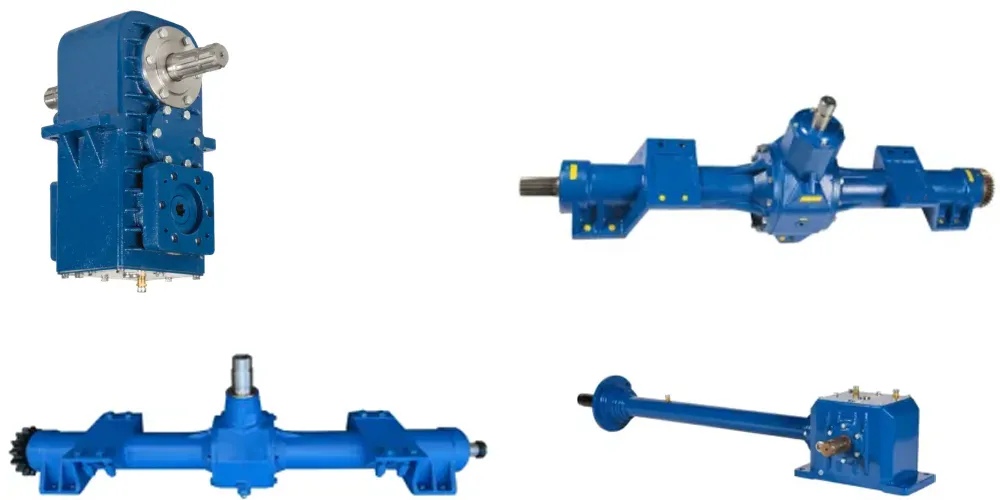
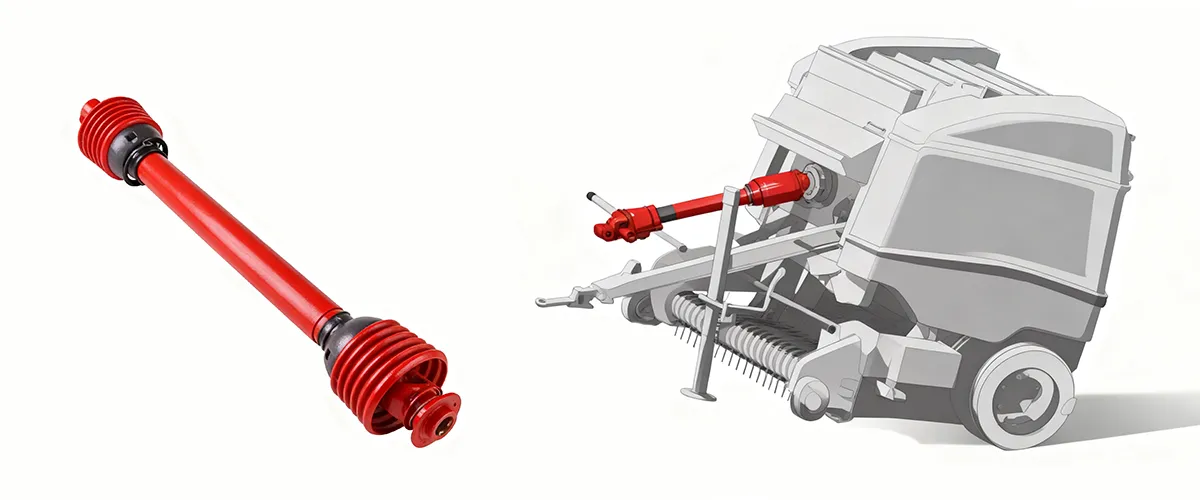
A round baler machine of this capacity places significant demands on the connecting drivetrain. The round baler gearbox and PTO shaft are not generic components — they must be matched to the machine's torque profile, input speed, and dimensional envelope. We supply both items as part of a complete system, eliminating the risk of mismatched components and simplifying your procurement process.
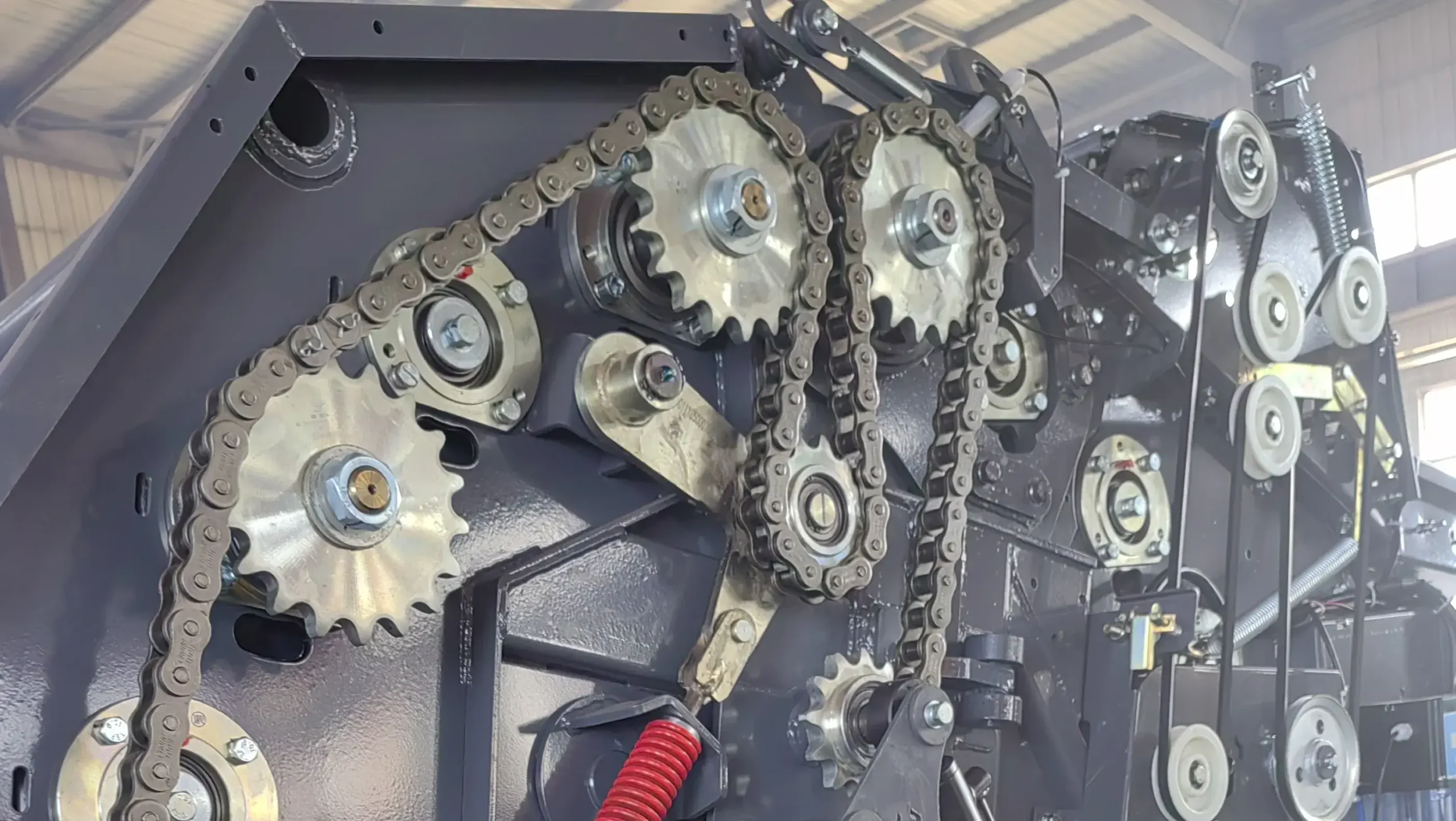
The internal round baler gearbox on this machine handles the step-down from PTO input speed to the multiple output shafts driving the pickup reel, feeding mechanism, compression rollers, and net wrap unit. At the power levels involved — up to 132.5 kW continuous — the gearbox specification is critical. Our matched gearboxes use case-hardened alloy steel gears with a minimum surface hardness of 58 HRC, housed in a ribbed ductile iron casting that dissipates heat efficiently during sustained high-load operation. Oil capacity and viscosity grade are specified to maintain adequate lubrication film at operating temperatures reached during full-day commercial baling runs.
The PTO shaft connecting your tractor to this round baler must be rated for the full torque range that a 132.5 kW tractor can deliver — approximately 2350 Nm at 540 rpm. An undersized shaft creates a serious safety and reliability risk. Our matched PTO shafts for commercial round baler applications incorporate wide-angle constant-velocity joints that accommodate the range of tractor-to-baler angular positions encountered in field use, a shear bolt or friction overrun clutch for baler protection, and CE-compliant full-length guarding. Browse our compatible PTO shaft range to find the correct length and coupling configuration for your tractor model.
8. About Us
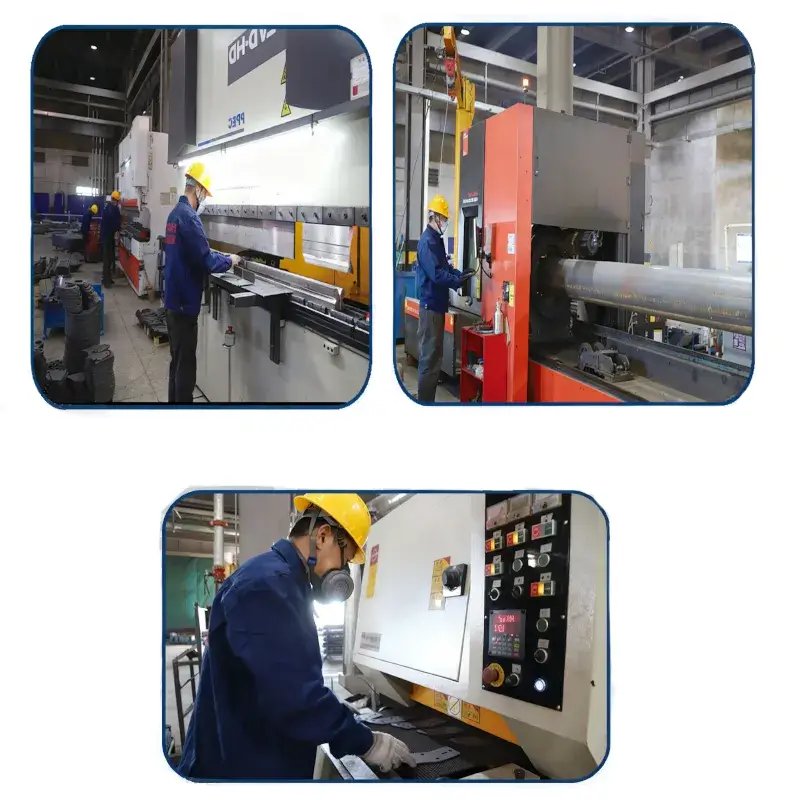
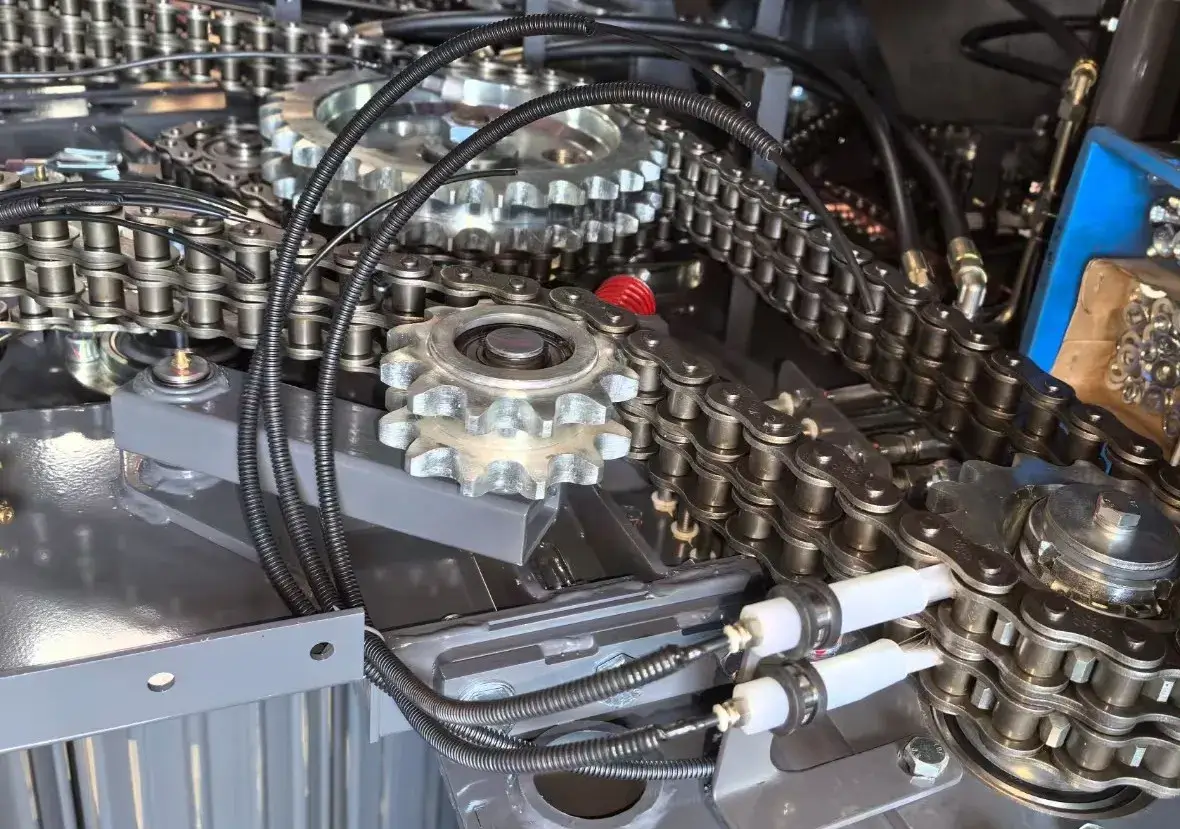
Our production facility operates a documented quality management process covering incoming steel certificate verification, dimensional inspection at fabrication stages, weld procedure qualifications, and full function testing of every machine before despatch. A structured spare parts programme covers all fast-moving round baler parts for this model, with stocking policies set by historical failure rate data from our global installed base.
WorkShop
Frequently Asked Questions
Q1. What is a round baler of this size typically used for on large commercial farms in South Korea and Australia?
A round baler at this scale — Φ1000 mm compression diameter, 2300 mm pickup width — is the tool of choice for commercial hay production, rice straw recovery, and silage baling on large farms and cooperative operations. In South Korea, the primary round baler application is baling rice straw after the autumn harvest and producing ryegrass hay in spring. In Australia it is most commonly used for large-volume grass hay destined for domestic or export markets. The automatic net wrap system, wide pickup, and high tractor power compatibility make it suited to operations that cannot afford slow cycle times or frequent field stoppages.
Q2. How many HP do you need to run a round baler of this capacity reliably without overloading the tractor PTO?
The matching power range for this round baler machine is 58.8–132.5 kW, which converts to approximately 79–178 hp. For most crop types and field conditions, a tractor in the 100–130 hp range (74–97 kW) will run this machine comfortably. If you regularly bale dense, high-moisture legume silage at high field speeds, sizing toward the upper end of the power window prevents PTO slippage and protects the gearbox from sustained overload. South Korean TYM, Kukje, and Daedong tractors in the 100–140 hp class are well matched for this machine. Australian John Deere and Case IH mid-frame models in the same power range also integrate well with the standard PTO connection.
Q3. How much does a round bale of hay weigh when produced by this Φ1000 mm machine, and what loader capacity is needed?
How much does a round bale of hay weigh at this bale size? Dry grass and straw bales from this machine typically weigh 350–600 kg. Higher-moisture silage bales can reach 700–900 kg. For safe handling, a front-end loader or telehandler rated for a minimum of 1200 kg is recommended to provide adequate margin when bales are at the heavier end of the range. In the Netherlands and Germany, bale handlers with a 1500 kg capacity are standard on farms of this scale. Korean farm operators should confirm their loader attachment type — bale spikes rated for 800 kg are widely available from Korean agricultural equipment dealers at competitive cost.
Q4. How many square bales in a round bale of this size, and how does that change feed management for a large beef operation?
How many square bales are in a round bale at Φ1000 mm diameter and 1250 mm width? The typical equivalent is 50–75 conventional small square bales (each approximately 15–20 kg), or 8–12 large square bales (each approximately 250–350 kg). For a commercial beef feedlot in Australia or Brazil running 500+ head, this means a single round bale provides one to two days of supplementary roughage feed for a mob of 80–100 cattle — reducing daily handling events dramatically compared to small square bale feeding. The key consideration is having a bale roller or unroller attachment that can ration the bale over the feeding period rather than offering the whole bale at once, which increases wastage.
Q5. What is the difference between automatic net wrapping and rope wrapping on an agricultural round baler, and which suits high-output commercial operations better?
Rope (twine) wrapping applies polypropylene cord in a helical pattern around the rotating bale, requiring multiple slow passes for adequate coverage. Automatic net wrapping applies a plastic mesh net over the bale in two to three fast passes, completing the cycle in 15–25 seconds versus 45–90 seconds for rope. For commercial operations producing hundreds of large hay round bales per day, this time difference compounds into meaningful output gains. Net-wrapped round bale net wrap also provides better bale shape retention on the ground, slightly better moisture resistance on the exposed outer surface, and faster net removal at feeding time. The net consumable cost per bale is higher than rope, but the cycle time saving and quality consistency typically outweigh this on high-volume operations.
Q6. Which round baler parts on this machine wear fastest, and how do I plan a spare parts inventory for a full season?
The fastest-wearing components on this round baler are the pickup spring tines, the feeder shift fork wear faces and screw flights, the compression roller surface layer, and the net wrap cutter blade. A well-stocked pre-season parts inventory for one machine running a full commercial season should include a full set of tines, a cutter blade, chain link and master link assortment, and at minimum one complete bearing kit for the pickup reel shaft. Critical round baler parts can be air-freighted for urgent situations, but planning ahead eliminates field delays during peak harvest. Contact us for a recommended initial spare parts kit tailored to your expected seasonal output.
Q7. What hay nets for round bales and net wrap products are compatible with this machine's automatic wrapping system?
The automatic net wrap system on this machine accepts standard round bale net wrap rolls in 1.23 m and 1.25 m width formats, which are the globally dominant supply sizes for commercial net wrap in South Korea, Australia, the Netherlands, and Brazil. Polyethylene net in 23–25 gsm weight with UV stabiliser is the appropriate specification for outdoor storage of up to 12 months. Hay nets for round bales — the reusable feeder nets placed over the bale at feeding time — are not part of the wrapping system; they are a separate farm consumable available from livestock equipment suppliers in all major markets. We can advise on compatible net wrap specifications and approved supplier options for your target market on request.
Q8. When does it make economic sense to upgrade from a small round baler to a large commercial model like this one for a Korean or Australian farm?
The upgrade from a small round baler or mini round baler format to a commercial-scale machine like this is justified when annual bale output exceeds approximately 1000–1500 bales per season and field size allows efficient operation of a wider-cut machine. At that volume, the time saved per bale by the automatic net wrap and wide pickup translates into either reduced total harvest days or the capacity to take on contract baling work for neighbouring farms. Korean agricultural cooperatives often reach this threshold by pooling member farm acreage under a shared machinery ownership model. Australian mixed farms typically cross it when they expand irrigated pasture area or add a hay export component to their income mix.
Q9. What is a baler used for in biomass energy projects, and how well does this model suit that round baler application?
What is a baler used for in the biomass context? It consolidates loose agricultural residues — straw, energy grass, crop tops — into dense, uniformly dimensioned units that are compatible with industrial handling, transport, and processing equipment. This EP round baler machine suits biomass projects particularly well because the Φ1000 mm bale format is accepted by most shredder and pre-processor equipment used at biogas plants and pellet mills. The 2300 mm pickup width makes it economically viable to bale roadside grass cuttings and verge trimmings — a growing biomass feedstock stream in the Netherlands, Germany, and South Korea under green infrastructure management contracts. The machine's robust construction also handles the variable and sometimes partially decomposed material found in these collection contexts better than lighter-duty models.
Editor: PXY