Cotton Processing Waste Management Series
Round Balers in Cotton Gin Trash Management: Reducing Disposal Costs
A technical guide on how round baler machines are applied to cotton gin trash collection and densification — covering material challenges, manufacturing structure, material system durability, gearbox requirements, bale economics, and the global regulatory context for cotton waste management operations.

Understanding the Cotton Gin Trash Problem
1. What Is Cotton Gin Trash and Why Does Its Management Matter for Cost Reduction?
Cotton gin trash — also referred to as gin mote or cotton ginning by-product — is the heterogeneous waste material produced during the mechanical ginning process that separates cotton lint from seed and plant matter. It consists of broken leaf and bract fragments, stem sections, immature bolls, cottonseed fragments, lint stickers, and small amounts of soil and sand. The composition and particle size vary significantly depending on the cotton variety, harvest method, field moisture, and gin configuration, but in most commercial operations, cotton gin trash represents 6–10% of the dry weight of seed cotton entering the gin plant. At a gin processing 5,000 tonnes of seed cotton per season, this translates to 300–500 tonnes of by-product that requires collection, handling, and disposal or utilization every year.
The traditional disposal method — spreading gin trash back onto cotton fields or piling it at the gin yard — is increasingly constrained by environmental regulations on organic waste accumulation, limited spreading capacity on owned land, and the operational cost of haul-off when third-party disposal is required. Forward-looking gin operators are instead exploring value-recovery pathways: cotton gin trash has documented use as a livestock feed supplement, a composting feedstock, a boiler fuel for on-site energy generation, and a soil amendment for land application at agronomically appropriate rates. All of these value-recovery pathways require the material to be densified, transported, and delivered to the receiving application — tasks that a round baler machine is well-positioned to perform at gin-yard or field scale.
For Korean textile and cotton processing industry investors — a sector with significant overseas cotton processing interests in Central Asia, Pakistan, and West Africa — and for domestic Korean agricultural equipment importers serving customers in cotton-growing regions, understanding how a round baler is adapted for cotton gin trash handling is directly commercially relevant. This guide explains the material-specific challenges, how the 9YG series round baler lineup addresses them, and the regulatory frameworks that govern waste management and biomass in key cotton-producing regions.
Material Properties
2. Why Cotton Gin Trash Is Mechanically Challenging to Bale
Cotton gin trash presents a collection of mechanical properties that challenge standard round baler operation in ways distinct from conventional forage crops. The material’s heterogeneous composition — ranging from fine lint fibers to rigid stem sections and soil-contaminated fragments — means its behavior inside the bale chamber is far less predictable than a uniform grass windrow. Fine lint fibers have a high surface-area-to-mass ratio and a tendency to mat together under compression, which can create uneven density distribution within the bale: a dense lint core surrounded by looser, coarser material at the periphery. This density gradient weakens bale shape retention after ejection and creates problems for downstream handling and storage.
The soil and sand fraction in cotton gin trash is highly abrasive and accelerates wear on every contact surface in the round baler’s drivetrain — tine tips, chain link plates, press roller shells, and net wrap knife blades all experience accelerated degradation compared to clean hay or straw applications. Operators who move from conventional baling work to cotton gin trash without adjusting their maintenance schedule and spare round baler parts inventory typically discover this the hard way, with a failed component during a peak processing period. Pre-deployment maintenance planning is essential for gin trash baling operations.
The moisture content of cotton gin trash at the time of baling varies enormously depending on whether the material comes from a gin processing freshly harvested seed cotton or from stockpiled material that has partially dried. Freshly processed gin trash may have moisture content of 20–35%, while aged material in an open yard can dry to 8–12% in warm weather. This variation directly affects bale density achievable at a given compressive force: denser, drier material will compress to a higher density with the same roller pressure, while wet gin trash may require significantly higher compressive force to reach the same target density. The sensor-controlled density management system on the 9YG series compensates for this variation by triggering ejection at the same mass-based density threshold regardless of material condition, rather than at a fixed time or volume.
Manufacturing Structure
3. Frame and Chamber Engineering for Cotton Gin Trash Densification
The structural requirements for a round baler deployed in cotton gin trash operations share some characteristics with sugarcane trash applications — both involve abrasive, heterogeneous material that places elevated cyclic loads on the frame and chamber — but cotton gin trash has the additional characteristic of lint fiber content that can accumulate on any surface with a gap or recess. This fiber accumulation behavior means that the bale chamber’s internal geometry, the clearances between press rollers and side endplates, and the pickup throat dimensions all need to be assessed for potential fiber packing points that could gradually obstruct material flow over a working shift.
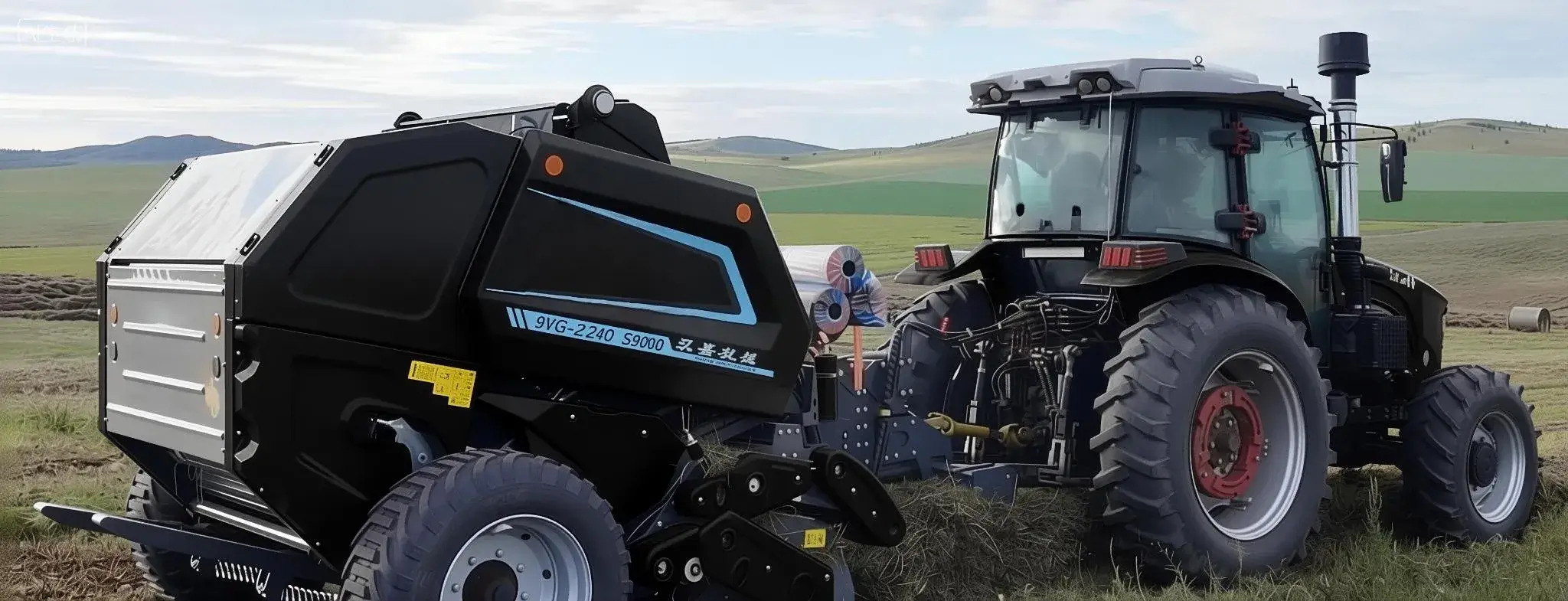
The 9YG-2.24D series bale chamber measures 1,200 mm in diameter and 1,400 mm in width, with 18 press rollers each 222 mm in diameter arranged in a drum array driven by dual-side chain on both chamber side plates. The relatively large roller diameter — 222 mm — provides more contact area per roller than smaller-roller designs, which distributes the compressive load more evenly across the heterogeneous gin trash material and reduces the tendency for lint-rich zones to create localized high-friction areas that stall roller rotation. The dual-side chain drive arrangement maintains symmetric torque delivery across the roller array, ensuring that even if the material distributes asymmetrically within the chamber, the compressive force remains balanced and does not create differential stress in the tailgate hinge structure.
The main frame is fabricated from CNC laser-cut structural steel plates with automated welding at all primary structural nodes. For cotton gin trash applications specifically, the quality of the surface finish at internal frame faces — minimizing exposed threads, projecting bolt heads, and recessed corners where lint could accumulate — is an important operational consideration. Operators should periodically inspect the internal frame surfaces and blow out accumulated lint from any buildup points, as compressed lint under cyclic stress can generate heat through frictional compression, representing a low-level fire ignition risk that gin operators are rightly conscious of given cotton’s natural flammability.
Material System
4. Chain Grades, Tine Steel, Roller Alloys, and Frame Coatings Under Cotton Gin Trash Conditions
The material demands of cotton gin trash baling are dominated by abrasion from the soil and sand fraction, and by the chemical exposure from the organic acids present in partially decomposed gin trash that has been stockpiled. Understanding the material system of the 9YG round baler series helps operators in gin trash applications plan maintenance schedules, manage spare round baler parts inventory, and set realistic expectations for component service intervals compared to conventional hay baling.
20A Heavy Roller Chain
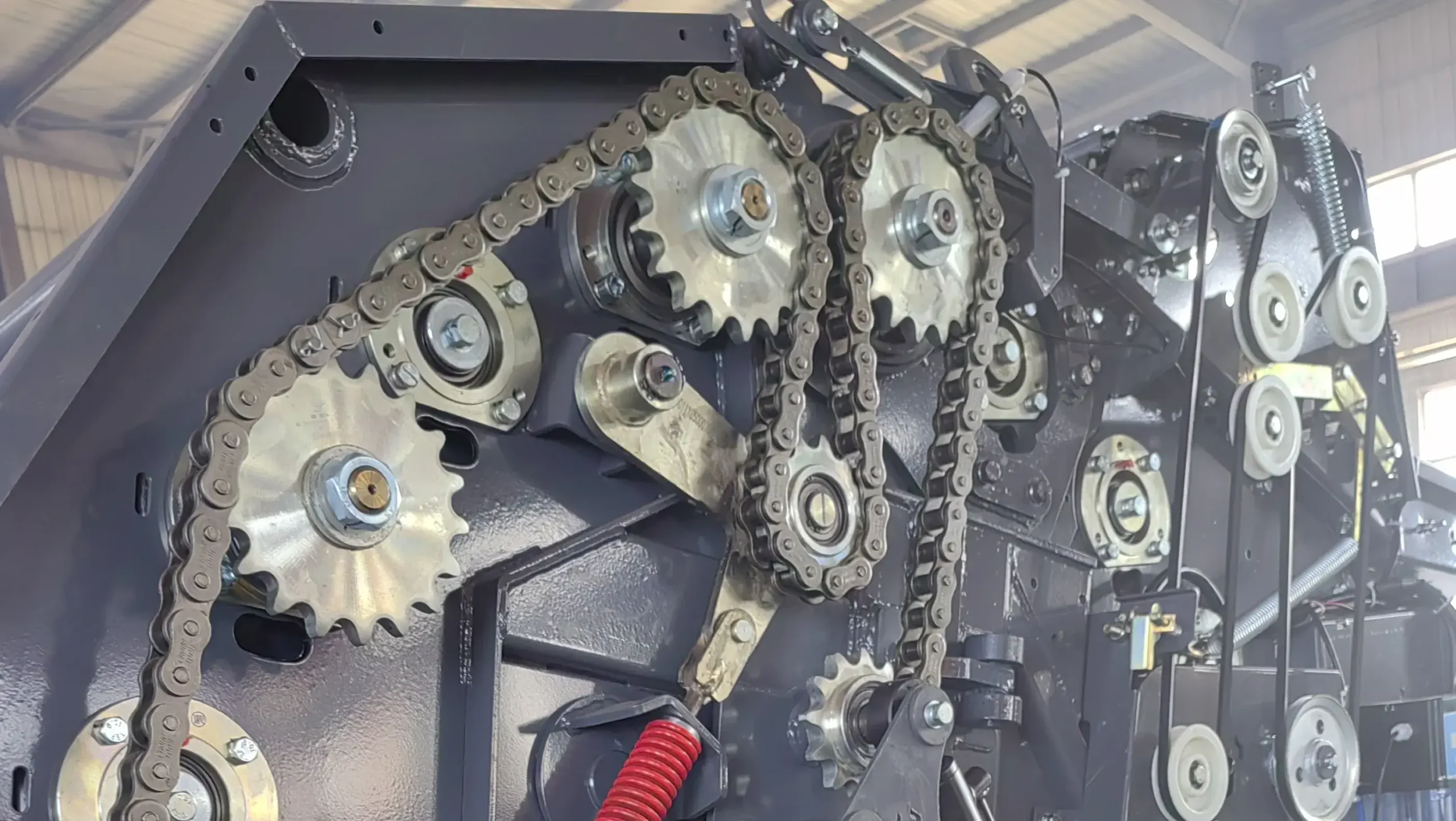
The rear chamber of the 9YG-2.24D series uses 20A specification roller chain on both sides, rated for the elevated compression forces needed to densify cotton gin trash to the 100–200 kg/m³ target range. In gin trash conditions the chain should be lubricated at the shortened interval of every 6–8 operating hours, since the abrasive soil fraction permeates chain link clearances and displaces lubricant from pin-bushing contact surfaces more rapidly than in clean crop applications. The dual-side arrangement prevents asymmetric chain elongation from developing, which would otherwise cause a progressive misalignment of the press roller array that manifests as consistently off-center bale cores.
Spring Steel Pickup Tines
High-tensile spring steel tines on the 9YG series provide the combination of flexibility and fatigue resistance that gin trash pickup requires. Gin trash scraped from a gin yard surface — particularly material that has been partially compacted by vehicle traffic — may contain embedded gravel or hardened clods that would fracture a rigid tine but merely deflect a spring-steel unit. The 2,240 mm pickup width on the 9YG-2.24D models covers a broad collection swath, which is valuable when baling gin trash that has been spread in windrows using a front loader or tractor-mounted blade. Tine tip wear in gin trash operations should be inspected every 50 operating hours due to the sand content of the material.
Press Roller Shell and Bearing Sealing
The 18 steel-tube press rollers in the bale chamber of the 9YG-2.24D are vulnerable to bearing contamination from the fine sand and soil particles present in gin trash. Pre-season replacement of all press roller end bearings with sealed-unit specification, combined with visual inspection of roller shell surface condition before deployment, should be part of the pre-ginning-season setup routine. Roller shells with wear ridges or out-of-round profiles create zones of uneven compression that produce bales with internal density variation — an issue for any downstream application where consistent fuel density or compost feedstock homogeneity is specified.
Electrostatic Frame Coating
Cotton gin trash in humid regions — particularly in the US Southeast, Pakistan, and parts of West Africa — carries moisture and organic acids that attack bare steel surfaces rapidly. The electrostatic powder coating applied over CNC-fabricated frame components provides a corrosion-resistant barrier that resists the combination of mechanical abrasion from the gin trash and chemical attack from organic decomposition products. In gin yard environments where the machine may sit idle between processing seasons, coating integrity should be inspected annually and any chips or scratches spot-primed before the ginning season begins to prevent undercutting corrosion at frame joints.
Cost Economics
5. How Round Baling Reduces Cotton Gin Trash Disposal Costs Compared to Alternative Methods
The financial case for investing in a round baler machine for cotton gin trash management rests on comparing the fully costed disposal burden against the combination of baling capital cost, operating cost, and the value realized from the densified bale material at its point of use. The comparison looks different depending on whether the gin operator is disposing of the trash as a waste stream or converting it into a value-added by-product — but in both cases, densification through baling substantially reduces the logistical cost of the material.
Loose gin trash has a bulk density in the range of 60–100 kg/m³ depending on its composition and how recently it was processed. A standard agricultural truck carrying 10 tonnes of payload can transport approximately 100–167 m³ of loose gin trash at those densities — or 5–8 bales from a 9YG-2.24D chamber at 200 kg/m³ target density, each bale containing approximately 370 kg of material. The same truck carrying bales rather than loose material can therefore deliver 4–5 times more mass per movement, reducing haulage costs per tonne by a corresponding factor. For a gin yard located more than 20 km from the nearest composting, feedlot, or biomass facility, this transport economics improvement alone can justify the capital cost of a baler within a single or two ginning seasons, depending on the volume of gin trash produced annually.
Beyond pure transport economics, baled gin trash commands a measurable premium over loose material when sold as a compost feedstock or biomass fuel, because the bale format simplifies unloading at the receiving facility, reduces dust and fiber loss during transport, and provides a standardized unit for weighbridge billing. For Korean textile industry investors operating overseas cotton processing facilities — where waste disposal costs are sometimes contractually imposed by local environmental authorities — converting gin trash from a disposal liability into a saleable baled by-product is a genuine balance sheet improvement rather than merely an operational efficiency.
Cotton Gin Trash Disposal Method Comparison
| Method | Transport Efficiency | Dust / Fiber Loss | Value Recovery Potential | Regulatory Exposure |
|---|---|---|---|---|
| Loose haul-off (truck) | Low (60–100 kg/m³) | High — environmental concern | Low — recipient sets terms | Moderate — dust and PM regulations |
| Open-pile yard storage | Not applicable | Very high — wind-borne fiber | Low — quality degrades over time | High — organic waste accumulation and fire risk |
| Land spreading (direct) | Limited to owned/nearby fields | Moderate — field-applied | Low — nutrient recycling only | Moderate — rate limits in many jurisdictions |
| Round baling + transport | High (100–200 kg/m³; 4–5× loose) | Very low — net-wrapped bale | High — compost, feed, biomass fuel | Low — managed waste stream |
Power Transmission
6. Gearbox Design Considerations for Cotton Gin Trash Operations
The round baler gearbox in a cotton gin trash application faces a load profile shaped by the material’s irregular density and the tendency for compressed lint fibers to momentarily bind the bale chamber rotation as the bale grows. Lint fiber has a higher coefficient of friction against steel than most forage materials at equivalent moisture content, and as the bale core becomes denser and the lint fibers interlock under compression, the rotational resistance at the press rollers increases noticeably. This progressive resistance increase means that the gearbox approaches a higher-than-average steady-state torque load during the final phase of bale formation — precisely the phase when the density sensor is preparing to trigger the wrapping sequence.
The 9YG-2.24D S9000 Transcend addresses this through its dual-coupling gearbox with a higher rated torque capacity than standard-class agricultural gearboxes. The additional torque reserve handles the elevated steady-state load during the late-bale-formation phase without the gearbox approaching its operating limit, maintaining stable press roller speed throughout the final compression cycle and ensuring the density sensor receives a consistent signal. The safety torque shaft in the PTO driveline provides overload protection for the specific gin trash risk of a large clump of compacted material — potentially including embedded debris — jamming the feed throat and imposing an instantaneous high-resistance event on the gearbox input.
Gearbox oil in cotton gin environments is subject to contamination from the fine dust that cotton processing generates. Even with the gearbox sealed, fine particles can infiltrate through worn seals or through the breather valve during repeated pressurization-depressurization cycles. An oil inspection every 80–100 operating hours — checking for particulate contamination by observing the color and clarity of a small oil sample withdrawn from the drain plug — is a prudent practice for gin trash operations. Replacing contaminated oil promptly protects gear tooth faces and bearing races from the abrasive damage that progresses rapidly once particulate contamination exceeds lubricant film capacity.
Value Recovery
7. Where Baled Cotton Gin Trash Goes: Livestock Feed, Compost, Fuel, and Land Application
Once cotton gin trash has been densified into bales, it enters a range of downstream value-recovery pathways that vary by region, local demand, and the specific quality characteristics of the material. Understanding these end uses helps gin operators make the baling investment decision and helps buyers of cotton gin trash bales specify the density and moisture requirements that their process demands.
Livestock Feed Supplement
Cotton gin trash with a high proportion of immature boll and cottonseed fragment content has a crude protein level of 6–10% and a metabolizable energy value that makes it a viable roughage supplement for beef cattle, particularly in feed-scarce regions. In the US cotton belt, gin trash bales have been used as emergency feed during drought years. In Pakistan and Central Asian cotton-growing regions, baled gin trash is sold to small-scale livestock operations that cannot access or afford conventional hay. A round baler producing consistent, net-wrapped bales at 100–200 kg/m³ density makes this market accessible in a way that loose material cannot reliably achieve.
Composting Feedstock
Cotton gin trash is a high-carbon organic material that complements nitrogen-rich feedstocks in composting operations. Municipal composters and agricultural compost producers in cotton-growing regions are growing markets for baled gin trash because the bale format allows them to inventory material through the off-season and meter it into compost windrows at the required carbon-to-nitrogen ratio. Bales at consistent density support the bin-loading systems used at industrial composting facilities, reducing handling time compared to loose material that requires a loader bucket for every addition.
Biomass Fuel (On-Site Boiler)
Gin trash at 10–15% moisture content has a net calorific value of approximately 14–16 MJ/kg, making it viable as a fuel for on-site gin boilers, biomass stokers, or co-firing applications. Some large gin operations in the US and Australia have installed dedicated biomass handling systems that accept round bales directly from the yard, automatically unwrap and shred the bale, and feed the material into the combustion system. For Korean textile investors managing overseas gin operations with on-site steam or power requirements, baled gin trash represents a waste stream that can partially offset purchased fuel costs.
Agronomic Land Application
At agronomically managed application rates, cotton gin trash improves soil organic matter, water-holding capacity, and cation exchange capacity. Many cotton growers apply gin trash to their own fields or sell it to neighboring farms as a low-cost soil amendment. The bale format makes rate management practical: a grower who wants to apply 3 tonnes per hectare can calculate bale numbers per paddock from known bale weight, distribute bales by tractor with a bale spike attachment, and unroll them in a single operation. Loose material requires spreading equipment that creates uneven application rates and more labor involvement.
Regulatory Frameworks
8. Waste Management Regulations, Machinery Safety Standards, and Gearbox Compliance in Key Cotton Regions
Cotton gin trash management is subject to agricultural waste regulations, biomass energy standards, and agricultural machinery safety requirements across all major cotton-producing regions. The following frameworks are relevant to operators considering round baler deployment for gin trash management.
Republic of Korea — Agricultural Waste Management and Overseas Investment Framework
Korea does not produce commercial cotton domestically, but Korean textile and investment enterprises operating cotton processing facilities in Central Asia, West Africa, and South Asia are subject to Korean environmental due diligence requirements under the Foreign Direct Investment framework and the guidelines of the Korea Trade Insurance Corporation (K-SURE). Waste management practices at overseas Korean-operated facilities — including gin trash disposal — may be evaluated as part of ESG reporting obligations that Korean-listed companies are increasingly required to fulfill. Converting gin trash from an unmanaged waste stream to a baled, traceable by-product directly supports this ESG documentation requirement.
United States — USDA Natural Resources Conservation Service and EPA Waste Regulations
In the US cotton states, gin trash is classified as an agricultural by-product rather than a solid waste under EPA definitions provided certain conditions are met — including that the material is applied to land at agronomically appropriate rates or used as animal feed. US gin operators storing gin trash in open piles at the gin yard may be subject to state-level air quality regulations governing particulate emissions and wind-borne fiber, administered by state Environmental Quality agencies. Round baling and covering gin trash reduces the surface area subject to wind erosion and can bring operations into compliance without requiring infrastructure investment in enclosed storage.
Australia — National Environment Protection Measures and State EPA Regulations
Australian cotton gin operators in the Queensland and New South Wales cotton-growing regions are subject to the National Environment Protection (Ambient Air Quality) Measure and state EPA licensing conditions that restrict particulate matter and organic waste accumulation at gin sites. The NSW Environment Protection Authority and the Queensland Department of Environment have issued specific guidance on gin trash management practices, including the requirement to manage stored material to minimize fire risk and wind-blown fiber. Round baling with net wrap provides a documented management approach that reduces both fire risk (by limiting dry, loose material exposure) and fugitive dust generation at the gin yard boundary.
Pakistan — Environmental Protection Act and Cotton Ginning Industry Regulations
Pakistan’s cotton ginning industry — one of the largest in the world by volume — operates under the Environmental Protection Act 1997 administered by the Pakistan Environmental Protection Agency. Provincial EPAs in Punjab and Sindh, the primary cotton-growing provinces, have issued guidelines on gin waste disposal that require gin operators to manage organic waste to prevent environmental nuisance from odor, leachate, and wind-blown fiber. The Punjab Environmental Quality Standards specify limits on open burning of agricultural waste that apply to gin trash. Round baling creates a compliant waste management pathway by converting the loose material to a stable, contained format that can be transported off-site for beneficial use.
ISO 4254-7 — Agricultural Machinery Safety for Baling Machines
ISO 4254-7 provides the international safety standard for baling machines, covering guarding requirements for the pickup rotor, chain drive, bale chamber, and ejection zone. For round balers deployed at gin yards where workers who are not regular agricultural machinery operators may be present — such as processing plant employees assisting with yard management during the ginning season — the availability of ISO 4254-7 compliant safety guarding documentation is a relevant due diligence item. The standard is referenced by machinery safety certifiers in the US, EU, Australia, and Korea.
Central Asia (Kazakhstan, Uzbekistan) — Sanitary and Phytosanitary Agricultural Waste Standards
Kazakhstan and Uzbekistan, significant cotton producers under the Eurasian Economic Union framework, impose agricultural waste management requirements under their national sanitary and phytosanitary regulations and the technical regulations of the EAEU. Gin operators in these countries are required to manage cotton processing by-products to prevent disease vector habitat development and to meet leachate standards for sites near water bodies. The GOST-R standards referenced under EAEU technical regulations cover agricultural machinery safety including gearbox design specifications, relevant to any round baler machinery imported into these markets for gin trash management.
Product Range
9. Round Baler Models for Cotton Gin Trash and Agricultural By-Product Management
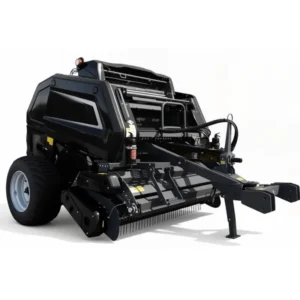
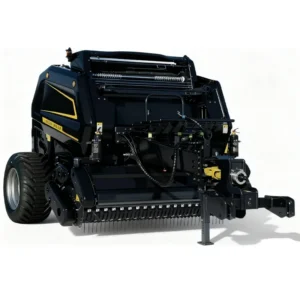
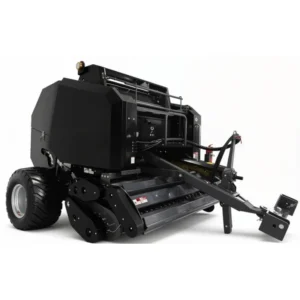
The 9YG series spans from compact units suited to small gin operations through to high-output commercial models appropriate for large gin yards producing several hundred tonnes of trash per season. All models use sensor-controlled bale density management, automatic net wrapping, and are manufactured under ISO 9001 quality management certification.
FAQ
Frequently Asked Questions: Round Balers for Cotton Gin Trash Management
Herausgeber: PXY