The 540 r/min PTO standard has been at the center of agricultural drivetrain design for over sixty years, and its continued relevance is not simply a matter of legacy inertia. In most mid-scale grassland and pasture baling operations — particularly on holdings below 80 hectares where tractor fleets include machines purchased ten, fifteen, or even twenty years ago — the 540 RPM output remains the standard connection point between tractor and implement. Choosing a round baler machine that runs natively at 540 r/min rather than requiring speed-up gearboxes or dual-speed PTO switching is a practical decision that affects daily operation, maintenance load, and long-term drivetrain health.
This article explains the engineering behind 540 r/min PTO compatibility in modern round baler design, explores the structural and material differences that allow compact balers to handle full working cycles on older tractors, and identifies which models in the current product range are best matched to fleets that have not — or cannot — upgrade to high-horsepower 1000 RPM output tractors. The guidance applies directly to Korean grassland farming contexts, where significant numbers of compact LS Mtron, TYM, and Dongyang tractors remain in active field service at power ratings of 40–80 hp and 540 RPM PTO output.
Understanding 540 r/min PTO: What It Means for a Round Baler
The power take-off shaft on a tractor rotates at either 540 r/min or 1000 r/min at the shaft output flange. Both speeds use the same 1-3/8 inch or 1-3/4 inch spline diameter, but the internal gear ratios inside the tractor and implement are calibrated to that specific shaft speed. A round baler designed for 540 r/min input receives a shaft spinning at approximately 540 revolutions per minute at full rated engine speed and uses its internal gearbox to distribute that rotational input to the pickup reel, compression rollers, and wrapping mechanisms at appropriate output speeds.
The 540 RPM standard was defined by ASABE S203 (formerly ASAE S203) and has been adopted globally by all major tractor manufacturers, including those supplying the Korean market. Because the 540 r/min output requires less internal gear reduction inside the tractor than 1000 r/min, it is available on tractors with lower-displacement engines and is the standard output on virtually all tractors below 80 hp. This is precisely the power range where the majority of Korean compact tractor fleets operate — making 540 r/min PTO compatibility not just a convenience feature, but a fundamental requirement for practical grassland baling on holdings of 20 to 60 hectares.
Modern round baler machines designed around 540 r/min input incorporate gearbox ratios and roller drive speeds that are specifically optimized for this input. Running a 540 r/min baler with a 1000 r/min PTO output (without an intermediate reduction adapter) will destroy the gearbox within a very short period — a common mistake when mixing older implements with newly upgraded tractors. Confirming PTO speed compatibility before connecting any round baler to any tractor is a mandatory pre-operation check.
Why Older Tractor Fleets Still Define the Grassland Baling Market
Agricultural capital assets have long service lives. A well-maintained tractor purchased in 2005 or 2010 — running at 50 or 65 hp with a 540 r/min PTO — is still a productive machine in 2025 and will likely remain in active use for another decade on moderate-scale Korean grassland operations. Purchasing an entirely new high-horsepower tractor to operate a round baler is rarely economically justified on holdings below 80 hectares, where seasonal baling hours are measured in the low hundreds per year rather than thousands.
Korean agricultural economics reinforce this pattern strongly. The average Korean livestock farm that produces its own forage operates between 10 and 50 hectares of grassland, typically with a tractor fleet of one or two machines purchased over a period of years. The older of these machines almost certainly outputs at 540 r/min PTO; the newer may have dual-speed capability. Sourcing a round baler that runs efficiently on either machine — but is specifically optimized for 540 r/min primary operation — allows the farmer to use whichever tractor is available without reconfiguring the implement between sessions. For silage cutting where weather windows are short, this flexibility has real operational value.
Beyond Korea, this dynamic applies across much of East Asia, Southeast Asia, and Central Europe. Collective farm equipment in parts of the Balkans, community-shared machinery in Japanese rural cooperatives, and medium-scale livestock farms in northern Vietnam all rely on tractor fleets where 540 r/min PTO compatibility determines which implements can be deployed. The global market for small round baler and compact round hay baler equipment designed for this power range is substantial and growing — driven not by enthusiasm for vintage machinery, but by the economic reality of agricultural capital cycles.
Manufacturing Structure: Engineering a Round Baler for 540 r/min Input
Gearbox and Drivetrain Layout
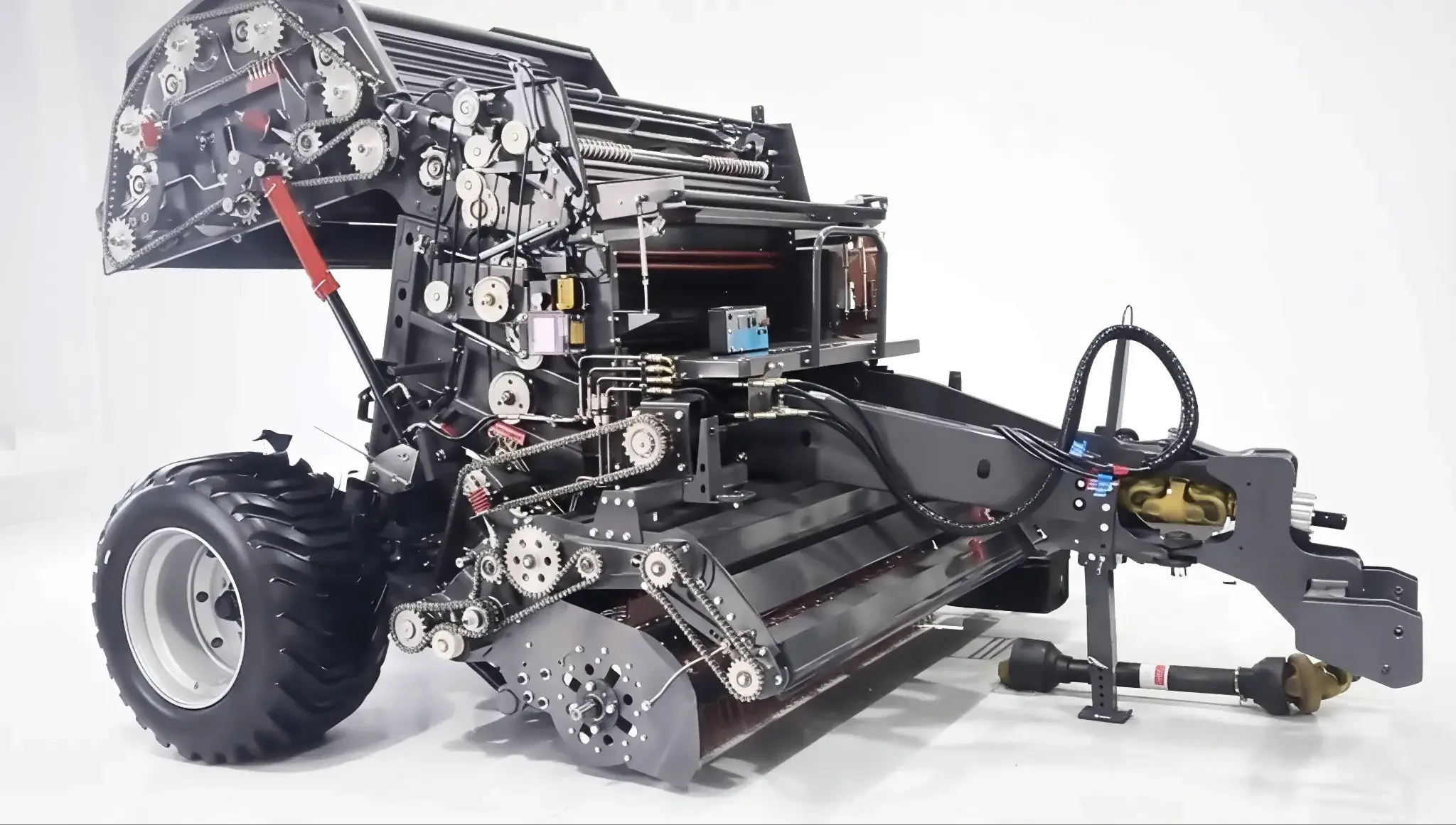
The internal drivetrain of a 540 r/min round baler must distribute input power efficiently to at least three separate output circuits: the pickup reel drive, the compression chamber roller drive, and the net-wrap or twine binding mechanism. The primary input gearbox — housed in ductile iron casing at the implement tongue — performs the first-stage ratio change, typically through spiral bevel gears at the input and helical spur gears at the distribution outputs. Gearbox design for 540 r/min operation differs from 1000 r/min equivalents primarily in gear diameter and tooth module: slower input speed requires larger-diameter, higher-module gears to transmit equivalent torque at lower shaft velocity.
For round balers in the 9YG-1.0 and 9YG-1.0C product range, the gearbox transmission ratio is calibrated at approximately 1:2, driving the roller circuit at appropriate surface velocity for optimal bale formation in grass and hay crops. The gearbox input flange accepts a 35 mm 6-spline PTO shaft (1-3/8 inch Z6 standard), fully compatible with all Korean compact tractors outputting 540 r/min at the PTO stub shaft. Rated input torque capacity exceeds 500 Nm, with a power-optimized design that reduces average fuel consumption by approximately 20% compared to conventional drivetrain layouts at equivalent bale density outputs.
Frame and Structural Load Path
At 540 r/min input, the torque levels transmitted through the drivetrain are proportionally higher than at 1000 r/min for the same power delivery. This means the frame structure of a well-designed 540 r/min round baler must accommodate greater torsional loads at the gearbox mounting points and along the main tongue beam. Quality manufacturers address this by specifying heavier section hollow profiles (80 x 80 x 6 mm or 100 x 60 x 6 mm rectangular hollow sections) at the tongue and gearbox support bracket, and by using fully penetration-welded gusset plates at all structural intersections. CNC-cut parts ensure that weld preparation bevels are consistent across production batches, reducing the risk of stress concentrations that would otherwise propagate as fatigue cracks through high-cycle field seasons.
The tailgate hinge assembly — particularly on fixed-chamber designs where the rear chamber door opens to discharge each bale — is another structural focal point. As bale density builds toward discharge pressure, the tailgate hydraulic ram absorbs increasing compression load. On older-tractor-compatible compact balers, this ram is typically in the 50–63 mm bore range, powered by the tractor auxiliary hydraulic circuit at 15–25 litres per minute. Compatibility with older tractors that may have lower-flow hydraulic systems is an important specification to verify before purchase.
Pickup Mechanism and Ground Clearance
The pickup reel on a 540 r/min compact round baler is driven at a tine-tip speed calibrated for the actual PTO input — typically 2.2 to 3.0 m/s at the tine tip on grass and hay windrows. At this speed, the pickup efficiently lifts and feeds material without launching it over the intake — a failure mode that increases field losses and creates hazard for the operator. Gauge wheels mounted fore and aft of the pickup reel maintain tine-to-ground clearance across uneven meadow ground, with adjustment range from 20 mm to 100 mm above surface to accommodate Korean highland terrain where irregular ground contours are common.
Material System: What Goes Into a Long-Life 540 RPM Round Baler
Material selection in a compact round baler for 540 r/min operation follows a consistent hierarchy: structural integrity first, wear resistance second, corrosion protection third. Each zone of the machine operates under a different combination of load, abrasion, and environmental exposure — and the material system must address all three simultaneously without adding unnecessary weight that would exceed the tongue load capacity of compact Korean tractors.
| Zone / Component | Material Specification | Hardness / Rating | Why It Matters at 540 r/min |
|---|---|---|---|
| Primary Gearbox Housing | Ductile iron GGG40 (EN-GJS-400-15) | Tensile strength 400 MPa | High torque at 540 r/min demands superior vibration damping versus aluminium alternatives |
| Drive Gear Set | 20CrMnTi alloy steel, case-hardened | HRC 58–62 surface | Larger gear modules at 540 r/min require through-hardened tooth roots for fatigue life |
| Compression Rollers | 45# carbon steel, induction-hardened | HRC 45–55 surface | Abrasion from grit in windrow; 16-roller array distributes contact load evenly |
| Drive Chains | ANSI #50 alloy steel, through-hardened | Min. tensile 60 kN | Shock load absorption during bale core formation cycle; longer pitch life at 540 r/min vs 1000 |
| Pickup Tines | 65Mn spring steel | High fatigue limit | Deflects on stone contact without permanent set; resists work-hardening under repeated flex |
| Main Chassis Frame | Q345B structural steel, RHS profile | Yield 345 MPa | Absorbs torsional reaction at gearbox mount; maintains geometry under lateral slope loading |
| External Surface Coating | Electrostatic epoxy primer + PU topcoat | Salt spray 500 h min. | Essential for Korean coastal and highland meadow environments with high humidity and dew cycles |
One detail worth noting in the table above: the drive chain pitch life advantage at 540 r/min versus 1000 r/min is significant for total-cost-of-ownership calculations. Chain wear rate is primarily a function of articulation cycles per unit time, not power throughput. A chain running at 540 r/min undergoes fewer articulation cycles per operating hour than one running at 1000 r/min at equivalent power, meaning the same chain grade lasts meaningfully longer in service. On a compact baler completing 30–50 working hours per season, this translates to an extended chain replacement interval that most operators of 540 r/min equipment notice after two or three full seasons.
Featured Model: 9YG-1.25A Round Baler — Optimized for 540 r/min Grassland Operation
9YG-1.25A — Meadow Grass to Mixed Forage, Compatible with 50–80 hp Tractors at 540 r/min
The 9YG-1.25A is the model in this series best positioned for mid-scale Korean grassland operations running 50–80 hp tractors at 540 r/min PTO output. It handles bale diameters in the 1200–1500 mm range with a working pickup width of 1.8 m, suited to well-conditioned ryegrass, timothy, and mixed sward windrows. The automatic net-wrap system operates from the tractor cab without interrupting forward motion, reducing cycle time between bale completions on long meadow runs.
Bale weight at target silage density (150–200 kg/m3) falls in the 250–320 kg range for 1.4 m diameter bales, manageable with most Korean-market front loaders rated at 800 kg or above. The PTO input specification — 1-3/8 inch Z6 spline at 540 r/min — is confirmed compatible with TYM T754, LS Mtron MT7, and John Deere 5075E at standard PTO output settings, covering the most common higher-end compact tractors in Korean grassland fleets.
Also Recommended: 9YG-1.25 Round Baler for 540 r/min Dual-Bale Grassland Operations
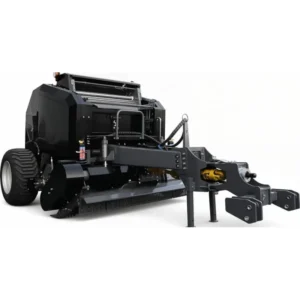
9YG-1.25 — Dual-Mode Pickup for Varied Grass and Corn Silage on 45–65 hp Tractors
The 9YG-1.25 extends the capability of the 1.25-series with a dual-mode pickup that switches between spring-tooth configuration for grass and hammer-claw for direct standing crop harvesting. This flexibility makes it a strong candidate for Korean farms that bale both meadow grass in summer and corn silage residue in autumn — two very different material handling tasks that this model handles within a single seasonal deployment on the same tractor. At 540 r/min PTO input, the dual-mode pickup reel operates at tine-tip speeds appropriate for each crop type without requiring a drive ratio change. Productivity in grass conditions typically achieves 40–80 bales per hour on well-prepared windrows in moderate-moisture conditions.
PTO Shaft and Coupling System: Connecting Older Tractors Safely
The PTO shaft that connects the tractor stub to the round baler gearbox input is a safety-critical component that older tractor fleet operators frequently underestimate. An undersized or worn shaft will fail under the torque peaks generated during bale core formation in dense grass windrows, with potential for the failed shaft to become a hazard. Beyond the mechanical failure risk, improperly guarded PTO shafts on older tractors are a leading cause of serious operator injuries in agricultural settings — a point that regulators in Korea, the EU, and Australia have all addressed through specific machinery safety legislation.
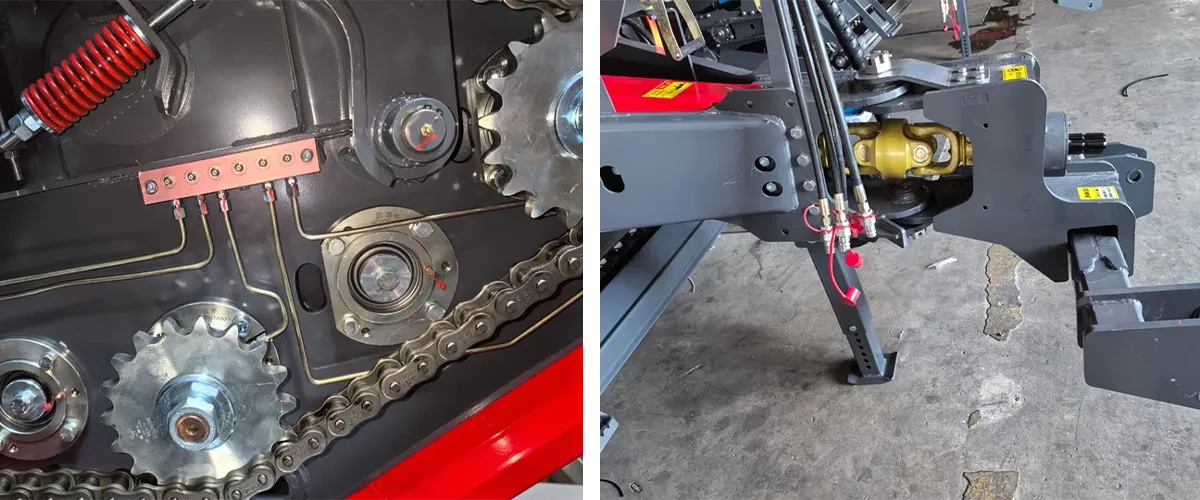
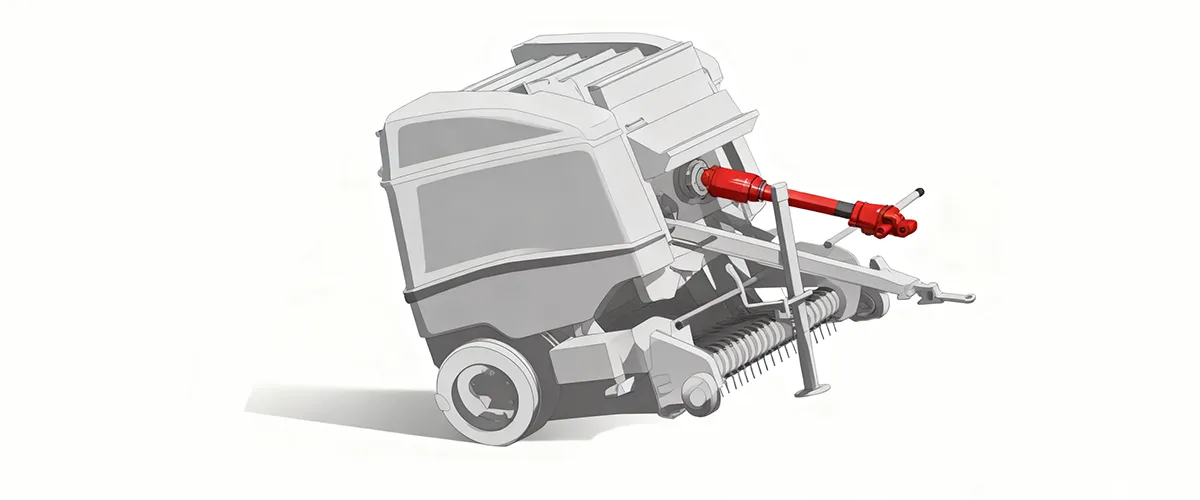
For 540 r/min operation across the 9YG-1.25 and 9YG-1.25A range, the PTO shaft specification is 1-3/8 inch (35 mm) 6-spline (Z6), adjustable length range 600 to 1200 mm, with torque transmission efficiency above 95% across the full length adjustment range. An integrated shear bolt or friction-clutch overrun protection in the shaft assembly is strongly recommended for older tractors, where the drivetrain may lack the electronic torque management systems found on newer machines. The overrun clutch absorbs the rotational energy stored in the baler chamber rollers when the tractor PTO is suddenly disengaged — preventing reverse torque from propagating back into the tractor gearbox at speed.
Shaft Length Note for Korean Tractor Models:
Korean-market tractors including TYM T-series and LS Mtron XP/MT-series use standard Category 1 and Category 2 hitches with PTO stub-to-hitch-pin distances that vary between models. Always measure the telescoping range required between tractor stub and baler input before ordering a fixed-length shaft. The adjustable-length EP-PTO shaft series (600–1200 mm) covers all common Korean compact tractor hitch geometries without requiring a custom-length order.
540 r/min vs 1000 r/min Round Baler: Practical Comparison for Grassland Operations
Many operators of older tractor fleets wonder whether upgrading to a 1000 r/min capable tractor — or fitting a speed-up box — would meaningfully improve round baler output. The table below provides an honest comparison based on grassland and pasture baling conditions relevant to Korean mid-scale holdings.
| Factor | 540 r/min Baler | 1000 r/min Baler | Verdict for Sub-60 ha Korean Farm |
|---|---|---|---|
| Tractor compatibility | All tractors 35 hp and above; all older Korean tractor models | Requires tractor with 1000 RPM PTO capability (usually 80 hp and above) | 540 r/min preferred |
| Bale output per hour (grass) | 20–80 bales/hr depending on model | 40–120 bales/hr on large machines | 540 r/min adequate for sub-60 ha seasonal volume |
| PTO shaft chain fatigue | Lower articulation cycles per hour; longer chain life | Higher articulation cycles; shorter chain replacement interval | 540 r/min preferred for lower maintenance cost |
| Gearbox torque load | Higher torque at lower speed; requires larger gear modules | Lower torque at higher speed; smaller gear modules feasible | Equivalent service life when correctly designed |
| Fuel efficiency | Lower engine speed for equivalent PTO output; 10–20% fuel saving typical | Higher engine speed required; fuel consumption proportionally higher | 540 r/min preferred |
| Capital cost of upgrade | No tractor upgrade needed; existing fleet compatible | May require tractor replacement or speed-up gearbox | 540 r/min strongly preferred |
Legal and Regulatory Framework: PTO Safety, Gearbox Standards, and Agricultural Machinery Compliance
Republic of Korea
Agricultural machinery in Korea is regulated under the Act on Development of Agricultural Mechanization, administered by MAFRA (Ministry of Agriculture, Food and Rural Affairs). PTO-driven implements including round balers must satisfy safety requirements for shaft guarding under the guidelines aligned with ISO 500-1, which specifies the minimum dimensions and retention requirements for PTO shaft guards on both tractor stubs and implement input flanges. Machines that meet MAFRA Agricultural Machinery Certification criteria become eligible for government mechanization subsidy programmes — a significant consideration for Korean farmers evaluating the net cost of a new round hay baler purchase. Farmers operating in designated grassland development zones may also access additional livestock-sector support funding for forage equipment.
The Korean Clean Air Conservation Act further supports baler adoption by prohibiting open-field burning of crop residues in most agricultural zones. Round baler operation is recognised as a compliant alternative residue management method, and this regulatory pressure has meaningfully expanded demand for baling equipment across Korean livestock farming prefectures, particularly in Gangwon, North Chungcheong, and South Jeolla regions where grassland acreage is greatest.
EU and Europe
In EU member states, round balers and PTO-driven implements fall under Machinery Directive 2006/42/EC (transitioning to EU Machinery Regulation 2023/1230 from 2027). CE marking is required for commercial sale, verifying compliance with essential health and safety requirements for guarding, emergency stop provisions, and stability during transport. ISO 11684 governs safety sign design on agricultural machinery across the EU. Separately, EN 12965 provides the technical specification for PTO driveshafts and shaft guards used in Europe — setting minimum wall thickness, guard clearance, and retention torque requirements that affect PTO shaft design for any round baler machine sold into European markets.
Japan
The Agricultural Mechanization Promotion Act provides a certification pathway for round balers imported or produced for Japanese use, managed through NARO (National Agriculture and Food Research Organization) performance testing. Japanese PTO standards follow the ISO 500 series, consistent with Korean requirements, meaning a machine certified for Korean use typically has compatible shaft spline geometry for Japanese compact tractor markets as well. Japanese JIS B 9700 (Safety of Machinery) overlaps substantially with EU Machinery Directive principles and is referenced in Japanese agricultural equipment procurement specifications.
United States
In the US, ASABE S203 defines PTO drive shaft dimensions and the 540/1000 r/min speed standards. Round baler gearbox design must also account for ASABE EP496.3 guidance on agricultural tractor PTO stub shaft configuration. No federal product certification is required for round balers before sale, but state-level road transport regulations apply when towing implements on public roads. California OSHA agricultural safety standards and similar state frameworks require documented PTO guarding compliance, particularly relevant for custom baling operations working across multiple farm sites.
Australia
Under the Australian Work Health and Safety Act 2011 and state model WHS regulations, agricultural machinery is classified as plant and subject to risk assessment obligations. Round baler gearbox and PTO shaft compliance is assessed against AS 4024 (Safety of Machinery series) and the National Code of Practice for Plant — both of which reference ISO standards for guard clearances and PTO shaft protection. Australian Standards also require that operators receive documented training on PTO-driven implement safety before unsupervised operation.
Compliance Reminder for Korean Buyers:
When sourcing a round baler from an overseas manufacturer, request documentation confirming ISO 500-1 PTO shaft guard compliance, CE marking certification where applicable, and MAFRA Agricultural Machinery Certification eligibility. These documents are required for subsidy application processing at Korean agricultural cooperatives. Confirm that the supplied PTO shaft assembly includes a functioning guard with retention clips — do not operate without them.
Practical Setup Guide: Connecting a Round Baler to an Older 540 r/min Tractor
The pre-connection checklist for attaching a round baler machine to an older tractor is longer than for newer equipment because older tractors may have worn hitch components, degraded hydraulic seals, or PTO stub shafts showing measurable spline wear. Taking fifteen minutes to verify these points before the first field session of the season avoids costly mid-season breakdowns and the field losses they cause when baling windows are short.
Step 1 — Verify PTO Speed Setting
Confirm the tractor PTO selector is set to 540 r/min, not 1000. On dual-speed tractors, the lever position or dashboard setting determines output speed independently of engine RPM. Mark the setting with a tag on older machines that lack clear cab labelling.
Step 2 — Inspect PTO Stub Splines
Wear on older tractor PTO stubs manifests as rounding of spline flanks and looseness when the shaft is pushed onto the stub. Excessive spline wear concentrates load on fewer teeth and accelerates shaft failure. Replace worn stubs before connecting a new baler.
Step 3 — Check Hitch Category and Height
Category 1 and Category 2 hitches differ in ball diameter and pin retention geometry. A baler hitch pin that fits loosely in the tractor lower link ball allows lateral oscillation that accelerates hitch wear and reduces steering response. Install spacer bushings if clearance exceeds 1 mm.
Step 4 — Test Hydraulic Flow
The round baler tailgate cylinder and net-wrap brake (on hydraulically controlled models) require a minimum hydraulic flow from the tractor auxiliary circuit. Test the hydraulic output before field use, particularly on tractors with older axial-piston pumps that may be delivering below rated flow at working temperature.
Optimising a 540 r/min Round Baler for Korean Meadow and Pasture Grass Conditions
Korean highland grasslands in Gangwon Province and the central mountain belt present specific challenges for round baler operation that are different from European or North American meadow conditions. Sward mixtures often include a broadleaf component alongside grasses, soil moisture is variable across hillside and valley floor positions within the same field, and summer rainfall events can change windrow condition between morning and afternoon baling runs within the same day.
For 540 r/min compact balers working these conditions, the key operational adjustments are forward speed management and pickup height calibration. Reducing forward speed by 20–30% in dense or moist windrow sections prevents overfeeding that leads to bale shape irregularities and — in worst cases — chamber blockage requiring manual clearance. Maintaining pickup gauge wheels at 40–60 mm above ground level on hillside terrain prevents tine contact with uneven soil humps while still collecting the majority of windrow material lying close to the surface. Experienced operators also adjust the chamber back-pressure (via the hydraulic control valve) slightly lower when starting a new bale in high-moisture conditions, allowing the bale core to form loosely before progressively increasing density as the bale reaches target diameter.
Net wrap application is another area where operator technique significantly affects bale quality. On moist silage bales, initiating the net wrap sequence one revolution earlier than the default setting ensures the outer 2–3 layers of material are fully bound before the tailgate opens for discharge. Bales that discharge partially wrapped tend to relax and lose shape on the headland — reducing silage fermentation quality and making subsequent wrapping by a bale wrapper more difficult. This is particularly important when baling with an older tractor that may have slightly slower hydraulic response times on the tailgate control circuit.
Compatible Components: PTO Shafts and Drive Chains for 540 r/min Systems
Running a round baler at 540 r/min on an older tractor demands that the connecting components between tractor and implement are appropriately rated and maintained. Two component types are particularly critical: the PTO driveshaft assembly and the internal drive chain set.
EP Agricultural PTO Shaft — 540 r/min Rated
The EP-पीटीओ शाफ्ट series for round balers uses a 1-3/8 inch Z6 spline, adjustable from 600 to 1200 mm, with torque transmission efficiency above 95% and integrated overrun protection. The wide length adjustment range accommodates both older short-tongue balers and newer long-tongue designs on the same shaft, avoiding the need for separate shaft purchases for each implement in a mixed fleet. Compatible with SAE and EURO flange standards, the EP-PTO shaft has been validated with LS Mtron, TYM, Dongyang, and major international tractor brands at 540 r/min output.
Agricultural Drive Chain — ANSI #50 for 540 r/min Baler Systems
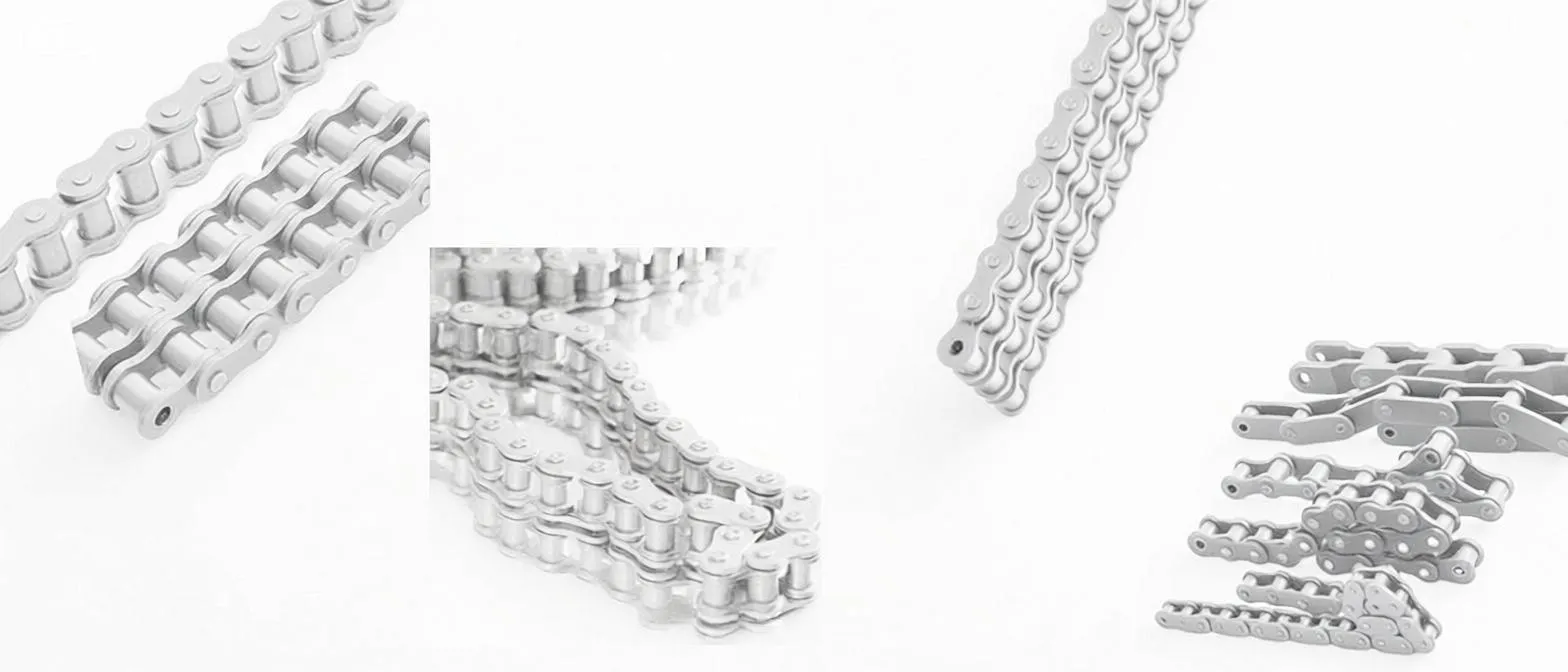
The drive chain inside a 540 r/min round baler operates at lower speed than a 1000 r/min equivalent, but at proportionally higher torque — particularly during bale core formation in dense grass. ANSI #50 alloy steel chains rated to 60 kN minimum tensile are the standard specification for the 9YG-1.25 and 9YG-1.25A models. Chain pitch of 15.875 mm (5/8 inch) with hardened rollers provides the balance of strength and fatigue resistance needed for 30–50 hour seasonal working cycles. Maintaining correct tension — 10–15 mm sag at midspan — and re-lubricating chain runs at the start of each baling day extends service life significantly beyond the first replacement interval.
About Our Round Baler Manufacturing Programme
Our agricultural machinery manufacturing programme was founded in 2013 and has operated continuously as an integrated production enterprise covering the full range of grassland harvesting and forage handling equipment. The product line spans light-duty compact round balers for small hay baler applications, heavy-duty commercial round baler machines for large-scale forage contractors, twin-blade and disc mowers, and raking equipment — providing a complete grassland management system from a single supply source.
Production facilities cover more than 60 large-format equipment units including CNC laser-cutting lines, automated robotic welding stations, and electrostatic powder-coating systems. Annual design capacity stands at 2,000 units. All production operates under ISO 9001 Quality Management System certification. Independent import and export rights allow direct supply to Korean, Australian, European, and North American markets without intermediary handling.
Our engineering team has specific experience adapting round baler specifications for the Korean and East Asian tractor fleet composition — including 540 r/min PTO optimisation, Category 1 hitch geometry, and bale size calibration for Korean barn and feeder standards. Enquiries for specifications, quotes, or technical compatibility confirmation for older tractor models are welcome through our contact channel.
Frequently Asked Questions
Which round baler models are compatible with 540 r/min PTO output on older Korean compact tractors?
How does running a round baler at 540 r/min versus 1000 r/min affect fuel costs for Korean grassland farmers?
What PTO shaft specification should I use when connecting a round baler to a 15-year-old TYM tractor in Korea?
Does a 540 r/min round hay baler qualify for Korean government agricultural machinery purchase subsidy?
What round baler parts are most often needed for 540 r/min systems after three or four seasons of grassland baling in Korea?
Can a small round baler designed for 540 r/min also run on a tractor with dual 540/1000 r/min PTO capability without damage?
संपादक: पीएक्सवाई