Agricultural Equipment Guide
What Is a Pre-Cutting System on a Round Baler and How Does It Improve Feed Quality?
A complete technical guide for livestock farmers, hay producers, and round baler operators across Korea and the Asia-Pacific region
If you run a livestock operation or produce forage for sale, you’ve likely heard the term “pre-cutting system” mentioned when comparing round baler models. But what does it actually mean in practice — and why do experienced hay producers consider it one of the most important features when choosing a round baler machine for high-volume work? This guide breaks down everything you need to know: how the mechanism works, what it’s made of, and the real-world difference it makes to silage and hay quality from the first bale of the season to the last.
A pre-cutting system — sometimes called a chopper or crop processor — is integrated into the pickup and feed zone of a round baler, positioned before the crop enters the compression chamber. As the baler picks up the windrow, the pre-cutting knives or blades slice through the stems at consistent, defined intervals. The result is a crop mass made up of shorter, more uniform particles instead of long tangled strands. This seemingly simple change has a measurable downstream effect on bale density, fermentation performance, animal intake, and ultimately on your operation’s feed efficiency numbers.
1. Action Mechanism: How the Pre-Cutting System Works
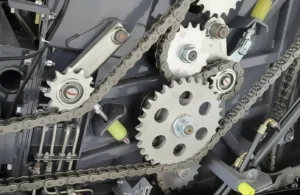
The pre-cutting system sits within the feed channel between the pickup header and the compression rollers. As the tractor’s PTO shaft — typically running at 720 r/min on models like the 9YG-2.24D series — drives the baler’s internal components, the pre-cutting assembly is powered in sync with the crop flow. On most modern round baler designs, a rotor fitted with hardened steel blades rotates at high speed directly across the path the crop must travel to reach the baling chamber.
The crop stream hits the rotating blades and is cut to a target chop length — commonly between 40 mm and 120 mm depending on the knife configuration and the number of active blades selected by the operator. The cut material is then fed forward by the intake rollers into the compression zone, where rollers or belts form the bale. Because the particles are shorter, they pack together more tightly and evenly, reducing air pockets and improving overall bale structure. The axial-flow semi-forced feeding mechanism — a design used in the 9YG-2.24D and 9YG-1.0 series — further reduces clogging and improves throughput compared to traditional cam-type pickups.
Operator interaction is straightforward. On most models, the number of active cutting blades can be adjusted from the outside of the machine — some configurations allow partial knife engagement so producers can choose between a standard cut for dry hay or a finer chop for fresh grass intended for silage wrapping. The sensor-controlled bale density system common to the 9YG series ensures that even with pre-cut material, bale diameter and density remain consistent from bale to bale, avoiding the loose-core problem that used to plague early attempts at in-baler chopping.
2. Manufacturing Structure: What the System Is Built From
The durability of a pre-cutting system depends almost entirely on how the knife rotor and housing are constructed. In high-output round baler work, the pre-cutting assembly is under enormous stress — it must shear through abrasive, silica-laden crop material at high speed for hundreds of hours per season without losing edge sharpness or structural integrity. Manufacturers that take this seriously use precision laser-cut steel plates for the rotor discs, with hardened-alloy blade inserts that can be reversed or individually replaced when they wear down.
The housing or cut-box surrounding the rotor is typically formed from thick-gauge structural steel using a combination of press-braking and robotic welding. Computer-aided design is used to optimize clearance between blades and counter-knives, because even a fraction of a millimetre in that gap makes a significant difference to cut quality and power draw. The counter-knife bar — the fixed row of blades that the rotor blades shear against — is mounted on a spring-loaded or hydraulically adjustable carrier, allowing the operator to open the gap when running coarse, fibrous material like corn stalks or closed it tight for fine hay cutting.
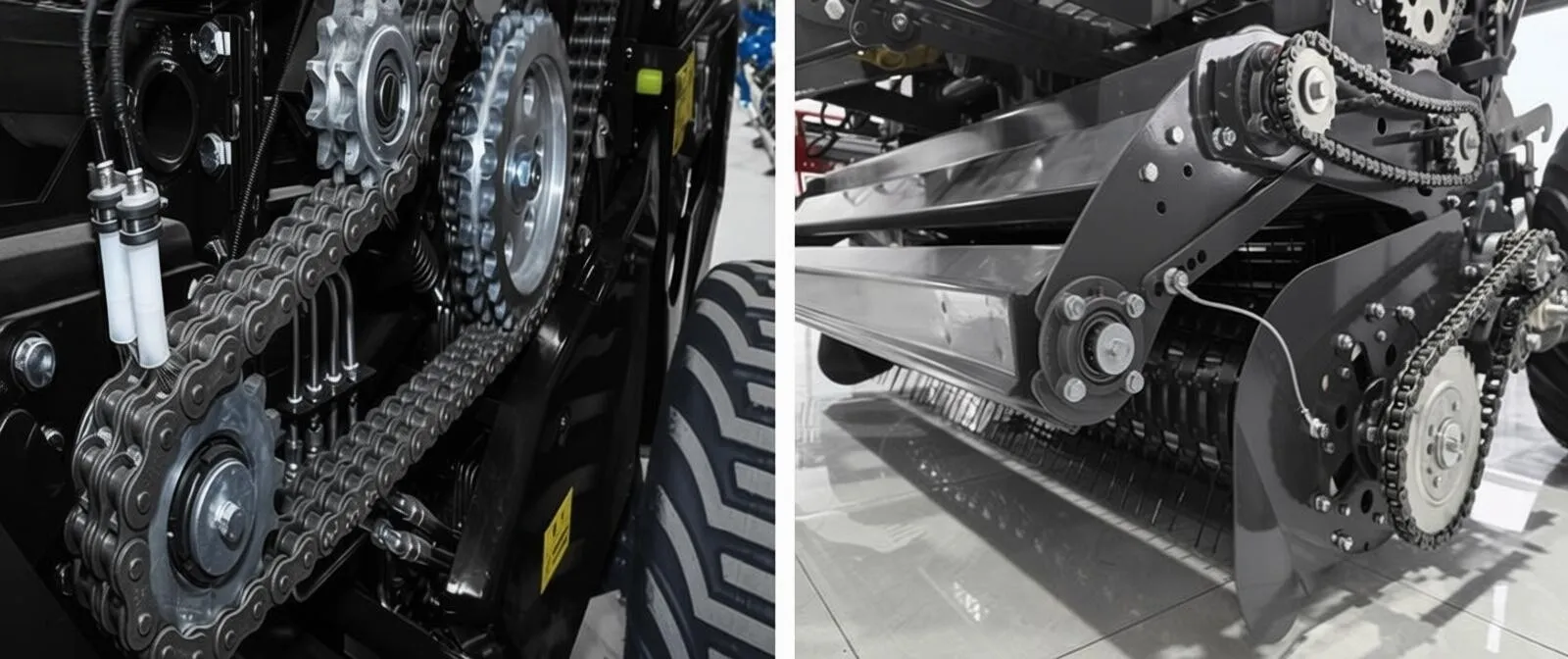
The entire pre-cutting module is integrated into the baler’s feed channel and in well-engineered machines, the module can be swung clear for inspection and maintenance without removing the pickup header. The chain and sprocket drive that links the cutter rotor to the main drivetrain is designed with a shear-bolt or slip-clutch overload protection device, preventing catastrophic damage if a stone or piece of wire enters the cutting zone — a critical feature for operation in the rocky or debris-prone fields common in parts of Korea’s agricultural regions.
3. Material System: The Steel and Alloys Behind the Blades
Not all cutting knives are equal. The performance gap between a low-cost pre-cutting assembly and a well-specified one often comes down to the alloy used for the blades and the heat treatment applied after machining. Quality-focused manufacturers specify boron-alloy steel or high-chrome cast iron for knife segments, both of which offer a meaningful improvement in wear life compared to standard medium-carbon steel. Boron steel, in particular, achieves a surface hardness in the range of 500–550 HBW after quenching — hard enough to hold an edge through abrasive dry grass but tough enough not to shatter under impact loading.
The counter-knives, which bear the brunt of the shearing load, are often made from through-hardened tool steel or Hardox-equivalent wear plate, providing a sharp shear edge that can be maintained by simply rotating or reversing the blade segments before full replacement. The rotor body itself — the shaft and disc assembly — is typically produced from normalized structural steel to balance strength with machinability, then surface-coated or electro-galvanised to resist the moisture and crop acid exposure that accelerates corrosion in baling operations.
The frame rails, feed channel walls, and pickup tine bars that surround the cutting zone are commonly produced from S355 or equivalent high-strength low-alloy structural steel. Manufacturers using CNC laser-cutting technology — as employed in the production of the 9YG series — can achieve the tight dimensional tolerances required for the knife-to-counter-knife gap without the manual fitting and shimming that older manufacturing methods required. This directly translates to more consistent cut quality across the life of the machine.
4. Impact on Bale Density and Structural Uniformity
One of the most tangible advantages of a pre-cutting system is the effect it has on bale density. When long, tangled crop stems enter the compression chamber of a round baler, they tend to bridge across the rollers and create irregular, loosely-packed zones — especially toward the bale core. Short-cut material flows more like a granular substance, filling voids progressively and allowing each successive layer of crop to compact against the one below it. The result is a denser, harder bale with a more consistent centre-to-edge density profile.
Higher bale density translates directly into practical benefits. A denser bale contains more dry matter per unit of volume, meaning you can store more feed in the same shed space or transport more feed in the same truck load. Sensor-controlled density management — standard on the 9YG-2.24D S9000 and Classic variants, which achieve a compression chamber diameter of φ1200 mm and a bale width of 1400 mm — ensures that even with pre-cut crop the sensor continues to regulate bale formation pressure, preventing the overpressure that can occur when cut material packs too quickly. Typical bale densities achievable with these systems range from 100 to 200 kg/m³ depending on crop type and moisture.
The structural uniformity of a pre-cut bale also matters for handling and storage. A bale with a soft core and hard outer shell is prone to deformation under its own weight during long-term storage, especially in warm climates. A uniformly dense bale keeps its shape, which reduces the number of split or misshapen bales that create handling problems and feed waste during the winter feeding season.
5. Fermentation Performance and Silage Quality
For wrapped round bale silage — a practice growing rapidly among Korean cattle and dairy farmers as they seek higher nutritional density forage — the interaction between chop length and fermentation quality is well established in the research literature. Shorter particle size increases the surface area of the crop mass available for lactic acid bacteria to colonise, accelerating the initial fermentation phase and pushing silage pH down faster. This matters because the window between wrapping and the point where pH falls below 5.0 is when the silage is most vulnerable to aerobic spoilage by yeasts and moulds.
A pre-cutting system that consistently delivers a particle length of 50–80 mm for ryegrass or legume silage, or 80–120 mm for drier hay crops, gives the fermentation process the best possible starting conditions. The cut particles also release more plant cell juice, which is rich in the water-soluble carbohydrates that fuel lactic acid fermentation. This is particularly important when making silage from low-sugar crops like mature grass or second-cut alfalfa, where fermentation substrate is naturally limited.
Beyond the fermentation phase, shorter particle length improves rumen function in cattle and sheep. Ruminants need a minimum amount of physically effective fibre to stimulate chewing and maintain rumen buffering, but research from multiple agricultural universities consistently shows that particle sizes between 40 and 80 mm achieve this requirement while also improving total dry matter intake compared to long-stemmed forage. Farms that switch from conventional round baling to pre-cut baling often report measurable improvements in daily milk yield and average daily gain within the first feeding season.
6. Pre-Cutting vs. Standard Baling: Key Differences at a Glance
The table below summarises the main practical differences between a standard round baler without a cutting system and a round baler equipped with a pre-cutting mechanism, across the metrics that matter most to commercial hay and silage producers.
| Parameter | Standard Round Baler | Round Baler with Pre-Cutting |
|---|---|---|
| Crop particle length | Uncontrolled (100–400 mm+) | 40–120 mm (adjustable) |
| Bale density | Lower; variable core | Higher; uniform 100–200 kg/m³ |
| Silage fermentation speed | Slower pH drop | Faster pH drop; better preservation |
| Animal dry matter intake | Moderate; sorting behaviour common | Higher; reduced sorting |
| Storage efficiency (dry matter/m³) | Lower | 10–20% improvement typical |
| Maintenance complexity | Lower | Moderate (knife inspection/rotation) |
| Power requirement (PTO) | 55–100 kW typical | 55–100 kW (marginal increase) |
| Suitability for silage wrapping | Acceptable | Recommended / optimal |
7. Round Baler Models — Specifications Overview
The following round baler models represent the main options available in the current lineup, each suited to different scale operations and tractor power ranges. Whether you are running a small round baler for a 40 hp tractor or scaling up to large-format baling with a 100 kW machine, the core engineering principles of the pre-cutting and feed systems described above apply across the range.
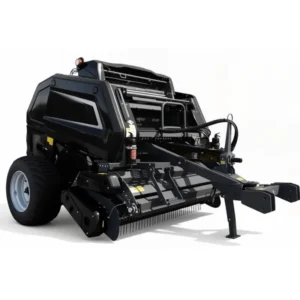
Pressa per balle rotonde 9YG-2.24D (S9000 Transcend)
Pickup width: 2240 mm | Chamber: φ1200 mm | Power: 55–100 kW | Bale density: 100–200 kg/m³ | Output: 40–100 bales/h
Features a dual-linked gearbox enabling 90° lateral rotation for tight-field manoeuvring. Tandem cross-joint PTO shaft with safety torque limiter protects drivetrain components during difficult conditions.
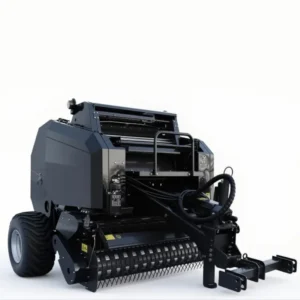
9YG-1.0 Round Baler (Mini)
Pickup width: 1900 mm | Chamber: φ1000 mm | Power: 48–80 kW | Bale size: Φ1100×1000 mm | Output: 40–100 bales/h
A small round baler optimised for lower-horsepower tractors. The axial-flow semi-forced feed mechanism reduces blockages and improves throughput by nearly double compared to conventional cam-type designs.
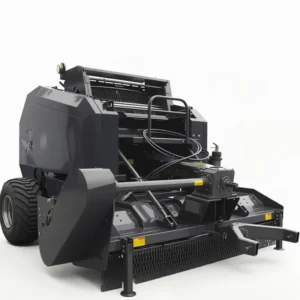
9YG-1.0C Round Baler (Corn Stalk Specialist)
Pickup width: 2400 mm | Chamber: φ1000 mm | Power: ≥69.8 kW | Hammer-claw pickup: 20 claws | Bale density: 115–200 kg/m³
Interchangeable spring-tine and hammer-claw pickup assemblies allow the operator to switch between hay collection and direct standing corn stalk baling without a separate windrowing pass.
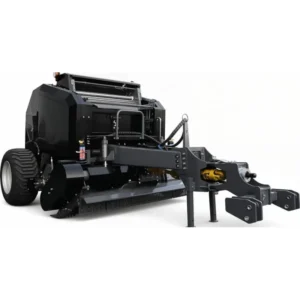
9YG-1.25 Round Baler (Double)
Pickup width: 2240 mm | Chamber: φ1200 mm | Power: ≥88.2 kW | Bale size: 1200×1250 mm | Output: 40–80 bales/h
Auger-plus-paddle-roller combined feed system handles mixed crop flows with less bridging. Interchangeable spring-tine and hammer-claw heads provide versatility across hay and stalk crops through a single season.
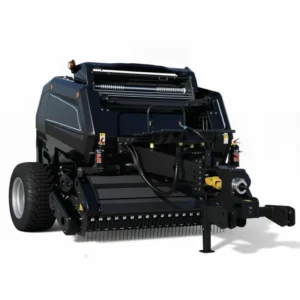
Pressa rotonda 9YG-1.25A
Pickup width: 2150 mm | PTO: 540–1000 r/min | Power: ≥75 kW | Bale density: 100–200 kg/m³ | Net wrap: 2000×1.25 m/bale
Wide PTO speed range (540–1000 r/min) makes the 9YG-1.25A compatible with a broader range of tractors, including older models with fixed-speed PTOs common on smaller Korean farms.
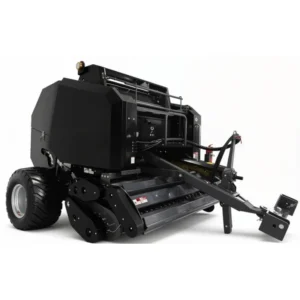
9YG-2.24D Round Baler (Standard)
Pickup: 2240 mm | 18 rollers (φ222 mm) | Power: 55–100 kW | Bale: φ1300×1400 mm | Weight: 3922 kg
The core 9YG-2.24D uses the same axial-flow feed mechanism with 18 compression rollers and sensor-controlled density management, making it a robust entry point for producers requiring consistent large-format bales.
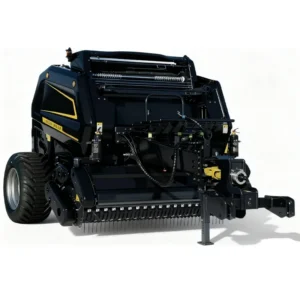
9YG-2.24D Round Baler (Classic)
Pickup: 2240 mm | H-type hydraulic fittings | Rear chamber: dual-side sprocket drive | Weight: 4312 kg | Output: 40–100 bales/h
The Classic variant features H-type sleeve-fit hydraulic connectors for higher working pressure and faster rear gate operation, alongside a buffer cylinder that dampens gate-close vibration to protect structural components.
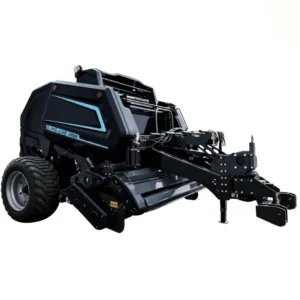
9YG-2.24D Round Baler (Transcend)
Dual 20A heavy-duty chains | Max hitch torque: 1000 Nm | Lateral steer: 100° | Tractor lateral tilt tolerance: 30°
The Transcend’s heavy-duty dual-side chains achieve noticeably higher compression pressure, enabling bale weights consistently in the 500–1000 jin range. The tilt-adjustable hitch solves terrain-tracking problems on uneven ground that limit conventional tow-type balers.
8. Round Baler Gearbox Standards and Regulations by Region
The gearbox is one of the most critical mechanical components in a round baler. It transfers power from the tractor’s PTO shaft to the machine’s internal mechanisms, and any design shortcoming here — insufficient rated torque, poor lubrication, inadequate bearing selection — will eventually result in premature failure. Understanding what regulations and standards apply to agricultural gearboxes in your region helps you evaluate supplier claims more objectively when sourcing a round baler.
| Country / Region | Applicable Standard / Regulation | Key Requirement |
|---|---|---|
| South Korea (한국) | Rural Development Administration (RDA) Farm Machinery Safety Certification; KS B 0006 / KS R | Agricultural machinery must pass RDA performance and safety testing. Gearboxes must conform to rated PTO speed standards (540/1000 r/min). Safety guards over exposed PTO shafts are mandatory under the Occupational Safety and Health Act (산업안전보건법). |
| European Union | Machinery Directive 2006/42/EC; EN ISO 4254-7 (Agricultural machinery — Safety — Forage harvesters) | CE marking required. Gearboxes must be rated for continuous PTO torque. Guards with interlock required around cutting zones. Risk assessment documentation mandatory. |
| United States | ASABE S493 (Safety for Agricultural Field Equipment); OSHA 29 CFR 1928 | PTO driveline guards and shear-bolt/slip-clutch overload protection expected. State-level equipment inspection programs vary. |
| Japan | Agricultural Machinery Act ; JIS B 9700 series (Safety of machinery) | Gearbox noise and vibration limits apply. Equipment entering the Japanese market is subject to Ministry of Agriculture, Forestry and Fisheries (MAFF) performance verification. |
| Australia / New Zealand | AS/NZS 4024.3 (Safety of machinery); Safe Work Australia Code of Practice for Plant | PTO shaft guarding requirements align closely with EU standards. State WHS Acts require suppliers to provide hazard information and safe operating instructions with each machine. |
| Russia / CIS | GOST R 52774-2007 (Self-propelled agricultural machines — safety); TR CU 010/2011 (Technical Regulation of the Customs Union on machinery safety) | EAC marking required for the Eurasian Economic Union market. Gearbox rated torque and efficiency specifications must be documented in the technical file. |
In South Korea specifically, the Rural Development Administration requires that all agricultural machinery sold through subsidised purchase programs meets approved performance criteria. Buyers who acquire round balers through the national agricultural machinery purchase support program (농기계 구입지원) should confirm that their chosen model has passed RDA testing and appears on the approved equipment list to qualify for subsidy — the gearbox specification and rated PTO torque are key factors in that evaluation.
9. Maintaining the Pre-Cutting System for Long-Term Performance
A pre-cutting system adds mechanical complexity to a round baler, and the additional wear items require a disciplined maintenance schedule to keep cut quality consistent over the life of the machine. The most important routine task is knife inspection and rotation. Cutting blades wear asymmetrically — the leading edge dulls faster than the trailing face — and most blade segments are reversible, meaning each knife can effectively deliver double the service life when rotated at the right time. For producers running high-volume operations (40+ bales per hour at peak season), a weekly knife check during the season is sensible.
The counter-knife gap should be checked and adjusted at the start of each season and whenever a noticeable change in cut quality is observed. A gap that has opened up due to wear or vibration-induced loosening will produce a torn rather than sheared cut, increasing the percentage of unchopped long fibres in the bale. The shear-bolt or slip-clutch in the rotor drive should be inspected after any stone or foreign object ingestion event — these components are designed to absorb the shock of an overload, so replacing them proactively after an event prevents undetected secondary damage to the rotor shaft bearings.
Lubrication points on the rotor bearings should follow the manufacturer’s grease specification — typically a lithium-complex NLGI 2 grease applied every 50 operating hours or at the interval specified in the operator manual. The chain drive that powers the rotor should be kept at correct tension and lubricated with chain oil rather than grease, as grease attracts crop dust that accelerates chain wear. At the end of each season, the entire pre-cutting module should be cleaned of crop debris, inspected for cracks or fatigue damage on the rotor discs, and stored with a light coating of protective oil on exposed steel surfaces.
10. Which Round Baler Configuration Is Right for Your Operation?
Choosing between a mini round baler, a mid-size round baler, and a large-format machine comes down to three things: the power output of your tractor, the scale of your operation, and the type of crop you are handling. For Korean farms with tractors in the 40–60 hp range, the 9YG-1.0 series is designed specifically for this power band — the axial-flow feed design keeps draft requirements low while maintaining throughput rates that make it practical for single-operator use without the physical fatigue of manual bale handling.
For producers running 100+ hp tractors and working large-scale hay production across paddy fields or upland grass areas, the 9YG-2.24D series in its S9000 or Transcend configurations offers the output capacity — 40 to 100 bales per hour — and the bale specification (φ1300×1400 mm, density up to 200 kg/m³) that supports commercial hay trading and silage contracting work. The dual 20A heavy-duty chains in the Transcend variant are specifically engineered for the higher bale density targets that export-grade hay buyers demand.
Producers handling both hay crops and corn or soybean stalks should consider models with interchangeable pickup assemblies — both spring-tine and hammer-claw configurations — which avoid the need for a separate machine for each crop type. This multi-crop flexibility is particularly relevant in Korea’s mixed-cropping farm landscape, where a single machine needs to perform across rice straw, ryegrass hay, and autumn corn stalk collections within the same calendar year.
Frequently Asked Questions
Redattore: PXY