Emergency Agriculture Guide
A detailed guide to the operational role of round baler machines in disaster-affected livestock regions — covering rapid deployment strategies, equipment specifications, between-farm logistics, manufacturing durability requirements, gearbox reliability under extreme conditions, and the regulatory landscape governing emergency agricultural machinery use worldwide.
When floods sweep through a river valley, when typhoons flatten standing forage crops, or when prolonged drought leaves pastures bare across entire provinces, livestock farms face an acute crisis that conventional supply chains are rarely prepared to resolve quickly. Feed depots run short. Transport networks break down. Hay sourced from unaffected regions arrives too slowly and at costs that threaten operations that were already running on thin margins. In these situations, the round baler machine becomes one of the most practically important pieces of agricultural equipment available — because it allows local forage resources, crop residues, and surviving vegetation to be harvested, compressed, and distributed as animal feed within hours of a decision to act.
This is not a theoretical scenario. In South Korea, typhoons and summer flooding events regularly disrupt livestock feed supply across regions such as Gyeonggi-do, Chungcheongnam-do, and the southern peninsula provinces where cattle and dairy operations are concentrated. In the United States, the American Relief Act of 2025 authorised USD 2 billion in Emergency Livestock Relief Program payments to offset feed cost losses following floods and wildfires in 2023 and 2024 — an indication of how large the scale of disruption can become. Across Russia, Kazakhstan, and Mongolia, seasonal drought and frozen pasture periods create recurrent episodes where stored feed is the difference between herd survival and catastrophic livestock losses. Understanding how round balers function in these conditions — and what makes a specific machine suited or unsuited to emergency deployment — is knowledge that livestock operations, agricultural cooperatives, and government disaster response agencies need before a crisis arrives, not during it.
1. Why Round Balers Are Central to Livestock Disaster Response
The core reason round balers matter in disaster response is logistics. Loose forage material — cut grass, standing crop residue, reed margins, river-bank vegetation — has an extremely poor density in its unprocessed form. Moving a meaningful quantity of loose hay across damaged roads, through flood-affected regions, or into temporary shelters where animals are being held is prohibitively slow and expensive. A round bale measuring ø1,300 × 1,400 mm and weighing 250 to 600 kg, as produced by machines in the 9YG-2.24D series, concentrates the feed value of a large volume of loose material into a weather-resistant, stackable, and transportable unit that can be moved efficiently on a standard trailer or loader and is inherently protected from rain and surface contamination by its net-wrapped outer surface.
A second reason is the speed of field-to-feed conversion. In a disaster scenario where a region still has standing or recently cut forage material — perhaps a hay field that escaped flooding, a cereal crop that was partially harvested before the event, or a conservation reserve area opened for emergency haying — the ability to deploy a round baler machine and convert that material to usable feed within hours is a meaningful capability that no other equipment type can match at field scale. The 9YG-2.24D series rates a productivity of 40 to 100 bales per hour at operating speeds between 5 and 35 km/h, meaning a full working day of 10 hours can yield 400 to 1,000 bales — enough feed supply to sustain a large number of livestock through an extended relief period. The 9YG-1.25 and 9YG-1.0 models provide comparable capability at smaller scale, suited to operations where lighter tractors or narrower field conditions apply.
A third consideration is the versatility of material that a well-designed round baler can handle. In disaster conditions, the ideal forage source is rarely available; what is available is whatever vegetation survived the event or is accessible within the local area. The axial-flow semi-forced feeding mechanism engineered into the 9YG series was designed to handle this variability: it processes dry cereal straw, wet grass, corn stover, reeds, and mixed-species swards equally well, without the blockages and throughput penalties that conventional passive-feed designs suffer when pushed outside their design crop type. For emergency deployment, this adaptability is not an optional feature — it is the primary attribute that makes a round baler useful under unpredictable field conditions.
2. Key Disaster Scenarios Where Round Balers Have Been Deployed
Emergency use of round balers occurs across a range of disaster types, each presenting different operational conditions that influence which machine specifications are most appropriate. Understanding these scenarios helps procurement officers, cooperative managers, and government relief coordinators select and pre-position equipment that will actually perform under the conditions it will encounter.
| Disaster Type | Primary Feed Challenge | Baler Role | Key Machine Requirement |
|---|---|---|---|
| Flood / typhoon | Stored feed destroyed or inaccessible; pasture submerged | Bale surviving unaffected forage for rapid redistribution | High moisture tolerance in feed mechanism |
| Drought | Insufficient pasture growth; feed reserve depletion | Bale emergency-hayed Conservation Reserve or roadside vegetation | Wide pickup for sparse windrows; high bale density |
| Wildfire / burned pasture | Pasture destroyed; air quality and field access issues | Collect remaining crop residues; bale buffer zone forage | Rapid mobility; reliable gearbox under dusty conditions |
| Winter freeze / blizzard | Transport cut off; pre-positioned bale stocks run out | Pre-disaster baling of maximum available forage | High throughput for pre-season stock building |
| Earthquake / infrastructure failure | Supply chain severed; feed imports unavailable | Local forage collection to replace external supply | Self-sufficient operation; minimal external parts dependency |
In South Korea, the Ministry of Agriculture, Food and Rural Affairs (농림축산식품부) has established pre-disaster inspection programs to identify vulnerable farm infrastructure in advance of the summer typhoon and heavy rainfall season. Round balers that are pre-positioned within agricultural cooperatives — and regularly serviced to ensure immediate readiness — represent a form of feed security infrastructure that complements these government inspections, providing the production capability needed to turn local forage into usable feed within the narrow window between a disaster event and the onset of critical feed shortages for livestock.
3. Manufacturing Structure: What Makes a Round Baler Suitable for Emergency Conditions
Emergency deployment places demands on a round baler machine that differ significantly from routine seasonal operation. Under normal conditions, a machine experiences relatively predictable crop types, prepared windrows, good traction surfaces, and access to workshop servicing. In a disaster scenario, the same machine may be asked to bale waterlogged reed in soft riverbank soil, collect half-dried alfalfa from an unfamiliar field, work on damaged access roads, and do so continuously over multiple days with minimal scheduled downtime. The manufacturing structure of the machine — its frame geometry, chamber design, drive system architecture, and hitch configuration — determines whether it can sustain this level of unpredictable use.
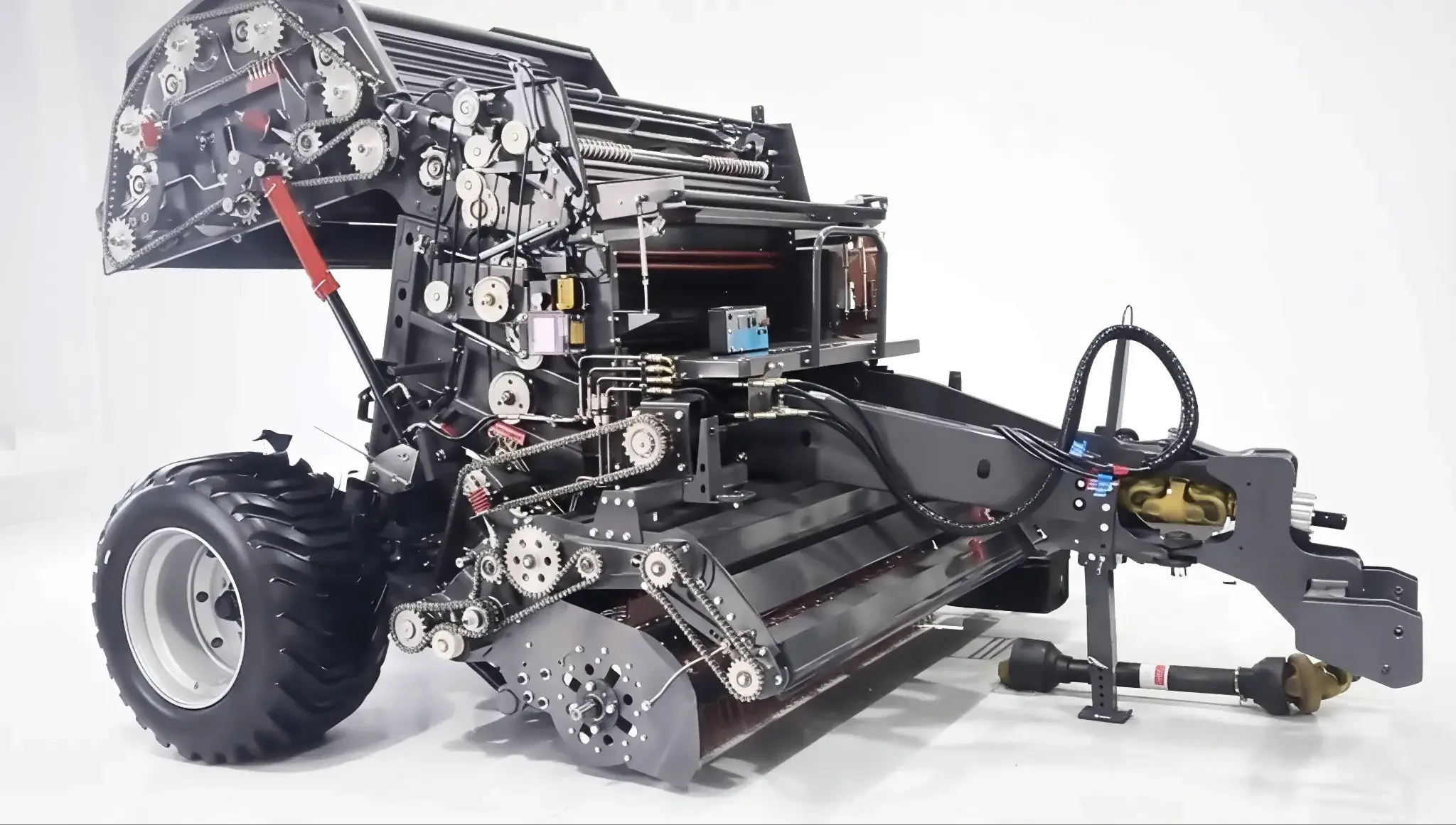
The 9YG-2.24D series uses a rigidly connected traction frame and gearbox assembly that maintains alignment across undulating and soft-ground terrain conditions. The dual cross-joint drive shaft with integrated safety torque-limiting protection prevents catastrophic driveline failure during the sudden load surges that occur when baling waterlogged or irregularly dense windrows — exactly the conditions produced in flood-affected fields. The dual-coupled gearbox design, allowing 90-degree lateral rotation in both directions without cutting PTO power, lets the machine complete tight headland turns on irregular terrain without interrupting the bale-building cycle, which matters enormously on fields with non-standard boundaries and obstructed approaches common in disaster-affected areas.
The roller-type compression chamber using 18 ø222 mm steel compression rollers on the 9YG-2.24D S9000 variant — or 16 rollers on the 9YG-1.0 series — distributes compression force across a large roller contact area rather than concentrating it in belt-lacing joints or fixed drive rollers. This design is significantly more tolerant of uneven crop density than belt-chamber alternatives, because individual rollers can flex independently against local density variations without creating the belt-slip events that cause bale asymmetry and wrapping failures in challenging conditions. For disaster feed applications where uniform bale shape is important for efficient transport and stacking, this structural characteristic translates directly into more usable bales per hour under adverse conditions.
| Model | Rollers | ピックアップ幅 | Power (kW) | Speed (km/h) | 生産性 | Bale Size |
|---|---|---|---|---|---|---|
| 9YG-2.24D (S9000) | 18 | 2,240 mm | 55–100 | 5–35 | 40–100 bales/h | ø1,300 × 1,400 mm |
| 9YG-2.24D (Classic) | 18 | 2,240 mm | 55–100 | 5–35 | 40–100 bales/h | ø1,300 × 1,400 mm |
| 9YG-1.25 (Double) | 18 | 2,240 mm | ≥75 | 5~20 | 40–80 bales/h | ø1,200 × 1,250 mm |
| 9YG-1.25A | 18 | 2,150 mm | ≥75 | 5–35 | 40–100 bales/h | ø1,300 × 1,250 mm |
| 9YG-1.0 | 16 | 1,900 mm | 48~80 | 5~20 | 40–100 bales/h | ø1,100 × 1,000 mm |
| 9YG-1.0C | 16 | 2,400 mm | ≥69.8 | 5~20 | 40–80 bales/h | ø1,000 × 1,250 mm |
4. Material System: Durability Requirements Under Disaster Field Conditions
The material system of a round baler is stress-tested far more severely in emergency deployment than in routine seasonal use. Disaster-affected fields present a combination of conditions that are individually demanding and collectively brutal: waterlogged ground, debris-laden windrows, extended continuous operating hours, minimal between-field servicing time, and temperatures that may be extreme in either direction. The metallurgical and mechanical specifications of the drive chains, roller surfaces, pickup tines, and hydraulic components determine whether the machine can sustain output through these conditions or becomes a liability that breaks down at the worst possible moment.
The dual-sided heavy-duty 20A roller chain used in the rear compression chamber of the 9YG-2.24D S9000 variant is the key material choice that distinguishes its disaster-readiness from lighter-specification machines. Heavy 20A chain has significantly higher tensile breaking strength and superior elongation resistance compared to standard 16A chain — meaning it tolerates the repeated shock loads generated when the compression chamber encounters a surge of wet, dense, or tangled material without the chain stretch that causes roller-speed variation and bale density inconsistency. For emergency operations where a machine may be run continuously for 12 to 14 hours, this difference in chain grade materially extends the interval before tensioning adjustment is required, reducing the frequency of field stoppages that compound rapidly during a relief operation.
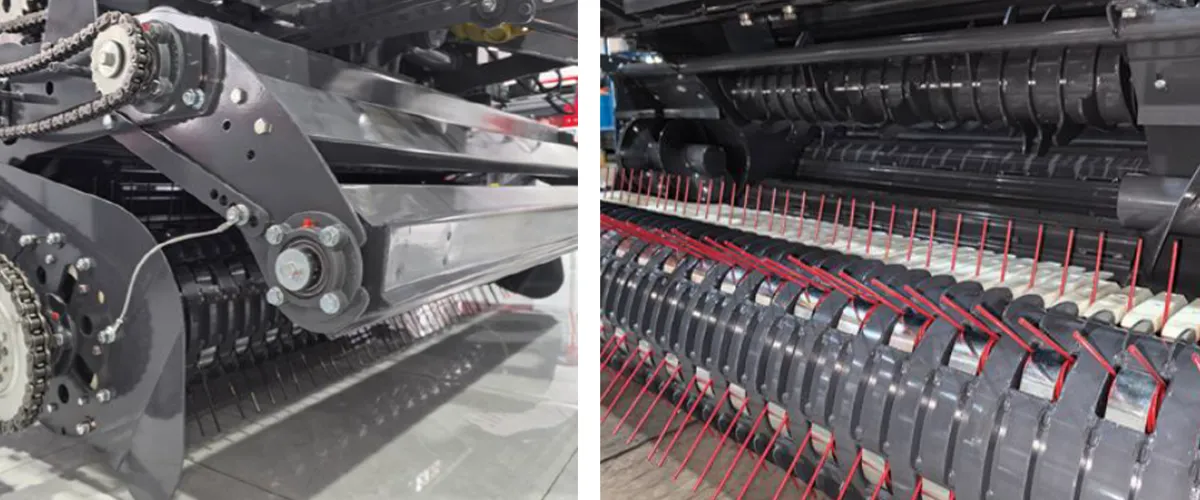
The spring-tooth pickup tines are manufactured from high-temper spring steel that deflects on contact with debris — stones, soil clumps, submerged roots — without permanent deformation or fracture. In flood-affected fields where the surface has been disturbed by water flow and may contain embedded debris not visible in the windrow, this elasticity is a damage-mitigation feature rather than a secondary characteristic. The camless, no-guard-ring pickup mechanism eliminates the most failure-prone component in conventional pickup designs — the cam follower track — removing a source of breakdown that, in a disaster context, would force a multi-hour repair with potentially no available workshop or spare parts within reasonable distance. For the 9YG-1.0C’s hammer-claw pickup variant, with its 20 rotating claw units across a 2,400 mm working width, the same principle applies: the claw design handles coarse, irregular material without the tine-bending failures that rigid-tooth pickups experience on post-disaster field surfaces.
5. Round Baler Gearbox Reliability in Emergency and Extended-Use Conditions
The round baler gearbox is the most mechanically stressed component in any extended emergency baling operation. It receives PTO input at 720 r/min on the 9YG-2.24D and 9YG-1.25 standard models, or across a range of 540 to 1,000 r/min on the 9YG-1.25A, and distributes this torque simultaneously to the pickup drive, the feed roller array, and the compression chamber roller system. Under normal seasonal conditions, the gearbox cycles through these loads in relatively predictable patterns. In a disaster-response context, the loading is irregular, often sustained at peak levels for extended periods, and occurs under ambient conditions — high humidity, dusty wildfire smoke, extreme cold — that are outside the gearbox’s standard design operating envelope.
The dual-coupled gearbox design in the 9YG-2.24D S9000 addresses the emergency deployment requirement for navigability across non-standard terrain: its 90-degree lateral rotation capability — with the tractor maintaining maximum lateral tilt of 30 degrees — allows the baler to operate on slopes, irregular paddock shapes, and approach routes that would immobilise a fixed-frame machine or require dangerous tractor maneuvers to navigate. In a flood-response context where access to fields is through compromised tracks and the geometry of available forage areas is determined by the pattern of damage rather than by agricultural planning, this mobility characteristic is directly related to how much feed can be produced per available hour.
The new-design traction hitch on the S9000 variant, with a maximum torque rating of 1,000 Nm and a self-developed dual cross-joint PTO shaft with integrated safety torque protection, is specifically engineered for the sudden, high-torque events that occur during emergency harvesting of dense or debris-laden windrows. This protection prevents the catastrophic driveline failures that have ended round baler deployments on emergency haying operations — events where a single rock or root mass, encountered without warning, transmits a torque surge through the PTO shaft that breaks an unprotected universal joint and puts the machine out of service at the worst possible time. Gearbox oil should still be checked after every 50 operating hours even during emergency use, with a spare oil supply maintained on the relief transport vehicle.
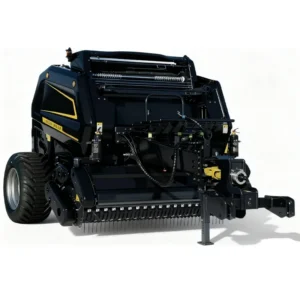
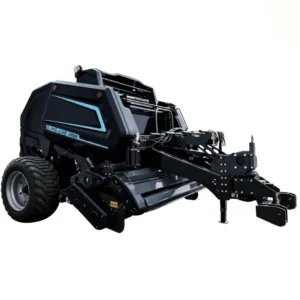
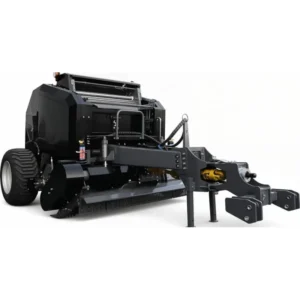
6. Round Baler Models for Disaster Relief and Emergency Feed Operations
7. Regulatory Frameworks Governing Emergency Agricultural Machinery Use
Government disaster response programs in key livestock-producing markets have developed specific legal and administrative frameworks that affect how round balers and other agricultural machinery are deployed, subsidised, and operated during declared emergencies. Understanding these frameworks is important for cooperatives, government procurement officers, and commercial operators who need to act quickly and compliantly when a disaster event triggers the need for emergency baling operations.
韓国
In South Korea, agricultural disaster response is coordinated through the Ministry of Agriculture, Food and Rural Affairs (농림축산식품부, MAFRA) under the framework of the Countermeasures Against Natural Disasters Act (자연재해대책법) and the Rural Development Administration’s (농촌진흥청, RDA) technical response protocols. Following typhoons, flooding, or drought events that disrupt livestock feed supply, the government can activate emergency haying provisions and coordinate the deployment of pre-registered agricultural machinery — including round balers — through regional agricultural cooperatives. The Agricultural Machinery Purchase Subsidy (농업기계화 지원사업) applies in normal procurement cycles and, in declared disaster zones, emergency procurement pathways may allow faster acquisition of critical equipment. Machinery used in emergency operations must still comply with standard Road Traffic Act (도로교통법) transport requirements, including width and weight notification for large balers. Gearbox and drivetrain safety must meet RDA certification standards, and PTO shaft guarding requirements remain in effect regardless of emergency status.
United States
The United States has the most developed legislative infrastructure for livestock disaster response globally. The American Relief Act of 2025 authorised USD 2 billion for the Emergency Livestock Relief Program (ELRP), administered by the USDA Farm Service Agency (FSA), to offset feed costs for livestock producers affected by drought, flooding, and wildfire in 2023 and 2024. The USDA can also authorise emergency haying and grazing of Conservation Reserve Program (CRP) acres, allowing round baler operations on normally restricted land. The Emergency Assistance for Livestock, Honeybees, and Farm-Raised Fish Program (ELAP) covers expenses associated with transportation of feed to livestock, which directly supports the logistics value of compact round bale units. Under OSHA 29 CFR 1928.57, PTO shaft master shields and all driveline guards must remain in place during emergency baling operations — emergencies do not suspend equipment safety requirements.
European Union
In the EU, agricultural disaster response is largely managed through national agricultural ministries, with co-financing available through the European Agricultural Guarantee Fund and the European Agricultural Fund for Rural Development for eligible disaster-related losses. Agricultural machinery deployed in disaster response must comply with the Machinery Directive 2006/42/EC regardless of operational context. PTO shaft guarding under EN ISO 5674 and gearbox safety marking under EN ISO 11684 remain mandatory. Some EU member states, including Germany and France, have specific emergency agriculture response protocols that allow pre-registered cooperative machinery pools to be mobilised rapidly under regional agricultural disaster declarations — a model that round baler equipment is well suited to participate in given its broad utility across crop types.
Russia, Kazakhstan, and EAEU
In Russia and the EAEU, agricultural disaster response is coordinated through regional agricultural departments under Russia’s Federal Law on Agricultural Development No. 264-FZ and emergency provisions of GOST R 53056 for agricultural machinery safety. Technical Regulation TR CU 010/2011 on machinery safety applies to all equipment including emergency-deployed balers. EAC conformity certification remains a requirement for imported equipment. Kazakhstan operates a parallel disaster forage response framework under the Ministry of Agriculture, with cooperative haying programs activated during drought years — the 9YG-1.25A’s broad PTO compatibility range of 540 to 1,000 r/min makes it particularly suited to the diverse tractor fleet found across Kazakhstani agricultural cooperatives.
Mongolia
Mongolia experiences recurrent dzud events — extreme winter conditions that kill livestock through starvation when snow cover prevents grazing — that represent one of the clearest examples of pre-positioned round bale stock as an emergency survival resource. The Mongolian Ministry of Food, Agriculture and Light Industry coordinates national hay reserves that are partly built up through contracted round baling operations during the summer season. Equipment deployed in these operations must meet the safety standards of the Mongolian National Standard MNS (Mongolian Standards), which reference EAEU machinery safety principles for imported equipment. Round balers operating in Mongolian summer haying programs must be capable of completing their harvest season rapidly, given the short growing season and the direct link between seasonal bale inventory and winter livestock survival rates.
8. Emergency Deployment Logistics: Moving and Operating a Round Baler Under Crisis Conditions
The logistics of deploying a round baler in a disaster response context differ fundamentally from routine seasonal transport. Road conditions may be compromised by flood damage, debris, or emergency vehicle traffic. Farm access routes that are normally suitable for standard tractor-baler combinations may be blocked or limited to lighter vehicles. The operator may need to work with an unfamiliar tractor from the receiving farm rather than their own equipment — a situation where broad PTO compatibility and a straightforward hitch connection are practically important rather than marginal conveniences.
The 9YG-2.24D series is configured for towed-type attachment, which makes it independent of a specific tractor’s three-point hitch geometry — a significant advantage in emergency deployment where the available tractor may not match the baler’s standard configuration. The horizontal traction frame can be adjusted for the available tractor’s hitch-arm connection height, and the dual cross-joint PTO shaft accommodates alignment variations within the standard hitch-coupling tolerance range. The overall working-state dimensions of 4,600 × 3,010 × 2,370 mm for the S9000 model require attention during road transport on damaged routes, and the 2,600 mm track width should be confirmed against any bridge or culvert weight restrictions on access routes before deployment.
For smaller-scale emergency deployment — a cooperative assisting a cluster of family farms, for example, or a government agency pre-positioning equipment at a regional hub — the 9YG-1.0 with its lighter 2,640 kg structural weight and compact working dimensions of 3,750 × 2,300 × 2,020 mm offers easier transport and better access to restricted farm approaches. Its 48 to 80 kW power requirement means it can be operated with a wider range of available tractors, and its productivity of 40 to 100 bales per hour remains sufficient to address feed shortages across the 10 to 20 farm scale that represents a typical cooperative relief operation.
Minimum Parts and Supplies for Emergency Round Baler Deployment
Full replacement set of pickup tines — the highest-frequency wear item in debris-laden post-disaster fields. Replace any bent or missing tines immediately before each field to maintain collection efficiency.
Drive chain repair sections — two to four links of the appropriate chain grade (20A for S9000 variants; 16A for 9YG-1.0C). A broken chain link is a 30-minute field repair if the links are on the machine; a two-hour delay if they are not.
Hydraulic seal repair kit for the chamber door circuit — small seals, large consequences if they fail on a high-cycle emergency day.
Net roll stock sufficient for two full production days. Running out of net is a foreseeable event that stops production entirely; it is not a supply failure, it is a planning failure.
Gearbox oil — one additional litre of the specified grade for mid-deployment top-up, and a dipstick check after every 50 hours of continuous emergency operation regardless of how pressured the schedule is.
9. About Our Round Baler Manufacturing
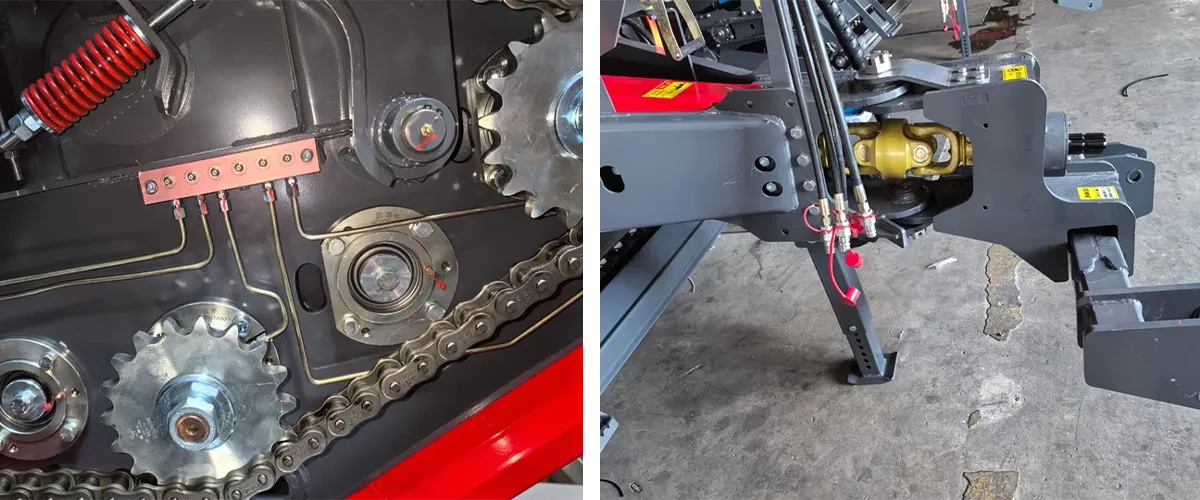
The 9YG round baler series is manufactured at an ISO 9001-certified facility with a total building area of over 32,000 m², two dedicated production lines (round balers and mowing/raking equipment), and an annual capacity of 2,000 units per line. The facility is equipped with CNC laser cutting, automated welding lines, and electrostatic coating systems, and the product range holds close to 100 registered patents — including exclusive rights to the axial-flow semi-forced feeding mechanism and the camless pickup design central to the machine’s performance in challenging field conditions. The product range has received the Best Innovation Award at the 12th Jiangsu International Agricultural Machinery Expo, an AAA Credit Enterprise rating, and a Quality Trustworthy Products designation, and has been exported to Russia, Mongolia, Belarus, and Kazakhstan with sustained market share growth in multi-season performance data.
10. Pre-Disaster Preparedness: Building Round Bale Stock Before a Crisis Arrives
The most effective use of a round baler in disaster management is not reactive deployment after an event — it is proactive stock-building before the risk season begins. In South Korea, this means maximising hay and straw baling output during the May-to-September growing season, before the typhoon and autumn flood period that runs from late August through October. A cooperative with a full-specification round baler running at 60 bales per hour for 200 productive days per season can theoretically generate 12,000 bales of stored feed reserve — sufficient to sustain hundreds of cattle through a multi-week feed disruption event. The economic calculation for pre-positioning this stock is straightforward: the cost of pre-baled emergency reserves is far lower than the cost of purchasing emergency hay at crisis prices, and it avoids the welfare implications of livestock distress and mortality during supply gaps.
In Mongolia, where dzud events have historically caused livestock mortality rates of 20 to 30 percent in affected regions, national hay reserve programs explicitly rely on contracted round baling operations during the brief summer window to build the winter buffer that determines survival rates. The round baler machine’s role in this context is not incidental — it is the primary conversion tool that transforms the short Mongolian summer into a winter feed reserve, and the productivity and reliability of the specific machine determines how much of the available forage window is successfully captured as storable feed before the season closes.
For operations evaluating a round baler for sale as part of a disaster preparedness investment, the selection criteria should weight mechanical reliability and throughput above all other factors. A machine that produces 30 more bales per day than a cheaper alternative adds up to hundreds of additional bales per season — each one a unit of feed security that costs nothing to hold once it is in storage. Net-wrapped bales in the 9YG series retain their structural integrity for 6 to 12 months outdoor storage, meaning spring and early summer baling activity directly contributes to the autumn and winter reserves that are most likely to be needed in a weather-related disruption.
| Preparedness Action | Timing | Machine Role | Relevant Model |
|---|---|---|---|
| Build summer hay reserve | May–August | Maximum throughput baling of all available forage | 9YG-2.24D (any variant) |
| Bale post-harvest straw before typhoon season | Jul–Aug (Korea) | Rapid residue collection from grain fields | 9YG-2.24D, 9YG-1.25 |
| Equipment service and readiness check | Before each risk season | Ensure immediate deployability; update parts stock | All models |
| Emergency-hay marginal vegetation | Immediately post-event | Collect reed, roadside grass, untouched pasture sections | 9YG-1.0C (coarse), 9YG-1.0 (light) |
| Relief bale transport and distribution | Within 24–72 hours of event | Deploy pre-positioned bale stock to affected farms | All models (source stock) |
11. Net Wrap and Bale Integrity: Keeping Emergency Feed Usable in Storage
The integrity of net-wrapped round bales during storage is a directly practical concern in disaster feed scenarios where bales may need to be held outdoors for extended periods before distribution or use. A bale that is poorly wrapped, improperly stored, or produced with insufficient density for its net coverage can deteriorate rapidly under wet conditions — losing 15 to 25 percent of its dry matter value in outer-layer spoilage over a six-month storage period. In a disaster feed context, this waste is not just an economic loss; it is feed that was counted on for animal welfare and is no longer available when needed.
All models in the 9YG series use automatic net wrapping with sensor-triggered initiation, ensuring that every bale reaches the wrapping cycle at the same density regardless of crop variability or operator fatigue. The net roll specifications are matched to each bale format: the 9YG-2.24D uses 2,000 × 1.4 m net rolls producing complete coverage of ø1,300 × 1,400 mm bales; the 9YG-1.25 uses 2,000 × 1.25 m rolls for its ø1,300 × 1,250 mm bales; and the 9YG-1.0 uses 2,000 × 1.0 m rolls for its compact ø1,100 × 1,000 mm format. The overlapping net application creates a weather-shedding outer surface that protects against rain penetration during the outdoor storage periods typical of disaster-scenario bale stockpiling. Bales stored on elevated timber bearers, with good drainage beneath and clear separation from standing water, consistently retain more than 90 percent of their nutritional value over six months under these net wrap specifications.
Frequently Asked Questions
編集者: PXY