PASTURE & MEADOW GRASS BALING
A technical guide for forage farmers, livestock producers, and agricultural engineers working with multi-species swards. Whether you are evaluating a small round baler for a compact paddock or a heavy-duty round baler for large-scale pasture operations, understanding how a round baler processes mixed plant material is essential to making the right equipment choice.
Mixed-species pastures present a challenge that single-crop hay fields simply do not. When ryegrass, orchardgrass, white clover, red clover, vetch, and bromegrass grow side by side in the same sward, their stem diameters, leaf textures, moisture contents, and aerodynamic behaviors differ substantially from one another. A round baler moving through such a field must lift every species uniformly, feed them at a consistent rate, and compress them into a well-formed, dense bale — all without letting the pickup mechanism preferentially gather the heavier, stiffer grasses while the fine-leaved legumes scatter to one side or blow through the rotor.
This article examines the engineering design principles that allow a modern round baler to handle this variability, from pickup tine geometry and rotor-feed interaction to bale chamber compression ratios and wrapping tension calibration. We also look at how real-world pasture conditions — moisture gradients, windrow irregularity, and terrain slope — affect pickup performance, and what design solutions specifically address these failure modes.
1. Understanding the Mixed-Species Pickup Challenge
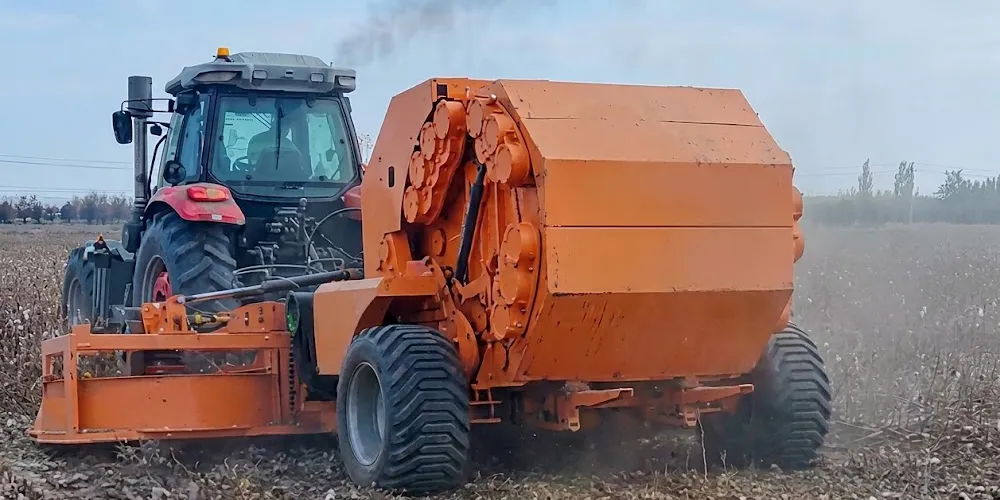
The term selective pickup failure describes what happens when a baler’s gathering mechanism consistently lifts one plant type while leaving another behind. In a pure-stand ryegrass field, the windrow behaves predictably: uniform stem weight, similar drag coefficient, and consistent moisture level allow the spring-tine pickup to engage evenly across the swath. Introduce a mixture of tall fescue, birdsfoot trefoil, and alsike clover into the same windrow, and the situation changes immediately.
Clover leaves are wide and flat, with a high moisture-to-weight ratio early in the season. They tend to mat together and resist the upward flick of a standard pickup tine. Vetch has a climbing stem structure that wraps around tines rather than being lifted by them. Bromegrass produces a seed head that is top-heavy and prone to shedding during aggressive tine action. Each of these properties demands a pickup system with enough flexibility to accommodate all species simultaneously, which is a significantly harder engineering target than a single-species design.
Compounding this is the issue of windrow density variation. A mower that cuts a mixed sward in a single pass produces a windrow whose cross-section varies from left to right, with heavier grasses accumulating on one side and fine-leaved legumes clustering on the other. If the pickup width is too narrow, the outer edges of the windrow are left unprocessed, reducing effective field efficiency and creating uneven bale density. If it is too wide without proper gathering control, material flows unevenly into the feed rotor and causes the bale core to form off-center — a problem that becomes a wrapping and discharge failure later in the cycle.
Understanding these failure modes is the starting point for appreciating why pickup design, feed rotor geometry, and bale chamber configuration are all interconnected aspects of a round baler’s ability to handle mixed pasture effectively.
2. Mechanical Structure of the Pickup System
2.1 Spring-Tine Pickup Design
The spring-tine pickup is the primary ground-contact mechanism of a round baler. Tines are mounted in staggered rows on a rotating drum, and their tips trace an elliptical path that dips below the crop windrow, lifts material upward, and transfers it rearward toward the feed rotor. For mixed-species pastures, the critical parameters are tine tip speed, tine angle at maximum penetration, and the clearance between tine tips and the stripper bars that separate lifted material from the tines.
A tine tip speed that is too low relative to the tractor forward speed creates a lag condition where fine-leaved clover and vetch are dragged rather than lifted. This bruises legume leaves and reduces the percentage of leaf material that actually enters the bale chamber — a nutritional loss that matters significantly when the baled forage is intended for high-performance dairy cattle. Conversely, too high a tip speed throws material over the feed rotor rather than delivering it smoothly, causing flutter losses on the fine-stemmed species.
The optimal tip speed ratio for mixed forage is typically between 1.2 and 1.6 times the machine’s forward travel speed, with the upper limit reserved for denser windrows where a more aggressive lift is needed. The 9YG-2.24D Round Baler S9000, with its 2240 mm pickup width and spring-tooth type pickup structure, provides a wide working swath that minimizes the need for multiple passes over the same area — an important factor when managing fine legume losses at the field edges.
2.2 Stripper Bars and Crop Transfer
Stripper bars serve the critical function of removing lifted crop from the tines as the pickup drum rotates. In mixed-species applications, the spacing and geometry of these bars must accommodate the varying stem thicknesses present in the windrow. A bar spacing designed for pure ryegrass may be too narrow for broadleaf species such as red clover, causing material to bunch and create a bridging plug that reduces throughput. Most commercial round balers designed for pasture use include adjustable or spring-tensioned stripper bars that float slightly to accommodate varying crop volumes.
The transfer zone between the pickup tines and the feed rotor is also where windrow irregularity becomes most damaging. A windrow that is thicker on one side enters the feed zone asymmetrically, leading to lateral bale density variation. Well-designed balers address this with crop deflectors above the pickup that redistribute flow horizontally before material reaches the rotor.
2.3 Round Baler Feed Rotor and Dial-Tooth Roller Design
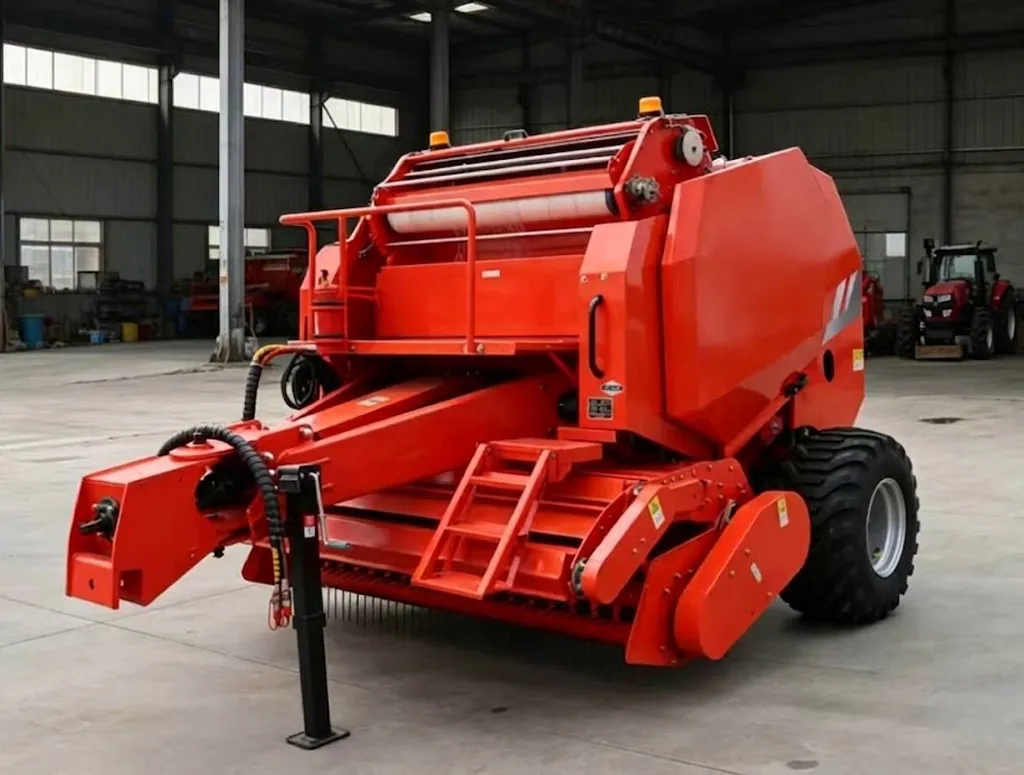
The feed rotor accelerates incoming crop material from the pickup and channels it into the compression chamber. In the 9YG-2.24D S9000, this takes the form of a dial-tooth roller plus drum-type feed structure, a configuration specifically chosen for its ability to handle coarse-fibered stems alongside fine leafy material without the blockages that plague simpler auger-based systems.
The toothed geometry of the feed rollers grips individual stems rather than relying on friction alone. For mixed pastures containing both slippery wet clover leaves and dry, stiff grass stems, this mechanical engagement ensures that no single plant type is selectively excluded. The drum portion of the feed system maintains material momentum through the critical transition zone, preventing the sluggish feeding behavior that often leads to bale core softness or off-center core formation in multi-species windrows.
3. Material System — What Goes Into a Round Baler Built for Pasture Grass
The materials used in construction directly affect how well a baler tolerates the abrasive and corrosive conditions found in pasture environments, where plant sap, morning dew, and mineral-laden soil particles combine to accelerate wear on contact surfaces. The table below outlines the key structural materials and their roles in a pasture-duty round baler.
| Component | Material | Function in Mixed Pasture Context |
|---|---|---|
| Pickup Tines | High-carbon spring steel | Maintains tine geometry under lateral loading from tangled vetch and wetted clover mats; spring-back prevents permanent deformation on stone contact |
| Pickup Drum Shell | Structural steel, hot-dip galvanized | Resists corrosion from acidic silage moisture; galvanizing extends service life in high-humidity meadow environments |
| Feed Rollers (Dial-Tooth) | Hardened alloy steel teeth | Grips both fine legume stems and coarse-fibered grass stems without selective slippage; tooth geometry prevents wrapping on wet material |
| Compression Rollers | Alloy steel, machined bore, Phi 222 mm diameter | 18-roller configuration distributes compression force across the bale perimeter; prevents localized pressure points that cause bale shape distortion in mixed-density material |
| Drive Chains | 20A heavy-duty roller chain, dual-sided | Delivers 100 to 200 kg/m3 bale density consistently across varying pasture crop types; dual-sided arrangement eliminates lateral torsional fatigue |
| Main Frame | Heavy-gauge welded structural steel | Withstands torsional loads from uneven pasture terrain; electrostatic powder coating provides long-term corrosion resistance in outdoor storage conditions |
| Bale Wrap Net | UV-stabilized polyethylene mesh | Accommodates the irregular surface profile of mixed-species bales; net wrapping conforms to clover-enriched bale surfaces better than twine, reducing bale shape loss |
| Traction Device | High-tensile steel, 1000 Nm rated torque | 100 degree lateral steering and 30 degree tilt adjustment allow the baler to follow uneven meadow ground profiles without transmitting damaging moments to the PTO driveline |
4. Bale Chamber Configuration and Compression Dynamics
The compression chamber of a roller-type round baler is where most of the species-related density problems either get resolved or get locked in permanently. Unlike belt-based chambers that provide relatively uniform pressure across the full bale face, a roller-type chamber applies compression through discrete contact points distributed around the bale circumference. The advantage is that roller geometry allows higher peak compressive forces, which is critical for achieving the 100 to 200 kg/m3 bale densities required for efficient transportation and storage of pasture forages.
In mixed-species pastures, bale density variation across the bale cross-section is an important quality indicator. A bale that is dense at the center but loose at the outer wrap is more susceptible to moisture ingress, internal heating, and mold during outdoor storage — problems that directly affect feed quality. The 18-roller arrangement in models like the 9YG-2.24D S9000, where each compression roller has a Phi 222 mm diameter, provides contact arc lengths that overlap sufficiently to prevent the formation of soft zones between roller positions.
Sensor-controlled bale density monitoring allows the operator to maintain a target density regardless of changes in windrow composition. As the baler passes from a ryegrass-dominant section of the paddock into a clover-rich zone, the sensor detects the change in chamber pressure and adjusts the wrapping trigger point accordingly. This prevents under-wrapped clover-dominant bales from being ejected before they reach the minimum density threshold.
| 仕様 | 9YG-2.24D S9000 Value | Relevance to Mixed Pasture |
|---|---|---|
| ピックアップ幅 | 2240 mm | Covers wide windrows from multi-species mower cuts; reduces double-pass requirements |
| Bale Diameter | Phi 1300 mm | Large diameter allows sufficient wraps of mixed material before ejection trigger, improving shape uniformity |
| Bale Width | 1400 mm | Matches typical pasture mowing widths; minimizes edge losses of fine-leaved legumes |
| Bale Density Range | 100 to 200 kg/m3 | Upper range critical for high-moisture clover bales intended for silage wrapping |
| Number of Compression Rollers | 18 (Roller Type) | High roller count prevents pressure gaps in mixed-density bales |
| 生産性 | 40 to 100 bales/hour | High throughput accommodates time-sensitive windows in pasture harvesting season |
| Matched Power (PTO) | 55 to 100 kW at 720 RPM | Wide power band accommodates both medium and large tractors used in Korean and Korean-market pasture operations |
| 構造重量 | 4262 kg | Mass provides stability on sloped meadow terrain; reduces baler pitch oscillation during uneven feed events |
5. How Different Pasture Grass Species Behave During Pickup
Perennial Ryegrass
Dense, fine-stemmed, and relatively uniform in moisture content. Ryegrass windrows compact into a firm mat that requires moderate tine tip speed to lift cleanly. Leaf shatter is low. In mixed windrows, ryegrass often settles at the base of the windrow due to its weight, meaning the pickup must reach sufficiently low to engage the floor of the swath without scalping the soil surface.
White and Red Clover
Wide trifoliate leaves that mat under their own weight when cut and wilted. High moisture retention means clover windrows are significantly heavier per unit volume than grass windrows. The main pickup risk with clover is mat formation, where overlapping leaves create a dense layer that resists tine penetration. Tines need enough rake angle to break into the mat surface rather than sliding over it.
Orchardgrass (Cocksfoot)
Coarser stems with a pronounced flat-leaf structure. Orchardgrass can be prone to bridging in the pickup entry zone, especially when windrow volume is uneven. Its stem stiffness means it resists being redirected by the feed rotor if the rotor’s tooth engagement geometry is not sufficiently aggressive. The dial-tooth roller type feed system handles orchardgrass particularly well due to mechanical tooth engagement.
Common Vetch
A climbing, twining legume with fine stems and tendril structures. Vetch is the species most prone to wrapping around pickup tines rather than being lifted by them. Its tendrils attach to adjacent stems and tines alike, potentially building up a bolus of material around the pickup drum that restricts airflow and increases drive load. Tine shape and spacing are critical for preventing this, as are smooth-surfaced tine shanks that do not provide attachment points for vetch tendrils.
Tall Fescue and Timothy
Both species produce erect stems with relatively narrow leaves. Tall fescue dried into a windrow can develop a stiff, low-density mat that springs back when released by the tines, causing material to flutter and settle outside the feed zone. Timothy seed heads are aerodynamically light and can be blown sideways by turbulence from the pickup drum rotation, which is why machines operating in Timothy-dominant swards benefit from lateral windrow guards that maintain material within the pickup width.
Italian Ryegrass (High-Moisture Silage)
When intended for bale silage rather than hay, Italian ryegrass is cut at an earlier growth stage with moisture content exceeding 60 to 65 percent. At this moisture level, the windrow behaves more like a semi-liquid mat than a dry fibrous mass. Tine penetration is easier, but material flow through the feed rotor can become sluggish as wet clumps form. High-density baling at the upper end of the 100 to 200 kg/m3 range is essential for producing oxygen-free silage cores that ferment correctly.
6. Terrain Effects on Pickup Uniformity in Pasture Environments
Slope is the pasture-specific challenge that flat-field baling equipment is simply not designed to handle. When a baler operates on a slope, gravity redistributes the windrow material toward the downhill side of the pickup width, creating a density gradient from left to right across the pickup that leads to asymmetric bale core formation. On steep terrain, this gradient is severe enough that the uphill side of the pickup barely contacts material while the downhill side is overloaded — exactly the scenario that produces the elongated bale cores and poorly wrapped edges seen in hill-country pasture operations.
Korea’s agricultural landscape illustrates this challenge acutely. Approximately 70 percent of the Korean peninsula’s land area is classified as mountainous or hilly, with the Taebaek and Sobaek mountain ranges forming substantial agricultural zones in Gangwon and the central provinces. Rice straw baling after autumn harvest requires operating through paddy ridge systems with elevation changes of 20 to 40 centimeters between adjacent terraces. Standard rigid-hitch balers often suffer driveline damage when the tractor climbs a terrace ridge while the baler remains at the lower elevation, because the PTO angle exceeds the safe operating limit for a rigid connection.
The 9YG-2.24D S9000 addresses this directly through its adjustable traction device rated at 1000 Nm torque, supporting a 100 degree lateral steering range and a 30 degree lateral tilt limit. The tilt adjustment allows the baler frame to remain parallel to the slope contour even when the tractor is traversing a terrace edge — preventing the forced angular loading on the PTO shaft that is the leading cause of driveline failure in Korean mountain pasture baling operations.
For winter Italian ryegrass silage baling in Jeolla and Gyeongsang provinces — a major forage production system in South Korea — the combination of high-moisture crop and sloped field topography makes traction device flexibility on a round baler an essential feature rather than a convenience. Operators comparing round baler models for Korean mountain forage operations consistently identify this tilt capability as the deciding factor. Operators working in these conditions report that machines without tilt adjustment require frequent stops to reposition the baler on ridgelines, reducing daily bale output by 20 to 35 percent compared to machines with full tilt capability.
7. Regulatory Framework — Agricultural Machinery Standards for Round Balers
Round balers and their associated gearbox and PTO systems are subject to technical standards that vary by market. Understanding these requirements helps operators verify that a machine is legally compliant for operation and transport in their country.
Republic of Korea (South Korea)
Agricultural machinery in South Korea is regulated under the Agricultural Mechanization Promotion Act (농업기계화 촉진법). The Korea Rural Development Administration (RDA, 농촌진흥청) publishes performance and safety standards for baling equipment, including mandatory safety guard coverage for PTO shafts and rotating components under KS standards. Machines intended for the Korean market should comply with KS B ISO 11684 series for safety sign requirements and KS R ISO 4254-1 for agricultural machinery general safety requirements. The round baler gearbox must also comply with KS B 1401 gear standards where applicable.
European Union
Round balers sold in EU member states must carry CE marking under the EU Machinery Directive 2006/42/EC (to be superseded by Regulation 2023/1230 from January 2027). PTO shaft guarding must comply with EN ISO 4254-7 (agricultural machinery — safety for forage harvesters and bale wrappers) and EN ISO 11684-1 through 11684-3 for safety markings. Gearboxes incorporated in round balers must meet EN 12965 requirements for PTO driveshafts and their guards.
United States and Canada
In North America, ASABE Standard S318 covers safety for agricultural equipment, and ASABE S296 applies specifically to PTO shaft dimensions and rotational speeds relevant to round baler operations. The Occupational Safety and Health Administration (OSHA) standard 29 CFR 1928 covers guarding requirements for PTO-powered farm equipment. Canadian regulations under the Occupational Health and Safety Act of relevant provinces mirror ASABE guidelines for most round baler gearbox and PTO applications.
Australia and New Zealand
Safe Work Australia guidelines and AS 1418 machinery standards apply to round baler imports and operation. The Australian Agricultural and Veterinary Chemicals Code Act governs net wrap materials used in bale wrapping where those materials come into contact with feed destined for livestock. New Zealand’s Health and Safety at Work Act 2015 requires that all towed machinery with rotating PTO drives meet relevant ISO guarding standards, which aligns with ISO 4254-1 requirements already applicable in other markets.
Brazil
ABNT NBR standards issued by the Brazilian Association of Technical Standards govern agricultural machinery safety. NR 12 (Norma Regulamentadora 12) under the Ministry of Labor establishes mandatory guarding requirements for machinery including chain drives, PTO connections, and rotating components on balers. Equipment used in ILPF (Integrated Crop-Livestock-Forestry) programs subsidized by Brazil’s ABC Plan may be subject to additional operational certification requirements issued by EMBRAPA and the Ministry of Agriculture.
ISO International Standards
ISO 8210 covers round balers specifically, defining terms, performance test methods, and reporting formats for bale density, pickup efficiency, and material loss measurement. ISO 11684 series governs safety sign requirements on agricultural machinery worldwide. ISO 4254-1 provides the overarching safety framework for self-propelled and trailed agricultural machines. Round baler gearboxes are typically evaluated under ISO 6336 for gear surface durability and ISO 9283 for gear system quality grades, with manufacturers certifying to these standards during production.
8. Recommended Round Baler for Mixed-Species Pasture Baling
For pasture operations that combine sloped terrain, mixed forage species, and high-throughput requirements — particularly in Korean and East Asian agricultural markets — the 9YG-2.24D ラウンドベーラー S9000 stands out as a well-matched solution. Below is a summary of the key specifications that relate directly to the pasture baling challenges discussed in this article.
9YG-2.24D Round Baler S9000
Engineered for uneven terrain and high-density pasture baling, the S9000 combines a 2240 mm spring-tooth pickup with a dual-sided 20A heavy-duty chain drive system and an 18-roller compression chamber. The adjustable traction device with 1000 Nm rated torque and 30 degree tilt protection makes it particularly well suited to the mountainous and terraced field conditions common in Korean livestock-producing regions.
- Pickup Width: 2240 mm (Spring Tooth Type)
- Bale Size: Phi 1300 mm x 1400 mm
- Bale Density: 100 to 200 kg/m3 (Sensor Controlled)
- Compression Rollers: 18 units, Phi 222 mm each
- Matched Power: 55 to 100 kW at 720 RPM PTO
- Productivity: 40 to 100 bales per hour
- Traction Device: 1000 Nm, 100 degree steering, 30 degree tilt
- Binding Method: Net Wrap (2000 x 1.4 m per roll)
- Overall Dimensions: 4240 x 3010 x 2450 mm (Working State)
9. Operational Best Practices for Minimizing Selective Pickup Failure in Mixed Pastures
Windrow Consolidation Before Baling
Using a wheel rake or disc rake to consolidate two swaths into one before baling produces a windrow with more uniform cross-sectional density. This reduces the width difference between species-segregated zones and helps the round baler pickup receive a more consistent material flow rate, improving bale shape and density consistency throughout the field. This single step often produces the most measurable improvement in round baler bale quality for mixed-pasture operators.
Ground Speed Management in Species-Variable Sections
Operating speed has a direct impact on pickup efficiency in mixed swards. When moving from a grass-dominant section into a clover-dominant section, reducing forward speed by 15 to 20 percent allows the pickup tines additional dwell time per unit of windrow length, improving lift efficiency on the mat-forming clover leaves. The S9000’s operating speed range of 5 to 35 km/h provides sufficient flexibility to manage this manually.
Timing the Cut for Moisture Uniformity
Cutting mixed pastures in the late morning rather than at midday allows light dew to burn off while leaving enough residual moisture to prevent excessive leaf shatter on the legume fraction. A target dry matter content of 75 to 80 percent at baling time helps the mixed forage form a cohesive bale core without the excessive plasticity of a wet clover bale or the brittleness of a bone-dry ryegrass bale.
Net Wrap Coverage and Tension Setting
Net wrap applied to mixed-species round baler bales should overlap the bale ends by at least 50 mm more than would be used for pure grass bales, because the uneven surface profile of clover-enriched bales creates edge zones where the net can slip during storage. Increasing net tension slightly above the default setting compensates for the lower bale surface friction coefficient of wet clover leaves.
Tine Inspection After High-Vetch Fields
After working through vetch-heavy swards, inspect pickup tines and tine shank bases for material buildup. Vetch tendrils can accumulate around the tine root over several hours of operation and, if left unchecked, create a growing obstruction that progressively reduces tine penetration depth. A mid-session inspection stop of five to ten minutes is worthwhile when vetch exceeds 30 percent of the sward composition.
10. Compatible Accessories — One-Stop Supply for Round Baler Systems
A round baler functions as part of a broader drivetrain system, and compatibility between the baler, the PTO shaft, and supporting components is essential for maintaining safe operating angles and power transmission efficiency. The following accessories are available to complement round baler operations.
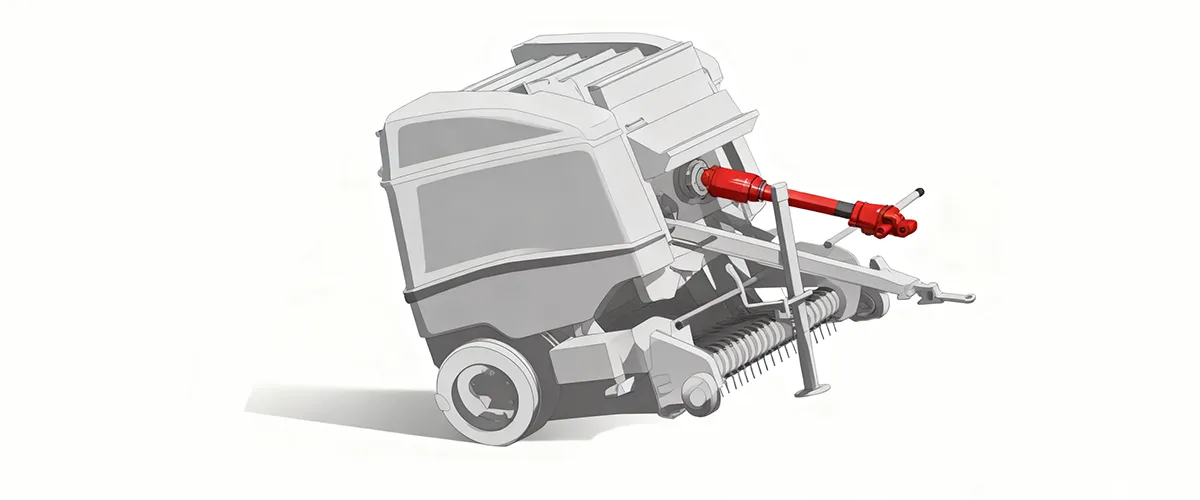
Agricultural PTO Shaft
The PTO shaft is the mechanical link between the tractor output and the round baler gearbox. For pasture operations on sloped terrain, shaft operating angle directly affects service life and vibration levels. A shaft that must operate at excessive angles due to terrain change generates cyclical speed variation that causes premature wear on the baler gearbox input bearing. Selecting a PTO shaft with a cross joint capable of handling the maximum angle encountered in field operations is essential for mixed-pasture and hillside work.
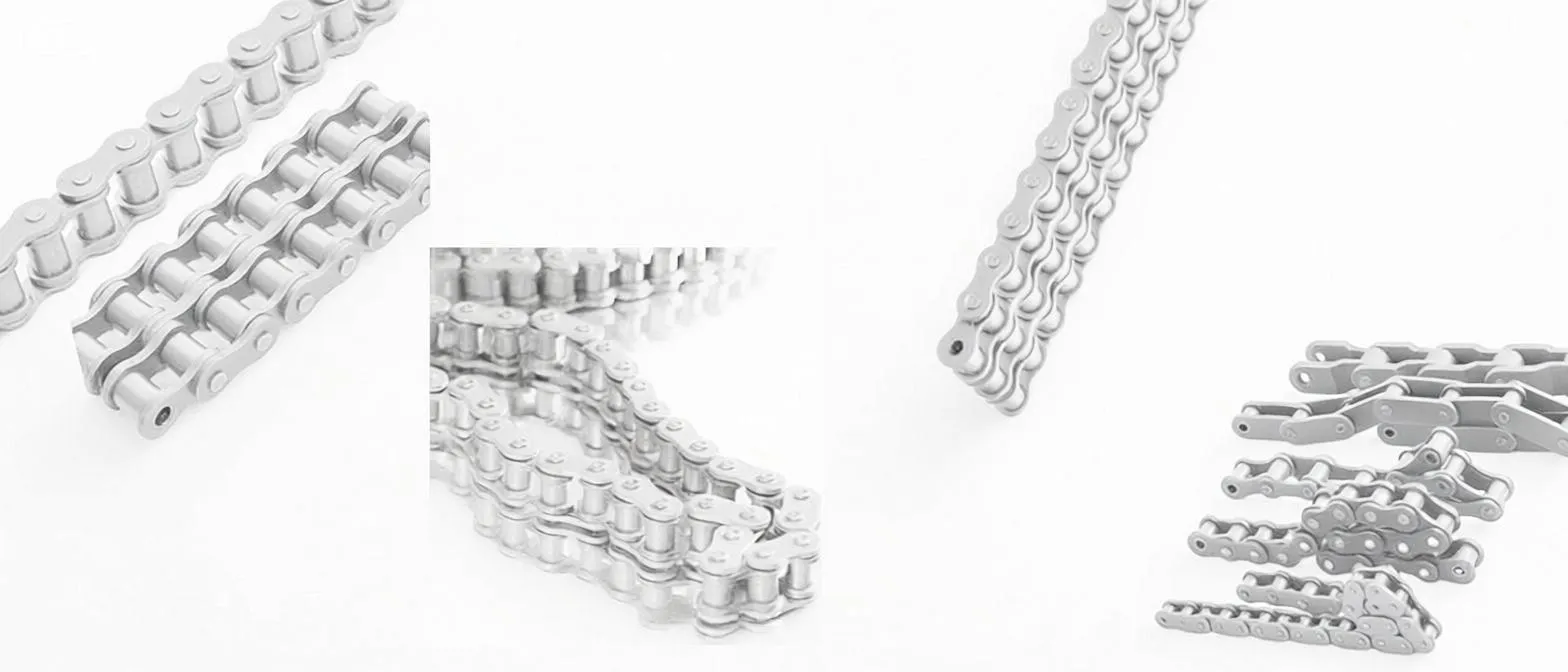
Agricultural Drive Chain
The internal drive chains of a round baler carry the compression forces that form the bale. In the 9YG-2.24D S9000, the dual-sided 20A heavy-duty chain configuration delivers compression forces sufficient for 100 to 200 kg/m3 bale densities across a wide range of forage types. Replacement chains sourced to the correct specification maintain the original tension calibration and prevent density inconsistency caused by chain stretch. Our full range of round baler chains is compatible with the EP series balers and available as genuine replacement components.
11. Over a Decade of Agricultural Machinery Experience
Our operation traces its roots to 2013, when we established a production base focused on the needs of modern livestock and pasture farms. Over more than ten years, we have developed a full lineup of agricultural harvesting machinery — from compact round balers suited to small-plot operations to heavy-duty traction balers designed for high-volume pasture and straw recovery applications. The product range extends beyond balers to include disc rotary mowers in both single and dual configurations, disc-type and horizontal hay rakes for single or twin-side operation, and mower-conditioner units for high-moisture forage crops.
Our quality management system holds ISO 9001 certification, and our production facility is equipped with CNC laser cutting systems, plasma cutting equipment, automated assembly lines, and electrostatic coating lines that deliver consistent finish quality across more than 2,000 units of annual production capacity. We maintain our own import and export trading rights, allowing us to supply agricultural operators worldwide without intermediary delays.
Every round baler in our lineup is backed by user documentation, after-sales technical support, and a genuine spare parts program covering all major round baler components. We conduct annual follow-up surveys with operators who have purchased our balers, providing technical refresher training during harvest season and gathering field performance data that drives ongoing design improvements.
Established
2013 — 10+ Years in Service
Annual Capacity
2,000 Units per Year
Production Equipment
60+ Large-Scale Machines
Certification
ISO 9001 Quality Management System
12. Choosing the Right Round Baler for Your Pasture Operation — Key Decision Factors
Selecting a round baler for mixed-species pasture work involves several decisions that go beyond simply matching horsepower rating to tractor size. The wrong round baler for your specific field conditions and crop type can result in higher operating costs, more frequent breakdowns, and lower forage quality than the investment warrants. The following decision framework covers the primary selection criteria for Korean and East Asian pasture operators.
Field Size and Shape: A small round baler suited to compact paddocks and narrow field entries makes sense for Korean paddy-adjacent forage plots with tight headland turns. Larger fields benefit from a high-capacity round baler with a wider pickup that reduces the number of passes required. For operations that span both small terraced plots and larger consolidated pasture blocks, the operating speed range of the round baler — 5 to 35 km/h in the S9000 — provides the flexibility to work efficiently in both environments by adjusting forward speed rather than changing equipment.
Crop Moisture and Intended Use: Hay and silage place different demands on a round baler. Hay baling at 15 to 20 percent moisture content requires a round baler that produces firm, dry bales that shed rain during outdoor storage. Silage baling at 55 to 70 percent moisture requires a round baler capable of producing the high-density, oxygen-excluding bales that create correct anaerobic fermentation conditions. A round baler with sensor-controlled density like the S9000 can be calibrated for both end uses by adjusting the density target in the control system.
Terrain Classification: Flat to gently rolling terrain allows virtually any traction round baler to operate without driveline stress. Steeper terrain — above 10 to 15 degrees slope — requires a round baler with an adjustable traction hitch that can tilt to compensate for the angular misalignment between tractor and baler when crossing slope contours. For Korean mountainous-zone operations, this feature moves from optional to essential. A round baler without tilt adjustment driven on steeper Korean hillsides will require driveline replacement within one to two seasons.
After-Sales Parts Availability: A round baler is only as reliable as the supply chain supporting its wear parts. Pickup tines, compression rollers, drive chains, and net wrap feed components all require periodic replacement. When evaluating round baler suppliers, ask specifically about lead times for common wear parts delivery to your country, and whether technical documentation is available in your preferred language. Our spare parts program covers all EP series round balers with global delivery capability and Korean-language technical support on request.
13. Maintenance Schedule for Round Balers Used in Pasture and Meadow Operations
A round baler operating through mixed-species pasture accumulates wear on its pickup, feed, and compression systems faster than a baler used exclusively for dry straw. Plant sap from clover and vetch is slightly acidic and promotes surface corrosion on bare steel components. Wet grass packs into sealed cavities around tine mounting bolts and compaction roller bearings, creating moisture-retaining plugs that accelerate bearing race wear. A structured maintenance schedule specific to pasture conditions extends round baler service life significantly and prevents the mid-season breakdowns that cost operators the most during tight harvesting windows.
| Interval | Round Baler Component | Action Required | Pasture-Specific Note |
|---|---|---|---|
| Daily (before use) | Pickup tines and tine shanks | Remove vetch and clover mat accumulation; check for bent tines | Vetch tendrils wrap tine shanks overnight; removal is faster before they dry hard |
| Every 8 operating hours | All grease nipples on round baler frame | Apply grease to all designated points per the lubrication chart | High-moisture pasture work increases water ingress at bearing seals; more frequent greasing displaces water |
| Every 50 hours | Drive chain tension and lubrication | Check chain slack per spec; apply chain lubricant | The dual-sided 20A heavy-duty chains in the S9000 round baler retain tension well but should be checked after high-density silage baling sessions |
| Every 100 hours | Compression roller bearings | Inspect for play and overheating; regrease sealed units where accessible | Mixed clover sap accelerates seal degradation around compression roller ends on round baler chambers |
| Seasonally (post-harvest) | Round baler gearbox oil | Drain and refill with manufacturer-specified viscosity grade | Gearbox oil in a pasture round baler accumulates fine metallic particles; annual drain removes these before the next season |
| Seasonally (post-harvest) | Net wrap system and feed rollers | Clean all plant material from roller surfaces; check wrap sensor function | Dry clover and grass fragments pack around round baler net wrap feed guides and can cause misfeed in the following season if not cleared |
14. Quality Indicators for Mixed-Species Bales — How to Assess Round Baler Performance in the Field
Assessing round baler performance in real-time allows operators to make operational adjustments before quality problems compound over many bales. The following indicators help distinguish a round baler operating within its design parameters from one that needs adjustment or attention.
Bale shape symmetry is the first visual indicator. A round baler producing well-shaped cylindrical bales with flat, parallel ends is operating with a centered, evenly distributed material feed. Bales that taper toward one end — what operators call a wine-bottle shape — indicate that the windrow is feeding unevenly across the pickup width, with more material entering from one side. This is common in mixed-species pastures where wind or mower overlap creates off-center windrow profiles. The solution is to re-rake the windrow into a more centered profile before the next baling pass.
Net wrap adhesion at the bale ends is the second quality indicator. If net wrap peels away from the bale ends within 24 hours of ejection, the bale surface moisture was too high at wrapping time, or the outer layer of material in the bale chamber included an excessive proportion of flat clover leaves that present a low-friction surface to the net. Increasing baling speed slightly to generate more heat through compression, or waiting until afternoon dew has fully lifted before resuming round baler operations, usually resolves this problem.
Field leaf loss is the third indicator. Walking the row behind the round baler after a pass and counting the percentage of clover leaves on the ground versus those in the bale gives a practical measure of pickup efficiency. Many round baler operators in Korean grass silage operations track this figure per field to compare round baler performance across different sward compositions. A loss rate above 8 to 10 percent for the legume fraction is generally considered excessive for a round hay baler designed for pasture use, and warrants adjustment of the pickup tine tip speed or windrow consolidation approach.
Frequently Asked Questions — Round Baler for Pasture Grass
編集者: PXY