Wheat Straw Harvesting Guide
A field-level decision guide covering machine specifications, structural design, material engineering, regulatory compliance, and model matching for professional wheat straw operations
1. Why Wheat Straw Baling Demands a Carefully Matched Round Baler
Wheat straw is one of the highest-volume agricultural residues generated globally, and its management after grain harvest represents a genuine logistical and economic challenge for large-scale grain producers. In countries like South Korea, where the government has tightened restrictions on open-field burning under the Clean Air Conservation Act (대기환경보전법) and expanded incentives for biomass utilization, the pressure to mechanically collect and bale wheat straw has increased substantially. A round baler machine that is correctly specified for wheat straw work can transform this post-harvest residue into a valuable co-product — usable as animal bedding, bioenergy feedstock, mushroom cultivation substrate, or export commodity — while simultaneously preparing the field for the next planting cycle faster and more cleanly than any tillage-based option.
But not every round hay baler is suited to the physical demands of wheat straw. Wheat straw is characteristically light, brittle, and low in moisture at harvest time, which means it flows very differently through a baling chamber than green forage or heavier corn stover. The pickup tines must handle dry, dusty material without clogging, the feeding mechanism needs to manage uneven windrow density created by modern combine headers that leave variable swath patterns, and the compression chamber must produce a bale dense enough for economical transport without shattering the fragile stem structure. Getting these machine parameters right is the difference between a smooth 80-bale-per-hour operation and a frustrating day of blockages, density failures, and net-wrap problems. This guide walks through every key decision point so you can match the right round baler model to your specific wheat straw harvesting scale and context.
2. Understanding Wheat Straw as a Baling Crop — Physical Characteristics That Drive Machine Selection
Before choosing a round baler, it helps to understand what physically happens inside the baling chamber when wheat straw enters. Unlike grass hay or silage, which bind naturally due to moisture and pliability, dry wheat straw is a rigid, low-cohesion material with very limited inter-stem friction. At typical harvest moisture levels of 12–18%, wheat straw compresses easily under initial roller contact but tends to spring back as bale pressure releases during ejection. This means the compression chamber must deliver high peak pressure through the final stages of bale formation — not just average pressure across the cycle — to achieve a bale density that remains stable in the field after ejection.
The length of the cut straw also matters. Combine headers set to aggressive cutting heights leave longer stem sections that tangle more predictably and form more stable bales. Very short-chopped straw, produced by some modern combine chopper attachments, creates a looser, less interlocked mass that is significantly harder to form into a tight round bale without the right pickup and feeding configuration. Operators who experience poor bale formation with wheat straw often trace the problem to combine chopper settings rather than any fault in the baler itself. Understanding this upstream interaction is part of selecting — and using — a round baler machine effectively in large-scale wheat straw harvesting conditions.
3. Manufacturing Structure of Round Balers Designed for Wheat Straw Work
The structural architecture of a round baler intended for wheat straw work differs from a general-purpose forage machine in several key respects. The main frame must withstand the higher cyclical vibration loads associated with dry-material baling — dry straw transmits more shock through the pickup and feeding mechanism than moist, pliable green material — so frame wall thickness and weld quality directly determine structural fatigue life over multiple harvests. The drum-type (roller-type) compression chamber, used across the 9YG series round baler lineup, is the most widely adopted design for wheat straw because rollers provide positive material transport without the slip-stick behavior that belt chambers can exhibit when handling dry, low-friction straw.
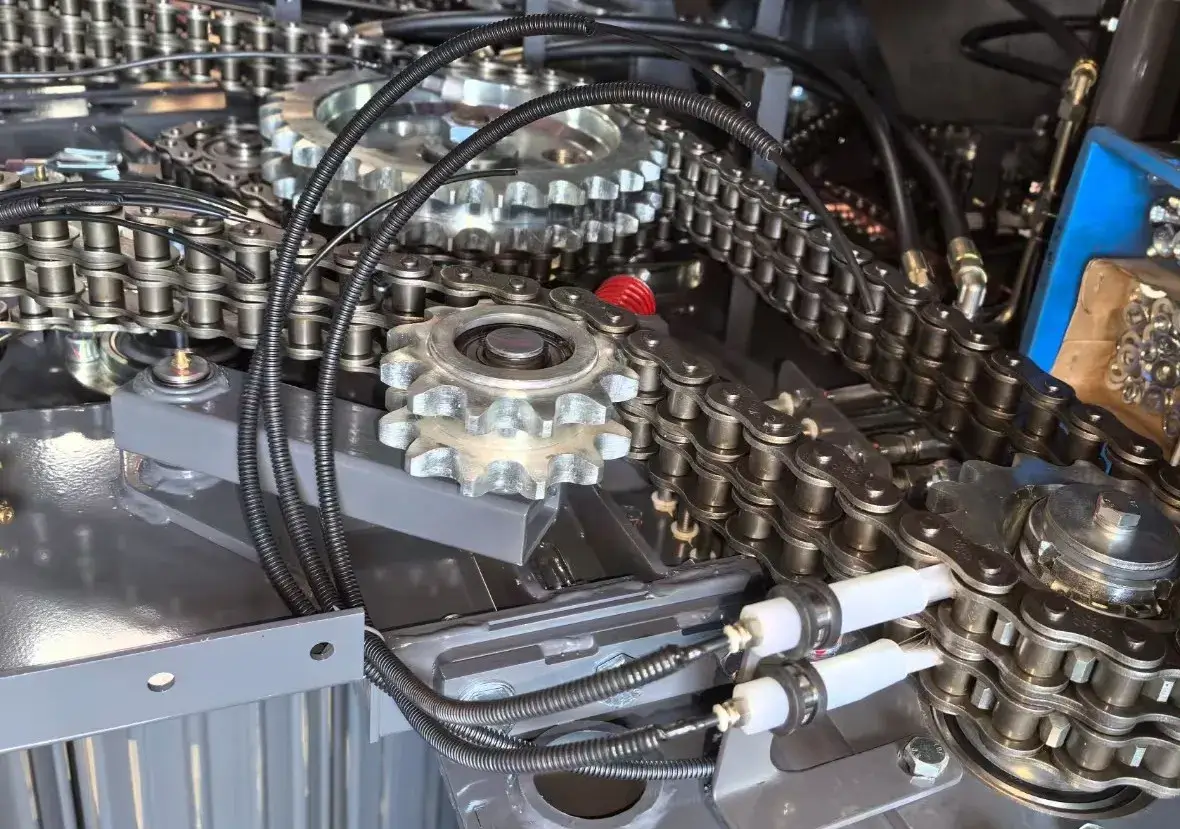
The rear tailgate assembly on large-format round balers used for wheat straw must be robust enough to handle the abrupt opening and closing forces generated at high bale output rates. On the 9YG-2.24D series, the rear chamber is designed with a dual-side chain drive arrangement, distributing the opening torque load across two chain runs rather than concentrating it on one side of the tailgate pivot. This bilateral load distribution significantly reduces fatigue at the hinge points and extends the service interval between structural inspections. The addition of a buffer hydraulic cylinder on Classic-variant models absorbs the impact of tailgate closure, which is an important detail for round balers working at sustained high throughput rates in large wheat fields where tailgate cycles accumulate rapidly.
The pickup header frame on wheat straw round balers also deserves attention. Because wheat straw windrows are often wide and irregular — combine headers can discharge material unevenly, particularly with side-wind conditions — the pickup width determines how much pre-raking work is needed to create a uniform windrow. Models like the 9YG-2.24D offer a 2,240 mm pickup width, which covers the output of most 5–6 meter combine headers in a single pass without requiring raking consolidation. Smaller-format models such as the 9YG-1.25A, with a 2,150 mm pickup width, are still well-matched to medium-scale combine operations. The spring-tine pickup mechanism on all 9YG models is engineered for reliable material collection in dry, low-moisture conditions — the tine spring rate is calibrated to maintain ground contact without digging into the soil and contaminating the straw bale with dirt, which reduces bale market value in feed and substrate applications.
4. Material System — Steel Grade, Chain Specification, and Surface Protection for Wheat Straw Environments
The material specification of a round baler’s critical components directly affects both performance and service life when operating in the dust-heavy environment of a summer wheat harvest. Grain fields at straw harvest time generate fine silica-based dust that penetrates every unsealed gap in the machine, acts as an abrasive on sliding contact surfaces, and accelerates wear on rubber seals and bearing races. Round balers intended for serious wheat straw work benefit from sealed bearing specifications across the pickup shaft, the roller axle set, and the gearbox input shaft — maintenance-free bearings eliminate the daily lubrication requirement that would otherwise represent a significant time cost across a long harvest period.
Frame steel on the 9YG series is processed from high-tensile structural plate through CNC laser cutting, producing parts with tight dimensional tolerances that reduce assembly variation and improve the long-term predictability of wear patterns. Welding is performed on automated lines, and the finished assemblies pass through an electrostatic spray painting process that applies a uniform, thick coating even in corner radii and internal surfaces where brush or dip painting typically leaves thin spots susceptible to corrosion. The drive chain specification is a telling indicator of how a manufacturer has traded off initial cost against durability: the 9YG-2.24D S9000 uses 20A heavy-duty chain (1.25-inch pitch) in the rear dual-side drive arrangement, which is rated for substantially higher tensile load than the standard 16A chain used in lighter-duty configurations. For operators running sustained production over multi-day wheat harvests, this chain grade difference translates directly into longer service intervals and fewer unplanned stoppages.
Roller surfaces inside the baling chamber are another materials consideration specific to wheat straw. Because dry straw exerts lower compressive feedback on the bale than moist forage, the rollers must maintain sufficient surface friction to continue pulling material into the growing bale even at low chamber fill — a condition that occurs at the start of each bale cycle. Hard-chrome or textured roller surfaces provide better grip on dry material than smooth steel, and round balers designed with this crop characteristic in mind show noticeably more consistent bale startup behavior in wheat straw than machines spec’d purely for silage or hay.

5. Round Baler Gearbox Engineering — Torque Capacity, Turning Flexibility, and Protection Systems
The gearbox assembly of a round baler is the single mechanical component that most directly determines both operational efficiency and long-term reliability in large-scale wheat straw harvesting. When a round baler runs at the upper end of its output range — 80 to 100 bales per hour in ideal wheat straw conditions — the gearbox cycles through thousands of bale-form and eject sequences per day, and any mechanical weakness in the power transmission path will surface quickly. For PTO-driven trailing round balers, the gearbox must convert tractor PTO shaft speed (typically 720 r/min) into appropriate drive speeds for the pickup roller, the compression rollers, and the net-wrap mechanism, while simultaneously absorbing the torque spikes that occur when a dense wheat slug enters the bale chamber.
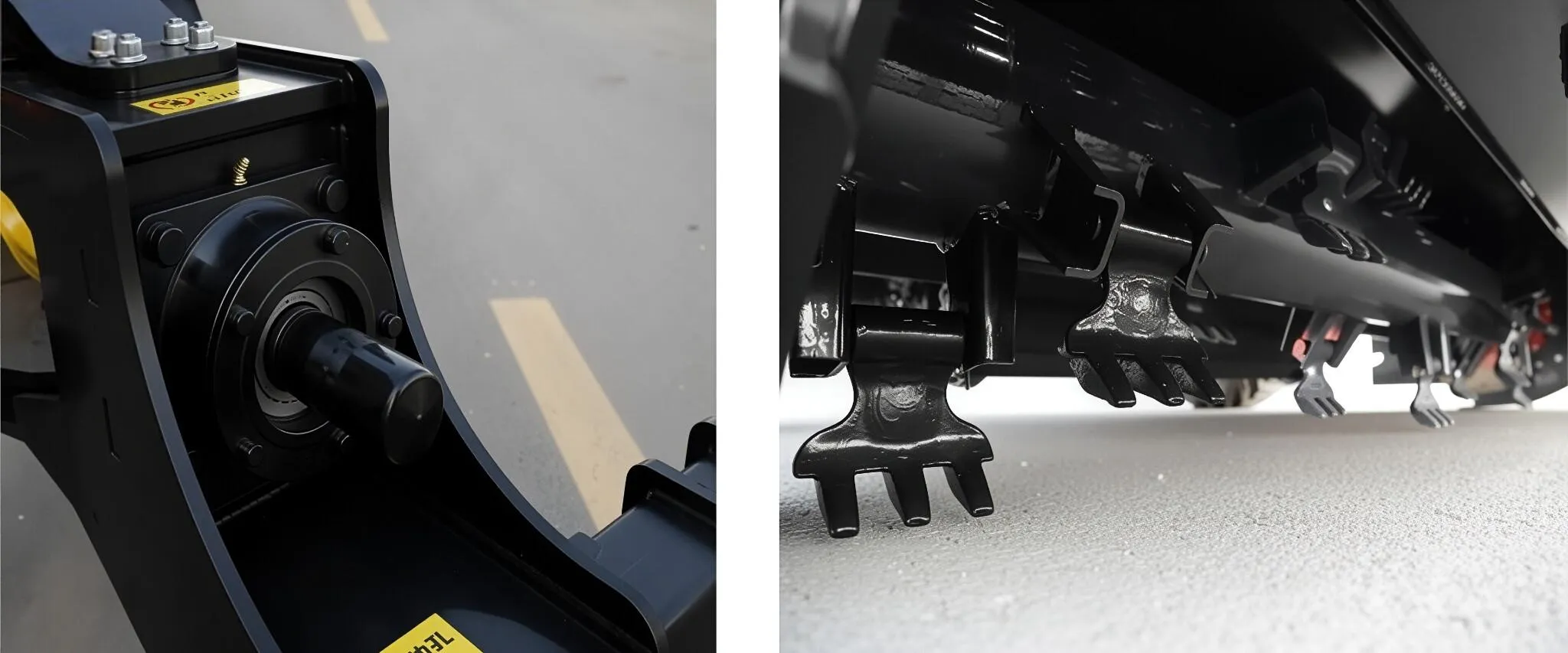
The dual-gearbox design featured on the 9YG-2.24D S9000 Surpass variant addresses the common problem of driveshaft binding during in-field turns. Because wheat fields — particularly in Korea’s Gyeongbuk or Jeonnam grain-producing regions — often include narrow headlands and irregular parcel shapes, the ability to keep the PTO engaged throughout headland turns without cutting power saves significant time across a full harvest day. The dual gearbox rotates up to 90 degrees left or right independently, keeping the PTO driveshaft within safe operating angles even during tight pivot maneuvers. The improved Transcend variant extends this with a new-generation drawbar that also adjusts tilt angle up to 30 degrees from horizontal, accommodating the cross-slope approach paths common on fields with slight grade.
A critical safety element in the gearbox system is the torque-limiting driveshaft that has been added as standard equipment on higher-specification 9YG variants. When a large wheat slug — a dense clump of straw that has piled against a field edge or in a low spot — enters the pickup in a single surge, the instantaneous torque demand on the gearbox can exceed the design limit of the chain drive or the roller bearings. The torque-limiting coupling absorbs this spike before it transmits to the gearbox internals, preventing catastrophic failure that would require multi-day repair in the middle of the harvest season. This is not a feature that can be retrofitted economically after purchase — it is worth specifying at the selection stage, particularly for operators who work fields with variable straw density or combine-discharge irregularity.
6. Key Selection Criteria for Wheat Straw Round Balers — Decision Framework
Selecting among the available round baler models for a specific wheat straw operation requires comparing several interdependent parameters simultaneously. The table below organizes the most important criteria and links them to the operational factors that drive each decision. No single parameter can be evaluated in isolation — a machine that wins on pickup width but loses on tractor power compatibility creates a mismatch that costs money to resolve in the field.
| Selection Factor | What to Assess | Implication for Wheat Straw |
|---|---|---|
| Farm area per season (ha) | Total annual bale volume | Determines whether a compact small round baler or full-width 2.24 m machine is economical |
| Available tractor power (kW / hp) | PTO output at rated speed | Under-powered tractor causes density and throughput shortfalls, accelerates clutch wear |
| Combine header width (m) | Straw discharge swath width | Pickup width ≥ discharge width eliminates raking pass; reduces bale pickup time |
| Target bale end-use | Density requirement (kg/m³) | Bedding: 160–200 kg/m³; substrate: 130–160 kg/m³; biomass: 140–200 kg/m³ |
| Field shape and headland width | Turning radius requirement | Dual-gearbox articulation critically improves efficiency on small Korean grain parcels |
| Straw moisture at baling | Expected range at harvest time | Moisture below 14% → risk of bale startup failure; above 20% → storage mold risk |
| Storage method | Outdoor vs. covered storage | Net wrap mandatory for outdoor storage; twine acceptable for covered barn storage |
| Operator experience level | Sensor control vs. manual adjustment | Sensor-controlled density systems significantly reduce density variation from operator input |
7. Round Baler Product Range — Matching Models to Wheat Straw Harvesting Scale
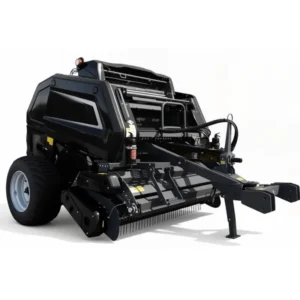
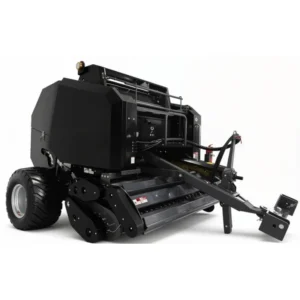
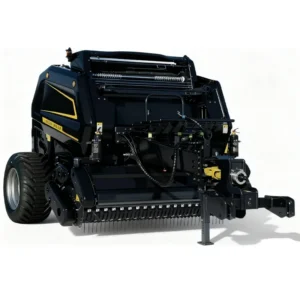
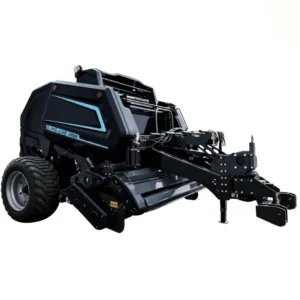
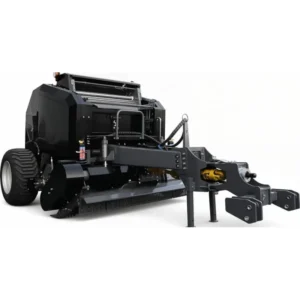
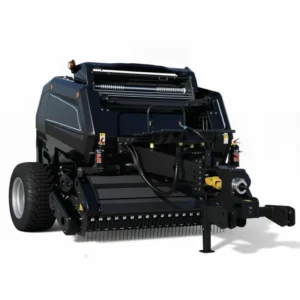
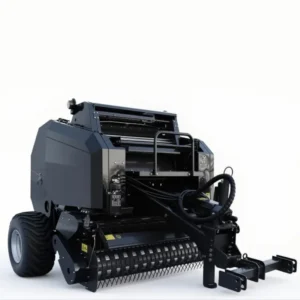
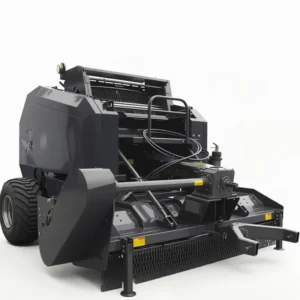
The 9YG round baler series covers a wide power-and-scale spectrum, from compact small round balers suited to 40–80 hp tractors operating on small Korean grain parcels, to full-width large-format machines designed for sustained high-throughput production across hundreds of hectares per season. The following product overview summarizes how each model aligns with wheat straw harvesting requirements. For a complete product listing, visit the full round baler product range.
8. Complete Technical Specifications — 9YG Series Round Balers
| Model | Pickup (mm) | Chamber Dia. (mm) | Bale Width (mm) | Power (kW) | Rollers | Density (kg/m³) | Output (bales/hr) | Machine Wt (kg) |
|---|---|---|---|---|---|---|---|---|
| 9YG-2.24D S9000 | 2,240 | 1,200 | 1,400 | 55–100 | 18 | 100–200 | 40–100 | 4,570 |
| 9YG-2.24D Classic | 2,240 | 1,200 | 1,400 | 55–100 | 18 | 100–200 | 40–100 | 4,312 |
| 9YG-2.24D Standard | 2,240 | 1,200 | 1,400 | 55–100 | 18 | 100–200 | 40–100 | 3,922 |
| 9YG-1.25 (Double) | 2,240 | 1,200 | 1,250 | ≥88 | 18 | 115–200 | 40–80 | 4,558 |
| 9YG-1.25A | 2,150 | 1,200 | 1,250 | ≥75 | 18 | 100–200 | 40–100 | 4,472 |
| 9YG-1.0 | 1,900 | 1,000 | 1,000 | 48–80 | 16 | 115–200 | 40–100 | 2,640 |
| 9YG-1.0C | 2,400 | 1,000 | 1,250 | ≥70 | 16 | 115–200 | 40–80 | 3,198 |
9. Regulatory Compliance for Round Balers and Agricultural Gearboxes — Korea, EU, and Global Standards
Operators sourcing a round baler for wheat straw work need to understand the regulatory landscape in their market before committing to a purchase. Agricultural machinery regulations exist primarily to protect operators and bystanders from mechanical hazard, but they also govern import eligibility, subsidy qualification, and environmental compliance — all of which affect the total cost and administrative burden of putting a new machine in the field. Below is a region-by-region summary of the standards most relevant to round baler procurement and operation.
South Korea (대한민국): Agricultural machinery in South Korea is regulated under the Agricultural Mechanization Promotion Act (농업기계화 촉진법), administered by the Rural Development Administration (농촌진흥청, RDA). All round balers sold in the domestic market must pass RDA type approval testing, which includes functional performance evaluation, operator safety assessment, and noise measurement. Machines on the RDA approved equipment list may qualify for the national Agricultural Machinery Subsidy Program (농기계지원사업), which can cover up to 50% of purchase cost for eligible smallholder farmers — a significant incentive for Korean wheat producers looking to invest in round baler capability. The Clean Air Conservation Act (대기환경보전법) also now restricts open-field crop residue burning in most grain-producing regions, which directly increases the regulatory pressure to mechanically bale and remove wheat straw rather than burning it. Import-market buyers should also confirm that the specific machine model has cleared Korean customs import classification under HS Code 8433.40 (hay or forage harvesting machinery including baling machines).
European Union: Round balers and their integrated gearbox assemblies marketed in EU member states must bear CE marking under the Machinery Directive 2006/42/EC. This requires a manufacturer’s Declaration of Conformity, a technical construction file, and compliance with EN ISO 4254-7 (Agricultural Machinery — Safety — Part 7: Combine Harvesters, Forage Harvesters and Cotton Harvesters, with provisions for balers). PTO shaft guards, pickup shields, and flywheel covers must all meet the guarding requirements of ISO 4254-1. From January 2027, the updated Machinery Regulation EU 2023/1230 replaces the Directive, introducing additional digital documentation requirements. German operators additionally fall under DGUV Rule 114-015, which specifies inspection intervals for agricultural machinery drives and gearboxes. ISO 9001 certification at the manufacturing level simplifies conformity assessment considerably.
North America (USA / Canada): ASABE Standard S493 (Safety for Agricultural Field Equipment) and ANSI/ASABE S296 provide the principal design safety framework for round balers in the North American market. In Canada, compliance with CCME (Canadian Council of Ministers of the Environment) emission guidance applies to any auxiliary diesel engines. State-level regulations in key US grain states (Kansas, Nebraska, South Dakota) may impose additional machinery noise or dust-suppression standards for large-scale baling operations near residential areas.
EAEU Markets (Russia, Kazakhstan, Belarus, Mongolia): Equipment exported to Eurasian Economic Union countries must be assessed under TR CU 010/2011 (Technical Regulation on Machine Safety) and carry EAC certification marking. GOST R 12.2.111 covers safety requirements for agricultural harvesting machinery including baling equipment. Gearbox assemblies exported to these markets must also meet GOST 21354 gear reliability standards. Manufacturers holding ISO 9001 certification have a simplified pathway to EAC conformity assessment through recognized third-party testing bodies.
| Region | Primary Regulation | Certification Required | Subsidy / Incentive? |
|---|---|---|---|
| Korea Selatan | Agricultural Mechanization Promotion Act; RDA Type Approval | RDA 농기계 형식검정 | Yes — up to 50% subsidy for eligible buyers |
| European Union | Machinery Directive 2006/42/EC; EN ISO 4254-7 | CE Mark + Declaration of Conformity | Varies by member state CAP programs |
| USA / Canada | ASABE S493; ANSI/ASABE S296 | ASABE Conformance | USDA EQIP program for qualifying operations |
| Russia / Kazakhstan / Belarus | TR CU 010/2011; GOST R 12.2.111 | EAC Mark | State agri-machinery subsidies available |
| Australia / New Zealand | AS 4024; Work Health and Safety Act | WHS-compliant design documentation | State-level rebate schemes in some regions |
10. Operational Best Practices for Large-Scale Wheat Straw Baling
Running a round baler machine efficiently through a large wheat straw harvest requires attention to several operational habits that experienced operators develop over seasons but that new baler owners often learn the hard way. The most impactful single factor is windrow consistency — before starting the baling run, take time to drive the raked windrows and identify any areas where the straw density is unusually high (due to combine discharge patterns, field low spots, or wind-row overlap). These dense zones are the most likely blockage points, and slowing down through them is far less costly than a 45-minute unplugging stoppage.
Maintaining a consistent travel speed is the second key habit. Round balers are most efficient when the pickup is running at a steady loading rate — varying speed between windrow approach and cross-field travel creates density variation within individual bales that reduces their market value and makes stacking unstable. Most experienced operators set a base field speed between 8 and 12 km/h for dry wheat straw and hold it as steadily as conditions allow, trusting the sensor density system to compensate for minor windrow variation without speed adjustment. The sensor-controlled density control on the 9YG series models continuously monitors bale pressure and adjusts the chamber variable to maintain the target density setpoint, which frees the operator to focus on field navigation rather than bale monitoring.
Net wrap management is another area where discipline pays off. Wheat straw bales that are stored outdoors in Korean summer monsoon conditions face substantial rainfall exposure, and a poorly applied or prematurely cut net wrap allows moisture penetration that can ruin the outer 15–20 cm of a bale within a few weeks. Setting the net overlap to at least two full wraps at each bale end, and verifying that the cutting knife is sharp enough to produce a clean, tight cut at the end of each wrap cycle, protects the bale value throughout the storage period.
11. Round Baler Parts Most Affected by Wheat Straw Work — Maintenance Calendar
Wheat straw is one of the most abrasive crops a round baler processes. The combination of silica-rich stem material, fine dust, and the high throughput rates typical of summer grain harvest creates an accelerated wear environment for several key round baler parts. Understanding which components need the closest attention — and at what intervals — allows operators to schedule preventive maintenance rather than reacting to failures during the harvest window, when every hour of downtime has a direct cost in straw left on the ground and field turnaround delayed.
| Component | Failure Mode in Wheat Straw | Check Interval | Action |
|---|---|---|---|
| Pickup tines | Tip wear, shaft bending from soil contact | Every 25 hours | Replace bent or tip-worn tines; carry spares |
| Net wrap cutting blade | Silica dust dulls blade; partial cuts cause bale unraveling | Daily inspection; every 500 bales | Sharpen or replace blade; clean guide channel |
| Drive chains (rear chamber) | Stretch under sustained high-load operation | Every 50 hours; pre-season | Check sag; replace at 3% stretch; lubricate |
| Gearbox oil | Dust contamination; thermal cycling degrades lubrication | Every 200 hours; annually | Drain, flush, and refill with manufacturer-specified grade |
| Roller bearings | Dust ingress accelerates race wear in unsealed units | Pre-season inspection; post-harvest check | Listen for noise; replace any bearing showing play |
| Hydraulic seals (tailgate) | High cycle count in large wheat fields degrades seals | Post-season inspection; 3,000+ bales | Check for cylinder weeping; replace seal kit proactively |
Frequently Asked Questions — Round Balers for Wheat Straw Harvesting
Q1. What is the best round baler for large-scale wheat straw harvesting on a commercial Korean grain farm with a 100 hp tractor?
For Korean commercial grain operations running a 100 hp (approximately 75 kW) or larger tractor, the 9YG-2.24D S9000 or Classic variant is the natural match. Both deliver a 2,240 mm pickup width that covers most modern 5–6 m combine header discharge patterns without a raking pass, and the dual 20A heavy-duty chain drive in the rear chamber sustains the high compression forces needed to produce dense, market-quality wheat straw bales at up to 100 bales per hour. The sensor-controlled density system is particularly valuable in commercial operations where bale weight consistency directly affects transport load calculations and downstream buyer specifications.
Q2. How does the round baler gearbox design affect performance and safety when running long daily hours during wheat harvest season?
During extended wheat harvest days — which in Korean grain regions can run 12–14 hours to capitalize on dry weather windows — gearbox integrity is tested by cumulative thermal load, not just peak torque. The dual-joint gearbox on the 9YG-2.24D S9000 distributes transmission load across two articulation points, reducing the concentration of heat and wear at any single contact surface. The added safety torque-limiting driveshaft means slug ingestion events that would damage a standard gearbox are absorbed before reaching the gearbox internals. These design features collectively extend mean-time-between-failures significantly compared to single-joint gearbox designs, which matters greatly when every repair hour during harvest costs multiple bales of straw.
Q3. What round baler bale density setting is best for wheat straw sold as mushroom substrate to Korean agricultural processors?
Mushroom cultivation substrate buyers in Korea typically specify bale density in the 130–155 kg/m³ range. Bales denser than 160 kg/m³ become difficult to break apart for inoculation without mechanical assistance, which adds cost at the processing facility. Bales below 120 kg/m³ do not provide enough structural integrity for transport without netting damage. The electronic density setpoint control on the 9YG-series models can be reliably held within this target window — a significant advantage over older spring-tension systems where density drifts with crop moisture variation across the day.
Q4. Which small round baler works best for wheat straw collection on a Korean family farm with a 40 hp tractor and fields under 5 hectares?
The 9YG-1.0 is the compact small round baler for 40 hp tractor operations in Korea’s smaller grain-producing parcels. It requires a minimum of 48 kW (roughly 65 hp at the PTO) and produces bales of approximately 1,100 mm diameter — compact enough for single-person loading onto a small trailer or cart. The bale weight range of 100–200 kg makes manual handling practical without a loading arm, and the net wrap format keeps bales weatherproof during outdoor summer storage. For farms under 5 hectares baling a single wheat crop per year, the economics of the 9YG-1.0 are typically more favorable than larger-format machines with higher operating costs.
Q5. How does the axial-flow feeding mechanism in the 9YG round baler series reduce wheat straw blockages compared to conventional baler feeding systems?
Conventional cam-type feeding mechanisms in round balers create a pulsed material flow that can develop choke points when wheat straw enters in variable density slugs from uneven windrows. The axial-flow semi-forced feeding system used in the 9YG series generates a continuous, smooth material progression from the pickup into the bale chamber without the momentary stop-start of cam-driven designs. This reduces the peak pressure at the chamber entrance — where most wheat straw blockages originate — and allows the baler to clear material variations without operator intervention. Field data from operators who have switched from conventional to axial-flow designs in wheat straw work consistently reports fewer stoppages per 100 bales.
Q6. When should Korean wheat farmers consider raking straw windrows before baling, and does it affect round baler pickup performance?
Raking is generally necessary when the combine header width exceeds the baler pickup width, when strong winds have scattered straw unevenly across the field, or when the straw is very short-chopped and too loosely distributed for consistent bale formation. On the 9YG-2.24D with its 2,240 mm pickup, most 5 m combine headers can be baled without raking. However, if you are running a 6 m or wider header, a single raking pass to consolidate to a 2 m windrow pays for itself in avoided density problems and bale startup failures. On the smaller 9YG-1.0 with its 1,900 mm pickup, raking is almost always worthwhile in medium-to-large wheat fields to maximize baling efficiency.
Q7. What round baler parts should I stock as spares before starting a large wheat straw baling season to avoid costly mid-harvest downtime?
The round baler parts that most often cause unplanned stoppages in wheat straw operations are pickup tines (carry at least 20–30 spare tines per machine), net wrap cutting blades (carry two replacement blades and a sharpening file), drive chain master links (two per chain run), and tension spring sets for the chamber variable. It is also worth carrying a spare set of hydraulic ferrule fittings compatible with the tailgate cylinder connections — a fitting failure under high cycle pressure causes oil loss that halts operation immediately. Having these parts in a field tool kit before the first baling day typically saves more time than the cost of the inventory.
Q8. How do Korean Agricultural Machinery Subsidy Program requirements affect the cost of purchasing a round baler for wheat straw operations?
The Korean Agricultural Machinery Subsidy Program (농기계지원사업) administered by the RDA can cover up to 50% of the purchase cost for eligible smallholder farmers — a significant reduction in net outlay for a round baler investment. To qualify, the machine model must be on the RDA approved equipment list, which requires the manufacturer or importer to complete the type approval process before sale. Buyers should confirm subsidy eligibility before finalizing supplier selection, as machines not on the approved list do not qualify regardless of their technical merits. The application window for subsidies typically opens in early spring before the wheat harvest season, so planning should begin several months in advance.
Editor: PXY