Rice Straw Baling | Korea Autumn Operations | 9YG-1.25 Field Guide
A detailed technical and agronomic guide for Korean paddy farm operators, agricultural cooperatives, and equipment procurement managers evaluating how the 9YG-1.25 round baler performs in the specific environmental and logistical conditions that define South Korea’s rice harvest season.
Korea Specific
9YG-1.25 Deep Dive
1. Korean Autumn Rice Harvest: The Environmental Conditions That Define Baler Demand
Every October, across South Korea’s paddy farming heartland — from Chungcheong’s wide flat basins to Jeolla’s productive coastal plains — the rice harvest converges into a compressed, high-pressure window that leaves little room for equipment uncertainty. The harvest happens fast, driven by the reliable deterioration of field conditions as the Korean autumn monsoon tail sweeps through and temperatures fall below the threshold where straw dries rather than accumulates moisture overnight. A round baler that performs acceptably in dry European hay conditions can fail repeatedly in this environment, where the straw emerging from the back of a self-propelled combine may be at 22–30% moisture content and packed into windrows that vary in density across a single paddy plot. The 9YG-1.25 round baler was developed against exactly this background, with its core engineering choices shaped by the feed intake, silica abrasion, field geometry, and throughput demands that characterize post-combine straw collection in Northeast Asian paddy systems.
Understanding how the 9YG-1.25 actually handles these conditions — not in theory, but at the mechanical level — matters for any procurement team or farm manager making a capital investment in baling capacity. The specifications of this machine are not abstract numbers: each one corresponds to a real operational challenge in the Korean harvest field. This guide works through those specifications systematically, from the machine’s manufacturing structure to its material system, drive configuration, and regulatory context, providing a structured basis for evaluating whether the 9YG-1.25 is the right round baler for your operation scale and straw market.
2. Understanding Korean Autumn Paddy Conditions: What the Machine Has to Handle
The Korean autumn harvest season runs from late September through early November, with peak activity concentrated in October in the central and southern provinces. During this period, daily temperature swings of 10–15°C between morning and afternoon are common. Morning dew frequently re-wets straw windrows that dried out the previous afternoon, and rainfall events with 10–30 mm in a 24-hour period are statistically likely at least once per harvest cycle in most provinces. This pattern of re-wetting creates a processing challenge that is quite different from the steady, gradual drying environment of Continental European wheat straw harvests, where a round baler machine can typically work at consistent straw moisture throughout the day.
Post-combine rice straw in Korea presents three specific mechanical challenges that a well-specified round baler must manage. The first is silica content: Korean rice varieties — including Chucheong, Ilmi, and Samcheobyeo — typically yield straw with silica content between 8% and 14% of dry weight, which is abrasive against pickup tines, feeder components, and compression roller surfaces. The second is windrow irregularity: Korean combines discharge straw either in narrow central windrows or spread evenly across the cut width, and many farms require a subsequent raking pass before baling — but in time-pressured operations, the baler often has to cope with a non-uniform windrow. The third is the headland constraint: Korea’s paddy plot structure means the baler must make many short passes with tight headland turns, making continuous-PTO operation and compact machine dimensions essential rather than simply convenient.
Straw moisture at baling ranges 18–35% depending on time of day, recent rainfall, and variety. Morning baling in wet conditions requires a feeder that handles high-moisture clumps without plugging.
8–14% silica content by dry weight accelerates wear on spring tines and roller surfaces at 3–4× the rate seen in typical hay operations. Tine specification and surface treatments directly affect maintenance cost.
Korean paddy plots average 0.3–1.5 ha with headland widths of 15–25 m. Short turning radius and compact machine dimensions (under 5.5 m combined tractor + baler) are practical requirements in most Jeolla and Chungcheong fields.
The effective straw collection window after harvest is typically 3–6 days before re-wetting or soil preparation for winter cover crops begins. Machine reliability — zero unplanned downtime — is as important as throughput rating.
3. Manufacturing Structure of the 9YG-1.25 Round Baler
The 9YG-1.25 round baler is a fixed-chamber, roller-type machine produced in a 1,250 mm chamber-width configuration. Its structural design reflects the engineering requirements of medium-horsepower paddy operations: compact enough to maneuver comfortably in Korean paddy field headlands, powerful enough to handle rice straw at production throughputs that clear a 50–80 ha operation within the standard autumn harvest window. The following section covers the principal structural subsystems and explains why each design choice matters specifically for post-combine straw in Korean autumn conditions.
Main Frame and Structural Chassis
The 9YG-1.25 frame is fabricated from Q345B structural steel using robotic MIG welding on primary load paths. The working dimensions in operating state are 5,250 × 2,700 × 2,350 mm (length × width × height), with a total structural mass of 4,558 kg. The trailer-type hitch configuration connects to the tractor’s lower link pins, with a horizontal drawbar that allows lateral flex during field turns. At this weight and operating dimension, the 9YG-1.25 requires a paddy headland width of approximately 12–15 m for a full three-point turn with a standard Korean 100 HP tractor — a geometry that fits the majority of paddy plots in Chungcheong and North Jeolla without significant field modification.
Pickup Mechanism — Interchangeable System
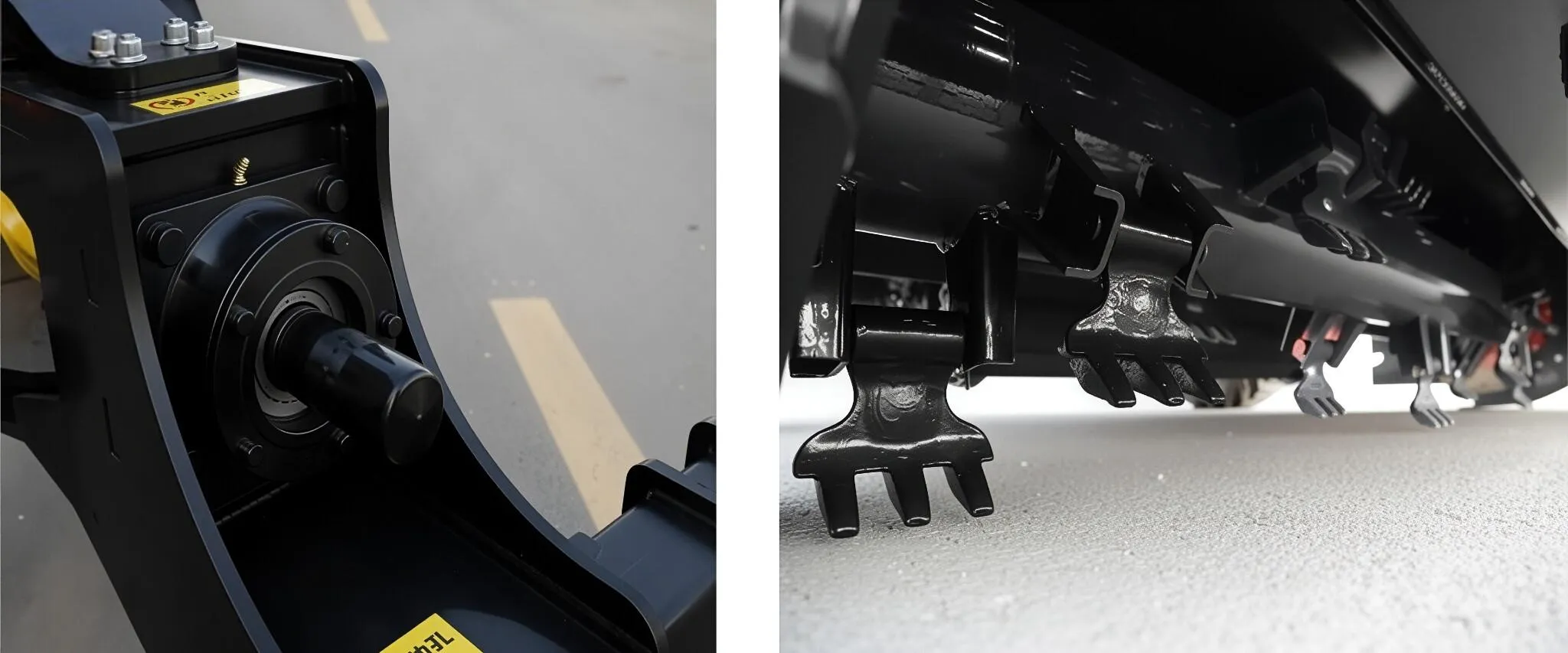
One of the 9YG-1.25’s defining features in the context of Korean rice straw operations is its interchangeable pickup system. The machine comes equipped with a standard spring-tine pickup (弹齿式) in 2,240 mm working width, which handles windrow straw efficiently at moisture levels below 25%. For operations dealing with standing, uncut rice straw — either from crops lodged by typhoon-force winds, which occurs seasonally in south and southwest Korea, or from deliberate partial-harvest systems — the pickup assembly can be exchanged for a hammer-claw (锤爪式) set of 18 units. This modularity eliminates the need to maintain separate machines for different post-harvest straw conditions, a real advantage for farms or cooperatives that service multiple plot types across different days within the same harvest window. The pickup width of 2,240 mm is well matched to the windrow width produced by the standard Korean self-propelled combine (typically 2.0–2.4 m cut width), minimizing missed straw at the field edges without overreaching into the bund zone.
Feeder System: Auger + Roller Combination
The feeder system on the 9YG-1.25 combines a helical auger (绞龙) with a toothed roller (拨齿辊) and a secondary drum roller (滚筒). This three-element feeder design addresses a specific limitation of single-roller feeders in high-moisture paddy straw: the tendency of moist, tangled straw to bunch at the chamber entry point rather than feed smoothly. The auger’s helical geometry moves straw laterally toward the center of the pickup width, preventing edge accumulation and ensuring the full 1,250 mm chamber width receives crop evenly across its entire span. The toothed roller then aggressively advances the consolidated crop into the chamber opening, while the drum roller at the entry point provides the final acceleration needed to start bale rotation against the compression rollers. In Korean autumn conditions where morning dew creates pockets of wetter straw interspersed with drier afternoon material, this multi-stage intake system provides more consistent feed behavior than simpler two-element designs.
Compression Chamber and Roller Array
The fixed compression chamber houses 18 steel rollers, each with a diameter of 222 mm. The rollers are arranged circumferentially and driven by the rear chain transmission system. Rice straw rotates inside the chamber, building the bale from the core outward in the standard fixed-chamber manner. Target bale dimensions are Ø1,200 × 1,250 mm (diameter × width), producing bales at a density of 115–200 kg/m³ depending on straw moisture and density setting. The sensor-controlled density monitoring system — standard on this model — signals the operator when the bale reaches the set diameter, allowing consistent bale weight across varying windrow density conditions. For Korean biomass straw buyers who operate automated bale handling systems calibrated to a specific diameter, this sensor consistency is a procurement-relevant feature rather than a mere operational convenience.
4. Material System: Component Specifications for Korean Paddy Straw Service
The material choices in a round baler designed for Korean paddy straw are not generic agricultural machinery decisions — they are responses to specific wear and corrosion mechanisms that this application creates. Silica-rich straw accelerates abrasive wear on any surface in crop contact. The humid autumn environment accelerates corrosion on uncoated or poorly sealed ferrous surfaces. Repeated shock loading during dense windrow intake cycles fatigues lower-grade weld joints and chain links faster than in lighter-duty hay applications. The 9YG-1.25 production process addresses these mechanisms through the following material specifications.
5. Drive System and Round Baler Gearbox Configuration
The round baler gearbox on the 9YG-1.25 is specified for a PTO input speed of 720 r/min and connects via the machine’s standard drawbar-mounted input shaft. The power requirement is a minimum of 88.2 kW (120 HP) from the tractor PTO, which positions this machine well for Korean medium-scale paddy operations typically running 100–130 HP four-wheel-drive tractors. The gearbox housing is cast in nodular iron, with the gear set and bearing assembly precision-machined to minimize play that would otherwise amplify into audible drivetrain noise and accelerated gear wear during the sustained full-load operation that a Korean autumn harvest requires.
The gearbox design in the 9YG-1.25 is not the twin-axis rotating type used in the larger 9YG-2.24D S9000 series — it is a fixed-orientation transmission that relies on the standard hitch flex for headland turning. This is appropriate for the 9YG-1.25’s operational context: farms in the 50–100 ha range where plots are large enough that headland-turn frequency is moderate and the full-rotation gearbox feature does not provide sufficient throughput uplift to justify the additional cost. What the gearbox does provide is torque ratings appropriate for sustained, heavy-cycle baling in dense straw — delivering the compression force to the 18-roller chamber array without the oil overheating or seal weeping that affects lighter-specification gearboxes after four to six consecutive hours of operation. For Korean autumn operations running from early morning through mid-afternoon in a single daily push, this thermal stability is the practical differentiator.
| Parameter | Specyfikacja | Parameter | Specyfikacja |
|---|---|---|---|
| Typ zaczepu | Trailing (牵引式) | Szerokość odbioru | 2,240 mm |
| Typ odbioru | Spring-tine / hammer-claw (interchangeable) | Feeder System | Auger + toothed roller + drum |
| Chamber Width | 1,250 mm | Chamber Diameter | 1,200 mm |
| Rollers | 18 × Ø222 mm | Bale Size (D×W) | Ø1,200 × 1,250 mm |
| Gęstość beli | 115–200 kg/m³ | Tractor Power | ≥88.2 kW / 120 HP |
| Prędkość WOM | 720 r/min | Prędkość robocza | 5–20 km/h |
| Wrapping | Automatic net wrap | Net Spec | 2,000×1.25 m/bale |
| Throughput | 40–80 bales/hr | Machine Mass | 4,558 kg |
| Working Dims (L×W×H) | 5,250×2,700×2,350 mm | Hammer Claws | 18 units (interchangeable kit) |
6. 9YG-1.25 and Related Round Baler Models
The 9YG-1.25 sits within a broader round baler range covering tractor power requirements from 48 kW to 100 kW. The following cards show the core models, each with published manufacturer specifications and direct product links.
7. Field Performance: What the 9YG-1.25 Delivers Under Real Korean Autumn Conditions
Translating published specifications into real-field performance requires understanding how the 9YG-1.25’s design choices interact with the conditions described earlier. At a working speed of 5–15 km/h through typical Korean paddy windrows — which tend to be lower-volume than North American corn stover windrows — the machine produces 40–80 bales per hour depending on windrow consistency and operator cycle time at the headland. In dry afternoon conditions with straw at 18–22% moisture, experienced operators consistently achieve the upper end of this range. In wet morning conditions with straw at 28–32%, the slower feeder intake behavior naturally reduces effective throughput, but the auger-plus-roller feeder system manages this reduction gracefully: it slows progressively rather than plugging abruptly, which is the critical operational difference between this feeder design and simpler roller-only systems in wet straw.
Bale weight in Korean paddy straw at 115–200 kg/m³ density typically produces bales in the range of 200–350 kg depending on straw moisture. This weight range is logistically manageable for Korean straw transport — within the capacity of standard agricultural bale forks and in line with the weight categories used by Korean livestock bedding and biomass buyers. The automatic net wrapping system using 2,000×1.25 m net per bale creates a tight weather surface that protects outdoor-stored bales against the 20–40 mm rainfall events that are statistically common in Korea’s harvest window. Bales stored on slightly elevated ground with net wrap intact remain within quality specifications for at least 10–14 days — sufficient time for the typical logistics cycle between field baling and collection truck arrival.
8. Regulatory Context: Korean and International Standards for Rice Straw Baling Equipment
Operating a round baler for rice straw collection in South Korea takes place within a clearly defined regulatory framework that has strengthened progressively over the past decade. Understanding this framework is relevant both for compliance and for accessing subsidy programs that can meaningfully reduce the effective acquisition cost of baling equipment.
South Korea — Primary Regulatory Environment
The Clean Air Conservation Act (대기환경보전법) is the central legal instrument driving Korean rice straw baling adoption. Under this Act and its implementing regulations at the provincial level, open-field burning of agricultural residue — including post-harvest rice straw — is classified as a source of fine particulate matter (PM2.5) and is subject to prohibition orders during the October–November peak harvest period in Jeolla, Chungcheong, and Gyeonggi provinces. Violations carry escalating administrative fines, and repeat offenders can face suspension of agricultural subsidy eligibility — a significant deterrent given that Korean rice farming economics depend heavily on government support payments. On the affirmative side, the Rural Development Administration (농촌진흥청, RDA) operates the 농기계 구입자금 융자 program providing low-interest machinery loans at 1.5–2.0% per annum for certified baling equipment. Machinery must meet the Korean Agricultural Machinery Safety Standard and may require third-party inspection under KS B 6007 to qualify. The Korea Agricultural Machinery Industry Cooperative (한국농기계공업협동조합) administers performance certification under these standards for domestically distributed equipment, including imported models that pass designated testing protocol.
Japan — Parallel Regulatory Context
Japan’s regulatory environment is relevant for manufacturers and buyers evaluating cross-border supply chains. The Air Pollution Control Act and prefectural agricultural residue burn bans create the demand-side driver, with fines reaching 300,000 JPY per incident in strictly enforced prefectures such as Niigata and Miyagi. Machinery safety is governed by the Labour Safety and Health Act and its agricultural machinery implementing regulations covering PTO guarding, stability, and operator zone requirements. MAFF maintains the National Agricultural Machinery Performance Database, and machines registered with verified performance data have easier access to the Agri-Innovation Program subsidy framework.
European Union — CE Marking and EN 703
For round balers entering EU markets — specifically to Spain’s l’Albufera and Ebro Delta rice zones or Italy’s Po Valley — CE marking under Machinery Directive 2006/42/EC is mandatory. The harmonized standard EN 703 (agricultural machinery — safety — crop harvest and processing machinery) and EN 12965 (PTO drive shafts) define the specific safety requirements. Net wrapping system guarding, pickup driveshaft shielding, and bale ejection zone protection are the typical areas of conformity review for baler CE certification. Buyers importing for EU use should request the manufacturer’s full Declaration of Conformity (DoC) and the technical file summary prior to purchase.
Vietnam and Southeast Asia
Vietnam’s Ministry of Agriculture and Rural Development (MARD) has issued policy guidance discouraging open burning of rice straw across the Mekong and Red River Deltas, where double and triple cropping creates residue volumes that cannot be incorporated mechanically in the short rotation interval. TCVN national standards govern machinery safety for imported equipment. Thailand’s Department of Agricultural Extension has issued similar anti-burning guidance for the Chao Phraya Basin, where rice straw demand from biomass plants is growing rapidly. Both markets represent emerging export destinations for properly certified round balers.
9. Maintenance Planning for the Korean Autumn Season
A 9YG-1.25 running a 50–80 ha Korean autumn harvest will accumulate approximately 80–150 operating hours per season depending on plot spread, straw volume per hectare, and daily working hours. This level of annual utilization places it in the moderate-duty category for agricultural machinery, but the silica content and moisture variation of Korean paddy straw mean that wear rates on specific components exceed what those operating hours alone would suggest. Maintenance planning that accounts for these accelerated wear mechanisms significantly reduces the probability of in-season breakdown.
Pickup tine inspection should occur every 40–60 bale-hours during the rice season, with tip wear measurements compared to the manufacturer’s minimum dimension. In high-silica straw, replace the full tine set when average tip wear reaches 1.5 mm, rather than waiting for the 2.0 mm threshold that applies in hay applications. The auger-plus-roller feeder assembly should be checked for straw wrapping around the auger shaft after each daily session — wrapped straw that dries overnight becomes a compacted mass that is difficult to remove and causes seal damage on the auger shaft bearings. Chain tension on both the feeder chain and the rear chamber chain set should be checked after the first 5 operating hours of the season and then every 25 hours thereafter. The gearbox oil level should be checked at the start of each working day; oil consumption is not expected in normal operation, and any drop in level signals a seal issue that should be investigated before continuing operation. At the end of the season, a full wash-down with pressurized water, followed by compressed air drying of all chain housings and the pickup carrier, prevents the rust nucleation points that form over winter in moist straw residues packed into enclosed spaces.
10. Compatible Drive Components: Agricultural PTO Shaft and Drive Chain
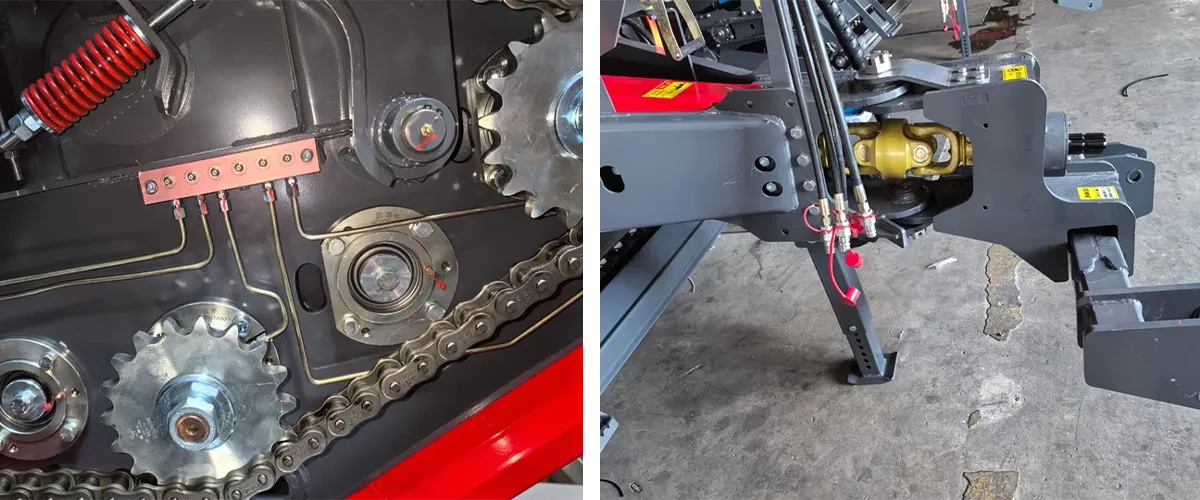
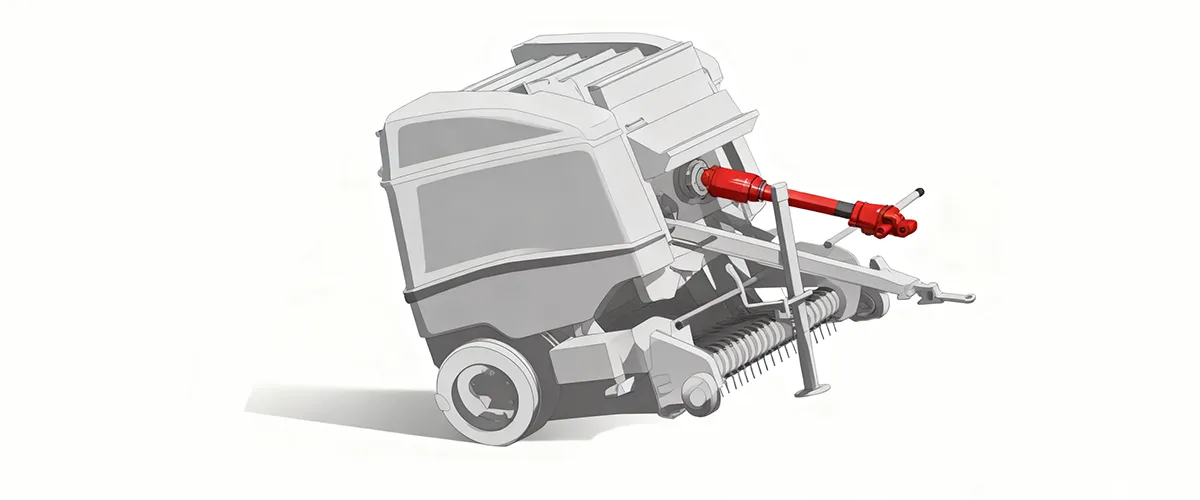
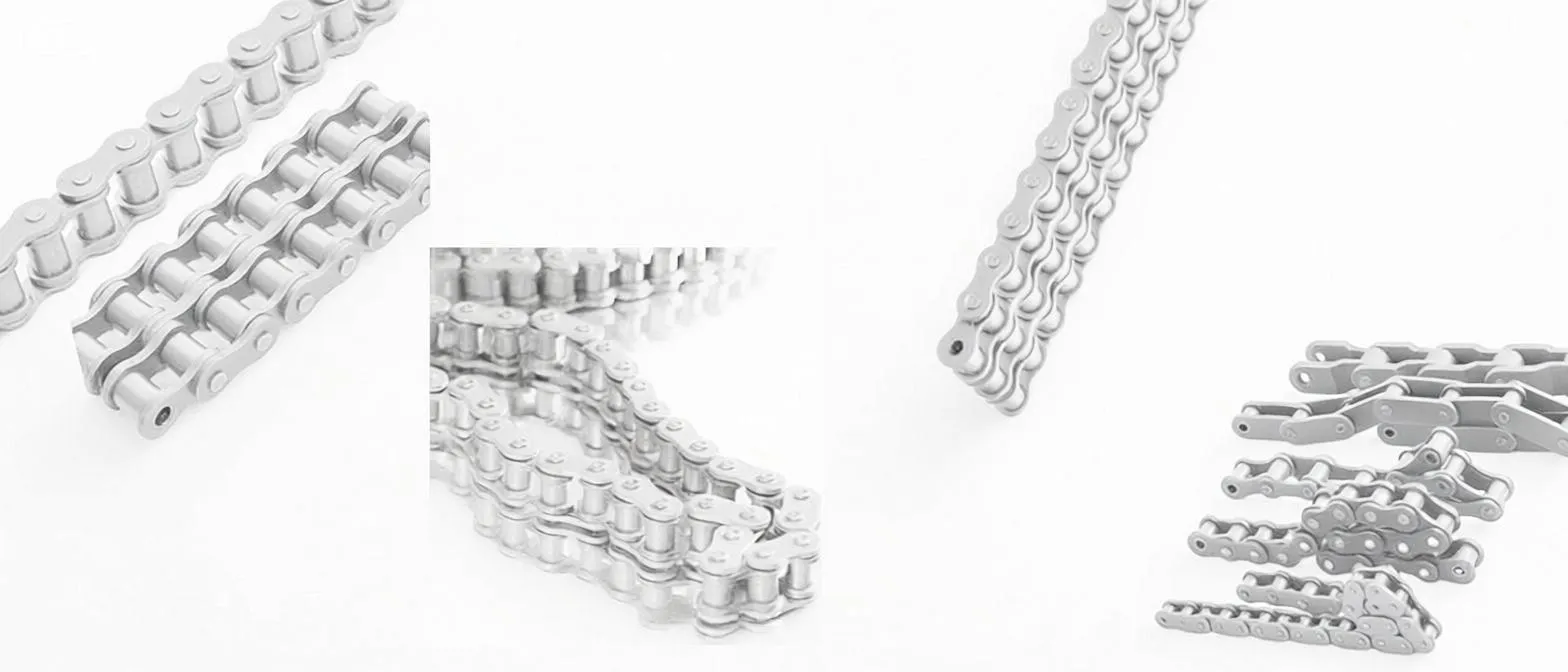
The 9YG-1.25 round baler is part of a complete drivetrain system that begins at the tractor PTO output and ends at the bale ejection mechanism. Specifying a matched Agricultural PTO Shaft for round balers — one sized and rated for the torque profile of a 120 HP baler in dense rice straw — is one of the most cost-effective reliability upgrades available to operators. Generic cross-type PTO shafts sold for hay equipment are often rated at lower continuous torque than baler operation requires, and they fail through shaft spline or bearing wear after one to two seasons at full baler load. Agricultural drive chain for the feeder and chamber systems is equally critical: 16A chain rated and surface-treated for abrasive conditions is the correct specification for Korean paddy straw applications, and sourcing this from the same supply chain as the baler itself eliminates specification mismatches.
Purpose-rated PTO shafts for round baler torque demands. Options include overrunning clutch and shear-bolt torque limiter for paddy straw shock-load protection.
16A and 20A heavy-duty roller chain sets compatible with 9YG series baler drive systems. Surface-hardened pins for extended service in high-silica Korean paddy straw environments. Available as full-machine replacement kits sized by model.
Frequently Asked Questions
Redaktor: PXY