1. The Mechanics of Roller Count: What Changes When You Go from 16 to 18
The compression chamber of a round baler machine is the enclosed cylindrical space formed by an array of driven rollers arranged in a circular pattern. As the bale grows from its initial seed core to full diameter, it is in constant contact with every roller in this array simultaneously, being squeezed and shaped with each rotation. The total number of rollers determines two fundamental geometric parameters that have measurable consequences for bale quality in dense wheat straw operations: the inter-roller gap at the design bale diameter, and the angular spacing between adjacent rollers around the bale circumference. Both parameters change directly when the roller count increases from 16 to 18, and both changes favour the 18-roller design in dense wheat straw baling conditions.
In a 16-roller arrangement in a round baler machine chamber dimensioned for Ø1300 mm bales, the rollers are spaced approximately 22.5 degrees apart in angular terms, and the inter-roller gap — the unsupported arc of bale surface between any two adjacent rollers — is approximately 255 mm at full bale diameter. In an 18-roller arrangement in the same chamber, the angular spacing reduces to exactly 20 degrees, and the inter-roller gap reduces to approximately 227 mm. This 28 mm reduction in the unsupported arc length per inter-roller gap may seem modest on paper, but its practical effect on bale formation in dense wheat straw is substantial. When dense, stiff straw material encounters the 255 mm unsupported arc of a 16-roller chamber, the outer bale surface has enough unsupported span to deform slightly outward between rollers under the internal compression pressure — creating the characteristic scalloped surface profile that is visually identifiable on high-density 16-roller wheat straw bales and that represents a density gradient from the roller contact points inward versus the inter-roller positions. The 18-roller design’s tighter 227 mm unsupported arc significantly reduces this surface deformation, producing a more cylindrical bale profile with more uniform density distribution from circumference to core.
2. Contact Arc Distribution and Bale Surface Quality in Wheat Straw
The bale surface quality produced by a round baler compression chamber has commercial significance in several wheat straw market segments — particularly for bioenergy feedstock supply where bale surface integrity affects net-wrap moisture protection, and for mushroom cultivation substrate supply where the bale’s external compaction level influences the uniformity of substrate colonisation. A smoother bale surface reflects a round baler compression chamber where roller contact is evenly distributed. The 18-roller array achieves this more effectively than the 16-roller configuration: 18 rollers in contact with the bale provide 18 contact points rather than 16, reducing the proportion of the bale circumference that is unsupported at any given moment.
The contact arc quality issue in the round baler is most apparent in dense wheat straw baling because wheat straw’s high lignin and silica content gives individual stems a rigid, resisting character that other crops — soft grass hay, for example — do not have. Soft grass hay conforms readily between rollers under compression pressure, filling the inter-roller gap with a continuous, flexible mass. Dense wheat straw rigid stems bridge the inter-roller gap, creating a structural arch that carries load at contact points but reduces compression in the inter-roller zone. This bridging effect is more pronounced in 16-roller round baler configurations than in 18-roller arrays. The 18-roller round baler design’s ability to suppress the wheat straw bridging effect is the core mechanical reason why it outperforms 16-roller designs in dense wheat straw baling.
The practical consequence in commercial Korean wheat straw supply is that 18-roller round baler bales require less remediation at the bioenergy or mushroom cultivation facility intake because their more uniform surface density reduces the proportion of low-density material at the bale outer layer that is typically identified as sub-specification in incoming quality checks. For processors who evaluate bale quality by probing multiple points across the bale surface with a density probe, an 18-roller bale shows less probe-point variation across its circumference than a comparable 16-roller bale at the same average density — which translates directly into fewer delivery adjustments and more predictable processing line throughput.
3. Compression Force Distribution: Why More Rollers Mean More Even Density
The hydraulic density control system of a round baler applies compression force to the bale through the rollers that are in contact with the gate-side of the bale chamber — these are the rollers whose positions are controlled by the hydraulic gate cylinders and whose outward movement is resisted by the density control pressure. The compression force in the bale chamber is therefore not uniformly distributed around the bale circumference: it is highest at the rollers directly linked to the gate force and must be transmitted through the bale material to produce compression at the positions between rollers and at the front of the chamber opposite the gate. The efficiency with which the applied gate force is distributed into uniform bale density throughout the bale depends on the number of contact points through which force can be transmitted and the angular spacing between them.
In a 16-roller round baler machine configuration, the angular spacing of 22.5 degrees means that the longest path from an applied compression point to the next roller contact point is 22.5 degrees of arc — approximately 255 mm at full bale diameter. The compression force attenuation from the gate-side rollers to the mid-point between rollers in the 16-roller arrangement is therefore determined by the structural properties of the wheat straw mass over this distance. Dense wheat straw, with its high specific modulus of elasticity compared to soft hay, transmits compression force effectively through short structural distances but experiences force attenuation over longer paths as the material undergoes localised compaction rather than global compression. This force attenuation over the 255 mm inter-roller distance in the 16-roller design contributes to the density gradient discussed in the previous section.
The 18-roller design reduces this attenuation by reducing the transmission distance to approximately 227 mm — a 10.6% reduction in the critical force transmission path length. For dense wheat straw with its high specific modulus, even this relatively modest path-length reduction produces a measurable improvement in compression force uniformity around the bale circumference. At the high compression circuit pressures used for bioenergy-grade wheat straw baling on 9YG series round baler models, the difference between 16-roller and 18-roller force distribution becomes more pronounced because the total compression force applied is higher, and the material’s resistance to non-uniform density under high force is lower in the inter-roller zones where force attenuation is greatest.
| Parameter | 16-Roller Configuration | 18-Roller Configuration | Wheat Straw Practical Effect |
|---|---|---|---|
| Angular roller spacing | 22.5 degrees | 20.0 degrees | 10.6% reduction in unsupported arc |
| Inter-roller gap (Ø1300 mm bale) | ~255 mm | ~227 mm | Reduces wheat straw bridging effect |
| Contact points with bale | 16 simultaneous | 18 simultaneous | 11.3% more contact coverage |
| Bale surface scalloping | Visible at high density | Substantially reduced | More cylindrical bale — better net wrap seal |
| Force per roller at 160 bar | Higher unit load per roller | Load distributed across 2 extra rollers | ~11% lower peak Hertz stress per roller |
4. Roller Wear in Dense Wheat Straw: How 18-Roller Arrays Last Longer
Compression roller wear in wheat straw round baler baling is driven primarily by two mechanisms: abrasive wear from the silica particles in wheat straw cell walls that act as a fine grinding compound against the roller surface under compression pressure, and fatigue wear at the roller surface from the repeated loading and unloading cycles as each bale passes through the chamber. Both mechanisms are related to the contact pressure between the roller surface and the bale material — higher contact pressure accelerates both abrasive wear rate and fatigue damage accumulation rate. The distribution of compression force across the roller array therefore has a direct influence on roller service life, and this is where the 18-roller configuration provides a tangible durability advantage over 16-roller designs in dense wheat straw service.
At any given hydraulic density circuit pressure, the total compression force applied to the bale is approximately the same in a 16-roller and an 18-roller round baler of equivalent gate geometry. However, this total force is distributed across 16 contact points in one design and 18 contact points in the other. The average force per roller contact is therefore approximately 11.3% lower in the 18-roller design. At the high density circuit pressures used in commercial Korean wheat straw baling — 140–175 bar for bioenergy and export straw supply — this 11.3% reduction in average roller contact force translates into a meaningful reduction in the Hertz contact stress at the roller surface, because Hertz contact stress increases with applied force at a rate proportional to the square root of force. The lower per-roller contact stress in the 18-roller design reduces both the abrasive wear rate (which scales with contact pressure) and the fatigue damage accumulation rate (which scales with contact stress amplitude) across every bale produced — and the cumulative effect across a full Korean wheat straw campaign of 10,000–50,000 bales is a measurably extended roller service life.
The practical service life comparison in Korean commercial wheat straw round baler conditions is approximately 3–5 seasons for hardened 18-roller arrays versus 2–4 seasons for equivalent hardened 16-roller arrays under the same conditions. This 25–33% roller service life advantage translates directly into lower round baler parts replacement costs per tonne of straw baled across the machine’s working life — a total cost of ownership advantage that partially or fully offsets the additional capital cost of an 18-roller round baler machine at commercial operation scales.
5. Bale Formation Stability at High Density Settings in Wheat Straw
Bale formation stability refers to the round baler machine chamber’s ability to maintain a consistently growing bale core from the initial seed core through to full diameter without the bale wandering off-centre, developing a skewed internal density distribution, or producing the asymmetric end-face geometry that makes bales difficult to handle, stack, and convey at bioenergy or processing facilities. Formation stability is particularly relevant in dense wheat straw baling because the stiff, brittle nature of wheat straw stems creates a tendency for the initial bale core to break apart or shift sideways before it has grown to a diameter where its own inertia and the roller contact forces stabilise it in the chamber centre. This early-stage instability risk is higher in a 16-roller round baler machine chamber because the larger inter-roller gaps provide less geometric guidance to the forming bale core at small diameters.
As the round baler bale core grows from 150 mm toward the 400–500 mm diameter where stability becomes self-sustaining, the 18-roller array’s tighter angular spacing provides more continuous lateral constraint. At 150 mm bale diameter, the inter-roller gap of a 16-roller array spans approximately 60 mm of the bale circumference — wide enough for wheat straw slugs entering the chamber to push the bale core laterally against one roller side and initiate the slight eccentricity that can persist as a density imbalance through the remaining formation cycle. The 18-roller array’s inter-roller gap at the same diameter is approximately 53 mm, providing tighter geometric constraint that suppresses the lateral displacement of the forming bale core during the vulnerable early formation phase. The result is that 18-roller round baler chambers produce a higher proportion of bales with symmetric internal density distribution and flat, parallel end faces — a quality outcome that matters most when bales are handled mechanically at high throughput and must register precisely with the handling equipment geometry.
6. Manufacturing Structure of the 18-Roller Compression Chamber
The addition of two rollers to the round baler compression chamber is not a straightforward dimensional change but requires careful re-engineering of the chassis bore pattern, the drive chain geometry, and the roller bearing arrangement to maintain the geometric accuracy that the tighter 20-degree angular spacing requires. If the bore pattern is not machined to higher angular precision than a 16-roller design — where a 1-degree bore position error creates 1/22.5 of the total angular spacing error versus 1/20 in the 18-roller arrangement — the tighter spacing advantage of the 18-roller design can be negated by manufacturing inaccuracy that creates uneven inter-roller gaps around the circumference.
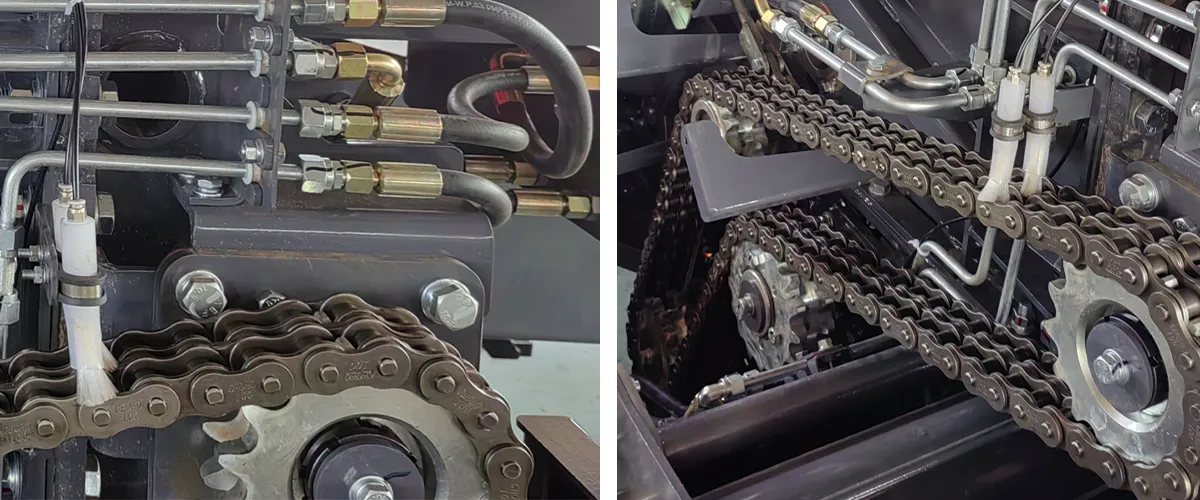
The 9YG-2.24D series chassis carries its 18 roller-mounting bores in a precision-machined pattern cut on CNC machining centres after the structural chassis welding is complete. Post-weld machining eliminates the thermal distortion effects of the welding process, which would otherwise cause the bore positions to shift from their design coordinates by amounts that are small but significant relative to the tight tolerance required for the 18-roller geometry. The bore-to-bore angular position tolerance across the full 360-degree array is maintained to within ±0.15 degrees of nominal, ensuring that no two adjacent rollers have an effective gap materially different from the designed 20-degree mean. This manufacturing accuracy is the engineering foundation that allows the 18-roller design to deliver its theoretical compression uniformity advantage in practice rather than just on a design drawing.
The chassis structural design must also accommodate the 12.5% higher roller drive chain tension load that arises from the larger number of driven elements in the 18-roller system compared to a 16-roller system at equivalent compression force per roller. The 9YG-2.24D chassis plate thickness and weld joint design at the roller mounting boss positions are engineered for this higher structural demand, ensuring that the combined load of the roller bearing reaction forces and the chain tension loads does not cause chassis deflection that would allow bore positions to shift during operation. For the dual-side 20A chain drive fitted to S9000 Classic and S9000 variants, the chain tension is distributed symmetrically across both sides of the roller array, halving the effective chain load on each side and maintaining the chain operating envelope within the sprocket and chain manufacturer’s fatigue life specifications even at the elevated loads of bioenergy-grade wheat straw compression.
Post-Weld CNC Bore Machining
18-bore pattern machined after chassis welding. Bore-to-bore angular accuracy within ±0.15 degrees. Ensures the designed 20-degree spacing advantage is realised in practice, not lost to manufacturing variation.
Enhanced Boss Weld Design
Roller mounting bosses carry 12.5% higher combined chain and bearing reaction loads than 16-roller equivalents. Chassis plate thickness and weld joint design prevent bore position shift during high-pressure wheat straw operation.
Dual 20A Chain Drive
Symmetric two-side drive distributes chain load across both frame sides. Halves effective chain tension per side on all 18 rollers, maintaining chain fatigue life within specification at bioenergy-grade density circuit pressures.
Cam-Free Feed Zone Integration
The 18-roller array’s tighter inner surface pairs with the cam-free axial-flow feed mechanism. Prevents crop blockage at the feed-to-chamber interface where a wider-gapped 16-roller array would allow straw plugs to partially enter unsupported gaps.
7. Material Systems in 18-Roller Bale Chambers for Wheat Straw Service
The 18 compression rollers in the round baler 9YG-2.24D series bale chamber are the most wear-intensive components in dense Korean wheat straw service, and their material specification must balance three competing requirements: surface hardness to resist abrasive wear from wheat silica, surface toughness to resist the impact-type loading from straw slug events, and dimensional stability to maintain the designed contact geometry across the service life of the machine. The materials and heat treatment processes used in the 9YG series roller specification address all three requirements through the case-hardening approach that provides a hard outer case over a tough inner core.
The roller blanks are formed from cold-drawn seamless steel tube — a manufacturing route that produces the precise cylindrical geometry and consistent wall thickness that dimensional stability across temperature cycles requires. Cold-drawing compresses the outer surface of the tube, introducing a compressive residual stress state in the outer zone that acts against the tensile stress that roller surface contact pressure creates, effectively pre-stressing the roller in the beneficial direction for contact fatigue resistance. After forming, the roller outer surface is induction-hardened to 55–62 HRC, creating the case hardness profile that provides the combination of surface abrasion resistance (high hardness at the contact surface) and core toughness (lower hardness at the tube wall mid-thickness) that wheat straw bioenergy service demands. The induction hardening process for the 18-roller array is applied individually to each roller after all forming operations are complete, ensuring that the hardness profile is consistent across all 18 rollers in the chamber array.
The bearing arrangement at each roller end must accommodate the complex loading that the 18-roller design creates: the radial compression load from the bale material pressing against the roller, the tangential load from the chain drive, and the asymmetric axial load that arises when the bale density is not perfectly uniform across the full bale width and the bale pushes against one end of a roller more than the other. Tapered roller bearings or angular contact roller bearings with appropriate preload are the appropriate design response for this combined loading scenario, maintaining roller axial position accuracy within the tight spacing tolerance of the 18-roller array across the service life of the machine. For Korean wheat straw bioenergy supply campaigns where rollers accumulate 300–400 operating hours per season, bearing preload should be verified at the start of each season and adjusted if measured bearing end-play exceeds the specified tolerance.
| Component | Material / Treatment | 18-Roller Specific Requirement | Wheat Straw Service Interval |
|---|---|---|---|
| Compression rollers | Cold-drawn tube, induction-hardened 55–62 HRC | Consistent hardness profile across all 18 rollers | Visual at 150 h; dimensional check annually |
| Roller bearings | Chrome steel tapered or angular contact, 60–66 HRC races | Preload verification for axial position accuracy in tight spacing | Check preload each season start |
| Chassis bore lining | Case-hardened steel bore surfaces, precision ground | ±0.15 degree angular accuracy sustained under operating load | Inspect after major slug events |
| Dual 20A drive chain | Hardened alloy steel, symmetric both sides | Carries 12.5% higher total load than 16-roller equivalent | Tension every 50 h; elongation check annually |
8. Round Baler Gearbox and Driveline Interaction with the 18-Roller Array
The round baler machine gearbox drives the 18-roller compression chamber through the roller drive shaft and chain transmission, and the gearbox torque demand is directly influenced by the number of rollers being driven simultaneously and the compression force each roller exerts on the bale. Understanding how the 18-roller configuration affects round baler gearbox loading helps operators and specifiers select the appropriate gearbox oil, service interval, and overload protection for their specific wheat straw application.
At equivalent bale density settings, the total torque demand on the round baler gearbox output shaft from the 18-roller array is approximately 11.3% higher than from a 16-roller array, because two additional rollers are being driven against the bale compression force simultaneously. However, the torque demand per roller is 11.3% lower, which means the chain drive load per link and the roller bearing load per bearing are both reduced despite the higher total gearbox output torque. This distinction matters for maintenance scheduling: the gearbox oil must handle the higher total output torque. All 9YG-2.24D series round baler models are rated for 720 r/min PTO input, and the gearbox gear sets are specified with the rated output torque that accommodates the 18-roller drive requirement at the maximum bioenergy-grade compression circuit pressure. The gearbox oil should be API GL-4 or GL-5 specification with viscosity index above 150, changed after each wheat straw campaign at 100–150 operating hours maximum in Korean summer conditions.
The safety torque shaft on the 9YG-2.24D S9000 Transcend round baler machine variant provides overload protection tuned to the 18-roller gearbox torque profile. At high-density wheat straw settings, the baseline gearbox output torque from the 18 driven rollers is near the rated continuous value, leaving less torque headroom before slug-event peaks reach the gear tooth fatigue limit than would exist in a 16-roller configuration at the same density setting. The torque-limiting slip element in the safety shaft is calibrated to engage at the appropriate threshold for the 18-roller torque profile, providing protection at the correct intervention point rather than the alternative of either over-protecting (reducing the working density capability) or under-protecting (allowing slug events to approach the gear tooth endurance limit).
9. 18-Roller Versus 16-Roller: Side-by-Side Operational Comparison
The following comparison provides a practical operational summary for Korean round baler machine buyers and specifiers who are evaluating 16-roller versus 18-roller round baler configurations for their specific wheat straw application. The comparison is most relevant for operators baling dense Korean wheat straw at bioenergy or export specification density targets, where the compression uniformity, roller durability, and formation stability advantages of the 18-roller design are most pronounced. For light, low-density straw baling at below 120 kg/m3, the performance difference between the two configurations is smaller and may not justify the additional specification cost of the 18-roller round baler variant.
| Operational Factor | 16-Roller Round Baler | 18-Roller Round Baler | Application Priority |
|---|---|---|---|
| Bale density uniformity | Good — visible inter-roller gradient at high density | Excellent — suppressed bridging and gradient | Bioenergy/pellet supply with density sampling |
| Bale surface quality | Moderate scalloping at high density | Smoother cylindrical profile | Net-wrap moisture seal; bioenergy facility intake |
| Roller service life | 2–4 seasons hardened, bioenergy use | 3–5 seasons hardened, bioenergy use | Long-term parts cost per tonne |
| Bale formation stability | Higher early-core displacement risk | Tighter core guidance from start | Dense wheat straw initial core formation |
| Gearbox output torque | Lower total at equivalent density | ~11% higher total; lower per-roller | Gearbox oil and torque protection spec |
| Drive chain load | Higher load per chain link | Load spread across 2 extra rollers per side | Chain fatigue life in continuous wheat straw |
| Best density range | Up to ~140 kg/m3 without significant gradient | Up to 180 kg/m3 with maintained uniformity | Target density tier selection |
10. Round Baler Models Featuring the 18-Roller Compression Chamber
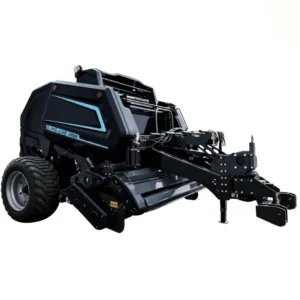
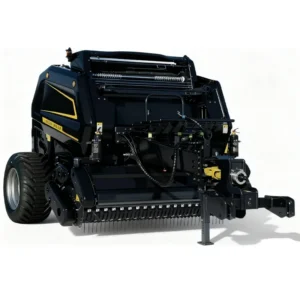
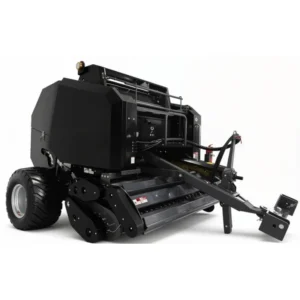
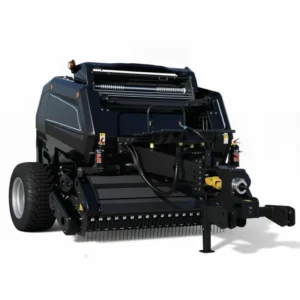
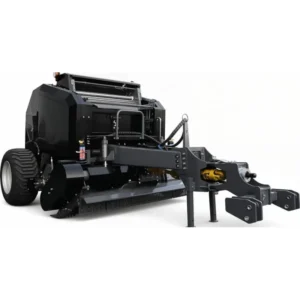
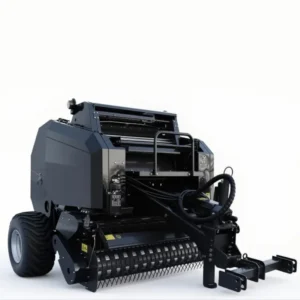
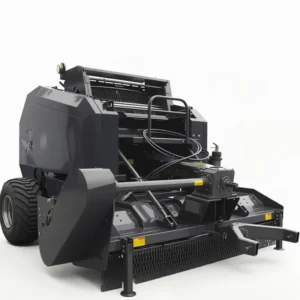
The 18-roller compression chamber is featured across the 9YG-2.24D series. The following round baler machine models cover the full range of Korean and international wheat straw operational requirements, from compact farm models through to large-scale commercial bioenergy supply configurations.
11. Regulatory and Quality Standards Relevant to Bale Compression Chambers
While no specific international standard mandates a minimum roller count for round baler compression chambers, the quality and safety standards governing round baler machines in major markets cover the compression chamber’s structural integrity, the gearbox and driveline that drives the roller array, and the bale quality outcomes that the chamber must produce for specific commercial applications. Understanding which standards are relevant helps Korean round baler buyers and equipment specifiers align their procurement decisions with regulatory compliance requirements.
Korea
The RDA Agricultural Machinery Performance Test evaluates the round baler machine bale formation quality — parameters that the 18-roller compression chamber improves relative to 16-roller alternatives. The test standard KS B 1521 covers the round baler gearbox performance at the rated output torque that the 18-roller drive system requires. MAFRA purchase subsidies of 30–50% are available for round baler machines certified under this programme, including the 9YG-2.24D series 18-roller models.
European Union
EU Machinery Directive 2006/42/EC (transitioning to EU Machinery Regulation 2023/1230 from January 2027) and the CE marking requirement apply to round baler compression chambers as structural elements of the machine. EN 1553 covers the round baler gearbox including the higher output torque specification that the 18-roller drive demands. EN ISO 4254-1 covers general safety requirements for agricultural machinery including the compression chamber access guards and roller guarding that must be in place for safe operation in Korean and EU market deployments.
United States
ASABE Standard ASAE S274 covers agricultural machinery rollover and structural protection, and ASABE S430 covers PTO driveline safety. For commercial bioenergy wheat straw operations where 18-roller round baler performance data is referenced in supply contract specifications, ASABE Engineering Practice EP408 provides the PTO driveline angle limits that the round baler gearbox driving the 18-roller array must comply with to maintain the rated torque transmission.
Russia and CIS
TR CU 010/2011 requires EAC certification for round baler machines sold in Russia and CIS countries. The gearbox output torque documentation required under EAC must cover the higher output demand of the 18-roller array, and the compression chamber structural integrity must be confirmed as part of the EAC technical file. For Korean round baler dealers and traders operating in CIS wheat straw markets — where wheat is extensively grown across Kazakhstan, Russia, and Ukraine — EAC-certified 18-roller round baler models offer a commercial advantage in the high-volume grain-belt applications where dense straw baling at commercial quality is required.
| Region | Compression Chamber Standard | 18-Roller Specific Requirement | Buyer Action |
|---|---|---|---|
| Korea | KS B 1521 / RDA Performance Test | Gearbox rated torque at 18-roller output demand | Confirm RDA cert for S9000 18-roller variants; MAFRA subsidy |
| EU | Machinery Directive 2006/42/EC / EN 1553 | Compression chamber guarding; gearbox torque doc | CE marking and Declaration of Conformity |
| USA | ASABE S430 / ASABE EP408 / OSHA 29 CFR 1928 | PTO angle compliance at 18-roller gearbox torque | Verify EP408 angle compliance for 18-roller drive |
| Russia / CIS | TR CU 010/2011 / EAC mark | EAC technical file: chamber structure + gearbox torque | Confirm EAC cert covers 18-roller variant specifically |
| International | ISO 4413 / ISO 11684 / EN ISO 17225 | Bale density uniformity supporting ISO 17225 quality class | Specify 18-roller for bioenergy supply contracts requiring ISO 17225 compliance |

Frequently Asked Questions
Q1. Why does the 18-roller compression chamber on the 9YG-2.24D round baler produce more consistent bale density than a 16-roller design in dense Korean wheat straw baling? +
Q2. Which round baler model with an 18-roller compression chamber is best for Korean bioenergy wheat straw supply under RPS contracts at 150 to 180 kg per cubic metre density? +
Q3. How does the 18-roller round baler gearbox torque requirement differ from a 16-roller design and what oil specification does it require for Korean summer wheat straw operations? +
Q4. Where can Korean wheat straw operators and cooperative procurement teams get a supplier quote for the 9YG-2.24D 18-roller round baler with MAFRA subsidy documentation? +
Q5. What round baler parts in the 18-roller compression chamber require the most attention for a Korean commercial wheat straw operator running continuous bioenergy supply campaigns? +
Q6. How does the 18-roller round baler compression chamber improve bale surface quality for Korean bioenergy wheat straw that must be net-wrapped for extended outdoor storage? +
Q7. What is the Korean MAFRA subsidy process for purchasing a 9YG-2.24D 18-roller round baler and which RDA certification documents are required for the application? +
Redaktor: PXY