
EP Square Baler-Hammer-Claw Type 2200 mm Picking Width
A square baler earns its place on a commercial farm or in a contracting fleet when it can handle the difficult material that other machines struggle with. This EP square baler machine is specifically engineered for exactly that scenario: it is currently one of very few machines capable of reliably picking up, shredding, and baling upright, lodged, or laid corn stalks and other hard-stem crop residues that block or stall conventional pickup designs. The hammer-claw type single shredding mechanism gives this machine a distinct capability advantage — it crushes and rubs hard stalks such as corn and sorghum before they enter the bale chamber, producing a denser, more uniformly formed square bale that holds together better in storage, transport, and subsequent feeding.
The machine operates as a towed-type square baler, meaning it is hitched to the rear drawbar of a compatible tractor and receives all drive power through the PTO connection. A tractor rated at ≥73.5 kW (approximately 99 hp) is the minimum matched power specification for this large square baler. At 2350 kg and an overall dimension of 6240×2760×1700 mm (L×W×H), this is a substantial field machine suited to the scale of commercial grain farms, livestock enterprises with large annual straw requirements, and agricultural cooperative baling services in South Korea (한국), Australia, the Netherlands, Brazil, Canada, and Colombia. The 2200 mm picking width means wide field coverage per pass — important for operations where time in the field during harvest windows directly determines annual income.
Heavy-Duty Agricultural Square Baler Machine
EP Square Baler — Hammer-Claw Type
2200 mm Picking Width | 6240×2760×1700 mm (L×W×H)
A towed-type agricultural square baler machine with a single-stage hammer-claw shredding mechanism and fork feeding system, purpose-built for baling upright, lodged, and laid crop — including corn stalks, rice straw, wheat straw, cotton stalks, and multiple forage types — at material moisture content 10–25%.
1. Technical Specifications
All dimensions in millimetres unless otherwise stated. Power range given in kW; multiply by 1.341 for horsepower equivalent. Confirm tractor PTO shaft speed and hydraulic output capacity before connecting this square baler machine.
| نہیں | Parameter | یونٹ | تفصیلات |
|---|---|---|---|
| 1 | ماڈل کا نام | - | EP Square Baler (Hammer-Claw Type, 2200 mm) |
| 2 | ہچنگ کا طریقہ | - | Towed-type |
| 3 | Picking Width | ملی میٹر | 2200 |
| 4 | Feeding Inlet Width | ملی میٹر | - |
| 5 | Picker Structure | - | Hammer-Claw Type |
| 6 | Feeder Structure | - | Fork feeding mechanism |
| 7 | Knotter Type | - | D-type |
| 8 | Number of Knotters | پی سیز | 2 |
| 9 | Compression Chamber Section Size (W×H) | ملی میٹر | 460×360 |
| 10 | بیلنگ کا طریقہ | - | Automatic rope baling |
| 11 | Matching Power Range | کلو واٹ | ≥73.5 |
| 12 | مجموعی طول و عرض (L×W×H) | ملی میٹر | 6240×2760×1700 |
| 13 | مشین کا وزن | کلو | 2350 |
Bean pasture and non-cereal forage grass: 17–23% moisture content. Rice straw, wheat straw, and corn stalks: 10–23% moisture content. Soil moisture content tolerance: 12–25%. Slope tolerance: ≤8°. These ranges reflect the conditions under which the hammer-claw shredding mechanism achieves efficient crushing and the fork feeding mechanism maintains consistent chamber flow without blockages.
2. Five Key Advantages of This EP Square Baler Machine
The single-stage hammer-claw shredding mechanism is this square baler's defining technical feature. It adopts a first-stage shredding structure that crushes and rubs hard-stemmed material — corn stalks, sorghum, cotton stalks — before compressing them into the bale chamber. This achieves two things simultaneously: it produces a denser, more stable bale with consistent forming quality, and it creates a product that is easier to handle, store, transport, and feed out or reprocess as biomass feedstock. For South Korean operations targeting corn stalk recovery in 경북 and 충남 agricultural zones, and for Australian operations dealing with tall standing wheat stubble, this capability is the direct answer to a problem that forces many operators to skip residue recovery entirely with standard equipment.
Most square baler machines require crop to be cut, windrowed, and dried to a lying flat position before pickup. This machine is one of the very few in the market that can handle standing upright stalks, lodged material leaning at various angles, and laid-flat crop in a single-pass operation without requiring the operator to pre-process the field with a rake or conditioner. For corn and sorghum residue in particular — where the stalks remain partially upright after grain harvest — this saves an entire field operation, reduces soil compaction from additional machine passes, and brings the total harvest-to-bale cycle time down to a level that makes large-volume residue recovery genuinely cost-effective on commercial operations.
At 2200 mm, the picking width of this square baler covers a broader swath per pass than most comparable machines in its class. For large-acreage operations — Korean cooperative farms baling across multiple member paddocks, Australian grain farmers recovering straw from thousands of hectares of wheat stubble, or Dutch forage contractors clearing wide-cut mower swaths — this width directly reduces the number of field passes required per hectare and therefore the total time and fuel cost per tonne of baled material. When combined with the automatic rope baling system, the time between bale ejections is kept to a minimum, so the wide pickup feeds the chamber at a rate that sustains high daily bale output without bottlenecks at the wrapping stage.
Different crops reach baling-ready moisture at different field conditions, and weather delays often mean crop is baled wetter than ideal. This square baler machine is designed for a material moisture range of 10–25% for soil, rice straw, wheat straw, and corn stalks — and 17–23% for bean pasture and non-cereal forage grass. This wide tolerance window means operators in South Korea's humid summer and autumn climate, in Brazil's variable tropical conditions, and in Australia's unpredictable harvest weather can bale across a broader range of field conditions without producing bale quality failures from moisture sensitivity. The hammer-claw shredding mechanism plays a role here too: crushed stalks dry more uniformly and bale with better density even at the upper end of the moisture range.
The D-type knotter design used on this square baler machine is a proven, robust binding mechanism that forms consistent, tight knots in the baling rope at high cycle rates. Two knotters operate in parallel across the 460×360 mm bale cross-section, tying both top and bottom ropes simultaneously to secure each bale completely before ejection. Automatic rope baling eliminates manual intervention in the tying sequence, which is both a safety improvement and a throughput gain — the bale chamber can begin the next compression cycle as soon as the tied bale is ejected, without waiting for an operator to manually secure the bale. Knotter timing and tension are adjustable for different rope grades and crop densities, allowing fine-tuning for optimal knot security across a range of baling conditions.
3. How Does a Square Baler Work — The EP Hammer-Claw Cycle
How does a square baler work? The operating cycle of a square baler differs fundamentally from a round baler: instead of building a cylindrical bale by rolling, a square baler compresses crop into a rectangular block using a reciprocating plunger in a fixed-cross-section bale chamber. This machine adds a pre-compression shredding stage at the front of that cycle, making it unique in its ability to process hard or standing crop. The complete bale cycle on this machine proceeds through five stages.
The 2200 mm hammer-claw type pickup simultaneously lifts crop from the ground and initiates the shredding process. Hardened hammer elements crush and rub tough stalk material — corn, sorghum, cotton — before it enters the feeding system. This stage is what allows this square baler to handle standing and lodged crop that would stall a conventional spring-tooth pickup reel.
The fork feeding mechanism takes pre-shredded material from the hammer-claw unit and meters it into the 460×360 mm compression chamber at a controlled rate. Fork feeding is preferred over auger feeding for large-section square baler chambers because it handles shredded stalk material without re-bunching or bridging, maintaining an even layer density across the full chamber cross-section as the bale builds.
A hydraulically or mechanically driven reciprocating plunger compresses each charge of material against the previous layer in the bale chamber. Each plunger stroke advances the forming bale forward by a small increment. The plunger force and stroke speed determine bale density; at this machine's power requirement (≥73.5 kW), plunger compression force is substantial enough to achieve the high density needed for stable large square bales of corn stalk and similar material.
When the bale reaches the programmed length, two D-type knotters activate simultaneously, each threading and tying a rope around one side of the 460×360 mm bale cross-section. The knotters cycle through the needle insertion, loop formation, and knot-tying sequence in a fraction of a second per knotter before returning to standby. Both ropes are tied and cut automatically without any operator action.
The completed square bale is pushed out of the rear of the bale chamber by incoming material and drops or slides to the ground — or onto a bale accumulator or chute if fitted. The bale chamber immediately begins receiving the next charge of material and the cycle restarts. On this machine, the automatic rope baling system means ejection and restart are seamless at normal field speed without any manual intervention required between bales.
4. Material Specification — Engineered for Abrasive Field Conditions
The hammer-claw type pickup mechanism on this square baler machine operates under conditions that are more mechanically demanding than a conventional spring-tooth pickup — it is actively crushing and shredding hard stalk material at high rotational speed rather than simply lifting and transferring soft crop. The hammer elements themselves are forged from high-chromium wear-resistant steel, hardened to 56–62 HRC, to withstand the sustained abrasion of corn stalk and sorghum shredding across thousands of field hours. Hammer attachment bolts and backing plates are oversized relative to the impact loads they carry, and the hammer bar assembly is dynamically balanced to avoid vibration-induced fatigue failure at operating speed.
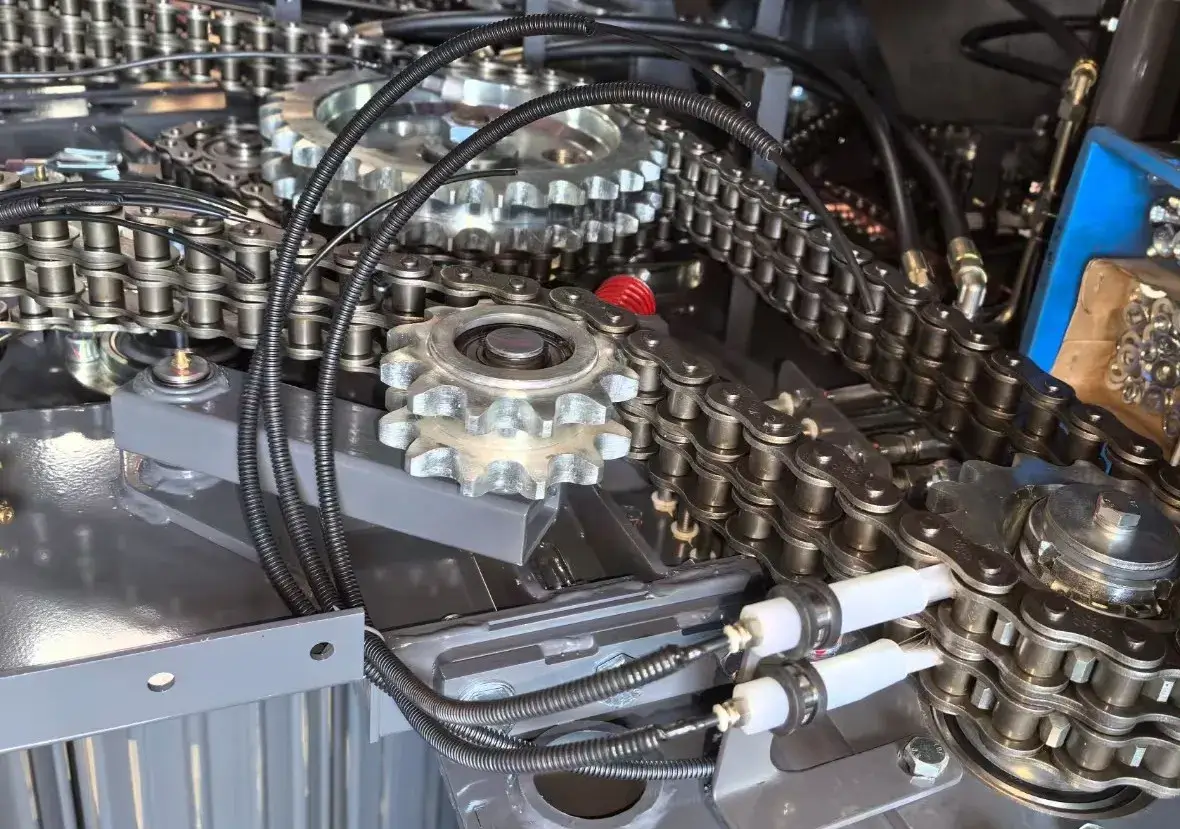
The main frame of the square baler is fabricated from heavy-section structural steel in a welded box construction, with the bale chamber walls formed from 10 mm-thick plate to resist the lateral forces generated by plunger compression at full bale density. The plunger itself is guided on precision-machined slide rails inside the chamber, and the plunger face is surfaced with replaceable hardened steel inserts rather than being integral with the plunger body — meaning the high-wear surfaces can be replaced without machining the plunger itself. Drive chain sprockets are case-hardened and matched in hardness grade to the chain, extending sprocket life by ensuring wear occurs on the chain side links rather than the sprocket tooth profile.
The D-type dual knotter assemblies are machined from cast alloy steel and include adjustable billhook tension and twine finger timing, allowing field adjustment for different rope materials and diameters. This matters because square baler twine quality varies significantly between supply regions in South Korea, Brazil, and Australia, and a knotter that cannot accommodate this variation will produce failed knots during harvest. The fork feeding mechanism forks are fabricated from spring-tempered steel that bends on impact with oversize material rather than breaking, protecting the feeding system and reducing the risk of a blockage-induced field stop during peak harvest operation. All square baler parts that contact crop are either heat-treated wear items or designed as bolt-on replaceable components to simplify field maintenance.

5. Square Baler Application — Where This Machine Works Best
The defining characteristic of this square baler machine is its ability to handle crop types and field conditions that exclude conventional balers. The following application scenarios reflect the primary contexts where the hammer-claw design delivers results that other machines cannot match.
Post-harvest corn and sorghum fields present a genuine machinery challenge — stalks often remain partially upright, are hard and fibrous, and have high moisture content at the base. This square baler machine is specifically capable of picking up, shredding, and baling these stalks directly from the field, including standing stalks, without requiring a separate chopping or mowing pass. The resulting large square bales of shredded corn stalk are compact enough for economical transport and have established markets as livestock bedding, mushroom substrate, and biomass energy feedstock — giving grain farmers a secondary income stream from material that would otherwise be burned or incorporated. This is particularly relevant in Korean corn-growing regions (강원도, 충북) where stalk disposal is a recognised environmental pressure.
Rice straw and wheat straw represent enormous recoverable resources in South Korea, Japan, and across the rice and wheat belts of Brazil and Colombia. The 2200 mm picking width of this large square baler allows efficient collection in a single pass across wide combine header widths, and the hammer-claw mechanism handles lodged or tangled straw that clogs narrower conventional pickup designs. Large square bales of rice or wheat straw at the 460×360 mm cross-section are the preferred format for export to livestock markets in the Middle East and Southeast Asia, where the bale dimensions and density are matched to container loading plans. Korean rice straw export programmes — particularly from 전남 (Jeonnam) and 충남 (Chungnam) production zones — increasingly rely on large square baler machines of this type.
Cotton stalks are among the most difficult agricultural residues to collect and bale. They are wiry, strong, and resist conventional pickup mechanisms. The hammer-claw type picker on this square baler handles cotton stalks reliably by shredding the stalk structure before it enters the chamber, producing a compressed bale that holds together without the springback that causes conventional square bale machines to produce poorly formed bales with cotton material. Baled cotton stalks are used as biomass fuel, mulch material, and — in some markets — as a low-grade animal roughage supplement. For cotton-producing regions in Brazil's São Paulo state and in Central Asian supply chains feeding into Korean textile industries, this square baler machine opens a viable residue recovery workflow.
Beyond residue recovery, this square baler machine performs equally well on conventional forage crops — alfalfa (lucerne), fresh and dry grass, and bean pasture. Square bale hay baler output in the 460×360 mm cross-section format produces large square bale hay that is the preferred format for transport to feedlots, dairy farms, and equine operations that purchase hay by the tonne. Square hay bales stack uniformly in storage sheds and on pallets, allowing precise inventory management that round bales do not. Australian dairy farms in Victoria and South Australia and Korean cattle enterprises purchasing supplementary hay in bulk both recognise the advantage of consistent large square bale dimensions for logistics planning.
The bioenergy sector in South Korea, the Netherlands, and Germany actively contracts for baled agricultural residues — straw, energy grass, and crop stalks — as feedstock for biogas digesters, pellet mills, and direct combustion plants. A square baler machine producing large square bales of consistent density and dimension is preferred over round balers for industrial feedstock supply because the square format stacks uniformly in transport vehicles, reducing void space and maximising load density. For a contractor operating this square baler across multiple farms under a biomass supply contract, the combination of wide picking width, hard-stalk capability, and automatic rope baling translates directly into a lower cost-per-tonne of delivered feedstock.
6. Regulatory Compliance — Gearbox, Machinery Safety & Transport by Market
At 6240 mm length, 2760 mm width, and 2350 kg, this square baler machine sits within the scope of multiple regulatory frameworks across its primary target markets — machinery safety standards, gearbox lubrication regulations, and road transport width limits all apply. The overview below covers the key applicable requirements for major markets. Always verify current local requirements before import and operation.
Agricultural machinery in South Korea is regulated under the Agricultural Mechanization Promotion Act (농업기계화 촉진법). Safety performance standards for square balers are administered by the Rural Development Administration (농촌진흥청), and Korean Industrial Standards (KS B) apply to gearbox and transmission components. The square baler gearbox must meet KS guarding requirements for all PTO-connected transmission elements. At 2760 mm working width, road transport of this machine requires an overwidth permit under the Road Traffic Act (도로교통법). PTO shaft guarding must comply with the Agricultural Machinery Safety Management Regulations, including full-length guard coverage of all rotating PTO shaft sections between the tractor and machine.
EU Machinery Directive 2006/42/EC (transitioning to Machinery Regulation EU 2023/1230 from January 2027) requires CE marking and a full technical construction file. EN ISO 4254-1 (agricultural machinery — general safety) and EN ISO 11684 (safety signs) both apply. The square baler gearbox falls within the scope of the EU Ecodesign Regulation for mechanical gearboxes if its oil sump meets the applicable volume threshold under Commission Regulation (EU) 2019/1781. Whole Vehicle Type Approval under Regulation EU 167/2013 is required for road transit at 2760 mm width in the Netherlands, Germany, Belgium, and France — all of which set standard non-permit road widths below this dimension. Dutch buyers in Groningen, Friesland, and Drenthe should confirm provincial transport authority requirements.
Safe Work Australia's Model Code of Practice for Managing Risks of Plant in the Workplace and state-level WHS Acts cover machinery safety for agricultural equipment including square balers. PTO guarding, bale chamber exclusion zones during operation, and pre-start safety checks are all addressed in these frameworks. At 2760 mm transport width, Oversize and Overmass (OSOM) permits are required in all states — standard non-permitted road width is 2.5 m. New South Wales Roads and Maritime Services, Queensland Transport and Main Roads, and Victoria's VicRoads each have specific permit application procedures and may require pilot vehicles for this machine width. Western Australian buyers in the grain belt should confirm requirements with Main Roads WA before transport is planned.
INMETRO Resolution 488/2021 and ABNT NBR standards govern agricultural machinery import conformity in Brazil. At this machine's weight and power class, a Technical Evaluation Report (Laudo Técnico) from an accredited inspection body is likely required for MAPA import registration. The square baler gearbox and PTO shaft must comply with ABNT NBR standards for mechanical transmission safety and guarding. Brazilian road transport regulations (DENATRAN) set a standard maximum road width of 2.6 m; at 2760 mm, an Autorização Especial de Trânsito is required for all road movement of this machine. Key target regions include Mato Grosso do Sul, Goiás, and Paraná — major grain states where corn stalk and soybean residue baling demand is growing.
Provincial OHS regulations and Canadian Agricultural Safety Association (CASA) guidelines govern square baler safety in Canada. Alberta OHS Code Chapter 18 and Ontario Regulation 851 both include machinery guarding provisions relevant to PTO-driven agricultural equipment. At 2760 mm, this machine exceeds standard provincial road width limits (generally 2.6 m) in all provinces; special transport permits are required in Saskatchewan, Alberta, Manitoba, and Ontario. Buyers should consult their provincial ministry of transportation for current permit procedures and confirm whether escort requirements apply on their intended transport route from port of entry to the farm. Canadian Prairie operations in the major grain belt are a primary target market for the wheat straw baling application of this machine.
Colombia's ICONTEC NTC 4116 and the Andean Community's harmonised technical regulations (Decisión 562 de la Comunidad Andina) apply to agricultural machinery safety labelling and guarding. The Ministry of Transport (Ministerio de Transporte) requires prior route authorisation for loads exceeding 2.6 m on national highways, applicable to this machine at 2760 mm working width. Key Colombian agricultural regions where this square baler machine addresses a genuine market need include Meta (corn and rice), Córdoba and Sucre (cotton and forage), and the Cauca Valley (sugarcane tops and forage). AGROSAVIA (Corporación Colombiana de Investigación Agropecuaria) and FINAGRO both provide technical and financing resources that Colombian buyers should explore when planning capital equipment purchases of this scale.
7. Compatible Accessories — Complete Drivetrain Supply
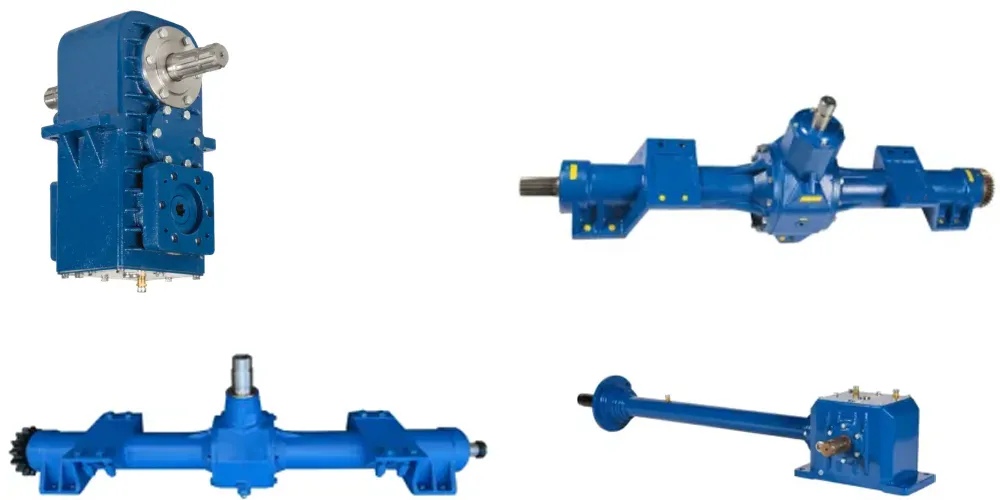
A square baler machine at this power level and application intensity demands matched drivetrain components rated for the torques involved. We supply both the round baler gearbox family and PTO shaft range as part of a one-stop supply proposition — ensuring compatibility and removing the risk of mismatched component specifications between tractor and machine.
The internal gearbox distributes PTO input power to the hammer-claw shredding mechanism, fork feeder, plunger drive, and D-type knotter system simultaneously. At ≥73.5 kW input, the gearbox must handle sustained torque during the plunger compression stroke — the most demanding load event in the square baler cycle. Our matched baler gearbox range uses case-hardened alloy steel gears in a ribbed ductile iron housing with adequate oil capacity for all-day commercial operation. Replacement gears, seals, and bearing kits are stocked to support fast turnaround servicing during harvest season.
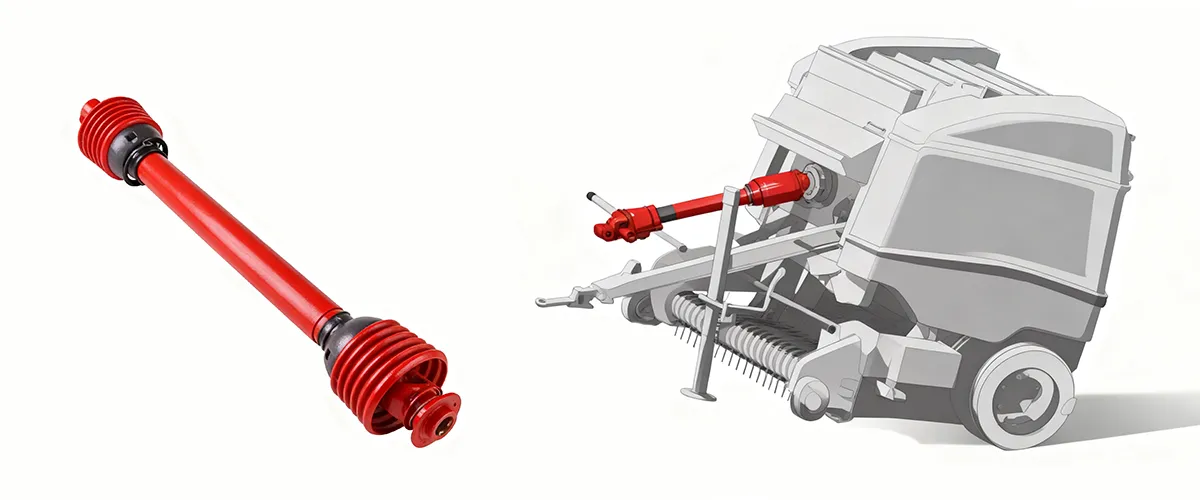
The PTO shaft between tractor and square baler must be rated for the peak torque generated during the plunger compression stroke — a momentary load significantly higher than the continuous average. Our PTO shaft for square balers includes models with wide-angle constant-velocity joints for drawbar manoeuvrability, overrun and shear-bolt protection to guard the plunger drive against sudden overloads, and CE-compliant full-length PTO guarding. Specify your tractor PTO connection type (6-spline 1-3/8" or 1-3/4"), PTO speed (540 or 1000 rpm), and the distance from tractor PTO output flange to machine input yoke when ordering to receive the correct shaft.
8. About Us — More Than a Decade of Agricultural Machinery Development
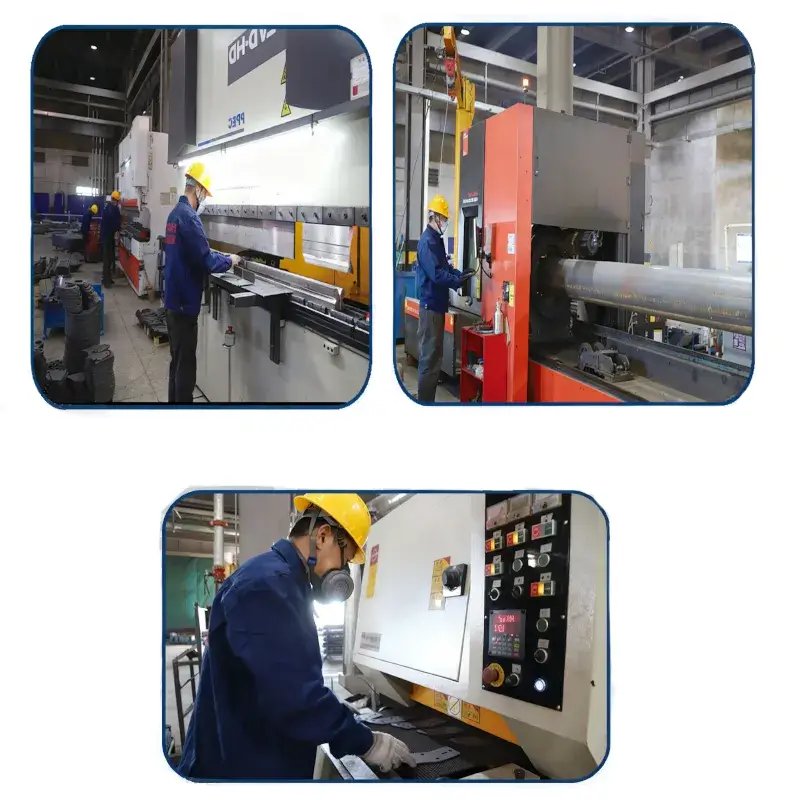
We have been developing and manufacturing agricultural harvesting machinery since 2013, operating as a modern, intelligent production enterprise focused on the agriculture and animal husbandry sectors. The product range spans light and heavy square balers and round balers, single and double blade mowers, disc rotary mowers, and single and double side rakes — all produced under one roof with independent import and export rights. Our quality management system is certified to ISO 9001, providing the structured framework that underpins consistent production quality at our current annual design capacity of 2,000 machines.
Our long-term objective is to earn recognition as a world-standard agricultural machinery brand rather than a volume commodity supplier. To support that, we continuously invest in advanced international production technology — currently more than 60 sets of large-scale fabrication and machining equipment — and we apply those resources to designing machines that solve real field problems rather than simply replicating conventional designs.
WorkShop

Frequently Asked Questions
Q1. What is a square baler and how does this hammer-claw model differ from standard square balers available in South Korea and Australia?
A square baler is a tractor-trailed machine that compresses cut or collected crop material into a rectangular block, ties it with twine or rope, and ejects it for storage or transport. This EP square baler machine differs from standard square baler designs through its hammer-claw type pickup mechanism, which actively shreds and crushes hard-stemmed crop like corn and sorghum stalks before they enter the bale chamber. Standard spring-tooth pickup designs on most square balers available in South Korea and Australia handle soft forage and straw well but struggle with standing or lodged hard stalks. The hammer-claw design handles both — making this machine a genuine multi-crop solution rather than a forage specialist.
Q2. Do they still make square balers with this kind of hard-stalk capability, and where can I get a quote for export to Australia or Brazil?
Yes — and this EP model is one of a relatively small number of commercially available square balers globally that can reliably handle standing upright corn and sorghum stalks without pre-processing the field. Most large square baler machines produced today are designed primarily for windrowed forage and straw, not for standing hard-stem residue. For export quotations to Australia, Brazil, South Korea, the Netherlands, Canada, or Colombia, use the product enquiry form on this page. Your quote will include EXW and CIF pricing options, packing specifications, applicable HS tariff codes, transport width documentation for permit applications, and current lead time from order confirmation to container loading.
Q3. How many horsepower do you need to run a square baler of this size reliably in commercial field conditions?
The minimum matched power for this square baler is ≥73.5 kW, which converts to approximately 99 hp. In practice, running at the absolute minimum power risks PTO slip during peak plunger compression loads, particularly when baling dense, high-moisture corn stalks where the shredding mechanism and plunger are both working hard simultaneously. Operating with a tractor in the 100–130 hp range provides the headroom needed for sustained commercial-rate baling without strain. South Korean TYM TX, Kukje M, and Daedong DK tractor series in the 100–120 hp class are well-matched. Australian John Deere 6M and Case IH Maxxum series in the same power range also pair well with this machine's PTO requirements.
Q4. How much does a square bale of hay weigh when produced by this machine, and what is the best handling equipment for large square bales?
How much does a square bale of hay weigh from this machine? The 460×360 mm compression chamber section produces bales whose weight depends on the set bale length and the crop. At typical commercial bale lengths, dry grass and straw bales weigh 150–280 kg, while high-density alfalfa bales at similar dimensions can reach 300–400 kg. These are large square bales that require mechanical handling — a telehandler rated for 1000–1200 kg or a front-end loader with a bale grab attachment. For storage and transport, large square bale dimensions stack uniformly on standard euro pallets or in flat-bed trailers, giving a load space efficiency advantage over the equivalent volume of round bales.
Q5. What are square hay bales called in different export markets, and how does the bale format affect export logistics to South Korea or the Middle East?
Large square hay bales are commonly referred to as "big square bales," "large square bales," or "3×4 bales" (from their approximate imperial dimension in feet) in English-language markets including Australia, Canada, and the United Kingdom. In South Korea, the format is referenced as 대형 각형 베일 (large rectangular bale). For export to South Korea and Middle Eastern livestock markets, the large square bale hay format is strongly preferred over round bales because: the rectangular form stacks without void space in shipping containers; bales can be double-stacked in 40-foot high-cube containers at standard forklift pallet widths; and end buyers find the consistent weight and dimensions easier to receive, store, and ration. Australian hay exporters specifically use large square baler machines of this cross-section class for container-export product.
Q6. What is the difference between round and square hay bales for livestock feeding, and which format should I choose for a South Korean cattle operation?
Square hay baler vs round baler output comes down to several practical differences. Large square bales are easier to store in confined sheds (they stack neatly), easier to export in containers (they fill rectangular space efficiently), and easier to ration precisely (a known weight per bale length). Round bales shed rainfall better when stored outdoors without covering, and they can be rolled out as a long strip for mob feeding without mechanical feed-out equipment. For a South Korean cattle operation with shed storage and a need to purchase or sell hay in trackable quantities, the large square bale format from this square baler machine is generally the better commercial choice. For outdoor windrow feeding to beef cattle on extensive range, round bales from a companion round baler may be more practical.
Q7. When is the best season to commission a large square baler for rice straw recovery in South Korea, and how early should I order to ensure delivery?
The main rice straw baling window in South Korea runs from mid-October to late November, immediately following the autumn rice harvest. To ensure the machine is on-farm, commissioned, and ready before this window opens, the order should be placed by July at the latest to allow for manufacturing lead time, ocean freight transit to a Korean port (typically Busan or Incheon), customs clearance, and pre-delivery inspection and setup. For Australian wheat straw operations, the main window runs October to January depending on latitude; an order in May or June ensures comfortable delivery ahead of the season. Contact our export team at the start of the relevant pre-season period to confirm current lead times before placing your order.
ایڈیٹر: PXY


