Wheat Straw Baling — Field Operations Series
A practical operational guide for Korean wheat farm operators and agricultural contractors — explaining how correct windrow preparation before the round baler pass eliminates the re-work passes that waste time, fuel, and straw, covering rake timing, windrow sizing, combine settings, moisture management, and the machine configurations that perform best when the windrow arrives in good condition.
The Hidden Cost of Re-work in Wheat Straw Baling
1. What Are Re-work Passes and Why Do They Happen in Korean Wheat Straw Operations?
A re-work pass is any additional field operation that would not be necessary if the initial windrow preparation had been done correctly before the round baler made its first productive baling pass. Re-work passes include: a second rake pass to consolidate straw that was too widely spread after the first raking attempt; a collection pass for residual straw left behind after the first baling pass due to a windrow that was too thin or too irregular for the pickup to capture completely; a re-raking pass after rainfall has matted and displaced straw that was raked before it was dry enough to maintain its windrow shape; and a remedial baling pass over areas where bale density inconsistency led to bales with too little material to hold their shape after ejection, requiring the loose material to be re-collected. Each of these events adds fuel cost, machine operating time, operator labor hours, and — critically — delay that may push the baling operation past the closing window of suitable field conditions.
For Korean wheat farm operators, the re-work problem is compounded by the narrow post-harvest weather window that the June–July harvest season provides. Korea’s early monsoon onset means that the interval between the combine finishing a wheat field and the arrival of rain events that will disrupt the windrow and make field access difficult is often 5–10 days rather than the 2–3 weeks available in drier wheat regions. A day lost to re-work on the wrong side of that weather window can mean that a portion of the straw is caught by rain, matted to the field surface, and requires either more aggressive remedial raking and baling or must be written off as too contaminated for the intended bale market. The economic value of good windrow preparation — measured in avoided re-work cost, avoided straw loss, and reduced weather risk exposure — is real and accumulates across every hectare of a Korean wheat season.
This guide addresses windrow preparation systematically, from combine settings through raking decisions to the moment the round baler makes its first pass. The machine specifications of the 9YG series round baler range are referenced throughout to explain how windrow characteristics interact with specific machine features — because good preparation is only beneficial if the baler is configured and operated in a way that takes advantage of it.
Combine Settings
2. How Combine Harvester Settings Create or Prevent Re-work Passes Before the Round Baler Arrives
The windrow that the round baler receives begins at the combine harvester’s straw management settings, not at the rake. Two combine settings have the largest influence on whether a re-work pass will be needed: the chopper/spreader configuration, and the straw spread width setting. A combine set to chop short and spread wide will deposit straw across the full cutting width in a flat, thin mat that is difficult for a round baler pickup to engage cleanly in a single pass without a consolidation raking step first. A combine set to a narrower spread width — ideally matching 60–80% of the baler pickup width — deposits the straw in a denser, narrower windrow that the baler pickup can engage directly without any additional raking, eliminating the most common source of pre-baling re-work on Korean wheat farms.
For Korean wheat farmers who operate both the combine and the baler, adjusting the combine’s straw management settings before the first field of the season is the highest-leverage single action available for reducing re-work passes. The practical approach is to run the combine across one representative headland width, then inspect the deposited windrow profile from behind: if the windrow’s outer edge falls within the pickup width of the baler — 2,240 mm on the 9YG-2.24D series, narrower on the compact models — the material can be collected in a single direct baling pass. If the straw extends beyond the pickup width, a consolidation rake pass before baling will save more total time than attempting to collect the overspread material directly, which creates ragged pickup edges, uneven bale filling, and the loose-residue trails that require a remedial collection pass afterward.
Chopper length setting also affects baling performance. Finely chopped straw — at chopper speeds optimized for even distribution across the full width — tends to create a flatter, more matted windrow profile with less structure than longer-stemmed straw. Longer straw (less aggressive chopping, or chopper bypassed entirely to produce a windrow rather than chaff spread) forms a windrow with more individual stem structure and bulk, which the spring-tooth pickup on the 9YG series can engage and lift more cleanly than flat-lying chopped straw. For Korean wheat farmers who sell baled straw to livestock buyers who value long-stem structure for bedding, coordinating the combine’s chopper setting with both the bale market requirement and the baler pickup’s preference is a double optimization with both quality and efficiency benefits.
Raking Strategy
3. When to Rake, When Not to Rake, and How Raking Decisions Affect Round Baler Performance
The raking decision for Korean wheat straw is not a binary yes-or-no choice — it is a conditional one based on the windrow profile left by the combine and the windrow width target for the specific baler model being used. The most common raking error in Korean wheat operations is raking too early (before the straw has sufficiently dried, creating a dense windrow mat that is difficult to rake back evenly) or unnecessarily (when the combine windrow is already within the baler’s pickup width, adding a raking pass that costs time and fuel without improving bale quality). Understanding when raking genuinely adds value versus when it creates additional work is the key skill for reducing total field operations per hectare.
A side-delivery rake is the most common windrow consolidation tool on Korean wheat farms, used to push two combine windrow widths together into a single baler-ready windrow. The ideal consolidated windrow for a 9YG-2.24D round baler with its 2,240 mm pickup should be 1,600–1,900 mm wide — wide enough to utilize most of the pickup width and maximize the material input per baling pass, but narrow enough that straw does not extend beyond the pickup’s outer tine row and fold over, creating the fraying and trailing-edge losses that force a remedial collection pass. For the compact 9YG-1.0 with its narrower pickup, the target consolidated windrow width is proportionally smaller — approximately 1,100–1,400 mm — and two combine swaths may need to be combined into one to reach this target in fields with light wheat yield.
The timing of the rake pass relative to the combine pass is critical in Korea’s June–July weather context. Raking too soon after the combine — when the straw is still at 18–22% moisture — produces a dense, compact windrow with high surface area that absorbs dew moisture overnight and may not dry sufficiently before the baling window if the following days are overcast or humid. Waiting until the straw is at 14–18% moisture before raking — typically 1–2 days after cutting in normal Korean early summer conditions — produces a windrow with better initial drying characteristics and maintains better structural integrity through the remaining drying period before baling at 10–16% target moisture.
Moisture and Timing
4. The Moisture Window for Korean Wheat Straw Baling — Why Timing Eliminates or Creates Re-work
The moisture content of the windrow at baling time determines more about the need for re-work passes than any other single variable. Too wet — above 20% — and the bale forms with a dense, heavy core that struggles to maintain its shape after ejection; the outer surface may appear dry but the interior continues to respire biological heat that can lead to spontaneous heating in storage, reducing bale market value and in extreme cases creating a fire risk. Too dry — below 8% in brittle straw — and the stems fragment excessively under pickup and compaction, producing fine dust and short-fiber material that clogs the feed throat, reduces bale structural integrity, and requires the operator to slow significantly to avoid blockages that interrupt the baling pass.
Optimal Baling Range: 10–16% Moisture
At 10–16% moisture, Korean wheat straw is in its ideal baling state. The stems retain enough structural flexibility to compress without excessive fragmentation, the windrow maintains its shape rather than collapsing flat under its own weight, and the bale formed at this moisture range is stable enough to hold its cylindrical shape after ejection without requiring immediate transport and storage. Bales formed at this moisture range can be left on the field surface for 24–48 hours without significant rain risk before loading and transport.
Warning Zone: 17–22% Moisture
At 17–22% moisture, the bale can still be formed but will be heavier than a dry bale at the same density setting, will take longer to cure in storage before it can be closed or stacked without spontaneous heating risk, and may be rejected by buyers who specify low-moisture straw for bedding or biomass use. In Korean market contexts where livestock buyers do their own moisture testing at delivery, bales above 18% moisture consistently create disputes over bale quality and weight. If the windrow is in this range, delaying baling by 24–48 hours to allow further drying is almost always preferable to producing lower-grade bales that may need to be re-sold at a discount or returned.
Rain Recovery Assessment
When rain falls on a dried wheat straw windrow in Korea — a common scenario in the June monsoon onset period — the recovery time before re-baling is possible depends on the rain intensity, whether the windrow remained intact or was flattened by the rain, and the post-rain weather conditions. A light shower on a fully-dried windrow will typically surface-wet the straw but leave the core at acceptable moisture within 12–24 hours of sunny, breezy conditions. A prolonged heavy rain event that flattens the windrow to the field surface requires re-raking to restore windrow height and air circulation before baling can resume — typically adding 1–2 days to the overall operation timeline in Korean weather conditions.
Machine Setup
5. Setting Up the Round Baler for First-Pass Success on Well-Prepared Wheat Straw Windrows
A well-prepared windrow does not automatically translate into first-pass baling success if the round baler machine is not correctly set up for the specific conditions of the day. Three setup parameters have the greatest influence on whether the first pass captures the windrow cleanly and produces consistent, well-shaped bales: pickup height, forward speed, and the density sensor setting. Getting these right before the first productive pass of the day — on a short trial pass if the field conditions are unfamiliar — prevents the mid-field adjustments that interrupt work rate and sometimes cause partially-formed bales that must either be ejected undersized or reversed over to add more material.
Pickup height is the setup parameter most directly connected to re-work pass generation. Too high — tine tips more than 25–30 mm above the field surface — and the bottom layer of the windrow is not fully captured, leaving a continuous stripe of straw at the base of the windrow path after each pass. This residual straw either accumulates across multiple passes to create enough density for the pickup to collect on the next pass, or must be raked together and re-baled in a separate operation. Too low — tine tips touching or scraping the soil surface — and the pickup scoops soil particles into the bale, contaminating the straw with abrasive material that accelerates wear on press roller surfaces and produces bales with elevated ash content that may be rejected by biomass buyers. The spring-tooth pickup on the 9YG series uses a floating mounting that allows independent ground-following movement, but the base height setting must still be made correctly for the specific field surface before the day’s baling begins.
Forward speed management during the first baling pass on a prepared windrow is critical because the windrow density may vary along its length — denser where two combine swaths overlap and thinner at the ends of individual passes. The sensor-controlled density management system on the 9YG series automatically adjusts the ejection trigger point to account for this variation, completing the bale formation cycle at the same target density regardless of where along the windrow the threshold is reached. The operator’s responsibility is to maintain a consistent forward speed at 6–10 km/h on dry wheat straw rather than varying speed in anticipation of windrow density changes — the sensor system handles the density variation, and speed consistency is what allows it to do so without creating bale-to-bale weight inconsistency.
Decision Framework
6. Windrow Condition Assessment: When to Bale Direct, When to Rake First, and When to Wait
| Windrow Condition | Moisture | Width vs Pickup | Recommended Action | Re-work Risk |
|---|---|---|---|---|
| Combine direct — narrow spread, dry conditions | 10–16% | Within pickup width | Bale direct — no raking needed | 低的 |
| Combine direct — wide spread (full header width) | Any | Wider than pickup | Rake first to consolidate | Medium without rake; Low after rake |
| Post-rake windrow — correctly sized, dry | 10–16% | 60–80% of pickup width | Bale immediately | Minimal |
| Fresh combine windrow — not yet dry | 18–25% | Any | Wait 1–2 days before raking or baling | High if baled wet; quality loss |
| Post-rain windrow — matted to field surface | Elevated 20%+ | Compressed flat | Re-rake, allow drying, then bale | High — hammer-claw preferred after re-rake |
| Thin windrow — light wheat yield, low residue | 10–16% | Too thin for one direct pass | Rake two swaths together; combine then bale | Medium without combining; Low after |
Manufacturing Structure
7. How the 9YG Round Baler Frame, Pickup, and Feed System Are Built for Windrow-Condition Versatility
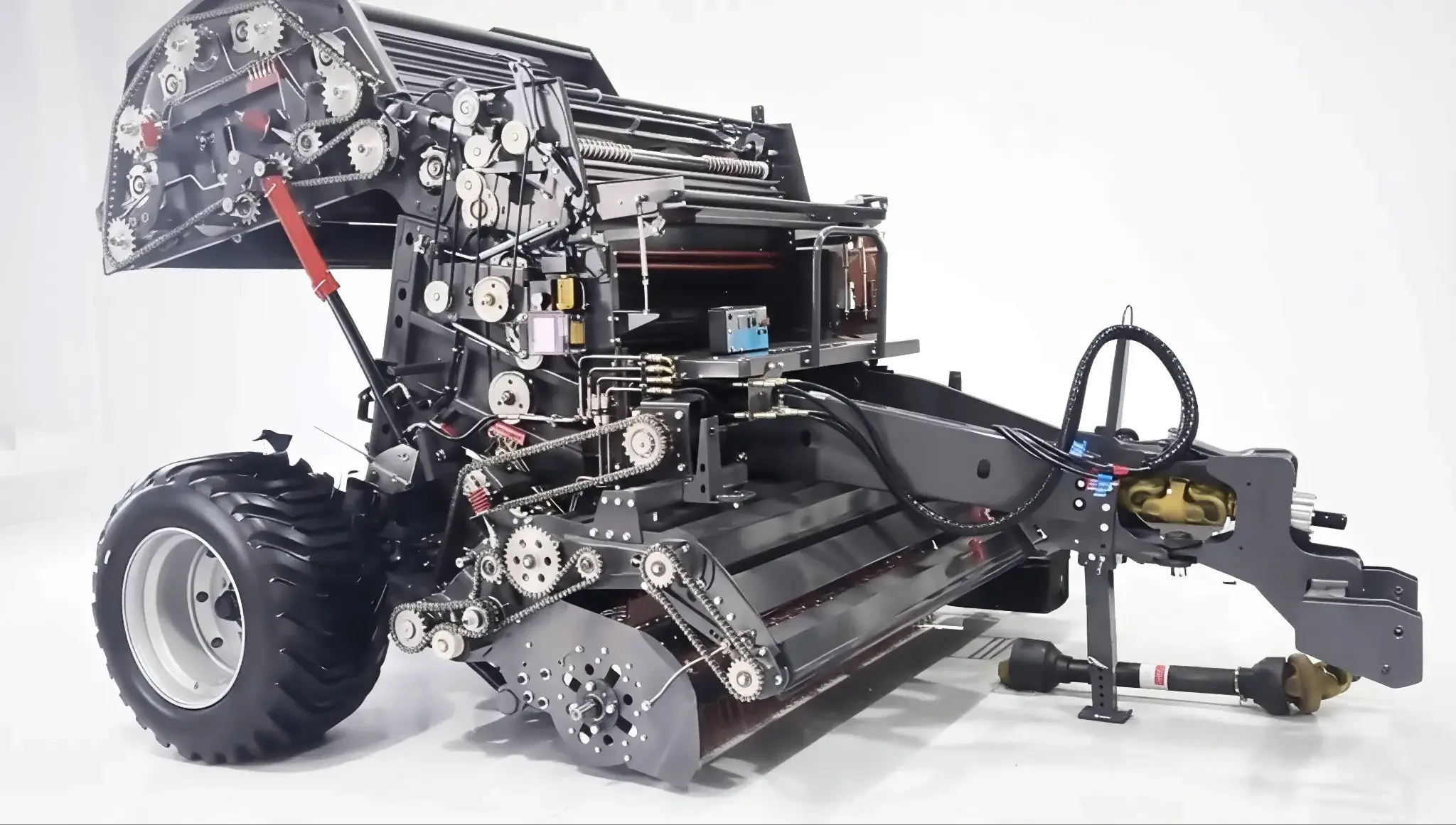
Good windrow preparation reduces re-work passes, but the round baler’s structural design determines how well it takes advantage of a well-prepared windrow and how tolerantly it handles the occasional imperfect windrow that every Korean wheat season produces. Three structural features of the 9YG series are most relevant to windrow condition versatility: the floating pickup mounting, the axial-flow feeding mechanism, and the sensor-controlled chamber density system.
Floating Pickup Mounting
The pickup assembly on the 9YG series is mounted on a floating linkage that allows independent vertical movement relative to the main frame. This means that as the tractor and baler navigate across the gentle undulations and microtopographic variations in a Korean wheat field, the pickup maintains a consistent ground clearance — and therefore a consistent tine-to-windrow engagement depth — without the operator needing to continuously adjust the pickup height control. On fields with slight humps or depressions where a fixed-mount pickup would alternately scalp and miss the windrow, the floating mount prevents the residual straw trails that require remedial collection passes. The CNC laser-cut frame ensures that the floating linkage geometry is consistent from one machine to the next, maintaining the design clearances across the full range of articulation.
Axial-Flow Semi-Forced Feeding Mechanism
The feeding mechanism between the pickup rotor and the bale chamber entrance routes material through a guided path that maintains continuous forward flow regardless of how the windrow material varies in density or stem orientation along the pass. When the windrow transitions from a dense section — where two rake passes overlapped — to a thin section at a field edge, the axial-flow mechanism maintains productive material flow into the chamber rather than stalling or recirculating material in the throat, which would require the operator to reverse and re-pick the stalled zone. This consistent-flow characteristic directly reduces the number of operator interventions during a baling pass, keeping the pass productive from end to end and eliminating the partial-bale ejection events that leave undersized bales requiring a separate re-collection pass.
Sensor-Controlled Density — Preventing Undersized Bale Re-work
Undersized bales — those that do not reach the target density before the operator manually triggers ejection — are a specific source of re-work in baling operations that lack automated density control. When the windrow thins toward a field end and the bale chamber fills more slowly, an operator without density feedback may eject the bale prematurely to keep the machine moving toward the headland, producing a bale with insufficient density to hold its shape after ejection. This bale then disintegrates partially on the field surface and must be re-collected in a separate pass. The sensor-controlled system on the 9YG series waits for the target density to be reached regardless of how long it takes, preventing premature ejection and the re-collection work that follows it.
Material System
8. Tine Steel, Chain Specification, and Coating System — How Materials Handle Windrow Variability Over Many Seasons
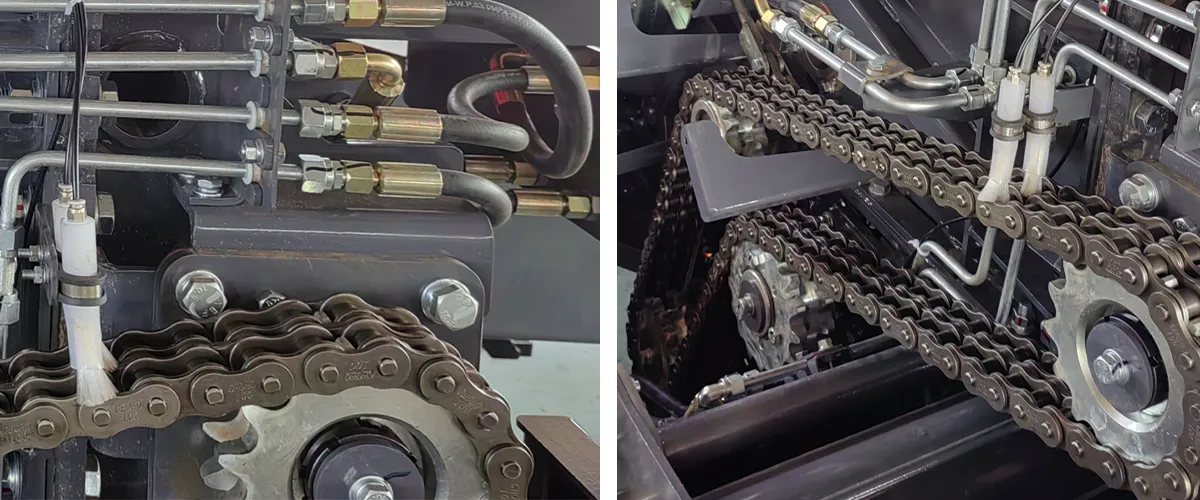
Good windrow preparation reduces machine wear as well as re-work passes — a machine that encounters a clean, well-structured windrow at the correct moisture content and width experiences less abrasive loading on its tines, less variable torque loading on its chain drive, and lower compactive resistance in the bale chamber than a machine struggling with an irregular, contaminated, or overly-dense windrow. The material system of the 9YG series is nevertheless designed to handle less-than-ideal windrow conditions without accelerated degradation, because even the best-prepared fields will occasionally present the machine with a challenging section.
High-Tensile Spring Steel Tines
Spring-tooth tines on the 9YG series are manufactured from high-tensile spring steel with hardened tip geometry. For Korean wheat straw windrow preparation operations, the tine’s ability to deflect on contact with embedded stones left from winter frost heave — common in Korean wheat-growing soils — and return to position without fracturing directly determines whether the pickup maintains its full complement of tines across a full day’s baling or requires mid-day tine replacement stops. A full tine complement is the baseline condition for first-pass windrow capture efficiency; a pickup with missing or bent tines creates gaps in the collection pattern that leave straw trails requiring remedial collection. Keeping a set of replacement tines in the tractor cab as standard practice for Korean wheat season baling prevents gaps from developing during the most critical days of the harvest window.
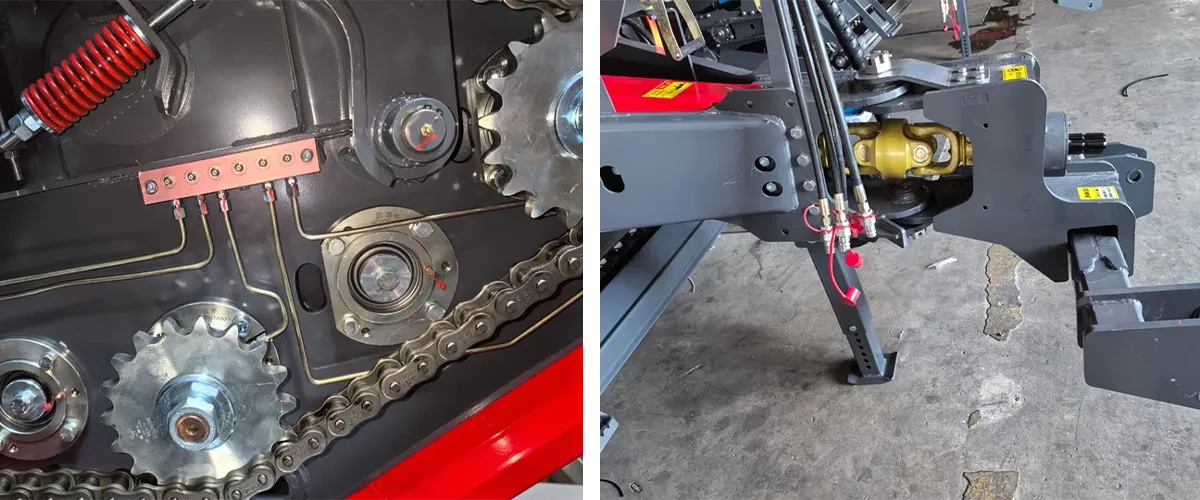
20A Roller Chain and Variable-Torque Windrow Handling
The dual-side 20A roller chain on the 9YG-2.24D series handles the variable torque loading that even well-prepared windrows impose — where two raked swaths merge at a field overlap point, the local windrow density may be 40–60% higher than average for a few meters before normalizing, creating a torque spike at the press roller drive. The 20A specification provides a rated dynamic load capacity that keeps these torque spikes below the chain’s fatigue threshold, maintaining consistent roller speed through the density variation and producing bales with a uniform cross-section rather than the density gradient that develops when chain elongation under overload causes momentary roller speed reduction.
Electrostatic Frame Coating
The electrostatic powder coating on the 9YG series frame protects against the humidity-driven corrosion that Korean wheat straw baling conditions impose — morning dew on the frame surface, moisture from baling at the high end of the acceptable straw moisture range, and the humid storage conditions of the Korean June–July period all contribute to a more challenging corrosion environment than dry-season harvests in continental climates. The adhesion quality of the coating at CNC-fabricated weld seams and joint interfaces determines how long the frame maintains its protection between the start of a Korean wheat season and the subsequent inspection and touch-up routine, which should be part of any responsible pre-season preparation for a machine deployed in Korean conditions.
Daily Checklist
9. Pre-Baling Day Checklist for Zero Re-work Passes on Korean Wheat Straw
The following daily checks — performed before the first baling pass of each day — represent the practical distillation of the windrow preparation guidance above into an operator checklist that takes less than 20 minutes and consistently reduces the probability of re-work passes.
Step 1 — Moisture Assessment
Check windrow moisture by squeezing a handful of straw from the windrow interior. If water can be squeezed out, delay baling. If stems snap cleanly rather than bending, the straw is at the dry end of the acceptable range — check pickup height to avoid excessive fragmentation. Target: pliable stems with no squeezable moisture.
Step 2 — Windrow Width Check
Walk along one windrow and measure its width at three points along the field. If it is consistently within 60–80% of the baler pickup width, bale direct. If consistently wider, plan a consolidation rake pass before baling. If inconsistently wide (variable combine spread), plan a strategic rake pass over the wide sections only.
Step 3 — Field Surface Check
Walk a representative section of the field and note any soft patches, standing water, or significant soil compaction from combine traffic. Mark or note the locations so the baling route can avoid or slow across these zones. Set the pickup height at its standard field position (tine tips 15–20 mm above surface) and adjust only if specific problem areas require it.
Step 4 — Machine Pre-check
Check all pickup tines are present and undamaged; verify chain tension and apply lubrication if the previous day’s operating hours warrant it; check net wrap supply level; confirm hydraulic connections are secure; verify the density sensor is reading correctly on the indicator before the first pass. Total time: 10–15 minutes.
Step 5 — First-Pass Trial
Run the first 50 meters at working speed (7–9 km/h), then stop and look back at the windrow path. If straw residue stripes are visible behind the pickup path, either the pickup is too high or the windrow was wider than anticipated. Adjust pickup height down 5 mm and check again on the next 50 meters before committing to full-speed baling.
Regulatory Context
10. Field Operations Regulations, Machinery Safety, and Crop Residue Management Rules Relevant to Korean Wheat Straw Baling
Wheat straw field operations in Korea and internationally are subject to regulatory frameworks covering both machinery safety and crop residue management. Understanding these frameworks helps operators plan their pre-baling windrow preparation and field operations in compliance with applicable rules.
Korea — Straw Burning Prohibition and Field Operation Rules
Korea’s Clean Air Conservation Act and local government implementing regulations prohibit or strictly limit open burning of wheat straw residue in agricultural fields during designated harvest periods. This regulatory framework directly incentivizes correct windrow preparation and baling as the primary straw management method, since the legal alternative to baling — burning — is no longer freely available in most Korean agricultural regions. Operators who invest in correct windrow preparation and efficient first-pass baling are simultaneously achieving regulatory compliance with these residue management rules while improving their commercial economics through reduced re-work costs and higher bale quality.
Korea RDA — Agricultural Machinery Safety and Operator Requirements
The Rural Development Administration (RDA) agricultural machinery safety guidance requires that operators of round balers have completed basic machinery operation training before operating certified equipment commercially or in subsidy-funded cooperatives. The RDA training guidance covers machine setup — including pickup height adjustment — as a core skill element, which directly aligns with the pre-baling setup checklist described in this guide. Operators who complete RDA safety training are better prepared to perform the daily pre-check routine that prevents re-work passes and are also covered by the liability protection that certified operation provides under Korean agricultural insurance frameworks.
ISO 4254-7 — Field Operation Safety for Baling Machines
ISO 4254-7 covers not only baling machine design safety but also field operation safety requirements, including the requirement that the pickup guard bar is correctly positioned before field operation and that warning zones around the pickup, bale chamber, and ejection area are clearly marked and respected during operation. During windrow preparation and re-raking passes that precede baling, other machinery is operating on the same field — the safety provisions of ISO 4254-7 that require ejection zone clearance before bale ejection and pickup zone avoidance while the machine is in motion apply whenever the round baler is operating, including the first trial pass used to check pickup height setup as described in the daily checklist above.
European Union — CAP GAEC Standards and Straw Management Requirements
EU wheat farmers receiving Common Agricultural Policy direct payments under the GAEC cross-compliance framework must manage crop residues to avoid soil erosion and nutrient loss. The windrow preparation practices described in this guide — including targeted raking that consolidates material rather than spreading it across the full field surface — align with GAEC soil protection requirements by reducing the straw mat coverage across the field that would otherwise create surface water runoff concentration during rain events. This alignment means that good windrow preparation practice is simultaneously a re-work reduction strategy and a cross-compliance compliance strategy for EU wheat farmers.
India — CRM Scheme Field Operation Guidelines
India’s Crop Residue Management (CRM) scheme, administered by state governments in Punjab, Haryana, and Uttar Pradesh, provides operational guidelines for subsidized round baler use that include windrow preparation specifications. These guidelines recommend that wheat straw windrows be consolidated to within the pickup width of the specific machine before baling begins — a direct field protocol equivalent to the raking guidance described in this guide. For Korean equipment exporters and ODA program operators supplying round balers to Indian CRM program participants, providing operator training materials that align with these CRM operational guidelines is part of the equipment delivery package that maximizes the program’s field efficiency impact.
ASABE S318 and Gearbox PTO Speed Compliance
ASABE S318 specifies PTO shaft color-coding, connection dimensions, and the safe operating speed range for each PTO shaft classification. For round balers operating during windrow preparation periods where tractor engine speed may be varied — including during the trial pass and pickup height verification described in the daily checklist above — maintaining PTO shaft speed within the standard operating range for the connected baler’s rated PTO input prevents the driveshaft imbalance and vibration that develops when PTO speed is pushed above or below the design range. The 9YG-1.25A’s wide 540–1000 r/min PTO input tolerance makes it more forgiving of engine speed variation during these setup operations than machines with narrow PTO speed specifications.
Product Range
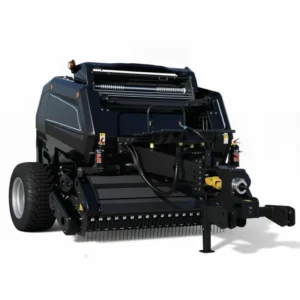
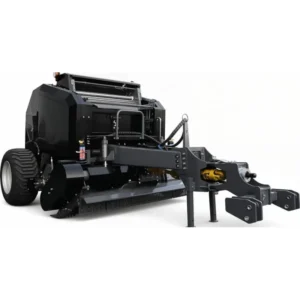
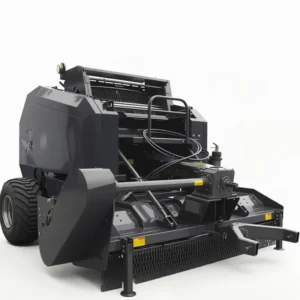
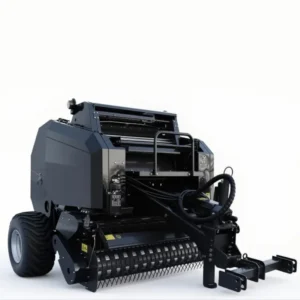
11. Round Baler Models for Optimized Wheat Straw First-Pass Baling in Korea
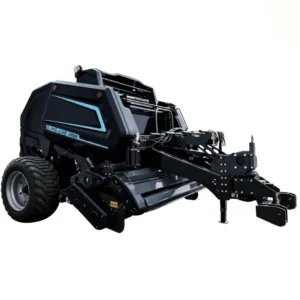
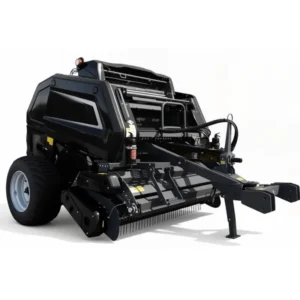
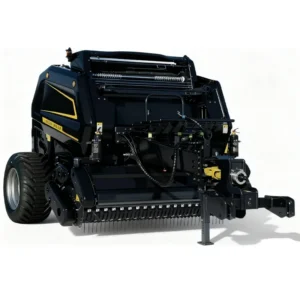
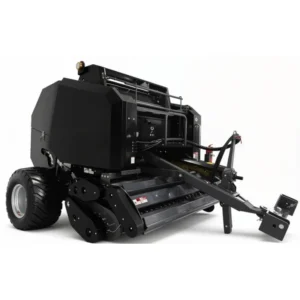
The 9YG series provides a complete range from compact small-farm models through to full commercial contractor machines — all featuring sensor-controlled density management, axial-flow semi-forced feeding, and floating pickup mounting that support the first-pass baling objective described in this guide.
FAQ
Frequently Asked Questions: Windrow Preparation and Re-work Reduction in Korean Wheat Straw Baling
編輯:PXY