Rice Straw Baling — Monsoon Season Guide
A technical guide to high-moisture rice straw pickup, compression chamber dynamics, gearbox load management, and operational technique for Korean and Asian rice paddy producers working through the autumn harvest window
1. The Wet Rice Straw Challenge — Why Monsoon Harvest Timing Makes Baling Fundamentally Different
Rice straw presents a baling challenge that has no direct parallel in wheat or barley operations. In Korea, Japan, Vietnam, and across monsoon-season Asia, rice harvest falls precisely at the junction of late-season rainfall and the shortening dry windows of early autumn. Korean rice paddies in Chungnam, Jeonnam, and Gyeongbuk provinces are typically harvested between late September and early November — a window when soil moisture from the summer monsoon season has not fully dissipated, and where a two-day rain event can raise straw moisture from 20% back to 35% overnight. Any round baler machine used in this environment must handle not just dry, brittle material in the style of summer wheat straw, but genuinely wet, cohesive, heavy material that flows completely differently through a baling chamber and creates a different set of mechanical demands on every component from the pickup tines to the gearbox drive chain.
The physical properties of wet rice straw are the starting point for understanding why standard round baler configuration advice — optimized for dry cereal straw — often produces poor results in rice paddy fields during monsoon-affected harvest windows. Wet rice straw has a bulk density approximately 1.5–2× higher than dry rice straw at the same degree of compression, meaning a round baler that produces 160 kg/m³ bales from dry wheat straw can produce bales in excess of 200 kg/m³ from wet rice straw at the same sensor density setpoint — simply because the material flows into the chamber and packs under gravity before compression even begins. The added moisture weight also increases bale mass substantially, which affects post-bale handling, storage management, and the load capacity of the bale transport equipment. Getting this right begins with choosing a round baler designed to handle high-moisture heavy material, and then configuring it properly for the conditions it will actually face in a Korean autumn rice paddy.

2. Rice Straw Physical Properties in Monsoon Harvest Conditions — What Changes at High Moisture
Understanding what happens to rice straw as moisture increases is essential for configuring a round baler correctly for monsoon-season paddy operations. The table below compares the key physical properties of dry and wet rice straw and maps them to their practical effects on round baler behavior. These figures are representative of Korean japonica rice varieties harvested in typical Chungnam autumn conditions; specific values will vary with variety, paddy management, and rainfall timing.
| Property | Dry Rice Straw (<20%) | Wet Rice Straw (25–40%) | Round Baler Impact |
|---|---|---|---|
| Straw mass per m³ windrow | 35–55 kg/m³ | 65–110 kg/m³ | Pickup loads heavier material per unit volume; gearbox sees higher torque demand at same field speed |
| Material cohesion | Low — loose stems | High — matted stems | Matted material feeds more consistently but risks bridging in feeder channel at high throughput |
| Stem flexibility | Low — brittle | High — pliable | Pliable stems compress easily but spring back less; bale core density more uniform than dry straw |
| Bale density at same sensor setpoint | Baseline | +30–60% higher | Sensor setpoint must be significantly reduced for wet rice straw to avoid over-dense, excessively heavy bales |
| Net-wrap adhesion on bale surface | 好的 | Excellent — moisture improves grip | Net wrap performs reliably on wet bales; fewer wrap failures than dry cereal straw |
| Ground-level field mud contamination | 低的 | Significant — paddy soil adhesion | Pickup tine soil contact contamination risk; pickup height management critical in soft paddy soil |
| Corrosion risk to baler components | 低的 | High — wet paddy soil is corrosive | Frame coating integrity, bearing seal quality, and daily machine cleaning become significantly more important |
3. Manufacturing Structure — Chamber Design, Roller Configuration, and Frame Engineering for Wet Material
Baling wet rice straw places different structural demands on a round baler machine than any dry cereal crop operation. The compression chamber must handle a material that is heavier, stickier, and more resistant to flow than dry straw — characteristics that translate into higher sustained compression forces, greater roller surface fouling risk, and more frequent bale formation difficulties if the chamber geometry and feeding system are not designed to manage the material actively rather than relying on its own flow properties. The drum-type (roller-type) compression chamber used across the 9YG series is inherently better suited to wet rice straw than belt-type chambers, because individual rollers provide positive mechanical transport of the material through the chamber regardless of whether the material flows freely. Belt chambers rely partly on the crop’s self-compacting behavior; roller chambers drive the material forward under positive mechanical contact at every roller interaction point, keeping the forming bale rotating evenly even when wet, clumping material tends to hang in the chamber rather than advancing smoothly.
The feeding system design is even more critical for wet rice straw than for dry cereal crops, because wet material creates two feeding failure modes that dry straw does not. The first is bridge formation: wet, cohesive rice straw mats together as it enters the feeder channel, forming a temporary blockage that stops material flow while the pickup continues collecting. In a conventional cam-guided pickup design, each tine dump event delivers a batch of material to the feeder entrance, and consecutive batches from heavy wet windrows can compress against each other and form a bridge across the feeder channel cross-section. The second failure mode is adhesion wrap: wet rice straw can adhere to the rotating surfaces of the feeder drum and build up over time, reducing the effective clearance of the feeder channel and eventually causing the material to jam against the buildup rather than advancing into the chamber. The proprietary axial-flow semi-forced feeding system on the 9YG series generates a continuous progressive material flow that minimizes both bridge formation and adhesion buildup, because the continuous flow prevents the momentary pressure peaks at the feeder entrance that trigger bridging, and the absence of fixed guide surfaces removes the stationary adhesion points where buildup initiates.
The tailgate and rear chamber frame must withstand the substantially higher bale ejection forces that wet rice straw bales generate. A wet rice straw bale at 140 kg/m³ in a φ1,300×1,400 mm format weighs approximately 260 kg in dry-matter terms — but with 30% moisture content, the actual bale weight can approach 330–360 kg. The ejection impulse of this heavier bale on a hydraulic tailgate opening cycle imposes a meaningfully higher structural load than a dry straw bale of the same density. The H-type ferrule hydraulic fittings and buffer cylinder on the 9YG-2.24D Classic are specifically engineered to absorb this ejection impulse without frame stress peaks, extending the service life of the tailgate hinge assembly under the high-weight bale cycles typical of a full autumn rice straw operation in a Korean paddy region.
4. Material System — Corrosion Protection, Chain Specification, and Bearing Sealing for Wet Paddy Field Environments
The wet paddy field environment of an Asian monsoon rice harvest is among the most corrosive operating conditions any agricultural machine encounters. Paddy soil in Korean rice-producing regions typically contains elevated silica content, organic acids from decomposing plant material, and residual agricultural chemicals that collectively create an aggressive corrosion medium for exposed steel surfaces, chain link plates, and bearing races. A round baler operating in this environment for 4–6 weeks per autumn season accumulates corrosion exposure that would require 2–3 seasons of dry cereal straw operation to match. Understanding the material specification choices that determine corrosion resistance in this context is a more commercially relevant evaluation criterion for rice straw applications than it is for any dry-crop baling context.
Frame surface treatment is the first line of corrosion protection. The electrostatic spray painting process used on the 9YG series applies a uniform, adhesion-optimized coating across internal frame surfaces, weld heat-affected zones, and recessed corners that conventional brush or dip painting cannot reliably reach. In wet paddy field conditions, where the baler’s lower frame sections run through wet soil and standing water in low paddy areas, the quality of this coating determines how quickly surface rust initiates at the pinhole corrosion sites that develop in thin-painted areas. For a rice straw operation expecting to use the same machine for 8–10 autumn seasons, the electrostatic coating quality is a relevant procurement specification rather than a surface finish preference. Daily post-harvest machine washing with clean water, followed by air drying before storage, supplements the factory coating in extending frame life under monsoon conditions.
Chain grade and chain protection are both more important in wet paddy field conditions than in dry straw operations. The 9YG-2.24D S9000 and Classic use 20A heavy-duty chain in the dual-side rear chamber drive — a grade that provides a higher tensile margin against the corrosion-weakening that accelerates in wet operating environments. Chain lubricant washout is a real concern in wet conditions: water ingress to the chain link plates removes the lubricant film and allows direct metal-to-metal contact that accelerates both corrosion and wear simultaneously. In rice straw operations, chain lubrication frequency should increase to every 15–20 operating hours compared to the 50-hour interval used in dry wheat straw work. Sealed chain options, where available, are worth considering for dedicated rice straw machines that will operate consistently in wet paddy conditions across multiple seasons.
5. Configuring Your Round Baler for Wet Rice Straw — Step-by-Step Operational Adjustments
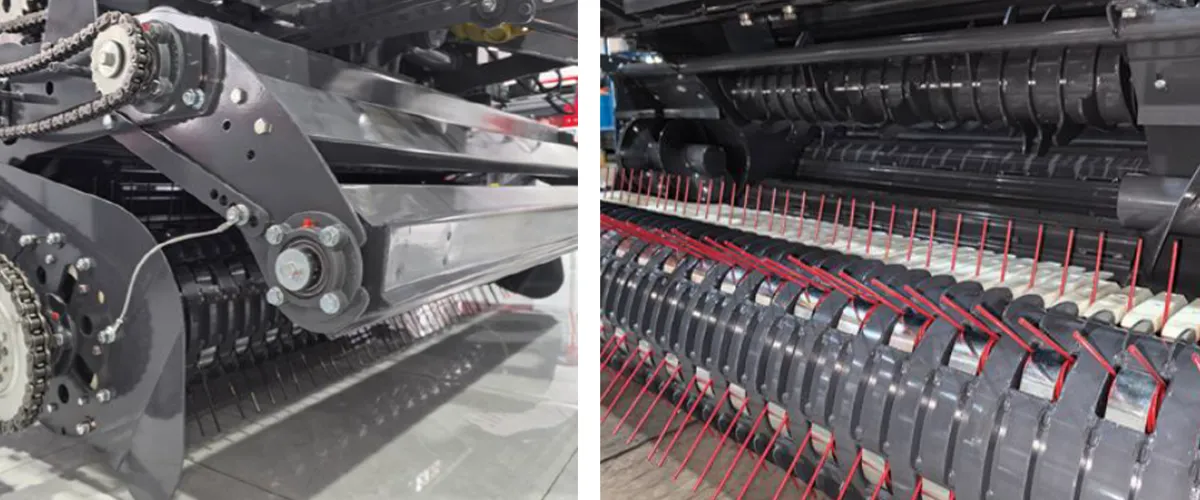
Transitioning a round baler from dry wheat straw operation to wet rice straw work requires both mechanical adjustments and operating technique changes. The configuration table below provides the key adjustment categories with the specific direction and rationale for each change. Applying these adjustments consistently when moving from the wheat straw season into rice straw season is the single most effective step toward achieving both good bale quality and acceptable machine availability through the autumn paddy harvest window.
| Parameter | Dry Wheat Straw Setting | Wet Rice Straw Setting | Reason |
|---|---|---|---|
| Sensor density setpoint | e.g. 160 kg/m³ | Reduce 20–35% (e.g. 110–130 kg/m³) | Wet material packs 30–60% denser at same pressure; lower setpoint delivers comparable bale weight with appropriate structure |
| Forward travel speed | 8–15 km/h | 5–8 km/h | Wet rice straw is heavier per volume; lower speed prevents pickup overload and feeder channel bridging |
| Pickup header height | 25–35 mm above soil | 35–50 mm above soil | Soft paddy soil allows tine tips to sink; higher clearance prevents soil and mud contamination of the bale |
| Chain lubrication interval | Every 50 operating hours | Every 15–20 operating hours | Water ingress from wet paddy soil washes lubricant from chain; more frequent application prevents corrosion-accelerated wear |
| Post-session machine wash | Weekly or as needed | After every operating session | Paddy soil contains corrosive silica and organic acids; drying mud on frame surfaces accelerates rust initiation |
| Net-wrap overlap | 1.5–2 wraps at bale end | Standard (wet surface improves adhesion) | Wet bale surface provides excellent net adhesion; standard overlap is sufficient, unlike the extra overlap needed for barley |
| Bale storage approach | Outdoor storage acceptable under 15% moisture | Covered storage essential; plan for extended dry-down time | Bales above 25% moisture stored outdoors will develop mold within weeks; indoor or ventilated covered storage is required |

6. Round Baler Gearbox Performance in Wet Rice Straw — Torque Demands, Thermal Load, and Regulatory Requirements
Baling wet rice straw imposes higher sustained gearbox torque demands than dry cereal straw work, because the heavier material per unit volume being processed through the pickup and feeding system requires proportionally more PTO-transmitted mechanical work. On a 500-meter rice paddy strip at 5–8 km/h forward speed, the gearbox operates at a higher average load factor than during wheat straw baling at the same field length — with less opportunity for load relief from the lighter field headland material that provides momentary torque reduction in wheat straw operations. For Korean rice paddies in Gyeongnam, Jeonbuk, and Chungnam provinces where field parcels are compact and headland turns are frequent, the gearbox load cycle is particularly continuous, because each pass ends with a headland turn rather than a sustained run across a large open field, and the material density at the start of each new pass is consistently high.
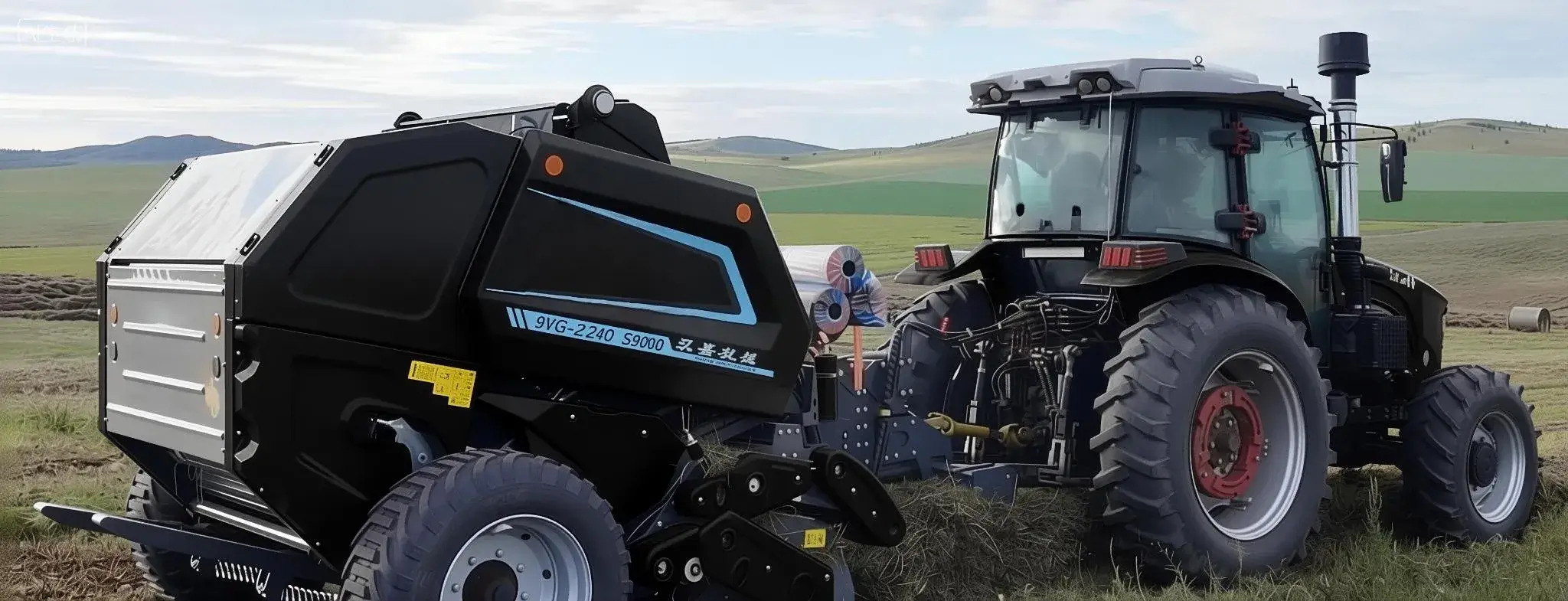
The dual-joint gearbox design on the 9YG-2.24D S9000 Surpass distributes the sustained wet rice straw torque load across two articulation points and through a rigid coupling to the drawbar frame, preventing the oscillating bending load that accumulates at single-joint gearbox-to-frame connections under continuous high-torque operation. The 1,000 Nm rated torque capacity of the Transcend variant’s new-generation drawbar provides a meaningful safety margin over the peak torque generated by dense wet rice straw slugs that can enter the pickup from piles accumulated at paddy field edges and drainage channels. The torque-limiting driveshaft incorporated as standard on these models is particularly valuable in rice paddy conditions, where the operator may encounter a water-soaked accumulation of fallen stems at the field edge that imposes a sudden, extreme torque spike with no advance terrain warning.
韓國: Round baler gearboxes operating in commercial rice straw baling operations must comply with the Agricultural Mechanization Promotion Act (농업기계화 촉진법) and RDA (농촌진흥청) type approval requirements. Rice-specific operational conditions — particularly the soil contamination and elevated corrosion exposure of paddy field environments — are not separately evaluated in the RDA protocol, but the type approval performance test at rated PTO speed provides the baseline regulatory validation for gearbox suitability. The Industrial Safety and Health Act (산업안전보건법) applies standard PTO guard requirements independently of crop type. Korean rice straw producers supplying biomass energy plants under the RPS (신재생에너지 공급의무화제도) may need to provide equipment quality management documentation where institutional biomass buyers specify supply chain compliance — ISO 9001 certification at the manufacturer level provides the relevant evidence. The Agricultural Machinery Subsidy Program (농기계지원사업) covers up to 50% of purchase cost for RDA-approved machines, applying equally to rice straw baling operations as to wheat and forage baling.
Japan: Japan is Korea’s largest rice straw export market for livestock bedding and substrate applications. Japanese buyers increasingly request production equipment certification from Korean rice straw suppliers. MAFF (Ministry of Agriculture, Forestry and Fisheries / 農林水産省) type approval documentation and JIS B 9700 compliance evidence provide the appropriate certification basis for these requests. Japanese agricultural cooperatives (JA) that organize collective straw procurement have begun specifying equipment standards in their supply contracts — operators using RDA-approved, ISO 9001-manufactured machines are better positioned to meet these evolving specifications.
European Union: Korean rice straw exported to EU-based livestock operations must meet the EU’s Machinery Directive 2006/42/EC CE marking requirement at the equipment level. EN ISO 4254-7 baler safety standards and the Declaration of Conformity documentation are the primary compliance evidence. From January 2027, Machinery Regulation EU 2023/1230 introduces enhanced digital documentation requirements. DGUV Rule 114-015 in Germany requires periodic gearbox inspection records for commercial agricultural operations.
EAEU Markets: TR CU 010/2011 (Technical Regulation on Machine Safety) and EAC certification govern round baler gearboxes in Russia, Kazakhstan, Belarus, and Mongolia — all markets where Korean rice straw is sold or where similar wet-condition rice harvesting occurs. GOST 21354 gear reliability standards require documentation of fatigue life across the full operating load range, which for wet rice straw operations includes the higher sustained torque profile described above.
Southeast Asia (Vietnam, Thailand, Indonesia, Philippines): These are the world’s largest rice straw producing regions, and their agricultural machinery standards are transitioning. Vietnam’s QCVN standards for agricultural machinery safety are based partly on ISO frameworks. Thailand’s TISI (Thai Industrial Standards Institute) applies agricultural machinery safety standards aligned with ISO 11684 for safety signage. Indonesia’s SNI standards for agricultural machinery reference international standards for PTO guard design. Operators in these markets should verify the most current national standard applicability before procurement.
| Region / Market | Gearbox / Baler Standard | Rice Straw Specific Note | Certification |
|---|---|---|---|
| 韓國 | Agricultural Mechanization Promotion Act; RDA Protocol; Industrial Safety and Health Act | RPS biomass supply chain docs; subsidy up to 50% | RDA 농기계 형식검정 |
| Japan | MAFF Agricultural Machinery Safety; JIS B 9700 | JA cooperative supply contracts increasingly specify equipment certification | MAFF Type Approval |
| European Union | Machinery Directive 2006/42/EC; EN ISO 4254-7; EU 2023/1230 (from 2027) | Rice straw export requires CE-marked production equipment documentation | CE Mark + DoC |
| Russia / Kazakhstan / Belarus | TR CU 010/2011; GOST 21354; GOST R 12.2.111 | Fatigue documentation must cover wet-condition higher torque profile | EAC Mark |
| Vietnam / Thailand | QCVN (Vietnam); TISI standards (Thailand); ISO 11684 basis | Standards transitional; verify current national standard before procurement | National type approval |
| USA / Canada | ASABE S493; ANSI/ASABE S296; OSHA 29 CFR 1928.57 | California paddy operations may face AQMD dust and water runoff regulations | ASABE Conformance |
7. 9YG Round Baler Models — Suitability for Wet Rice Straw in Korean and Asian Paddy Operations
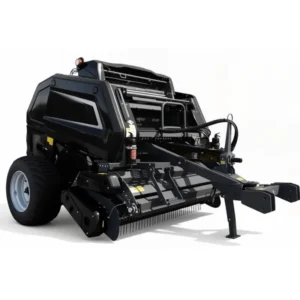
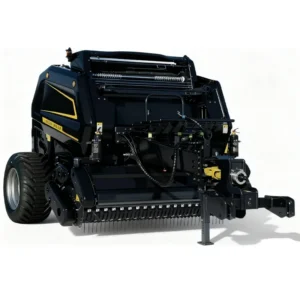
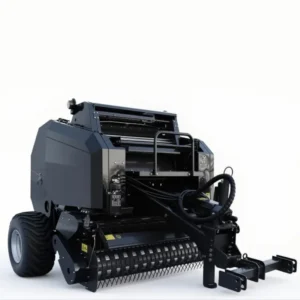
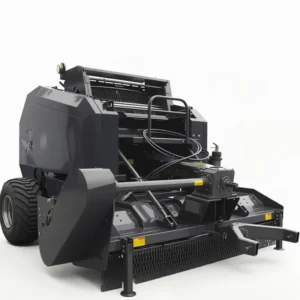
The right round baler for wet rice straw work in Korean paddy fields depends on the farm scale, available tractor power, paddy parcel geometry, and the end-use market for the straw. The 9YG series covers the full range from compact small round balers suited to the small parcels common in Korean traditional paddy regions to full-width commercial-scale machines suited to large paddy cooperatives.
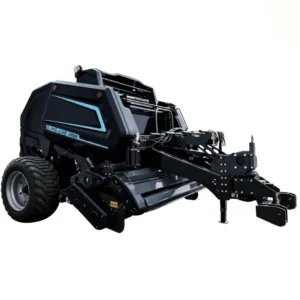
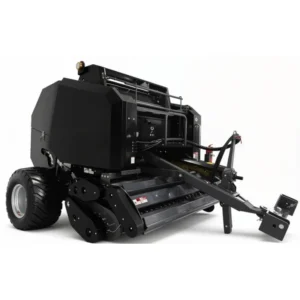
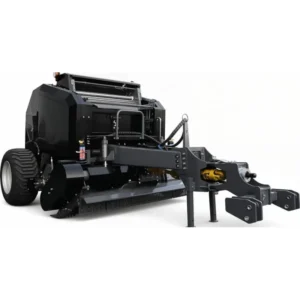
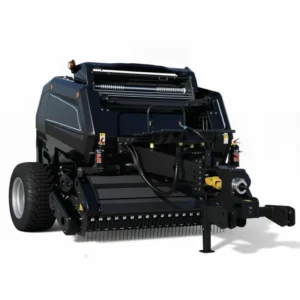
8. Wet Rice Straw Bale Storage — Why High-Moisture Bales Demand Different Handling Than Dry Cereal Straw
The single most common cause of rice straw bale quality failure in Korean operations is improper storage of bales produced at high moisture. Wheat straw bales at 14–18% moisture can tolerate outdoor net-wrapped storage for months without significant mold development if drainage is adequate. Rice straw bales from monsoon-season harvests at 25–35% moisture have a completely different behavior: at these moisture levels, the microbial decomposition process begins within days of baling, generating internal heat and carbon dioxide that break down the cell wall structure of the straw and reduce its feed or substrate value measurably. A rice straw bale at 30% moisture stored outdoors under Korean October rainfall will typically show visible mold on the inner surface within 3–4 weeks and will have lost 15–25% of its dry matter nutritional value within 8 weeks.
The correct approach for wet-season Korean rice straw bales is either to defer baling until the straw has dried in the field to below 22–25% moisture — which may require 3–7 days of favorable post-harvest weather — or to bale at high moisture and move immediately to covered, ventilated storage where the drying process can continue under controlled airflow. Bale wrapping with silage-quality stretch film is a third option used by some Korean operators who intentionally ferment the rice straw for livestock feed (known as rice straw silage or 볏짚 발효), where the high moisture content is an advantage rather than a problem. For operators making this choice, configuring the round baler to produce tighter, denser bales — which preserve the anaerobic environment needed for proper fermentation — is part of the production protocol, and the sensor density control system on 9YG models can be set to achieve this systematically.
Frequently Asked Questions
Q1. How does a round baler machine handle wet rice straw at 30% moisture without causing feeder channel blockages in Korean paddy fields?
At 30% moisture, rice straw is highly cohesive and tends to mat together, creating bridge formation risk at the feeder channel entrance in conventional cam-guided round balers where material enters in batched pulses. The axial-flow semi-forced feeding system on the 9YG series generates a continuous progressive material flow that prevents the pressure concentration at the feeder entrance where bridges initiate. The absence of fixed guide surfaces in the cam-less design also removes the adhesion points where wet, sticky rice straw accumulates over time and reduces feeder channel clearance. For Korean paddy conditions, reducing forward travel speed to 5–8 km/h when straw moisture exceeds 25% further reduces the material volume entering the feeder per unit time, keeping the flow rate within the feeder’s continuous-flow capacity.
Q2. What round baler density setpoint should Korean rice farmers use when baling wet paddy straw at 25–30% moisture to avoid excessively heavy bales?
Wet rice straw at 25–30% moisture packs 30–60% denser than dry straw at the same sensor pressure setpoint because the moisture adds mass and the pliable wet stems compact under their own weight before compression begins. To produce bales in the 120–140 kg/m³ target density range for storage or biomass use, the sensor setpoint should be reduced to approximately 110–125 kg/m³ compared to the 160 kg/m³ used for dry wheat straw. The exact adjustment should be confirmed by weighing three test bales at the reduced setpoint against the target weight for your bale format. Because moisture varies across the day and field, checking setpoint validity with a mid-session test bale helps catch density drift before it affects a full storage batch.
Q3. Which round baler manufacturer offers corrosion-resistant specifications suitable for sustained wet paddy field operations in Korean autumn rice harvests?
The 9YG series uses an electrostatic spray painting process that provides uniform coating coverage across internal frame surfaces and weld zones — the areas most vulnerable to corrosion initiation in wet paddy soil conditions. Combined with sealed maintenance-free bearing specification, 20A heavy-duty chain for slower corrosion-accelerated stretch, and the daily machine washing protocol recommended for paddy field use, the 9YG series is engineered for sustained wet-condition operation across multiple autumn seasons. For Korean buyers evaluating corrosion resistance as a procurement criterion, requesting information on the frame surface treatment process and the bearing seal specification — rather than just the paint color or overall machine weight — provides the most relevant comparative data.
Q4. How should Korean rice paddy round baler operators adjust pickup height when baling wet straw on soft, waterlogged paddy soil?
Soft paddy soil in waterlogged conditions allows the pickup header flotation wheels to sink deeper than they would on firm dry soil, effectively lowering the tine tip clearance below the set height. To maintain 35–50 mm tine-to-soil clearance in wet paddy conditions — the range that prevents soil contamination while collecting the full windrow — the pickup header should be set 10–15 mm higher than the equivalent setting used for wheat straw on firm soil. Check the actual clearance by walking alongside the machine at baling speed and observing whether tine tips leave drag marks in the soil surface; if they do, raise the header further until drag marks disappear. In the most waterlogged paddy field sections, it may be necessary to wait until the soil surface firms slightly before baling to achieve acceptable contamination levels.
Q5. Where can Korean rice farmers get a supplier quote for a small round baler suitable for traditional paddy parcels with a 40–60 hp tractor?
The 9YG-1.0 compact round baler is matched to 48–80 kW (approximately 65–108 hp) tractors and produces φ1,100×1,000 mm bales suited to traditional Korean paddy parcel sizes. Request a supplier quote through our contact page. The technical team will confirm model suitability for your tractor specification and paddy parcel geometry, provide delivery and customs documentation for Korean RDA type approval and subsidy applications, and advise on the moisture-condition configuration adjustments described in this article for your specific autumn harvest window conditions.
Q6. What round baler parts should Korean rice straw operators inspect after every session in wet paddy field conditions?
After each operating session in wet paddy field conditions: wash the entire machine with clean water, paying attention to chain runs and lower frame sections where paddy soil accumulates; check chain lubrication and reapply if any run shows visible water contamination of the lubricant; inspect sensor housing seals for mud ingress; verify pickup tines for soil adhesion that can change spring rate behavior; and check hydraulic fitting connections for weeping that may worsen when thermal cycling accompanies wet-to-dry transitions between operating day and overnight storage. These post-session checks take 20–30 minutes but prevent the silent damage accumulation that turns into unscheduled failures during the peak harvest window.
Q7. How does the round baler gearbox dual-joint design improve efficiency in compact Korean paddy field parcels where headland turns are frequent?
Traditional Korean paddy parcels in Chungnam and Jeonnam provinces are often 30–80 meters wide and 100–200 meters long — dimensions that produce a headland turn every 1–2 minutes of baling time at normal field speed. The dual-joint gearbox on the 9YG-2.24D S9000 rotates 90 degrees left and right, allowing the tractor to complete headland turns without cutting PTO power. At 1–2 turns per minute, the difference between a PTO-engaged and PTO-disengaged turn accumulates to 60–120 PTO engagement events over a 6-hour operating day — each disengagement and re-engagement cycle involving clutch wear, density inconsistency in the first bale of each re-engagement, and operator fatigue from the engagement process. Maintaining continuous PTO operation through turns eliminates all of these costs simultaneously.
Q8. When is the right time to bale Korean rice straw after combine harvest to balance optimal moisture for storage against the risk of monsoon rain during the field drying window?
In Korean paddy regions, the optimal baling window for dry storage is when straw moisture has dropped to 20–25% — typically 3–5 days after combine harvesting under favorable dry autumn weather conditions. Baling below 20% is ideal but rare in October-November Korean paddy conditions. Baling at 25–30% produces acceptable bales for covered indoor storage where natural ventilation can continue the drying process. Waiting beyond 5–7 days introduces the risk of a rainfall event that returns straw to 35–40% moisture, requiring a complete restart of the drying window. The practical strategy is to monitor straw moisture daily with a portable moisture meter and bale when the best available window occurs within 20–30% moisture range, accepting covered storage as the default post-bale management approach for Korean autumn rice operations.
編輯:PXY