Contractor Operations Guide
A practical deep-dive into how professional baling contractors plan their seasons, select the right round baler machine for multi-farm operations, manage between-farm maintenance, and comply with local regulations — all while maximising throughput and client satisfaction.
For most individual farms, a round baler machine sits idle for the majority of the year. The harvest window is narrow — sometimes no more than three to six weeks — and the capital cost of owning a full-specification round baler rarely pencils out for operations under 150 hectares. This economic reality is exactly why the agricultural contracting model has grown so consistently across South Korea, Russia, Kazakhstan, and other major crop-producing regions: a single contractor running a well-chosen round baler can service dozens of farms within a realistic travel radius during a single season, spreading equipment costs across a much larger base of billed work.
But running a round baler across multiple farms is not simply about driving from field to field. It requires a systematic approach to scheduling, machine setup, crop-specific configuration, between-farm maintenance, and the kind of mechanical reliability that prevents a single breakdown from cascading into a missed client commitment. This guide covers the practical side of that operation — from choosing the right model and understanding gearbox specifications, to the regulatory framework that applies in key export markets, and the specific structural and material attributes that determine how well a round baler holds up under commercial contractor workloads.

1. The Contractor Business Model: Why Multi-Farm Baling Works
Agricultural baling contractors operate on a fundamentally different economic logic than owner-operators. Where an individual farmer needs a round baler for perhaps 40 to 80 working hours per year, a contractor aims to log 400 to 800 hours or more across a full season — achieving the utilisation rate that justifies the capital investment in a high-specification machine. This density of use is what makes commercial contracting viable, and it is also what places the most demanding requirements on equipment reliability, since every unscheduled stoppage represents not just a loss of work on one farm but a potential chain reaction of missed appointments on others.
In South Korea, where rice straw collection is subject to the Clean Air Conservation Act and open burning restrictions have significantly increased demand for mechanical baling, contracting services have expanded rapidly since 2019. Regional agricultural cooperatives in provinces such as Chungcheongnam-do and Gyeonggi-do now routinely hire contractors to service member farms during the post-harvest window in October and November. A single contractor with one large-format round baler — for example, a model rated at 40 to 100 bales per hour — can cover 12 to 20 member farms over a five-week period, billing per bale or per hectare and generating sufficient revenue to justify the equipment outlay within two to three seasons.
In Russia and Kazakhstan, where pasture and cereal straw operations span enormous distances, the contracting model is equally prevalent, though the logistical challenges differ. Here, travel time between farms can be a significant cost factor, which shifts the selection criteria toward machines with higher per-hour output — prioritising pickup width, compression chamber capacity, and the ability to maintain production speeds across diverse windrow densities without operator intervention. The right round baler for this environment is one that requires minimal stops, recovers quickly when conditions change, and carries the kind of mechanical reserves that allow a contractor to push through a long day without worrying about drivetrain fatigue.
2. Seasonal Scheduling: How Contractors Stack Farm Visits
Effective seasonal scheduling is the first place where contractor operations either succeed or fail. The baling window for any given crop in a region is determined by a combination of harvest timing, weather windows, and the availability of the preceding field operations — mowing, tedding, and raking — that produce a windrow ready for the baler. A contractor managing 15 farm clients cannot service them simultaneously; the scheduling task is essentially a travelling salesman problem constrained by crop readiness dates, field travel time, and machine turnaround intervals.
In practice, experienced contractors build a geographic cluster of clients within a reasonable radius — typically 30 to 80 kilometres in well-developed agricultural regions — and sequence their visits according to crop maturity and weather forecasts. Farms with earlier-maturing crops or located in more exposed positions where drying is faster get scheduled first, with later, more sheltered fields following. When a weather delay opens up, contractors use the time to perform preventive maintenance, move equipment, or complete partial baling on fields that are partially ready, minimising idle days without rushing work that would produce low-quality bales.
| Farm Type / Crop | Typical Baling Window | Bales Per Hectare (Est.) | Key Scheduling Risk |
|---|---|---|---|
| Rice straw (Korea) | Oct – early Nov | 8 – 14 | Rain compression of windrow |
| Wheat straw | Jun – Jul | 5 – 10 | Overlap with grain harvest |
| Pasture / meadow hay | May – Sep (multi-cut) | 6 – 12 per cut | Multiple cuts require return visits |
| Corn stover | Sep – Oct | 7 – 12 | Field wetness after combine |
| Alfalfa hay | May – Sep (3+ cuts) | 10 – 18 per cut | Leaf shatter in high-speed pickup |
Multi-cut crops like alfalfa and pasture grass require contractors to return to the same farm two or three times during the season. This places a premium on machines that can be quickly reconfigured between crops — for example, switching between spring-tooth and hammer-claw pickups — since a contractor serving both cereal straw and corn stover clients in the same season needs that flexibility without a full-day changeover at each transition point.

3. Manufacturing Structure: What Separates a Contractor-Grade Round Baler
Not all round balers are built to the same standard of structural integrity, and the gap between a farm-duty machine and one suited to contractor-level workloads becomes apparent after the first few hundred hours of accumulated use. The critical structural elements that contractors should evaluate are the main frame construction, the compression chamber design, the traction hitch geometry, and the drive system architecture — all of which interact to determine how the machine handles the cumulative stress of moving between fields, adapting to different crop densities, and baling at near-peak capacity for extended periods without a planned rest.
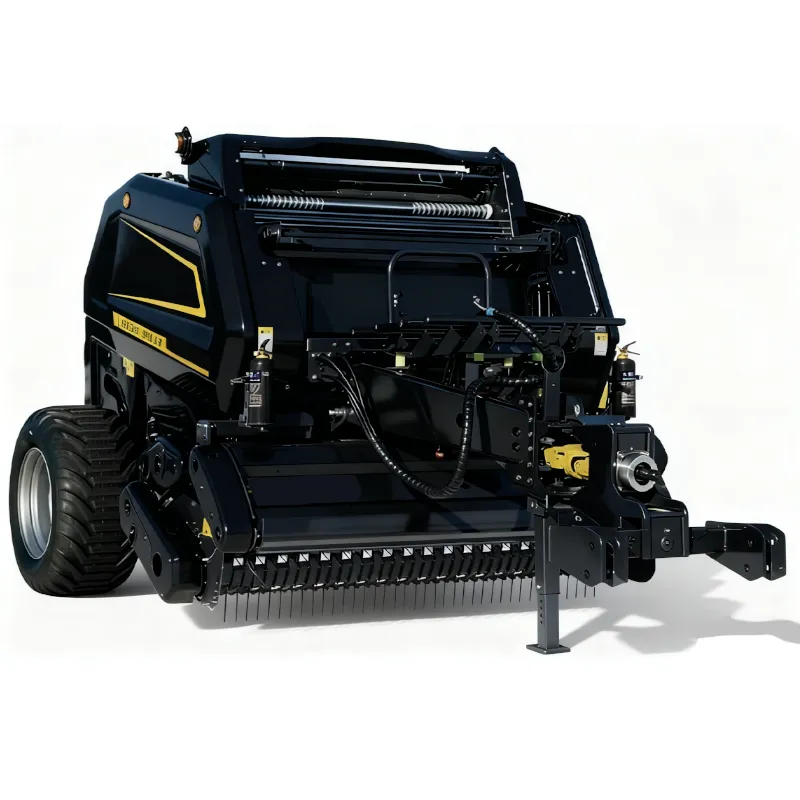
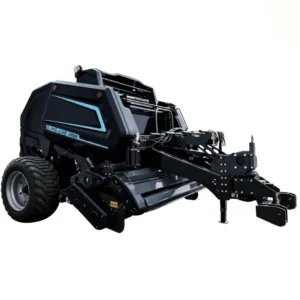
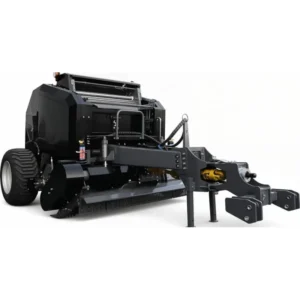
In the 9YG-2.24D series, the rear compression chamber uses a roller-type design with 18 steel compression rollers of ø222 mm diameter arranged around a chamber measuring 1,400 mm wide and ø1,200 mm in diameter. This configuration handles throughput rates that conventional smaller-chamber machines cannot match, producing bales of ø1,300 × 1,400 mm at densities of 100 to 200 kg/m³ with a productivity range of 40 to 100 bales per hour. For a contractor billing by the bale, the difference between 40 and 100 bales per hour over a ten-hour day is the difference between 400 and 1,000 bales — a figure that directly determines how many farm clients can be completed within a single weather window.
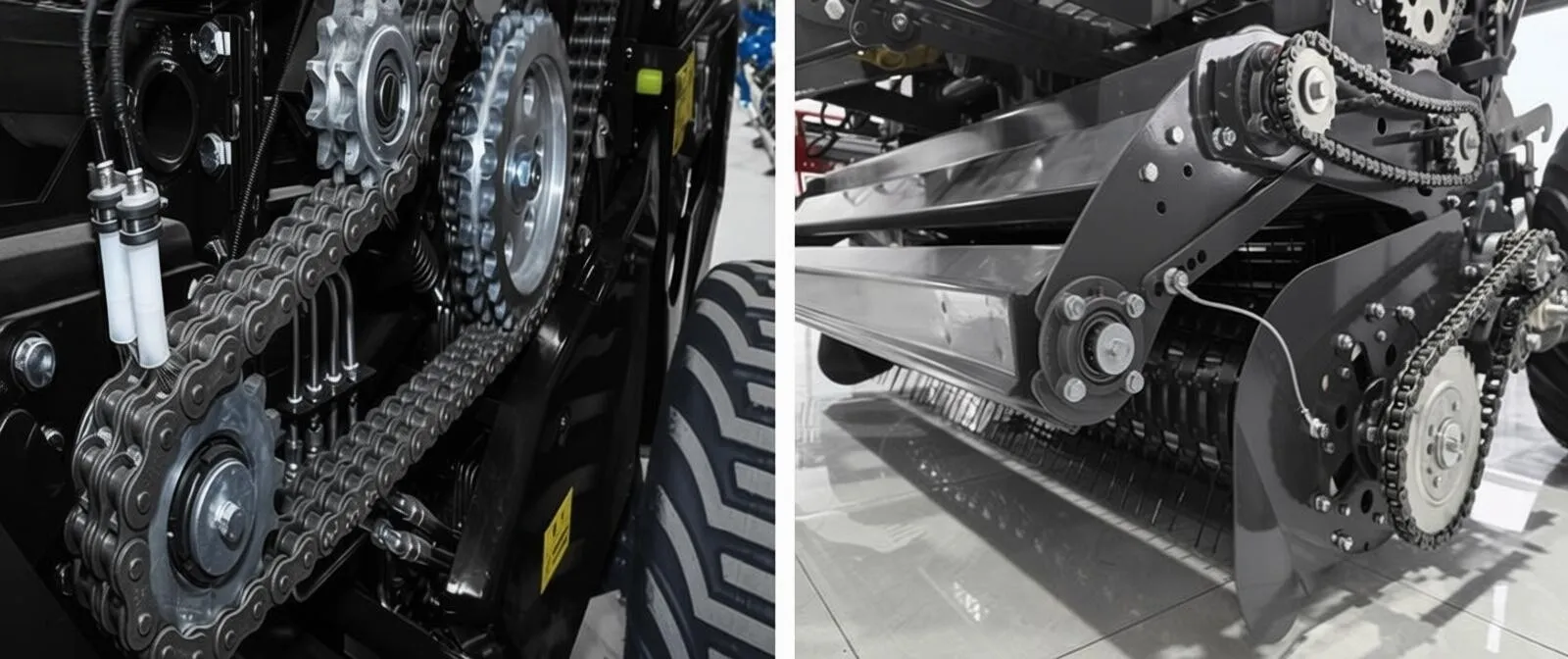
The S9000 variant uses dual-sided heavy-duty 20A roller chain on the rear compartment drive, a specification that significantly outperforms the 16A chain found in lighter-duty machines in terms of both tensile strength and elongation resistance over high-load cycles. For contractor operations where the chain may accumulate 500+ hours per season across diverse crop types, this difference in chain grade materially affects both uptime and the frequency of tensioning adjustments required in the field. The dual cross-joint drive shaft also includes a safety torque-limiting shaft, which protects the drivetrain during the sudden surges that occur when the baler encounters a dense clump mid-row — exactly the kind of unpredictable loading event that happens more frequently when a contractor is working across unfamiliar fields with variable crop management histories.
| Component | 9YG-2.24D S9000 | 9YG-1.25 | 9YG-1.0 | Contractor Relevance |
|---|---|---|---|---|
| Compression rollers | 18 × ø222 mm | 18 × ø222 mm | 16 × ø222 mm | More rollers = more even pressure, less bale irregularity |
| Chamber width | 1,400 mm | 1,250 mm | 1,000 mm | Wider = higher per-bale tonnage, fewer trips per field |
| Drive chain grade | Dual 20A heavy-duty | Standard grade | 16A | Higher grade extends service intervals under heavy use |
| Pickup width | 2,240 mm | 2,240 mm | 1,900 mm | Wider pickup = fewer passes, faster field completion |
| PTO speed | 720 r/min | 720 r/min | 720 r/min | Compatibility with a wider tractor fleet |
| Max operating speed | 5 – 35 km/h | 5 – 35 km/h | 5 – 20 km/h | Higher speed enables faster field completion per day |
| Structure weight | 4,570 kg | 4,060 kg | 2,640 kg | Heavier = more road transport planning required |
4. Material System: What the Machine Is Built From and Why It Matters for Contractors
The materials from which a round baler is constructed determine its service life under contractor conditions more directly than any other single design parameter. Contractors accumulate hours at a rate that individual farm owners do not, and the cumulative effect of vibration, torque surges, abrasive crop material, and repeated towing over rough roads exposes material weaknesses that would take a farm owner years to encounter. The areas of greatest concern are the pickup tine material and mounting, the compression roller surface hardness, the drive chain and sprocket metallurgy, and the hydraulic fitting specifications.
The H-type sleeve hydraulic fittings used in the 9YG-2.24D S9000 Classic are rated for significantly higher working pressures than standard press-fit connectors, which matters when the chamber door is being cycled rapidly during a high-output day — the speed of door opening and closing directly affects per-hour bale count, and it is the hydraulic pressure envelope of the fittings that determines how fast that cycle can safely run. Fitting failure under repeated high-pressure cycling is one of the less-discussed causes of mid-season downtime in contractor operations, and the specification of heavier fittings at the manufacturing stage removes this as a risk factor.
Spring-tooth pickup tines are manufactured from spring steel with sufficient temper to deflect and recover without permanent deformation across the thousands of impacts with soil, stones, and dense root clumps that a contractor’s machine encounters over a full season. The 9YG series uses a camless, no-guard-ring pickup design that eliminates the cam track components most vulnerable to wear and misalignment in abrasive conditions. The result is a pickup mechanism that requires less frequent adjustment between farms and maintains consistent collection efficiency even as accumulated hours rise through mid-season. This is not a marginal benefit — it is the kind of design choice that visibly separates the machine’s condition in week six of a season from what a conventional pickup would look like at the same usage point.
5. Round Baler Models Suited to Contractor Operations
6. Round Baler Gearbox Performance for Contractor Workloads
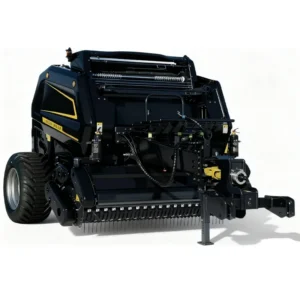
The round baler gearbox is the component most directly exposed to the cumulative stress of contractor operations, and its specification deserves careful attention from any B2B buyer planning multi-farm seasonal use. The gearbox receives rotational input from the tractor’s power take-off shaft at 720 r/min (as rated on the 9YG-2.24D, 9YG-1.25, and 9YG-1.0 series) and distributes drive torque to the pickup assembly, the feed rollers, and the compression drum array simultaneously. Under peak field conditions — dense windrows at high travel speeds — the instantaneous torque demand on the gearbox input shaft can be two to three times the average operating load, meaning the gearbox must be sized not for average conditions but for these peak events.
The dual-coupled gearbox design used in the 9YG-2.24D S9000 series provides an additional operational benefit specific to contractor work: it rotates 90 degrees left or right relative to the tractor centerline without cutting PTO power. This means the machine can complete headland turns in a significantly tighter arc than a fixed-frame equivalent, reducing the amount of windrow left unbaled at each field end. For a contractor working 15 fields per season, the accumulated reduction in headland loss across all those fields represents a meaningful difference in total bale count — and therefore in billings.
Gearbox oil level should be checked every 50 hours of operation under contractor-intensity use, with a full oil change scheduled according to the manufacturer’s specification rather than deferred to off-season. Contaminated or degraded gearbox oil is among the leading causes of bearing failure in round baler drivetrains, and bearing replacement on a main input shaft is the kind of repair that puts a machine out of service for two to three days — an unacceptable delay during peak season for a contractor with multiple clients waiting.
7. Gearbox and Equipment Regulations Across Key Markets
Contractors operating round balers across international borders, or sourcing equipment for operations in regulated markets, need to understand the legal framework that governs agricultural machinery design, safety, and operation in each jurisdiction. The gearbox and drivetrain are among the most regulated components, as they represent both a safety interface between the tractor and implement and a source of potential oil contamination if seals fail in environmentally sensitive areas.
韓國
In South Korea, agricultural machinery including round balers must comply with the Agricultural Machinery Certification System (농업기계 검정제도) administered by the Rural Development Administration (농촌진흥청, RDA). The certification process includes drivetrain endurance testing, gearbox thermal performance assessment, and field safety evaluation. Machines that pass RDA testing become eligible for inclusion in the Agricultural Machinery Purchase Subsidy (농업기계화 지원사업), which can offset a substantial portion of the purchase cost for registered farmers and cooperatives. For contractors purchasing equipment on behalf of cooperative clients, this subsidy pathway significantly affects the net acquisition cost and should be a standard part of any procurement discussion. The Road Traffic Act (도로교통법) also applies during machine transport between farms, and round balers above certain width and weight thresholds require advance notification or escort arrangements for road movement.
European Union
In the EU, round balers and their drivetrain components must comply with the Machinery Directive 2006/42/EC (and its successor, the Machinery Regulation EU 2023/1230, which applies from January 2027). Safety marking on PTO shafts and gearbox housings must comply with EN ISO 11684 (Safety of machinery — Safety signs and hazard pictograms). PTO shaft guards are mandatory and must conform to EN ISO 5674. The EU’s Ecodesign Regulation and Regulation (EU) 2016/1628 on non-road mobile machinery emissions influence the specification of tractors that power these balers, and contractors operating in emission-sensitive zones should ensure their tractor fleet meets Stage V requirements.
Russia and EAEU
In Russia and the broader Eurasian Economic Union, agricultural machinery is subject to Technical Regulation TR CU 010/2011 on the safety of machinery and equipment. Performance standards for gearboxes and drive systems in agricultural implements are referenced under GOST R 53056 (general requirements for agricultural machinery safety). Machines imported into the EAEU must carry EAC certification (Евразийское соответствие), and contractors sourcing equipment for Russian or Kazakhstani operations should confirm EAC conformity before finalising a purchase.
Japan
In Japan, agricultural mechanisation is governed under the Agricultural Machinery and Equipment Rational Use Promotion Law. Safety standards for machinery including baler drivetrains are published by the Japan Agricultural Machinery and Food Technology Research Association (JAFT), and equipment recommended by this body qualifies for subsidy consideration under national mechanisation programs. Gearbox specifications must also align with JISB0144 coupling standards where applicable.
Australia
In Australia, agricultural machinery safety is addressed through a combination of Safe Work Australia guidance and state-level Work Health and Safety (WHS) regulations. PTO shaft guarding and gearbox safety features are covered by AS 2765.1 (Guarding of farm machinery — general principles). Contractors operating in Australia are also subject to state biosecurity requirements governing movement of equipment between farms, particularly during periods of high fire or disease risk — a practical scheduling consideration for multi-farm contractors.
8. Between-Farm Maintenance: Keeping the Machine Ready for the Next Job
The discipline that separates consistently profitable contractors from those who suffer mid-season breakdowns is the quality and consistency of their between-farm maintenance routine. This does not mean a full workshop service between every visit — it means a systematic 20 to 30 minute inspection protocol that covers the most failure-prone components in order of criticality, performed before the machine leaves each farm. The objective is to catch developing issues while they are still inexpensive to address, rather than discovering them when they become failures in the middle of the following day’s work.
The between-farm inspection on a round baler should cover: pickup tine condition and count (missing or bent tines create uneven collection and should be replaced immediately), all drive chain tensions using the operator manual’s specified deflection method, roller surface condition for flats or pitting, hydraulic fitting integrity including the H-type sleeve connections on the chamber door circuit, PTO shaft coupling wear and correct engagement depth, net roll loading and film path alignment, and gearbox oil level check if 50 or more hours have accumulated since the last check. This protocol takes longer to describe than to perform, and the time investment is reliably returned in avoided breakdowns.
| Component | Check Frequency | Replace / Service Interval | Failure Risk If Neglected |
|---|---|---|---|
| Gearbox oil level | Every 50 hours | Per manual schedule | Input shaft bearing failure |
| Drive chain tension | Between each farm | Replace when worn beyond limit | Roller speed variation, bale irregularity |
| Pickup tines | Between each farm | Replace individually as needed | Uneven collection, field losses |
| Hydraulic fittings | Between each farm | Replace at any sign of seep | Chamber door speed loss, cycle delay |
| Compression rollers | End of each season | Replace when pitting detected | Uneven bale density, network wrap failure |
| PTO shaft and couplings | Before each farm | Replace worn cross joints | Vibration, driveline fracture |
9. Feeding System Versatility: Handling Diverse Crops Across Different Farms
One of the defining advantages that separates a contractor-capable round baler from a single-purpose farm machine is the feeding system’s ability to handle a variety of crop types without requiring a full mechanical reconfiguration between farms. The axial-flow semi-forced feeding mechanism used across the 9YG series was developed specifically to address this requirement. Rather than relying on a fixed cam-track path that works well for one crop type and struggles with others, the axial-flow design uses driven paddle rollers and auger elements that actively move material into the compression chamber regardless of its moisture content, strand length, or bulk density.
For a contractor whose schedule in a single week might include dry wheat straw in the morning, pasture hay mid-day, and wet rice straw in the afternoon — all on different farms — this adaptability is not a convenience but a prerequisite for maintaining consistent throughput across the day. The 9YG-1.25 model takes this a step further with a fully interchangeable pickup system: the standard spring-tooth reel can be swapped for a hammer-claw configuration to handle standing corn stover, eliminating the need to own two separate machines for mixed-crop contractor operations. With 18 hammer-claw units and a pickup width of 2,240 mm on the corn stover configuration, the machine handles standing material at productivity rates of 40 to 80 bales per hour — comparable to what it achieves on formed windrows of conventional hay.
The 9YG-1.0C takes the same approach for smaller-scale operations requiring corn stover collection, with 20 hammer-claw units across a 2,400 mm pickup width on a machine sized for 48 to 80 kW tractors. For contractors serving a mix of small family farms with limited tractor power and larger cooperative operations with full-specification equipment, this model bridges the gap — allowing work to continue on lower-horsepower clients without switching machines or declining certain jobs.
10. Bale Quality as a Contractor Differentiator: Net Wrap and Density Control
For farmers selecting a baling contractor, the quality of the finished bale is often the deciding factor in whether they rebook the same contractor the following season. A bale that is consistently dense, correctly shaped, and tightly netted will store well outdoors through the winter, maintain its nutritional integrity for livestock feeding, and handle efficiently with standard bale-moving equipment. A bale that collapses, splits, or deteriorates in storage reflects directly on the contractor’s reputation — and in cooperative farming communities, reputation effects spread quickly.
The automatic net-wrapping system with sensor-triggered initiation that is standard across the 9YG series removes the operator judgment variable from this equation. Rather than relying on the operator’s estimate of when the bale has reached target density — which introduces significant variation when the same operator is running at high speed across variable windrows for ten hours — the sensor fires the net wrap at the same density reading every time. For the 9YG-2.24D, this means every bale in the ø1,300 × 1,400 mm format consistently falls within the 100 to 200 kg/m³ density range, regardless of which farm it was produced on or what time of day the pass was made.
Net roll consumption is a significant variable cost in contractor operations. The 9YG-2.24D uses 2,000 × 1.4 m net rolls per bale, the 9YG-1.25 uses 2,000 × 1.25 m rolls, and the 9YG-1.0 uses 2,000 × 1.0 m rolls. Contractors should carry sufficient roll stock for at least two full days of production at each farm visit, as running out of net mid-field and having to stop to source additional stock is a preventable disruption that adds cost without adding billable bales.
11. About Our Round Baler Manufacturing
The round baler series described throughout this article is manufactured at an ISO 9001-certified facility with a production area of over 32,000 m² and a dedicated workforce of 180 personnel. Two dedicated production lines — one for round balers and one for mowing and raking equipment — each carry annual capacity of 2,000 units, supported by CNC laser cutting, automated welding lines, and electrostatic coating systems. The product range holds top domestic market share in annual baler sales and has been exported to Russia, Mongolia, Belarus, and Kazakhstan, with the 9YG series holding close to 100 registered patents including exclusive rights to the axial-flow feeding mechanism that is central to its multi-crop performance.
All current models are registered in national and regional agricultural machinery subsidy catalogs where applicable, and the product range has received recognition including the Best Innovation Award at the 12th Jiangsu International Agricultural Machinery Expo, an AAA Credit Enterprise rating, and a Quality Trustworthy Products designation. B2B buyers, cooperatives, and contractors seeking equipment for multi-farm operations are encouraged to contact the international sales team to discuss configurations, spare parts packages, and after-sales service arrangements suited to contractor-level workloads.
12. How Contractors Price Their Services and What Farmers Expect
Baling contracting services are typically priced on one of three bases: per bale, per hectare, or per hour. Each model has different risk allocation between contractor and client. Per-bale pricing transfers the crop yield risk to the client — the contractor earns the same rate regardless of how many passes are needed to collect the field — but requires the contractor to be confident in their throughput estimates. Per-hectare pricing is the most common model in South Korean cooperative contracting and in large-field Russian and Kazakhstani operations, as it aligns payment with the area served and is straightforward to invoice. Per-hour pricing is sometimes used for complex or uncertain jobs, such as very wet or uneven fields where per-bale estimation is difficult.
From the farmer-client’s perspective, the key expectations of a baling contractor are: reliable attendance within the agreed scheduling window, consistent bale quality that meets their storage and feeding requirements, and a clear understanding of what the contractor will and will not do — for example, whether the service includes bale stacking or transport, or only the baling and ejection itself. Contractors who clearly define their service scope, arrive with equipment in demonstrably good condition, and produce uniform bales tend to command higher rates and build more stable client books than those competing primarily on the lowest quoted rate.
For B2B buyers evaluating a round baler purchase for contractor use, the total cost of ownership over a five-year horizon typically includes machine acquisition, annual round baler parts and consumables (tines, chains, net rolls, hydraulic seals), fuel, tractor depreciation allocated to baling hours, and any regulatory compliance or certification costs specific to the operating market. Against this, the revenue model is built on bale count per season, average service rate, and client retention rate — all of which are directly influenced by machine reliability, throughput, and bale quality. A machine that produces 30% more bales per day, with lower between-farm downtime, and consistent bale quality that retains clients across multiple seasons, repays a higher initial acquisition cost within the first two to three seasons of operation.
13. Tractor Compatibility Across a Multi-Farm Client Base
One practical reality of multi-farm contracting that rarely gets sufficient attention is tractor compatibility. Contractors typically own their own tractor and bring it with the baler — but in some cooperative contracting arrangements, particularly in South Korea and parts of Central Asia, the contractor is expected to use the farm owner’s tractor, which may be a different brand and specification from the contractor’s own equipment. The 9YG series round balers are designed with broad tractor compatibility in mind: the PTO input shaft operates at 720 r/min standard across the larger models, and the 9YG-1.25A is rated for 540 to 1,000 r/min PTO input — covering the full range of PTO speeds found across tractor brands including domestic Korean manufacturers such as LS Mtron and TYM, as well as imported brands operating in the region.
The traction hitch geometry of the dual-coupled gearbox design accommodates a lateral steering angle of 100 degrees and a maximum tractor lateral tilt of 30 degrees, which means the machine remains operable and safely coupled across the full range of terrain profiles encountered when moving between farms of different topographic character. Contractors working across a mix of flat paddy fields and undulating hillside pastures in the same season — a common situation in South Korea’s regional farming geography — can do so without mechanical adaptation between each field type, which keeps transition time low and billable hours high.
Frequently Asked Questions
編輯:PXY