Reed and Wetland Grass Baling — Drive System Engineering
An engineering-level guide to chain drive design, material selection, and maintenance practice for round baler operators working in demanding wetland reed environments across Korea and international markets.
A 圓捆打捆機 in commercial reed service operates through one of the most demanding mechanical environments in agricultural machinery. Reed — harvested from managed wetland reedbeds, riparian margins, or coastal grassland — carries dense silica in the outer cuticle of every culm. Thousands of culms per hour through the pickup and forming chamber release silica as a continuous abrasive stream settling into every bearing clearance and chain gap. The chain drive distributing power to the pickup and forming rollers is the component most directly exposed — and the one most likely to fail prematurely in a 圓捆打捆機 not engineered and maintained to cope.
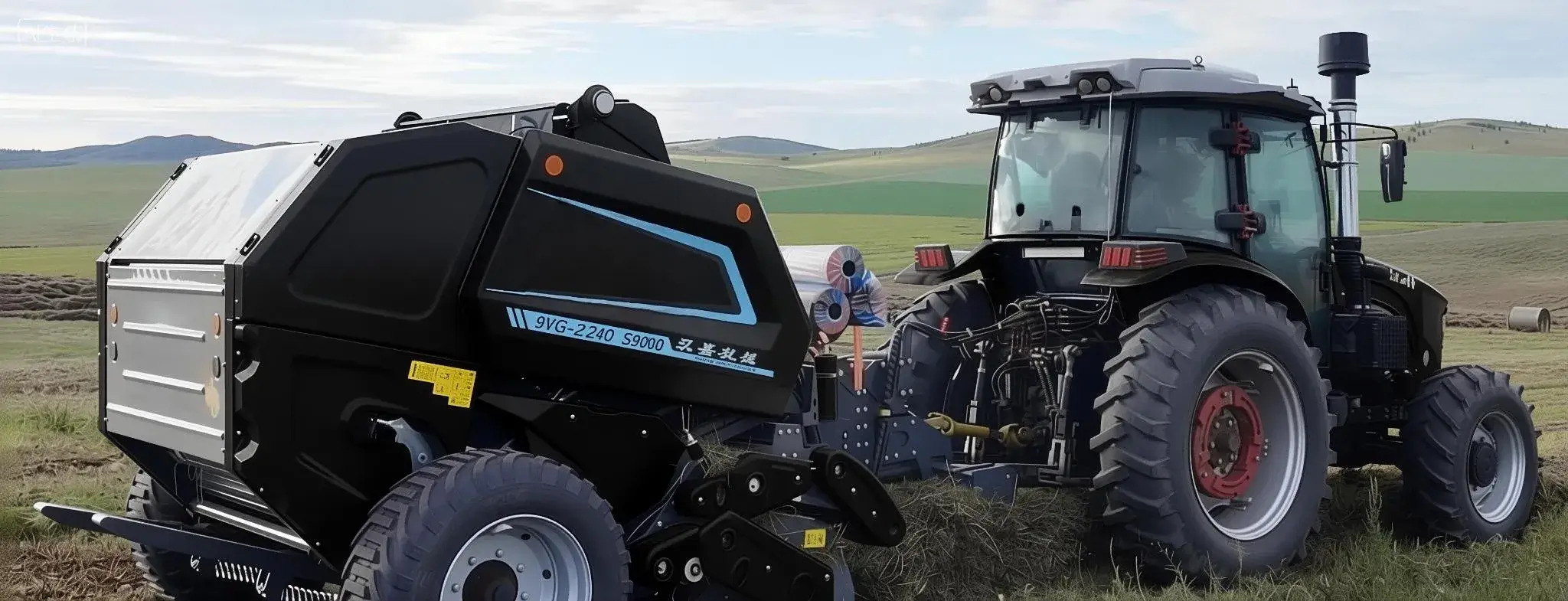
This guide covers the manufacturing structure of the chain drive, material specification for wear resistance, the interaction between chain design and reed silica abrasion, and the maintenance protocols that translate good engineering into actual service life. The EP-9YG-2.24D 圓捆打捆機 series provides the primary technical reference, though the engineering principles apply across the broader 圓捆打捆機 range.
Why Reed Silica Is So Destructive to Standard Chain Drive
Common reed (Phragmites australis) deposits silica dioxide in the outer epidermal cell layer of every culm — a continuous mineral shell distributed across the full stem surface, not concentrated at nodes as in cereal straw. A single culm at 800–1 200 mm harvest length presents a large abrasive surface area relative to its mass. When the pickup rotor processes reed at 400–600 rpm, these surfaces fracture and release silica particles in the 10–50 micron range into the machine’s internal airflow.
Standard roller chain is inherently open — air flows freely through the inner link plate, pin, bushing, and outer plate gaps, carrying silica aerosol into the bushing-pin clearance. Once inside, each chain articulation around the sprocket grinds silica against the pin and bushing surfaces. The result is chain elongation at three to five times the rate of standard hay or straw service. A 圓捆打捆機 running an unsealed chain in reed conditions for 150 hours may reach the same elongation as a sealed-link chain after 500 hours — fundamentally changing the service life economics and maintenance scheduling.
Manufacturing Structure: How a Reed-Duty Chain Drive System Is Built
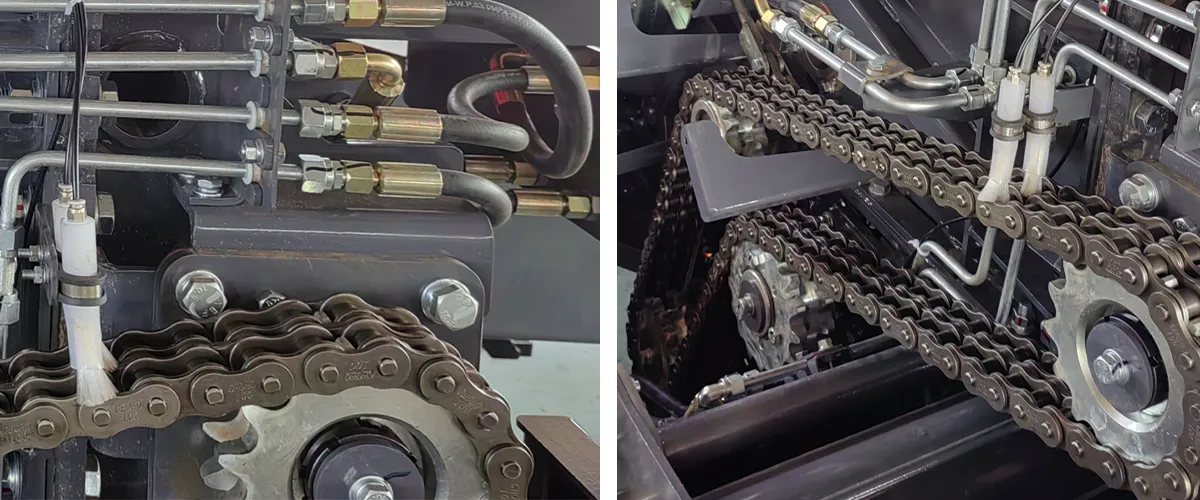
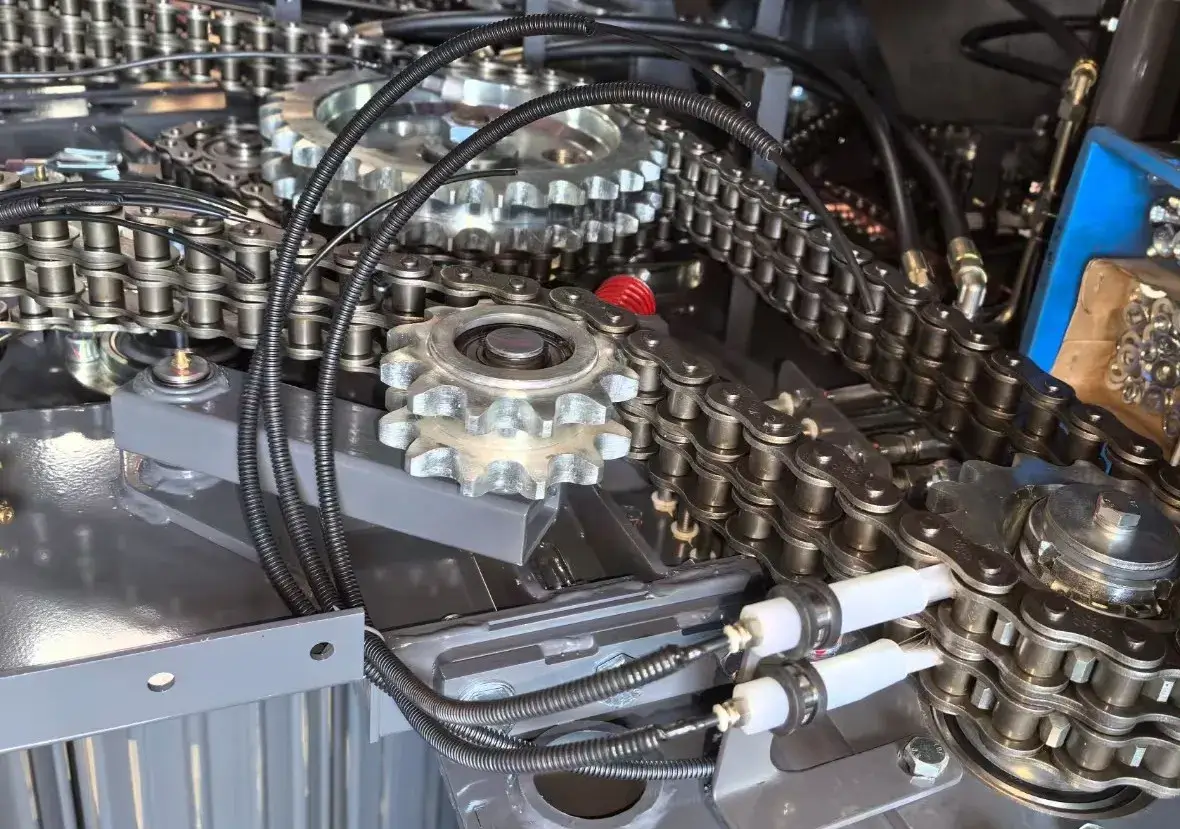
The chain drive in a reed-service 圓捆打捆機 is a system of interacting parts: the primary drive chain from gearbox to pickup shaft; secondary forming roller chains; sprockets; chain case enclosure; and the tensioner maintaining correct slack as wear accumulates.
Primary Drive Chain
The primary chain carries the full gearbox-to-pickup-shaft power output — 15–40 kW depending on 圓捆打捆機 model and PTO HP. In the EP-9YG-2.24D series, chain pitch is 19.05 mm (#60 class) or 25.4 mm (#80) per model variant, with design breaking load four to six times maximum running tension. The primary chain is the highest-torque stage and the most consequential failure point — a break stops the entire machine immediately.
Forming Roller Drive Chains
Secondary chains distribute drive from the pickup shaft to the forming rollers. These run at lower tension but higher speed than the primary chain, and they are more exposed to silica liberation because the forming chamber is where most culm fracturing occurs. On a well-designed 圓捆打捆機, forming roller chains are enclosed in sealed cases that limit direct silica aerosol exposure to the chain interior.
Sprocket Set and Chain Case
The sprockets are as important as the chain. In reed service, sprocket tooth wear accelerates chain elongation — worn teeth cause incorrect chain seating, increasing stress and rate of elongation. Reed-duty sprockets use through-hardened alloy steel (40Cr or 42CrMo) at 50–55 HRC tooth face hardness. The chain case on a reed-duty 圓捆打捆機 does more than guard the operator: a well-sealed case reduces silica-laden airflow around the chain — the most cost-effective single intervention for extending chain life in reed conditions.
The tensioner maintains correct chain sag (1–2% of span) as the chain elongates. A spring-loaded tensioner accommodates gradual elongation automatically but reaches its travel limit — requiring link removal or chain replacement. For long reed seasons, a hydraulic tensioner with greater travel range allows more elongation accumulation before manual intervention, reducing mid-harvest disruption on a 圓捆打捆機 operating on a remote wetland site.
Material System: What Makes a Chain Reed-Duty Capable
Service life difference in reed conditions is determined by four parameters: pin surface hardness, bushing material, seal type, and plate steel specification.
| Component | Standard Chain | Heavy-Duty Reed-Duty Chain | Service Life Impact in Reed |
|---|---|---|---|
| Pin | Case-hardened carbon steel, 55–58 HRC surface | Through-hardened alloy steel (20CrMnTi or equivalent), 58–62 HRC surface, chrome-plated option | Higher surface hardness resists silica lapping; chrome plating further reduces wear coefficient in abrasive media |
| Bushing | Sintered steel or carbon steel, case-hardened | Sintered alloy steel with oil-retaining porosity; some designs use bronze bushing for enhanced lubricity | Oil-retaining sintered bushing maintains lubrication film even when external lubrication schedule is missed; critical in reed conditions where intervals are compressed |
| Seal | No seal (open chain) — standard agricultural roller chain | O-ring seal (NBR or FKM compound) or X-ring seal between inner and outer plate, retaining grease pack in pin-bushing clearance | Seal excludes silica aerosol from pin-bushing zone — the single most effective design intervention for reed conditions; service life 2.5–4 times unsealed chain |
| Plate steel | Carbon steel, punched and profile-stamped | Low-alloy steel (e.g. 40Mn2 or 50CrV4), nickel-plated or zinc-phosphate treated outer plates | Nickel plating resists corrosion from wetland salt aerosol and reed-derived organic acids that attack bare steel plate edges |
| Lubrication fill | No internal grease fill — relies entirely on external lubrication application | Grease-packed at assembly, retained by seal; grease specification typically NLGI 2 lithium-complex or PTFE-enhanced | Internal grease pack provides lubrication at pin-bushing contact regardless of whether external chain oiling is applied on schedule |
The X-ring seal uses a cross-section with two independent sealing lips on each face — if one lip is damaged by an abrasive particle impact, the second continues to function. For a 圓捆打捆機 working a full Korean wetland reed season of 200–350 hours, the difference between O-ring and X-ring seal integrity at end of season determines whether the chain still has acceptable elongation or requires immediate replacement. Nickel plating on outer plates resists the salt aerosol on Korean coastal wetland sites — particularly west-coast sites in South Jeolla Province — where standard zinc phosphate treatment deteriorates within a single season.
Round Baler Gearbox Integration with Chain Drive in Reed Service
這 round baler gearbox and chain drive are mechanically interdependent in a way that is easy to miss. The gearbox output shaft bearing carries chain tension — reaching 2–4 kN static plus dynamic impact loads at full PTO power. When a chain elongates beyond its service limit and is not replaced, the increased polygon effect on sprocket engagement causes cyclic torque variation transmitted back into the gearbox output bearing. In reed conditions this matters because chain elongation happens faster than the standard maintenance interval assumes. A round baler gearbox bearing within its grease life can accumulate fatigue damage from elevated dynamic load that eventually manifests as early failure — often in the following season, making the connection to delayed chain replacement difficult to see.
Check the round baler gearbox oil level and breather at every chain inspection interval in reed service. A blocked breather creates positive internal pressure that forces oil past shaft seals, depleting oil level and contaminating the chain drive with oil that collects reed dust into a silica-laden paste on the chain exterior. This paste accelerates outer plate corrosion and chain case wear simultaneously.
EP-9YG-2.24D Transcend: Chain Drive Engineered for Extended Reed Season
Recommended for commercial reed operations requiring 圓捆打捆機 chain drive durability across a full harvest season.

Chain Drive Maintenance Schedule for Long Reed Harvest Seasons
The maintenance protocol for a 圓捆打捆機 chain drive in reed service is more intensive than for standard crops — the same items apply but intervals are compressed because wear is accelerated. The following schedule targets a Korean commercial reed harvest of 200–350 operating hours in a four-to-eight week window.
| Interval | Task | Tool / Method | Action Threshold |
|---|---|---|---|
| Daily | Visual inspection of chain sag and chain case seal integrity; clean reed dust accumulation from chain case exterior | Visual + compressed air blow-down | Any cracked or missing case seal — replace before next use |
| Every 10 h | Apply external chain lubricant (oil mist or spray) to all exposed chain runs; check tensioner spring position | Chain lubricant spray; visual check | Tensioner at 75% travel — adjust chain or plan replacement |
| Every 40 h | Measure chain elongation on primary drive using elongation gauge over 12 links; inspect sprocket tooth profile for hooked wear | Chain elongation gauge; visual sprocket inspection | Elongation above 1.5% of nominal pitch — replace chain and sprocket |
| Every 40 h | Check round baler gearbox breather for reed dust blockage; check oil level; inspect output shaft seal for leakage | Dipstick + visual; clean blocked breather with solvent | Oil level below minimum mark — top up immediately; any shaft seal weep — replace seal before 40 further hours |
| End of season | Replace round baler gearbox oil; measure all chain elongation and record; replace any chain above 1.5%; replace all sprockets concurrently with chain replacement; flush chain cases | Full disassembly of chain cases; oil drain and refill | Any chain replaced in-season triggers concurrent sprocket replacement at end of season regardless of apparent tooth condition |
End-of-season gearbox oil replacement should be done while the oil is warm — immediately after the final harvest day. Warm oil carries suspended silica and metallic debris; draining promptly removes contaminants before they settle and reactivate at the following season’s first start-up. Refill with fresh GL-4 80W-90 gear oil.
Regulatory Context: Chain Drive, Gearbox, and Machine Safety in Key Markets
The chain drive and gearbox of a 圓捆打捆機 fall under specific regulatory requirements in commercial biomass operations across key markets.
South Korea (KR)
The Agricultural Mechanization Promotion Act requires agricultural machinery including a 圓捆打捆機 to meet RDA safety standards. Chain drive guards must be intact before field operation — operating with an open chain case violates safety regulations under the Occupational Safety and Health Act for agricultural workers. KS B 1407 covers roller chain specifications for agricultural applications and provides the dimensional and performance baseline that chain suppliers must meet for RDA-compliant equipment.
European Bloc (EU)
The Machinery Directive 2006/42/EC and the incoming Machinery Regulation (EU) 2023/1230 require all chain drives to be guarded by enclosures that cannot be opened without a tool during operation. EN ISO 4254-7 (balers) and EN 294 (safe distances) specify the guarding requirements. For round balers exported to EU markets, the CE Declaration of Conformity must confirm chain drive guarding meets these standards. Operator modifications that reduce guarding level invalidate the CE marking.
Japan (JP)
Agricultural machinery in Japan must comply with JIS B 9700 (Safety of Machinery) and JIS B 1801 for roller chains. The MAFF-administered Japanese Agricultural Standards framework includes certification for subsidised equipment. A 圓捆打捆機 chain drive not conforming to JIS B 1801 specifications may not qualify for import certification under MAFF guidelines, affecting import duties and subsidy eligibility for reed baling equipment operators.
North America (US / Canada)
ASABE standard S493 covers chain and sprocket drive guarding on agricultural machinery in the US and Canada. Guards must withstand impact from expelled crop material — relevant in reed applications where ejected culm material strikes adjacent components. OSHA 29 CFR 1910.219 on mechanical power-transmission guarding is referenced in agricultural machinery liability assessments and applies to commercial reed baling operations.
All EP 圓捆打捆機 models are manufactured under ISO 9001 QMS certification — recognised across all markets above and referenced in import assessments.
Round Baler Parts: What to Stock Before a Reed Harvest Season
Planning spare round baler parts before a reed season is fundamentally different from a standard hay season. Accelerated wear rates mean components lasting two seasons in normal use may be consumed in one, and some items require multiple units because mid-season replacement is inevitable regardless of how well the machine is maintained.
Primary drive chain (sealed-link)
Stock one complete replacement length plus one joining link set. A 350-hour reed season can consume the primary chain to replacement threshold — keeping the replacement on hand avoids a sourcing delay at a critical point in the harvest window.
Drive sprockets (matched set)
Stock a matched sprocket set for the primary drive stage. Because chain and sprocket must be replaced together, stocking the sprockets before the season avoids a second parts delay when chain replacement is due.
Pickup tines
One full set of replacement pickup tines is the minimum. Reed culm silica abrades the tine tip geometry faster than in hay service, and tines with worn tip profiles increase the rate of crop left behind in the windrow — visible as recovery loss that directly affects yield per operating hour.
Gearbox oil (GL-4 80W-90)
Enough for two full gearbox changes during the season. The 40-hour interval in reed service typically requires at least one mid-season oil change in addition to the end-of-season replacement. Oil stored on the harvest site prevents delays from requiring a resupply run.
Net wrap cutter blade
Two to three replacement blades. Reed silica dulls the cutter knife three to five times faster than in grass baling — a blunt knife produces ragged net ends that trap air in the bale surface, reducing bale density consistency.
Pickup shaft bearing (sealed)
One spare sealed bearing housing for the pickup shaft. Reed dust penetration through single-lip seals can cause bearing failure within 150 hours. A sealed replacement bearing on site avoids a complete harvest stoppage waiting for parts.
The cost of this on-site 圓捆打捆機 inventory is modest compared to a single unplanned machine stoppage on a remote wetland site. Failing to complete the harvest within the available weather window may forfeit the entire season’s reed yield — a contractual failure with consequences well beyond the cost of replacement parts.
Compatible System Accessories: PTO Shaft and Drive Chain
A 圓捆打捆機 chain drive system is only as strong as its weakest connected component. The PTO shaft and the secondary drive chain both require specification matching the reed operating environment.
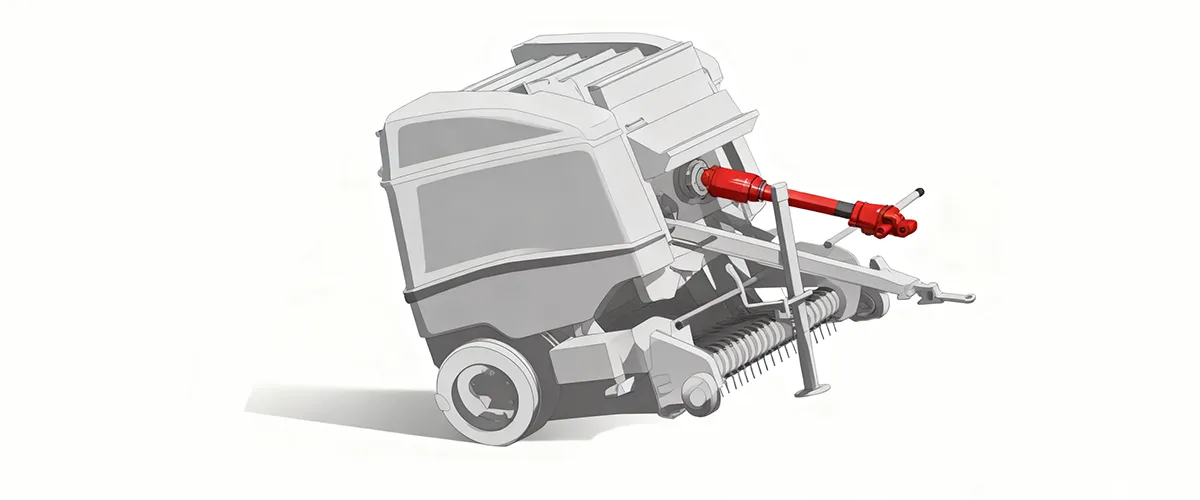
Agricultural PTO Shaft
The PTO shaft transmits torque to the 圓捆打捆機 input at 540 rpm and must be rated for peak torque at bale completion — two to three times mean running torque in reed conditions. An overrun clutch protects the chain drive and gearbox from wind-up shock when the tractor decelerates. EP-compatible PTO shafts are engineered to each EP model’s torque envelope with CE-compliant safety guards meeting EN ISO 4254-7 requirements for Korean and EU markets.
Agricultural Drive Chain
For 圓捆打捆機 applications in reed harvesting, the drive chain must be sealed-link design with nickel-plated outer plates and grease pack retained by O-ring or X-ring seals. This provides the silica exclusion and corrosion resistance that distinguishes a chain for a full Korean reed season from one requiring mid-season replacement. Chain pitch must match the sprocket specification exactly — geometry mismatches accelerate both chain and sprocket wear from the first hours of operation.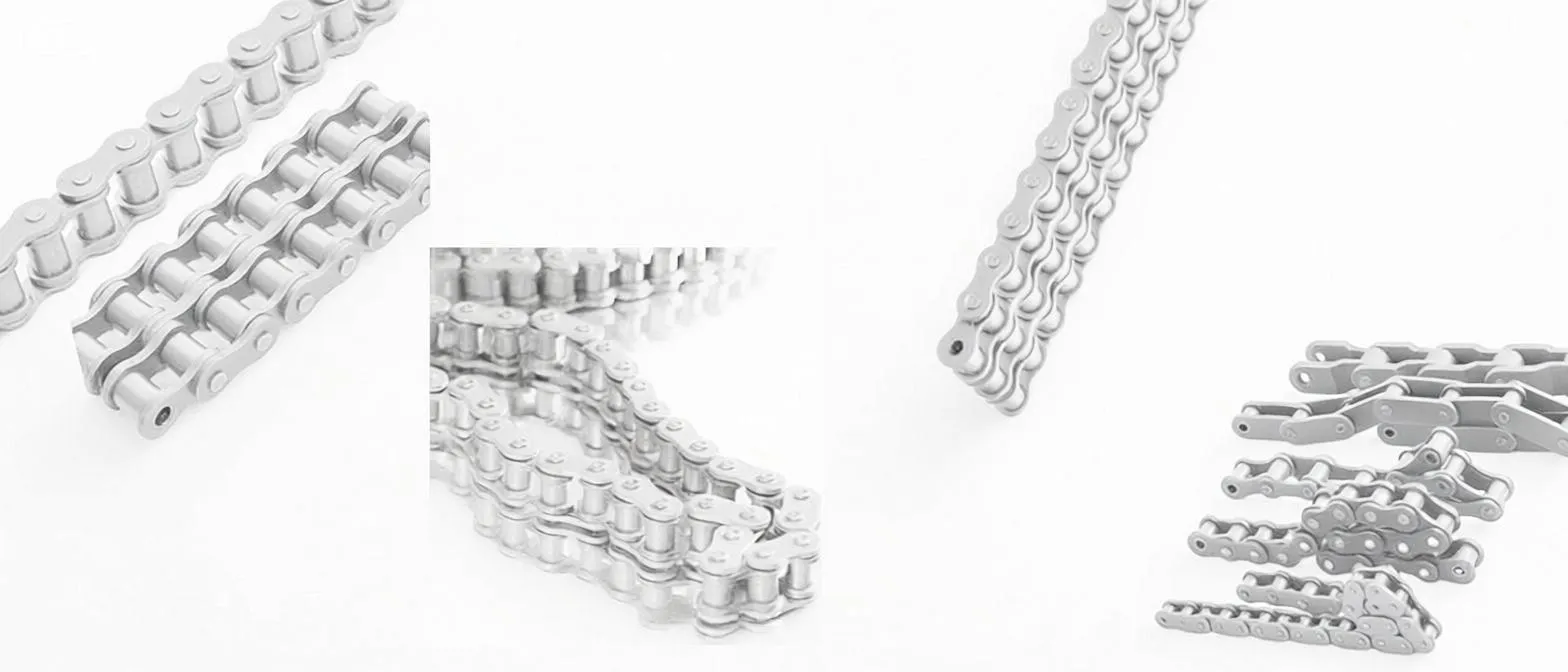
10+ Years of Agricultural Machinery Manufacturing
Our agricultural machinery operation has manufactured harvesting and baling equipment since 2013 — light and heavy round balers, mowers, and rakes — all under ISO 9001 QMS certification in a facility operating 60+ sets of large-scale production equipment. Independent import and export rights support direct buyer engagement across Korea, Japan, Southeast Asia, and Central Asia. Annual capacity is 2 000 units. For commercial reed harvest operators, our technical team can advise on chain drive specification, PTO shaft selection, and maintenance scheduling to ensure reliable performance through a full harvest season.
Find the Right Round Baler for Your Reed Harvest Operation
Frequently Asked Questions
編輯:PXY