Choosing the right round baler for commercial-scale reed harvesting is not simply a matter of picking the largest available model. The operational environment in Korean coastal and riverine wetlands — constrained ground bearing capacity, limited access tracks, short seasonal harvest windows, and specific bale density requirements tied to end-market logistics — creates a decision matrix where a machine that is too small for the workload and a machine that is too heavy for the terrain can both cost the operator money. The right answer sits at the intersection of throughput, terrain compatibility, tractor fleet capacity, and whole-season cost per bale.
This article compares the 9YG-2.24D series round baler against smaller models in the same product range — specifically the 9YG-1.25, 9YG-1.25A, 9YG-1.0C, and 9YG-1.0 — across the criteria that matter most for high-density commercial reed baling. The comparison is structured to help Korean wetland operators, agricultural cooperative managers, and biomass procurement teams make a defensible equipment selection ahead of the November-to-February Phragmites harvest window.
What Commercial-Scale Reed Harvesting Actually Demands from a Round Baler
The definition of commercial scale in Korean wetland reed harvesting typically starts at 500 bales per season for small cooperative operations and extends to 3,000–8,000 bales per season for the larger biomass and thatching contractors working the Nakdong River delta, Sihwa tidal flats, and Saemangeum coastal zones in Gyeonggi and Jeolla Provinces. At these volumes, machine selection becomes an economic decision rather than a preference — the throughput rate and downtime frequency of the round baler machine directly determines whether the seasonal harvest is completed within the optimal quality window or whether late-season deterioration of the standing crop reduces bale quality and market value.
Commercial reed baling makes four simultaneous demands on a round baler that smaller-scale hobby or mixed-use machines frequently cannot satisfy simultaneously. First, sustained throughput: a commercial operation cannot afford to run at 8–12 bales per hour with frequent manual clearances — it needs 20 bales per hour or above, continuously, across a full working day. Second, high and consistent bale density: commercial thatching buyers and biomass procurers specify a minimum density (typically 90–130 kg/m3 for thatching reed, 100–150 kg/m3 for biomass) and reject or discount bales below that threshold. Third, bale weight consistency: transport logistics for commercial reed require predictable bale weights for load planning, and high variance between bales creates inefficiency across the whole supply chain. Fourth, machine durability in the wetland environment: coastal Korean wetland reed contains significant silica in the stem, and machines that are not built to resist this abrasion will see accelerated wear on intake components within a single season.
Manufacturing Structure: How the 9YG-2.24D Differs from Smaller Models
Pickup Width and Windrow Coverage
The most immediately visible structural difference between the 9YG-2.24D round baler and the smaller models in the range is the pickup width. The 9YG-2.24D carries a 2.24 m working pickup width, compared to 1.8 m on the 9YG-1.25/1.25A series and 1.4–2.2 m on the 9YG-1.0/1.0C models depending on configuration. In reed harvesting terms, this difference matters because commercial reed swaths — particularly in the tall Phragmites beds of the Nakdong and Han River corridors — are typically cut and raked to windrows of 1.8–2.2 m width by the preceding disc mower pass. A 2.24 m pickup covers this width in a single pass; a 1.8 m pickup leaves windrow edges behind, requiring either a secondary raking pass or acceptance of field losses at the margins. On a 200-hectare commercial reed estate, a single secondary raking pass adds meaningful hours and fuel cost to the season operation.
Compression Chamber and Roller Count
The compression chamber in the 9YG-2.24D uses an 18-roller configuration with roller diameters of 222 mm. Smaller models in the range — the 9YG-1.25A and 9YG-1.0C — use 16-roller chambers. The additional two rollers in the 9YG-2.24D configuration increase the contact arc circumference available for bale compression by approximately 12%, which directly translates to a more uniform pressure distribution across the bale cross-section during formation. For reed — which has a tendency to form loose, low-density core regions when the early bale formation rollers do not maintain consistent contact — the higher roller count reduces the frequency of density voids in the finished bale. This matters most in commercial supply chains where bale rejection for below-specification density has financial consequences.
Frame and Structural Mass
The 9YG-2.24D series carries a structural mass of approximately 1,800–2,200 kg depending on model variant and optional equipment. The 9YG-1.25 and 9YG-1.25A sit at approximately 1,400–1,600 kg, and the 9YG-1.0 series at 1,100–1,300 kg. In wetland terrain where ground bearing capacity is the limiting factor — typically 20–50 kPa on unfrozen coastal Korean flats — this mass difference must be assessed against the tractor and implement combination footprint. The 9YG-2.24D tongue load at the tractor hitch point is higher than smaller models at equivalent bale density, which is a relevant constraint for compact Korean tractors (LS Mtron MT-series, TYM T-series) in the 60–80 hp range operating on soft ground. Wide flotation tyres on the baler axle can partially compensate, but operators on very soft terrain should verify tongue load capacity against their specific tractor front axle specification before committing to the larger model.
Material System: Build Quality Across the Model Range
The material specifications across the round baler range share a common foundation in the main structural and drivetrain components, with the 9YG-2.24D series carrying heavier section ratings at the chassis, gearbox, and intake rotor to match its higher throughput capacity. The table below summarises key material and structural differences across models.
| Component / Parameter | 9YG-2.24D Series | 9YG-1.25 / 1.25A | 9YG-1.0 / 1.0C |
|---|---|---|---|
| Chassis main frame section | 100x60x6 mm Q345 RHS | 80x60x6 mm Q345 RHS | 80x50x5 mm Q345 RHS |
| Compression rollers | 18 rollers, 222 mm dia., induction-hardened | 16 rollers, 200 mm dia., induction-hardened | 14–16 rollers, 180–200 mm dia. |
| Gearbox peak torque rating | 900 Nm peak | 700 Nm peak | 550–600 Nm peak |
| Pickup width | 2.24 m | 1.8 m | 1.4–2.2 m |
| Pickup tine spec (reed config) | 65Mn spring steel, 5-tine carriers, 60 mm spacing | 65Mn spring steel, 5-tine carriers, 65 mm spacing | 65Mn spring steel, 4–5 tine, 70–80 mm |
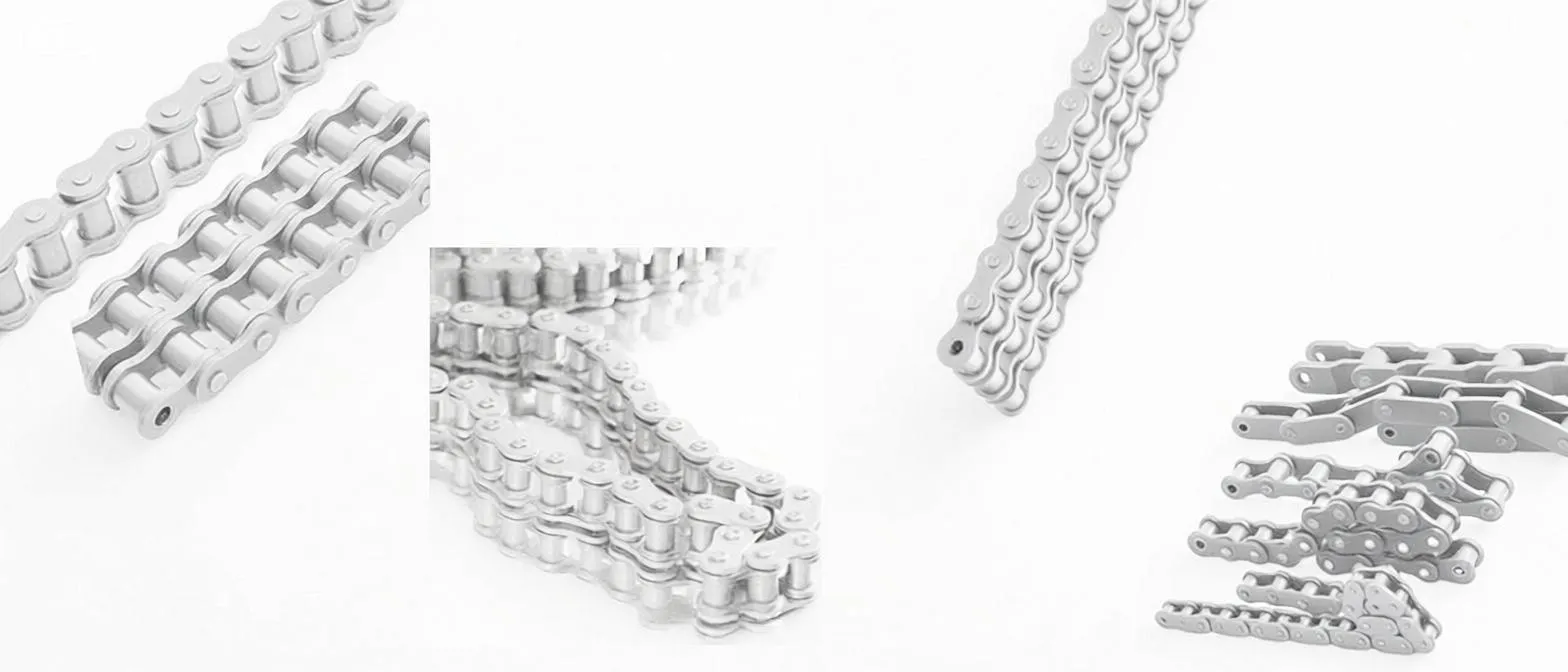
| Drive chain spec | ANSI #60 alloy, 80 kN tensile | ANSI #50 alloy, 60 kN tensile | ANSI #50 alloy, 60 kN tensile |
| Surface coating system | Epoxy primer + PU topcoat, 500 h salt spray | Epoxy primer + PU topcoat, 500 h salt spray | Powder-coat over epoxy primer |
| Compatible tractor PTO (hp) | 55–100 hp at 540 r/min | 45–80 hp at 540 r/min | 35–65 hp at 540 r/min |
| Machine working weight (approx.) | 1,800–2,200 kg | 1,400–1,600 kg | 1,100–1,350 kg |
The ANSI #60 drive chain specification on the 9YG-2.24D represents the most meaningful hidden structural difference between this model and the smaller machines. Chain choice at #60 (80 kN tensile) versus #50 (60 kN tensile) is a 33% increase in rated chain strength — and in commercial reed baling where torque spikes from the intake rotor are frequent and the chain runs continuous hours per day, this margin is the difference between a chain that needs mid-season replacement and one that completes the season intact.
Throughput Comparison: What Each Model Delivers in Commercial Reed Conditions
Throughput in commercial reed baling is measured not by rated machine capability but by actual bales-per-day delivered under the field conditions of Korean coastal wetland harvesting — which include access track time, headland turns on constrained parcel shapes, occasional manual adjustment events, and the daily moisture variation in cut reed that changes intake behaviour between morning and afternoon sessions. The following estimates are based on the machine specifications and typical Korean reed harvesting conditions, and represent realistic rather than best-case performance expectations.
| Model | Bale Diameter (Reed) | Bales per Hour (Reed) | Bales per Day (8 hr) | Season Output (60 days) | Commercial Scale Fit |
|---|---|---|---|---|---|
| 9YG-2.24D | 1,200–1,500 mm | 25–40 | 170–270 | 10,000–16,000 | Full commercial scale |
| 9YG-1.25A | 1,200–1,500 mm | 18–30 | 120–200 | 7,000–12,000 | Medium commercial, cooperative |
| 9YG-1.25 | 1,200–1,500 mm | 15–25 | 100–170 | 6,000–10,000 | Small commercial, cooperative |
| 9YG-1.0C | 800–1,000 mm | 12–20 | 80–140 | 5,000–8,000 | Semi-commercial, farm-scale |
| 9YG-1.0 | 800–1,100 mm | 8–15 | 55–100 | 3,000–6,000 | Farm-scale, mixed-use |
The throughput figures above illustrate the threshold effect at commercial scale. An operation targeting 5,000 bales per season — a modest commercial contract in the Korean coastal reed market — is achievable by the 9YG-1.0C or 9YG-1.25, but only under sustained daily operation with minimal weather delays and no mechanical issues. The 9YG-2.24D achieves the same output in significantly fewer operating days, leaving buffer capacity for weather interruptions, which are common in the Korean late-autumn and winter harvesting window. For operations targeting above 8,000 bales per season, the 9YG-2.24D is effectively the minimum machine specification — the smaller models cannot reliably deliver this volume within the optimal seasonal window even under ideal conditions.
Round Baler Gearbox: Capacity Differences Across the Range for Reed Duty
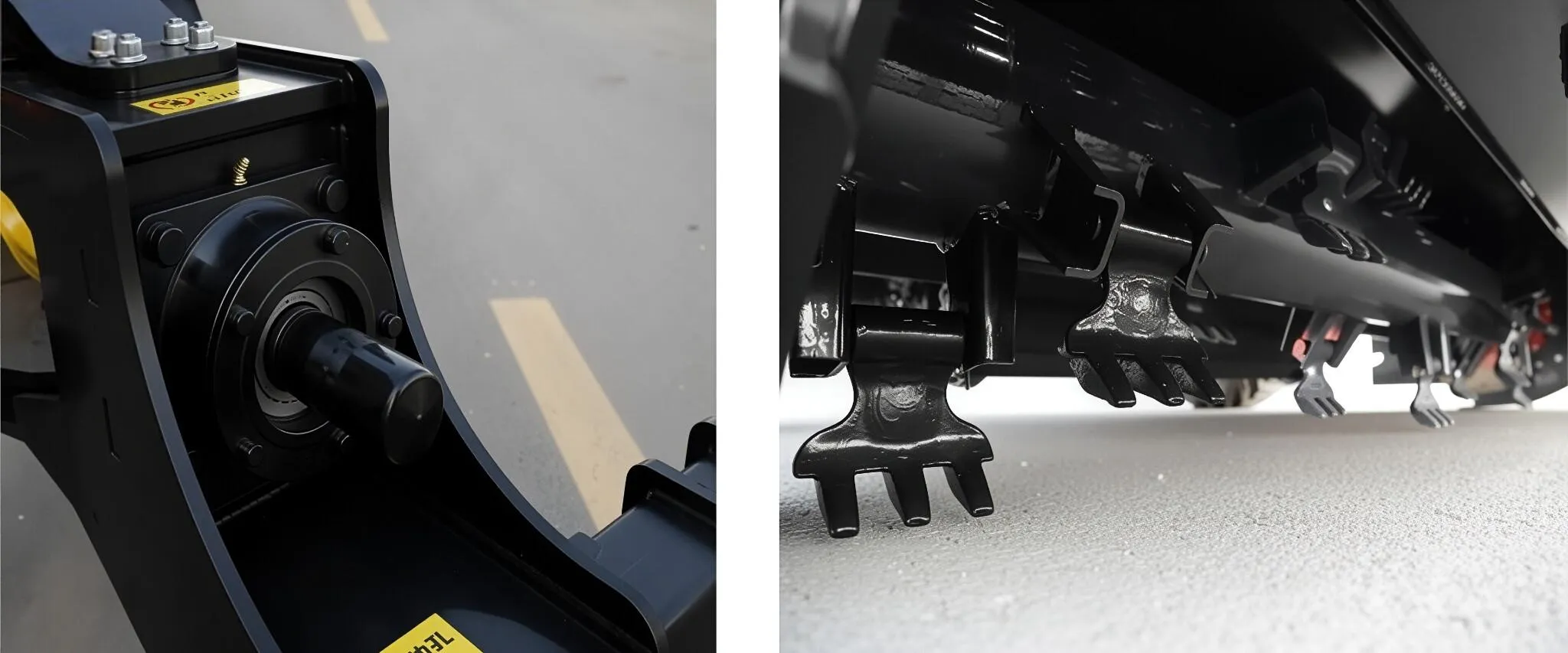
The round baler gearbox is the component most likely to differentiate performance between models in commercial reed conditions, and the one most often under-specified when operators choose a machine based on pickup width alone. Reed baling — particularly at the intake phase where the semi-forced feeding rotor encounters bundles of rigid Phragmites stems — generates torque spikes that are significantly higher per unit time than equivalent grass baling. These spikes propagate through the rotor drive chain into the gearbox input stage, and a gearbox operating at or near its peak torque rating under this condition accumulates gear contact fatigue damage faster than the design service life assumed by the manufacturer assumes.
The 9YG-2.24D uses a spiral bevel primary stage (20CrMnTi, HRC 58–62 case-hardened) rated to 900 Nm peak and 550 Nm continuous. The 9YG-1.25A gearbox is rated to 700 Nm peak and 430 Nm continuous. In practical terms, this means the 9YG-2.24D gearbox has approximately 29% more peak torque headroom for the spike events that reed intake generates. Operators running the 9YG-1.25A or 9YG-1.25 for full-season commercial reed baling should budget for more frequent gearbox oil inspection — at least every 30 operating hours rather than the standard 50 — because spike-loaded gearboxes generate more internal heat and metal debris than smooth-load applications.
Gearbox oil specification for all models in reed applications should be ISO VG 90 GL-4 or GL-5 synthetic during the Korean winter harvest period. Synthetic gear oil maintains its viscosity more reliably at the low starting temperatures (minus 5 to minus 15 degrees C) of early morning November–January operations in Gyeonggi and South Chungcheong coastal zones, reducing the cold-start bearing load that contributes to early gearbox wear in tractors and implements operated on frozen wetland ground.
Featured Model: 9YG-2.24D Round Baler — The Commercial Reed Standard
9YG-2.24D — Pickup Width 2.24 m, 18-Roller Chamber, Commercial Wetland Reed
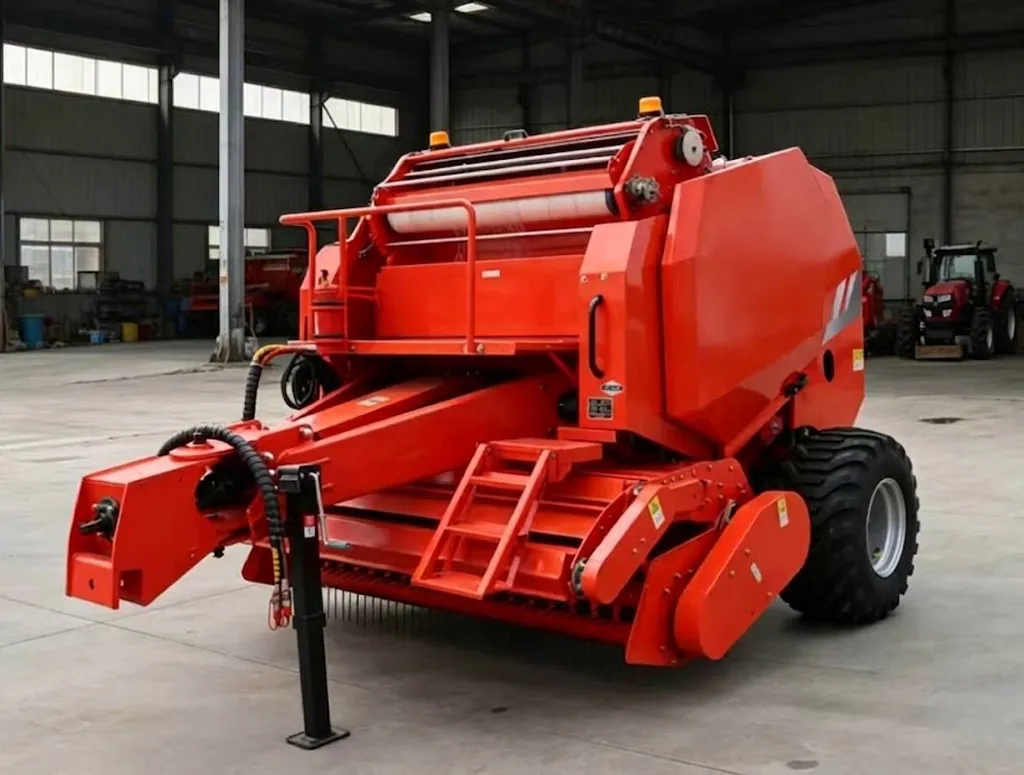
The 9YG-2.24D is the model in this product range positioned for full commercial-scale reed and wetland biomass harvesting. The 2.24 m working pickup width eliminates the secondary raking requirement that narrows the daily operating window on larger reed estates. The 18-roller fixed compression chamber produces bale diameters in the 1,200–1,500 mm range at densities of 100–160 kg/m3 on properly cured Korean coastal reed — within the specification range for commercial thatching and biomass supply contracts.
The semi-forced feeding intake system on the 9YG-2.24D — with its spiral rotor positively driving long Phragmites stems through the intake throat — eliminates the manual clearance events that reduce productivity on smaller machines running standard cam-track pickups in reed conditions. Compatible with Korean compact and mid-size tractors from 55 to 100 hp at 540 r/min PTO, it covers the range from TYM T754 and LS Mtron MT7 through to larger farm tractors in the Korean cooperatives that manage the major coastal wetland harvesting programmes.
When a Smaller Model Is the Right Choice for Wetland Reed
The 9YG-2.24D is not the right answer for every Korean reed harvesting context, and recommending it without qualification would be misleading. There are three specific scenarios where a smaller round baler model is the more appropriate selection, and understanding these scenarios is as important as understanding when the larger machine is justified.
Where wetland soil bearing capacity is consistently below 20 kPa — as occurs in the inner tidal flat zones of Sihwa during mild winters or in the interior marsh areas of Saemangeum before full drainage — the 9YG-2.24D combined with a 60–80 hp tractor may exceed the safe axle loading for the available ground. In these conditions, the 9YG-1.25 or 9YG-1.0C on a compact tractor with wide flotation tyres reduces ground disturbance and avoids the risk of getting bogged. The productivity loss is real, but so is the alternative of a stuck machine on soft ground 2 km from the nearest hard track.
Many Korean coastal wetland reed beds are accessed through narrow agricultural access roads and earthen levee tracks with turning radii that restrict larger implements. The 9YG-2.24D working width and turning radius on public roads and levee access tracks must be verified before purchase for any site where access track width is below 3.5 m. The 9YG-1.25 and 9YG-1.25A are significantly more maneuverable in these conditions and may actually deliver more productive hours per day on constrained sites than the larger machine would if transport access slows its movement between fields.
For Korean livestock farms that bale meadow grass and hay as their primary round baler application but also access adjacent reed beds for 4–8 weeks per year as a secondary income source, the 9YG-1.25A or 9YG-1.0C provides a better investment case. The reed harvest volume from secondary-use operations rarely exceeds 1,500–2,500 bales per season, and the 9YG-1.25 series is fully capable of delivering this within the harvest window. Purchasing the 9YG-2.24D for this application represents capital overcapacity relative to the volume and revenue it is expected to generate.
Regulatory and Compliance Context for Commercial Reed Baling Equipment
Republic of Korea
Commercial-scale round baler machines for reed harvesting must meet MAFRA Agricultural Machinery Certification under the Act on Development of Agricultural Mechanization, which applies to all PTO-driven implements including round balers operating in agricultural classifications. For the 9YG-2.24D and larger machines in this class, gearbox and PTO shaft guarding compliance with ISO 500-1 is mandatory. Commercial reed harvesting operations in designated wetlands additionally require harvest permits under the Wetlands Conservation Act. The Korean Agricultural Mechanisation Support Programme provides subsidy eligibility for certified machines, covering up to 50% of purchase cost for operations that satisfy both the machinery certification and the environmental permit requirements. KOSHA regulations (Occupational Safety and Health Act) apply to commercial operations employing harvest workers, requiring documented equipment inspection records for all PTO-driven machinery.
EU and Europe
Round baler equipment sold in EU markets must carry CE marking under Machinery Directive 2006/42/EC, transitioning to EU Machinery Regulation 2023/1230 from January 2027. Gearbox and PTO shaft guarding must comply with EN 12965. For commercial reed harvesting operations in the Netherlands, Germany, and Poland — the largest European commercial reed markets — additional environmental compliance is required under the Habitats Directive 92/43/EEC and national wetland management frameworks. In the Netherlands specifically, low-ground-pressure machine specifications (maximum 50 kPa axle load) are often written into wetland management permits, which affects the feasibility of deploying the heaviest round baler models on protected peat soils.
Japan
Round baler equipment for commercial use in Japan is subject to the Agricultural Mechanization Promotion Act and must pass NARO performance testing for certification. PTO shaft specifications follow ISO 500-1 (aligned with Korean standards), and gearbox safety requirements conform to JIS B 9700. Commercial reed harvesting in Japanese protected coastal and riverine wetlands requires permits under the River Act and the Natural Parks Act, both of which set ground disturbance and machinery weight constraints that are directly relevant to machine selection decisions.
Australia
In Australia, commercial-scale wetland biomass harvesting is subject to state environmental protection legislation and the federal EPBC Act 1999. Round baler equipment must comply with AS 4024 (Safety of Machinery) and WHS Act requirements for PTO guarding and hydraulic circuit documentation. Victoria and South Australia have specific guidelines for machinery operating in waterway management zones within the Murray-Darling Basin, including limitations on implement ground pressure that commercial operators in these zones must address at the equipment selection stage.
Subsidy applications for round baler machines under the Korean Agricultural Mechanisation Support Programme require both MAFRA Machinery Certification documentation and, where applicable, the relevant wetland harvesting permit from the Ministry of Environment. Both documents must be submitted together — certification alone does not complete the application. Confirm the certification status of the specific model and variant with the supplier before finalising any purchase intended for subsidy reimbursement.
Total Cost of Operation: 9YG-2.24D vs 9YG-1.25A over a Five-Season Reed Programme
Capital cost is the most visible element of the equipment investment decision, but it is rarely the determining factor over a multi-season commercial operation. The real comparison between the 9YG-2.24D and the 9YG-1.25A for commercial-scale Korean reed baling involves four cost categories across five seasons: machine depreciation, fuel and maintenance, round baler parts replacement, and the opportunity cost of uncaptured bales when throughput is insufficient for the seasonal window.
Depreciation: the 9YG-2.24D has a higher purchase cost, but also higher throughput. On a per-bale depreciation basis across a season of 6,000 bales, the difference between models narrows significantly. On a season of 10,000 bales, the 9YG-2.24D typically achieves a lower per-bale capital cost than the 9YG-1.25A, because the denominator — total bales produced — grows faster than the numerator cost differential.
Maintenance and parts: the 9YG-2.24D uses a heavier drive chain (#60 vs #50) that typically lasts two full reed seasons before replacement, while the #50 chain on the 9YG-1.25A in the same conditions may require replacement after one full season. The heavier intake rotor on the 9YG-2.24D also carries a longer wear interval on the spiral fingers in silica-heavy coastal reed, because the larger contact face of the heavier forging distributes wear more broadly. These differences compound across five seasons into a meaningful round baler parts cost advantage for the larger machine in pure reed applications.
Opportunity cost: the most significant financial variable for commercial Korean reed contractors is the value of bales not made because the machine could not complete the harvest within the quality window. Cut reed that lies in the windrow beyond the optimal 7–14 day post-cutting window begins to deteriorate in colour and thatching quality, and coastal Korean reed buyers apply quality discounts of 15–25% to late-harvested material. A 9YG-1.25A round baler running at 85% efficiency that cannot complete a 7,000-bale contract within the window costs the operator more in quality discounts than the entire seasonal maintenance budget for a 9YG-2.24D.
Compatible Components for the 9YG-2.24D in Commercial Reed Applications
At commercial scale, the round baler machine is only part of the equation. The PTO shaft and internal drive chains must be matched to the higher torque demand of the 9YG-2.24D in continuous reed duty — and sourcing these as a complete system from a single supplier simplifies warranty and replacement logistics across a multi-machine commercial fleet.
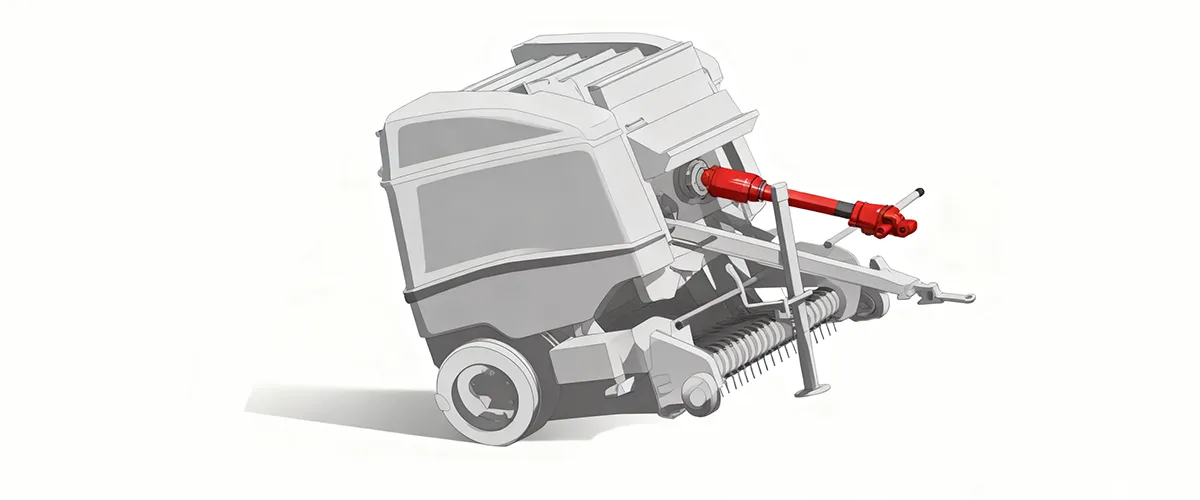
Agricultural PTO Shaft — Commercial Reed Spec for 9YG-2.24D
At commercial scale on the 9YG-2.24D, the PTO shaft must handle continuous torque peaks from the semi-forced feeding rotor across sustained daily operating hours. The EP-عمود نقل الحركة series rated for the 9YG-2.24D drive torque uses a 1-3/8 inch Z6 spline at 540 r/min with an integrated friction-clutch overrun protector — the appropriate selection for reed harvesting where sudden intake blockage events can generate reverse torque spikes back towards the tractor. Length adjustability from 600 to 1,200 mm covers all common Korean tractor-to-baler geometries in the 55–100 hp compatibility range.
Agricultural Drive Chain — ANSI #60 for 9YG-2.24D Commercial Reed Duty
The 9YG-2.24D specifies ANSI #60 alloy steel drive chains rated to 80 kN tensile for the internal rotor and chamber drive circuit. At commercial-scale reed harvesting throughput — continuous operation across daily 8-hour sessions with the high torque-spike frequency of the semi-forced feeding rotor — the #60 chain provides the additional fatigue margin that makes the difference between one- and two-season chain life. Maintaining chain tension at the prescribed 10–15 mm midspan sag on the 9YG-2.24D is a more frequent task in reed conditions than in grass, and stocking one pre-cut connecting link set per operating season is a practical precaution for commercial operators.
Over a Decade of Agricultural Machinery Manufacturing
Our agricultural machinery production programme has been operating since 2013 with a focus on the full commercial range of harvesting and baling equipment. We produce round baler machines from compact single-farmer models through to the heavy-duty 9YG-2.24D series designed for commercial forage and wetland biomass applications, alongside single and double blade mowers, disc rotary cutters, and raking equipment that supports the complete harvest sequence. All production runs under ISO 9001 Quality Management System certification with more than 60 large-format production units and annual capacity of 2,000 machines. Independent import and export rights allow direct supply to Korean, Japanese, Australian, European, and North American customers. Our engineering team has hands-on experience designing round baler specifications for the Korean wetland reed harvesting environment, including intake system calibration for Phragmites australis and gearbox specifications for the torque-spike loading pattern of commercial reed intake.
Frequently Asked Questions
How does the 9YG-2.24D round baler compare to the 9YG-1.25A for commercial-scale reed harvesting in Korean coastal wetlands near Gyeonggi Province?
What bale density does the 9YG-2.24D round baler achieve on Phragmites australis reed harvested in Korean wetland conditions?
Which Korean tractor brands and models are compatible with the 9YG-2.24D round baler for commercial wetland reed harvesting?
Where can a Korean agricultural cooperative get a quote for multiple 9YG-2.24D round balers for a commercial reed harvesting programme in South Chungcheong Province?
When should a Korean wetland reed harvesting operation consider upgrading from the 9YG-1.25A to the 9YG-2.24D round baler?
المحرر: PXY