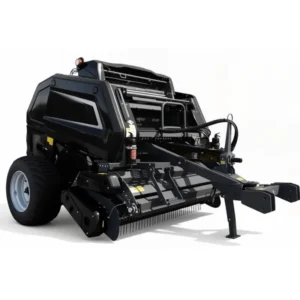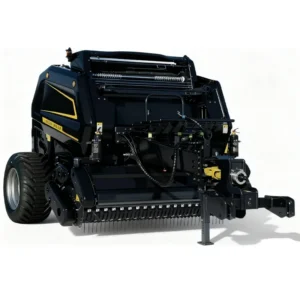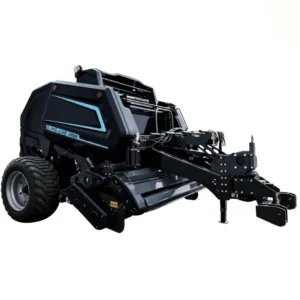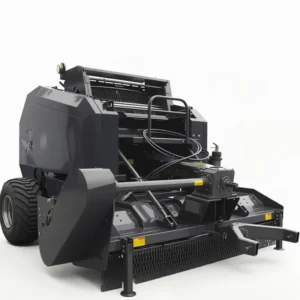
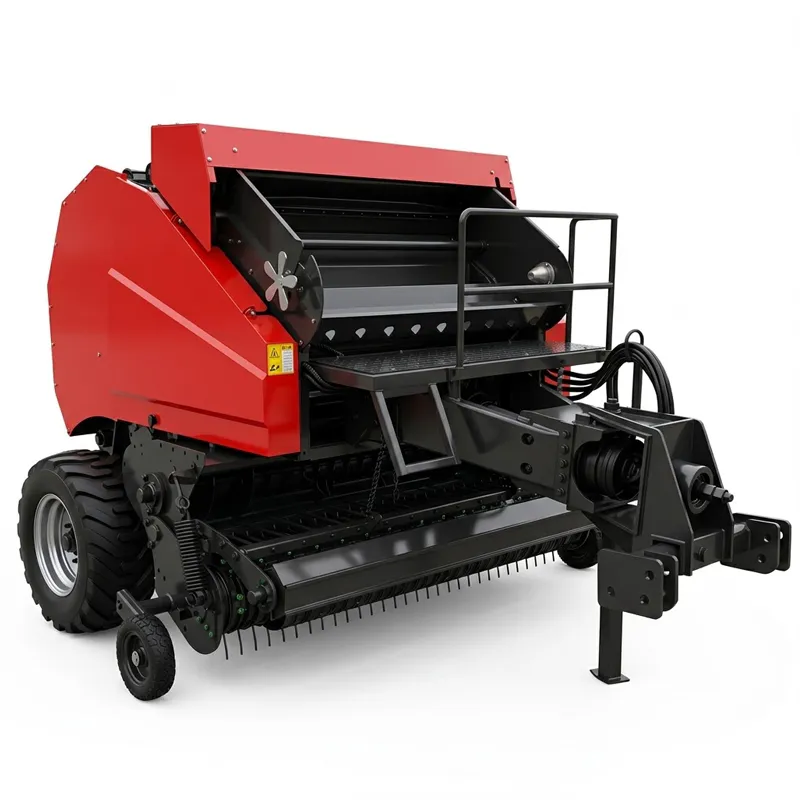
EP-3200×2500×2010mm (L×W×H) Φ1000mm Compression Round Baler
The EP ∅1000mm is a professional-grade, trailed-type round baler designed for commercial livestock farms, agricultural contractors, and cooperative harvest operations that demand consistent high-density bale output across long working days. With an overall machine footprint of 3200×2500×2010mm and a finished bale diameter of Ø1000mm, this unit occupies the heavy-duty tier of the round baler machine market — a segment where bale weight, wrapping reliability, and mechanical durability translate directly into seasonal profitability.
Heavy-Duty Agricultural Round Baler
EP-3200×2500×2010mm (L×W×H) ∅1000mm Compression مكبس دائري
A large-capacity trailed agricultural round baler engineered for high-throughput commercial forage operations — delivering Ø1000mm round hay bales with automatic net wrapping, 18-roller pressing chamber, and a matched power range of 36.7–110.3 kW.
1. المواصفات الفنية
All data below corresponds to the EP-3200×2500×2010mm (L×W×H) ∅1000mm Compression Round Baler, based on the 9YQ-1950 series engineering platform.
| لا. | Parameter | وحدة | مواصفة |
|---|---|---|---|
| 1 | اسم الطراز | — | EP ∅1000mm Compression Round Baler |
| 2 | طريقة الربط | — | تمت ملاحقته |
| 3 | Picking Width | مم | 1950 |
| 4 | Feed Inlet Width | مم | — |
| 5 | Picker Structure | — | نوع أسنان الزنبرك |
| 6 | Feeder Structure | — | Shift Fork Feeding Mechanism + Screw Continuous Feeding Mechanism |
| 7 | Bale Chamber Type | — | Roll Drum Type (Fixed Chamber) |
| 8 | Compression Room Width | مم | 1250 |
| 9 | Bale Diameter | مم | Ø1000 |
| 10 | No. of Pressing Rollers | جهاز كمبيوتر | 18 |
| 11 | Pressing Roller Diameter | مم | Ø190 |
| 12 | Bundling Type | — | Automatic Net Wrapping |
| 13 | Matching Power Range | كيلوواط | 36.7 – 110.3 |
| 14 | الأبعاد الكلية (الطول × العرض × الارتفاع) | مم | 3200 × 2500 × 2010 |
| 15 | وزن الآلة | كيلوغرام | 2385 |
2. Five Key Advantages of the EP ∅1000mm Agricultural Round Baler
01 — Ø1000MM BALE DIAMETER
The Ø1000mm compression chamber produces round hay bales significantly larger in volume than standard Ø800mm units. For commercial contractors baling grass hay across large paddock areas in Australia or South Korea, this diameter means fewer bales per paddock to move, wrap, and store — reducing total labour hours and loader fuel consumption per tonne of finished product. It also means each bale holds more feeding value per handling event, a direct cost advantage on commercial livestock operations feeding large cattle or dairy herds.
02 — AUTOMATIC NET WRAPPING
Unlike basic rope-wrap models, this round baler machine is equipped with an automatic net wrapping system (自动缠网). Round bale net wrap creates a tighter, more uniform outer surface on every bale, reducing surface dry matter losses on bales stored outdoors and improving compatibility with commercial silage wrapping lines. The automated wrap cycle activates without cab intervention, maintaining production rhythm and reducing operator fatigue during sustained harvesting runs — a meaningful ergonomic and throughput advantage over manual or semi-automatic bundling systems.
03 — DUAL FEEDING MECHANISM
The feeder structure combines a shift fork feeding mechanism with a screw continuous feeding mechanism — a dual-path intake design that handles volume surges from heavy windrows without choking the inlet. Single-mechanism feeders often stall when crop density in the windrow spikes due to overlapping swaths or wet patches. The screw-assisted continuous feed keeps material moving at a steady rate into the 1250mm compression room, maintaining bale formation cycle time even in difficult crop conditions typical of high-yield paddy straw or dense ryegrass cuts.
04 — 18-ROLLER FIXED CHAMBER
Eighteen Ø190mm press rollers arranged in the fixed roll drum chamber deliver even circumferential pressure throughout each bale formation cycle, producing dense, geometrically consistent bales regardless of crop variety. The larger Ø190mm roller diameter (versus the Ø152mm found on lighter models) distributes radial load across a broader contact area, extending roller bearing service life and reducing the compressive stress on individual roller surfaces — a design choice that significantly reduces round baler parts replacement frequency during heavy commercial use.
05 — BROAD POWER RANGE
A matching power range of 36.7–110.3 kW (approximately 49–148 HP) gives this agricultural round baler exceptional flexibility across tractor fleet configurations. The wide envelope means it can be deployed on a mid-range utility tractor for lighter crops or stepped up to a high-powered row crop tractor for maximum throughput on dense straw or silage-grade material. This versatility is particularly valued by agricultural contracting businesses operating mixed fleets across diverse terrain types in Colombia, Canada, and the broader Asia-Pacific region.
3. Working Principle — How This Round Baler Operates
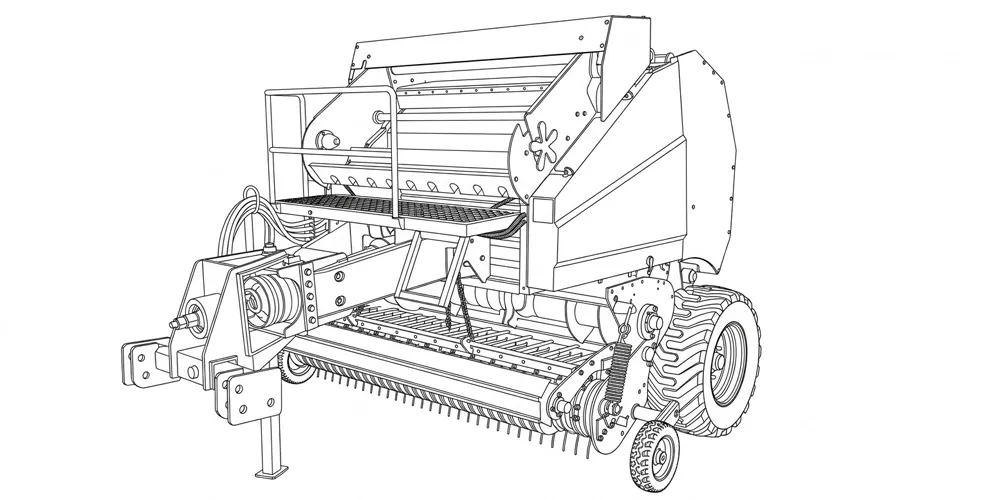
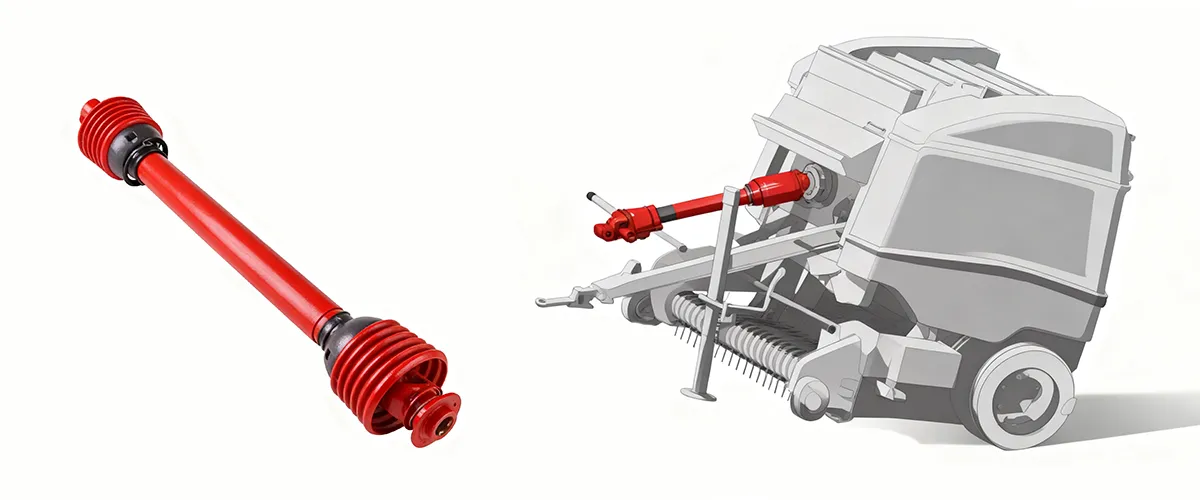
The EP ∅1000mm is a PTO-driven trailed round baler machine. Power flows from the tractor via the PTO shaft through the round baler gearbox, which distributes torque to the 1950mm spring tooth pickup, the dual-path feeder assembly, and the eighteen Ø190mm pressing rollers inside the fixed-chamber bale room. As the tractor and baler move forward along the windrow, the spring tooth pickup teeth — arranged across the full 1950mm working width — lift crop material from the ground surface and feed it rearward into the machine intake. The wide 1950mm pickup width is a key throughput advantage on wide windrows formed by rotary rakes or wide swath mowers, reducing the number of tractor passes required per paddock and allowing higher field travel speed without leaving crop on the ground.
Material entering the feeder encounters the combined shift fork and screw continuous feeding system. The shift fork component positively pushes dense crop clumps into the compression room, while the screw mechanism maintains a steady, metered material flow that prevents bridging and blockage at the inlet throat. This dual-mechanism design is particularly effective on high-moisture silage-grade material and on coarse-stemmed crops such as maize stover and sorghum residue, where single-path feeders frequently choke. Once inside the 1250mm wide fixed bale chamber, crop material is gripped by the rotating array of eighteen Ø190mm rollers and begins to tumble into a growing cylindrical bale core under increasing radial pressure.
As bale diameter reaches the target Ø1000mm, a sensor signals the operator and the automatic net wrapping cycle initiates. Net wrap dispenses across the full bale width and is cut cleanly at cycle end. The rear gate then opens via the hydraulic system, the finished round hay bale rolls clear of the machine, and the gate closes to restart the next formation cycle — all within seconds of the wrapping sequence completing. The whole process, from empty chamber to ejected bale, runs continuously without the operator leaving the cab, making this agricultural round baler suitable for large-acreage contracting operations where sustained all-day productivity is the primary performance metric.
4. Materials & Build Quality
At 2385 kg machine weight, the EP ∅1000mm is built to a commercial-grade structural specification that reflects its intended heavy-duty application context. The primary chassis is fabricated from thick-section structural steel, with key stress nodes — particularly the rear gate pivot, the pickup mounting beam, and the gearbox bracket — reinforced with additional plate steel to withstand the repeated shock loading generated during bale ejection and field travel over uneven terrain. All main chassis welds are carried out under controlled production conditions and are subject to inspection before primer and topcoat application.
The eighteen pressing rollers are manufactured from seamless heavy-wall steel tube to Ø190mm outer diameter — a substantially heavier cross-section than the Ø152mm rollers found on entry-level round baler machines. The increased roller mass contributes to bale density by adding rotational inertia to the chamber, smoothing out brief crop input variations and maintaining consistent radial pressure during the formation cycle. Roller surfaces are hardened against crop abrasion and fitted with sealed roller bearings to resist the fine crop dust and siliceous grit that are the primary causes of premature bearing failure on field machinery.
The 1950mm spring tooth pickup assembly uses high-carbon spring steel tines, individually replaceable without tools, and is designed to clear the ground surface at a consistent height using gauge wheels adjustable for different field surfaces — from firm cereal stubble to soft irrigated pasture. The automatic net wrap mechanism uses commercial-grade tensioner components compatible with standard net wrap rolls widely stocked by agricultural dealers across the UK, Netherlands, Australia, South Korea, and the Americas, making consumable sourcing straightforward for international operators and reducing the risk of incompatibility with locally available wrap brands.
5. Round Baler Application Scenarios
The EP ∅1000mm round baler handles the full spectrum of commercial forage and crop residue applications — wherever large bale volume, wrapping reliability, and mechanical endurance matter most.
Commercial Grass Hay Production
Large-scale round hay baler operations producing forage for sale — particularly in Korea, Australia, and Canada — benefit most from the Ø1000mm format. Fewer, heavier bales mean lower handling and wrapping costs per tonne of hay sold, and the automatic net wrap system maintains product presentation quality across an entire field lot, which matters for buyers purchasing hay by the pallet or the truckload. The 1950mm pickup width keeps pace with wide conditioner-mower swaths without double-lapping.
Paddy & Wheat Straw Baling
In South Korea, Japan, and Southeast Asia, rice straw management after harvest is both an agronomic and environmental requirement. Baling straw for mushroom cultivation substrate, livestock bedding, or direct biomass sale has become a recognised income stream for grain farmers. The dual-feed mechanism on this agricultural round baler handles the short, brittle fibre of paddy straw more reliably than belt-based feeders, and the wide pickup clears large paddy field areas quickly within the tight post-harvest window before planting of the next crop must begin.
Silage & Haylage Baling
The automatic net wrapping function is essential for baled silage and haylage production, where bales proceed directly from the round baler to a stretch film wrapper. Net-wrapped bales hold their shape better through the wrapping cycle than rope-wrapped alternatives, reducing film waste and ensuring a consistent seal on every bale. For high-moisture grass silage operations on dairy farms across the Netherlands, the UK, and New Zealand, reliable net wrap application on every cycle is not optional — a missed wrap or partial application means a compromised bale that cannot ferment correctly.
Biomass Energy Crop Baling
Dedicated energy crops — miscanthus, switchgrass, reed canary grass — are increasingly important feedstocks for biomass power plants and district heating systems across northern Europe and Korea. These crops are often tall, dense-stemmed, and challenging for light-duty round baler machines. The EP ∅1000mm's heavy-frame construction, powerful matching tractor range (up to 110.3 kW), and robust dual feeding mechanism are well-matched to the demands of energy crop baling, where high throughput and durable machinery are the primary cost levers.
Agricultural Contracting Services
Agricultural contractors in Brazil, Colombia, and the broader South American market use high-capacity round baler machines as billable-hour revenue assets — the more bales per day, the higher the return on equipment investment. The EP ∅1000mm's wide 1950mm pickup, automatic net wrap, and broad power compatibility mean contractors can serve diverse farm clients with a single machine configuration, reducing the need to carry multiple baler models in their equipment fleet. Durable round baler parts and straightforward servicing further support the total cost of ownership economics that determine equipment choice for contracting businesses.
6. Regulatory Standards & Market Compliance
Agricultural machinery exported to international markets is subject to a range of country-specific safety, machinery, and environmental standards. Buyers should confirm applicable requirements in their jurisdiction before importing or registering any trailed agricultural baling equipment.
كوريا الجنوبية
Round baler machines intended for the Korean market must comply with the Agricultural Mechanization Promotion Act, which mandates performance and safety testing administered by the Rural Development Administration (RDA). Machines eligible for government purchase subsidies must pass RDA type approval, with gearbox and PTO shaft guarding evaluated under defined criteria for trailed powered machinery. Importers should obtain Korean-language technical documentation and confirm HS classification for customs clearance.
European Union
EU market entry for agricultural machinery — including the Netherlands, Germany, and France — requires CE marking under the EU Machinery Directive 2006/42/EC, currently transitioning to EU Machinery Regulation 2023/1230. Standard EN ISO 4254-7 applies specifically to balers and baling presses, covering safety guards, PTO connections, and rear gate release mechanisms. The round baler gearbox must comply with EN 13463 series requirements for non-electrical equipment used in potentially dusty environments where grain dust may present ignition risk.
Australia & New Zealand
Safe Work Australia and state WHS legislation require that trailed PTO-powered machinery such as round baler machines carry guarding compliant with AS 1410 for PTO shafts and related drive components. The heavy machine weight (2385 kg) means transport on public roads requires appropriate farm vehicle permits in several Australian states. In New Zealand, the Health and Safety at Work Act 2015 and its associated regulations set the compliance framework for agricultural machinery introduction and operation.
Canada
Canadian machinery imports are governed by provincial occupational health and safety Acts. CEMA (Canadian Equipment Manufacturers Association) technical standards inform industry best practice for baler safety and PTO shaft guarding design. The broad matching power range (up to 110.3 kW / 148 HP) encompasses virtually all high-powered two-wheel-drive and four-wheel-drive tractors commonly operated on Canadian grain and forage farms, making tractor compatibility straightforward to verify prior to purchase.
Brazil & Colombia
Brazil's ABNT standards and MAPA agricultural machinery regulations apply to imported equipment, with INMETRO product certification relevant for certain machinery categories. In Colombia, ICA and INVIMA frameworks govern agricultural equipment imports alongside standard HS customs tariff schedules. Both markets benefit from favourable soil and climate conditions for multi-cut forage production, making large-format round baler machines commercially viable for farm-level investment across cattle-ranching regions in Mato Grosso, Minas Gerais, and the Colombian Llanos.
United Kingdom
Post-Brexit, the UK applies its own UK Machinery Regulations (SI 2008/1597 as amended), independent of EU Machinery Directive requirements. UKCA marking is required for machinery placed on the Great Britain market. The Provision and Use of Work Equipment Regulations 1998 (PUWER) applies to the use of trailed balers on farms. PTO shaft guarding standards align with BS EN 12965, and the Health and Safety Executive (HSE) publishes specific guidance on agricultural machinery safety for PTO-driven equipment.
7. Compatible Accessories & System Components
Complete drivetrain compatibility from tractor to bale chamber — we supply the round baler, matched gearbox, and PTO shaft as a unified package, removing the specification guesswork that leads to mismatched components and premature wear.
Round Baler Gearbox
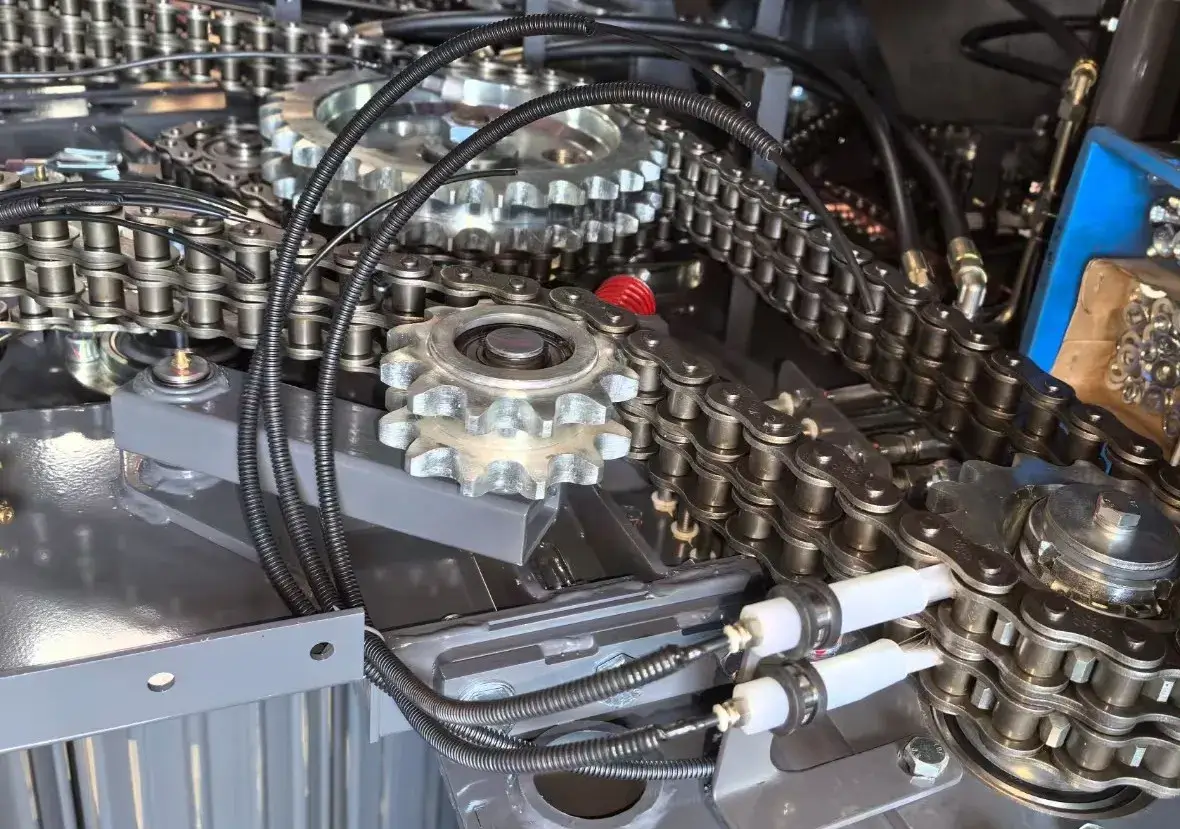
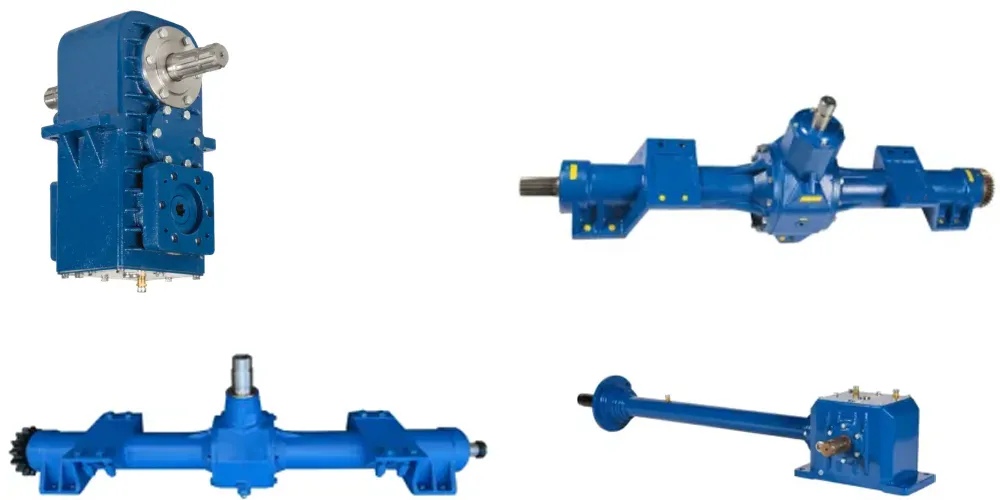
The gearbox that transfers tractor PTO torque to the pickup, feeder, and roller systems is one of the highest-stress components on any round baler machine. Our round baler gearbox is rated for the full 36.7–110.3 kW operating envelope of the EP ∅1000mm platform, using precision-cut case-hardened gear sets running in an oil-bath sealed housing. The gear ratios are matched specifically to the pickup speed and roller surface velocity requirements of this baler model, eliminating the risk of over-speed or under-speed drive ratios that occur when generic agricultural gearboxes are substituted. For buyers in Korea, Australia, and the Netherlands who require complete documentation packages for regulatory compliance, we supply full gearbox technical data alongside the main baler unit as standard.
PTO Drive Shaft
Matching the PTO shaft to the gearbox and tractor is a critical step that is frequently underestimated by buyers sourcing components separately. Our EP PTO shafts for baler applications are engineered to the torque ratings and telescoping length range of the ∅1000mm baler series, with wide-angle constant-velocity joints available for installations where tractor-to-baler geometry causes extreme angularity at headland turns. All shafts are fitted with EN 12965-compliant guarding suitable for direct import into EU and UK markets, and include grease nipple service points aligned with the baler's own maintenance schedule intervals — reducing the number of separate service events per season. Sourcing gearbox and PTO shaft from the same manufacturer as the round baler ensures seamless compatibility verification and simplifies spare parts logistics for dealers operating across multiple export markets.
8. About Us
We are a dedicated manufacturer and international export supplier of professional agricultural baling equipment, matched drivetrain components, and associated accessories. Our product range spans the full spectrum of round baler machine configurations — from compact mini round hay baler units for smallholder applications to heavy-duty commercial balers such as the EP ∅1000mm reviewed here — and is complemented by matched round baler gearbox and PTO shaft supply for one-stop procurement. Our engineering and quality teams hold deep institutional knowledge of the specific mechanical demands placed on baling equipment across diverse global farming environments, from the hot, dusty grain belts of Australia and the Americas to the cool, wet forage systems of Korea, Japan, and northern Europe.
WorkShop

Frequently Asked Questions
المحرر: PXY