Agricultural Equipment Knowledge Series
What Is a Continuous Baling System
and How Does It Differ from Conventional Balers?
A comprehensive guide covering motion mechanisms, structural engineering, material systems, gearbox design, and global regulatory compliance for modern round baler technology.
Foundation Concepts
1. What Is a Continuous Baling System?
A continuous baling system refers to a round baler architecture — and the workflow it enables — where material pickup, feeding, and compression proceed with minimal or no interruption between successive bales. In a conventional stop-and-eject cycle, the operator must halt or slow significantly while the bale chamber opens, the finished bale discharges, the chamber closes again, and the machine resets for the next cycle. A continuous system eliminates or dramatically shortens this dead time by using a secondary accumulation buffer or a parallel pickup path so that fresh material keeps flowing while the finished bale exits.
In practical field terms, this means far fewer tractor stops per hour — fewer engine warm-idle periods, less clutch engagement, and a more consistent forward work speed. For livestock operations or large-scale hay harvesting in countries like South Korea, where grassland productivity and labour availability are both under sustained pressure, the efficiency advantage is substantial. Korean farmers managing timothy, reed canarygrass, or rice straw frequently cite bale throughput per hour as their primary criterion when evaluating a new round baler for sale, and continuous-feed capability has become one of the most commercially decisive distinctions in the current Asian market for round hay baler machines.
It is worth noting that “continuous baling” is sometimes used loosely in marketing to simply mean “high-speed baling.” In engineering terms, a genuine continuous system requires mechanical or hydraulic decoupling of the bale-forming chamber from the intake stream. The sections below unpack exactly how that works and how it compares to the conventional variable-chamber and fixed-chamber round baler designs most operators already know.
Motion Mode Analysis
2. How Motion Modes Differ: Continuous vs. Conventional Operation
Understanding the motion mode of a round baler machine starts with the pickup-to-bale flow. In a conventional fixed-chamber or variable-chamber baler, the entire machine operates as a single sequential unit: crop is picked up, fed into one compression chamber, and once the bale reaches target density the machine signals the operator to stop. The rear gate swings open, the bale rolls out, the gate closes, and the pickup resumes. This stop-start cycle repeats for every bale produced — which on a busy harvesting day may mean several hundred full stops.
A continuous baling system routes incoming crop through an auger or conveying mechanism into an accumulation buffer while the main bale chamber completes wrapping and ejection autonomously. Some designs use a dual-chamber layout: one chamber builds the bale while a second receives fresh material. Others use a retractable intake conveyor that temporarily pauses the flow entering the bale zone without stopping the pickup header, so the swathed row continues to be cleared from the ground without interruption.
Conventional Motion Cycle
Pickup → Feeder → Single Chamber → Density Sensor Alarm → Operator Stops → Net Wrap → Gate Opens → Bale Ejects → Gate Closes → Restart. Typical dead time per bale: 25–60 seconds depending on wrap type and operator experience.
Continuous System Motion Cycle
Pickup → Accumulator Buffer → Main Chamber builds simultaneously → Wrap & Eject while buffer fills → Transfer fresh core to new bale cycle. Dead time reduced to near zero for skilled operators on suitable terrain.
The 9YG-2.24D series round baler models feature a semi-forced “axial flow” feed mechanism with no cam guards and no retaining rings on the pickup. This proprietary intake geometry substantially reduces clogging events — which in conventional balers often force emergency stops far longer than a normal eject cycle — effectively acting as a continuous-flow enhancement even within a single-chamber architecture. Operational productivity has been observed to nearly double versus traditional feeding designs under similar crop conditions.
For operators working on undulating terrain, motion mode also governs stability requirements. The dual-joint PTO shaft used in the S9000-series allows the tractor to pivot up to 100° laterally and tilt up to 30° without interrupting power flow, so neither continuous nor conventional baling cycles are disrupted by field topography — a meaningful advantage on the sloping grasslands common in both northern Chinese pastoral regions and Korea’s mountainous interior provinces.
Engineering & Build
3. Manufacturing Construction: Frame, Chamber, and Assembly
The structural engineering of a round baler machine determines not just durability but operational capability range. Conventional balers use a single welded steel mainframe with a fixed pivot for the rear tailgate. The bale chamber is formed either by rubber belts (variable-chamber design, producing softer outer shells) or by fixed steel rollers (fixed-chamber design, producing denser bales from the core outward). Each configuration has direct implications for how crop flows through and how tightly bales pack at varying moisture levels.
In roller-based fixed-chamber construction — dominant in commercial-grade models — the 9YG-2.24D uses 18 steel rollers per chamber, each φ222 mm in diameter, arranged to form a compression chamber of φ1200 mm internal diameter and 1400 mm working width. Finished bale dimensions reach φ1300 × 1400 mm with achievable density of 100–200 kg/m³. That density range covers light pasture grass through dense rice straw or corn stover, making one machine viable across the diversified cropping systems typical on Korean mixed farms.
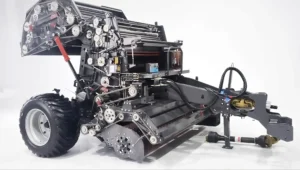
Continuous baling systems require a more complex frame because they must accommodate two functional zones — a buffer accumulation path and an active bale chamber — without adding prohibitive weight or width. The engineering trade-off is real: dual-path machines tend to be heavier and require greater tractor power. The 9YG-1.25, weighing up to 4,558 kg with its auger-plus-roller feeding system, represents a practical bridge: the auger pre-conditions incoming crop into an even mat before the roller compression zone, smoothing density spikes that would otherwise trigger mid-cycle stoppages in a fully conventional design.
Primary frame steel in high-quality round balers is high-tensile structural steel, precision-cut by CNC laser equipment and formed on hydraulic press brakes for dimensional accuracy. Automated robotic welding lines produce consistent seam quality throughout. An electrostatic powder-coat paint finish applied as the final step provides corrosion protection appropriate for outdoor storage in humid environments — directly relevant for Korea’s coastal provinces where salt-laden air accelerates rust on farm equipment stored between seasons.
The rear tailgate design most visibly distinguishes continuous from conventional architectures. Conventional balers use a single hydraulic cylinder to open and hold the gate. The S9000 Classic model adds a dedicated buffer cylinder on the gate to absorb closing-shock vibration, protecting roller bearings and chain tensioners from impact fatigue — a straightforward modification that measurably extends service intervals in high-throughput operations running 1,000 or more bales per harvest season.
Material Systems
4. Material Systems: Pickup, Feed, Compression, and Binding
The “material system” in baler engineering describes the entire pathway crop travels — from the swath on the ground through to a finished, wrapped bale. It encompasses the pickup type, feeder mechanism, compression rollers or belts, and the binding consumable (net wrap or twine). Each stage interacts with the others, and mismatches between crop type and machine configuration remain the leading cause of field inefficiency. Choosing the right small round baler or full-size round baler machine for a specific operation starts with understanding this pathway.
Pickup System Options
Standard spring-tine pickups are standard across most 9YG-series models. The 9YG-2.24D offers a 2,240 mm pickup width, while the compact 9YG-1.0 works with a 1,900 mm header suited to smaller tractors. The 9YG-1.25 and 9YG-1.0C both offer interchangeable pickup assemblies: operators can substitute the standard spring-tine reel with a 20-hammer-claw head designed for standing corn stalks, removing the need for a separate raking pass and saving a full field operation per season. This modularity effectively turns one round baler machine into two purpose-built tools.
Feeding and Pre-Compression
Feeder combinations in the 9YG series pair a tine reel with a drum roller, or add an auger in the 9YG-1.25 and 9YG-1.0C. The auger distributes crop evenly across the full chamber width, preventing the side-loading bias that produces out-of-round bales in thin or uneven swaths. The 9YG-1.0’s proprietary axial-flow semi-forced feed mechanism has no cam guards or pickup shields, allowing it to ingest larger, less-uniform crop bundles without blockage — reported to approximately double effective throughput versus standard pickup configurations under comparable crop conditions.
Net Wrap Binding
All series models use automatic net wrapping as the standard binding method. Net wrap produces a tighter, more weather-resistant outer shell than twine, which is particularly important for bales stored outdoors between cutting and feeding — common practice on Korean cattle and dairy farms where barn space is limited. Net roll sizes scale with chamber width: 2,000 × 1.4 m per bale on the 9YG-2.24D, 2,000 × 1.25 m on the 9YG-1.25, and 2,000 × 1.0 m on the 9YG-1.0. Density is managed by a sensor-control system that monitors chamber pressure and triggers automatic wrap initiation when target density is reached, removing the guesswork that causes bale-to-bale inconsistency in manual conventional systems.
Material Compatibility by Model
| Model | Pasture Grass | Rice / Wheat Straw | Corn Stalks | Density kg/m³ |
|---|---|---|---|---|
| 9YG-2.24D S9000 | ✓ | ✓ | ✓ (windrow) | 100–200 |
| 9YG-1.25 (double) | ✓ | ✓ | ✓ (standing) | 115-200 |
| 9YG-1.25A | ✓ | ✓ | ✓ (windrow) | 100–200 |
| 9YG-1.0 | ✓ | ✓ | ✓ (windrow) | 115-200 |
| 9YG-1.0C | ✓ | ✓ | ✓ (standing, 20 claws) | 115-200 |
Drivetrain Deep Dive
5. Gearbox and Drivetrain: The Mechanical Heart of the Round Baler
The round baler gearbox is the single most failure-critical component in the drivetrain. It receives power from the tractor’s power take-off (PTO) shaft — typically at 540 r/min or 720 r/min — and distributes that torque to the pickup, feeder rollers, and bale chamber simultaneously. In a continuous baling system, the gearbox must also manage the additional power path for the accumulation buffer mechanism, making gear-ratio design and torque capacity specifications meaningfully more complex than in a conventional single-chamber baler.
The 9YG-2.24D S9000 series uses a heavy-duty (加重型) gearbox with PTO input at 720 r/min. The dual-joint gearbox assembly on the traction arm is the most distinctive engineering feature of the S9000 range: it allows 90° lateral rotation in both left and right directions, enabling the tractor to turn sharply in small paddocks without cutting traction-shaft power. This eliminates the chronic transmission jam problem that afflicts conventional tow-type round balers when working small-block fields — a scenario common in Korean farming landscapes where field plots are historically fragmented and average farm size remains below 1.5 hectares.
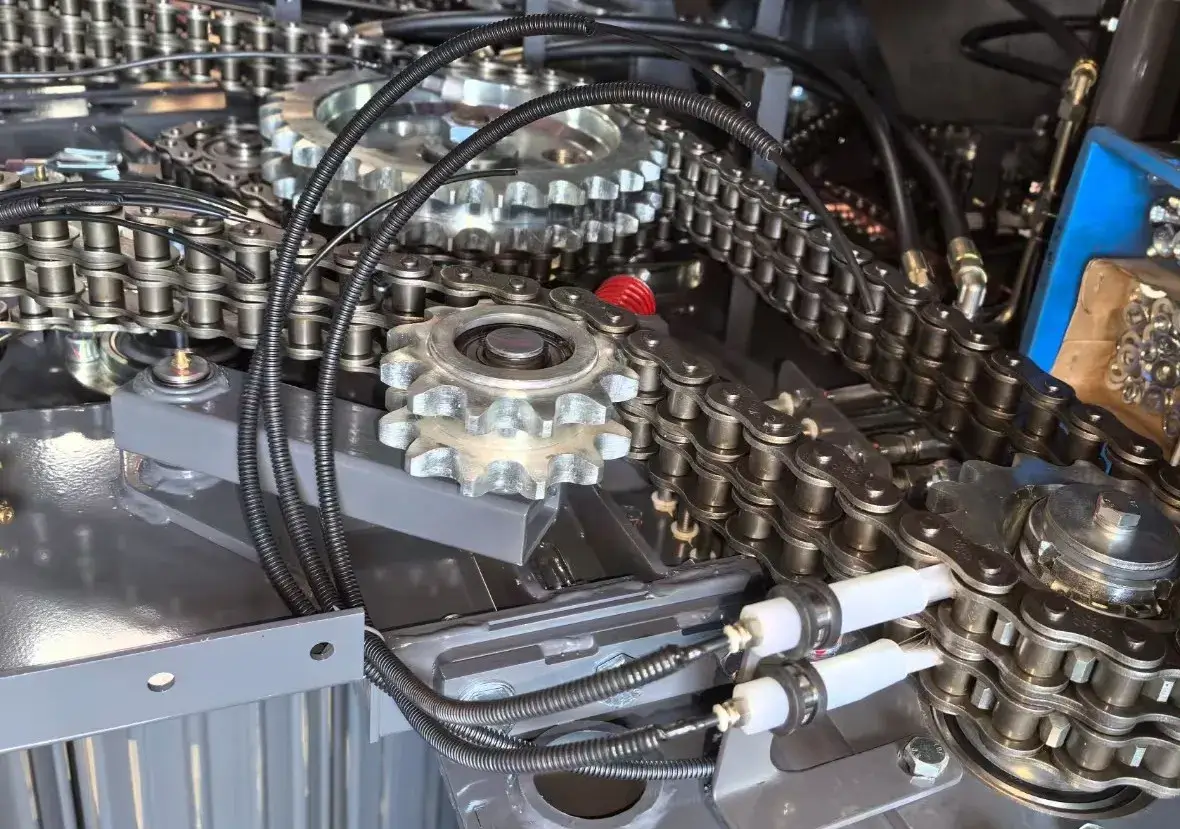
Maximum torque on the newer traction assemblies reaches 1,000 Nm, and the tilt-adjustment capability on the horizontal pivot means the assembly can handle a tractor roll angle of up to 30° before any power interruption occurs. The rear compartment on the S9000 uses a dual-side sprocket drive design, distributing roller drive load across two chain paths rather than one. This reduces per-link chain load and extends chain service life — a measurable maintenance-cost benefit over a full season of commercial baling operations.
The hydraulic system uses H-type ferrule fittings on all connections, which increase rated working pressure relative to standard push-fit hydraulic connectors. Higher working pressure allows the gate-open and gate-close cycles to operate faster, reducing the mechanical dead time in each conventional baling cycle. Combined with the buffer cylinder on the gate, this means that even a conventional-cycle machine operating within the 9YG-2.24D family achieves per-cycle efficiency that rivals some purpose-built continuous systems at a lower mechanical complexity and purchase investment.
Side-by-Side Comparison
6. Continuous vs. Conventional Round Baler: Head-to-Head
The table below summarises the key operational and engineering differences between conventional single-chamber round baler machines and continuous-flow baling systems. Use it as a quick-reference decision tool when evaluating which configuration suits your operation.
| Criterion | Conventional Baler | Continuous System |
|---|---|---|
| Bale Cycle Dead Time | 25–60 seconds per bale | Near zero (buffer absorbs crop) |
| Tractor Stops per Hour | 40–100 full or partial stops | Minimal or none |
| Machine Complexity | Single chamber, simpler drivetrain | Dual zone, more components |
| Tractor Power Required | 55–100 kW (9YG-2.24D range) | Typically higher — 88 kW+ |
| گٹھری کثافت کنٹرول | Sensor-controlled, 100–200 kg/m³ | Sensor-controlled, same range |
| Best For | Small to mid-size farms, varied terrain | Large flat fields, high bale volume |
| Maintenance Access | Straightforward, fewer wear parts | More access points required |
| Crop Flexibility | High — interchangeable pickups available | Varies — some systems optimised for specific crops |
Operational Impact
7. Real-World Productivity and Operating Cost Implications
The productivity gap between a well-configured conventional round baler and a true continuous system widens most noticeably in large-scale, flat-field operations. When a machine produces 40–100 bales per hour — the published range for the 9YG-2.24D series — the cumulative dead time from conventional eject cycles can amount to 30–45 minutes of non-productive time per 8-hour working day. A continuous system converts most of that into additional bales. Over a 30-day harvest window, the yield difference can represent hundreds of additional bales without any additional fuel or labour input.
For smaller operations — the kind that characterise much of Korean agricultural structure, with average arable plots under 2 hectares — the calculus shifts. The additional capital cost and tractor power requirement of a continuous system may not deliver a payback period that makes economic sense when annual baling volume is modest. A well-optimised conventional small round baler running with the axial-flow feed design, sensor density control, and H-type hydraulic fittings will often satisfy throughput requirements at lower total cost of ownership. This is why the 9YG-1.0 series, which targets tractors in the 48–80 kW range, remains highly relevant in Asian markets where the small hay baler segment is the primary consideration for operators with limited horsepower available.
Fuel consumption per bale also favours continuous operation on large flat fields, as the tractor never cycles through idle-to-full-load transitions during stops. Frequent stop-start cycles are mechanically hard on both the tractor drivetrain and the baler itself — every stop subjects the PTO shaft to a torque spike on restart. Over a full season, these micro-fatigue events accumulate and can accelerate wear on round baler parts including input shaft seals, chain tensioners, and roller bearings.
Compliance & Regulations
8. Legal and Regulatory Framework: Gearboxes, Safety, and Agricultural Equipment Standards
Purchasing or importing agricultural equipment across international markets requires understanding the applicable safety, emissions, and design standards in the destination country. Gearboxes and drivetrain components in particular are subject to both mechanical safety and noise regulations in multiple jurisdictions. Below is an overview of relevant regulations in key markets where round balers are commonly purchased and operated.
South Korea (주요 법규)
In South Korea, agricultural machinery including round balers and their gearbox assemblies is regulated primarily under the Agricultural Mechanisation Promotion Act (농업기계화 촉진법). Equipment sold or used in Korea must meet the safety standards defined by the Rural Development Administration (농촌진흥청, RDA), which issues performance and safety certifications for agricultural machinery through its Agricultural Machinery Test and Evaluation program. PTO-driven equipment must comply with KS B ISO 500 standards regarding rear-mounted PTO shafts, including protective guarding requirements for all exposed rotating shaft elements. The Occupational Safety and Health Act (산업안전보건법) imposes additional operator protection requirements for rotating machinery, requiring fixed or interlocked guards on all parts of the gearbox accessible to the operator during normal use. Imported agricultural equipment may also require type approval from the Ministry of Agriculture, Food and Rural Affairs (농림축산식품부) before being eligible for the Agricultural Machinery Purchase Subsidy program (농기계구입자금지원사업), which provides low-interest financing to Korean farmers purchasing approved equipment.
European Union
EU-market balers and their gearbox assemblies must satisfy the Machinery Directive 2006/42/EC (updated under the Machinery Regulation EU 2023/1230, applicable from January 2027). Specific requirements apply to PTO-driven equipment under EN ISO 4254-10 (agricultural machinery safety for forage balers) and EN ISO 11684 for safety signs. Gearbox noise levels must comply with Directive 2006/42/EC Annex I requirements. CE marking is mandatory before any agricultural machinery is placed on the EU market.
United States
In the US, the American Society of Agricultural and Biological Engineers (ASABE) publishes standards governing baler design and PTO shaft safety, including ASABE S361.2 (PTO shaft clearance zones) and ASABE AD5673 (Safety for agricultural equipment). OSHA 29 CFR 1928 contains agricultural machinery safety requirements covering guarding of power transmission components including gearboxes, belts, and chains. State-level equipment inspection programs may impose additional requirements, particularly for hired-labour operations.
Australia and New Zealand
Australia requires agricultural machinery to comply with AS 4024 (Safety of machinery) and the applicable Safe Work Australia codes of practice for plant in the workplace. New Zealand’s Health and Safety at Work (General Risk and Workplace Management) Regulations 2016 govern plant and machinery safety, with WorkSafe NZ guidance covering PTO shaft guarding specifically. Both markets require comprehensive operator manuals in English as a condition of sale.
Russia, Mongolia, and Central Asia
Equipment exported to Russia must carry the EAC (Eurasian Conformity) mark, which covers the Eurasian Economic Union (Russia, Belarus, Kazakhstan, Armenia, Kyrgyzstan). Technical Regulation TR CU 010/2011 on the safety of machinery applies. Gearbox assemblies must meet GOST standards for agricultural machinery transmissions. Mongolia applies its own set of national standards (MNS) for imported equipment but generally accepts international certifications as supporting documentation for customs clearance.
ISO 9001 Quality Management: Look for round baler suppliers holding ISO 9001 certification — this ensures documented quality management processes cover design, manufacturing, and after-sales service. ISO 9001-certified production facilities apply formal non-conformance tracking and corrective action procedures, which translates into more consistent component quality and more reliable round baler parts availability over the machine’s service life.
Product Range
9. Round Baler Series: Full Product Overview
Each model in the series is engineered for a specific power class and application. Use the specifications below to identify which round baler machine fits your tractor, crop, and volume requirements.
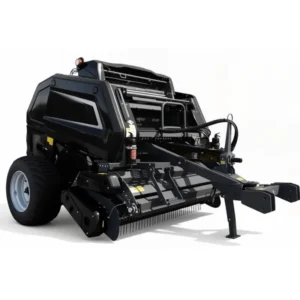
9YG-2.24D راؤنڈ بیلر (S9000 Transcend)
Power: 55–100 kW | Pickup: 2,240 mm | Bale: φ1300×1400 mm | Density: 100–200 kg/m³ | Output: 40–100 bales/h | 18 rollers φ222 mm
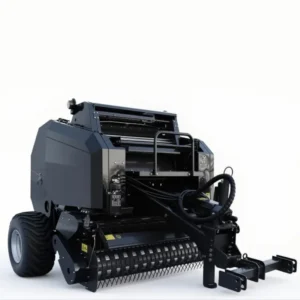
9YG-1.0 Round Baler
Power: 48–80 kW | Pickup: 1,900 mm | Bale: φ1100×1000 mm | Density: 115–200 kg/m³ | Output: 40–100 bales/h | Compact mini round baler for smaller tractors
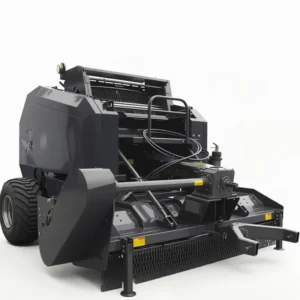
9YG-1.0C Round Baler (Corn Stalk Specialist)
Power: ≥69.8 kW | Pickup: 2,400 mm hammer-claw | Bale: φ1000×1250 mm | 20 claws | Output: 40–80 bales/h | Handles standing corn stalks directly
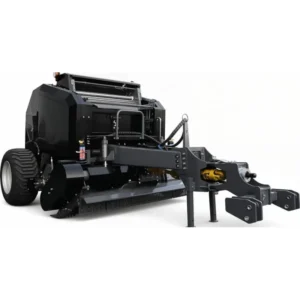
9YG-1.25 Round Baler (Double/Interchangeable)
Power: ≥88.2 kW | Pickup: 2,240 mm (spring-tine or hammer-claw) | Bale: φ1200×1250 mm | Density: 115–200 kg/m³ | Output: 40–80 bales/h
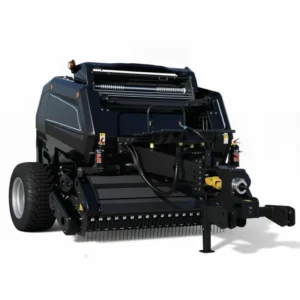
9YG-1.25A راؤنڈ بیلر
Power: ≥75 kW | Pickup: 2,150 mm | Bale: φ1300×1250 mm | Density: 100–200 kg/m³ | PTO: 540–1000 r/min | Output: 40–100 bales/h
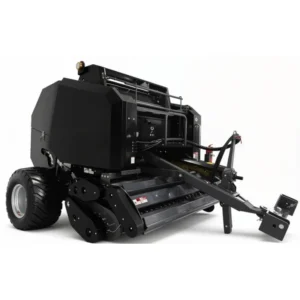
9YG-2.24D Round Baler (Standard)
Power: 55–100 kW | Pickup: 2,240 mm | Bale: φ1300×1400 mm | 3,922 kg | Output: 40–100 bales/h | Axial-flow semi-forced feed
Customer Feedback
10. What Operators Say About Continuous-Flow Round Baler Performance
Real-world feedback from operators using modern round baler machines in diverse harvesting conditions consistently highlights several themes: the reduction in operator fatigue due to fewer emergency stops, the consistency of bale weight and density across long working days, and the durability of the drivetrain components under extended commercial use. Operators in Mongolian and Russian steppes — where round bale volumes can reach several thousand per season — emphasise the importance of gearbox reliability and parts availability above all other factors when selecting a round baler supplier.
Korean farmers evaluating round balers for sale note that compact dimensions and lower tractor power requirements are decisive factors on fragmented smallholdings. The 9YG-1.0 and 9YG-1.25A models address this directly, with machine weights of 2,640 kg and 4,472 kg respectively, and compatibility with tractors from 48 kW upward — covering the majority of the Korean small tractor fleet.

Frequently Asked Questions
Common Questions About Round Balers and Continuous Baling Systems
Q1. What kind of round baler machine is best suited to a small Korean farm operating with a 40–60 hp tractor?
Q2. How does a continuous baling system actually reduce operating cost compared to a conventional round baler on a large paddy farm in Asia?
Q3. Which round baler model should I choose if I need to handle both pasture hay and standing corn stalks on the same farm in one season?
Q4. What does sensor-controlled density mean in a modern round hay baler, and how does it compare to manual density adjustment?
Q5. How do round baler gearbox requirements differ between Korean agricultural regulations and European CE certification standards?
Q6. How often should round baler parts like chains and roller bearings be replaced to avoid field breakdowns during busy harvest periods?
Q7. What is the minimum tractor horsepower needed to run a full-size round baler machine capable of producing 1,300 mm diameter bales efficiently?
Q8. What is the difference between a mini round baler and a small round baler, and which is more practical for rice straw harvesting in Korean paddies?
About Our Round Baler Range
Our round baler series covers the full spectrum from compact mini hay baler models for small tractors to heavy-duty commercial machines capable of 100 bales per hour. All models are backed by ISO 9001-certified manufacturing, holding multiple technology patents, and are built in a dedicated agricultural machinery production facility equipped with CNC laser-cutting, robotic welding, and electrostatic coating lines. Products are exported to and actively operating in multiple Asian markets including Mongolia and Russia, with the range designed to meet international safety standards including European CE requirements.
Whether you’re looking for a small round baler for a 40 hp tractor, a high-output round hay baler machine for large-scale commercial use, or guidance on which round baler gearbox configuration suits your terrain and crop mix — our technical team is available to advise.
Get in Touch
Ready to find the right round baler machine for your operation? Request a quote or ask a technical question about any model in the range.
ایڈیٹر: PXY